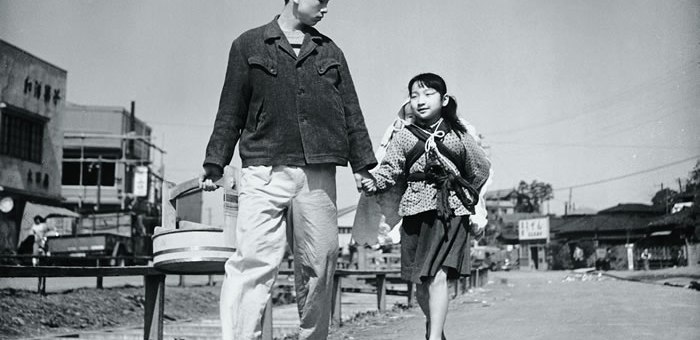
Farewell to Dream (夕やけ雲, Keisuke Kinoshita, 1956)

Does adulthood mean the death of dreams, or simply accommodation with disappointment? Yoichi (Shinji Tanaka), the cheerfully romantic hero of Keisuke Kinoshita’s Farewell to Dream (夕やけ雲, Yuyake-gumo), has made his peace with “losing” out in the great game of life, comforting himself in working hard to provide for others while becoming good at what he does, but keeping one eye always on the past and the boy he once was whose horizons were boundless and future untethered. 

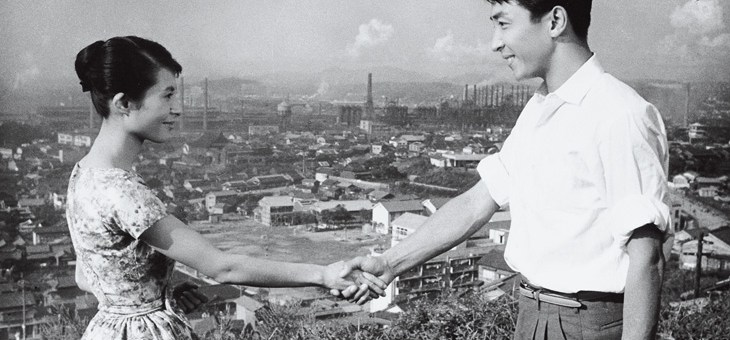
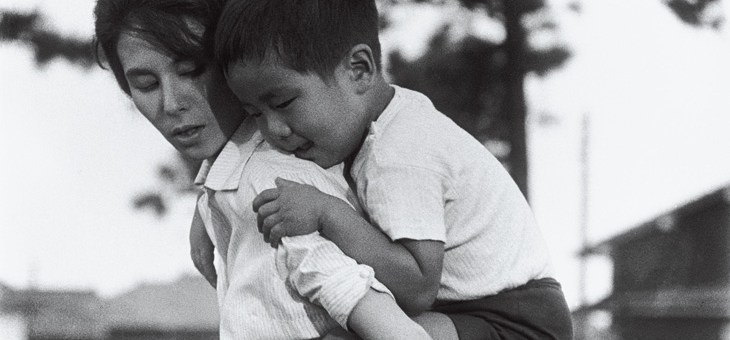
In his chipper yet somehow poetic opening monologue, 20-year-old Yoichi introduces us to the family fishmonger’s he runs with his mother. If he says so himself, standards have improved since his father’s day and he’s done quite well for himself. His mother even jokes about finding him a wife, but that’s a long way off. To show us how he got here, he picks up his binoculars, a present from an uncle who sailed away and never came back, to show us “the last chapter of his youth, full of innocent dreams”. At 16, Yoichi dreamed of becoming a sailor, staring out over the horizon and catching sight of a beautiful woman in a distant window far on the other side of town. He lives with his parents and three younger siblings, while his older sister Toyoko (Yoshiko Kuga) has an office job that supplements the family income seeing as there’s not much money in fishmongering. 

Yoichi describes his sister as beautiful yet cold. No one can quite believe such a fantastic beauty was born to a lowly family of fishmongers with a back alley shop in a small town, but her beauty has made her cruel and avaricious. She wants out of poverty and she doesn’t much care what she has to do to escape it. She knows the easiest way, and in real terms perhaps the only way, is to attach herself to a man of means, which is why she’s just agreed to marry a man named Sudo (Takahiro Tamura) who comes from a wealthy family and is head over heels in love with her. When he tells her that his family business has collapsed and he’s no more money, she abruptly calls the engagement off and begins courting her widowed boss, eventually marrying him despite the fact that it’s a second marriage and he’s more than twice her age. 

Toyoko may just be playing the only cards she’s been dealt, but she’s also a personification of selfish post-war individualism. She only cares about herself, has no real sense of morality, and a total disregard for the feelings of others. Sudo, who for some reason truly seems to have loved her, cannot let her go, turning up on her wedding day to punch her in the face. Toyoko is fully aware of the effect she has on men and skilled in manipulating it, drifting back into an affair with Sudo even after her marriage, leaving her irate husband forever ringing her parents with orders to return her to her new home as if they had any real influence over her. 

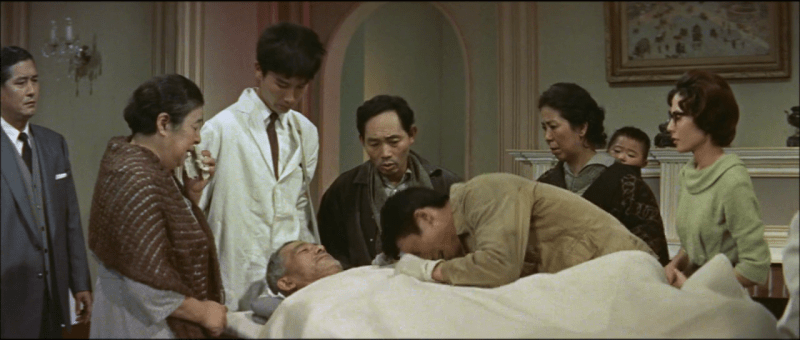
Despite himself, Yoichi is by contrast the “good son” who gives up the right to his individual future to take care of his family. At 16, he hates being a fishmonger’s boy because the other kids tease him that he always smells of fish, as if he can’t wash away the scent of poverty. He dreams of freedom as a sailor out on the wide ocean, forever staring at the horizon with his binoculars, and of the beautiful woman who, he decides rather romantically, must be suffering with some kind of illness which is why she’s always in her room. When his father becomes ill, suffering a heart attack brought on by Toyoko’s harsh words, Yoichi begins to realise that his dreams are dying. Like the fish in his shop, he’s trapped, no longer able to swim free but tethered to the ground. There can’t be anything more of life for him than becoming a fishmonger himself, whether he liked it or not. His fate was sealed before he was even born. 

Yet unlike the flighty Toyoko who seems unhappy in her marriage but doing her best to put up with it by continuing to do as she pleases, Yoichi has made peace with warmhearted practicality. At 16 he lost everything – his father, the image of Toyoko, his younger sister fostered out to a badgering uncle, his best friend, the beautiful woman in her lonely room, and finally the horizon and his dreams. “His dream was as fleeting and as beautiful as the clouds at sunset” the opening text tells us, echoing the film’s title with a poetic melancholy that makes plain that Yoichi has not so much abandoned his dream as made the memory of it a part of him, a relic of another time when all was possible. Still, in essence perhaps it’s only what it is to grow up, an acceptance of shrinking horizons and that dreams are by definition things destined not to be, but that’s it’s OK in the grand scheme of things because that’s just the way life is. Forced to become a fishmonger, Yoichi becomes the best fishmonger he could be, and even if he does so with a heavy heart, he has a lightness in his step in knowing he does it not for himself but for those he loves. 


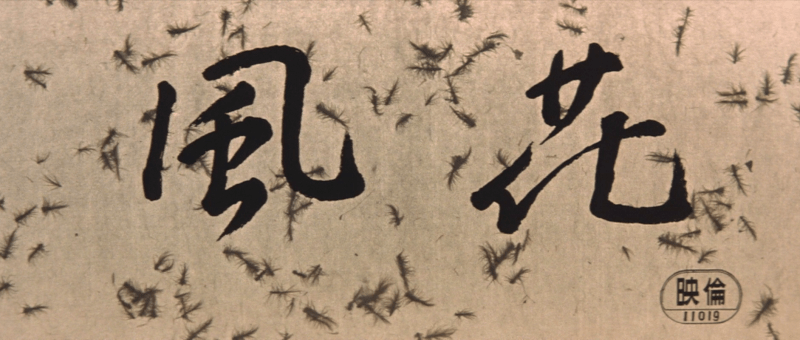
Titles and opening (no subtitles)

Until We Meet Again (また逢う日まで, Tadashi Imai, 1950)

Til we meet again poster 1Despite later becoming a member of the Communist Party, Tadashi Imai had spent the war years making propaganda pictures for the militarist regime. He later described his role in the propagation of Japanese imperialism as “the worst mistake of my life”, and thereafter committed himself to socially conscious filmmaking. Imai was later identified most closely with a style that was the anthesis of many his contemporaries branded “realism without tears”. Nevertheless, in 1950 he found himself making a full on romantic melodrama with anti-war themes. Until We Meet Again (また逢う日まで, Mata Au Hi Made) was, unofficially, an adaptation of Romain Rolland’s 1920 novel Pierre et Luce in which war conspires against the pure hearted love between two innocent young people.

Relocated to the Tokyo of 1943, Until We Meet Again begins at its conclusion with anxious student Saburo (Eiji Okada) pacing the floor, prevented from meeting his one true love, Keiko (Yoshiko Kuga), because his sister-in-law has fallen dangerously ill. Having just received notice that his draft date has been moved up and he’s expected to report for duty that very night, he fears he may never see her again whereupon he flashes back to their early courtship, all adolescent innocence and filled with the pure joy of falling in love for the first time.

Yet, as much as the war is the destructive force which will always stand between them, it’s also the one which brings them together. Saburo makes nervous eye contact with a pretty girl sheltering in a subway during an air raid. They are both afraid, and he chivalrously comforts and shields her with his body. Most particularly in the Japan of 1943, such bodily contact with a stranger of the opposite sex would be considered extremely inappropriate. There would be no other opportunity to enter this mild kind of physical intimacy save for the external pressures of life in war. Saburo doesn’t yet know the name of the woman in the subway, but can seemingly think of little else, seeing her everywhere he goes and looking for her in every face he sees. When they finally “meet”, they both agree that they are already acquainted and the intimacy between them quickly deepens through unexpected and perhaps transgressive physicality – a hand taken and placed inside a jacket to fight the cold, an embrace taken to guard against one explosion but leading to another. This innocent diffidence eventually leads to the film’s most famous scene in which Saburo, lamenting he must leave Keiko’s home, returns briefly to look at her in the icy window through which they share a chaste kiss.

Saburo, a wealthy young man too sensitive for the times in which lives, is ill-equipped to understand the difficulties of Keiko’s life. A closeup on her ragged shoes and her hard-nosed practicality make plain her penury and her determination to escape it. If he allowed himself to dream seriously of a life with her after the war, he might have to consider the words of his hardline brother, once sensitive like him but now fully committed to the militarist cause, who reminds him that an idle romance may be irresponsible considering that it will only cause them both, and more particularly her, pain when he must leave perhaps never to return. Saburo knows his brother might be right, wrestling with his love for Keiko while she professes that she would rather be with him no matter what pain might come.

Saburo’s friends tell him that “love is taboo”, and his brother something similar when he berates him for wasting his time hanging around with girls rather than preparing for the military. The enemy is less “the war” than it is the persistent austerity of militarism which crushes individuality and emotion to make love itself an act of treason. Yet it’s the very presence of the looming threat of war that makes their race towards romance possible. Saburo will be shipping out. Everything is fraught and desperate. There may not be another time and so the only time is now. It’s no coincidence that each incremental step in the couple’s relationship is preceded by an explosion, or that alarms are constantly ringing, while clocks tick ominously counting down their time.

Having been seriously injured in a freak accident despite wielding his privilege to serve in Japan and not on the front line, Saburo’s brother reconsiders and tells him that he is leaving his share of life’s happiness to him and so he has a duty to be doubly happy. Keiko too just wants her little “slice of happiness”, but it’s something this world has seen fit to deny them. The couple daydream about furnishing a house filled with children, but it’s a fantasy that will never materialise because theirs are the unrealised hopes of the youth of Japan cruelly denied their rightful futures because of a foolish war waged by their fathers and their grandfathers. The poignant final scenes suggest the older generation too will collapse under the weight of the tragedy they provoked, but sympathy remains with men like Saburo who went to war unwillingly because they had no other choice, unable to protect the things they loved from the chaos they left behind.


The Eternal Rainbow (この天の虹, Keisuke Kinoshita, 1958)

Eternal rainbow poster 1Famously, towards the end of the war, Keisuke Kinoshita got himself into trouble with a dialogue free scene of a mother’s distress as she sent away the son she’d so carefully raised “for the emperor” towards an uncertain future in the midst of hundred of other, identically dressed faceless boys. Army might have showcased the director’s propensity for resistance, but one could also argue that there was just as much propagandistic intent in the post-war films as their had been in the militarist era even if the messages they were selling were often more palatable. 1958’s The Eternal Rainbow (この天の虹, Kono Ten no Niji) is a case in point. A portrait so positive one wonders if it was sponsored by Yahata Steel, The Eternal Rainbow is nevertheless conflicted in its presentation of defeated post-war hope, exploitation, and growing social inequality even as it praises its factory city as a utopian vision of happy industry and fierce potential.

A lengthy opening sequence featuring voice over narration recounts the history of the Yahata Steel Works which began operations in 1901 in Northern Kyushu and now employs thousands of people, many of whom live nearby in the ever expanding company dorms the newer models of which feature bright and colourful modern designs in contrast to the depressing grey prefab of the traditional workers’ homes. Gradually we are introduced to our heroes – chief among them Mr. Suda (Yusuke Kawazu), a young man from the country who saw a factory job as his over the rainbow but is rapidly becoming disillusioned with its dubious gains. Rather than the company dorms, Suda rooms with the foreman, Kageyama (Chishu Ryu), and his wife Fumi (Kinuyo Tanaka) whose young son Minoru (Kazuya Kosaka) didn’t qualify for a factory job on account of his small frame and his been unable to stick at anything in the precarious post-war economy. Meanwhile, Suda has made friends with an older worker, Sagara (Teiji Takahashi), who has fallen for a secretary, Chie (Yoshiko Kuga), but her family are dead against her marrying a factory worker while she is also in a relationship with a college educated engineer, Machimura (Takahiro Tamura), but is beginning to doubt the seriousness of his intentions.

The drama begins when Sagara employs Kageyama to act as a go-between in a formal proposal of marriage to Chie’s parents, the Obitas. Kageyama didn’t really want to be a go-between because it’s gone badly for him before and he thinks this one is a non-starter too – women around here have their sights set on office workers, no one in the arranged marriage market is looking to marry someone on the shop floor. The Obitas feel much the same. Mrs. Obita is keen for Chie to marry up and is somewhat offended by the proposal, granting it only the customary consideration time to not seem rude in turning it down flat. Sagara is stoic about the matter, but the abruptness of the rejection greatly offends Suda who cannot stand for the Obitas snobbish put down of working people.

Herein lies the central conflict. Suda was a country boy who’d been sold an impossible dream. He believed that a job in the factory, for which he had to sit an exam and has been chosen out of thousands of other hopefuls, was his ticket out of rural poverty. Now that he’s working there he realises he is little more than a wage slave, working long hours for almost nothing with the only goal of his life being to earn enough to feed a family with a little (very little) left over for his old age. Minoru, the Kageyamas’ son, feels much the same and has already turned cynical and desperate. He can’t abide his father’s work ethic and wants more out of life than there perhaps is for it to give him. Suda repeatedly asks how people can learn to be happy in this sort of life, wondering if those that claim to be have simply given up their hopes and aspirations in resignation. When Minoru decides not to go to Tokyo it ought to be a victory, but then perhaps it is more that he has simply accepted that there is no hope there either.

Nevertheless, the depiction of Yahata as a place to work is ridiculously positive even as Kinoshita undercuts it with the disillusionment of both Suda and Sagara. A factory city, Yahata is characterised as a cornerstone of the burgeoning post-war economy, literally making the rails on which the new Japan will run. The works provides affordable accommodation for families, guaranteed employment, insurance, a “self service” supermarket right on site, social clubs, cultural activities, and festivals. They even get a large scale show from Tokyo every year.

Even so, an immense and seemingly unbridgeable gap exists between the steelworkers and the company men. Mrs. Obita might seem self serving and mercenary, but she’s had a hard life and perhaps it’s only natural that wants better for her daughter. Suda is angry to think a good man like Sagara who might be a bit old fashioned and unsophisticated but has taken the trouble to do things the “proper” way would be dismissed out of hand simply out of snobbery. His attitude is, however, somewhat problematic in that he begins bothering Chie to find out her reasons for declining the proposal, refusing to recognise that she doesn’t need to offer any reason besides her own will. Chie, meanwhile, is conflicted. A proposal of marriage from a man she doesn’t even really know is not something she was minded to consider in any case, but her feelings for Machimura are tested once she becomes aware that he is not quite in earnest and may have been messing around with his landlady while enjoying the attention he receives as an eligible bachelor around town.

Machimura, like Suda, Sagara, and Minoru, is somewhat listless and apathetic even if for the opposite reason in that his life is far too easy and he hasn’t had to make a lot of concrete decisions about his future. Chie doesn’t deny that his college education and urban sophistication are part of the reason she was attracted to him, but as she later tries to explain to Suda, she wasn’t simply angling to marry up – she just fell in love with someone who happened to be of a higher social class which isn’t the same as looking down on working people. She has a right to her feelings whatever political label an increasingly resentful Suda might like to put on them. Even so, if she had been trying to marry up who could really blame her for that? In a society in which women are still entirely dependent on a man, being largely prevented from pursuing a career in their own right, a marriage is effectively a job for life. Shouldn’t she pick the offer with the best benefits, just as Suda did when he chose to leave the country for a factory job?

Progressive factories are often presented as an ideal solution the problem of post-war poverty, but here Kinoshita does not seem so sure. Despite the emphatic tone of the infrequent voice over and the central messages that factory jobs are good jobs and looking down on manual work nothing more than snobbery, Suda and Sagara remain conflicted. This work is dangerous, pays little, and offers nothing more than false promise. If the vast cities like Yahata are the engines repowering the economic growth of a still straitened Japan, what will be the end result? Metropolis made flesh, the “eternal rainbow” is exposed as a self serving lie but what, Suda might ask, else is there for men like him in a society like this?


Original trailer (no subtitles)

The Garden of Women (女の園, Keisuke Kinoshita, 1954)

garden of women still 1Things changed after the war, but not as much as some might have hoped. Sadly still topical, Keisuke Kinoshita’s Garden of Women (女の園, Onna no Sono) takes aim both at persistent and oppressive patriarchal social structures and at a compromised educational system which, intentionally or otherwise, systematically stifles attempts at progressive social change. A short few years before student protests would plunge education into crisis, Kinoshita’s film asks why it is that the establishment finds itself in conflict with the prevailing moods of the time and discovers that youth intends to have its brighter future even if it has to fight for it all the way.

The setting is an exclusive private woman’s university in the elegant historical city of Kyoto. The ladies who attend this establishment are mostly from very wealthy families who have decided to educate their daughters at the college precisely because of its image of properness. As one student will later put it, there are two kinds of girls at the school – those who genuinely want to study in order to make an independent life for themselves and intend to look for work after graduation, and those who are merely adding to their accomplishments in order to hook a better class of husband. Everyone, however, is subject to a stringent set of rules which revolves around the formation of the ideal Japanese woman through strictly enforced “moral education” which runs to opening the girls’ private letters and informing their families of any “untoward” content, and requiring that permission be sought should the girls wish to attend “dances” or anything of that nature.

As might be expected, not all of the girls are fully compliant even if they superficially conform to the school’s rigid social code. Scolded for her “gaudy” hair ribbon on the first day of school, Tomiko (Keiko Kishi) rolls her eyes at the over the top regulations and enlists the aid of the other girls to cover for her when she stays out late with friends but her resistance is only passive and she has no real ideological objection towards the ethos of the school other than annoyance in being inconvenienced. Tomiko is therefore mildly irritated by the presence of the melancholy Yoshie (Hideko Takamine). Three years older, she’s come to college late and is struggling to keep up with classes but is, ironically enough, prevented from studying by the same school rules which insist she go to bed early.

Meanwhile, dorm mate Akiko (Yoshiko Kuga), from an extraordinarily wealthy and well connected family, is becoming increasingly opposed to the oppressive atmosphere at the school. However, as another already politically active student points out, Akiko’s background means there are absolutely no stakes for her in this fight. She has never suffered, and likely never will, because she always has been and always will be protected by her privilege. Fumie (Kazuko Yamamoto), a hardline socialist, doubts Akiko’s commitment to the cause, worrying that in the end she is only staging a minor protest against her family and will eventually drift away back to her world of ski lodges and summer houses. Despite her ardour, Akiko finds it hard to entirely dispute Fumie’s reasoning and is at constant battle with herself over her true feelings about the state of the modern world as it relates to herself individually and for women in general.

This is certainly a fiercely patriarchal society. Even though these women are in higher education, they are mostly there to perfect the feminine arts which are, in the main, domestic. They are not being prepared for the world of work or to become influential people in their own right, but merely to support husbands and sons as pillars of the rapidly declining social order that those who sent them there are desperate to preserve. For many of the girls, however, times are changing though more for some than others. Tomiko rolls her eyes and does as she pleases, within reason, and even if she eventually wants to see things change at the school it is mostly for her own benefit. She sees no sense in Akiko’s desire for reform as a stepping stone to wider social change, and perhaps even fears the kinds of changes that Akiko and Fumie are seeking.

Akiko and Fumie, and to an extent, Tomiko, seem to have a degree of agency that others do not as seen in the tragic story of Yoshie whose life has been largely ruined thanks to the selfish and heartless actions of her father. From a comparatively less wealthy family, Yoshie worked in a bank for three years during which time she met and fell in love with an earnest young man named Shimoda (Takahiro Tamura). However, her father, having become moderately successful, developed an appetite for social climbing and is determined she marry “well” to increase his own sense of superiority as a fully fledged member of the middle classes. He sees his daughter as nothing more than a tool or extension of himself and cares nothing for her thoughts or feelings. In order to resist his demands for an arranged marriage, Yoshie enrolled in school and is desperate to stay long enough for Shimoda to finish his education so they can marry.

Yoshie is trapped at every turn – she cannot rely on her family, she cannot simply leave them, she cannot yet marry, if she leaves the school she will be reliant on a man who effectively intends to sell her, but her life here is miserable and there is no one who can help her. All she receives from the educational establishment is censure and the instruction to buck up or get kicked out. She feels herself a burden to the other girls who regard her as dim and out of place thanks to their relatively minor age gap and cannot fully comprehend her sense of anxiety and frustration.

Finally standing up to the uncomfortably fascistic school board the girls band together to demand freedoms both academic and social, insisting that there can be no education without liberty, but the old ways die hard as they discover most care only for appearances, neatly shifting the blame onto others in order to support their cause. “Why must we suffer so?” Yoshie decries at a particularly low point as she laments her impossible circumstances. Why indeed. The oppressive stricture of the old regime may eventually cause its demise but it intends to fight back by doubling down and the fight for freedom will be a long one even if youth intends to stand firm.


Titles and opening scene (no subtitles)

Spring Dreams (春の夢, Keisuke Kinoshita, 1960)

vlcsnap-2019-01-10-00h23m29s867Let them eat sweet potato? The heartless bourgeoisie at the centre of Keisuke Kinoshita’s absurdist satire Spring Dreams (春の夢, Haru no yume) have found themselves accidentally engulfed by the revolution which seems to be attacking them on every front including from inside their palatial, Western-style mansion. Things are about to change in the Okudaira world, but then again maybe not all that much.

The Okudairas are the owners of a large scale pharmaceuticals firm. Widowed patriarch Shobei (Eitaro Ozawa) is the CEO, but he’s at the constant mercy of his mother-in-law (Chieko Higashiyama) who acts as the guardian of the family business’ legacy. Meanwhile, he has three problematic children – oldest daughter Tamiko (Yatsuko Tanami) who has become a promiscuous playgirl with a taste for “mothering” college students, Chizuko (Mariko Okada) who is the only “normal” one in the house and has fallen in love with an impoverished painter, and Mamoru (Yusuke Kawazu) who is a kind of melancholy Hamlet waxing on his existential angst while eating everything in sight.

Into this already strained household comes the unexpected figure of sweet potato salesman, Atsumi (Chishu Ryu). With the house empty for a change, romantically conflicted maid Umeko (Yukiyo Toake) calls one of her boyfriends down at the fish shop to get the potato guy to come round. Kimiko (Meiko Nakamura), the other maid, goes out to pick some up but ends up flirting with a delivery boy so sends Atsumi inside where Umeko ropes him into helping shift some furniture which is how he ends up having a minor stroke in the Okudaira’s living room. Luckily for Atsumi, the person who finds him is Shobei’s compassionate spinster secretary, Kazuko (Yoshiko Kuga), who has some sad experience in this area as her father passed away after a stroke when she was a teenager, they say because someone moved him too early. A visit from the family doctor (Shuji Sano) backs up her advice and Atsumi will be staying put in the living room for the foreseeable future.

Of course, this doesn’t go down well with most of the Okudairas. Shobei wants him gone but what can you do? Atsumi stays because on balance it would be awkward if he ended up dying and staining the Okudaira name. Sadly, greed and indifference are not unique to the bourgeoisie as we discover when a parade of “well wishers” from Atsumi’s tenement house begin showing up to see how he is. Aside from the kindly, filial Eiichi (Shinji Tanaka) who has taken time off work to look after the old man, everyone else thinks Atsumi’s time has come. They know his tragic history, that he’s all alone now since both his sons were killed in the war and the rest of his family lost in the bombing. They want to get in with him to be remembered in the will, or even get their hands on his wallet for something like an advance. Poor old Atsumi is just an object fit for exploiting – a symbol of the Okudaira’s largesse, and of a potential windfall when the inevitable happens.

Meanwhile, the winds of change are blowing. Shobei is tied up with a labour dispute at the factory, obsessed with the idea of crushing the unions while the workers’ rousing chorus of the Internationale echoes ever more loudly in the distance. Grandma advises “just fire them all”, but things aren’t as easy as they were back in Meiji. Grandma thinks Shobei is a bit useless, especially since her daughter died and he’s been allowed to get off easy. She needs to find a successor seeing as Mamoru’s too weird to take over which means one of the girls needs to get married. Tamiko’s ruled herself out thanks to her eccentric love life, which leaves only Chizuko who wants to marry a painter and has no real interest in saving the family business. Chizuko is determined to oppose the idea of an arranged marriage, she’s a post-war girl after all, but grandma is firm. When she was a girl they made her give up on her first love, who happened also to be named “Atsumi”, to marry an Okudaira and so Chizuko is merely being unreasonable.

Nevertheless the presence of Atsumi begins to soften grandma’s heart with memories of her youth and the cruelty with which her youthful dreams were stripped away. Love blossoms in the cold Okudaira mansion, genuine bonds between people are recognised while the opportunist are rejected, and the young regain their freedom from the old who now recognise how destructive the old order could be. Will the house of the Okudaira’s fall? Probably not. Revolutions don’t take hold over night, but greed at least is on its way out paving the way for a better, kinder future for all.


Titles and opening (no subtitles)

Thus Another Day (今日もまたかくてありなん, Keisuke Kinoshita, 1959)

Thus Another Day vertical bannerThe cinema of the immediate post-war era, contrary to expectation, is generally hopeful and filled with the spirit of industry. Keisuke Kinoshita might be thought of as the primary proponent of post-war humanism in his fierce defence of the power of human goodness, but looking below the surface he’s also among the most critical of what the modern Japan was becoming, worried about a gradual loss of values in an increasingly consumerist society which refuses to deal with its wartime trauma in favour of burying itself in intense forward motion.

The housewife at the centre of Thus Another Day (今日もまたかくてありなん, Kyo mo mata Kakute ari nan), Yasuko (Yoshiko Kuga), is a perfect example of this internal conflict. She and her husband Shoichi (Teiji Takahashi) have built a modest house way out of the city in the still underdeveloped suburbs for which they are still burdened by an oppressive mortgage. Shoichi has a regular job as an entry level salaryman but his pay is extremely low and Yasuko is forced to scrimp and save just to get by. The central conflict occurs one summer when Shoichi’s boss declares he’s looking to rent a summer house in the quiet area where the family live. Shoichi thinks it would be a great idea to rent out their house to his boss earning both money and favour. Yasuko can go stay with her family who live in a pleasant resort town while he will stay with a friend in a city apartment. Yasuko does not really like the idea, but ends up going along with it.

Shoichi is trying to live the salaryman dream, but it isn’t really going anywhere. Yasuko is home alone all day with the couple’s small son, Kazuo, who is too young to understand why the family lives the way it does and continuously asks probing questions which upset and embarrass his mother. Watching her painstakingly washing clothes by hand, Kazuo wants to know why they don’t have an electric washing machine like some of his friends’ mothers do. Yasuko tells him they’re saving money to get one, at which point he pipes up that he personally would rather have a TV set. Like his father, he is rather self-centred but being only four can perhaps be forgiven. Nevertheless, Yasuko is constantly embarrassed by the family’s relative poverty. When another neighbour spots her out shopping and decides to accompany her, she is visibly distressed that the stall she takes her to is a little more expensive than the one she had in mind. Wanting to save face, she buys expensive fish but is mindful of there being less money for the rest of the week.

Meanwhile, Shoichi is obsessed with “getting ahead” by ingratiating himself with his bosses – hence why he decided to let out his own house over the summer. The house is, after all, Yasuko’s domain and she perhaps feels family atmosphere isn’t something you should be selling. She resents that the family will be split up over the summer even if it gives her an opportunity to visit her mother and sister out in the country. Even when Shochi arrives to visit, he makes them trot out to a neighbouring town to visit his boss’ wife also on holiday in the area, and stays there all day playing mahjong while Yasuko and Kazuo are bored out of their minds sitting idly by. The second time he doesn’t even bother to invite them.

The small resort town itself is something of a haven from the demands of the city but there is trouble and strife even here. Shortly after her arrival Yasuko meets a strange, rather sad middle-aged man who is a stay at home dad to his beloved little girl, Yoko. Takemura (Nakamura Kanzaburo XVIII) came of age in the militarist era, attending a military university to become one of the elite. The world changed on him and he remains unable to reconcile himself to the demands of the post-war society. Experiencing extreme survivor’s guilt, Takemura is filled with regret and resentment towards the ruined dreams of his misguided youth in which he abandoned a woman he loved to marry a wealthy man’s daughter who he has also let down by refusing his military pension, forcing her into the world of work and eventually onto the fringes of the sex trade as a hard drinking bar girl.

As if to underscore the looming danger, a thuggish gang of yakuza have also decided to spend the summer in the resort, holing up at the inn where Takemura’s wife is working. The young guys terrorise the youngsters of the town, disrupting the well established social hierarchy with acts of violence and intimidation. The punks cause particular consternation to Takemura who remembers all the men their age who went to war and never came back only for the successive generation to live like this. Having lost everything which made his life worth living, Takemura decides to take a stand against modern disorder, hoping to die in battle the way he feels he ought to have done all those years ago.

Thus Another Day is among the darkest of Kinoshita’s post-war dramas, suggesting that there really is no hope and that past innocence really has been lost for good. The values of Takemura’s youth, however, would not perhaps line up particularly well with those most often advanced in Kinoshita’s cinema, as kind and melancholy as he seems to be. Yasuko goes back to her crushing world of unfulfillable aspirations with her obsequious husband and demanding son with only gentle wind chimes to remind her of happier days while she tries to reaccommodate herself to the soullessness of post-war consumerism .


Original trailer (no subtitles)

The Snow Flurry (風花, Keisuke Kinoshita, 1959)

Snow Flurry poster 2

Studies of the post-war world have often made the cities their home. Filled with the starving, the ruined, and the hopeless, the cities of post-war Japan were places of defeat but also of perseverance as a betrayed generation struggled to survive in whatever way they could. Generally speaking, the rural countryside seems to fare better, coping only with the absence of lost sons and lonely daughters as life goes on much as it always has. Nevertheless things are changing even here. Recalling the subversion of his earlier Army, Keisuke Kinoshita’s The Snow Flurry (風花, Kazahana) employs a complex non-linear structure to examine the various ways in which the past continues to inform the future, trapping post-war youth in the same way their parents were trapped not only with a legacy of wartime rigour but with the weight of the feudal world pressing down upon them as they struggle to escape the authority of the generation by whom they have been betrayed.

We begin with the conventional “happy ending”. A middle-aged woman looks on with genuine happiness as a younger one leaves in a bridal outfit before running off to look for her son, Suteo (Yusuke Kawazu), who has run off towards the river with dark thoughts clouding his mind. Stepping back a little, we are told that 19 years previously Suteo’s mother, Haruko (Keiko Kishi), attempted double suicide with his father, Hideo (Masanao Kawakane) – the son of the local lords. Hideo, fearing that he would soon be sent away to war and knowing that his noble family would never approve of the woman he loved, felt death was his only solution but while his attempt succeeded, Haruko’s did not. Surviving she gave birth to a child and was eventually taken in by Hideo’s family, the Naguras, but only to avoid the gossip in town that their heartlessness was the cause of their son’s death. Haruko and Suteo, rather than living in the main house with the other family members, occupy a small shed to the side of the property and are treated as a maid and farm hand respectively. The only member of the family to treat them kindly is the grand-daughter, Sakura (Yoshiko Kuga), who is a little older than Suteo and remains unmarried at 25 while her grandmother insists on finding a wealthy man willing to marry into the family and save it from dying out altogether.

Though the main action takes place in 1959, not much has changed in the village and the eventual arrival of modern cars belonging to Sakura’s prospective suitors proves jarring in more ways than one. The Naguras, once the feudal landlords, have been greatly reduced in status thanks to the post-war agricultural reforms which limited the amount of land which could be held by one family to that which they could reasonably farm themselves. This obviously means that their income has sharply decreased which, coupled with the patriarch’s profligacy, makes their present way of life untenable unless they can find a wealthy man to marry into the family and re-inject it with cash while they figure out how to make money by farming their own land. Sadly, this will be hard because the Naguras are terrible people with a bad reputation thanks not only to their unpleasant personalities but the lingering stigma of Hideo’s death and the continuing existence of Suteo.

Nagura (Yasushi Nagata), a hard man, rejected his son’s remains out of shame for his “cowardice” in refusing to die bravely for the emperor. When Suteo is born in 1941, he takes it upon himself to register the child’s birth name without consulting the mother, insisting that the child is neither hers nor his but belongs to the nation and will be expected to sacrifice himself in his father’s place to make up for Hideo’s failure of duty. “Suteo” itself means “abandoned boy” and is hardly a warm legacy to leave to anyone let alone your own grandchild and the only offspring of your own late son.

Despite their reduced circumstances, the Naguras continue to behave like lords and are trapped within the feudal pre-war world, obsessed with status and position while those around them have entered the brave new era of promised equalities and modern possibility. Sakura, the only “legitimate” child of the last generation, is literally kept a prisoner by her hardline grandmother (Chieko Higashiyama) who has insisted on conferring various “accomplishments” such as traditional dance and learning to play the piano intended to hook an upperclass husband. Such things hardly matter now in the post-war world and any man who valued them is unlikely to make her very happy, but the Naguras care little for happiness and only for their own “good” name. Sakura wanted, like her friends, to go Tokyo for university but of course she couldn’t – her family wouldn’t even let her spend time with the other girls because there were boys around and they viewed even that as “improper” given her “position”. It’s no wonder that Sakura already feels as if her life will be “crushed by the weight of this house” and longs to leave it, as well as her cold and oppressive family, far behind her.

Suteo’s tragedy is the same has his mother’s, he has fallen in love with someone who can never be his because of outdated notions of social class and the unbreakable authority of the older generation. Sakura loves him too, though she hardly knew it until faced with her own dilemma and realises a marriage is the only way to escape her miserable existence even if she must sacrifice her feelings to do so. Despite all this lifelong suffering, grandma declares herself satisfied in having reasserted her noble status in marrying Sakura off to another prominent family, even if it is to a second son and no one could be persuaded to take on their family name. The Nagura family ends here and she gives her permission for the estates to be sold after she’s gone. All of this sacrifice in name of honour was, apparently, entirely pointless.

Employing a bold non-linear structure in which past and present inhabit the same space, Kinoshita mythologises his ordinary villagers through the repeated use of theatrical narration in the songs which accompany Sakura’s traditional dance, commenting on the action with a melancholy passivity. Trapped by circumstance and burdened by legacy, his protagonists are backed into corners with no way out other than to accept the paths before them. The future for Suteo lies in “abandonment” as he prepares to reject his cruel history and attempts to start again by walking bravely into the post-war world free of feudal oppression.


Original trailer (no subtitles)

Elegy of the North (挽歌, Heinosuke Gosho, 1957)

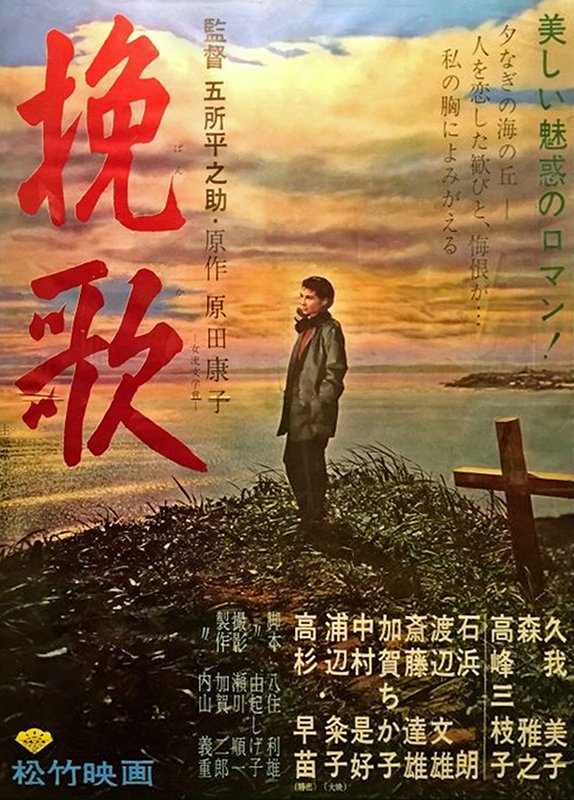
elegy of the north posterHeinosuke Gosho is perhaps among the most neglected Japanese directors of the “golden age”. A pioneer of the “shomingeki”, Gosho’s work is marked by a profound humanism but also a refusal to reduce the complexity of human emotions to the superficially immediate. Elegy of the North (挽歌, Banka) takes him much further in the direction of standard melodrama than he would usually venture, echoing contemporary American or European romantic dramas filled with soaring scores and moments of intense emotion bridged by long periods of restraint and repression. Yet it is also among the most psychologically complex of Gosho’s narratives, telling stories of death and rebirth in place of the usual coming of age and first heartbreak for which the genre is so well loved. In Reiko (Yoshiko Kuga) he presents us with a heroine we can’t be sure we like and certainly are not intended to approve of even as we sympathise with her pain and long for an end to her (often self inflicted) suffering.

Walking along the smoking volcanic soil of frozen Hokkaido, Reiko offers us the first of many voiceovers in which she tells us about her left arm – withered and almost numb due to childhood arthritis. When her withered arm is bitten by a dog, Nellie, owned by a melancholy architect, Katsuragi (Masayuki Mori), she barely feels it but Katsuragi is mortified. “She’s never bitten anyone before”, he tells Reiko by way of explanation, “I’ve never been bitten before”, Reiko fires back but bitten she certainly has been. Captivated by the idea of Katsuragi, she doesn’t immediately take him up on the offer of coming to his house and possibly adopting a puppy but catches sight of him around town and then decides to pay him a visit. He isn’t in, but Akiko (Mieko Takamine), his wife, is. Reiko didn’t want to see Katsuragi’s wife so she makes a speedy escape.

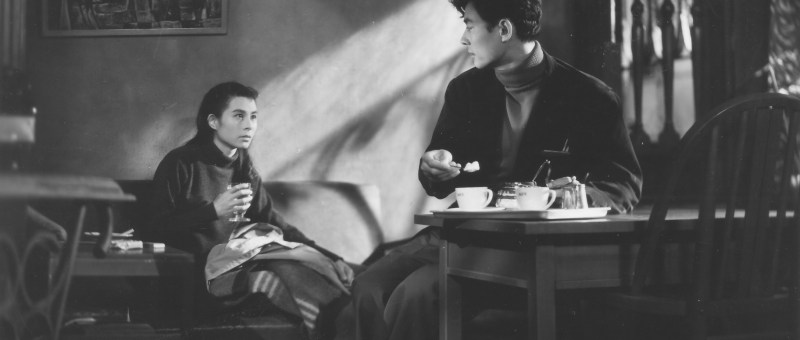
Having caught sight of Akiko, Reiko is equally intrigued. Akiko, as Reiko discovers, is having an (unhappy) affair with a much younger medical student, Tatsumi (Fumio Watanabe). Failing to read the emotional landscape of this sorry scene, Reiko regards this information as a juicy piece of gossip in her ongoing campaign to win over Katsuragi. She spies on the lovers, childishly eavesdropping on them in a local cafe, even suddenly delivering their coffee for them so she can get a proper look at Akiko – not that she really sees her or the distraught look on her face, she merely observes her rival – the wicked woman who has betrayed her beloved Katsuragi.

Reiko is constantly berated by her father and grandmother for her unwomanliness. Compared with the typical Japanese woman of the time and particularly with the stoic yet miserable Akiko, Reiko can certainly be thought unusual. Dressing in androgynous loose trousers, polo neck jumper and overcoat, without makeup and with unkempt hair, her aesthetic is one of rambunctious child or rebellious teenager. Her habit of throwing out awkward, inappropriate questions at first seems like childish ineptness but later seems calculated to unbalance. She is often cruel, perhaps deliberately so, but then remorseful (if only for selfish reasons). Though Reiko seems to feel that it’s her disability that marks her out as an outcast, unfit for marriage or a “normal” life, her family appear much more concerned with her unconventional rejection of femininity in her boldness, masculine dress, and refusal to learn the traditionally feminine crafts of housework and cookery so necessary to becoming the ideal wife.

What Reiko sees in Akiko is an image of her idealised self – beautiful, poised, elegant, and the wife of Katsuragi. As part of her nefarious plan, Reiko decides to “befriend” Akiko while Katsuragi is away on a business trip. What she never expected is that she would come to genuinely care for both Akiko and the couple’s small daughter Kumiko (Etsuko Nakazato), making her position as a potential home wrecker impossible. Reiko’s father blames himself for her unwomanliness, having raised her alone after his wife died, denying her of a maternal influence from whom she would have learned all the essentials of femininity which she now seems to lack. Akiko, a few years older, becomes both friend and surrogate mother – Reiko even begins calling her “Mamma” just as Kumiko does. Akiko’s distant poise begins to thaw when Reiko crawls in through her door one night after contracting pneumonia. Nursing Reiko as a mother would brings the two women closer together but it also unwittingly drives them apart in deepening Reiko’s sense of guilt in being torn between two loves in the knowledge that she must destroy one of them or herself.

Akiko, the tragic heroine of the piece, remains a cypher precisely because of her adherence to the rules of traditional femininity. Reiko is first drawn to her because of her sad smile – something she later brings up again in their fiercely undramatic yet heartrending parting scene as Reiko tries to undo the harm she has just done only for Akiko to mildly reject her by instructing her that she needs to take better care of herself. Her relationship with Katsuragi appears to have floundered and, trapped in a lonely marriage, Akiko has found herself in an emotionally draining entanglement with a younger man whose life she fears she is ruining. Tatsumi, needled, is irritated by Reiko’s buzzing around Akiko, asking her an awkward question of his own in accusing her of being a lesbian, to which Reiko gives one of her infuriately barbed replies with “call it what you want”. Reiko’s intentions probably do not run that way (at least consciously), so much as she longs for the love and affection she missed out on after losing her mother at such a young age. Akiko, however, may see things differently. Her life appears lonely, and her friendship with Reiko, whom she brands “reckless yet somehow cheerful” (again, like an infuriating child), is one of its few bright spots. The betrayal is not so much that Reiko has slept with her husband, but that Reiko has deliberately ruined their friendship by exposing it as a cruel ruse in the most wounding of ways. The last time we see Akiko, she is wearing the necklace that Reiko gave to her – a sure sign that her final decision is, in someway, taken on Reiko’s behalf.

Reiko’s tragedy is that her intense self loathing which she attributes to her withered arm, leads her to suspect each act of kindness is only one of pity and that no one can truly love her, they’re just overcompensating because of her “deformity”. At the beginning of the film she asks herself if her mind is as warped as her body. Her actions are often “warped”, as in she works against herself and ultimately destroys the very thing she wanted most yet there is a kind of settling that occurs through her interactions with Akiko. In the final sequence, Reiko has shed her dowdy, dark coloured, worn trousers and jumpers for an elegant skirt and blouse, and has learned to accommodate a certain level of domesticity. Even if she is merely echoing Akiko, Reiko has at least attempted to move forward in exploring the areas of femininity she had hitherto rejected outright. That it is not to say her “unusual” nature is tamed in favour of conforming to social norms, merely that a side of herself which she had decided to keep locked has been opened up for examination (and may then be rejected with greater self knowledge). Elegy of the North lives up to its name in singing a long and painful song of mourning, but Gosho ends on a note of hopeful, in pained, optimism for his contrary heroine, literally forced to move past the scene of her crime towards a possibly happier future.


Screened at BFI as part of the Women in Japanese Melodrama season.

An Inlet of Muddy Water (にごりえ, Tadashi Imai, 1953)

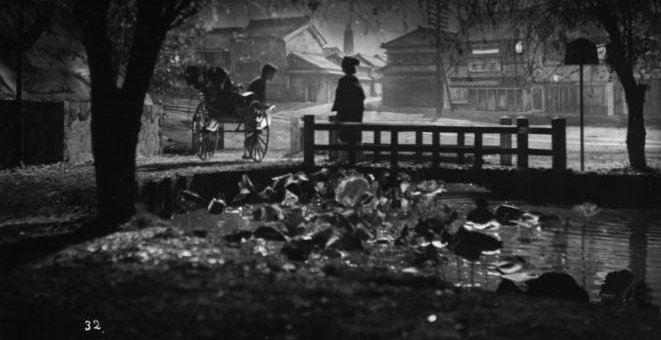
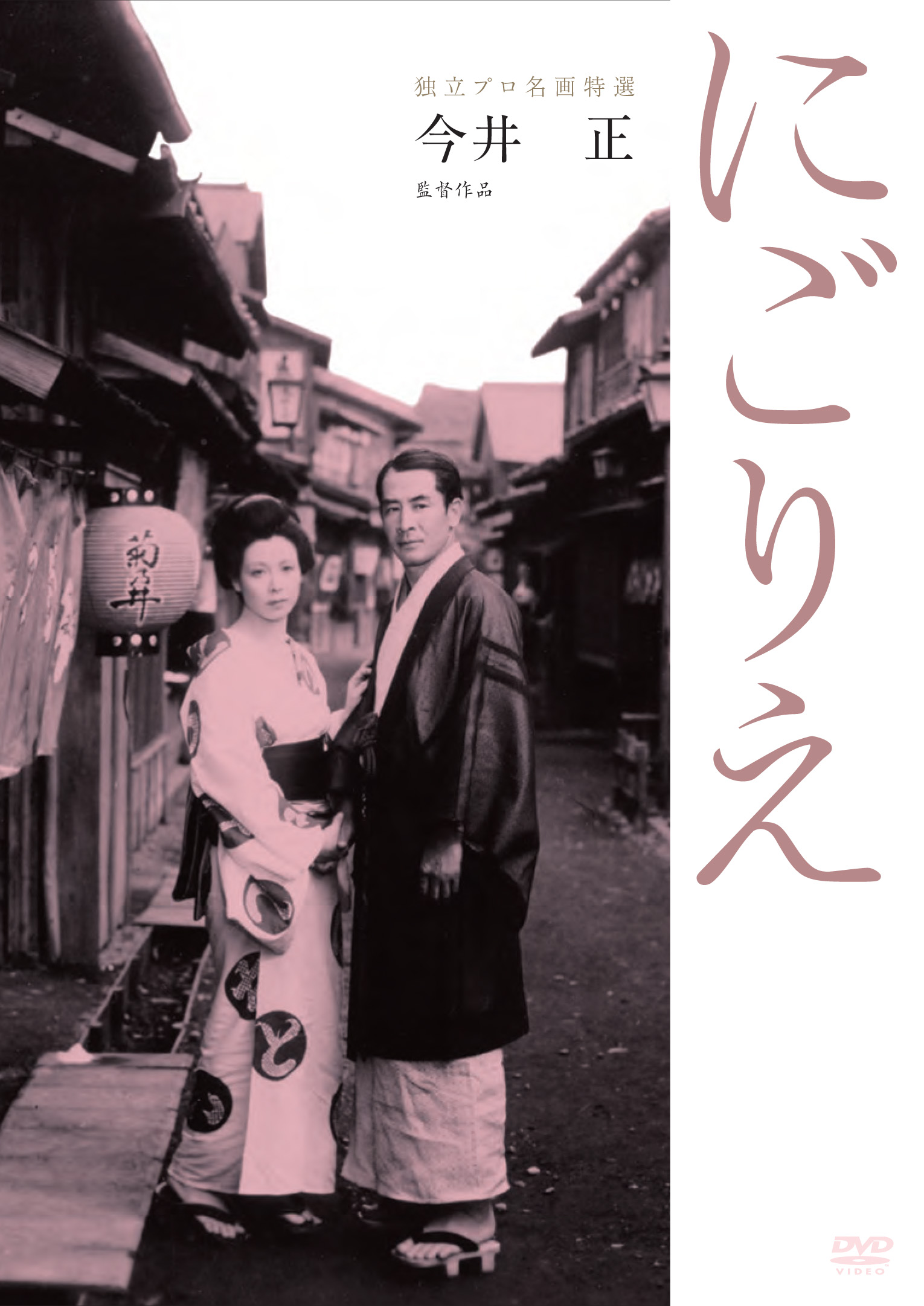
inlet of muddy water dvd coverTadashi Imai was among the greatest directors of the golden age though his name remains far less known than contemporaries Ozu or Mizoguchi. Despite beginning in outright propaganda films during the war, Imai is best remembered as a staunchly left wing director whose films are known for their gritty realism and opposition to oppressive social codes. An Inlet of Muddy Water (にごりえ, Nigorie) very much fits this bill in adapting three stories from Japanese author Ichiyo Higuchi. Higuchi is herself a giant figure of Japanese literature though little of her work has been translated into English. Like Imai’s films, Higuchi’s stories are known for their focus on female suffering and the prevailing social oppression of the late Meiji era which had seen many changes but not all for the better. Higuchi was not a political writer and her work does not attack an uncaring society so much as describe it accurately though her own early death from tuberculosis at only 24 certainly lends weight to the tragedy of her times.

In the first part of the film which is inspired by one of Higuchi’s best known stories, The Thirteenth Night, a young woman returns home to her parents, no longer able to bear living with an emotionally abusive husband. Oseki (Yatsuko Tanami) had been raised an ordinary, lower middle-class girl but, like many a heroine of feudal era literature, caught the eye of a prominent nobleman who determined to marry her despite their class difference. Life is not a fairytale, and so the nobleman quickly tired of his beautiful peasant wife, belittling her lowly status, lack of education, and failure to slot into the elite world he inhabits.

Oseki’s plight elicits ambivalent reactions in each of her parents though they both sympathise with her immensely, if in different ways. Her mother (Akiko Tamura) is heartbroken – having long believed her daughter to be living a blissful life of luxury, she feels terribly guilty not to have known she had been suffering all this time and believes Oseki has done the right thing in leaving. Her father (Ken Mitsuda), however, also feels sad but reacts in practicality, pointing out that to leave her husband now would mean losing her son forever and probably a long, lonely life of penury. He, somewhat coldly, tells her to go back, grin and bear it. Oseki can see his point and considers resigning herself to return if only to look after her son.

On her way home she runs into a childhood friend whom she might have married if things had not turned out the way they did. “Life gets in the way of the things we want to do”, she tells him by of explanation for not staying in touch. Rokunosuke (Hiroshi Akutagawa), once a fine merchant, is now a ragged rickshaw driver, bereaved father, and divorcee. Like Oseki his life is a tragedy of frustration with the added irritant that he and Oseki might have been happy together, rather than independently miserable, if an elite had not suddenly decided to interfere by crossing class lines just because he can rather than out of any genuine feeling.

The callousness of elites is also a theme in the second story, The Last Day of the Year, in which a young maid, Omine (Yoshiko Kuga), works for a wealthy household dominated by a moody, penny pinching mistress whose mistreatment of her staff is more indifference than deliberate scorn. Omine’s uncle, who raised her, has fallen ill. At the beginning of his illness he took out a loan but he’s got no better and still needs to pay it back so he asks Omine to ask the mistress for an advance of the paltry sum of two yen in the hope that his son will be able to enjoy a new year mochi like the other kids. The mistress says yes and then changes her mind, leaving Omine to consider a transgressive act of social justice.

Where The Thirteenth Night and The Last Day of the Year pointed the finger at uncaring elites, Troubled Waters broadens its disdain to the entire world of men in focussing on two women caught on either side of the red light district – Oriki (Chikage Awashima), a geisha stalked by a ruined client, and the client’s wife, Ohatsu (Haruko Sugimura), who endures a life of penury thanks to her husband’s geisha obsession. Oriki’s sad story is recounted to a wealthy patron (So Yamamura) who is more fascinated in learning the secrets of her soul than her kimono, but like many of her age it begins with parental strife, orphanhood and perpetual imprisonment as a geisha wondering what will become of her when her looks fade and she’s no longer number one. She has no control over the men who spend time with her but is worried by Gen (Seiji Miyaguchi) who ruined himself buying her time and now stalks her in and around the inn. Infatuated and obsessed with Oriki, Gen has turned against his noble wife Ohatsu who is working herself to the bone to support the family while Gen has resorted to a life of casual labour but rarely does much of anything at all.

Recalling Higuchi’s famous diary, Imai opens each of the segments with a brief voiceover detailing the inconsequential details of the weather with a world weary, often melancholy tone as the writer laments too much time spent on fiction and resolves to tell the story of the world as it really is. There is no real connection or overarching theme which unites the three stories, save for the continued suffering of women at the hands of men and the society they have devised. Oseki must return to her abusive husband, Omine will continue to work for her heartless mistress, and Ohatsu will have to make do on her own after being so thoroughly let down by her husband. There is no recourse or escape, no path forward that will allow the women to break free of their oppression or even to learn to be free within it. Each of the stories is bleak, ending on a note of resignation and acceptance of one’s fate as terrible as that may be but Imai’s ending is most terrible of all, reminding us that today is simply another day and the heavy atmosphere of dread and oppression is certain to endure as long as we all remain resigned.


Screened at BFI as part of the Women in Japanese Melodrama season.

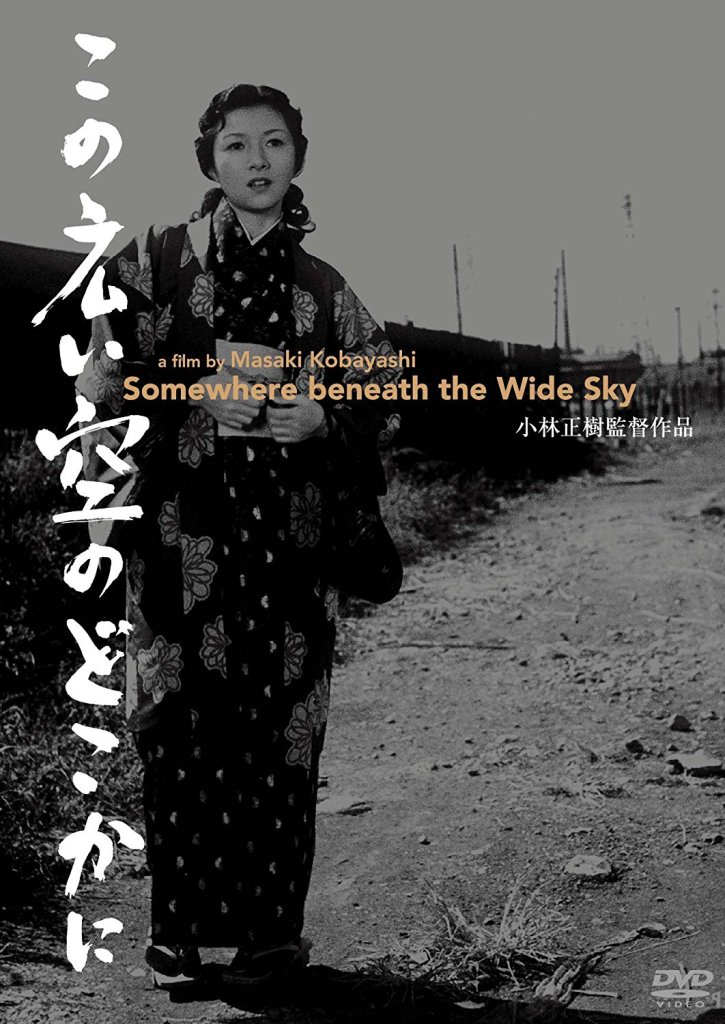
Somewhere Beneath the Wide Sky (この広い空のどこかに, Masaki Kobayashi, 1954)

somewhere-beneath-the-wide-skyOf the chroniclers of the history of post-war Japan, none was perhaps as unflinching as Masaki Kobayashi. However, everyone has to start somewhere and as a junior director at Shochiku where he began as an assistant to Keisuke Kinoshita, Kobayashi was obliged to make his share of regular studio pictures. This was even truer following his attempt at a more personal project – Thick Walled Room, which dealt with the controversial subject of class C war criminals and was deemed so problematic that it lingered on the shelves for quite some time. Made the same year as the somewhat similar Three Loves, Somewhere Beneath the Wide Sky (この広い空のどこかに, Kono Hiroi Sora no Dokoka ni) is a fairly typical contemporary drama of ordinary people attempting to live in the new and ever changing post-war world, yet it also subtly hints at Kobayashi’s ongoing humanist preoccupations in its conflict between the idealistic young student Noboru and his practically minded (yet kind hearted) older brother.

The Moritas own the liquor store in this tiny corner of Ginza, where oldest brother Ryoichi (Keiji Sada) has recently married country girl Hiroko (Yoshiko Kuga). The household consists of mother-in-law Shige (Kumeko Urabe), step-mother to Ryoichi, unmarried sister Yasuko (Hideko Takamine), and student younger brother Noboru (Akira Ishihama). Things are actually going pretty well for the family, they aren’t rich but the store is prospering and they’re mostly happy enough – except when they aren’t. Ryoichi married for love, but his step-mother and sister aren’t always as convinced by his choice as he is, despite Hiroko’s friendly nature and constant attempts to fit in.

As if to signal the dividing wall between the generations, Somewhere Beneath the Wide Sky opens with a discussion between two older women, each complaining about their daughters-in-law and the fact that their sons married for love rather than agreeing to an arranged marriage as was common in their day. These love matches, they claim, have unbalanced the family dynamic, giving the new wife undue powers against the matriarchal figure of the mother-in-law. While the other woman’s main complaint is that her son’s wife is absent minded and bossy, Shige seems to have little to complain about bar Hiroko’s slow progress with becoming used to the runnings of the shop.

Despite this, both women appear somewhat hostile towards Ryoichi’s new wife, often making her new home an uncomfortable place for her to be. Though Hiroko is keen to pitch in with the shop and the housework, Shige often refuses her help and is preoccupied with trying to get the depressed Yasuko to do her fair share instead. At 28 years old, Yasuko has resigned herself to a life of single suffering, believing it will now be impossible for her to make a good a match. Yasuko had been engaged to a man she loved before the war but when he returned and discovered that she now walks with a pronounced limp following an injury during an air raid, he left her flat with a broken heart. Embittered and having internalised intense shame over her physical disability, Yasuko finds the figure of her new sister-in-law a difficult reminder of the life she will never have.

A crisis approaches when an old friend (and perhaps former flame) arrives from Hiroko’s hometown and raises the prospect of abandoning her young marriage to return home instead. No matter how her new relatives make her feel, Hiroko is very much in love with Ryoichi and has no desire to leave him. Thankfully, Ryoichi is a kind and understanding man who can see how difficult the other women in the house are making things for his new wife and is willing to be patient and trust Hiroko to make what she feels is the right decision.

Ryoichi’s talent for tolerance is seemingly infinite in his desire to run a harmonious household. However, he, unlike younger brother Noboru, is of a slightly older generation with a practical mindset rather than an idealistic one. Ryoichi simply wants to prosper and ensure a happy and healthy life for himself and his family. This doesn’t mean he’s averse to helping others and is actually a very kind and decent person, but he is quick to point out that he needs to help himself first. Thus he comes into conflict with little brother Noburu from whom the film’s title comes.

Noburu is a dreamer, apt to look up at the wide sky as symbol of his boundless dreams. His fortunes are contrasted with the far less fortunate fellow student Mitsui (Masami Taura), who comes from a much less prosperous and harmonious family, finding himself working five different jobs just to eat twice a day and study when he can. Noburu wants to believe in a brighter world where things like his sister’s disability would be irrelevant and something could be done to help people like Mitsui who are struggling to get by when others have it so good. Ryoichi thinks this is all very well, but it’s pie in the sky thinking and when push comes to shove you have to respect “the natural order of things”. Ryoichi wants to work within the system and even prosper by it, where as Noburu, perhaps like Kobayashi himself, would prefer that the “natural order of things” became an obsolete way of thinking.

Nevertheless, it is the power of kindness which cures all. Gloomy Yasuko begins to live again after re-encountering an old school friend and being able to help her when she is most in of need of it. Being of use after all helps her put thoughts of her disability to the back of her mind and so, after hiding from a man who’d loved her in the past out of fearing his reaction to her current state (and overhearing his general indifference on hearing of it), she makes the bold decision to strike out for love and the chance of happiness in the beautiful, yet challenging, mountain environment.

Like many films of the era, Somewhere Beneath the Wide Sky is invested in demonstrating that life may be hard at times, but it will get better and the important thing is to find happiness wherever it presents itself. This is not quite the message Kobayashi was keen on delivering in his subsequent career which calls for a more circumspect examination of contemporary society along with a need for greater personal responsibility for creating a kinder, fairer and more honest one. A much more straightforward exercise, Somewhere Beneath the Wide Sky is Kobayashi channeling Kinoshita but minimising his sentimentality. Nevertheless, it does present a warm tale of a family finally coming together as its central couple prepares to pick up the reins and ride on into the sometimes difficult but also full of possibility post-war world.