
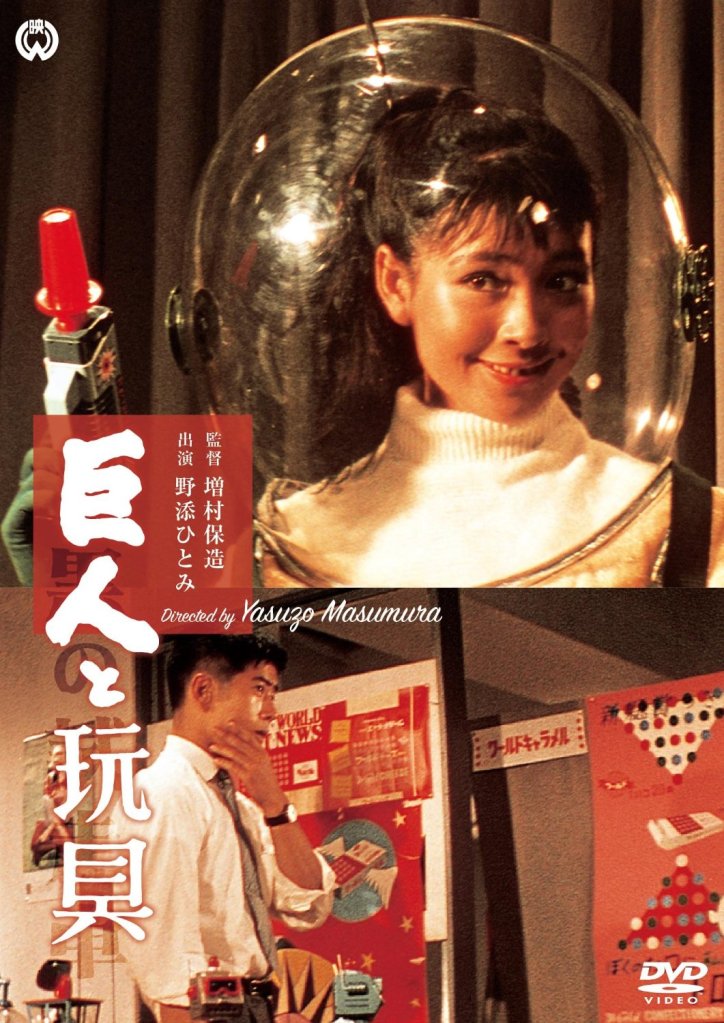
Less acerbic than Masumura’s later Black Test Car, Giants & Toys (巨人と玩具, Kyojin to gangu) is an altogether more humorous, if no less piercing look at post-war consumerism. This time the battle ground is confectionary as the Japanese sweets industry laments the all powerful American candies taking over the Japanese landscape. Three sweet companies are duking it out for the hearts of Japanese consumers and the hard working salarymen in the PR & marketing departments are becoming ever more desperate to find the key to becoming Japan’s top selling sweet maker.
The three companies are Giant, Apollo and World, each of which is currently trying to come up with an advertising campaign which has a competition element that will really hook in the populace. Our main focus is with World whose top PR man, Goda, is currently stumped when he spots quirky hillbilly Kyoko in a bar and hatches on an idea to make her the central poster girl of his ad campaign. Kyoko is 18 with gap teeth and a childlike innocence that makes her a great fit for selling their confectionary products to the adult market. At the same time, Goda’s assistant Nishi meets an older female executive from Apollo who’s trying to shift a set of spacesuits. This fits in neatly with another of Goda’s space themed ideas and a suitably bizarre campaign is launched with the gangly Kyoko dressed up in a kitsch spacesuit and pointing a ray gun which is somehow supposed to encourage people to buy sweets. Kyoko is a hit! However, the more popular Kyoko becomes the more her innocent charms begin to dissipate. What will become of her, and of the campaign, as the competition mounts?
For an area that’s supposed to be so totally frivolous and cheerful, confectionary sales are serious business. Goda is working himself into an early grave just to sell sweets to grownups and old people. It’s advertising and marketing but like everything else in life it’s just so much spin. What they’re really trying to sell is frivolous fun and a return to childhood’s freedom all packed into a momentary suck on a salted caramel. In the Japan where “everyone works all the time” this may be quite an attractive idea, especially to the put upon members of the confectionary marketing board.
However, trivial as sweets are, they represent the fleeting unimportance of pop culture memes. During one of Kyoko’s recording sessions we meet one of the solitary female producers (labelled a “machine” by two of the other women waiting to be seen) who laments that a has been star keeps hassling her for work though her time has passed and no one’s interested. This is most likely how things will wind up for Kyoko, five minutes of being everywhere followed by a lifetime of being nowhere at all. After signing with World for their TV and radio advertising she becomes a break out personality attending events as a celebrity in her own right and later even becoming a pop star complete with a totally strange, South Pacific themed musical number referencing some kind of cannibalistic genocide where they’ll sell back the remains of the men they’ve killed to the native wives. Pointed satire in more ways than one.
Goda wants to build a kind of mass media dictatorship, cleverly controlling the public mood through all pervasive advertising (a prescient thought, if ever there was one). Having taken things too far, he’s taken to task by his underling, Nishi, who’s had a bit of a rethink following a series of heartbreaks involving friends and lovers. “I won’t sacrifice my dignity” he says, only to be shown doing just that a couple of minutes later as he himself dons the ridiculously camp space suit, takes the ray gun in hand and wanders out into the streets to be met by a series of bemused stares from the passersby. Eventually, the woman from Apollo with whom he’d been having an affair spots him and with an equally amused expression instructs him to “smile warmly”, at which point he grimaces before managing to turn it into a robotic grin.
Still oddly current, Giants & Toys is an absurdist’s guide to corporate politics where personal integrity is sacrificed on the altar of commerce. Everyone runs round in circles working hard to sell things no one really wants or needs to other hardworking people just to keep the wheel spinning. “Kanban Musume” come and go, one ridiculous meme follows another and we all just fall over ourselves to chase whichever unattainable ideal they pitch us. It would be nice to think the world has moved on since 1958, however…
Giants & Toys is available on R1 DVD with English subtitles courtesy of Fantoma.
Trailer
 In I will Buy You (あなた買います, Anata Kaimasu, a provocative title if there ever was one), Kobayashi may have moved away from directly referencing the war but he’s still far from happy with the state of his nation. Taking what should be a light hearted topic of a much loved sport which is assumed to bring joy and happiness to a hard working nation, I Will Buy You exposes the veniality not only of the baseball industry but by implication the society as a whole.
