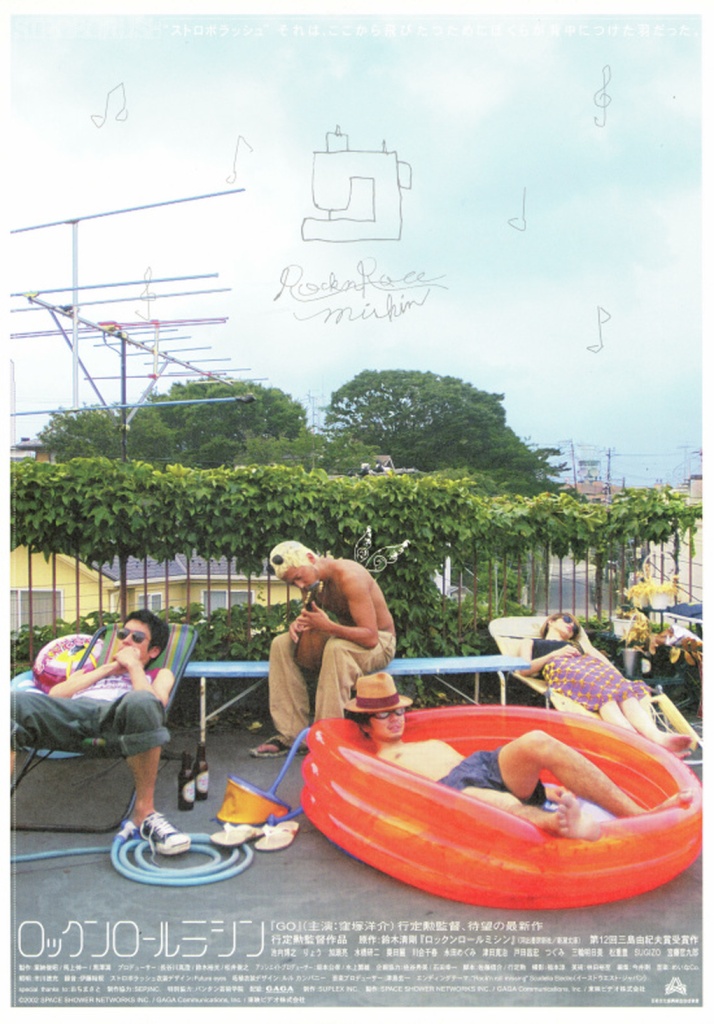
Rock’n’Roll Mishin (ロックンロールミシン, Isao Yukisada, 2002)

rock'n'roll misshinYou know how it is, you’ve left college and got yourself a pretty good job (that you don’t like very much but it pays the bills) and even a steady girlfriend too (not sure if you like her that much either) but somehow everything starts to feel vaguely dissatisfying. This is where we find Kenji (Ryo Kase) at the beginning of Isao Yukisada’s sewing bee of a movie, Rock ’n’ Roll Mishin (ロックンロールミシン). However, this is not exactly the story of a salaryman risking all and becoming a great artist so much as a man taking a brief bohemian holiday from a humdrum everyday existence.
Kenji’s life probably would have continued down a path of corporate serfdom uninterrupted if he had not run into old schoolfriend Ryoichi (Hiroyuki Ikeuchi) who, he learns, is setting up an indie fashion label with some of his friends. Ryoichi has to leave pretty quickly but he pastes a note on the outside of the restaurant window with his contact details so Kenji can find him again.

At work the next day Kenji “enjoys” some “banter” with an extremely unpleasant corporate stooge colleague who seems to be under the mistaken impression that he and Kenji are friends. After making some misogynistic comments about how Kenji is too much of a pushover and should “knock some sense” (literally) into his girlfriend, his colleague sets in on some typical salaryman careerist chat which is exactly the kind of thing Kenji is becoming disillusioned with.

Having failed to meet her at the restaurant, Kenji returns home one evening to find his girlfriend waiting outside his flat. She comes in and immediately takes off her clothes and gets into bed all without saying anything at all. When her T-shirt accidentally blows off the washing line and gets caught on some cabling below, Kenji remembers about his friend’s fashion company and decides to pay them a visit. Kenji is taken in by the sense of freedom and individual enterprise he finds in the workshop in contrast to his corporate drone office job. Eventually Kenji quits and joins the fashion gang full-time though he quickly finds that making a dream come true is surprisingly uphill work.

Unlike other films of this nature, there’s very little inspirational content to be found in Rock ’n’ Roll Mishin. The “mishin” of the title means a sewing machine and early on Ryoichi teases Kenji by telling him that his is a “rock and roll” machine because it beats out 8 stitches a second and if you really step on it it goes up to 16. Ryoichi’s teacher and mentor, Megumi (Ryo) lets Kenji in on the joke by explaining that it’s really called a “lock” machine because it holds the fabric in place for you. The other member of the team is a fashionista, Katsuo (Kenji Mizuhashi), who wants to create fashion that makes a sun of your heart so that you shine forth with an inner light. Needless to say, though the original three all have fashion skills from Ryoichi who’s the designer to Megumi who is a fashion teacher and Katsuo who studied fashion in London, nobody has any kind of business sense or a real business plan for this fledgling business.

In another film this might be where Kenji’s salaryman experience plays in, completing a missing element of the group which will enable them to triumph over adversity. However, Kenji’s experience is also fairly limited but the sensible economic advice he has to offer largely falls on deaf ears with his more creatively orientated teammates. They may understand the business on some level – at least enough to know what they can realistically expect to charge for their wares but are completely clueless about how they can go about managing their costs and maximising their profits. They also don’t really seem to know how to promote their business in anything other than a grungy, underground way which might be cool but is unlikely to take off without a serious amount of cynical marketing gimmickry which Ryoichi isn’t prepared to go for.

What Rock ’n’ Roll Mishin has to say about the youth of today isn’t very encouraging. It paints them as a group of unrealistic dreamers unwilling to put the work in to achieve anything. They might start to go for it in the beginning, but as soon as things start to look up they get scared and childishly run away rather than following through. Ryoichi is very much the tortured artist type, so fixated on maintaining his own image of artistic integrity that he’s completely unable to commercialise to work in any effective kind of way. Kenji is sucked in by the atmosphere of creative freedom but ultimately he has very little to offer and even if he is the one most affected by this new, bohemian lifestyle he’s also the best placed to recognise that you can’t live on dreams alone.

It’s tempting to read Rock ’n’ Roll Mishin as an ultra conservative, stick to the path message movie. It almost wants to say that it’s just not worth trying anything new because you’ll never see it through and you’ll be heading back to your old life with your tail between your legs quicker than you can say haute couture. However, even if the typical underdog triumphs against the odds narrative doesn’t materialise, Kenji at least comes to view his time in the fashion business in a broadly positive light. What he values is the time spent with friends, and, even if it didn’t work out quite the way they would have liked they still created something that was a success on its own terms and was ultimately appreciated by fellow travellers along the same path which, in the end, is what it’s all about.


Not exactly a trailer but this music video for one of the songs used in the film, Rock ‘n’ Roll Missing by Scudelia Electro, contains some footage from the film (lyrics in English)

Miss Hokusai (百日紅, Keiichi Hara, 2015)

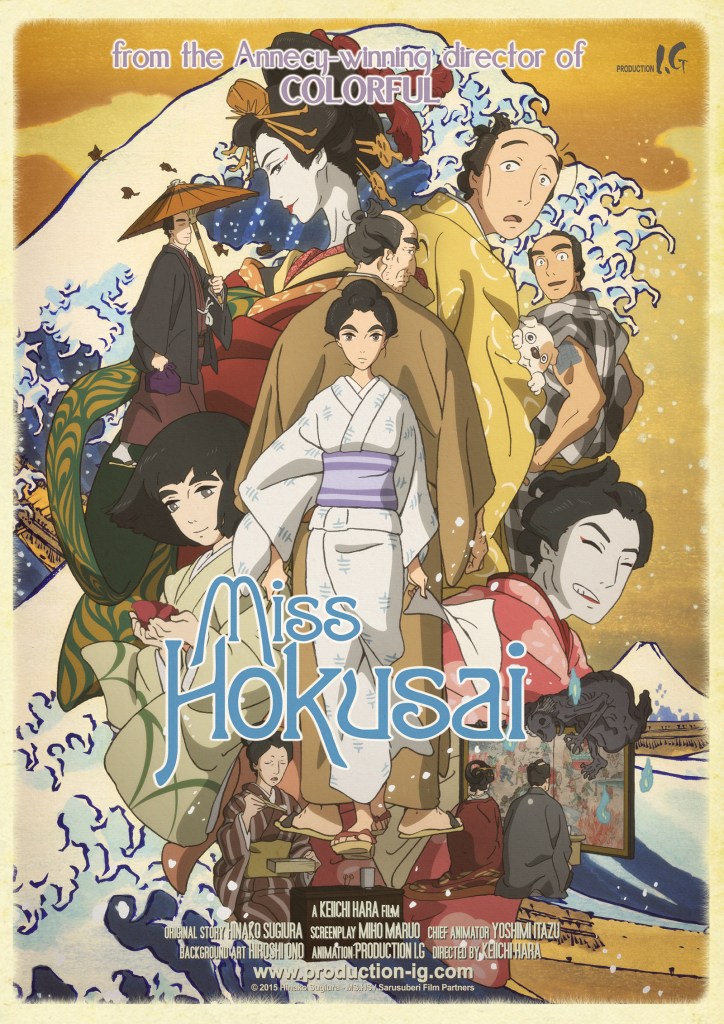
MISS_HOKUSAI_teaser_A4_oldpaper_1600When it comes to the great Japanese artworks that everybody knows, the figure of Hokusai looms large. From the ubiquitous The Great Wave off Kanagawa to the infamous Dream of the Fisherman’s Wife, the work of Hokusai has come to represent the art of Edo woodblocks almost single handedly in the popular imagination yet there has long been scholarly debate about the true artist behind some of the pieces which are attributed to his name. Hokusai had a daughter – uniquely gifted, perhaps even surpassing the skills of her father, O-Ei was a talented artist in her own right as well as her father’s assistant and caregiver in his old age.
Miss Hokusai, based on the popular 1980s manga Sarusuberi by Hinako Sugiura, takes up O-Ei’s story towards the beginning of her career before her marriage and subsequent divorce, after which she returned to her father’s side to nurse him as his health declined. Like the manga, the film is a collection of scenes from Edo life loosely tied together by its overarching theme, but broadly follows O-Ei as she lives her life as a young woman with a level of forthrightness and determination which sets her apart from the women of the time. Determined to become an artist, she lives with her father in their studio where neither of them cooks or cleans but each devotes themselves solely to art. Also living with them at the time is an ex-samurai and aspiring artist, Zenjiro, who specialises in erotica which has its own particular qualities even if his skills aren’t on a par with Hokusai or O-Ei.

When not in her father’s studio, O-Ei likes to visit her younger sister who, ironically, was born blind and is being cared for by the local nuns. O-Nao’s blindness is a sore spot for her father who hardly ever visits her, feeling as if her lack of sight is some sort of cosmic slight against him – the master painter with the daughter unable to appreciate his art and therefore his entire life philosophy. O-Ei is not so rigid and delights taking the girl out on trips where she can experience the world through her richly developed other senses. O-Nao particularly likes visiting the bridge with its complicated soundscape from the river below to the vendors above and all the passersby. There’s also a lovely set piece in which a young boy who quickly figures out that O-Nao can’t see tries to entertain her by knocking snow off a tree. Miss Hokusai, though a story of visual art, has an especially intricate sound design which proves that you can paint with materials other than ink and makes a point of calling out the stubbornness inherent in the world view of someone like Hokusai whose singleminded vision has become his entire universe.

O-Ei has her fair share of troubles as a young woman, though living with her father as his assistant she is a relatively free and unsheltered one. Her father doesn’t hide any aspect of his work from her – she even assists him with his erotic pieces and is said to be a particularly fine painter of women though her male figures lack conviction. “Sensation” itself becomes a theme, art is something which must be felt and therefore must have feeling imbued within it. As an unmarried woman O-Ei is ill equipt to complete these kinds of assignments and some say perhaps she should not be given them though her determination would never permit her to turn them down leading to rather a strange interlude in which she tries to gain some “experience” in a presumably “safe” way which won’t have much effect on her later life.

Less successfully, the film also attempts to enter the realm of the supernatural as we learn a painting can have other effects on the viewer particularly if it isn’t completed in the proper fashion. From a possessed geisha to a woman driven mad by O-Ei’s suitably creepy painting which features terrifying scenes from hell, Miss Hokusai most definitely occupies a world where ghosts, spirits and demons are real things which co-exist with real people. Luckily, Hokusai is able to fix the problem with the disturbing painting by closing its symbolic imagery with a suitable addition whilst berating O-Ei for having cut corners and not properly complete her vision so as to leave the onlooker “haunted” in an unintended way. Again, the painter is parent to the painting which attains the kind of immortality impossible for its creator in this transient world.

Clearly bound-up with the notion of transience, Miss Hokusai makes a valiant attempt to bring ordinary Edo living with its geisha houses, dusty rooms and drinking songs to life in vivid detail. However, its message becomes slightly confused with the superimposition of the modern Tokyo in the final frame of the film. At this point, the rather bizarre choice of a modern, electric guitar based soundtrack, begins to make a degree of sense at least on a thematic level but nowhere near enough to mitigate its jarring presence throughout the film.

Animated by animation powerhouse Production I.G who have been responsible for some of the most beautifully made animated movies of recent times, Miss Hokusai is a giant step up from Hara’s previous film, Colorful, in terms of its execution and boasts a number of scenes which are remarkable in their technical proficiency. The sky in particular as well as the background in general takes on a dreamy, woodblock style which is perfectly fitting for the film’s themes. An interesting look at the young O-Ei, an inexperienced female artist still looking for her voice in a world where the only thing that counts is the signature, Miss Hokusai doesn’t quite succeed in breathing life into its disparate collection of tales but makes a valiant attempt all the same.


Miss Hokusai is currently touring the UK with the Japan Foundation Touring Film Programme 2016 and will be released by All the Anime later in the year.


Kabukicho Love Hotel (さよなら歌舞伎町, Ryuichi Hiroki, 2014)

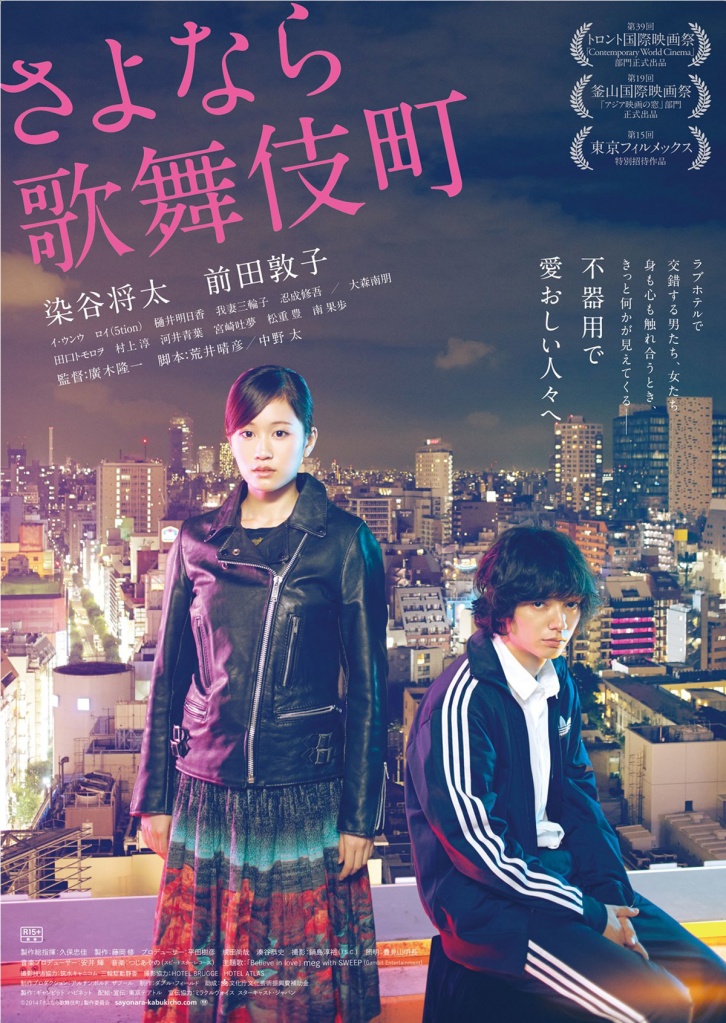
165709_02Kabukicho Love Hotel (さよなら歌舞伎町, Sayonara Kabukicho), to go by its more prosaic English title, is a Runyonesque portrait of Tokyo’s red light district centered around the comings and goings of the Hotel Atlas – an establishment which rents by the hour and takes care not to ask too many questions of its clientele. The real aim of the collection of intersecting stories is more easily seen in the original Japanese title, Sayonara Kabukicho, as the vast majority of our protagonists decide to use today’s chaotic events to finally get out of this dead end town once and for all.

The first couple we meet, Toru and Saya are young and apparently in love though the relationship may have all but run its course. She’s a singer-songwriter chasing her artistic dreams while he longs for a successful career in the hotel industry. He hasn’t told her that far from working at a top hotel in the city, he’s currently slumming it at the Atlas. Our next two hopefuls are a couple of (illegal) Korean migrants – she wants to open a boutique, he a restaurant. She told him she works as a hostess (which he’s not so keen on but it pays well), but she’s a high class call girl well known to the staff at the Atlas. Our third couple are a little older – Satomi works at the Atlas as a cleaner but she has a secret at home in the form of her man, Yasuo, who can’t go outside because the couple is wanted for a violent crime nearly 15 years previously. In fact, in 48hrs the statute of limitations will pass and they can finally get on with their lives but until then Satomi will continue to check the wanted posters on the way to work. That’s not to mention the tale of the teenage runaway and the hard nosed yakuza who wanted to recruit her as a call girl but had a change of heart or the porn shoot on the second floor which stars a lady with an unexpected relationship to one of the hotel’s employees…

It’s all go in Kabukicho. The punters come (ahem), go and leave barely a mark save for the odd tragedy to remind you that this is the place nobody wanted to end up. In fact, the picture Hiroki paints of Kabukicho is the oddly realistic one of someone hovering on its fringes, acknowledging the darkness of the place but refusing to meet its eyes. Everybody is, or was, dreaming of something better – Toru with his job at a five star hotel and a sparkling career in hospitality, Satomi and her romance or the Korean couple who want to make enough money to go home and start again. In short, this isn’t the place you make your life – it’s the one you fall into after you’ve hit rock bottom and promptly want to forget all about after you’ve clawed your way out.

However, while you’re there, you’re invested in the idea of it not being all that bad, really. There’s warmth and humour among the staff at the hotel who treat this pretty much the same as any other job despite its occasional messiness. In fact, the agency for the which the Korean hopeful works is run by an oddly paternalistic “pimp” (this seems far to strong a word somehow) who sits around in an apron and chats, offering comfort and fatherly advice in between dispatching various pretty young girls off to any skeevy guy who wants to rent them for an hour or two.

That’s not to say anyone is happy here though, all anyone’s focussed on is getting out and by the end the majority of them decide it’s just not worth it and the time to leave is now. Kabukicho Love Hotel may be one of Hiroki’s most mainstream efforts (despite its far less frequent than you might expect though frank sexual content) but its overlong running time and its failure to fully unify its disperate ensemble stories make it a slightly flawed one. An interestingly whimsical black comedy that takes a humorous view of Kabukicho’s darkside, Kabukicho Love Hotel is perhaps one it’s fairly easy to check out of well before the end of your stay but does offer a few of its own particular charms over the duration of your visit.


Or perhaps, you can check out any time you like, but you can never leave? We are all just prisoners here, of our own device….

Midnight Diner (深夜食堂, Shinya Shokudo, Joji Matsuoka, 2015)

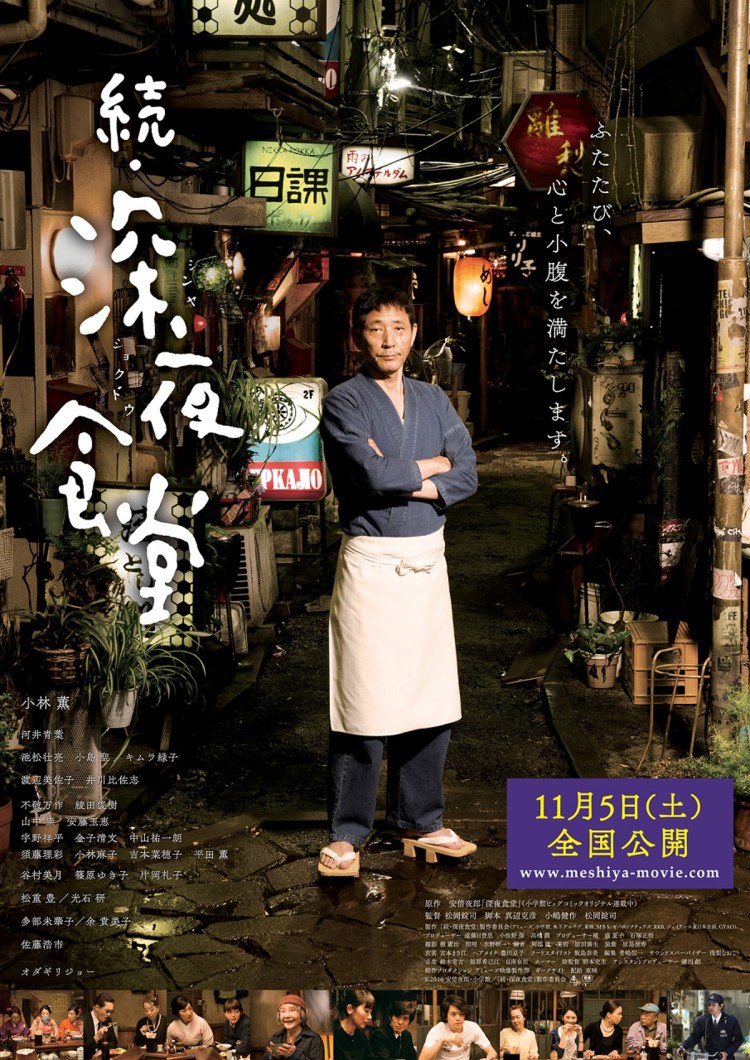
mainvisualYaro Abe’s manga Midnight Diner (深夜食堂, Shinya Shokudo) was first adapted as 10 episode TV drama back in 2009 with a second series in 2011 and a third in 2014. With a Korean adaptation in between, the series now finds itself back for second helpings in the form of a big screen adaptation.

Midnight Diner is set in a cosy little eatery which only opens between the hours of midnight and 7am. Presided over by the “Master”, a mysterious figure himself with a large unexplained scar running down one side of his face, the restaurant has only one regular dish on its menu but Master is willing to make whatever his customers want provided he has the ingredients. Regulars and newcomers mingle nightly each with their own, sometimes sad, stories while Master offers them a safe place to think things through coupled with his gentle, all knowing advice.

The big screen movie plays just like a series of connected episodes from the television drama yet manages unify its approach into something which feels consistently more cinematic. Keeping the warm, nostalgic tone the film also increases its production values whilst maintaining its trademark style. The movie opens with the same title sequence as its TV version and divides itself neatly into chapters which each carry the title of the key dish that Master will cook for this segment’s star. A little less wilfully melodramatic, Midnight Diner the movie nevertheless offers its gentle commentary on the melancholy elements of modern life and its ordinary moments of sadness.

Fans of the TV drama will be pleased to see their favourite restaurant regulars reappearing if only briefly, but the film also boosts its profile in the form of some big name stars including a manager of another restaurant in town played by Kimiko Yo who seems to have some kind of history with Master as well as a smaller role played by prolific indie star of the moment Kiyohiko Shibukawa and the return of Joe Odagiri whose character seems to have undergone quite a radical change since we last saw him.

The stories this time around feature a serial mistress and her dalliance with another, poorer, client of the diner; a young girl who pulls a dine and dash only to return, apologise and offer to work off her bill; a lovelorn widower who’s come to Tokyo to chase an aid worker who probably just isn’t interested in him; and then there’s strange mystery of a mislaid funerary urn neatly tieing everything together. Just as in the TV series, each character has a special dish that they’ve been longing for and through reconnecting with the past by means of Master’s magic cooking, they manage to unlock their futures too. As usual, Master knows what it is they need long before they do and though he’s a man of few words, always seems to know what to say. One of the charms of the series as a whole which is echoed in the film is that it’s content to let a few mysteries hang while the central tale unfolds naturally almost as if you’re just another customer sitting at the end of Master’s counter.

Shot in more or less the same style as the TV series favouring long, static takes the film still manages to feel cinematic and its slight colour filtering adds to the overall warm and nostalgic tone the series has become known for. Once again offering a series of gentle human stories, Midnight Diner might not be the most groundbreaking of films but it offers its own delicate insights into the human condition and slowly but surely captivates with its intriguing cast of unlikely dining companions.