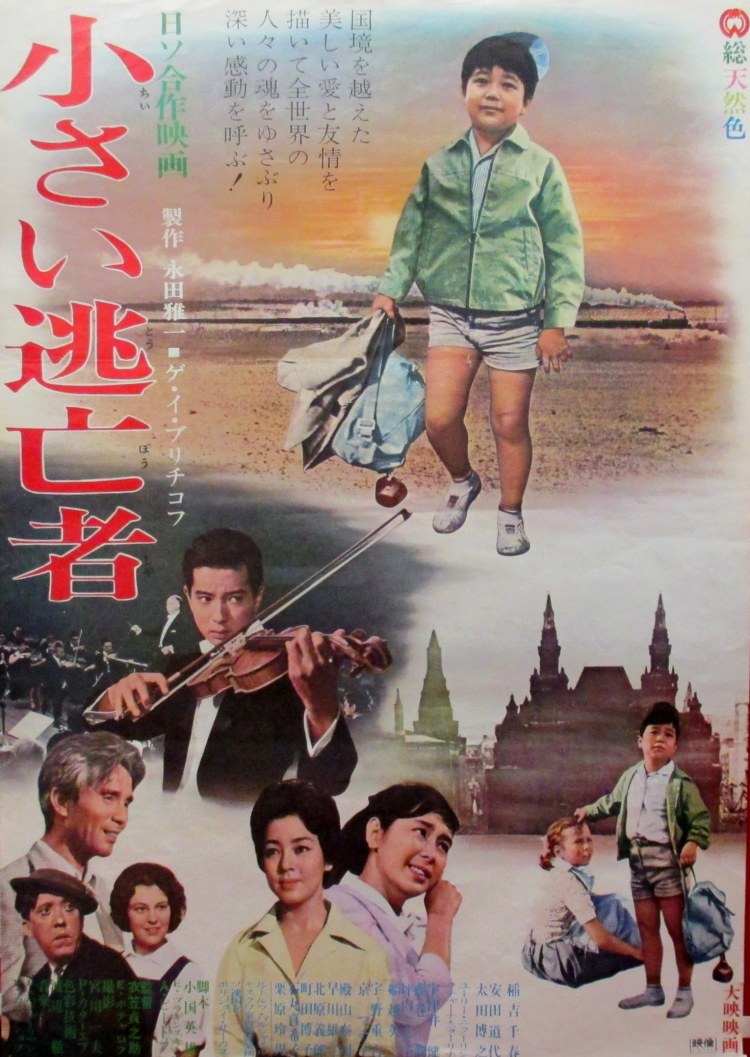
 Teinosuke Kinugasa maybe best known for his avant-garde masterpiece The page of Madness even if his subsequent work leant towards a more commercial direction. His final film is just as unusual, though perhaps for different reason. In 1966, Kinugasa co-directed The Little Runaway (小さい逃亡者, Chiisai Tobosha) with Russian director Eduard Bocharov in the first of such collaborations ever created. Truth be told, aside from the geographical proximity, the Japan of 1966 could not be more different from its Soviet counterpart as the Eastern block remained mired in the “cold war” while Japan raced ahead towards its very own, capitalist, economic miracle. Perhaps looking at both sides with kind eyes, The Little Runaway has its heart in the right place with its messages of the universality of human goodness and endurance but broadly makes a success of them if failing to disguise the obvious propaganda gloss.
Little Ken (Chiharu Inayoshi) is ten years old and lives with his violinist uncle, Nobuyuki (Jukichi Uno). Ken has obvious talent at the violin and, like most kids in this rundown area, his drunken uncle has roped him into helping out for a few extra pennies. One fateful night, Nobuyuki has tied one on and lets slip that Ken’s dad might not be dead, but stuck in a hospital in Moscow. Soon enough a Russian circus comes to town and Ken strikes up a strange friendship with the kindly clown, eventually stowing away to the Soviet Union to look for his long lost father.
From one point of view, The Little Runaway conforms to a certain type of family drama which centres on the disconnect between a father and a son. Ken feels abandoned (no reference is ever made to his mother), though he loves and respects the uncle who takes care of him even if recognising his standard of care often leaves a lot to be desired. His desire to find his father is not so much motivated by unhappiness (his life is difficult but it’s the only one he’s ever known), but by the desire for answers as regards his own ancestry and the emotional need to reconnect with the biological father he no longer remembers clearly.
From another point of view, The Little Runaway conforms to the genre of children’s cinema in its close following of Ken’s quest. With no word of warning, Ken takes off for Russia as if he were simply going to check out a neighbouring town. Unaware of the political context and hoping to use his friendship with the circus troupe to his advantage Ken stows away on a boat headed for the USSR, but his clowning friends aren’t on it and he doesn’t speak any Russian.
The central tenet of the story is that there are kind people everywhere willing to help a determined little boy with melancholy eyes. Ken manages to get to Russia but then escapes his “escort”, hoping to travel to the capital faster. Wandering through the empty landscape, he chances into a house and makes friends with a peasant boy who introduces him to his wider family and a man with many daughters who could use a son just like Ken. Ken also tries to support himself by taking casual work as a labourer, having learnt the Russian word for such a job and repeatedly emphasising it, trying to assure them that he’s stronger than his appearance suggests.
Despite not speaking the language Ken manages to make himself understood through sand paintings, though the Russians he meets are all eager to share their food and shelter with him without much by way of explanation. As might be expected, the Russia depicted may not be particularly realistic, the officials are kind and jovial, the streets are clean, the people healthy and happy, and you can even buy Moscow cigarettes from woman running a stand in the square. The Japan Ken knows, by contrast, is one down at heels in which children are being pressed into shady forms of employment from Ken’s violin playing to little girls selling flowers on the street.
Depicting events from an innocent, child’s eye view, The Little Runaway finds only goodness rather than political anxiety but it is quick to emphasis the importance of helping those in need as the clown later avows. More or less straightforward in shooting style, Little Runaway is more intent on seeing the virtues of the cooperation between the Soviet block and the burgeoning Japanese economy than resolving its central mystery but nevertheless provides another welcome addition to the plucky child adventure genre while urging a kind of universal kindness probably not much in evidence in the real life Tokyo or Moscow of 1966.
Original Japanese trailer (no subtitles)
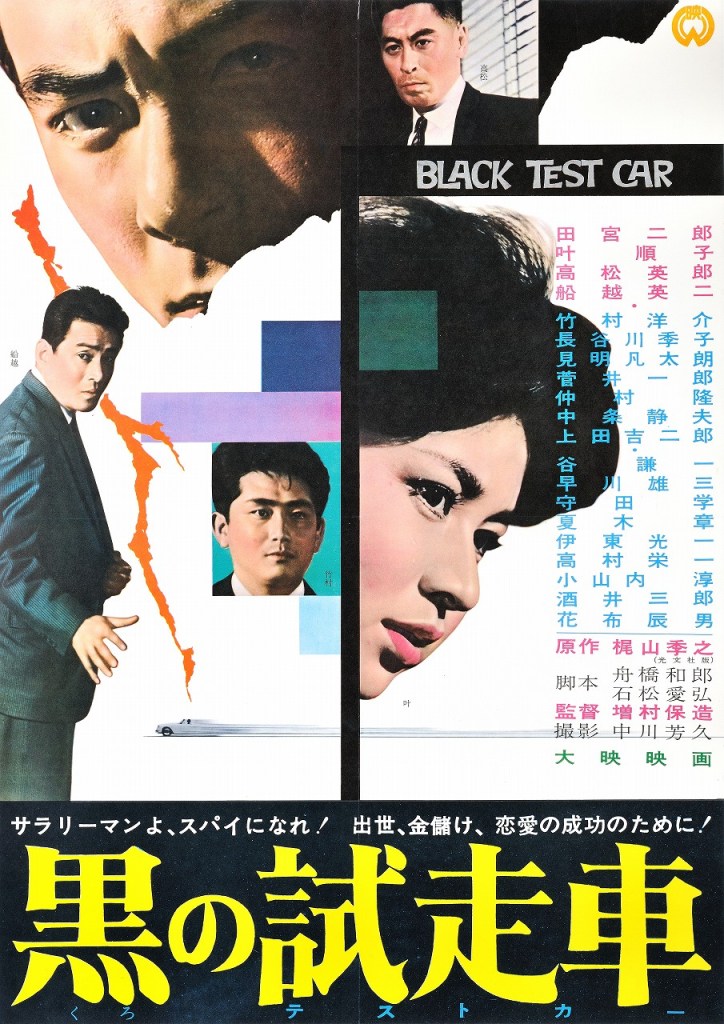 The automobile business is a high stakes game. Do you want to play faster, shinier and sleeker, or safer, family friendly and reliable? Family cars are the best sellers – everyone one wants something that’s reliable for getting to work every morning, getting the grocery shopping done and that you won’t worry about taking your kids to the park in. However, it’s the 1960s and lifestyles are shifting, men (in particular) are marrying later and they want to have fun before they do – hence having quite a lot of disposable income they can blow on a flashy two-seater sports car with no wife to complain about it. Tiger have just finished a new prototype called the Pioneer they plan to launch as a revolution in commercial sports cars which is super speedy but with the convenience of an everyday sedan. However, the Yamato company are also set to launch a new car and it keeps looking suspiciously like the Pioneer – does Tiger have a mole?
