Zero (零戦燃ゆ, Toshio Masuda, 1984)

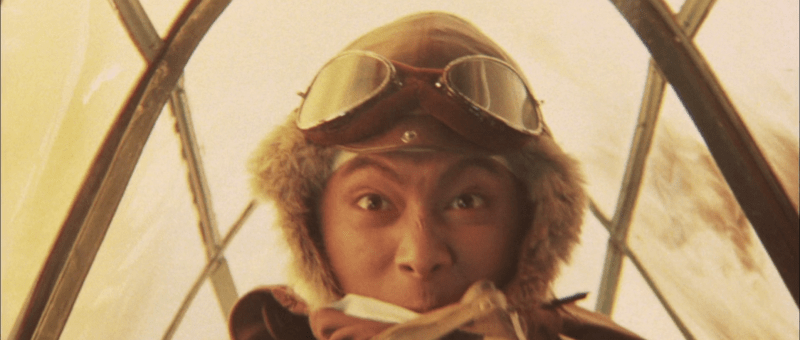
The Zero Fighter has taken on a kind of mythic existence in a romanticised vision of warfare, yet as Toshio Masuda’s Zero (零戦燃ゆ零戦燃ゆ, Zerosen moyu) implies its time in the spotlight was in fact comparatively short. Soon eclipsed by sleeker planes flown by foreign pilots, the Zero’s glory faded until these once unbeatable fighters were relegated to suicide missions. On one level, the film uses the Zero as a metaphor for national hubris, a plane that ironically flew too close to the sun, but on another can never overcome the simple fact that this marvel of engineering was also a tool of war and destruction. 

The film is loosely framed around two members of Japan’s Imperial Navy, Hamada (Daijiro Tsutsumi) and Mizushima (Kunio Mizushima), who as cadets consider deserting to escape the brutality of Navy discipline. Having left the base they’re accosted by an inspirational captain who talks them out of leaving by showing them a prototype model of the Zero and convincing them they only need to stick it out for a few more years in order to get the opportunity to fly one. Mizushima, the film’s narrator, doesn’t qualify as a pilot and is related to the ground crew while Hamada does indeed get to pilot a Zero fighter and becomes one of the top pilots in the service. 

The viewpoint is is then split between the view from the ground and that from the clouds. Mizushima makes occasionally surprising statements such as candidly telling love interest Shizuko (Yû Hayami) that they are unlikely to win the war, while becoming ever more concerned for Hamada at one point telling him there’s a problem with his plane in the hope that he won’t take off that day. Hamada meanwhile is completely taken over by the spirit of the Zero and even when given a chance to escape the war after being badly injured, chooses to return because he does not know what else to do. When he visits home after leaving hospital, no one is there. His mother eventually arrives and explains that the family has become scattered with his siblings seconded to the war effort in various places throughout the country. 

Hamada’s dedication and personal sacrifice are in some senses held up as the embodiment of the Zero. The reason for its success is revealed to lie in the decision to remove the armouring for the cockpit leaving the pilot’s life unprotected, something which the American engineers describe as unthinkable. In an early meeting, a superior officer complains that they’re losing too many pilots and need to reinstall some of the armouring, but finds little support. Not only this is a cold and inhuman decision, but it’s poor economic sense given that skilled pilots are incredibly valuable and in short supply. After all, you can’t just make more. If you start from scratch you’ll need to wait 20 years and then teach them fly, but it’s a lesson the Navy never learns that is only exacerbated with the expansion of the kamikaze squads which squander both men and pilots for comparatively little gain. 

These “philosophical differences” are embodied in the nature of the Zero which is configured to be nimble and outmanoeuvre the enemy but is quickly eclipsed not least when foreign powers figure out the way to beat it lies in numbers in which they have the advantage. There is something of a post-Meiji spirit in the feeling that Japan is lagging behind Western powers and desperately needs to develop its own military tech in order to defend itself. On hearing rumours of the Zero fighter, MacArthur scoffs and says that Japan can’t even build cars so he doesn’t believe they could design a plane that could fly such large distances while others suggest that they will still need the element of surprise if they ever go to war with America because its technology is still superior. 

Walking a fine line, the film tries to avoid glorifying “war”, but it cannot always help indulging in nationalist fantasy such as in its statement that thanks to the Zero “the Japanese flag covered a vast area of the Pacific” in the wake of Pearl Harbour. These may be fantastically well designed machines that were incredibly good at what they were created to do, only what they were created to do was kill and destroy. The plane’s fortunes and Japan’s are intrinsically linked, the sense of superiority in the air lasts only a short time before Western technological advances over take it and the war continues to go badly. The film dramatises the tragedy of war through the friendship between the two men which eventually causes Mizushima to sacrifice his love for Shizuko by convincing her marry Hamada hoping that his priorities would change and he’d decide to take a position as an instructor rather than heading back to the front. 

For her part, it seems that Shizuko was also in love with Mizushima, but also caught in a moment of confusion between love and patriotism that encourages her to think she should do as Mizushima says and embrace this man who has dedicated his life to his country. In the end, it buys them each loss and misery, but also a moment of transcendent hope even if it was based on a falsehood in the pleasant memory that Mizushima gives Hamada of the life he is giving up by rejecting it to return to the front. For Mizushima, Hamada and the Zero may become one and the same. At the end of the war he can’t bear to see the remaining Zero’s sold for scrap and asked to be “gifted” one as the Captain who’d first shown one to him said he would be, so that he can give it a proper a “funeral”, or perhaps send it to Hamada in the afterlife after he is killed mere days before the surrender. Masuda cannot help romanticising the wartime conflict with his dashing pilots and their thrilling dogfights, often depicting it more as a kind of game than an ugly struggle of death and destruction, but does lend a note of poignancy to his tale of lives thwarted by the folly of war.


Trailer (no subtitles)
The Target of Roses (薔薇の標的, Kiyoshi Nishimura, 1972)

One of a series of internationalist conspiracy thrillers arriving in the early 1970s, Kiyoshi Nishimura’s Target of Roses (薔薇の標的, Bara no Hyoteki, AKA Red Target) finds itself at a particular moment of paranoid anxiety. In the immediate wake of Asama-Sanso, its villains are a band of revolutionaries hiding out in the mountains behind the shield of “New Religion” as they plot the over throw of the state. Yet these villains are not left-wing former student protestors but Nazi holdovers branding themselves as the “Fourth Reich” while insisting that they are not “fascists” but merely trying to create a new world order free of “corrupt governments”. 

The hero, Akira, in keeping with similar roles Yuzo Kayama played in this period, is a former Olympic sharpshooter who fled to America after being implicated in the death of a teammate. You can tell that things haven’t been going well for him by the terrible mutton chops haircut he is forced to wear throughout the film, but his problem seems to be that he has lost all interest in living. That’s one reason he’s recruited by the Fourth Reich’s local leader Tachibana who theorises that Akira is a man who lives for the gun and is good as dead without one. He and his one-eyed associate Nomura (Toby Kadoguchi), a former sharpshooter himself, begin training him with various strange exercises never revealing their true purpose until asking him to shoot a prisoner they’ve tricked into trying to escape from their secret base. Realising the target is human Akira refuses but then changes his mind shooting the man at much closer range as he runs through a forest. 

Meanwhile, foreign photographer Robert (Ralph Jesser) and his assistant Ling Ling (Taiwanese actress Chen Chen) accidentally end up finding the secret camp after becoming lost in the forest, Robert returning later to investigate and take more photos. Akira is then sent to Hong Kong where the pair have travelled to visit the grave of Ling Ling’s brother, a war photographer killed by a landmine in Laos, in order to take out Robert before he exposes their operation in the newspapers. Never asking any questions of his new job, Akira is unexpectedly moved on seeing Ling Ling’s distress over Robert’s body, later striking up a relationship with her when she too becomes a target for the Fourth Reich. 

In a surprising contrast to similar contemporary crime thrillers, Hong Konger Ling Ling represents a kind of innocent beauty as symbolised in her interest in photographing flowers rather than the war zones covered by her brother. At one point she and Akira are even seen tiptoeing on the railway tracks just like innocent lovers only for Akira to then reflect on the sight of an obsolete steam train likening it to himself, abandoned and destined to be torn to pieces. His love for Ling Ling gives him new reason to live, breaking the nihilistic spell which he claims had led him to want to destroy everything. To that extent Tachibana is correct when he says that Akira has no interest in the future of mankind, but he has become determined to preserve the world of two which exists between himself and Ling Ling which leads him to oppose The Fourth Reich, of whose activities he had been previously ignorant. 

It has to be said that Nishimura’s repurposing of Holocaust imagery, the failed “trainees” of the Fourth Reich’s re-education programme driven to vacant madness and piled up on wooden bunk beds later to be gassed and burned on mass funeral pyres, may be a little inappropriate in its accidental flippancy. Nomura’s claim that the Fourth Reich is not a resurrection of fascism is somewhat disingenuous even if they seem to have no other ideology than their weird super soldier brainwashing programme designed to create some kind of new society, later suggesting that the conspiracy already has assets within the Japanese government. Yet Akira is indifferent to fascism, as Tachibana had framed him a man of the gun born only to pull a trigger a function he later uses in order to convince him to destroy himself. Often marred by overly theatrical dialogue rendered in sometimes awkward English which plays much less well than it might in Japanese, Target of Roses remains a little on the pretentious side despite Nishimura’s characteristic artistry but nevertheless embraces its nihilistic philosophy in the vast emptiness of its internecine conclusion. 


Sanjuro (椿三十郎, Akira Kurosawa, 1962)

Adapted from a novel by Shugoro Yamamoto, Akira Kurosawa’s Yojimbo had taken place in a world of collapse in which the foundations of the feudal order had begun to crack while the disruptive allure of hard currency had left ordinary people at the mercy of gang intimidation in place of exploitative lords. A quasi-sequel or perhaps more accurately termed a companion piece, Sanjuro (椿三十郎, Tsubaki Sanjuro) by contrast, takes place in a world that should be peaceful and orderly but suggests that the corruption was there all along and tolerated to the extent of being coded into the system. 

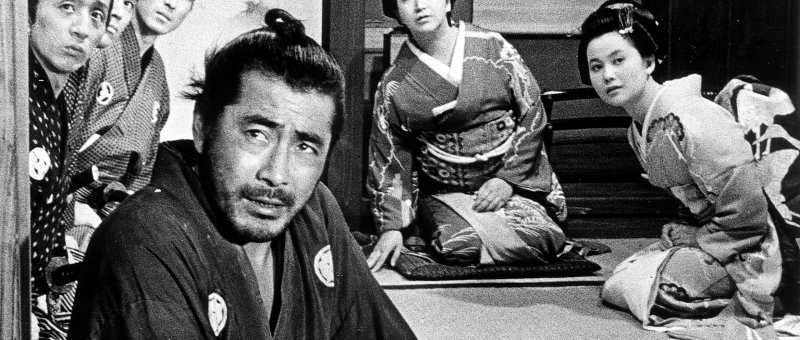
The accused man, Mutsuta (Yunosuke Ito), says as much at the film’s conclusion explaining that he meant to deal with the matter “more discreetly” after amassing incontrovertible evidence he could he could offer to his superiors in the capital if only his hot-headed nephew and the idealistic young samurai with him hadn’t jumped the gun by naively thinking they could expose conspiracy by force of will. This time around, the wandering ronin who gives his name as Sanjuro (Toshiro Mifune) finds himself adopting a fatherly position trying to convince the youngsters to think before they act. Overhearing their conversation, he explains to them that they have mostly likely been misled, Mutsuta is innocent and his attempt to warn them off well-meaning while the superintendent Kikui (Masao Shimizu) is the real villain and almost certainly intends to have the lot of them bumped off before they figure out what’s really going on. 

Unlike Yojimbo, Sanjuro takes place entirely within samurai society which ought to be an orderly place where everyone follows the same code and does their best to act honourably. This sense of stability is reflected in Kurosawa’s composition which leans closer to the classicism of the historical drama than the windswept vistas of the lonely ghost town in Yojimbo, and by the contrast so often drawn between the wandering ronin and the young samurai who are shocked by his rough way of speaking and wilful rejection of the politeness with which they have been raised. As a captured prisoner points out, Sanjuro has a sarcastic manner and a tendency to insult where he means to praise which further fuels the doubt some have in him, unsure whether they can really trust this “outspoken and eccentric” drifter fearing he will simply sell himself to the highest bidder and betray them. Mutsuta sympathises with this to some degree, forgiving the boys for having thought him a villain but lamenting that his long face has often got him into trouble. They thought he was the bad guy because he looked like one and trusted Kikui because he looked honest, laying bare the childish superficiality soon corrected by the well honed instincts of the veteran Sanjuro. 

It’s this superficiality that also leads them to dismiss the advice of Lady Mutsuta (Takako Irie) as “hopelessly naive” while only Sanjuro can see that she has a full grasp of the situation at hand and accepts her admonishment that he has the “bad habit” of killing too easily when another solution may be available. When the boys catch one of Kikui’s henchmen they suggest killing him because he’s seen their faces, but Lady Mutsuta decides to invite him into their home, assuring him he won’t be harmed and even giving him one of their fancy kimonos to wear. The man seems to have been won over by their hospitality, sometimes emerging from the cupboard where he is (voluntarily) imprisoned to offer a word of advice along with a defence of Sanjuro having observed him and figured out that he is a good man with an admittedly gruff manner that makes him a bad fit for conventional samurai society. “He would find it too confining here,” Mutsuta agrees, “he wouldn’t wear these fine garments or be a docile servant of the clan.”

In any case, the film doesn’t particularly reject samurai society only suggest that if you’re going to live within it you should follow the rules and if you can’t you should follow your own path as Sanjuro has been doing in a sense “freed” by his ronin status serving no master but himself. Lady Mutsuta had a point when she said that he glistened like a drawn sword, something he too concedes after facing off against his final foe, Heibei (Tatsuya Nakadai), whom he describes as much like himself another drawn sword in a society in which direct violence is inappropriate as the explosive spray of blood on Heibei’s all too matter of fact defeat makes plain. “The sword is best kept in its sheath” she reminds him, she and her husband both suggesting that this world is ruled by intrigue which is why Mutsuta hoped to handle the corruption “discreetly” though he won’t condemn the young men for their desire to enforce the rules of their society and stand up against corruption and injustice. Their rebellion has accidentally led to unnecessary deaths because of their youthful hot-headedness and tendency towards the simplistic solution of violence, but all things considered it has worked out well enough for all concerned. And so, his work done, Sanjuro is left to wander telling the boys not to follow him because he too is a disruptive and dangerous a presence in this codified world of peace and order in which a sword loses its value the moment it is drawn.


Sanjuro screened at the BFI Southbank, London as part of the Kurosawa season.

Original trailer (English subtitles)

Bullet Wound (弾痕, Shiro Moritani, 1969)

“Your love for your country can’t change anything now” the conflicted hero of Shiro Moritani’s conspiracy thriller Bullet Wound (弾痕, Dankon) is advised as a villainous chaos agent attempts to convince him to switch sides. Like many of Toho’s gunman dramas of the late ‘60s, Bullet Wound anticipates the cinema of paranoia which would take hold in the following decade set against the constant anxiety of the ANPO protests while the Japanese-American CIA agent hero struggles with his uncertain place in a world of geopolitical instability. 

Takimura (Yuzo Kayama) is a man with two countries, born in the US to Japanese parents but later orphaned, now working for the CIA in Japan. Perhaps tellingly, we can’t initially tell what side he’s on even as he tries to prevent an assignation attempt on some kind of dignitary connected to the US. The main crisis occurs when Takamura helps a Chinese man, Yang (Shin Kishida), escape a trade summit in order to defect and chase freedom in America. The Americans, however, then torture him until he finally admits that he’s a stooge, the defection was merely a means of getting him into the US as a spy while the trade delegation is only a front for an upcoming arms deal with a international smuggler known as “Tony Rose” (Andy Seams). Takimura and his team are obviously keen the transaction not take place, but are unable to take Rose out because as Takimura’s boss points out they’ve used him too and he’s too well connected. If they move against him, someone will move against them. 

The Chinese arms deal is linked back to a sense of cold war paranoia which spreads to the young students protesting the ANPO treaty. Takimura’s boss calls them “terrorists” unable to understand how there can be Japanese people who could do this to their own country seemingly unaware of the minor irony in his statement. Meanwhile, he prepares to sacrifice Takimura as need be, callously remarking that a man with two countries who can’t choose between them can be dangerous while admitting that his services have been useful to the Americans but they may not always be so. The Americans meanwhile make crass racist remarks while chasing down the Chinese spies, taking altogether too much pleasure in eradicating them while the hitherto stoical Takimura looks on with disapproval mixed with hurt and shame beginning to wonder if he’s really on the right side. “You and the US will never defeat us” his rivals insist, revealing a mind-blowing piece of info that sets Takimura on a collision course with fate. 

Meanwhile, a strange young artist crafts horrifying statues displaying the “agony of loneliness” and longs to escape Japan for South America where they apparently have the best stone. But as someone later tells her, the desire to go to a new land is not born of hope, and expectations are almost always betrayed. Only love can change everything into hope he tells her, as she pins hers on running away with Takimura while he tries to tie up a few loose ends. Yet there’s also a kind of fatalism that defines their relationship, Takimura reflecting on watching a man die up close and haunted by the searching look in his eyes as if he were trying to understand the meaning not of life but of death. An ironic street singer sings a sad song about those who die and what they leave behind, the soldier apparently leaving not a trace of peace. 

The implication is perhaps that Takimura’s dual nationalities are not viable, that a man with two countries cannot escape by choosing a third nor can he survive without sacrificing one or the other. Meanwhile, Moritani slides into anti-Americanism painting the CIA as duplicitous and exploitative as they simultaneously demonise the Japanese and position men like Tony Rose as international chaos agents destabilising the global order. Handheld photography adds to the sense of anxious immediacy and confusion as Takimura attempts to define his own identity only to discover perhaps that he no longer has one caught as he is between two nations as two selves at the heart of a silent war. 


The Creature Called Man (豹は走った, Kiyoshi Nishimura, 1970)

By the late 1960s, Japan had more or less achieved its economic miracle yet there was still a degree of political tension manifesting itself in a second round of widespread protests towards the automatic renewal of the security treaty with the Americans in 1970. The third feature from Kiyoshi Nishimura, The Creature Called Man (豹は走った, Jaga wa Hashitta) anticipates the cinema of paranoia which was to take hold in the 1970s but as confused as its internal politics sometimes are, reflects the continuing sense of dissatisfaction in the wake of the student movement’s failure in its attempt to critique ongoing complicity with American foreign policy in Asia as well as Japan’s checkered geopolitical history. 

As such, Nishimura opens with hand-coloured stock footage of civil unrest in an Asian nation while the accompanying voiceover features protestors chanting “down with Jakar”, later revealed to be the ousted dictator of “Southnesia”, seemingly a stand-in for the recently assassinated Sukarno of Indonesia. As opposed to the rather pompous English title, the Japanese is simply “Jakar got away”, a phrase repeated during the opening titles and which appears as “Jaguar got away” on a typewriter sitting above the Japanese title in red which uses the character for leopard in place of Jakar’s name. In fact, animal codenames will later become something of an ironic motif with the hero referred to as a German shepherd while his rival brands himself a wolf and is referred to by his handlers as the black panther. 

This slightly tongue-in-cheek use of spy movie cliche is in keeping with the brand of humour often found in Toho’s ‘60s spy spoofs though this is largely a much more serious affair if one with an undercurrent of absurdity. The hero, Toda (Yuzo Kayama), is an Olympic sharpshooter working for the Tokyo police before he is abruptly asked to resign so that he can take part in a “special mission” which turns out to be as a backup bodyguard for Jakar who has been smuggled out of his home nation and intends to defect to America which has, it is implied, been backing his regime as a bulwark against communism in Asia while his rise to power was facilitated by Japanese soldiers who stayed in the country after the war. He’s supposed to be staying for a few days in a top hotel while the Americans figure out the paperwork for him to seek asylum at their embassy but the top brass are worried the revolutionaries might try to assassinate him on Japanese soil which would be very bad for diplomatic relations and potentially create political instability across the continent. 

As Toda later says, he’s just doing his job (even though he’s technically no longer a policeman), so he doesn’t give much thought to the wider political context of his actions only concentrating on preserving a man’s life no matter now steeped in blood that life might be. Meanwhile, a duplicitous corporation, Dainihonboeki (lit. Great Japan Trading) is attempting to cut some shady deals apparently having facilitated Jakar’s escape but now frustrated that the Revolutionary Government won’t honour their contracts for military equipment and so is offering to help assassinate him to prevent his forming an alternative government in exile and creating additional problems for the new regime. 

Kujo (Jiro Tamiya), the killer for hire, and the dutiful policeman Toda are exposed as two sides of the same coin, Toda later killing an innocent woman mistaking her for a member of the conspiracy against Jakar only to later learn she is in fact a war widow whose fiancé was an American GI killed in Vietnam. Her exaggerated death sequence filmed with expressionist flare in mimicking that of a soldier gunned down in battle. The two men face off against each other in what is essentially a battle of wits, Toda not taking aim at Kujo but anticipating his plan and foiling it before it takes effect. Leaning in to the Toho spoof, there is considerable absurdity in their machinations, waiters falling to the ground after the rope they were climbing to sneak in through a window is shot through, or sex workers brought in to shine a guiding light towards the target, but there’s a lot of blood and terror too not to mention some sleaze and a general sense of nastiness. Once the Jakar matter is concluded, the men still have a score to settle, facing off in a one-on-one duel in a disused aircraft hangar firing potshots at each other from behind various pieces of military equipment their life and death struggle shot in elegant slow motion until they each collapse into the swirling dust in a moment of nihilistic futility as another civil war quietly brews in Southnesia precipitated by their actions. 

Strikingly composed capturing the neon-lit nightscape of an increasingly prosperous Tokyo filled with the shining lights of new corporate entities and scored with noirish jazz and occasional flights into expressionism, Nishimura’s paranoid political thriller takes aim at a new world of geopolitical instability while making villains of amoral capitalists and indulging in a mild anti-Americanism but most of all is a tug of war between a hitman inconveniently regaining his humanity and a policeman temporarily abandoning his in questionable national service. 


Sun Above, Death Below (狙撃, Hiromichi Horikawa, 1968)

“Fighting is the only way I have to live my life” according to a hitman battling existential ennui in Hiromichi Horikawa’s Toho action B-movie, Sun Above, Death Below (狙撃, Sogeki). A starrier affair than the studio’s other forays into moody crime, Horikawa’s psychedelic exploration of a killer drawn to death nevertheless situates itself very much in the world of 1968 in which the hero’s attempt to escape his sense of emptiness through killing is directly linked to an increasing economic prosperity and its concurrent costs in the nation’s current geopolitical positioning. 

As if to signal this sense of societal anxiety, the first target Matsushita (Yuzo Kayama) knocks off is sitting in the back row of the last carriage on the Shinkansen out of Tokyo. His next job, however, will apparently be more complicated. A criminal gang want him to take out “five or six” targets at a specific location in order to intercept a fortune in gold smuggled by, as later becomes clear, an international Chinese gangster, though the men at the waterside greet each other in Arabic. The hit does not go entirely to plan but Matsushita is later able to bring the situation under control allowing the gang to get their hands on the gold. The smugglers, meanwhile, are obviously unhappy with this turn of events and send in their best hitman (Masayuki Mori), who permanently travels with a blonde companion, to take back what’s theirs. 

Matsushita is a killer for hire so he doesn’t really care very much about the gold and is even annoyed when the gang try to pay him with it, correctly surmising they didn’t really expect him to succeed so haven’t bothered bringing any cash. As he explains to love interest Shoko (Ruriko Asaoka), he doesn’t really care about anything. He simply shoots at the best target, man, with his favourite gun. He kills to feel alive, explaining that the intense concentration in which he becomes one with the gun as if it were an extension of his own body allows him to overcome his sense of existential dread which is why he’s so ice cool all the time. 

A fashion model obsessed with rare butterflies and the paradise to be found New Guinea Shoko dreams of a time in which they can become one under the sun, envisioning a future in which Matsushita has become friends with all the creatures of the forest. Yet as Matsushita tells an old friend, Fukazawa (Shin Kishida), running a secondhand gun shop near a US army base as a front for his revolutionary activities, he has no dream or ideal and knows nothing other than killing. Whereas as his friend is apparently working for some kind of never quite explained but seemingly left-wing/anarchist cause, Matsushita simply lives out his days of emptiness on some level knowing he’ll probably never make it to Shoko’s New Guinean utopia. 

Fukazawa nevertheless hints at the political instability all around them, firstly agreeing to pawn a gun for a pair of Americans after beer money, and then by handing Matsushita an AK47 apparently smuggled back from Vietnam via the American base. Matsushita’s sense of ennui is born of this growing unease with empty capitalistic consumerism and a concurrent sense of powerless in Japan’s ongoing complicity with American foreign policy in Asia. Displaying a sense of Sinophobia familiar from many similar films of this era, the big boss turns out to be Chinese while many that surround him are also from outside of Japan even if Matsushita’s rival is just a slightly older, crueller version of himself. 

One of Toho’s more serious crime dramas, Horikawa often veers into experimental territory with his psychedelic butterfly imagery Matsushita apparently having some kind of vision while experiencing carnal ecstasy that equates climax with literal gunshot, while his usage of stock footage featuring the New Guinean indigenous community along with an out of place blackface tribal dance performed in a hotel room clearly display some outdated attitudes otherwise unacceptable and potentially offensive in the present day. Nevertheless, Sun Above, Death Below largely lives up to its hardboiled title, the Japanese “Sniping” perhaps also hinting at the various ways Matsushita eventually strays into the crosshairs of his own inevitable destiny. 


Original trailer (no subtitles)

Big Shots Die at Dawn (顔役暁に死す, Kihachi Okamoto, 1961)

“Assassins make the world an unfit place to live in” according to a random gas station attendant clueing our errant hero in to the fact his small-town home is now a “den of yakuza” and unlikely tourist hotspot. An early, delightfully absurdist yakuza romp from Kichachi Okamoto, Big Shots Die at Dawn (顔役暁に死す, Kaoyaku Akatsukini Shisu) is part Nikkatsu parody, part ironic western, and all cartoonish fun as a prodigal son returns to find his father murdered and his uncle on the throne. Sound familiar? 

Jiro (Yuzo Kayama) has been working for the forestry commission in Alaska and has not returned to his small-town home of Kuraoka in some time which is why he didn’t even know his father, the mayor, was dead let alone that he was apparently assassinated in a manner which strongly anticipates the Kennedy assassination though the film was released in 1961. He also had no idea his father, a widower, had remarried and his family home is now occupied by his stepmother Hisako (Yukiko Shimazaki), a former secretary who scandalously lounges around in her underwear all day. His uncle Imamura (Eijiro Yanagi) is now the mayor, and as he explains to him, the town is a hotbed of gangster activity apparently a consequence of his attempt to turn it into a tourist hotspot. In trying to find out who killed his father, Jiro finds himself quite literally in the middle of a petty yakuza gang war aided and abetted by corrupt police. 

Quite clearly influenced by American cinema, Big Shots Die at Dawn situates itself in the new frontier of small-town Japan in which a war is being fought over the spoils of the post-war era. Uncle Imamura’s legacy is apparently a children’s theme park with the distinctly pregnant name Dreamland. Apparently a man who just loves the children but was unable to have any of his own, he’s also opened a pre-school for the local kids. Meanwhile, in the yakuza-backed casino, obsessive gamblers brush their teeth at the tables while local kingpin Goto (Akihiko Hirata) attempts to fend off the incursion of the rival Handa gang. Jiro’s return puts the cat among the pigeons as both sides attempt to use him as a way to take out the other.

The dark heart of small-town Japan is however present in the greed and double dealing which extends even to the police, a corrupt officer offering to sell Jiro a key piece of evidence he had concealed in the hope of profit. Just about everyone tries to sell the evidence to someone else at one time or another, leveraging an idea of justice alongside greed and self-interest. Meanwhile, Yoshiko (Kumi Mizuno), a quasi-love interest and former girlfriend of a fallen foot soldier, reports that she gave the police valuable evidence that her fiancé’s death wasn’t a suicide but they ignored her.

Jiro’s come to clean up the town, but the showdown takes place incongruously in the children’s theme park complete with its cutesy mascot characters and adverts for chocolate in the background making plain that these venal gangsters are really just boys playing war, taking pot shots at each other from tiny trains. What could be a dark comment on a loss of innocence is more cartoonish irony from Okamoto who shoots in extreme closeup with intentionally humorous composition and slapstick choreography. Nevertheless the message is unmistakable as we piece together the connections between small-town government and organised crime underpinned with a rather creepy all for the kids justification. 

Then again, the world has its share of misogyny, everything coming down to the incursion of transgressive femininity as one duplicitous woman manipulating her feminine wiles becomes the common link between each of the warring factions, as if this is all her fault and Jiro’s return is a way of clearing up the pollution her arrival provoked. Nevertheless as even he says, his father, and implicitly his father’s generation, must share some of the blame. Filled with stylish action sequences, car chases, self-consciously cool dialogue, and scored with a mix of moody jazz and dreamy childlike melodies, Okamoto’s cartoonish takedown of the zeitgeisty youth movie is very much in keeping with Toho’s spoofier side but chock full of charm even if its hero’s particular brand of smugness occasionally borders on the insufferable. 


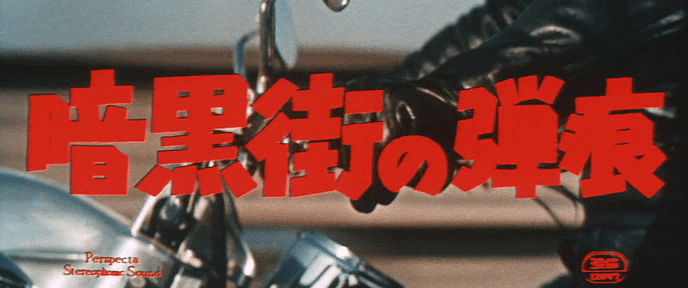
Blueprint of Murder (暗黒街の弾痕, Kihachi Okamoto, 1961)

Alongside its trademark tokusatsu Toho also had a sideline in genre-hopping B-movie comedy of which Kichachi Okamoto’s Blueprint of Murder (暗黒街の弾痕, Ankokugai no Dankon) is a prime example. Playing into a zeitgeisty anxiety about corporate corruption which led to several series of films revolving around industrial espionage such as Yasuzo Masumura’s Giants & Toys and the later Black Test Car, Okamoto’s ironic take on noir and globalisation anticipates the spy spoofs Toho would produce in the wake of Bond fever while quietly also perhaps poking fun at Nikkatsu’s crime melodramas.

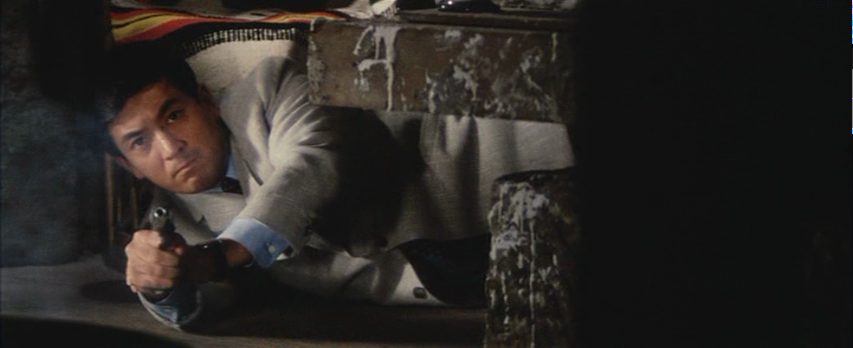
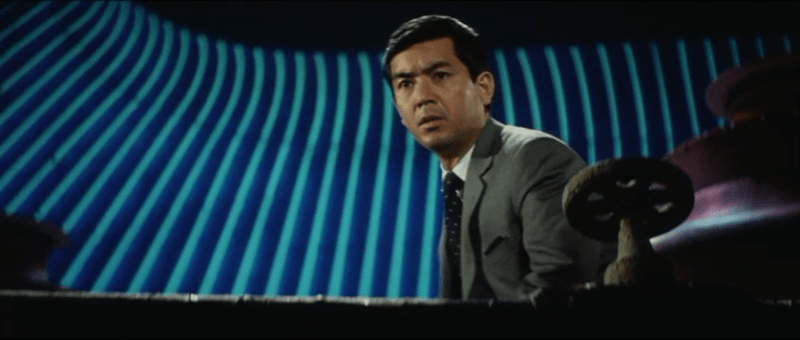
The film opens with a young man, Kusaka (Ko Mishima), and his boss Komatsu (Ichiro Nakatani) testing an experimental car engine that would be ultra efficient and cheap to produce. The test goes well, but Kusaka is run off the road on the journey home, caught between a truck and a mysterious man on a motorcycle. Meanwhile, Kusaka’s brother Jiro (Yuzo Kayama), a whale hunter, is busy working on a new kind of harpoon when he gets a telegram from an old friend telling him to come home right away because his brother is dead. On meeting with Komatsu, Jiro starts to think perhaps his brother’s death wasn’t an accident. It seems there are a lot of people interested in this technology, some of whom would rather it not see the light because cheap, efficient engines are not good news for the oil industry. 

Hearing that Kusaka was recieving threatening letters, Jiro wonders why he wouldn’t go to the police, but Komatsu points out that it would have made no difference. Firstly, the police rarely get involved with cases of corporate espionage, and secondly if they did the blackmailers would win anyway because if there were a court case they would have to make full disclosure of their plans. Jiro tries going to the police himself and showing them that he has evidence, as well as the “instinct of a whale hunter”, which suggests that his brother was murdered, but nonchalant policeman Azuma (Tatsuya Mihashi) doesn’t seem very interested. Teaming up with an old uni friend, Sudo (Makoto Sato), who now runs some kind of scandal rag newspaper and is well connected around town, Jiro tries to investigate but soon becomes entangled in a complicated web of corporate intrigue.

Sudo, whose paper seems to be on the verge of bankruptcy, has some sort of game going with corrupt businessman Otori (Seizaburo Kawazu) who runs Goei Economic Reporting Agency which was one of three companies bidding for Komatsu’s engine. Later, Sudo’s main squeeze Tomiko (Kumi Mizuno) also tries to blackmail Otori by posing as the daughter of a man he drove to suicide after poaching technology from his company. Played at his own game, Otori is extremely disturbed to have this traumatic incident thrust in his face, and it quickly becomes clear that although he was onboard with various kinds of corporate duplicity, he had his lines and is worried to think someone might have crossed them on his behalf. 

Otori is right to worry, they are coming for him too. Eventually unmasked, it will come as no surprise to know that the big boss is from Hong Kong making this another quiet instance of Sinophobia betraying an essential anxiety about a newly global Japan. Meanwhile, Jiro’s problems are closer to home. He starts to doubt Sudo, warned off him as man only interested in money, and witnessing him play every angle to his own advantage. Sudo may be playing his own game but has his friend’s interest at heart and is simply trying to protect him from endangering himself in a world he does not understand. 

Rather than the fulfilment of a dangled romance, what we’re left with is the restoration of the friendship between the two men in which they ultimately re-inhabit their innocent student selves complete with a surreal game of air baseball while Tomiko and Komatsu’s sister Kyoko (Mie Hama) cheer excitedly from the sidelines. Okamoto throws in a killer punchline to an early whale hunting gag while piling on the absurdist humour in characteristic style with one unexpected pay off after another even as the guys find themselves in an increasingly murky world of corporate double cross, femme fatale nightclub singers with their own identical minions/backing bands, and rowdy gangsters while trying to ensure the little guy is still free to innovate outside of consumerist concerns.  


Original trailer (no subtitles)

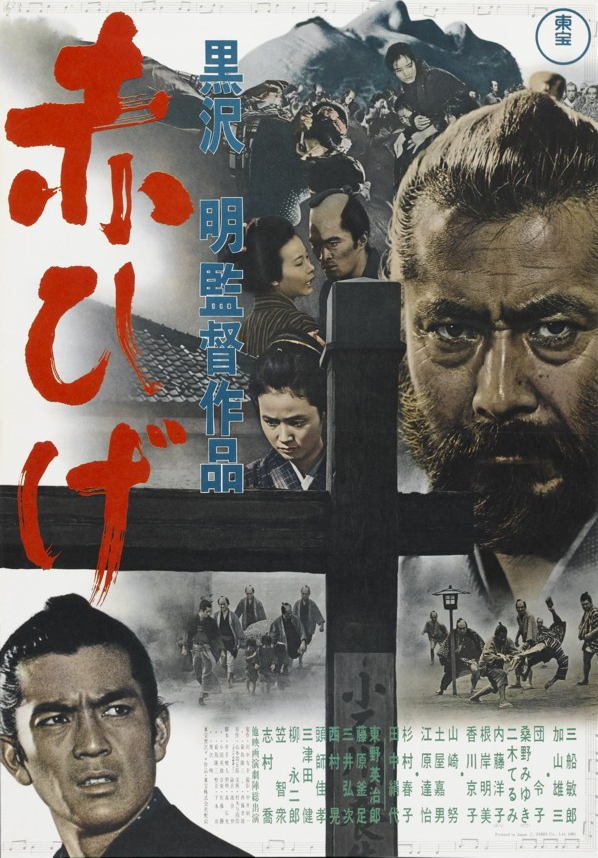
Red Beard (赤ひげ, Akira Kurosawa, 1965)

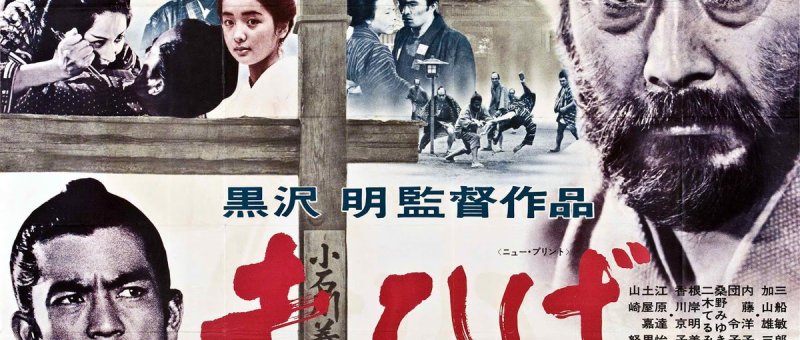
Red Beard posterAkira Kurosawa may be the most familiar golden age director of Japanese cinema to international audiences, but he was in many senses somewhat atypical. Where many of his contemporaries were eager to tell the stories of women, Kurosawa’s films are resolutely male and where many were keen to find the good among the bad, Kurosawa was often keen on the reverse. Nevertheless, that does not mean that he did not see goodness, merely that it was something which needed to be rooted out and fought for rather than simply permitted to exist. His final collaboration with Toshiro Mifune, Red Beard (赤ひげ, Akahige) finds the director at his most optimistic, fully embracing his natural tendency towards humanism even while making plain that goodness can often be hard to find, especially within yourself, and there may be no real cure for injustice but you have to treat the symptoms anyway.

The tale begins at the close of the Tokugawa era as a young doctor, Yasumoto (Yuzo Kayama), pays a courtesy call to the Koishikawa public clinic presided over by an old friend of his father’s, Doctor Niide (Toshiro Mifune) – otherwise known as “Red Beard”. Yasumoto, having just graduated from studying under the Dutch in Nagasaki, had only intended to make a brief visit on his way home and is therefore shocked to realise that he has been tricked into accepting a position at a hospital for the poor.

Our introduction to the Koishikawa clinic is through the eyes of Yasumoto as he receives a tour from another doctor who loudly remarks that he is glad that Yasumoto has now arrived because that means he can finally be free of this wretched place. Yasumoto’s nose wrinkles on smelling the “rotting fruit” of the poor waiting for afternoon appointments, while one of the patients complains about the “sterility” of the environment and his plain hospital clothes before a genial inpatient, Sahachi (Tsutomu Yamazaki), explains the reasoning behind such austerity and praises the attention to detail of head doctor Red Beard who has thought carefully about the best way to ensure his patients experience the best of care.

Yasumoto is extremely displeased by his predicament. He had believed himself on track to become a royal doctor working for the Emperor and being sent to poor clinic seems like a poor joke. He is indeed extremely full of himself, refusing to surrender his medical notes from Nagasaki as if he had made some great discovery and hoped to profit from it. Hoping Red Beard will fire him, Yasumoto behaves like a petulant child – refusing to wear his uniform, deliberately stepping into areas he knows are out of bounds, refusing to see patients, and just generally being unpleasant to have around. Red Beard is stoic and patient, though it gradually becomes apparent that perhaps Yasumoto has been sent here deliberately for a humbling everyone believes he had coming to him. Asked to perform the most routine of tasks, Yasumoto is forced to realise that the medical knowledge of which he was so proud is mostly book learning. He doesn’t know how to diagnose a living patient, has never been present at an operation, and has never sat with someone while they died knowing there was nothing more he could do for them. Reluctantly, he has to accept that the advice he received from the other doctors on his first day, that there was much to be learned here for those who wanted to learn it, was as true as it could be.

The first half of the film is indeed Yasumoto’s humbling as he begins to come around to the mysterious workings of Red Beard who gradually leads him to understand his first duty as a doctor is help those in need. Then again, Red Beard is an unwilling mentor. He is fully aware of the corruptions of the world in which he lives but has made a decision with which he remains conflicted to bend them to his advantage. Enraged to discover his government funding is being cut, Red Beard deliberately over charges the local lord whom he, amusingly enough, puts on a diet as he snorts like a piggy short of breath thanks to his unhealthy life of luxury. He also blackmails another local lord to save a young mother who turned a knife on an abusive husband, and later uses his medical knowledge to unfair advantage to take out a whole gang of yakuza. Red Beard isn’t sure he’s in a position to become anyone’s role model, but that only seems to make Yasumoto respect him more.

Nevertheless, there is darkness too in Red Beard’s philosophy. The real enemy here and perhaps everywhere is poverty and the selfishness which enables it. Most of the diseases Red Beard treats in his clinic are a direct result of impoverished living, mostly those of malnutrition and overwork as well as the necessity of living in cramped, unsanitary conditions. Yasumoto, a young man of means, has a puffed up sense of self and a natural ambition that tells him he is destined for the court and so he looks down on these unfortunate people as something other, something that does not concern him and is not worthy of his attention. He won’t put on his uniform out of spite, but eventually relents when Sahachi explains to him that the uniform marks him out as member of the clinic meaning that ordinary people who cannot afford to pay a doctor know that he is someone they can ask for help when no one else will help them.

As Red Beard says, there may be no real cures for disease. All they can do is fight poverty and mask their ignorance. Yasumoto learns by experience. He discovers the rampant injustice of his society in the sad stories that he hears. A “mad” woman who became a serial killer after years of childhood abuse, a woman who rejected a good father out of fear and allowed a bad mother to marry her to a bad man who was also her mother’s lover, a little girl adopted by a cruel madam who turned in on herself when she tried to press her into sex work at only 12 years old, a sex worker suffering with syphilis but too valuable to be released and sent home. This world is built is built on female suffering which is not, perhaps, something which Red Beard is in much of a position to treat.

The mad woman tries to hang herself and Red Beard wonders if it would have been kinder let her die, while the mother of a family who decided on group suicide asks him what the point was in saving her. The world is not an easy place to live in, but Red Beard’s prescription is refreshingly simple. One heals oneself by helping others, as he proves to Yasumoto through making him both doctor and patient to a wounded little girl who then passes her new found humanity on to another needy soul eventually reformed by kindness alone. Day by day, Red Beard goes to war against selfishness and indifference, treating the symptoms in order to undermine the disease which has infected his society in the hope that it might eventually decide to cure itself.


Original trailer (No subtitles)

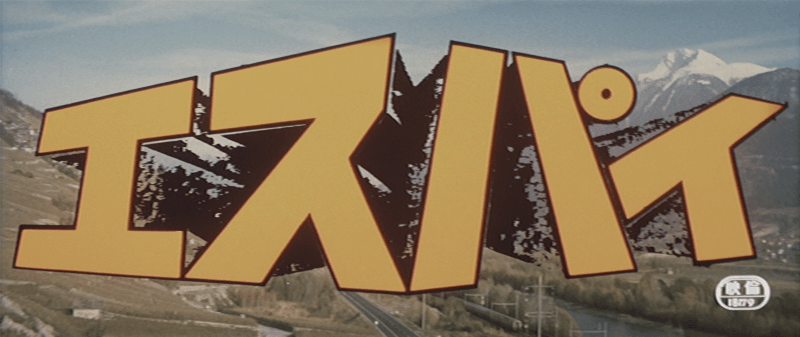
Espy (エスパイ, Jun Fukuda, 1974)

espy posterBy 1974 the Toho SFX movie was perhaps long past its heyday though Jun Fukuda’s Espy (エスパイ) was far from the last. Clearly influenced by popular spy franchises such as James Bond as well as more serious cold war spy dramas, Espy is a jet setting tale of superpowered assassins, international conspiracy, and love as an unexpected source of salvation, but as much as it embraces its hippyish message of total communication it also moves further into the realms of exploitation, skewing closer to Nikkatsu’s ’70s output than the more child friendly supernatural adventures of ages past.

The world is at breaking point. A small conflict in a tiny East European nation known as Baltonia threatens to spark a third world war. A UN delegation is currently en route to a conference in which they hope to settle the conflict in a peaceful way but all hope is lost when a sniper equipped with X-ray vision takes them all out with maximum precision.

Meanwhile, back in Japan, test driver Miki (Masao Kusakari) gets into trouble on the course when he swerves to avoid some pigeons. The car spins out of control but just at the last minute, Miki turns it around through his dormant psychic powers which brings him to the attention of the IPPG – the International Psychic Power Group. Following the assassination of the UN delegation, all eyes are on Japan where the prime minister of Baltonia is due to meet the US president in what is hoped will be a bold new development in international relations but the IPPG have reason to believe an attempt will be made on the prime minister’s life and only their ESP equipped team can stop it.

Espy takes the essential components of both the spy thriller in its international conspiracy set up, and the B-movie science fiction adventure in its presentation of the good and evil possibilities of advanced technologies or in this case innate superpowers. The Espy team are pitted against the Anti-Espy who have similar powers but are committed to using them to harm mankind. The leader of the Anti-Espy, Ulrov (Tomisaburo Wakayama), sees himself as a superior being to regular Earthlings and, believing that humans have overpopulated the planet which they continue to damage, is convinced the best solution is a mass cull. He plans to do this by helping the “lesser” humans destroy themselves by provoking a third world war or a hundred mini conflicts in which thousands will die.

Ulrov’s arguments tie in nicely with Toho’s trademark environmentalism and ambivalent attitude towards scientific development, but they go against the prevailing sense of humanism which is to be found in the studio’s genre output. In Ulrov’s fascistic view of the world, he and the other ESPers are a superior race whose existence is threatened by weaker humans and their reckless disregard for the planet as a whole. Due to a traumatic childhood incident, he believes that humans are cruel beasts who lust for blood and talk of peace with hearts filled with hate. He may have a point, but his message conflicts with the positive movement for peace which is advanced by the Baltonian PM who doesn’t want a world in which peace is brokered and balanced but one of true unity.

Espy is, however, of its time and fails to fully live out its peace and love ideals. Team member Maria (Kaoru Yumi) is kidnapped by Anti-Espy and taken to Ulrov’s lair where she is forced to dance lasciviously in front of fellow team member Tamura (Hiroshi Fujioka) with whom she shares an especially strong connection. Tamura’s arms and legs are cuffed as he communicates telepathically with Ulrov, semi-hypnotised by Maria’s strange dance. Maria is then approached by a large dark-skinned man wearing only a loincloth who proceeds to tear open her shirt at which point she snaps out of her trance, frees Tamura, and rips out the attacker’s tongue.

Meanwhile, new recruit Miki has failed in his mission and killed a man for the first time sending him into a kind of depression. Though Miki was introduced as the protagonist, he is in fact absent for most of the film though his journey is among the strangest as he reminisces about a foreign girl he was friends with as a child and enjoys an unusually strong bond with his intrepid dog, Caesar, who teaches the gang a few lessons about unconditional love. Maria is severely traumatised by her attack while Tamura reconsiders his sense of self worth having temporarily lost his powers, but eventually the team realise that their psychic abilities are nothing more than a manifestation of a great love. Ulrov later has the same epiphany but the team’s decision to consider him possessed by something “inhuman” is a worrying one. They don’t want to accept that it was humans who made him that way because it would be too sad, but not to do so is a failure to recognise humanity’s darkness as well as its light.

Espy bites off a little more than it can chew in failing to deal with some of the more interesting ideas it raises though it makes the most of its meagre budget to present an exciting spy thriller voyaging from Japan to Turkey and Switzerland. Skewing more towards Nikkatsu’s brand of exploitation action, Espy is definitely among the more adult orientated of Toho’s SFX adventures but its messages are broadly the same in its insistence on human interconnectedness as the ultimate superpower.