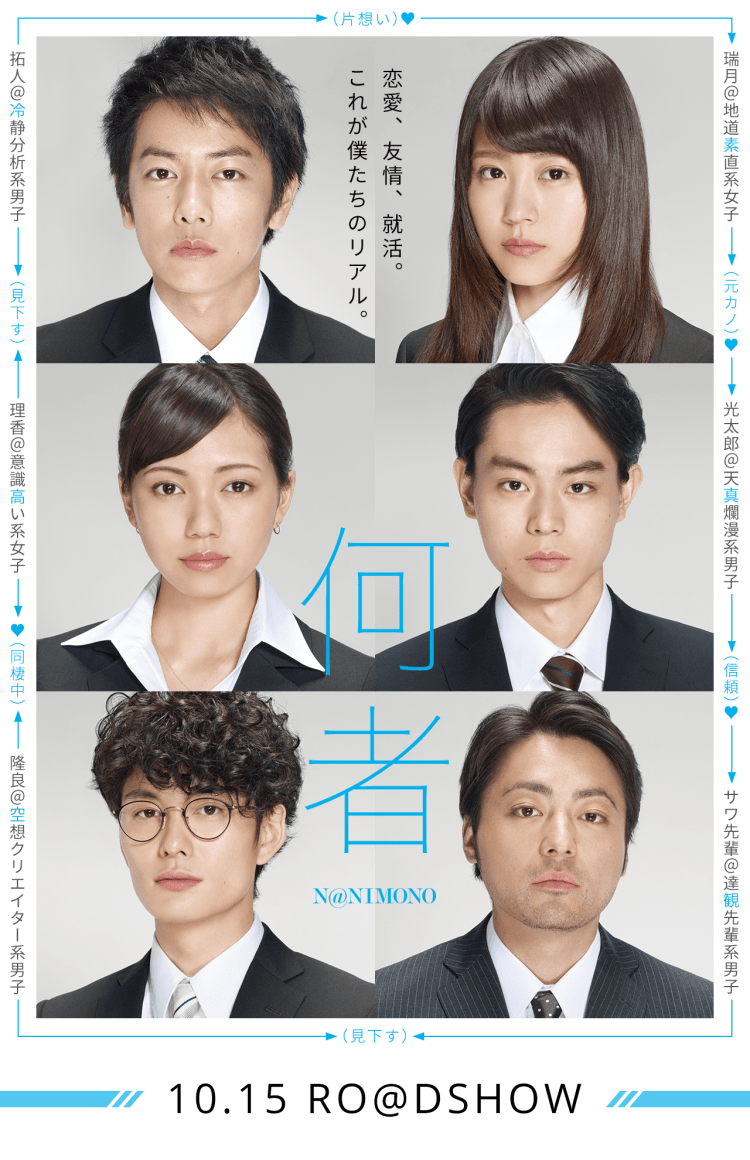
N@NIMONO (何者, Daisuke Miura, 2016)

Nanimono posterGrowing up is a series of battles in Japan. Exam hell soon gives way to the freedom and liberation of university but students know that their carefree days of youth and discovery will be short lived. Job hunting is done en masse and takes place in the final year of study (or even before). The process of securing a work placement is much the same as deciding on which school to apply to – attending job fairs to meet with representatives, getting hold of brochures, talking to anyone and everyone you know about the various reputations of the big firms, and then figuring out what your best bets are. Many companies run written exams which are then followed by group interviews in which the applicants are made to answer humiliating questions in front of their fellow candidates. What this all amounts to is a gradual erasure of the self in order to become the perfect hire, making the same tired phrases sound interesting in an effort to say all the right things whilst trying not too seem calculating or too bland.

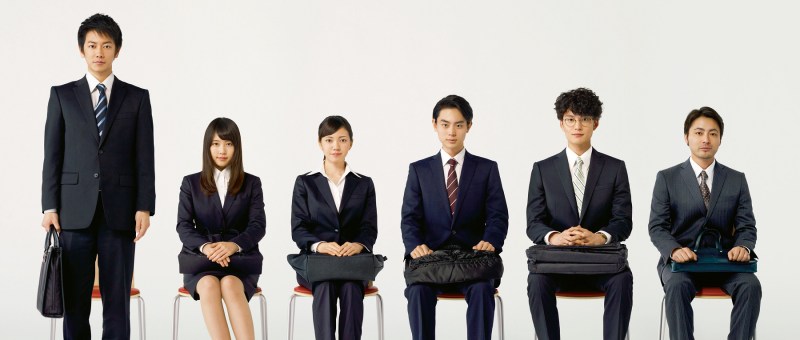
The group at the centre of Daisuke Miura’s adaptation of the Naoki Prize winning novel by Ryo Asai, N@NIMONO (何者, Nanimono, AKA Somebody / Someone), know this better than most. Protagonist Takuto (Takeru Satoh) used to be interested in theatre but has abandoned his dreams of the stage for the mainstream route into company life while his friend Kotaro (Masaki Suda) has played his last gig as the lead singer of a rock band, died his hair black again, and got a smart haircut in preparation for interviews. The boys are still good friends and roommates despite the fact that Takuto has long been carrying a torch for Kotaro’s former girlfriend, Mizuki (Kasumi Arimura), who has just returned from studying abroad. Mizuki is good friends with another girl, Rica (Fumi Nikaido), who happens to live upstairs from the boys and suggests that the four of them all get together to compare notes on the job hunting process. Rica lives with her boyfriend (still somewhat unusual in Japan), Takayoshi (Masaki Okada), who is working as a freelance journalist and is disdainful of the others’ passage into the regular workaday world but later tries to get into it himself.

There is a kind of sadness involved in this process, even if no one seriously thinks about fighting back. Everyone wants to get their foot onto that corporate ladder to become “someone”, at least in the eyes of society. There are a lot of rungs on the ladder to success, and if you miss your footing it’s near impossible to get it back – you’ll wind up one of the many crowded round the bottom staring up at the top even if you don’t want to admit it. University is the last time time there is real scope for indulging one’s personality before the corporate life takes hold – thus Takuto and Kotaro both accept that their artistic pursuits have to go in their quest for a regular middle-class life even if they inwardly struggle with their decisions to “sell-out”.

Takayoshi thinks of himself as above all this. He asks himself what all of this is for, why people put themselves through this humiliating ritual just to be locked into a nine to five that makes them miserable and turns them into soulless drones. There’s an obvious answer to that, and Takayoshi’s refusal to take it into account borders on the offensive, as does his often patronising attitude to those actively engaged in the job hunting process, but his hypocrisy is eventually brought home to him when he turns down a project to work with another artist because he thinks their work isn’t good enough. Maybe there’s courage in just putting something of yourself out there, even if it isn’t very good, rather than sitting at home looking down on everything and critiquing everyone else’s life choices whilst getting nothing done yourself.

It’s this conflict between interior and exterior life in which N@NIMONO is most interested. Main character Takuto begins as the everyman, depressed and stressed by his job hunting odyssey but aloof isolationism soon reveals itself as a kind of cowardice and self-involvement born of insecurity as he takes to a “secret” Twitter account for acerbic comments on his friends’ lives, sarcastically taking cruel potshots safe in the knowledge of his anonymity. Takuto’s entire concept of himself is a construction as his eventual descent into abstraction shows us in recasting his interaction with his friends as an avant-garde theatre show in which he finally begins to see the various ways his resentment of others is really just a way of expressing dissatisfaction with himself. This inability to fully integrate his own personality is offered as the final reason he hasn’t managed to find employment – his insincerity marks him out as a poor prospect. Takuto’s final realisation that he is unable to successfully answer the standard interview question “define your own personality in under one minute” for the perfectly sensible reason that the task is impossible kickstarts his own journey to a more complete life, even if it doesn’t do much to help the countless other “someones” out there hammered into a standard sized holes as mere cogs in the great social machine.


N@NIMONO seems to have been screened under the English titles of both “Somebody” and “Someone” but “N@NIMONO” is the one that features on the title card of the English subtitled Hong Kong blu-ray.

Original trailer (no subtitles)
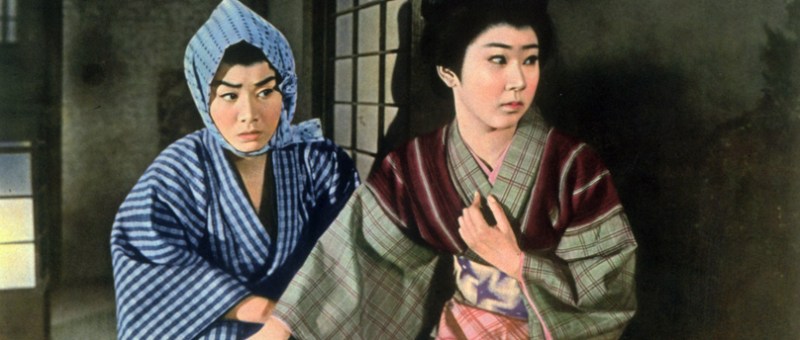
Hibari Ohako: Benten Kozo (ひばり十八番 弁天小僧, Yasushi Sasaki, 1960)

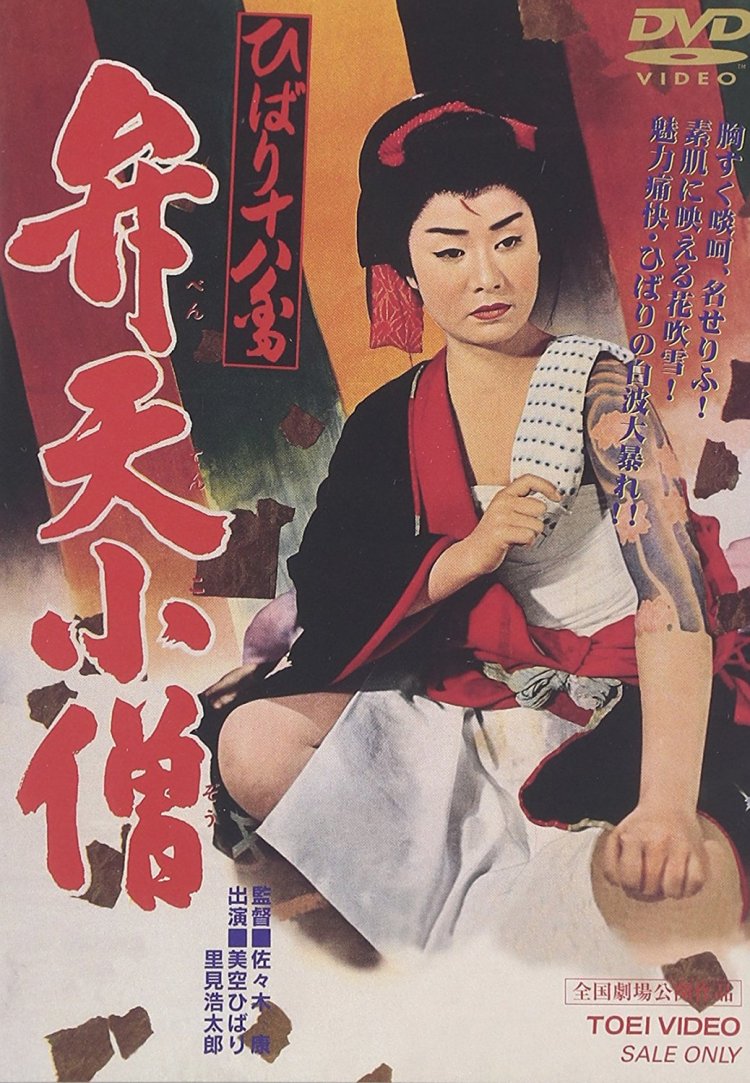
Benten Kozo dvd coverStarting out as a child actress, Hibari Misora was one of the biggest singing and acting stars of the post-war period whose songs are often pointed to as embodiments of the era’s melancholy yet determined spirit. Though it’s her singing career which has perhaps had the most historical impact, Misora made an immense number of films most of them in ’50s and ‘60s, many typical star vehicles of the time – silly comedies and softer musicals, usually finding an opportunity or two for a song even in straight drama. Hibari Ohako: Benten Kozo (ひばり十八番 弁天小僧), released in 1960 for Toei, is very much of this mould and showcases another somewhat interesting facet of Misora’s career in her readiness to play ambiguous gender roles.

Based on the well known kabuki play, Benten Kozo, which had also been adapted two years previously in a version starring male actor Raizo Ichikawa, Sasaki’s film stars Hibari Misora in the title role – a 13 year old boy who was given up at birth to be raised in a temple which specialises in performing Noh theatre. Kikunosuke (Hibari Misora) is their star, but there’s a dark side to temple performing companies in that they’re dependent on donations and it’s accepted practice to allow wealthy patrons to do whatever they like with the talent, no matter their age or gender. Kikunosuke knows this and isn’t having any of it. Pushed into a room with a lecherous, overly made-up older woman, Kikunosuke balks at the old monk’s attempts to pimp him out and tries to leave, much to the monk’s disappointment.

Unfortunately, just as Kikunosuke is leaving, a thief arrives to steal the money meant for the monk and kills the old woman in the process. Kikunosuke kills the thief but is accused of killing the old woman too and is forced on the run. Tracking down his birth mother, Ofuji (Mitsuko Miura), Kiku thinks he’s found a home but is betrayed, at which point he adopts the name “Benten Kozo” (lit. “Benten Kid” where Benten is the name of the goddess at the temple where he was raised) and joins a gang of Robin Hood-style outlaw thieves.

Like many period films of the time, Benten Kozo revolves around exposing the corruption of the samurai order. In this case, it’s a salt scam – the samurai elders have been stockpiling salt to push the price up, endangering the lives of ordinary people for their own financial gain and thinking nothing of it. The thieves, led by later Lone Wolf and Cub star Tomisaburo Wakayama, are dedicated to robbing the rich to feed the poor but they also aim to expose those in power for the reckless bullies they really are. Benten Kozo joins the “Shiranami Five Alliance” both out of self preservation and out of genuine sympathy with their cause, eventually encountering the same corrupt monk who turned a blind eye to his attempted molestation when he intervenes to save a woman forced into prostitution to pay her father’s debt whom the monk was attempting to rape.

Benten Kozo listens to the woman’s story and decides to give her his savings (which he no longer wants after being betrayed by his mother for whom he’d been saving the money) to pay off her family debt. In fact the pair met earlier when Benten Kozo was on the run and she helped him hide from the authorities. The woman, like several in the film, falls for Benten Kozo’s androgynous charms though he remains resolutely noble and indifferent. Benten Kozo would originally have been played by a male actor on the kabuki stage which did not allow female performers. The “onnagata” or actors who specialised in playing women were often effeminate younger men or boys much like Benten Kozo himself who plays these skills to the max throughout the film.

Hibari Misora, with her low, husky voice, effortlessly switches between the elegant upperclass women Benten Kozo impersonates on stage and in service of the gang’s scams, and the rough and ready dialect of a street ruffian. In a shocking display of bravado, Benten Kozo drops the top of his kimono to show his off his tattoos proving once and for all that he’s no lady but still his appeal lingers perhaps precisely because of his gender ambiguity.

Benten Kozo is not a musical but finds two occasions for Misora to sing – once as Benten Kozo takes off on the road, and the other at the end as he paddles a boat away back to his new found friends. The film ends with a giant mass brawl and also provides ample scope for Misora to escape across roof tops and fight off the unjust but it’s otherwise fairly straightforward fare and not exactly among the singer’s most memorable outings. It is however generally entertaining and interesting enough in its central theme of woman playing man playing woman to warrant attention from more than just diehard Misora fans.


Hibari Misora singing Benten Kozo in concert some years later.

Antiporno (アンチポルノ, Sion Sono, 2016)

Antiporno posterIf freedom exists in Japanese cinema, it exists only through sexual liberation. Only in this most private of acts can true individual will be expressed. Sion Sono, ever the contrarian, wants to ask if that very idea of “freedom” is in itself oppressive and he’s chosen to do that through his contribution to the Roman Porno Reboot Project in which five contemporary directors attempt to recreate Nikkatsu’s line in ‘70s soft-core pornography.

Opening in a room of bold primary colours – the sunlit walls of the yellow bedchamber and the garish red of the doorless bathroom, Sono homes in on the figure of Kyoko (Ami Tomite) who lies face down on a bed with her underwear around her ankles. She seems somehow broken and exhausted, staring into a piece of glass from a shattered mirror and making ominous statements to herself. Suddenly her mood changes, no longer the maudlin woman she transforms into the cute and quirky high schooler so beloved of certain genres of Japanese entertainment. When her assistant arrives, Kyoko delights in humiliating her, forcing Noriko (Mariko Tsutsui) to crawl around on all fours wearing a dog collar and then ordering her to allow herself to be raped by an (all female) team of newspaper reporters.

So far, so Petra von Kant, but Sono doesn’t stop here. He shows us that this brightly coloured room is a stand-in for Kyoko’s fracturing psyche, a failed attempt to order her chaotic world. Someone shouts “cut” and we’re on a film set – roles are reversed, Kyoko is no longer in control. Her memories enter free fall as she flits between an awkward (possibly imagined) childhood, and her present predicament as, alternately, plaything and dominatrix.

The roots of Kyoko’s confusion stem back to the contradiction in her parents’, or really her society’s, attitude to sex. During a very strange family dinner, Kyoko and her younger sister have a frank discussion with mum and dad about male and female genitals and how they fit together. The language is pointed, but Kyoko’s father has very clear ideas about what is obscene and what isn’t – “Cocks” are what men stick into prostitutes and they’re obscene, but he has no sensible answer when pressed on how exactly “cocks” and “male genitalia” can be all that different. Her parents tell her sex is indecent and shameful while continuing to talk about their own sex life openly and refusing to shield their daughters from their obvious appetites. They offer no answer for this continuing paradox, only the affirmation that Kyoko’s desires are “indecent” and must be rejected.

Kyoko’s sister finds her freedom in another way, but Kyoko pursues hers through sexuality, looking for a connection in midst of true liberation. She wants to become a “whore” which the adult version of herself describes as “a woman so pure it breaks her own heart”, but what she’s looking for is the freedom which eludes her in her day to day living. Kyoko and later Noriko repeat the mantra that they will dismantle the “annoying freedoms which restrict me”,  lamenting that there is no freedom of speech in a country like Japan and that no woman has ever been able to attain their own freedom in a world entirely controlled by men. A protest against the renewal of the ANPO security treaty runs on the TV while Kyoko’s sister holds up a book of butterflies, exclaiming that all the free things fly away. The women of Japan, according to Noriko, praise free speech but reject their own freedom, forced to chase false liberations and endlessly allowing themselves to be manipulated by a culture they themselves willingly create.

The fly away butterflies hit the ceiling, and Kyoko’s captive lizard cannot escape its bottle. Sono seems to suggest that there is no true freedom, that the very idea of “true freedom” as mediated through the idea of sexual liberation is itself another fallacy used to manipulate women into doing what men want. Kyoko ends up in a “Roman Porno” to empower herself, but is disempowered by it – rendered an anonymous object trapped inside an entirely different kind of tube. Blinded by colours and memory she searches for an escape but finds none, groping for the mechanism to set herself free from the delusion of liberation but grasping only empty air.


Antiporno is available to stream in the UK via Mubi until 8th January and will be released on blu-ray by Third Window Films in April 2018.

Original trailer (English subtitles)

Souls on the Road (路上の霊魂, Minoru Murata, 1921)

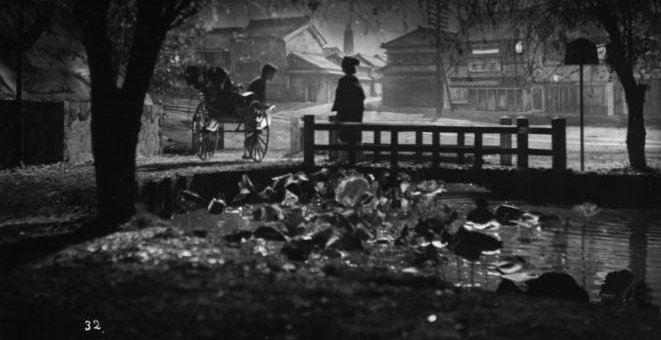
vlcsnap-2017-12-09-00h26m35s417Minoru Murata was one of the most important figures in early Japanese cinema but as the majority of his 36 films are lost and he sadly died at the young age of 43 in 1937, his work has largely been over looked outside of scholarly circles. Starting his career as an actor in the “shingeki” movement which aimed to bring modern, naturalist theatre to Japanese stages, Murata first performed in Norimasa Kaeriyama’s “Pure Films” in 1918 before joining Shochiku’s acting school on the recommendation of playwright Kaoru Osanai. The “Pure Film” movement, like the Shingeki movement in theatre, sought to create a new more modern Japanese cinema as opposed to the overly theatrical, kubuki influenced productions of the time. Souls on the Road (路上の霊魂, Rojo no Reikon), an early directorial effort for Murata in which he also stars, was made for Shochiku and is very much influenced by the Pure Film Movement as well as foreign cinema from Europe and America.

The narrative of Souls on the Road is adapted from two foreign literature sources – Gorky’s play The Lower Depths and the German novel Mutter Landstrasse, das Ende einer Jugend by Wilhelm August Schmidtbonn. Influenced by the work of D.W. Griffith, Murata cuts between the stories of four interconnected groups of people – a failed violinist who returns home to his family with a wife and daughter in tow, two escaped convicts hiding out in the woods, the local master and his servants including a young woodcutter played by the director, and a wealthy young girl.

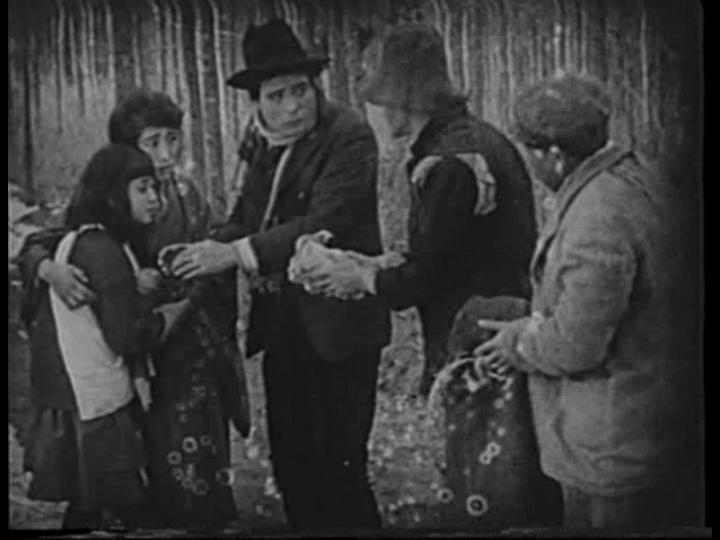
The central drama revolves around the musician who left home under a cloud to become a concert violinist in Tokyo but failed to make a success of himself. Despite having a fiancée at home, Koichiro (Denmei Suzuki) has married a Tokyo woman (Haruko Sawamura) and has a young daughter. Desperate and starving, the trio have made the snowbound journey back to Koichiro’s Hokkaido village largely on foot but Koichiro’s father (Kaoru Osanai) who is the master of a large estate refuses to help him. The former fiancée, Mitsuko (Ryuko Date), who is also Koichiro’s cousin, still lives with the master and is distressed by Koichiro’s return. Battling her own emotional pain, she wants to help Koichiro’s wife and daughter who are obviously in a bad way, but is also conditioned by the need to obey the master’s instructions even when they seem cruel and immoral.

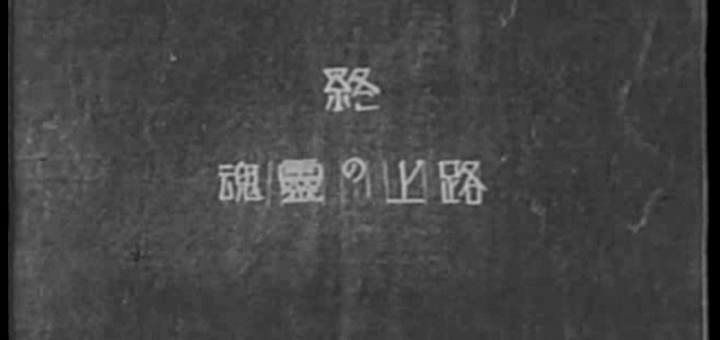
Murata bookends the film with direct quotes – firstly from Gorky’s play and then from the Bible emphasising the need for human compassion. The master’s refusal to help his son is directly contrasted with the fate of the two convicts who cross Koichiro’s path in the forest. The two men originally try to rob Koichiro, but seeing that they too have nothing and the little girl is close to starving, the convicts give up their own food to help them. When they chance upon house they remain conflicted about trying to rob it – they don’t want to end up back in prison and they don’t want to steal but they are also starving and have no other options. The custodian of the house catches them in the act and enacts a sadistic punishment but later changes his mind and decides to help them.

Meanwhile, one of the master’s servants, a boy named Taro (played by director Minoru Murata), runs into the rebellious young mistress of a local estate (Yuriko Hanabusa) who dresses in a sailor suit and gleefully shoots her minder with an air gun to avoid having to go home. The young mistress strikes up a cross class friendship with Taro and invites him to the Christmas party she is organising at her mansion to which pretty much everyone is invited regardless of class origins or backgrounds. The young mistress’ “Christmas Party” might seem incongruous for a rural town in the Japan of 1921 and does indeed take on the trappings of Russian literature with the mummers and balalaika players replaced with traditional Yagibashi dancers, but the party itself seems to have no particular religious dimension as the young mistress dreams of being visited by Santa and a small shot of Mitsuko seeming to pray as Koichiro’s wife and daughter lie freezing in a barn is the only hint of a real presence of Christian thought outside of the overt references in the framing sequences and overall Christianising morality of the film as a whole.

Murata’s signature approach mixes an entrenched naturalism of location shooting and realistic performances with expressionistic techniques. Literally “souls” on the road, Murata introduces as series of ghosts using dissolves and superimpositions as the protagonists are haunted by alternate pasts and futures or even by themselves as Koichiro finds himself interrogated by the hopeful violinist who left with big dreams but has brought his wife and child to the brink of starvation and death from cold in a barn steps away from his childhood home. Somewhat heavy handed in its closing moments as Taro wonders what might have been if the master had been more forgiving and welcomed his son home instead of punishing him for leaving, and the young mistress wonders what might have happened to the convicts if the custodian had not taken pity on them, Souls on the Road is an early visionary masterpiece far ahead of its time which looks forward to a new kind of Japanese cinema.


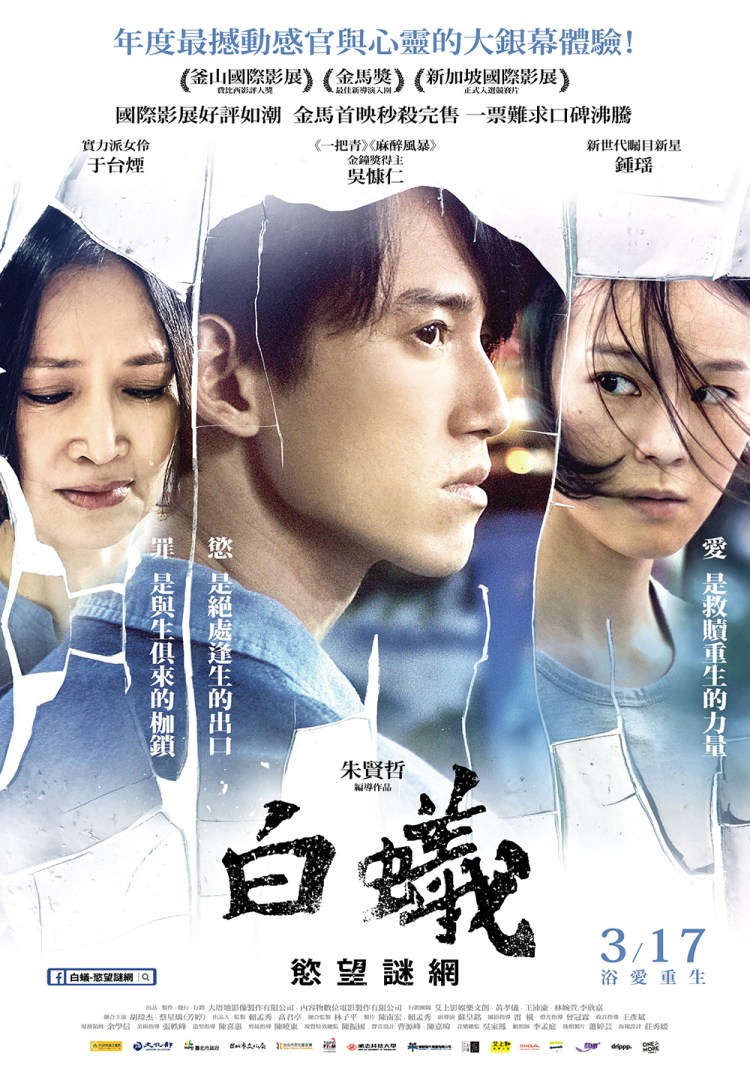
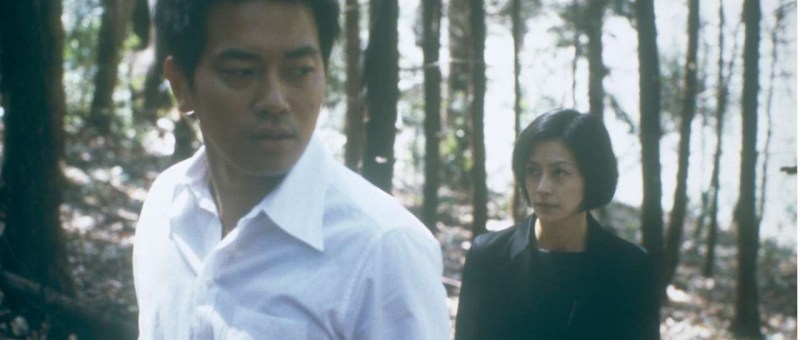
White Ant (白蟻─慾望謎網, Chu Hsien-che, 2016)

白蟻_poster_D_0105_final_更新tenga_cs5White Ant (白蟻─慾望謎網, Báiyǐ – Yùwàng Mí Wǎng) – another name for termite, is an apt title for this first indie narrative feature from veteran Taiwanese documentarian, Chu Hsien-che. Voyeurism, sexual fetish, social conservatism, stigma, embarrassment, and longstanding mental illness conspire towards tragedy as one young man becomes the target for a betrayed woman’s scorn, an innocent bystander in her quest for revenge as a salve for her own repressed emotional pain and loneliness. Chu certainly finds plenty of that as guilt and shame continue to eat away at our protagonists, burrowing ever deeper like the termite of the title, undermining already fragile foundations in each of these differently damaged people.

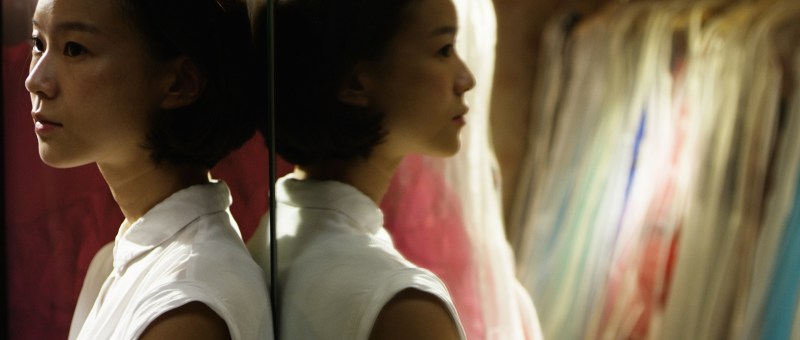
Bai Yide (Chris Wu Kan-Ren) is a quiet, aloof young man who works in a bookstore. On his way home one day, he stops to swipe a set of ladies’ underwear hanging out to dry in the courtyard where he lives. Bai puts on the underwear and then removes it to masturbate in front of his mirror, reduced to angry, desperate tears in the shame of his compulsion.

Unbeknownst to Bai, his illicit activities have not gone unnoticed. Two bored students, Tang Junhong (Aviis Zhong) and her minion Lu Peiyi, saw Bai steal the pants and bra and filmed him doing it. On the rebound for a bad breakup and looking for some random payback, Junhong mails Bai a copy of the DVD exposing his sordid needs. Junhong is, apparently, offended by Bai’s “depravity” though her true motivations remain unclear even to herself. Despite the urgings of Peiyi and Peiyi’s boyfriend who partially assists through his social media accounts, Junhong continues to taunt Bai who soon descends into a cycle of paranoia and depression which eventually has tragic consequences of the kind Junhong had not intended or imagined.

Besides the act of theft, which has admittedly deprived someone of a set of underwear, Bai’s unusual fetishes serve to harm no one though they appear to cause him a degree of mental stress in feeling himself to be in someway transgressive and required to keep his tastes firmly under wraps. The act of theft may be an attraction in and of itself, though if Bai desired pristine, unworn underwear he would likely find it difficult to acquire for the same reasons that lead him to feel ashamed just for wanting it. Junhong has no real right to feel as outraged as she does – it’s not as if Bai stole her pants or harmed her in any way. He is simply an innocent bystander who happened to step into a space approximating that of Junhong’s ex on whom she vowed revenge.

As we later find out from Bai’s melancholy mother, Lan (Yu Tai-yan), Bai had been experiencing a degree of mental distress since childhood. Following the death of his father and subsequently witnessing his mother with another man, Bai has suffered with a compulsion to steal ladies’ underwear beginning with Lan’s. Lan blames herself for this – in having been both too clingy in allowing him to sleep in the same bed long past the age most children lock themselves away in their own rooms, and in having been too self-centred in taking a lover which, she feels, led to a neglect of her son’s interests. Bai, suffering apparent paranoia and depression even in childhood, believing that there is a voice in his hair which torments him, is further unbalanced by Junhong’s campaign of terror. Trying to track down the blackmailer and figure out what is they want out of all of this, he becomes suspicious of everyone, permanently on edge, terrified, and angry lest his sordid secret be revealed.

Driven half mad by her own frenzy of vengeance, Junhong’s actions places a wedge between herself and her best friend Pieyi who thinks things have gone far enough. Friendships ruined, Junhong ends up just as lonely and isolated as Bai before eventually emerging scarred and guilty, unwilling to process the unintended consequences of what she saw as an amusing series of practical jokes probably designed to make her feel powerful when she felt anything but. Junhong attempts to atone by connecting with Bai’s sorrowful mother, Lan, who doesn’t know her true identity, but in any case continues to blame herself for her son’s death. Lan, a tragic figure, is also isolated by her feelings of guilt and self loathing both in claiming responsibility for Bai’s mental instability and for the loss of her husband which kickstarted the pair’s eventual downfall.

Strangely enough the two women bond through their shared guilt and grief, finding common ground even after the truth is revealed. Despite this final plea for empathy and connection, Chu’s premise seems to rest on an association of unusual sexual proclivities with mental illness. Bai’s suffering is never condemned, indeed the film seems to believe he should suffer for his “perversions” rather than criticising the society which has relentlessly excluded him, viewing his instability as further evidence of his otherness rather than a symptom of the isolation he is forced to feel through continued rejections. Nevertheless, Chu does seem to be clear that it is these repressed emotions that eventually become white ants, burrowing deeply inside the sufferer until they threaten to destroy the foundations of humanity, though whether the damage can ever be fully repaired appears to be far less clear.


Seen on Mubi.

Original trailer (English subtitles)

Interview with director Chu Hsien-che from Busan 2016

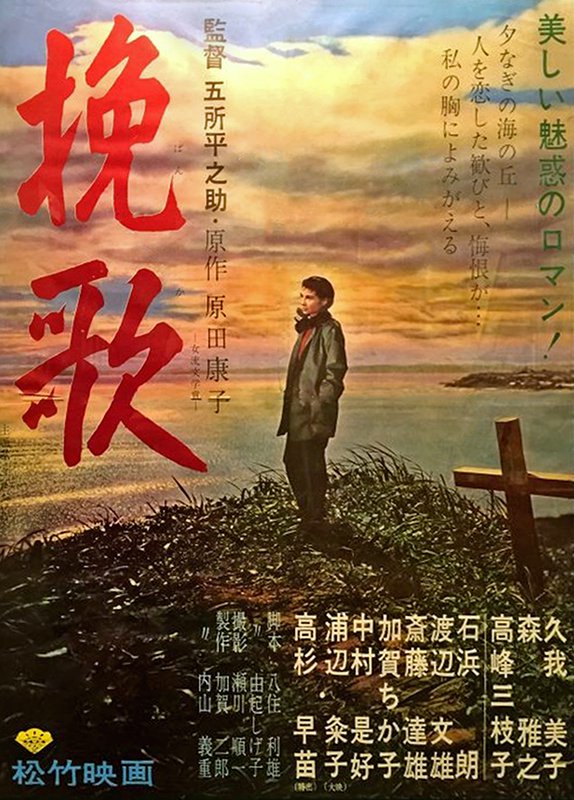
Elegy of the North (挽歌, Heinosuke Gosho, 1957)

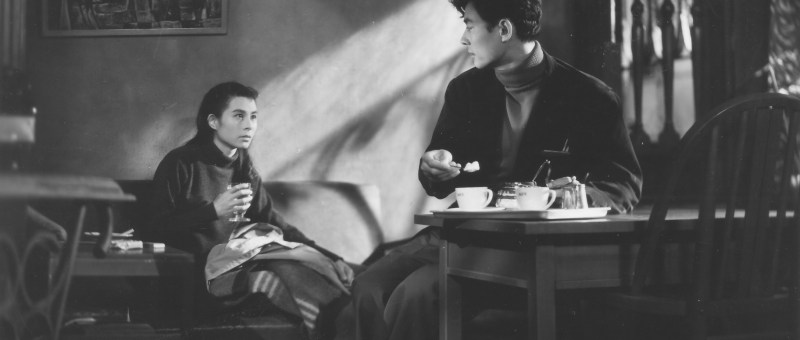
elegy of the north posterHeinosuke Gosho is perhaps among the most neglected Japanese directors of the “golden age”. A pioneer of the “shomingeki”, Gosho’s work is marked by a profound humanism but also a refusal to reduce the complexity of human emotions to the superficially immediate. Elegy of the North (挽歌, Banka) takes him much further in the direction of standard melodrama than he would usually venture, echoing contemporary American or European romantic dramas filled with soaring scores and moments of intense emotion bridged by long periods of restraint and repression. Yet it is also among the most psychologically complex of Gosho’s narratives, telling stories of death and rebirth in place of the usual coming of age and first heartbreak for which the genre is so well loved. In Reiko (Yoshiko Kuga) he presents us with a heroine we can’t be sure we like and certainly are not intended to approve of even as we sympathise with her pain and long for an end to her (often self inflicted) suffering.

Walking along the smoking volcanic soil of frozen Hokkaido, Reiko offers us the first of many voiceovers in which she tells us about her left arm – withered and almost numb due to childhood arthritis. When her withered arm is bitten by a dog, Nellie, owned by a melancholy architect, Katsuragi (Masayuki Mori), she barely feels it but Katsuragi is mortified. “She’s never bitten anyone before”, he tells Reiko by way of explanation, “I’ve never been bitten before”, Reiko fires back but bitten she certainly has been. Captivated by the idea of Katsuragi, she doesn’t immediately take him up on the offer of coming to his house and possibly adopting a puppy but catches sight of him around town and then decides to pay him a visit. He isn’t in, but Akiko (Mieko Takamine), his wife, is. Reiko didn’t want to see Katsuragi’s wife so she makes a speedy escape.

Having caught sight of Akiko, Reiko is equally intrigued. Akiko, as Reiko discovers, is having an (unhappy) affair with a much younger medical student, Tatsumi (Fumio Watanabe). Failing to read the emotional landscape of this sorry scene, Reiko regards this information as a juicy piece of gossip in her ongoing campaign to win over Katsuragi. She spies on the lovers, childishly eavesdropping on them in a local cafe, even suddenly delivering their coffee for them so she can get a proper look at Akiko – not that she really sees her or the distraught look on her face, she merely observes her rival – the wicked woman who has betrayed her beloved Katsuragi.

Reiko is constantly berated by her father and grandmother for her unwomanliness. Compared with the typical Japanese woman of the time and particularly with the stoic yet miserable Akiko, Reiko can certainly be thought unusual. Dressing in androgynous loose trousers, polo neck jumper and overcoat, without makeup and with unkempt hair, her aesthetic is one of rambunctious child or rebellious teenager. Her habit of throwing out awkward, inappropriate questions at first seems like childish ineptness but later seems calculated to unbalance. She is often cruel, perhaps deliberately so, but then remorseful (if only for selfish reasons). Though Reiko seems to feel that it’s her disability that marks her out as an outcast, unfit for marriage or a “normal” life, her family appear much more concerned with her unconventional rejection of femininity in her boldness, masculine dress, and refusal to learn the traditionally feminine crafts of housework and cookery so necessary to becoming the ideal wife.

What Reiko sees in Akiko is an image of her idealised self – beautiful, poised, elegant, and the wife of Katsuragi. As part of her nefarious plan, Reiko decides to “befriend” Akiko while Katsuragi is away on a business trip. What she never expected is that she would come to genuinely care for both Akiko and the couple’s small daughter Kumiko (Etsuko Nakazato), making her position as a potential home wrecker impossible. Reiko’s father blames himself for her unwomanliness, having raised her alone after his wife died, denying her of a maternal influence from whom she would have learned all the essentials of femininity which she now seems to lack. Akiko, a few years older, becomes both friend and surrogate mother – Reiko even begins calling her “Mamma” just as Kumiko does. Akiko’s distant poise begins to thaw when Reiko crawls in through her door one night after contracting pneumonia. Nursing Reiko as a mother would brings the two women closer together but it also unwittingly drives them apart in deepening Reiko’s sense of guilt in being torn between two loves in the knowledge that she must destroy one of them or herself.

Akiko, the tragic heroine of the piece, remains a cypher precisely because of her adherence to the rules of traditional femininity. Reiko is first drawn to her because of her sad smile – something she later brings up again in their fiercely undramatic yet heartrending parting scene as Reiko tries to undo the harm she has just done only for Akiko to mildly reject her by instructing her that she needs to take better care of herself. Her relationship with Katsuragi appears to have floundered and, trapped in a lonely marriage, Akiko has found herself in an emotionally draining entanglement with a younger man whose life she fears she is ruining. Tatsumi, needled, is irritated by Reiko’s buzzing around Akiko, asking her an awkward question of his own in accusing her of being a lesbian, to which Reiko gives one of her infuriately barbed replies with “call it what you want”. Reiko’s intentions probably do not run that way (at least consciously), so much as she longs for the love and affection she missed out on after losing her mother at such a young age. Akiko, however, may see things differently. Her life appears lonely, and her friendship with Reiko, whom she brands “reckless yet somehow cheerful” (again, like an infuriating child), is one of its few bright spots. The betrayal is not so much that Reiko has slept with her husband, but that Reiko has deliberately ruined their friendship by exposing it as a cruel ruse in the most wounding of ways. The last time we see Akiko, she is wearing the necklace that Reiko gave to her – a sure sign that her final decision is, in someway, taken on Reiko’s behalf.

Reiko’s tragedy is that her intense self loathing which she attributes to her withered arm, leads her to suspect each act of kindness is only one of pity and that no one can truly love her, they’re just overcompensating because of her “deformity”. At the beginning of the film she asks herself if her mind is as warped as her body. Her actions are often “warped”, as in she works against herself and ultimately destroys the very thing she wanted most yet there is a kind of settling that occurs through her interactions with Akiko. In the final sequence, Reiko has shed her dowdy, dark coloured, worn trousers and jumpers for an elegant skirt and blouse, and has learned to accommodate a certain level of domesticity. Even if she is merely echoing Akiko, Reiko has at least attempted to move forward in exploring the areas of femininity she had hitherto rejected outright. That it is not to say her “unusual” nature is tamed in favour of conforming to social norms, merely that a side of herself which she had decided to keep locked has been opened up for examination (and may then be rejected with greater self knowledge). Elegy of the North lives up to its name in singing a long and painful song of mourning, but Gosho ends on a note of hopeful, in pained, optimism for his contrary heroine, literally forced to move past the scene of her crime towards a possibly happier future.


Screened at BFI as part of the Women in Japanese Melodrama season.

The Eternal Breasts (乳房よ永遠なれ, Kinuyo Tanaka, 1955)

(c) Nikkatsu 1955

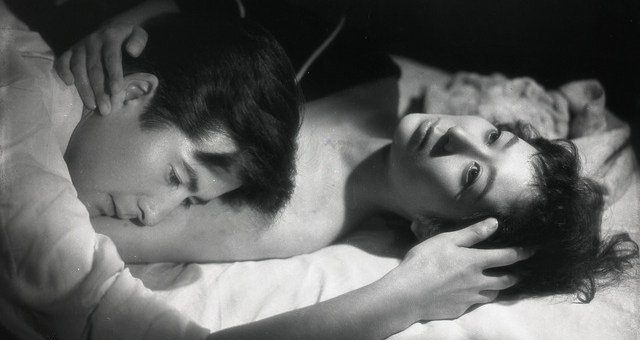
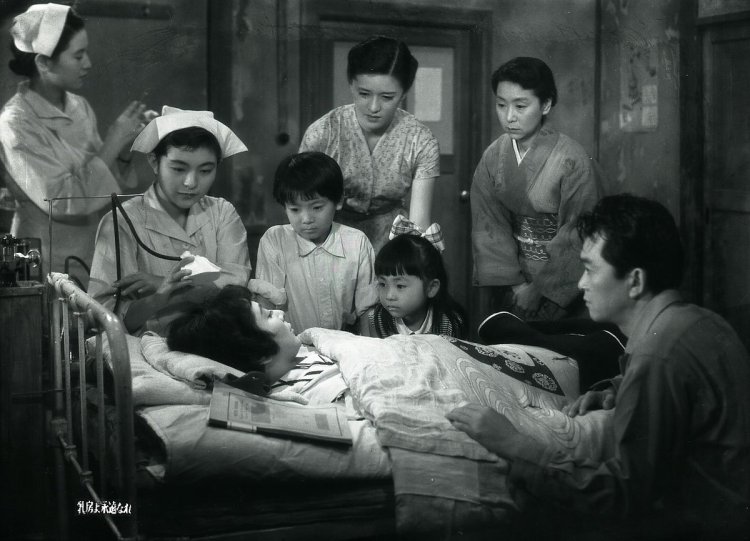
(c) Nikkatsu 1955Having made her directorial debut for Shin Toho with the beautifully drawn post-war romantic melodrama Love Letter scripted by Keisuke Kinoshita, and then moving on to her second film after being accepted as a career director at Nikkatsu – the Ozu scripted humorous romantic family drama The Moon Has Risen, Tanaka chose to work with female script writer Sumie Tanaka (no relation) for a tale of female resilience and resistance in the face of extreme suffering. Fumiko Nakajo was a real life figure who had died of breast cancer at the age of 31 in 1954. The Eternal Breasts (乳房よ永遠なれ, Chibusa yo Eien Nare) , a biopic of sorts, was released in 1955, barely a year later but makes no concession to the recency of Nakajo’s passing in examining both the still taboo subject of breast cancer and the effects of the disease and its treatment on the heroine who, arguably, finally learns to become herself through battling her illness.

Fumiko Shimojo, née Nakajo, (Yumeji Tsukioka) is the wife of a grumpy, resentful stock broker and the mother of their two children, Noboru and Aiko. It’s clear that things in the Shimojo household are far from peaceful with the discord between husband and wife a talking point throughout the local community. Despite her husband’s claims to the contrary, Fumiko is the dutiful “good wife” of the period, trying hard to make her marriage work even in the face of her husband’s ongoing resentment and thinly veiled inferiority complex given Fumiko’s slightly elevated class credentials and education. To get away from her disappointing home life Fumiko has joined a local poetry circle specialising in tanka and is well known for the gritty realism of her poems in which she expresses all of her suffering and unhappiness in regards to life with her husband. When she comes home early one day and finds a woman dressed in kimono entertaining her man, she decides it’s time for a divorce, reverts to her maiden name of Nakajo, and goes back to live with her mother and soon-to-be-married brother, regretting only that her husband insists on custody of their son, Noboru.

The early part of the film deals with the equally taboo subjects of divorce and family breakdown as Fumiko struggles to adjust to her life as a single mother as well as coming to terms with being separated from her son. Though she is often approached by matchmakers and encouraged to remarry, her experience of married life has left her reluctant to commit to a second round of matrimonial subjugation. Her mother, whom she partly blames for pushing her into a marriage she never wanted in the first place, and her brother are fully on her side as are her friends, the Horis – a Christian couple who champion her poetry and act almost as a set of second parents despite being only a little older than she is.

Released from matrimonial shackles, Fumiko is free to embrace her life as a poetess even if she never dreams of any kind of literary success. As the tactless women at the poetry circle put it, pain is good for art and it’s certainly true that each advance in Fumiko’s fortunes is accompanied by emotional suffering. Struggling to cope with the divorce and the children, Fumiko neglects chest pains and a strange feeling in her breast only to keel over when an unpleasant woman arrives to reclaim Noboru with whom she thought she’d finally been reunited.

Diagnosed with late stage breast cancer, Fumiko undergoes a double mastectomy. Refusing to shy away from the medical consequences, Tanaka films the surgery as a kind of fever dream as the bright surgery lights loom over Fumiko whose breasts appear in full view as the surgeons prepare to do their work. The loss of Fumiko’s breasts results in one of her most famous poems, published in a national newspaper, but the physical and emotional consequences are not so easily defined. Before her illness we’re constantly told that young Fumiko was a “tom boy”, and at times it appears as if she has been unsexed after being shorn of her femininity. According to her brother, however, Fumiko has become more like a child – something that rings true as she gaily sings in the bath and almost delights in shocking her friend by flashing her surgery scars unannounced. Mrs. Hori, Kinuko (Yoko Sugi), generally a kind and progressive sort, can hardly bear to look and is unwilling to engage with the physical reality of Fumiko’s condition as much as she would like to help her.

Despite proclaiming that at least she won’t be bothered with marriage proposals anymore, Fumiko’s “unsexing” appears to have the opposite effect in reawakening and intensifying her sense of desire. Earlier on, post-divorce and hiding out from her brother’s wedding at which she feels an awkward guest, Fumiko visits Hori (Masayuki Mori) and confesses her love for him though she knows nothing will come of it. Her love is, however, pure – she also loves and respects Hori’s wife Kinuko safe in the knowledge that Kinuko makes Hori happy. After her operation she returns to the Hori’s home and asks Kinuko to run her a bath so that she can bathe in the same water as her beloved – confessing to her friend that she had been in love with her husband. Kinuko seems to know already and is sympathetic, if a little embarrassed. This same boldness later manifests itself in Fumiko’s last great act of passion in which she embarks on a brief yet intense affair with the journalist (Ryoji Hayama) who is covering her career for a paper in Tokyo.

Fumiko’s relationship with the reporter is originally compromised by his overly gloomy copy which proclaims that her death is only a matter of time (then again, for whom is that not true?). Fearing that her death is being fetishised, that no one would be giving her a second glance if she were not dying, Fumiko refuses to write or have visitors. Just as she was “imprisoned” within her marriage, she is now “imprisoned’ by death. As she puts it in one of her poems, the hospital ward is a gloomy place in which she’s often framed by bars – through the windows, through the footboard of her bed, even the hospital kimono she is wearing is patterned with tiny railings. In an eerie, dream-like sequence she wanders out of her room and follows a parade of wailing relatives as a body is wheeled away but just as she is about to leave the metal gate slides shut in front of her, trapping Fumiko like a ghost in the purgatorial world of the hospital ward as she realises that that same gate will be her only exit route.

The same image is repeated at the end of the film as Fumiko’s own bed is wheeled through the mortuary gates which slam shut across the eyes of her confused children who have been left entirely on their own and without a proper explanation of where their mum is going. Fumiko’s final poem is crushing in its anger and ambivalence as it instructs her children to accept her death as the only thing she has to bequeath them. This terrible legacy seems too cruel, condemning her children to a life of grief and mourning even as she instructs them to “accept” her passing. Yet it also speaks of the final contradictions of her character – loving mother and passionate woman, fierce poet and shy genius. Unlike the sickly heroines of melodrama, Fumiko does not always bear her suffering with saintly stoicism but rages, finally embracing the “true self” she only dared to express through her poetry, learning to live only in the knowledge that she must die.


Screened at BFI as part of the Women in Japanese Melodrama season.

An Inlet of Muddy Water (にごりえ, Tadashi Imai, 1953)

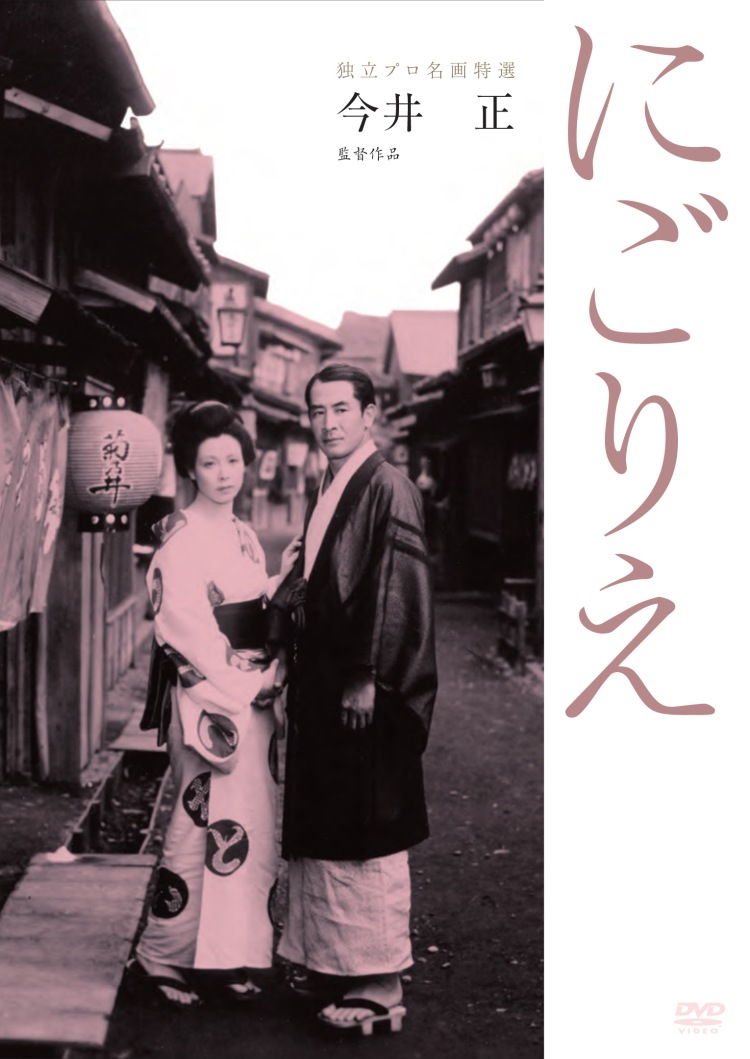
inlet of muddy water dvd coverTadashi Imai was among the greatest directors of the golden age though his name remains far less known than contemporaries Ozu or Mizoguchi. Despite beginning in outright propaganda films during the war, Imai is best remembered as a staunchly left wing director whose films are known for their gritty realism and opposition to oppressive social codes. An Inlet of Muddy Water (にごりえ, Nigorie) very much fits this bill in adapting three stories from Japanese author Ichiyo Higuchi. Higuchi is herself a giant figure of Japanese literature though little of her work has been translated into English. Like Imai’s films, Higuchi’s stories are known for their focus on female suffering and the prevailing social oppression of the late Meiji era which had seen many changes but not all for the better. Higuchi was not a political writer and her work does not attack an uncaring society so much as describe it accurately though her own early death from tuberculosis at only 24 certainly lends weight to the tragedy of her times.

In the first part of the film which is inspired by one of Higuchi’s best known stories, The Thirteenth Night, a young woman returns home to her parents, no longer able to bear living with an emotionally abusive husband. Oseki (Yatsuko Tanami) had been raised an ordinary, lower middle-class girl but, like many a heroine of feudal era literature, caught the eye of a prominent nobleman who determined to marry her despite their class difference. Life is not a fairytale, and so the nobleman quickly tired of his beautiful peasant wife, belittling her lowly status, lack of education, and failure to slot into the elite world he inhabits.

Oseki’s plight elicits ambivalent reactions in each of her parents though they both sympathise with her immensely, if in different ways. Her mother (Akiko Tamura) is heartbroken – having long believed her daughter to be living a blissful life of luxury, she feels terribly guilty not to have known she had been suffering all this time and believes Oseki has done the right thing in leaving. Her father (Ken Mitsuda), however, also feels sad but reacts in practicality, pointing out that to leave her husband now would mean losing her son forever and probably a long, lonely life of penury. He, somewhat coldly, tells her to go back, grin and bear it. Oseki can see his point and considers resigning herself to return if only to look after her son.

On her way home she runs into a childhood friend whom she might have married if things had not turned out the way they did. “Life gets in the way of the things we want to do”, she tells him by of explanation for not staying in touch. Rokunosuke (Hiroshi Akutagawa), once a fine merchant, is now a ragged rickshaw driver, bereaved father, and divorcee. Like Oseki his life is a tragedy of frustration with the added irritant that he and Oseki might have been happy together, rather than independently miserable, if an elite had not suddenly decided to interfere by crossing class lines just because he can rather than out of any genuine feeling.

The callousness of elites is also a theme in the second story, The Last Day of the Year, in which a young maid, Omine (Yoshiko Kuga), works for a wealthy household dominated by a moody, penny pinching mistress whose mistreatment of her staff is more indifference than deliberate scorn. Omine’s uncle, who raised her, has fallen ill. At the beginning of his illness he took out a loan but he’s got no better and still needs to pay it back so he asks Omine to ask the mistress for an advance of the paltry sum of two yen in the hope that his son will be able to enjoy a new year mochi like the other kids. The mistress says yes and then changes her mind, leaving Omine to consider a transgressive act of social justice.

Where The Thirteenth Night and The Last Day of the Year pointed the finger at uncaring elites, Troubled Waters broadens its disdain to the entire world of men in focussing on two women caught on either side of the red light district – Oriki (Chikage Awashima), a geisha stalked by a ruined client, and the client’s wife, Ohatsu (Haruko Sugimura), who endures a life of penury thanks to her husband’s geisha obsession. Oriki’s sad story is recounted to a wealthy patron (So Yamamura) who is more fascinated in learning the secrets of her soul than her kimono, but like many of her age it begins with parental strife, orphanhood and perpetual imprisonment as a geisha wondering what will become of her when her looks fade and she’s no longer number one. She has no control over the men who spend time with her but is worried by Gen (Seiji Miyaguchi) who ruined himself buying her time and now stalks her in and around the inn. Infatuated and obsessed with Oriki, Gen has turned against his noble wife Ohatsu who is working herself to the bone to support the family while Gen has resorted to a life of casual labour but rarely does much of anything at all.

Recalling Higuchi’s famous diary, Imai opens each of the segments with a brief voiceover detailing the inconsequential details of the weather with a world weary, often melancholy tone as the writer laments too much time spent on fiction and resolves to tell the story of the world as it really is. There is no real connection or overarching theme which unites the three stories, save for the continued suffering of women at the hands of men and the society they have devised. Oseki must return to her abusive husband, Omine will continue to work for her heartless mistress, and Ohatsu will have to make do on her own after being so thoroughly let down by her husband. There is no recourse or escape, no path forward that will allow the women to break free of their oppression or even to learn to be free within it. Each of the stories is bleak, ending on a note of resignation and acceptance of one’s fate as terrible as that may be but Imai’s ending is most terrible of all, reminding us that today is simply another day and the heavy atmosphere of dread and oppression is certain to endure as long as we all remain resigned.


Screened at BFI as part of the Women in Japanese Melodrama season.

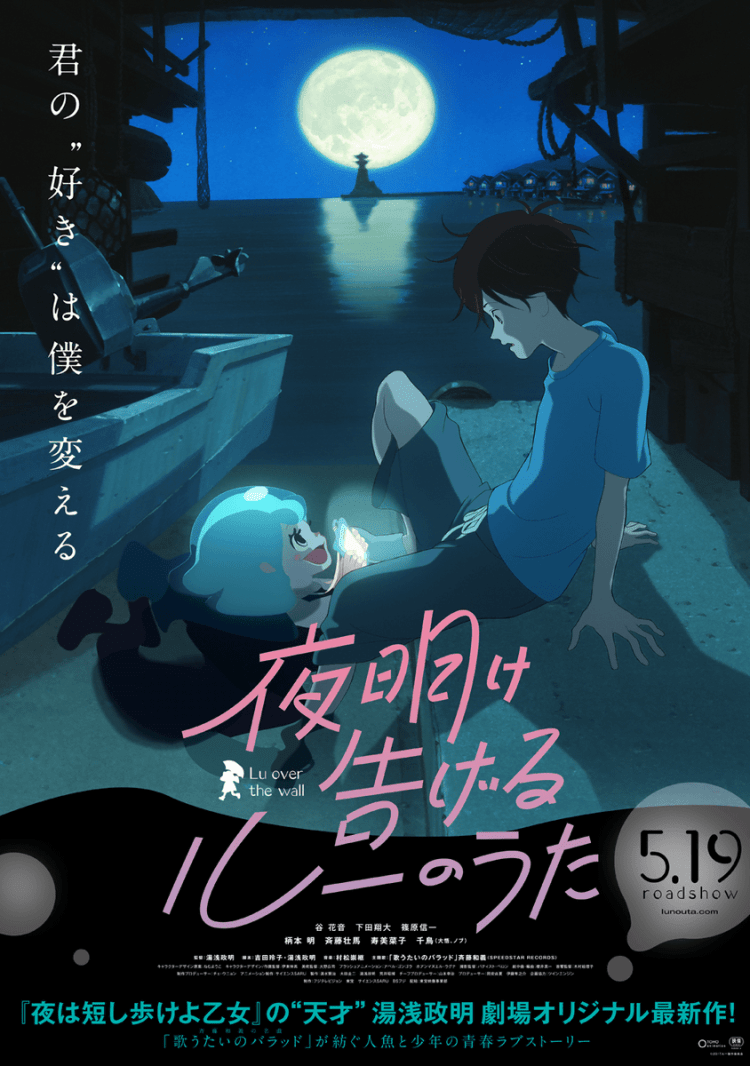
Lu Over the Wall (夜明け告げるルーのうた, Masaaki Yuasa, 2017)

Lu over the wall posterComing of age dramas are the mainstay of anime, but if anyone was going to take one in a pleasingly new direction it would be Masaaki Yuasa. His second release of 2017 following the comparatively more abstract The Night is Short, Walk on Girl, Lu Over the Wall (夜明け告げるルーのうた, Yoake Tsugeru Lu no Uta) is the tale of a boy learning to break of out his emotional repression in order to step into a healthier adulthood but it’s also one of learning to live with loss and grief. From the Irish selkie to the conventional mermaid, people of the sea have more often than not stood in for people from a land of lost things where souls are carried away and lonely sailors lured to their doom, but perhaps we’ve simply misunderstood them and the song they sing isn’t intended to make us sad but only to make us remember the joy of living.

Sullen teenager Kai (Shota Shimoda) is in his last year of middle school with a lot of decisions awaiting him as to the further direction of his life. For the moment, Kai lives in the small fishing village of “Hinashi” somewhere in Southern Japan. “Hinashi” literally means “sunless” and the town is indeed overshadowed by a large cliff which blocks the town from the sun but there’s a more metaphorical kind of gloominess lurking here too. Kai is not the only miserable one, pretty much all of the townspeople once dreamt of escape but have either proved unable to get away from their small town roots, or have tried and failed to make it somewhere else before reluctantly returning, salmon-like, to the place of their births. The only one, it seems, to successfully make it out is Kai’s mum who left the family when Kai was small.

Much to his father’s (Shinichi Shinohara) irritation, Kai’s big dream is music though he’s less than thrilled when bamboozled into joining two other aspiring rockstar teens, Kunio (Soma Saito) and Yuho (Minako Kotobuki), as the third member of “Seirèn” even if it does give him an excuse to explore the generally forbidden territory of Mermaid Island. Whilst there, the trio’s song calls out to a music loving Merfolk girl, Lu (Kanon Tani), who can’t resist joining in and, awkwardly, is a much better lead vocalist than the divaish Yuho.

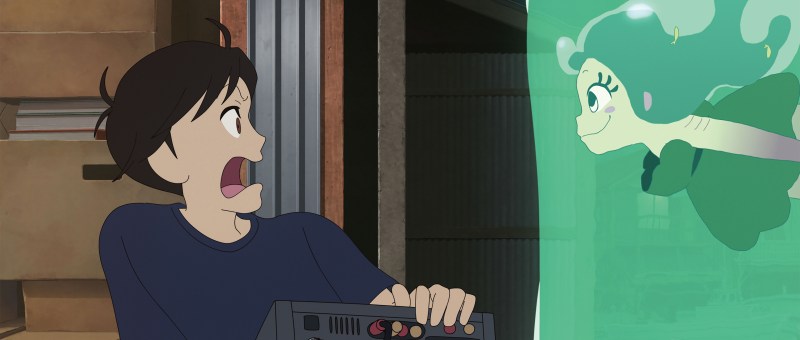
Lu, a charmingly vibrant toddler-type, is perfectly primed to bring this moribund town back to its sunny old self. Able to conjure her own portable corridors of water to travel over land, Lu tracks down Kai hoping to hear more wonderful music and making childish attempts to communicate through broken Japanese so that she can learn to understand the human world. Lu is not, however, the image most of the townspeople have when they think about Merfolk considering most of the local legends paint them as voraciously carnivorous predators existing only to steal landlubbing souls.

The Merfolk are a perfect metaphor for most of the ills consuming the town – a never seen manifestation of unknown fears. Everyone here has lost someone or something at sea (this is, after all a fishing village) or to the city, or just in themselves in learning to accept reality over the lure of unattainable dreams. Kai’s young and caring if distant father tries to push his son towards the “correct” path of non-stop studying and moral uprightness, but his son is just like teenage him, dreaming musical dreams of escape. It might have all gone wrong for Kai’s dad, but as he’s finally able to admit thanks to the guidance of Lu, he doesn’t regret a minute of it.

Ironically enough, Kai’s name is also the word for shellfish in Japanese, making his grandfather’s (Akira Emoto) frequent lament that the muscles in his dinner won’t open more than a little pointed. Kai is definitively closed off, refusing to even open the letters from his mother and keeping himself aloof at school and at home. Yet he’s not the only one who needs to open up – forced to dance to Lu’s tune (literally) each of the townspeople comes to make peace with those things that are so very hard to say, either letting past traumas float away or deciding to swim away with them.

It is, however, a little uncomfortable when the final resolution takes on a romantic dimension seeing as Lu has been painted as an adorable child with her giant bubbly head, cute high pitched voice, and childishly broken Japanese, not to mention that a secondary plot strand revolves around her father (an anthropomorphised shark/killer whale) who has attempted to shed some prejudices of his own to help his daughter in her desire to make friends with humans. Nevertheless, Yuasa and his scriptwriter Reiko do their best to do justice to all the ills of the town from the corporate greed of the mermaid loving old timer who wants to open a theme park exploiting their image, to the creepy behaviour of Yuho’s governor father, and the ever present themes of loss, guilt, and disappointment. The trio of teens at the centre may have felt themselves trapped in a dead end town, but thanks to Lu they come to realise that they too can jump over the wall and go wherever they want so long as they take the music with them.


Lu Over the Wall is in UK cinemas for one night only on 6th December 2017 courtesy of Anime Ltd.. Find out where it’s screening near you via the official Lu Over the Wall microsite.

Anime Ltd. trailer (Dialogue free)

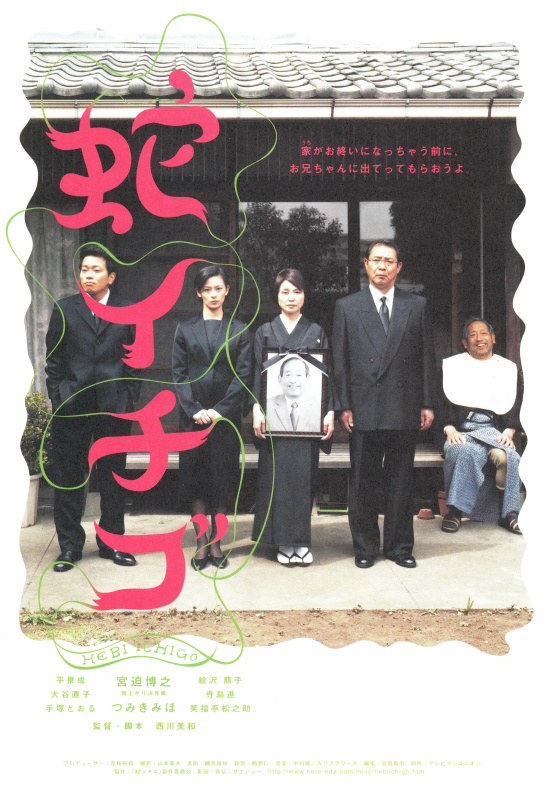
Wild Berries (蛇イチゴ, Miwa Nishikawa, 2003)

wild berries poster

The family drama was once the representative genre of Japanese cinema. In the turbulent post-war world, the one unchanging, unbreakable touchstone was the bonds between parents and their children even if it must also be realised that those bonds will necessarily change over time. Tiny cracks might have been visible even in Ozu’s Tokyo Story in the growing disconnection between the old folks in the country and their city kids, but it wasn’t until the ‘80s when Japan’s economic recovery had fully taken hold that the family itself began to come under fire. Yoshimitu Morita’s The Family Game kickstarted a trend of family implosion movies which implied that familial bonds were more social affectation than genuine connection, but post-bubble the tables turned again. These days, Hirokazu Koreeda has picked up the family drama mantle, depicting broadly positive pictures of normal family life. It is then all the stranger that his protege, Miwa Nishikawa, should be the one to ask again if family really is all it’s cracked up to be.

An ordinary breakfast in the Akechi household. Grandpa (Matsunosuke Shofukutei ) is dipping his toast in the coffee again while salaryman dad Yoshiro (Sei Hiraizumi) reads his paper. Schoolteacher Tomoko (Miho Tsumiki) barely has time to look at her breakfast before her mother, Akiko (Naoko Otani), reminds her that today is “Wednesday” – not only does she need her PE kit, but it’s also the day that her fiancé, Kamata (Toru Tezuka), is coming round to tea to meet the folks. The atmosphere is pleasant, genial, but why has Yoshiro had his mobile phone cut off and is the bald spot Akiko has just discovered on the top of her head really anything to worry about?

The Akechis are the archetype of a modern middle-class family, living a comfortable life in a nice home while dad goes out to work and mum does everything else. It is not, however, quite as it seems. Yoshiro’s phone has been cut off because he hasn’t paid the bill. He hasn’t paid the bill because he’s lost his job. He hasn’t told his wife he’s lost his job because he’s too ashamed, so he’s taken out vast loans from gangsters rather than trying to find a more honest solution. Mum Akiko plays the dutiful housewife, cooking, cleaning, putting up with Yoshiro’s imperious behaviour and looking after grandpa who has advanced dementia and thinks he’s still at war. In reality she’s bored and resentful, tired of the burden of looking after her husband’s ungrateful father and longing to have some time for herself. The only uncorrupted member of the family is schoolteacher Tomoko who finds herself giving a strange lesson on the evils of lying to her class of small children. Tomoko is perhaps too uncorrupted, prim as a schoolmarm but dull with it.

When grandpa meets an unfortunate end, the longstanding family secret is revealed – Tomoko is not an only child, she had an older brother, Shuji (Hiroyuki Miyasako), who had been expelled from the family for his immoral ways – i.e, lying, cheating, and stealing. In fact, Shuji’s return was an accident – his main job is stealing the condolence money from funerals and he just happened to be at the one next door. Shuji’s conman credentials might be just what the family needs, but could they and should they let him save them and is “saving” the family that rejected him really a part of Shuji’s grand plan?

Japan’s rapid economic recovery is usually blamed for the collapse of the family, sending sons away from the villages and prizing the commercial over the spiritual. Tomoko’s fiance, Kamata, has a slightly different take on the problem. After his first meal with the Akechis he’s touched by the warm and friendly family atmosphere, comparing them favourably with his own upperclass family which he feels to be cold and austere. The class difference and Kamata’s obvious discomfort surrounding it is one problem as is his problematic characterisation of Tomoko’s family as earnest and hardworking as, perhaps, he thinks people without inherited wealth ought to be is another, but the real irony is reserved for Kamata’s eventual reaction to discovering the truth. Yoshiro didn’t take to Kamata because he thought him “unconventional” with his unkempt hair and pretentious tastes, but Kamata proves himself the most conventional of all in his cruel rejection of his fiancée over what he sees as a betrayal by her family.

Wild berries, once they take root, quickly take over, leaving a trail of destruction in their wake. Secrets, and the need to keep them, have eaten away at the foundations of the Akechi family but which is the best way to repair them – starting all over again and working hard to put things right, as Tomoko would have it, or opting for Shuji’s dishonest quick fix? The youngsters battle it out amongst themselves for the soul of the family unit while mum and dad are just too world weary to even care anymore. Faith in the family may be running at an all time low, but Nishikawa at least manages to mine the situation for all of its bleak irony, laughing along knowingly with each dark revelation or small tragedy.


Screened as part of Archipelago: Exploring the Landscape of Contemporary Japanese Women Filmmakers.

Original trailer (no subtitles)