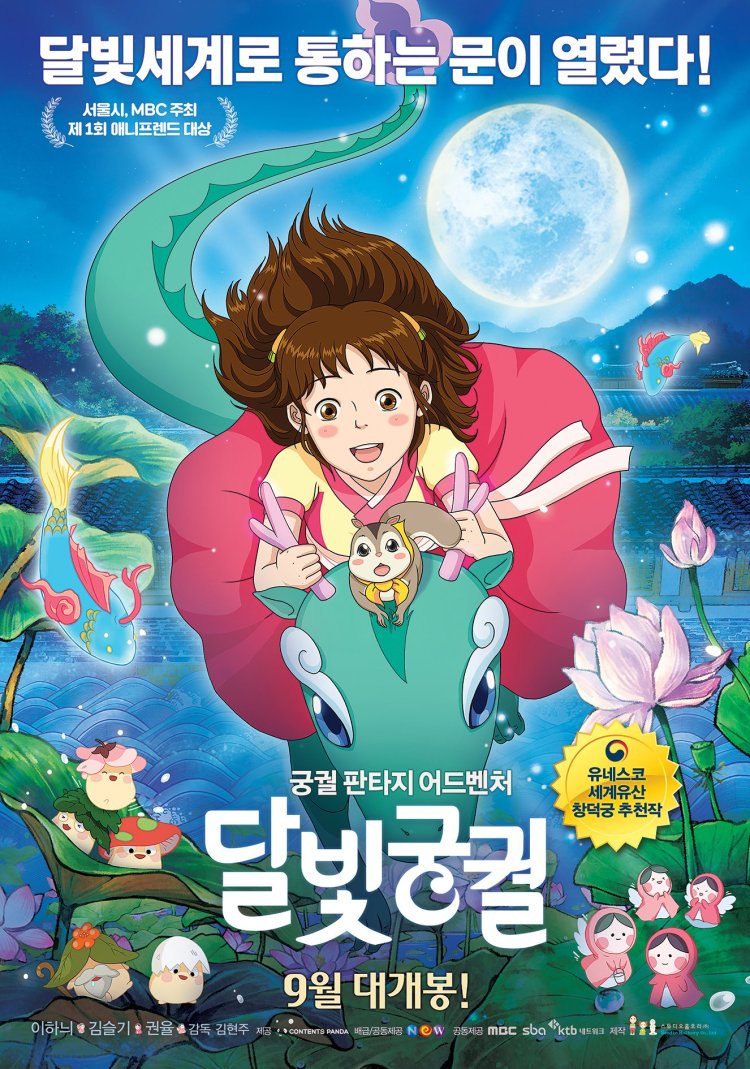
 Girl gets lost in a fantasy land and has to find herself to find the way out – it’s a familiar enough tale but then perhaps Lost in the Moonlight (달빛궁궐, Dalbitkungkwol) is mostly about that kind of familiarity. The debut feature from Korean director Kim Hyun-joo, Lost in the Moonlight was plagued with widespread internet controversy on release of the movie’s trailer and publicity material which heavily echoed Studio Ghibli classic, Spirited Away. Though this is, in some ways, unfair – you can’t escape the fact that fantasy mythical Korea shares some aesthetic similarities with that of Japan or China, or the fact that girls slipping into fantasy realms is the nature of the genre, it’s hard to get past the presence of the tiny helpers and their resemblance to Dust Bunnies, or the poster which puts the flying dragon front and centre. Nevertheless, Lost in the Moonlight’s intentions are less intense than Spirited Away’s and focus more keenly on a particular notion of learning to shine in the role you’ve been given rather than desperately chasing an external spotlight.
Hyunjunli (Kim Seo-young) is an ordinary thirteen year old girl who is set to participate in the performance of a musical at Changdeok Palace. Her parents, remaining off screen, sound supportive and are excited about seeing their little girl in such a big show even if Hyunjunli is a typical teenager who’s mortified at the idea of her parents showing up and embarrassing her, or she them with her minimal involvement in the action. Though shy and dreamy, Hyunjunli longs for the spotlight and feels silly stuck at the back of the chorus playing the very uninspiring part of a tree while her friends get to play animal gods and all manner of other exciting things.
Meanwhile, a Rat God of time is feeling exactly the same, tired of just standing around in the back not really doing anything. He makes a break for it and ends up in the human world where he drops his magic tag. Hyunjunli, a helpful sort of person, picks it up and is whisked off to a fantasy land where she meets a new friend, Mr. Squirrel, and is taken to the Moonlight Palace by the mysterious Lady Blossom.
Hyunjunli in the land of Moonlight is story of a little girl lost that runs back through Alice in Wonderland among many others, though the stakes originally appear a little lower as Moonlight seems safe enough save for the talking animals and general unfamiliarity of the place. The setting is inspired by traditional Korean mythology with its bickering mountain gods and focus on the natural world but is also, of course, heavily influenced by Hyunjunli’s perception of it. Slightly confusingly, the film has a mild environmentalist message as the conspiracy Hyunjunli walks straight into revolves around the awakening of the juniper tree which allows all the trees which have apparently been arrested by the tyrannical rule of time to get up and exact revenge against humanity for its widespread destruction of the planet, meaning that Hyunjunli has to find a way to restore time and stop the murderous tree rampage to save the Earth (which is also what the trees want to do).
Predictably enough, the fantasy land situation echoes Hyunjunli’s own as the drama is revealed to have been caused by the Rat God who also felt bored and unloved working as part of a team rather than doing something flashier out in front. What Hyunjunli learns is that everyone has their place and that the system fails when the little guys don’t pull their weight. The message, that there are no small parts just small actors, is fair enough as Hyunjunli realises it’s wrong to try and steal a spotlight which does not belong to you but then it also reinforces a less palatable message about social conformity and the necessity of living only inside the box in which you were born. Nevertheless, even if it does not always make complete sense Lost in the Moonlight does manage to provide a family friendly fantasy that its target audience may well be far more forgiving of than the confused adults watching along with them.
Screened at London Korean Film Festival 2017.
Original trailer (no subtitles)