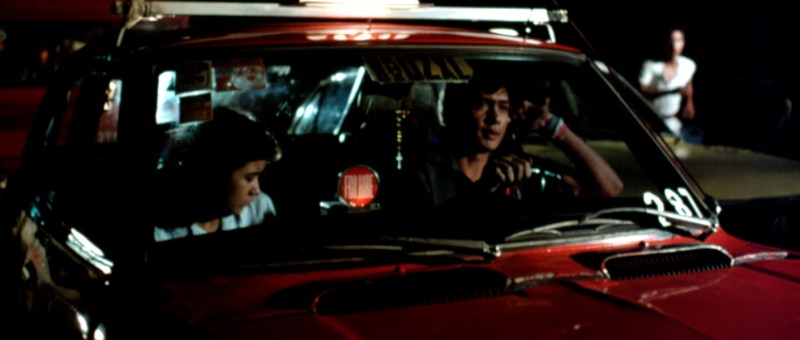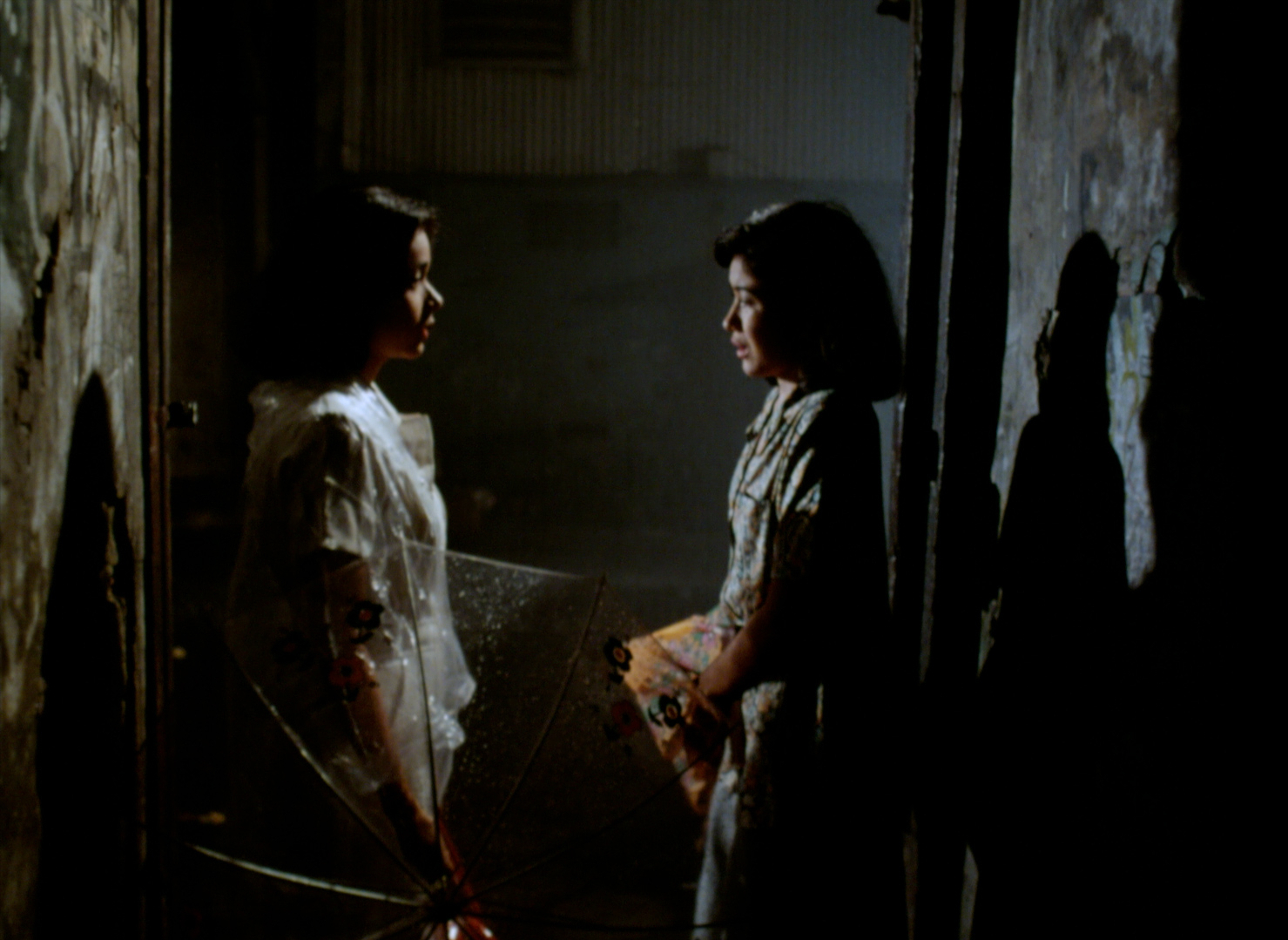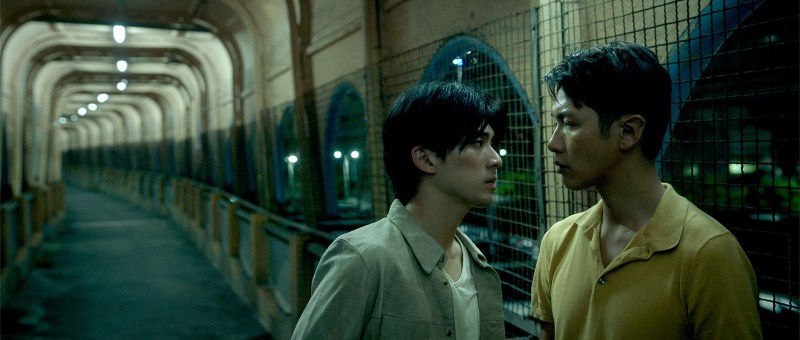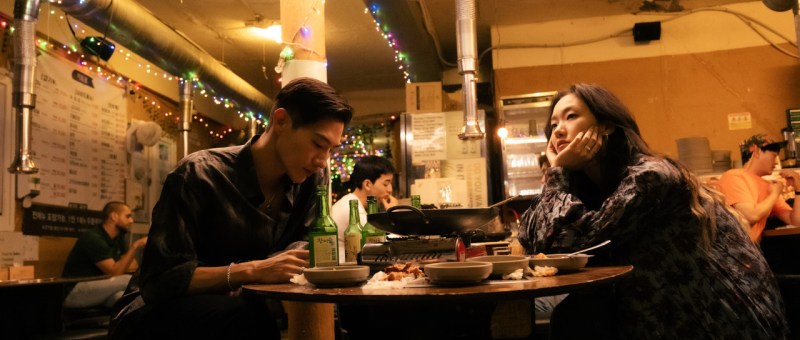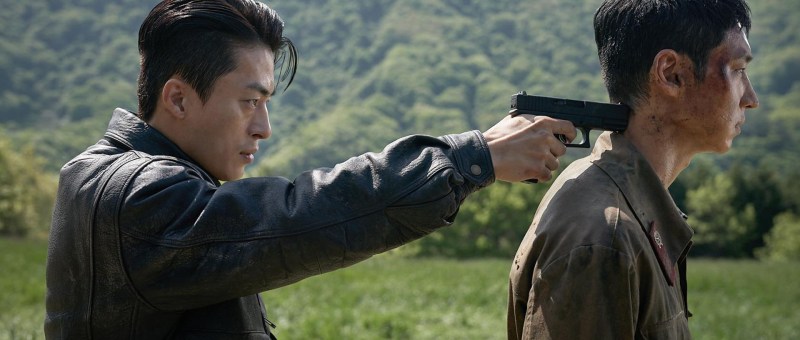
Pierce (刺心切骨, Nelicia Low, 2023)

What are the limits of unconditional love and is it always a good thing? The hero of Nelica Low’s intense fraternal drama Pierce (刺心切骨, cì xīnqiè gǔ) is desperate to believe that his older brother is innocent of a crime he’s been imprisoned for for the last seven years, but in another sense it seems like the fact itself doesn’t matter to him. What he wants is the emotional intimacy of authenticity which is something he doesn’t seem to get from his steely mother intent on crafting a protective bubble of fantasy that may be as much for herself as her son.

In any case, Ai Ling (Ding Ning) is convinced that Zihan (Tsao Yu-ning) was born bad. She needs no convincing that when he stabbed his opponent with a broken blade during a fencing competition he did so knowingly and it was an act of murder rather than an accident as he claims. Zijie (Liu Hsui-fu), her sensitive younger son, is not so sure and feels that his mother’s total rejection of his brother is unfair. He needs to believe in part that Zihan is innocent because he once saved him from drowning though according to his mother if she had not arrived when she did Zihan would happily have watched him die. Ai Ling also says that she suspected Zihan had harmed Zijie during their childhood, but if this is true then Zijie appears not to remember it or perhaps willingly suppresses his memories of cruelty because it would be too difficult for him to accept that his own brother tried to kill him. 

But objectively speaking, there is something not quite right about Zihan who seems to be a charmer with manipulative tendencies. He was once a three time national fencing champion, and as he says fencing is all about figuring out your opponent’s intentions without letting them see your own. Of course, the way he behaves could equally be because of the way his mother behaves towards him. In some senses he too is a broken blade, apparently craving his mother’s approval and affection and perhaps becoming what she believed him to be out of frustration and resentment. He lies all too easily, crashing a dinner party with Ai Ling’s wealthy suitor Zhuang and his family and leaning into her cover story that he had been away studying medicine in the US while adding a touch of his own in a tearful story of wanting to specialise in radiology having watched his father painfully pass away of cancer. 

Of course, even if he is a raging sociopath, that doesn’t necessarily mean he committed an apparently motiveless murder or that he has no feelings at all for his brother who dotes on and idolises him with almost incestuous intensity. Zihan instantly picks up on the fact his brother is gay and that a boy in the fencing club has a crush on him, offering nothing other than support and reassurance of the kind he’d never get from Ai Ling. When Zhuang tries to set Zijie up with a girl and he declines, he broaches the idea he might not be straight but Ai Ling immediately changes the subject implying that probably she already knows but it’s another thing she’s papered over perhaps afraid that it might damage her relationship with Zhuang who appears to come from a wealthy family though they may not be as conservative as she fears them to be. 

In contract to the intimacy Zijie craves, beginning to confess himself, Ai Ling protects and distances herself from others through deliberate misrepresentation. Zhuang seems at least that he would be more upset about the deceit than that Ai Ling has a son who involved in a high profile, violent crime and also appears not to care that Zijie maybe gay while otherwise attempting to bond with him and be a sincere father figure. His love may in fact be unconditional in a way Ai Ling’s clearly is not whereas Zijie finds himself wavering, confronted by contradictory evidence that suggests his brother may not be so innocent after all. Deciding into a Grand Guignol fantasy in its final stretches, Low fills the screen with an ominous red, the billowing curtains creating an artificial dreamscape of ambiguous reality in which the brothers, each of them, discover at least their own truth and the answers they were seeking which may in its way be all they really needed.


Pierce screened as part of this year’s New York Asian Film Festival

Original trailer (English subtitles)

A Balloon’s Landing (我在這裡等你, Angel Teng I-Han, 2024)

A dejected Hong Kong writer longs to find the path back to paradise if in the most ironic of ways, but finds something quite different after accidentally being befriended by a young street tough in Teng I-Han’s lowkey queer romance A Balloon’s Landing (我在這裡等你, wǒ zài zhèlǐ děng nǐ). Seemingly inspired by the boy’s love genre, the film is chaste in the extreme and overly subtle in its central love story which seems to borrow heavily from other similarly themed East Asian romances such as Il Mare and Comrades, Almost a Love Story.

Director Peter Chan is in fact name checked several times, while Taipei street tough A-Xiang (Fandy Fan) has a poster of Patrick Tam’s Nomad on his wall which of course features the face of Leslie Cheung who occupies a similar space to that of Teresa Teng in Comrades in connecting the would-be lovers. Cheung tragically took his own life in 2003, the same year writer Tian Yu’s (Terrance Lau) parents were killed, while Tian Yu himself seems to have suicidal thoughts and intends to end his life at a place called The Bay of Vanishing Whales he thought he’d made up for his novel but is informed is real in a letter from a little boy in Taiwan he continues writing to as a kind of pen pal older brother. 

In a way, A-Xiang represents his desire for life, fond saying that there’s “always a solution” and begging him not to die just like one of the letters he received urging him to carry on living because the sender would be waiting for him at the Bay of Vanishing Whales. A-Xiang is also his literal saviour in that they meet when he rescues him from a group of conmen after he got very drunk bar but though their first meeting is sexually charged with both men wandering round in their pants their romance is slow-burn to the point of non-existence. While on road trip to find the mythical bay, the pair grow closer with Tian Yu slowly giving up on the idea of finding it along with the death it represents only for fate to intervene.

At this point the film changes direction in allowing Tian Yu to rewrite his present, no longer in search of death but of love and a way to save A-Xiang in the same way A-Xiang has saved him. At least, A-Xiang becomes a kind of symbolic other self as hinted at in his stories of men as lonely islands casting messages in bottles out into the sea in longing for connection. This sense of isolation may stem from a feeling of otherness born of his sexuality, though the film never clearly defines it, along with the more literal orphanhood and existential loneliness he shares with A-Xiang. 

As expected there is a fated connection between the two men which is more than a little contrived if perfectly in keeping with the genre of romantic melodrama as Tian Yu begins to chase a future rather than the past even while actively rewriting it to engineer a better outcome. It might be tempting to read something more into the connections between these two men each orphaned, floating islands seeking new futures together though the central theme seems to be less romance than desire for life in which Tian Yu is able to overcome his depression and desire for death through his connection with A-Xiang who gives him a new reason for living. 

A-Xiang’s symbolic value as Tian Yu’s desire for life might explain why the relationship between them never sufficiently ignites in what is at least billed as a queer romance though could easily be taken for simple friendship or platonic brotherhood with the only expression of desire longing looks and tentative motions from A-Xiang. In any case, Teng lends the beautiful Taiwanese landscape a note of wistful melancholy, a place of infinite nostalgia in Tian Yu’s mind and an evocation of the paradise he’s seeking that’s simultaneously past and future waiting for parallel lines to cross. The lyricism cannot however overcome the coyness of the central romance that for its potential poeticism remains somewhat obscure, an unrealised desire awaiting its season but also a shift in the times born of a new desire for life rather than the melancholy loneliness of past emptiness.


A Balloon’s Landing screened as part of this year’s New York Asian Film Festival.

Original trailer (Traditional Chinese / English subtitles)

Ice Cream Fever (アイスクリームフィーバー, Tetsuya Chihara, 2023)

“Cold and sweet” is the way a customer to Million Ice Cream describes their produce, but it might also be an odd way to describe its comforts echoing the melancholy of the series of women who pass through its doors in Tetsuya Chihara’s adaptation of a short story by Mieko Kawakami, Ice Cream Fever (アイスクリームフィーバー). For each of the heroines it represents a kind of purgatorial space as they find themselves torn between past and future while seeking new directions.

For Natsumi (Riho Yoshioka), who took the job working part-time at the ice cream shop after experiencing burn out in her career as a designer, that new direction appears in the form of Saho (Serena Motola), an alluring yet sullen woman dressed all in black who turns out to be a formerly successful novelist plagued by writer’s block. A series of flirtatious encounters seem to rejuvenate the creative impulses of both women with Natsumi returning to doodling new signs for the shop and Saho beginning to write again, though there remains something distant and elusive between them. Saho later describes herself as like a summer storm destined to pass by in an instant and soon forgotten though in an ironic way her aloofness and enduring mystery may in fact be a way to ensure she is not forgotten while she at least seems unable to embrace her romantic desires instead sublimating them into her literature.

This inability to forget has also marred the life of Yu (Marika Matsumoto), a similarly lost woman approaching middle age who is suddenly approached by a niece she’s never met because she cut ties with her sister after she stole her boyfriend. Her mother having now passed away, Miwa (Kotona Minami) has come to Tokyo in search of her father and though seemingly aware of the circumstances of her familial estrangement enlists her aunt to help find him thereby forcing Yu to confront the past and reassess her life. Like Natsumi she is also becoming disillusioned with contemporary working culture and contemplating making a change. While she is a devotee of ice cream, it’s the local bathhouse, “an oasis for working women” as she describes it, that her been her refuge. When it suddenly closes due to the elderly owner’s (Hairi Katagiri) own decision to pursue a different kind of life, Yu wonders if she might be happier giving up her high powered corporate job to take it over. 

The dilemma both women face is reflective of a generational shift away from a desire for conventional success achieved by hitting each of life’s landmark events to that for immediate individual happiness derived from small comforts such as an ice cream cone or a soak in a large bath. The irony is that Miwa comes to Tokyo in search of an absent father and finds her aunt, while Yu is able to make peace with her past and accept the new gift life has given her in accepting a maternal role in her niece’s life. What both women choose are pleasant lives rooted in community and giving pleasure to others rather ones of consumerist desire or external validation.

Still, that doesn’t necessarily mean romantic resolution. While one woman’s decision may reflect a desire to move on, the other’s may not but rather an intention to wait if also to do so in a happier and more fulfilling environment that unlike the Mexican salamanders in Saho’s tank she has chosen for herself. Gradually we come to understand these events are unfolding at differing time intervals though weaving through around each other, pursuing a logic of memory rather a more literal reality while driven by the natural rhythms of a life which continues onward around them in continual oscillation. Gradually spinning outward it ropes in the unfulfilled romantic desires of Natsumi’s punkish co-worker choosing to move on in the realisation that her feelings have not been acknowledged and are unlikely to be returned, along with the cruel irony of the happy life seemingly being lived by Miwa’s long absent father. With its gentle framing and pastel colours, the film has an atmosphere of calm and serenity that belies its underlying melancholy in the frosty sweetness of a dormant love kept in the deep chill waiting for summer’s return.


Ice Cream Fever screens in New York July 20 as part of this year’s JAPAN CUTS.

Original trailer (English subtitles)

Blue Period (ブルーピリオド, Kentaro Hagiwara, 2024)

An ennui-ridden teen finds the world opening up to him after he discovers the power of art yet fears he can’t live up to his new epiphany in Kentaro Hagiwara’s adaptation of the manga by Tsubasa Yamaguchi, Blue Period (ブルーピリオド). Less about art itself, the film presents its hero with the cowardice of conformity, challenging him above all to know himself and wield his selfhood like a weapon in a world that can at times be unforgiving.

Even so, Yatora (Gordon Maeda) is a model student who gets good grades and is known for being well-mannered but secretly he’s filled with emptiness and has largely been just going through the motions. In his opening voice over, he relates that he does what he has to do, but declares himself unfulfilled and directionless. Unexpectedly captivated by a fellow student’s painting, he’s confronted by the power of art and the freedom it offers vowing to get into prestigious art school Tokyo University of the Arts.

The constraints he feels are partly economic in that his parents can’t afford a private university so he has to do his best to get into a public arts school while his mother seems dead against the idea of him going into the arts because it doesn’t put food on the table. Yatora parrots back similar lines describing art school as a pointless waste of time but is quickly taken to task by fellow student Yuka (Fumiya Takahashi) who challenges his tendency towards conformity and needles him into independent thoughts and action.

Yuka is also contrained by conservative social codes in that she dresses in a female uniform though many still call her by her male name, Ryuji. Though the pair have a rather spiky relationship, it’s Yuka’s attempts to challenge him that bounce Yatora towards discovering his true self which as it happens is done through embracing his least palatable elements. As Yuki correctly observes, his good boy persona and tendency towards hard work are just masks for his inner insecurity.

Yet as he’s also told, art isn’t just about talent but requires passion and tenacity which in its way makes it a perfect fit for Yatora’s hard-working nature as he buckles down to become a promising artist in the run up to his high school exams. As he later reflects, others may be more talented than him but they can’t make the things that he makes because the point is they come from himself. His early pieces are criticied for their superficiality, that he only sees what’s directly in front him rather than learning to see the world in other, more unique ways and engage with it on an individual level but through his artistic journey he discovers new ways of seeing along with his true self in all its complexity. 

His newfound desire to follow his heart places him at odds with prevailing social codes which favour the sensible though it also spurs others on to do the same, one of his best friends deciding to become a pastry chef rather than get a regular salaryman job hinting at a greater desire for personal fulfilment among the young. Often poetic in his imagery such the sparks that fly from Yatora’s nascent artwork or the comforting blue of the Shibuya twilight that becomes his safe space, Hagiwara sometimes paints Yatora’s quest like a shonen manga with a series of bosses to beat in Yatora’s various rivals and challenges most which teach him something about himself that spurs him on to continue chasing his artistic dreams while the exams themselves are also mental exercises of strategy and thinking outside the box to unlock a particular kind of self-expression. There is something quite refreshing, however, in the fact that Yatora’s only real rival is himself in his ongoing quest for skills and self-knowledge, earnestly applying himself to master his craft eager only for the places his artistry will take him both mentally and physically and no longer so dissatisfied with the world around him but filled with a new curiosity and the confidence in himself to continue exploring it.


Blue Period screened in New York as part of this year’s JAPAN CUTS.

Original trailer (English subtitles)

Kubi (首, Takeshi Kitano, 2023)

Apparently in gestation for a couple of decades, it’s unsurprising that Takeshi Kitano gave himself the role of Hideyoshi in a long-awaited historical drama adapted from his own novel, Kubi (首). Played as an irascible but wily old man, Hideyoshi is the second of Japan’s great unifiers and, unlike his predecessor, died as a result of an illness rather than intrigue. He was also a peasant who rose through the ranks and is perhaps witness to the tumultuous class conflict and social divisions of a hierarchal society.

Even so, in this version of events, Oda Nobunaga (Ryo Kase) too speaks in a thick rural dialect that sets him apart from his retainers and seems to hint at his uncouthness. This Nobugana is an unhinged despot who threatens and humiliates his subordinates, not to mention sexually assaulting them. In short, there’s no real mystery why his men have begun to turn against him and there is intrigue in the court. The film opens with Murashige’s (Kenichi Endo) quickly quelled rebellion which floundered when his reinforcements failed to arrive. Murashige is on the run and Nobunaga has heavily suggested whoever brings in his head will be first in line for the succession, but Murashige is also in a relationship with Mitsuhide (Hidetoshi Nishijima) another courtier vying for favour in more ways than one from the capricious Nobunaga. 

The striking thing about the staging is how like a yakuza drama this intrigue really is with each of the main factions manoeuvring for control, forming temporary or duplicitous alliances forged in the mutual desire of ousting a ruler whose increasing instability presents only the likelihood of a return to chaos. Nobunaga’s flamboyant speech and threatening manner are reminiscent of a yakuza boss on his way out, as is his obvious tactic of setting his rivals against each other while secretly planning to hand the reins to his son anyway. The film takes place in a largely homosocial world, the only women on screen are sex workers and peasants about to be murdered, only this time defined by romantic intrigue in which the various relationships between the men are inescapably linked with power and duplicity.

Mitsuhide’s relationship with Murashige is originally framed as a giri/ninjo conflict, Mitsuhide torn between the exercise of his duty as a samurai and his love for Murashige, only to later be set wondering if Murashige isn’t also playing him in urging him too towards rebellion, while Murashige accuses him of harbouring desires for Nobunaga which would also necessarily be desire for advancement. Advancement is something sought by all and in particular Mosuke (Shido Nakamura), a peasant who is taken on as a foot soldier after looting a battlefield for amour and killing his friend to get his hands on the prize only to realise just at the critical moment how pointless the constant desire for heads really is. The absurdity is rammed home in the closing scene in which Hideyoshi declares himself uninterested in the severed head he asked for, rendering the quest entirely pointless.

This absurdity extends to introducing the character of a comedian who is later killed for talking too much, while Kitano wise cracks his way along as the affable Hideyoshi. Kitano is in his way in dialogue with other samurai epics, using Akira Kurosawa’s horizontal wipes and introducing a pair of bumbling comic relief peasants only to suddenly kill one of them off because at the end of the day this world isn’t very funny. It’s cruel, and mean, and meaningless, so you might as well laugh like Hideyoshi. Residents of a ninja village conduct a festival in which they pray for death and to be released from this earthly torment as soon as possible, while farmers still dream of becoming samurai little knowing the reality of samurai life.

It’s this cycle of futility that is echoed in the opening image of a severed neck into which crabs in a river are crawling. Kitano stages lavish battle scenes, but ones that are often horrifying and absurd, a visceral struggle in mud and blood fought for no real reason. These samurai live their lives on the point of a sword, but they move and behave like yakuza fighting pointless turf wars and games of petty intrigue until someone finally comes for their heads. In the end, the victor is the one who doesn’t play the game at all, but sits and laughs at the absurd cruelty all around them in which the only stable force is ambition accompanied by a nihilistic lust for blood in an already bloody world.


Kubi  screens in New York July 16 as part of this year’s JAPAN CUTS.

Trailer (English subtitles)

Summer Vacation 1999 (1999年の夏休み, Shusuke Kaneko, 1988)

The curious thing, or perhaps a curious thing among many, about Shusuke Kaneko’s loose adaptation of Moto Hagio’s The Heart of Thomas Summer Vacation 1999 (1999年の夏休み, 1999 Toshi no Natsuyasumi) is that it takes place in a theoretical future that is also quite clearly an imaginary past. In a second introductory sequence, the voice of an adult man tells us that his is his memory, a fragment of the past kept alive by the clarity with which he remembers it. We don’t know who this voice belongs to, though the images encourage to think it must be the man the boy on screen, like the others played by a girl, will one day become but in another sense this boy doesn’t really exist either or at least is the bearer of several different identities.

The fact he travels to this remote mansion in the countryside on an otherwise empty train signal’s the place’s unreality and detachment from the regular world. We’re told it’s 1999, a year that was still to come on the film’s release in 1988, and inevitably hints at a millennial dread along with the new dawn the writer describes himself having in experienced in what is otherwise a summer holiday movie. However, in the opening sequence we witnessed a boy who looked very like this one slip what is later assumed to be a suicide note under another boy’s door before walking through the gothic space of the country mansion and out to a rugged cliff where he takes his own life by jumping into a nearby lake. The name of the boy who died, apparently brokenhearted and filled with despair after his romantic overtures to another boy were rebuffed, was named Yu (Eri Miyajima). This one claims his name is Kaoru (also Eri Miyajima) and is different in temperament in character to the boy who may have died, his body has not been found, though to the others staying at the school over the summer holiday he seems somehow like a vengeful ghost arriving to take them to task for Yu’s death. 

Kaneko specifically frames the school as haunted through the gothic photography of its billowing curtains and 19th century European aesthetics but also through its emptiness. The sound of children laughing, the boys who have left and returned somewhere else, echo through empty corridors further framing it as a place of memory and it seems true enough that the other boys who remain are trapped here in the same way they are trapped within themselves in their inability to express their emotions. The youngest of the boys, the sensitive Norio, (Eri Fukatsu) intensely resents Kazuhiko (Tomoko Otakara) who is as he describes beloved by all but himself cannot bear to be loved and may have contributed to Yu’s suicide through the abruptness of his romantic rejection. 

Later Kazuhiko recalls a memory of himself watching the sunset as a child in which he felt so terribly alone, as if he were the only person left on earth and there was no one with whom he could share this beauty. This sense of loneliness and isolation is further symbolised by the remote nature of the boarding school which seems to exist outside of time itself. Inspired by the setting of the novel, the boys dress in a fashion more associated with 19th century aristocracy than the late 1980s yet they are surrounded by machines and makeshift, retro futuristic technology in which they spend their days programming some kind of computer system. The leap into the lake is also into memory, but otherwise a kind of rebirth or rebaptism which allows Kazuhiko to make sense of himself and the other boys to come to an acceptance of Yu, Kaoru, and everything he embodies in relation to themselves. 

Even so, the elliptical nature of the film’s ending hints that this is a continually looping story replaying endlessly in the memory of a now much older man recalling the journey into adolescence in which he ruptured the shell of his ignorance much as the caterpillar becomes a butterfly even if that butterfly was something that Kaoru wanted to kill without harming its beauty. Perhaps in away that’s what the man has done in preserving this memory with its all of its gothic shades of billowing curtains and shadowy corridors amid the ethereality of the twilight of youth.


Summer Vacation 1999 screened as part of this year’s Queer East.

After School (成功補習班, Lan Cheng-lung, 2023)

In an odd kind of way, Lan Cheng-lung’s autobiographically inspired coming-age drama After School (成功補習班) charts how far Taiwan has come since the mid-90s while pivoting around the figure of Mickey Chen, a hugely influential LGBTQ+ filmmaker who passed away 2018. Chen was in fact Lan’s own cram school teacher and in terms of the film a voice for the future giving the children the permission to be themselves in the post-martial law society even as they struggle to break free of the authoritarian and fiercely patriarchal past. 

In a sense, cram school itself is the manifestation of that culture in that most of the kids have been forced to go there by their parents to pursue futures not of their choosing. The hero Cheng Heng (Zhan Huai-Yun), Lan’s stand in, wants to be a filmmaker but his dad wants him to be a maths teacher. That might be one reason he and his friend Cheng Hsiang (Chui Yi-tai), who lives with his family because problems with his own, spend most of their time messing around and playing childish pranks on the teachers and admin staff. Meanwhile, they’re far mare interested in potential romance than studying with Cheng Hsiang a bit of a ladies man and Cheng Heng nursing a crush on the school’s most popular girl Chen Si (Charlize Lamb). 

Nevertheless, the closeness between the boys gives rise to a few rumours that they may be gay. The idea is only further cemented by an ironic incident in which Cheng Heng sustains an embarrassing injury to his groin while watching a pornographic video he swiped from a cousin little realising that it was actually gay porn. His parents, or really more his father, do not take well to this and see it perhaps as just more evidence of his rebelliousness and lack of respect for his family in his desire to follow his own path rather than the one they’ve set down for him of getting a steady, respectable job as a teacher. 

That’s one reason that the arrival of Mickey (Hou Yan-xi), a recent graduate taking a temporary teaching job to save for studying abroad, is thought so disruptive because he encourages the kids to be who they are not who they’re taught to be. Mickey holds progressive sessions on sex and sexual identity, explaining concepts such sexual orientation and safe sex which is surprising not least because this is a cram school which exists solely to help kids do well on standardised tests rather than give them any broader kind of education. The headmaster, who is also the father of the boys’ friend Ho Shang (Wu Chien-Ho), is by contrast an authoritarian remnant of the martial law era who can’t permit any kind of liberalisation or individualisation and often inflicts corporate punishment on pupils deemed to have transgressed the rules of a polite society. 

But it’s Mickey who tries to help the boys accept and become comfortable with their sexuality and that of others, taking them to a gay bar where he interviews several of the regulars for his documentary. The barman once entered a marriage of convenience and had a child to please his parents but feels deep guilt and regret for the way he treated his wife and his since been disowned by his family. Now he hosts a New Year dinner for others like him who have nowhere else to go because their families have rejected them. The boys too are rejected by their fathers solely on the suspicion of homosexuality while the mothers remain broadly supportive of their children but trapped by those same patriarchal social codes caught between their authoritarian husbands and love for their sons.

Yet even with these more distressing themes, Lan’s film is at times a little too rosy, sticking to its lighthearted tone rather than fully address the implications of society’s attitude to the LGBTQ+ community in the mid-1990s as opposed to that of today in which Taiwan became the first Asian nation to legalise same sex marriage. Nevertheless, it presents a warm-hearted firsthand account of the effect Mickey had on those around him as the teens rebel against the authoritarian past to embrace their freedom and identities, no longer afraid to speak their feelings but determined to be themselves and accept the selves of others rather than live under the constraints of oppressive patriarchy and traditions.


After School screened as part of the 18th Season of Asian Pop-Up Cinema.

Trailer (Traditional Chinese / English subtitles)

Who’ll Stop the Rain (青春並不溫柔, Su I-Hsuan, 2023)

What does “freedom” actually mean? Su I-Hsuan’s post-martial law drama Who’ll Stop the Rain? (青春並不溫柔) sees a younger generation struggle to shake off the authoritarian yoke meanwhile it seems clear that freedom has its limits and has not been granted equally to or by all. Set in 1994 it takes place against the longest student strike in the nation’s history and ultimately pits the forces of protest and complicity against each other in the constant struggle for individual freedom. 

Free-spirited Chi-wei (Lily Lee) might be something of an outlier in this age, later expressing confusion to the comparatively repressed Ching that she doesn’t understand why they’re fighting for freedom when freedom was something they had always possessed. Yet at the university she finds herself constrained in what is supposed to be an artist’s school, denied creative freedom by stuffy professors who mark their students not by the quality of their work but their obedience and willingness to accept the lessons the professors see fit to give them. Chi-wei’s professor gives her telling off because he says her hair’s too messy, then humiliates her in front of the class by throwing her work on the floor and telling her to start again. Chi-wei, however, remains defiant and continues to work her own way regardless of what the teachers may say. 

It’s after a chance encounter with Ching (Yeh Hsiao-Fei) that she’s drawn into the student movement which opposes the authoritarian rule of the professors and demands greater creative freedoms for the students and society at large as this generation who came of age after martial law considers the kind of future they envision for themselves. But like any student movement, there are innate tensions within the group with some suggesting that its leader, Kuang (Roy Chang), is merely trying to relive the White Lily movement and is in fact less committed to the cause than he seems as evidenced by his willingness to enter dialogue with the staff against the wishes of his girlfriend, Ching. 

Unlike the others, Ching is a law student and not and artist. She’s also the daughter of a prominent, conservative and patriarchal politician and the group is somewhat ironically often dependent on her familial wealth. Her background perhaps makes it harder for her to emerge into a new, ostensibly freer age as bound by a set of ideas otherwise alien to Chi-wei who is at any rate absolutely herself and unafraid to be so. Ching tells her that she longs to be part of a group, which is presumably why she’s joined the artists in their protest even if others accuse her of simply rebelling against her privilege, which is something Chi-wei has little need for as she has already discovered the power of freeing her mind. 

It’s these forces that generate the push and pull between the two women as Chi-wei is eventually awakened to her sexuality by Ching only to experience her pulling away in her deeply internalised shame. Even so, she takes an approach that largely avoids direct confrontation but allows her to stay by Ching’s side, patient yet confused in attempting to create a safe space that Ching can accept as her own. Both women are also constrained by forces of traditional patriarchy with even Kuang stating that perhaps women shouldn’t be too independent after all or else they wouldn’t need him in an ironic moment foreshadowing his total redundancy. Meanwhile, Chi-wei is aggressively pursued by a fellow student who won’t be deterred by her frequent rejections and general lack of interest in men while ironically trying to convince her she’s been “brainwashed” by the strikers and is really a good girl, like him willing to bend to the authoritarian yoke. 

Perhaps it’s telling that it’s only once the strike is over and following a confrontation with her authoritarian father that Ching is able to overcome the barriers that prevent her from embracing her true desires and authentic self. In her opening voiceover, Chi-wei reflects that back then they still believed a tiny flame could burn down the forest implying at least that she was mistaken but even if a wider revolution ends if not exactly in failure than in compromise, disappointment, and rancour, it is true enough that the spark between these women was enough to burn through the forces that kept them apart to find a more individual kind of freedom that exists outside of oppressive superstructures even if as Ching says protest never ends.


Who’ll Stop the Rain screened as part of this year’s BFI Flare.

Trailer (English subtitles)

A Song Sung Blue (小白船, Geng Zihan, 2023)

Late into Geng Zihan ’s coming-of-age drama A Song Sung Blue (小白船, xiǎo bái chuán), the heroine’s father (Liang Long) who perhaps knows a little more about her than we might have assumed, tells her that love and resentment are often the same thing. At least, they are both unforgettable. Resentments are something Xian (Zhou Meijun) has in spades, though she has little way of expressing them outside of her sullenness and silence while perhaps learning some unhelpful lessons in her seemingly unreturned attraction to the daughter of her father’s receptionist. 

Firstly, Xian is resentful towards her mother who has abandoned her to go on a humanitarian mission to Africa for an entire year explaining that the hospital have promised her a long awaited promotion after which she won’t have to do the nightshifts and so can spend more with her daughter, the irony being that by that time Xian will be in her late teens and perhaps less keen to spend time with her mum. Secondly, Xian is resentful towards her estranged father whom she only sees at family gatherings and has little connection with. She also seems resentful towards the other children in the choir and has no real friends. When the choir runs out of female uniforms she’s told to wear one of the boys and stand at the back hoping no one will notice. Meanwhile, she’s a little surprised after venturing backstage and catching sight of her choir mistress embracing another woman. 

Yet in other ways Mingmei (Huang Ziqi), the daughter of her father’s receptionist with whom he is also in a relationship, is simply her inverse. Flighty and confident, Mingmei appears much older than her years and is training to be an air stewardess but inwardly seems hurt and vulnerable. She lives a fairly chaotic life in which she’s learned at an early age how to weaponise her sexuality and largely relies on sugar daddies for her financial upkeep while hating herself for doing so. It’s after learning that the man in question maybe about to leave his wife and marry Mingmei that Xian abruptly kisses her but is immediately rebuffed, Mingmei running a thumb across Xian’s lips as if more concerned about what she may have passed to Xian than outraged or offended.

Then again, Mingmei seems to have been aware of Xian’s attraction while no doubt tipped off by the fact that she was playing around with a stethoscope and presumably noticed her heart beating unusually fast. At times she seems insensitive, wilfully so or otherwise, or perhaps simply doesn’t know how not to manipulate the attraction that she inspires in others cruelly taking Xian along on one of her sugar daddy dates or asking her to help her dress. But then Xian also learns some problematic lessons, adopting some of Mingmei’s behaviour patterns in attempting to manipulate the attraction shown for her by a boy in the choir she is otherwise uninterested in by virtually forcing herself on him and then asking for a loan to get the money for Mingmei to open a store so she won’t have to rely on potentially violent sugar daddies and would therefore be more available to Xian who has also developed a white night desire to save her from her self-destructive instincts.

The only bright spot in Xian’s melancholy existence which is generally coloured in blue, her desire for Mingmei is palpable even gazing at the many photos of her taken by her father including one in striking red. Yet there’s an another sense of distance in her longing given that Mingmei is a member of the Chinese-Korean community. Xian is at once struck by this additional layer of exocitity and bewildered by her inability to understand it knowing no Korean nor much of Mingmei’s culture. The film takes its Chinese title from the song Xian sings at the choir recital, the traditional folksong Little White Boat which actually originated in Korea. Xian is disappointed not to spot Mingmei in the audience little knowing that she had been there but left early. Later in the film, Mingmei sings the song herself but in Korean perhaps a way of letting Xian know she came after all, or else simply intended in the way song is often sung as one of parting. In any case, Xian is indeed like the little boat dotting the horizon drifting along barely noticed and with no means of controlling her direction. Geng frames her with a quiet empathy and a gentle sense of recognition for those whose gaze is rarely returned.


A Song Sung Blue screened as part of this year’s Queer East.

Trailer (English subtitles)

Heavy Snow (폭설, Yun Su-ik, 2023)

“It’s obvious it was a romance, why did you pretend it wasn’t?” one wounded woman asks another while their connection seems to be frustrated by internalised shame and conflicting desires. Yun Su-ik’s frosty drama Heavy Snow (폭설, pokseol) does indeed seem to suggest that their love for each other can only exist in a kind of otherworld, eventually segueing into a metaphysical realm which simultaneously implies that this isn’t actually a romance but self-reflection and interrogation as a tomboyish actress searches for herself inside her various roles.

Indeed, Su-an (Han Hae-in) views Seol (Han So-hee) with a kind of awe which might be understandable given that Seol is a TV drama superstar improbably transferring to her rural arts school for a break from the world of showbiz. Or as Seol would later imply, because she’s become too difficult to manage and is rebelling against the emptiness of her ostensibly glamorous life through increasing acts of reckless self-harm. Su-an might wonder if that’s all her flirtation is, an attempt to flaunt a taboo while otherwise puzzled and jealous as to why someone like Seol would actually be interested in her. 

Yet Su-an’s interest is also in part idolisation, attracted to Seol because she fears she is everything she wants to be but isn’t, beautiful and talented. But Seol seems to doubt she’s either of those things while otherwise superficially confident in her sexuality and drawn to Su-an because of her ordinariness. Experiencing a moment of identity crisis, she’s looking for herself outside the frame yet also perhaps like Su-an caught in moment of self-idolisation. Noticing one of the giant billboards of her face that the litter the city she briefly touches it before walking away as if attracted to an image of herself she recognises and doesn’t. 

Yet it seems it’s less the awkwardness of too much intimacy that causes Su-an to pull away when Seol kisses her than shame. She tells Seol that she thinks it isn’t right, and perhaps goes on to regret that decision while continually pining for an idealised teenage love. The two women in a sense trade places. Years later Su-an is a famous TV actress, having in a way taken over the image of Seol, while Seol is evidently no longer acting but a depressed and defeated figure still resentful of Su-an’s rejection. The effects of their shifting fame deepen the gap between them with the teenage Su-an further nervous in her relationship with Seol knowing the danger that her celebrity presents. There is a suggestion that their creative desires conflict with the romantic, that they feel they cannot embrace their sexuality freely and remain in the entertainment industry because of the intense pressures a conservative society places on prominent people to be shining examples of moral purity. Each of them appear to become worn out by the demands of their fame, Su-an turning to drugs in attempt to mask her depression while the teenage Seol ponders quitting acting to become more her authentic self.

In the dreamlike third act which commences at the sea, a touchstone for each of the women connected to the innocence of their teenage romance, may suggest that in looking for Seol Su-an is really looking for herself or perhaps simply to recapture the person she was at the beginning of everything. At odds with each other, the two women become marooned in a snowbound land with no one else around. Finally repairing their relationship, it seems that they can only embrace their love in this barren place where no one else exists to judge them. The implication maybe that as Seol says the things Su-an wants to say to Seol she really wants to say to herself in a desire for self-acceptance, but equally that we can’t be sure that any of this “real” rather than dream or wishfulment.  In any case all that remains is a painful longing either for an unrealised love or the elusive self. 

Hinting at the pressures of the contemporary society, the unrealistic expectations placed on those in entertainment industry and outward social conservatism the film never less presents its central romance with an evenhanded poignancy even in its continuing impossibility as the two women continue to look for the self in each other but seemingly struggling to see past the hollow images of their own self-projections.


Original trailer (no subtitles)

Heavy Snow screened as part of this year’s BFI Flare.