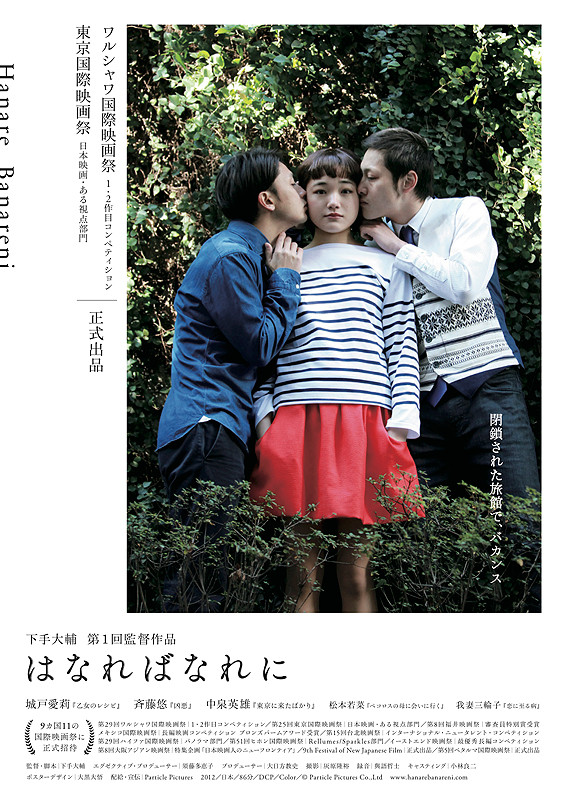
Kuro (はなればなれに, Daisuke Shimote, 2012)

poster2All these years later, it’s easy to forget just how revolutionary the wheezy, breezy youthfulness of the French New Wave was. Kuro proves that there’s life in this whimsical, summer seaside feeling yet as three misfits find themselves holing up at a disused small hotel to think about what they’ve done until they learn to grow up a little.

Kuro starts our story as she mournfully chows down on some of the pastries at the bakery she works at whilst treating a customer in a very disdainful way. She wanted to be a baker but her boss never really lets her do anything and when they argue about her guzzling half the stock she quits in a fit of pique. Roaming around the city doing absurd things like partying with a jazz band before running off with their change can or messing around with a sharp suited guy in a hotel room she meets womanising stage actor Gou who’s had a tiff with his actress wife after paying to much attention to the new girl. He flirts with and eventually semi-kidnaps Kuro for a road trip where they meet photographer Eito who has also had a tiff with his woman over having neglected to file the marriage papers at city hall. He’s heading up to an old hotel his uncle used to own where he was meant to spend his honeymoon and invites Gou and Kuro to join him.

Kuro’s original Japanese title, はなればなれに “Hanarebanare ni” literally means “scattered pieces” and was, coincidentally, the same title used for Godard’s 1964 masterpiece Bande à part. First time director Daisuke Shimote wears his influences on his sleeve with an atmosphere that recalls early period Godard which is all whimsy minus Godard’s slightly arch, confrontational irony. Leading lady Kuro, played by Airi Kido, has a definite touch of Anna Karina running through her from the way her retro haircut neatly frames her child-like face to her striped top and colourful red skirt. Taking her cue from Karina’s innocent insouciance, her absurd, pixyish pranks take on a cute and quirky quality which is backed up by a youthfully punkish disregard for the normal order of things.

Kido dances with the jazz band like Karina dancing in the bar in Vivre sa Vie and the gang even fake die in a water gun and finger shoot out a la Franz and Arthur in Bande à part. There’s also something of Tati in the intricate way Shimote sets up what are actually quite small and simple jokes like the Wii tennis match that suddenly turns into an entirely different kind of “virtual” game. At this point, the photographer who’s been perpetually on the sidelines, observing, finds himself joining in and experiencing his very own Natasha at the dance moment which, perhaps, finally allows him to break through something that’s been causing a rift in his personal life.

Through their season at the sea, each of these disparate characters comes to a kind of personal realisation that leaves them, well, more or less the same but much more settled. Kuro learns that sometimes you just have to buckle down and do as you’re told, Gou perhaps learns to be nicer to his wife and Eito maybe realises that you don’t know what you’ve got until it’s leaving you. Each of the characters is quite depressed, in the best new wave tradition, or just filled with ennui but perhaps you can’t have these kinds of absurd adventures in any other mood. That said, the heavier side of new wave surrealism with its nihilistic overtones is almost entirely absent leaving the atmosphere light and bright with the feeling that everything will (probably) be alright in the end.

Light on conventional narrative and high on sight gags and surrealist humour, Daisuke Shimote has crafted a charming and amusing new wave inspired ensemble comedy that, yes, wears its influences on its sleeves but isn’t afraid to bring its own moves to the dance floor. It might seem a little bit like a curveball from someone who’s spent so much of his previous life studying the work of Ozu with his formalist compositions and inclusory tatami mat viewpoint, but then Ozu was also a master of subtlety who could make peeling an apple into one of the most profoundly moving scenes in cinema history and Shimote is able to harness a similar fastidiousness here only in more of a comedic bent. Charming, whimsical, absurd but absolutely internally consistent, cinematically literate and beautifully made Kuro is one of the most impressive feature length debuts of recent times and hints at a promising career for its still inexperienced director.


Bonus videos of people (mostly Anna Karina) dancing in Godard films:
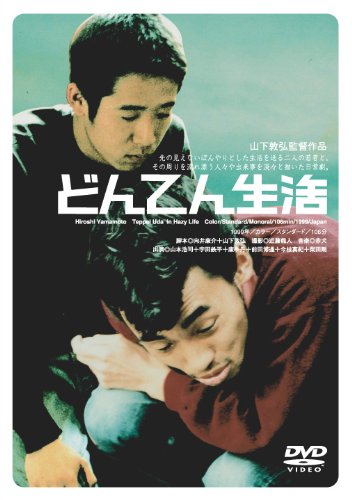
Hazy Life (どんてん生活, Nobuhiro Yamashita, 1999)

51GlvZf-iiLStarting as he meant to go on, Nobuhiro Yamashita’s debut feature film is the story of two slackers, each aimlessly drifting through life without a sense of purpose or trajectory in sight. His humour here is even drier than in his later films and though the tone is predominantly sardonic, one can’t help feeling a little sorry for his hapless, lonely “heroes” trapped in their vacuous, empty lives.
Kee (Hiroshi Yamamoto), a rocker with a giant quiff, meets Tsutomu (Teppei Uda) outside a pachinko parlour and the two strike up an unlikely friendship. Tsumtomu, a little gormless looking and near silent, ends up moving into Kee’s apartment where his main “job” appears to be copying videotapes of the amateur porn (sorry, “erotic cinema” movies) made by his friend Todokoro and his girlfriend(?) Akiko. In fact, Kee sometimes “stars” in the films too, which is something he might have wanted to tell Tsutomu before showing him the video. Kee also has a four year old child he doesn’t really get to see who lives with his ex-partner and only knows him as “uncle”.

As in many of Yamashita’s other films, nothing much happens as Kee and Tsutomu kill time whilst worrying and not worrying about the future. Neither of the guys has a proper job or any concrete ambitions, they mostly just eat time playing pachinko, drinking and hanging out with Tadokoro and Akiko. Kee is still mooning over his ex-girlfriend and, though it’s not clear why they split up, his own fecklessness may be the reason he’s not more involved in his child’s life even if he clearly would like to be. Tsutomu has developed a bit of a crush on Akiko but he never really tries to do very much about it (though he does have the good grace to turn down Kee’s invitation to become a star in one of the videos).

In constrast to his later work, Yamashita injects a number of fantasy sequences which seem to take place entirely within Tsutomu’s mind. Mostly they’re quite gentle – making a bunch of money at Pachinko and taking Akiko out for a slap-up meal or the poignant final scene of all the characters together as they enjoy a picnic under the cherry blossoms like one big happy family. However, there is one very unexpected scene which occurs after Tsutomu is caught shoplifting (which he does very badly) offering only the excuse that he’s forgotten his wallet and was too lazy to go back and get it. This fairly shocking scene of violence is one that does not typically re-occur in Yamashita’s later work and is notable for its extreme bloodiness and direct contrast to the overall tone. Perhaps intended to show Tsutomu’s inner frustrations (he spends much of the rest of the film asleep), this scene becomes one of the most intriguing in the film.

Hazy Life is a “zero budget” affair and makes no attempt to hide that. Shot on low quality equipment and committed to a “natural” look, it makes no claim to aesthetic prettiness though it does display Yamashita’s gift for interesting compositions this time working within a 4:3 frame. The fantasy sequences themselves are presented as reality bar one use of double exposure which is in general out of keeping with Yamashita’s naturalistic style as is the brief use of time-lapse photography.

Not uninteresting, but perhaps more interesting as a taste of things to come rather than as a feature in its own right. Hazy Life is just that, hazy and somewhat meandering as Kee and Tsutomu muddle through life with an air of mild depression and no particular hope in sight. “what day is it?”, “I don’t know”, “Well never mind – at least we’re alive”. This late conversation more or less sums the entire film and it’s poignantly sweet, fantasy sequence ending adds another layer of pathos to this subtly humorous look at laid-back modern life at the bottom of the heap.


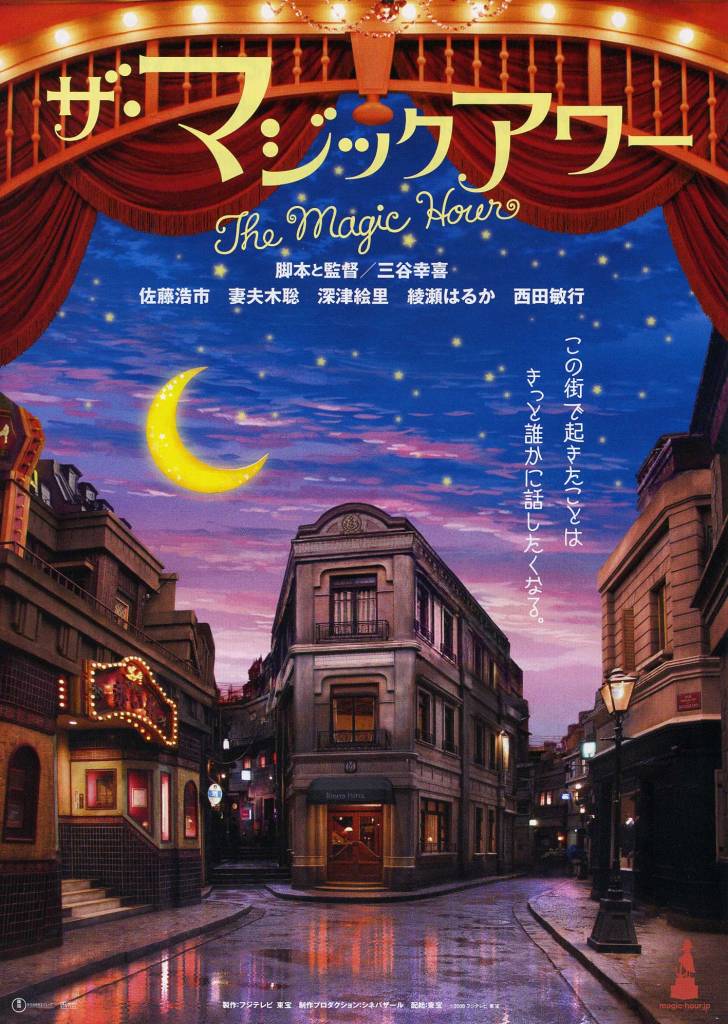
The Magic Hour (ザ・マジックアワー, Koki Mitani, 2008)

Magic Hour PosterIf there’s one thing you can say about the work of Japan’s great comedy master Koki Mitani, it’s that he knows his cinema. Nowhere is the abundant love of classic cinema tropes more apparent than in 2008’s The Magic Hour (ザ・マジックアワー) which takes the form of an absurdist meta comedy mixing everything from American ‘20s gangster flicks to film noir and screwball comedy to create the ultimate homage to the golden age of the silver screen.
In classic style the film opens with a bunch of goons chasing a scantily clad club owner out of a hotel window. Bingo (Satoshi Tsumabuki) has been hitting the jackpot with the boss’ girl, Mari (Eri Fukatsu), so the two are about to be given a new set of kicks in the latest fashion – cement. Luckily Bingo overhead some of the other guys talking about looking for another gangster, Della Togashi, so he quickly starts talking about him as if he were a long lost friend. The boss, Tessio (Toshiyuki Nishida), gives the pair a reprieve on the condition Bingo tracks down Togashi and brings him in within five days. Slight hitch – Bingo had never heard of Togashi before today and has no idea where to start. Finally, with the help  of some of his bar staff he hatches on the idea of getting a random actor to play the part, seeing as no one knows what Togashi looks like. However, the actor, Murata (Koichi Sato), plays his part a little too well and gets hired to work for the gang all the while thinking it’s just a movie! Pretty much everyone is getting a little more than they bargained for…

If you’re thinking that the oddly American looking 1920s street scene looks a little fake and everyone seems to be overacting like crazy, you wouldn’t be wrong but like everything else there’s a reason for that. What originally looks to be the primary setting for the film is a strange bubble which seems to co-exist with the modern world only its filled with people straight out of The Public Enemy or Scarface who think cement shoes is an efficient way of dealing with traitors. Murata, by contrast, is from our world and is completely oblivious to the strangeness of this movie gangster sound stage universe.

Murata is fixated on the Casablanca-esque final scene of his favourite movie in which a dyed in the wool tough guy entrusts the love of his life to a loyal friend before heading off to face certain death. His own career has not been going particularly well and even if he originally turns down Bingo’s offer as working with a first time director on a film where there’s no script sounds pretty fishy to begin with, circumstances soon find him throwing himself into the mysterious leading role with aplomb. Indulging his long held gangster dreams, Murata becomes the archetypal movie hit-man. He’s giving the performance of his life but has no idea there is no film in the camera.

The “Magic Hour” of the title refers to the twilight time near the end of the day when the light is dying but the conditions are perfect for making a movie. Mitani doesn’t fail to remind us we’re watching a film with constant exclamations of “just like a movie” or “doesn’t this look like a film set”. It’s a Barnum & Bailey world, just as phoney as it can be – but somehow it all just works despite its rather arch, meta approach. By the point we’ve hit Mari sitting on a crescent moon to give us her rendition of I’m Forever Blowing Bubbles (we’re back to The Public Enemy again) we’ve hit peak ‘20s though we scarcely mind at all.

Though he is indeed sending a lot of these classic ideas up, there’s real love here particularly for those golden age Hollywood movies with their wounded tough guys and beautiful chorus girls in need of rescue. Mitani adopts a primarily theatrical tone which meshes well with the absurdist, artificial atmosphere but always makes sure to leave us a fair few clues in the way of laughs. However, probably correctly assuming we know these films as well as he does, Mitani doesn’t give us the typical narrative that would almost write itself (or allow Bingo to write it based on his own trips to the motion picture house). The “bad” guy turns out to be not so bad, the “hero” wasn’t who we thought he was and none of our central guys winds up with a girl. Beautifully silly yet intricately constructed, The Magic Hour is another comedy masterpiece from Mitani which is filled with his characteristic warmth, mild sentimentalism and plenty of off-centre humour of the kind only Mitani can come up with.


The Japanese DVD/blu-ray release of The Magic Hour includes English subtitles.


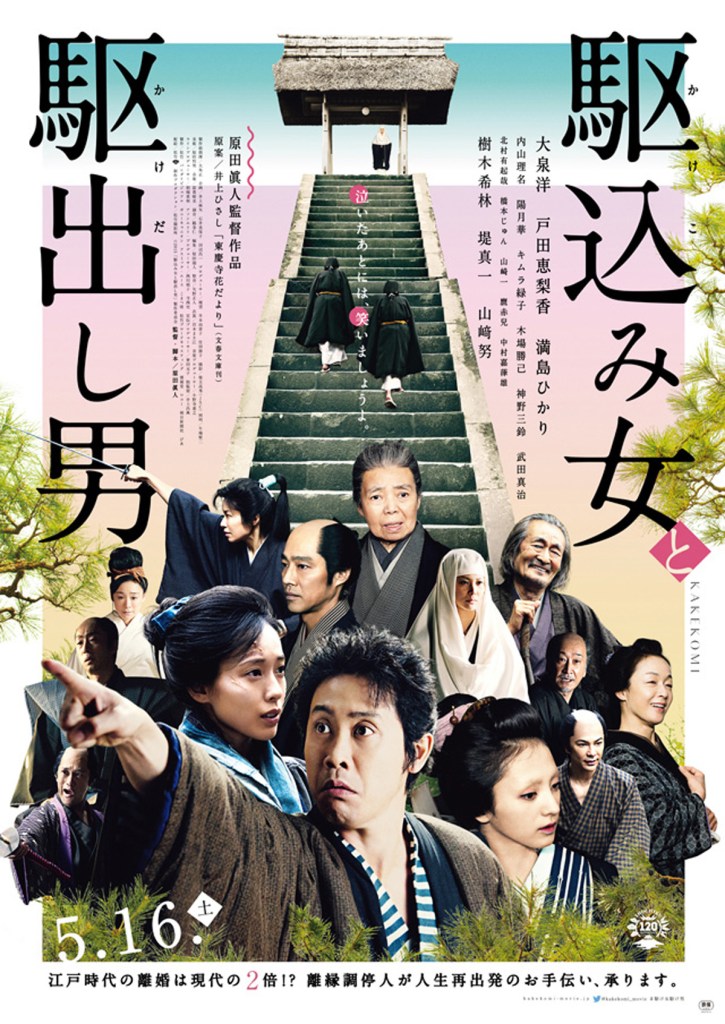
Kakekomi (駆込み女と駆出し男, Masato Harada, 2015)

166028_02The world of the classical “jidaigeki” or period film often paints an idealised portrait of Japan’s historical Edo era with its brave samurai who live for nothing outside of their lord and their code. Even when examining something as traumatic as forbidden love and double suicide, the jidaigeki generally presents them in terms of theatrical tragedy rather than naturalistic drama. Whatever the cinematic case may be, life in Edo era Japan could be harsh – especially if you’re a woman. Enjoying relatively few individual rights, a woman was legally the property of her husband or his clan and could not petition for divorce on her own behalf (though a man could simply divorce his wife with little more than words). The Tokeiji Temple exists for just this reason, as a refuge for women who need to escape a dangerous situation and have nowhere else to go.

Kakekomi (駆込み女と駆出し男, Kakekomi Onna to Kakedashi Otoko) places this important institution at its centre as it focuses on the stories of a number of women who’ve each ended up at the temple after a series of difficult circumstances. Jogo (Erika Toda) is married to a womanising drunkard who forces her to run his iron smelting business from the front lines (hence the painful looking blisters on her face) while he enjoys his life of debauchery. When the staff complains about his attitude and their subsequent fears for their jobs and Jogo raises their concerns with him he simply beats her before returning to his mistress. She then faces a decision – Tokeiji, death, or endurance. During her flight, she runs into O-Gin (Hikari Mitsushima), a mysterious wealthy woman who’s sprained her ankle after fighting off bandits in the woods. The pair bond on their quest to reach Tokeiji where they hope to find refuge from their turbulent home lives.

Before you can enter Tokeiji you’re held at one of the receiving inns where they hear your story, assess the possibility of being able to reconcile with a husband and, if deemed necessary, allowed to travel to the temple where you’ll live as a Buddhist nun for two years at which time your husband must legally sign the divorce papers. The inn adheres to strict Buddhist principles – no men are allowed near the temple (even the outside helpers wear bells so the ladies can hear them coming), you eat only temple cuisine (no meat or stimulants like garlic and onions), and have to abide by the word of the head nun. There are also three different classes of resident starting with the most expensive court lady lifestyle, then one of sewing and making repairs, and finally the lowest class which does all the day to day cooking, cleaning and other menial tasks.

The other pivot around which the film turns is the one time medical student Shinjiro (Yo Oizumi) who has literary dreams but has had to beat a quick retreat from Edo after defiantly breaking its ridiculous “no singing in the streets” law (amongst other things). At this period Edo and the surrounding area is undergoing its own mini cultural revolution as the current authorities advocate a period of austerity which sees things like literature, music and even sushi outlawed. Perceiving threats everywhere, the powers at be are also looking for a way to close down Tokeiji by any underhanded means necessary.

Shinjiro is a fast talking wise guy who can generally talk his way out of anything though he is also a keen student and a promising young doctor. As a relative of the Tokeiji inn owners, he’s seeking refuge too but also hoping to make use of their extensive archives for his writing career. As a doctor he’s immediately fascinated by the burns on Jogo’s face which he believes he can treat though in her frightened state she’s alarmed by his direct manner and refuses. After hearing his more reasoned arguments she finally submits and in turn becomes interested in his medical knowledge assisting him to gather herbs in the forest before starting her own herb garden in the temple.

Of course, the two develop a growing romantic attachment though frustrated by Jogo’s position as a married woman and the temple’s prohibition against male contact. Their romance is never played for melodrama, more as a simple and natural course of events though it’s well played by both Toda and Oizumi. At heart, Kakekomi is an ensemble drama which encompasses the often sad stories of its female cast who are each at the mercy of the cruel and rigid Edo era social system. O-Gin’s reasons for fleeing to Tokeiji turn out to be a little different from everyone else’s though she too is still suffering for love.

A humorous look at this untold story, Kakekomi proves an engaging ensemble drama anchored by the committed performances of its cast. Toda takes Jogo from a frightened and abused woman to a confident and learned scholar who is perfectly capable of taking charge of things on her own and her transformation is the true heart of the film. Apparently, director Masato Harada shot nearly four hours of footage before cutting the film down to the more manageable two and a half which may explain why it sometimes feels a little abrupt but nevertheless Kakekomi proves one of the most enjoyable mainstream Japanese movies of recent times.


The Japanese blu-ray/DVD of Kakekomi includes English subtitles.

Snakes and Earrings (蛇にピアス, Yukio Ninagawa, 2008)

91+iM1s07LL._SL1500_When 21 year old Hitomi Kanehara’s Snakes and Earrings (蛇にピアス, Hebi ni Piasu) was published back in 2003 it took the coveted Akutagawa prize for literature and the country by storm. Its scandalous depictions of the dark and nihilistic sex life of its outsider youngsters outraged and fascinated enough people to get it onto the best seller lists and earn a cinematic adaptation from Japan’s top theatre director Yukio Ninagawa in only his second foray into the world of moving pictures. However, Snakes and Earrings is perhaps that rare instance of an adaptation which clings to closely to its source material as its detached, emotionless and straightforward approach end in something of a miss fire.
Lui (Yuriko Yoshitaka) is a typical “gyaru” – for those of you reading from the future, this is an “ultra feminine” fashion trend which encourages young women to barbie doll it up to the max. It’s a little strange then when she catches sight of young punk Ama (Kengo Kora) in a nightclub and becomes fascinated with his forked tongue. In actuality, it’s the tongue she falls for, not the guy, but the two become a couple and she moves into his apartment. Before long she too gets a tongue ring and becomes determined on splitting her own tongue as well as getting herself a large tattoo. That’s how she meets Ama’s tattooist friend Shiba (Arata Iura) who becomes equally fascinated with Lui. Lui trades sex with Shiba in return for designing her body art and the two begin an illicit, sado-masochistic affair behind Ama’s back but even after Lui’s tattoo is completed it only sends her further into a spiral of nihilistic self annihilation.

Snakes and Earrings opens with a beautifully shot near silent sequence which pans across the skyline of modern Tokyo picking out the neon lights and advertising boards that proclaim it as a city which belongs to the young. Even when we’re with Lui inside the nightclub, the sound remains muted as young men and women dance to music that we cannot hear – even when Lui spots Ama it’s only the visuals that hang until he comes over and talks to her and we realise she’s had her headphones in the entire time. This sequence is neatly echoed at the film’s conclusion but is, however, something of an anomaly when it comes to the prevailing style of the film which is relentlessly detached and straightforward in approach.

Lui – short for “Louis Vuitton” remains something of a cypher. She’s torn between her two lovers – the punkish dope Ama who would kill for her and the cold, sadistic Shiba who would kill her given half the chance. She doesn’t seem to know what she wants or who she is and quickly loses herself in alcoholism and self disgust. It feels as if there should be more to this – a critique of the emptiness of modern life or the dehumanising effects of the city but all there is is a great nothingness. Perhaps that’s the point, there is nothing to Lui – not even a real name. She possesses no clearly defined identity and therefore does not exist. This is a fine idea, on paper, but does leave a great gaping hole where the protagonist ought to be.

Lui’s two love interests, the oddly vibrant Ama and the restrained Shiba represent two sides of the same thing as Lui is torn between pleasure in pain and pain in love. Kengo Kora does what he can with a thinly defined role which often feels more like a plot device than anything else. Arata Iura fares a little better with the meatier role of Shiba who is accorded more screen time but the film remains resolutely cold and distant. In a minor instance of distraction, Shun Oguri and more prominently Tatsuya Fujiwara turn up as bit players in the roles of two street punks who get into a fight with Ama which is, frankly, baffling.

Though opting for simplistic, straightforward compositions much of Snakes and Earrings is beautifully captured even if deliberately alienating. As in the book, even the frequent, semi-explicit sex scenes are shot in such a matter of fact way as to render them totally neutered, devoid of any kind of sensation. Ultimately, Snakes and Earrings finishes as a noble failure, neatly echoing its heroine’s nihilistic mindset whilst simultaneously failing to engage.


The Hong Kong DVD/blu-ray release (as well as the Japanese blu-ray) of Snakes and Earrings includes English Subtitles.


Heavenly Homecoming to Stars (별들의 고향, Lee Jang-ho, 1974)

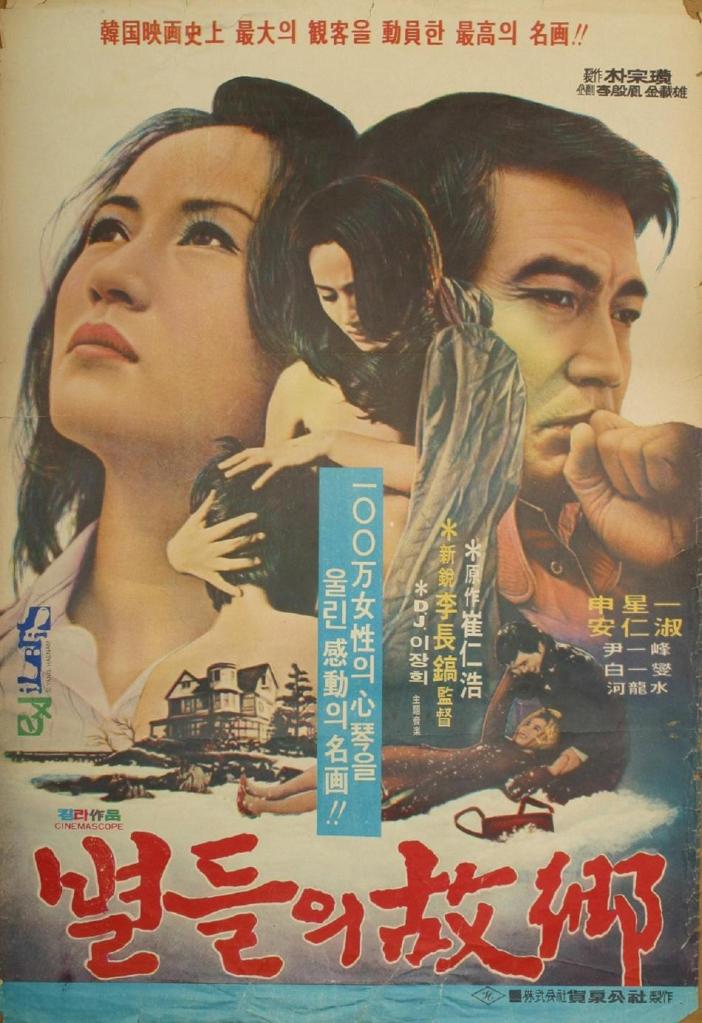
%EB%B3%84%EB%93%A4%EC%9D%98_%EA%B3%A0%ED%96%A52In writing the original novel which inspired Heavenly Homecoming to Stars, Choi In-ho stated that he wanted to tell the story of “a woman whom a city killed”. The novel itself was first serialised in a newspaper where it quickly became a must read and popular discussion point among readers of all ages. It’s perhaps less surprising then that this completely radical film adaptation by first time director Lee Jang-ho proved to be the big cinema hit of 1974. A new “youth culture” movement was beginning inspired by social and political developments from overseas and there was a growing appetite for films and novels which were equally revolutionary. Heavenly Homecoming to Stars managed to provide this but also, crucially, was able to appeal to older age ranges too thanks to its re-imagining of classical melodrama.
In essence, Heavenly Homecoming to Stars is a traditional “fallen woman” narrative. Told in non-linear fashion, the film follows the sorry tale of Gyeong-a and her relationships with four different men each of whom contributes to her downfall. At the earliest point we see her she’s a cheerful young woman like any other working in an office in the city. She finds first love with her co-worker and the pair plan to marry but before they do Yeon-seok pressures her into sex. It’s at this point that everything goes wrong for her as in order to acquiesce to his desires, she begins drinking.

Later she winds up marrying a middle-aged widower with a young daughter but Man-jun is not the man she thought he was and is still nursing a wound from having driven his first wife to suicide through his jealous and increasingly erratic behaviour. After finding out about Gyeong-a’s past, he too leaves her.

Man three is Dong-heok, a rough and violent pimp who turns her into a bar hostess which only increases her reliance on alcohol. Before we meet the quasi-hero of our story, melancholy artist Mun-ho, Gyeong-a is already an alcoholic and well on the way to her own ruin.

Truthfully, Mun-ho may have been able to save Gyeong-a, but he doesn’t. We already know that things don’t end well for her – the film begins with its epilogue as Mun-ho carries a little white box full of ashes across a frozen forest. Hers is a sorry tale though one that’s been told hundreds of times over the course of history and, sadly, will likely continue to be told for centuries to come. Choi In-ho says the city killed her, but it’s only partly “the city” – what it really is is a cruel and patriarchal society which permits men to use and discard women relegating them to a kind of underclass from which it is impossible to escape. Gyeong-a is a woman among hundreds who came to the city in search of a better life and contributed to Korea’s modernisation but found herself sacrificed its name.

Having said that the tone is one of sadness much more than anger. The strict censorship practices of the time placed severe limitations on what could be expressed in a film such as this though, sadly, the ballad of Gyeong-a is one audiences of all ages could identify with. Though it condemns the behaviour of the men in Gyeong-a’s life it does not so much call for change as for lament. Gyeong-a was young, naive and in need of protection which she was denied at every turn – first from the anonymous and unfeeling city and then by its self centred men who took what they wanted from her and callously discarded her afterwards when she no longer fulfilled their standards of a “pure woman”.

Yet, Gyeong-a remains a “pure woman” at heart. Innocent and true, she dies alone in the snow, a woman still young yet ruined by drink, dreaming of her first lover who was also the cause of all of her later misfortune. We’ll be singing the ballads of a hundred Gyeong-as until the sun goes out, but that doesn’t make her story any less sad. Lee Jong-ho’s directorial technique is something of a revelation for the time period neatly allaying standard melodrama tropes with a new brand of Korean realism mixed with European arthouse style. Former child actress Ah In-suk (still only 22 at the time of making this picture) gives a beautifully nuanced performance as the tragic Gyeong-a though apparently retired from acting due to her marriage soon after completing Heavenly Homecoming. An extremely important film in terms of the history of modern Korean cinema kicking off a youth culture movement which would extend into the turbulent 1980s, A Heavenly Homecoming to Stars succeeds both as a conventional melodrama but also as a symbol of a culture in flux.


Heavenly Homecoming to Stars was recently re-released on blu-ray in a beautiful new restored edition which also includes English subtitles on not only the main feature but also the commentary track as well as coming packaged with a booklet in both Korean and English.

However, you can also watch the (considerably less pretty looking) unrestored version with English subtitles and for free (legally) via the Korean Film Archive YouTube channel.

Can’t seem to find a trailer but here’s a poignant (unsubtitled) scene from towards the end of the film:

Poppoya (鉄道員, Yasuo Furuhata, 1999)

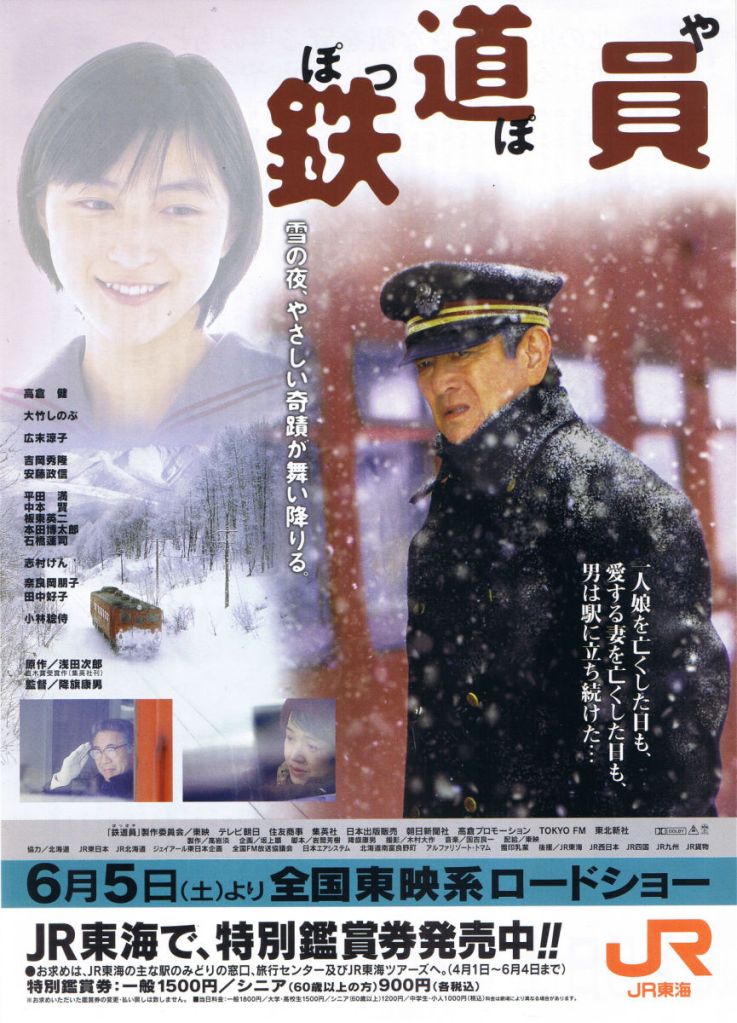
img_0The late Ken Takakura is best remembered as cinema’s original hard man but when the occasion arose he could provoke the odd tear or two just the same. 1999’s Poppoya (鉄道員) directed by frequent collaborator Yasuo Furuhata sees him once again playing the tough guy with a battered heart only this time he’s an ageing station master of a small town in deepest snow country which was once a prosperous mining village but is now a rural backwater.
Otomatsu Sato has spent his life in service to the railway. Like his father before him who believed the key to the modernisation of Japan after its defeat in the second world war was in its transportation network, Sato started as an engineer before being promoted to station master. Morning and evening in the freezing cold he bid in and sent out each passenger and freight train travelling through his one track station. However, though he clearly loves his job Sato has experienced a great deal of personal tragedy in pursuit of his career. He wasn’t there when his baby daughter died, nor was he there when his wife lay dying in hospital. He was where he always is, on the platform until the last train goes out. Now, however, the mine has closed, the town is full of old people and there are no passengers on the train so the line will be closing. Having given his life to something which will be so unceremoniously erased, what is a man like Sato to do now?

In true Takakura fashion, Sato appears tough and fairly unapproachable on the outside but actually he’s quite well respected in the town and even if some of the other residents bemoan his rigid ways, they grudgingly respect him for being the way he is. He takes his duties seriously and would never countenance breaching them for something as trivial as personal concerns, even when those concerns are something as understandable as the death of a family member. The way he sees things, this is his duty and must be fulfilled, properly each day no matter what. This may seem a little obsequious in Western eyes, though many of the other (particularly female) characters also agree Sato takes things much further than he needs to, but dedication to one’s duty is, after all, an admirable trait.

However, now it’s all been for nowt. The railway line is to be closed, the land will engulf it once again erasing the years of Sato’s work just as if he were never there. He’s sacrificed final moments with his wife and child – not even that, just sacrificed moments. He’s given all to the railway and now there’s no place left there for him. His best friend, the father of a son also in the railway business, is to take another job at a hotel complex but Sato is a railwayman through and through – he’ll work on the tracks or not at all.

Around this time Sato also starts seeing some strange new children around. He assumes they’ve come to stay with grandparents in the village, this being the time of the New Year holiday. The little one has a strangely old fashioned looking doll that reminds Sato of one he bought for his infant daughter only she never really had the chance to enjoy it. Then he meets an older sister who’s kind of a live wire before meeting the oldest – a high school student dressed in an old fashioned looking uniform who really reminds him of someone he used to know. All these strange encounters force Sato to further re-examine his past, reliving old regrets and assessing a life lived in service to an ideal at the expense of the joy he might have felt as a happy family man.

Beautifully photographed with picturesque shots of trains against the deep snows of Northern Japan, Poppoya was Japan’s submission for the 1999 Oscars and does have all the trappings of a prestige melodrama. It unabashedly pulls at the hearts strings and even if the rather sentimental score takes things too far, Poppoya does nevertheless manage to draw the odd tear for Sato’s lonely, regretful old age. Sentimental yet genuinely affecting, Poppoya is an effectively crafted weepy which serves as a timely reminder to embrace the things which are most important to you while there’s still time.


The Hong Kong blu-ray release of Poppoya includes English subtitles (though they are a little “imperfect”).

Only trailer I can find has Korean subs:


Beijing Bicycle (十七岁的单车, Wang Xiaoshuai, 2001)

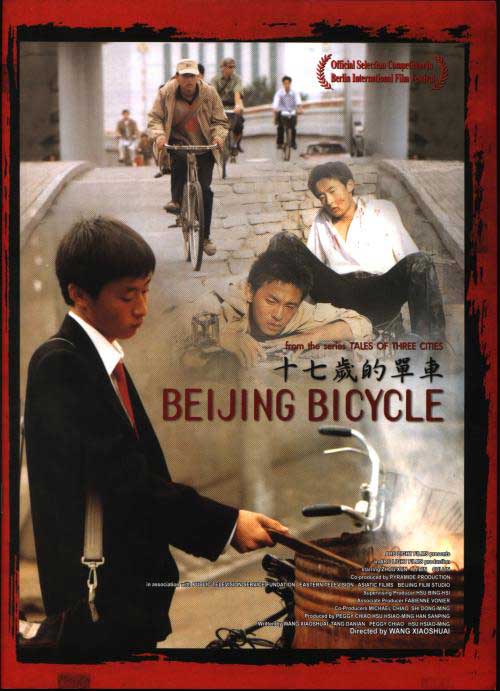
BeijingBicycleThere are nine million bicycles in Beijing (going by the obviously very accurate source of a chart topping song) but there are 11.5 million inhabitants so that’s at least two million people who do not own a bike. Still, if you’re in the unlucky position of having your bike stolen by one of the aforementioned two million, your chances of finding it again are slim. Luckily for the protagonist of Wang Xiaoshuai’s Beijing Bicycle (十七岁的单车, Shí Qī Suì de Dānchē), he manages to track his down through sheer perseverance though even once he gets hold of it again his troubles are far from over.
A young guy from the country, Guei has lucked out with a good job at a bicycle courier company. Each of the new employees is given a new, high-tech bicycle which they will eventually own after working off the cost through a 20/80 salary split and once the bike is theirs they’ll be on an even better 50/50 pay rate. This is a dream job for Guei and he’s pretty good at it – he’s nearly paid for the bike in under a month. However, after being messed about by a hotel reception desk which keeps him hanging around longer than usual, he emerges to find his bike no longer waiting for him.

The vehicle turns up in the hands of another boy of a similar age but very different background. Jian is a lower middle-class boy at a posh school where most of his classmates are considerably better off than he is and it seems to get to him. Jian’s father has been promising to buy him a bicycle for years but something always comes up and now it’s that his little sister got into a better school so they need the money for her fees. Resentfully, Jian gets himself a bike to hang out with his posh friends through other means and generally continues to be a little shit about it.

Quite obviously inspired by De Sica’s neo-realist classic Bicycle Theives, Beijing Bicycle doesn’t quite have that movie’s harsh sentimentalism but goes about as far as Wang could take a similar message and still get around China’s frighteningly tight censorship regulations. Guei does everything right – well, almost everything, he gets so upset about losing his bike that he forgets to deliver his final package which is what gets him fired from the delivery firm (they didn’t really mind about the bicycle anyway). He offers to find the bike and bring it back and is promised a second chance if he can actually beat the odds and track it down but his boss doesn’t seriously expect to see him again. Guei needs the bike to live, he can’t work without it and this was about the best job he’s likely to get in the bustling metropolis of Beijing without qualifications or family connections.

On the other hand, it becomes increasingly difficult to sympathise with Jian and his petty squabbles with his very reasonable father and attempts to blend in with the equally awful group of thuggish rich boys from school. Of course, it’s all about a girl really – somehow he thinks she’d care about him having a bicycle (she wouldn’t) and luckily said girl is too sensible to hang out with someone who’d beat up some poor kid and take away his only way of supporting himself just because he could. Yes, he’s a young man and he’s angry so he’s doing stupid teenage boy stuff but he’s ruining lives in the process and desperately needs someone to explain to him about the world not being fair.

Guei eventually steals back his bike, only for Jian’s mates to beat him up and take it again. Guei doesn’t give up though and eventually the two end up sharing the bike even though Jian only uses it for swanning around and trying to impress a girl who isn’t interested in him. Needless to say it all ends quite badly. Jian gets Guei into even more trouble that he didn’t ask for and both boys end up losing out both ways. As in De Sica’s film, society turns us all into bicycle thieves whether we wanted to be or not. The boys are both chasing an unattainable dream but they’re doing it from very different places and though both are arguably at a disadvantage boys like Guei will always lose out to cowardly thugs with muscle like Jian.

Nicely filmed in a modern indie, neo-realist inspired style Beijing Bicycle does suffer a little with its lengthy running time especially as the tussle over the bicycle itself turns into a repetitious saga in which you just want someone to give Guei back his bicycle and have done with it. Nevertheless, having said that it actually does quite a lot with an economical script though Zhou Xun’s virtual walk on of a cameo as the glamorous neighbour feels a little underdeveloped even if it pays off in the second half of the film. A sadly realistic tale of a very unlucky boy who just wants to get on and works hard to get there only to come up against cowards and thugs with money Beijing Bicycle does what it can do to highlight the unfairness inherent in the post-communist world.


Beijing Bicycle was previously released by Tartan in the UK and is currently available to stream via Amazon. In the US it’s currently available on DVD through Sony Pictures Classic.

Watched via Mubi.


The Rambling Guitarist (ギターを持った渡り鳥, Buichi Saito, 1959)

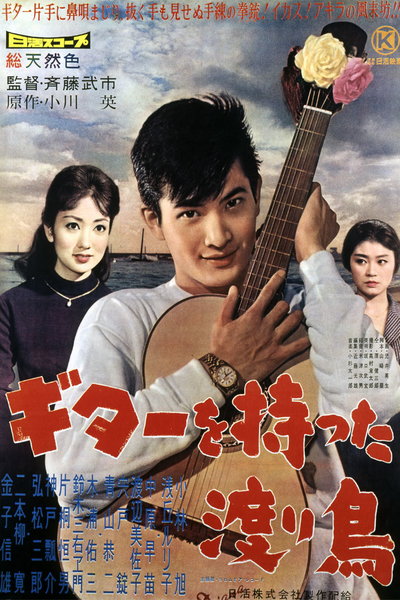
60030340Sometimes, just like an aimless drifter wandering into town, you feel as if you’ve come in during the second reel and missed some vital piece of information leaving you feeling a little at odds with the current situation. So it is with Buichi Saito’s The Rambling Guitarist (ギターを持った渡り鳥, Guitar wo Motta Wataridori) which is, apparently, the first film in a series though feels a little more like the second.
The film begins with a scene straight out of a classic western as the titular guitar toting wanderer, Taki (played by rising Nikkatsu star of the time Akira Kobayashi looking very fresh faced indeed), is fast asleep on the back of a cart travelling through an arid landscape with a mountain looming in the background before being woken by the driver who points him towards the nearest town. Having left the dry expanses on foot, Taki hasn’t been in Hakodate for long before he’s wrecked a local drinking establishment in a two on one bar brawl with a couple of drunken foreign sailors who were hassling the other musicians. This brings him to the notice of the crime kingpin Akitsu who offers him a job but Taki doesn’t like to linger and this kind of work’s not his thing so he passes. That is until a chance encounter with Akitsu’s pretty young daughter leads to a change of heart…

Akira Kobayashi went on to become one of the studio’s biggest action stars but here he’s every inch the pretty boy in a Brando-esque leather jacket and with a cooler than cool devil may care approach to life. The very epitome of the kind of pin-up star these films were created to sell, Taki is a noble, broken hearted drifter mournfully strumming along on his ever present guitar whenever the opportunity presents itself. Appealing to the rebellious side of post-war youth but still possessing a moral centre which places him on the side of right, Taki is the kind of youth hero you can still take home to mama.

Post set-up, The Rambling Guitarist drops most of its western tropes pretty quickly and falls back into a standard youth crime drama mould as Taki ends up joining the Akitsu gang who have a plan to build an amusement park on the quiet edge of the island to pull in a bit more tourist money. The snag is, there’s a small house and fishing company based there that they need to take out – the owners have a loan and are already in debt so it shouldn’t be too hard but Akitsu has neglected to mention that the house belongs to his sister (and her husband whom he doesn’t like very much).

Just when you thought everything was about to settle down, an old “friend” emerges from underneath a raincoat in the form of “Killer George” played by fellow Nikkatsu rising star, Jo Shishido. It’s from here on that we start to piece together some of Taki’s previous life and the reason he’s on this seemingly endless path of wandering from to place to place with no clear aim in sight. Things start to take a more generic turn as Taki and George dance around each other a little bit with Akitsu fuelling the fire by plotting behind both of their backs from the shadows. It’s a conventional narrative but acquits itself well enough.

Like the other films of the period, The Rambling Guitarist is built of bright, colourful and above all youthful fun. Consequently it has an energetic, freewheeling atmosphere coupled with a mildly nihilistic bent designed to appeal to the youth of the time. Aside from having some of the least realistic fight choreography ever committed to celluloid (that first bar brawl scene has some real howlers), The Rambling Guitarist proves an enjoyable embodiment of its genre but ultimately fails to build up the kind of emotional investment that would earn it a higher place on the list. A little bit disposable, perhaps, but nevertheless fun The Rambling Guitarist does at least leave you wanting to wander off and find your way to The Rambling Guitarist 2.


The Rambling Guitarist is the third (and final 😦 ) film included in Arrow’s Nikkatsu Diamond Guys Vol. 1 collection.

Chasuke’s Journey (天の茶助, SABU, 2015)

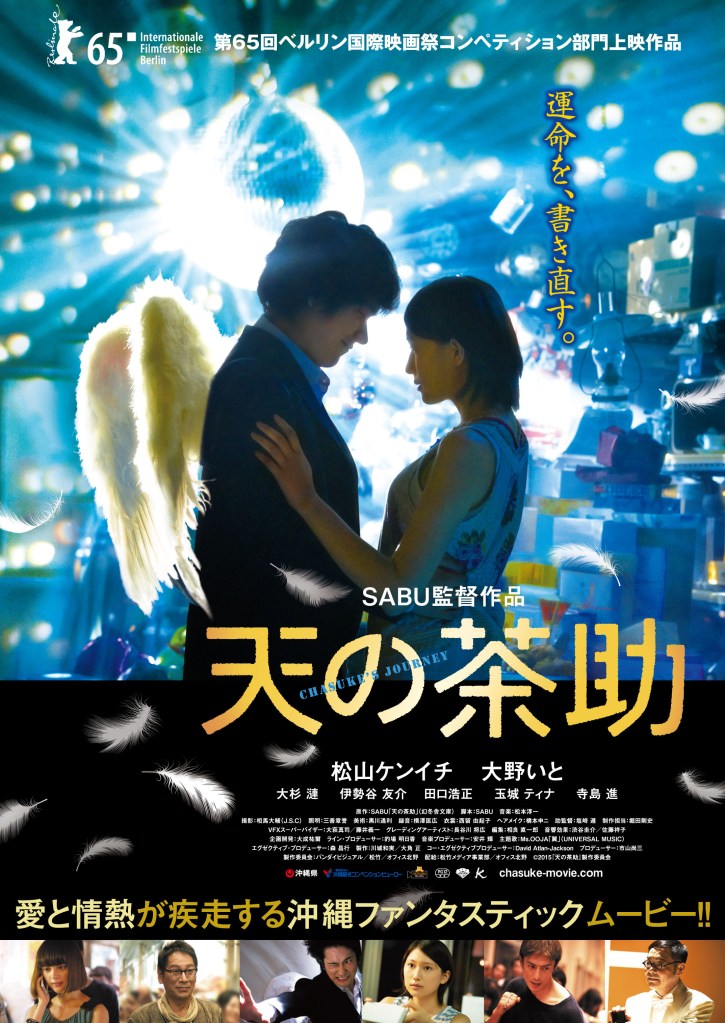
jon_chirashiNo fate but what we make – to steal the lines from another film just as one of the heavenly scriptwriters might in the latest film from the prolific Japanese director SABU (otherwise known as the actor Hiroyuki Tanaka), Chasuke’s Journey (天の茶助, Ten no Chasuke). Adapting his own novel for the screen (though the book was actually published after the film was completed), Sabu creates a romantic fantasy in which a lowly tea boy from heaven descends to Earth on a quest to save the woman he loves from certain death.

Chasuke (Kenichi Matsuyama) is the tea boy in “heaven” (his name, “Chasuke” literally means “tea assistant”). Here, there is a room full of scriptwriters who draft life stories for the people down below in service to The Man. Their task is a difficult one as each change in one person’s screenplay necessitates a change in all the others. It’s the butterfly effect gone mad. So, when The Man sends in a request for everything to suddenly go “more avant-garde” everyone is a little bit overworked. One writer asks Chasuke’s advice on what this might mean but all he comes up with is moving the action to a karaoke booth which has the unfortunate effect on the scene of getting the man’s proposal of marriage rejected causing him to leave in a mood and callously run Yuri (Ito Ono), whom Chasuke has developed a fondness for, over. Yuri’s screenwriter begs Chasuke to go down to Earth and use his unique powers to save her before it’s too late.

Luckily two of the other scriptwriters have pledged to support Chasuke’s mission from up above so he gets help from a former aspiring actor who now runs a small antique shop (Ren Osugi) and a broken hearted former boxer who now runs a ramen bar (Yusuke Iseya). Co-incidentally, both know and like Yuri who is a regular customer at both of their establishments. Coming from up above, Chasuke is already quite familiar with each of the character’s backstories and is able to fill us in with a touch of storytelling of his own. SABU has a dig here at unimaginative screenwriters who’ve ripped off most of their best ideas from other movies, which is sort of ignoring the fact that someone must have crafted the movies from up above anyway though the thought of screenwriters scripting screenwriters writing scripts about scriptwriters sort of makes your head spin.

Anyway, without venturing too far into spoiler territory, Chasuke’s quest is finished within the first half of the film with the remainder given over to a confused series of episodes featuring him as a celebrity healer committed to correcting all the awful scripts full of misery that his hack friends have come up with. That’s in addition to the constant threats of correction to Chasuke’s edits threatened by the jilted lover and a policeman who’ve both been given white painted faces (to be more “avant-garde”, as requested). Oh, and Chasuke’s memories of a former mortal life also start to return with a fairly surprising backstory of his own.

In truth, it’s all a little messy – almost as if someone were still working on the second draft even as we’re watching it. However, that’s sort of the point – we are watching someone re-writing on the hoof, trying to accommodate for someone else’s notes right as the keys are hitting the paper (or in this case, the ink splashing the parchment). When you come right down to it, life is a messy business and rarely makes any kind of sense during the “live broadcast”. Chasuke’s final message proves something of a riddle as he at once advises you to stick to The Man by living your own life and forging your own destiny whilst also putting his salvation down to the power of prayer which is about as close as you can get to an existential paradox.

Often beautifully photographed with Chasuke’s escape from up above an early highlight, Chasuke’s Journey is certainly a handsome looking film whatever faults it may have. Though the performances are committed, it never quite makes the jump from gentle satire to anything more emotionally engaging undermining the impact of its final sequence. However, for the vast majority of its running time Chasuke’s Journey does prove an interesting, if slightly flippant, take on freewill versus predestination with a hearty dose of social criticism thrown in to boot.


The Japanese blu-ray/DVD release of Chasuke’s Journey includes English subtitles.

(Unsubtitled trailer again though, sorry).