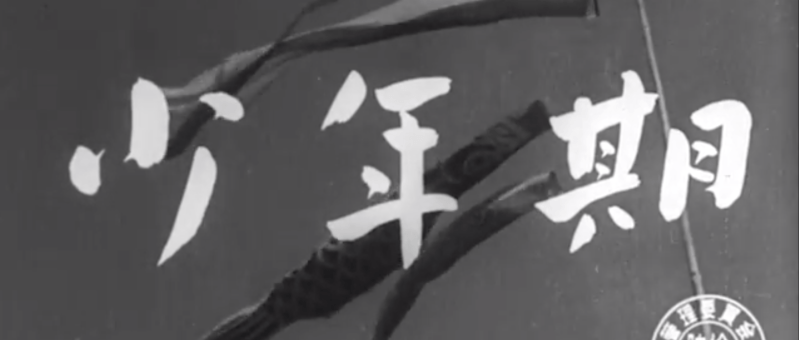
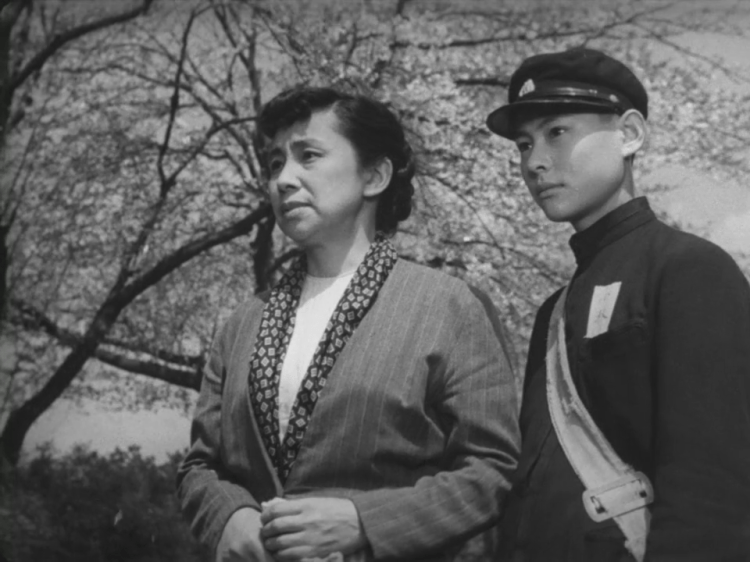
 It’s easy to look back in judgement with the benefit of hindsight, but much less so to see clearly in the moment. Keisuke Kinoshita’s Boyhood (少年期, Shonenki), arriving just six years after the events that it depicts, is a painful if sympathetic look at the conflicts of the age seen through the eyes of a conflicted adolescent as he struggles to understand his place in a world which is becoming ever colder.
In the spring of 1944, 16-year-old Ichiro (Akira Ishihama) and his mother (Akiko Tamura) investigate the possibilities of retreat, back to the country and away from the increasingly fraught and dangerous city. Their first prospect which offered the comfort of family nevertheless proves too inconvenient and so Ichiro’s mother decides perhaps Suwa, a rural area not quite so out of the way, might be better even if it would mean starting all over again with no friends or family to offer support. Ichiro, however, doesn’t want to leave at all. He is afraid of being thought a coward and doesn’t see why he should have to leave his school and classmates behind just because there’s a war on. If he had his druthers, he’d be a pilot dropping bombs, not a resentful schoolboy torn between his feelings for his family and the increasingly austere demands of militarism.
Ichiro may be 16, and if it were not for his poor health perhaps he might already have been drafted, but he seems younger and is trapped in the difficult gulf between boy and man which makes him petulant and occasionally unreasonable. His father (Chishu Ryu), a professor of English literature, is a well known social liberal which is a problem that eventually makes it impossible for the family to stay on in the city. They decide to sell the house and move to Suwa, allowing Ichiro to stay behind alone as a lodger for the family of greengrocers who are the new occupants, but despite his insistence on his independence Ichiro is not yet ready for self sufficiency and misses his family, especially his mother, dearly, while he also experiences harsh treatment from the military instructors at school thanks to his general lack of soldiering aptitude.
Like his nation, Ichiro is lost in a fog of confusion – torn between the prevailing ideology of the age and that of his gentle hearted father. His problem is that as he is still “a child” and the conditions in which they find themselves make openness difficult, nobody is willing to talk to him seriously about the issues at hand – his father perhaps less out of fear or reticence than because he is acutely aware that his son must come to his own conclusions even if those conclusions prove contrary to his own. Thus, much to Ichiro’s consternation, he refuses to allow him to enrol at a military academy but does not explicitly state why, leaving him with only the vague idea that his father is “anti-war” and therefore a social pariah in a nation where everyone is expected to do their duty.
Ichiro begins to resent his father for the family’s plight, certain that he is the reason they were forced out of their home and also the ongoing cause of his mother’s suffering as she finds herself becoming the family breadwinner as an unlikely milk lady – a job she was only able to get thanks to the friendship of a gregarious neighbour, herself a fellow evacuee in a similar position. Far from the community spirit such situations are said to engender, Ichiro and his family find themselves perpetually excluded, viewed with suspicion as “outsiders” and at the bottom of the pile when it comes to the distribution of resources. “Extra” people get only the extra after the real villagers have had their fill. Meanwhile, Ichiro is bullied by the full on fascists at school, one of whom is the son of a local military commander and has fallen completely under the militarist spell.
Everyone is always telling Ichiro that he will come to understand when he is older. Being young, he resents this intensely but eventually comes to see that they were right, some things can only be understood with the weight of experience. With the war’s end and the eventual defeat of militarism, the fog begins to lift, allowing him to see that the prevailing ideology is not always the correct one and that there’s something to be said for quiet resistance and sticking steadfastly to one’s principles even if it would be much easier to go along with the majority. His father, however, reminds him that those who chose to do just that can hardly be blamed and will likely suffer in whatever is to come. They will need the all love and compassion in the world in order to find a new, less destructive path than the one they had been obliged to walk through a time of fear and madness. Using imperialistic song and propaganda to ironic, somewhat chilling effect Kinoshita presents a characteristically empathetic portrait of a “difficult age” in the life of a young man and his country who each find themselves emerging from chaos and confusion into something completely unknown and perhaps frightening but open and filled with possibility.
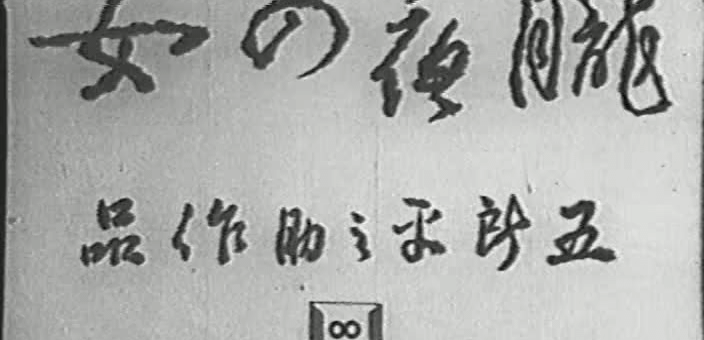
Title sequence and opening (no subtitles)


 Ahead of the official ceremony on 6th February, the Blue Ribbon Awards has released its list of winners for the 61st edition which honours films released in 2018. Runaway box office hit One Cut of the Dead (
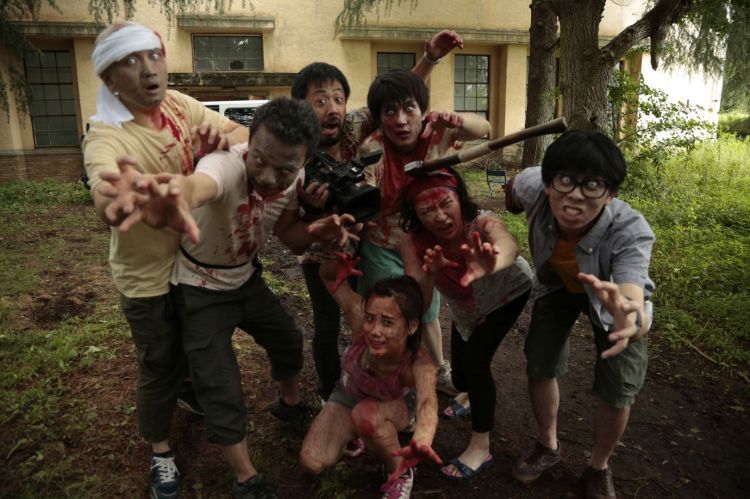 One Cut of the Dead has already devoured the Japanese box office and now finds itself the winner of the prestigious Blue Ribbon Award for best film. Opening with a 40 minute single take of zombie mayhem, this hilarious horror comedy begins with a film crew trying to make a zombie movie in an abandoned water filtration plant with a dark past only for some uninvited guests to turn up and join the fun…
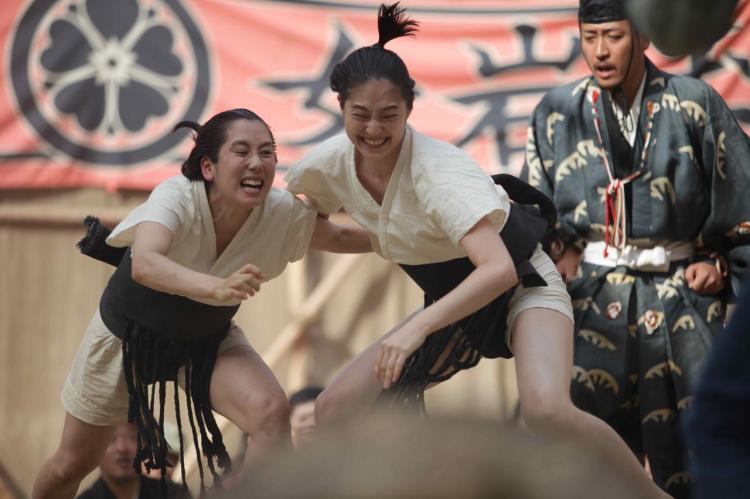 The recently prolific Takahisa Zeze retreats to the Taisho era for a tale of sumo and revolution as a band of anarchists known as the Guillotine Society find themselves fascinated by an itinerant troupe of female sumo wrestlers shortly after the Great Kanto Earthquake of 1923.
 Kazuya Shirashi, winner of this year’s best director award, pays tribute to the world of Battles Without Honour in an ’80-style neo-noir in which a straight-laced rookie is partnered with a veteran rogue cop who leads him straight into the heart of darkness.
  Not to be confused with Kazuya’s Shiraishi’s Sunny, Hitoshi Ohne’s Sunny: Tsuyoi Kimochi Tsuyoi Ai is a remake of the classic 2011 Korean film by Kang Hyeong-cheol in which a dying 40-year-old woman reunites with her high school friends from 1990 to relive her memories of a bubble-era adolescence.
 A CEO discovers dark secrets about his own company when a tire comes off one of their trucks and kills a young mother.
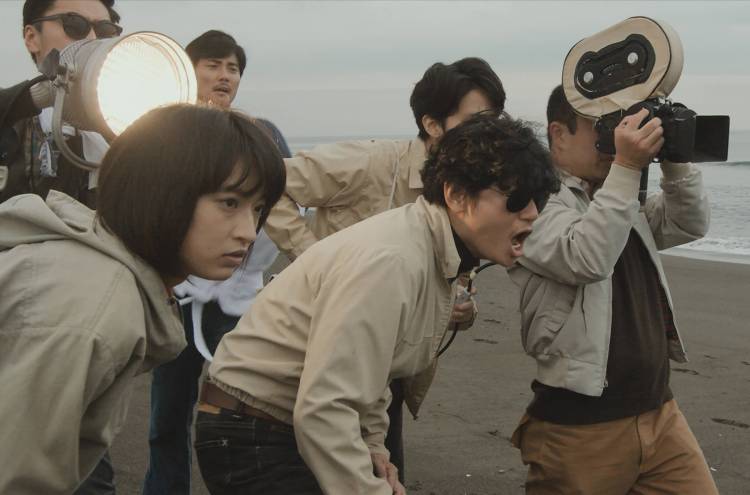 Another of three films released this year by Best Director winner Kazuya Shiraishi, Dare To Stop Us revolves around the legendary figure of Koji Wakamatsu – a hugely influential director of pink film who sadly passed away in 2012 following a traffic accident. Set at Wakamatsu Productions between 1969 and 1972, the film is told from the point of view of female crew member Megumi Yoshizumi, played by Best Actress winner Mugi Kadowaki.
 Starring the legendary Kirin Kiki in one of her final performances, Every Day a Good Day is inspired by the writings of Noriko Morishita and revolves around the serene elegance of the traditional tea ceremony.
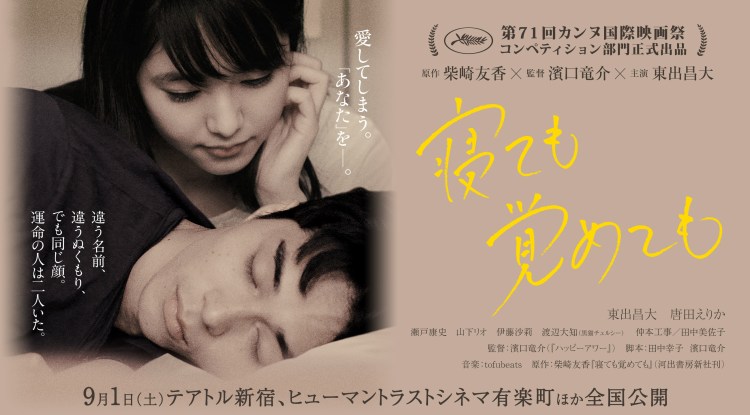 A conflicted young woman struggling to move on from lost love falls for a guy who looks just like her ex but can’t decide whether to embrace the fantasy of unresolved romance or the security of a steady relationship in Hamaguchi’s complex yet playful comedy drama adapted from the novel by Tomoka Shibasaki.
 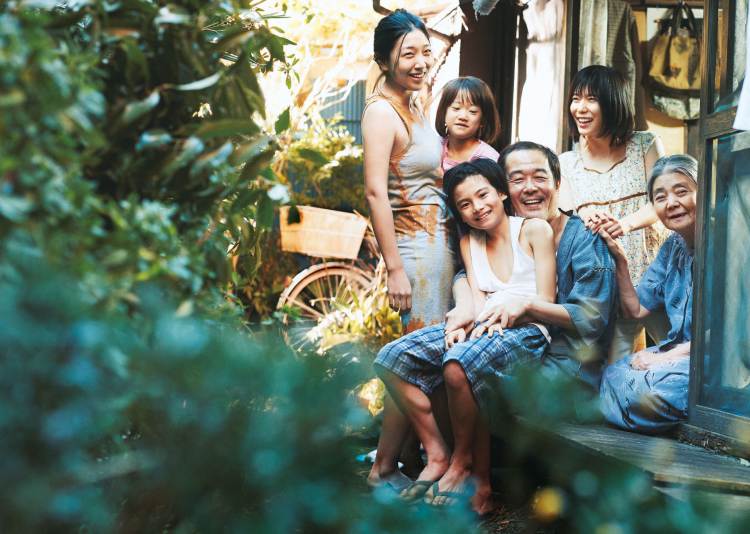 This year’s Palme d’Or winner, Shoplifters earns Hirokazu Koreeda another spot in the top 10 with a hard hitting tale of marginal lives and manufactured families which continues the long line of Japanese films asking what exactly family means in an increasingly disconnected society.
  Directed by third generation Zainichi director Wishing Chong, Yakiniku Dragon revolves around a Korean-Japanese family in the early ’70s who run a yakiniku restaurant on the outskirts of Osaka.