Five Marines (五人의 海兵 / 5인의 해병, Kim Ki-duk, 1961)

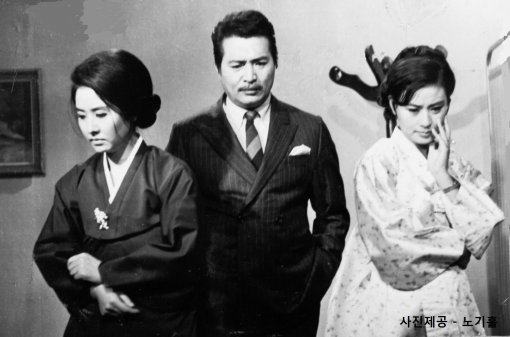
Five Marines posterKorean War films have a very particular tone and flavour often absent from those from elsewhere. As sad and despairing as they can be across the world, war films are generally the realm of macho heroism, men bravely holding back tears and charging forth with unrestrained rage in a quest to avenge their fallen comrades. Korean War films, however, like the majority of the nation’s cinematic output, are tinged with melodrama. These men wail, talk about their mothers, and worry for the future while forging intense bonds of homosocial brotherhood and becoming a battlefield family. The debut feature from Kim Ki-duk, Five Marines (五人의 海兵 / 5인의 해병, O in-ui haebyeong) is a prime example of this approach, eschewing combat scenes for behind the lines ensemble drama as ordinary men attempt to come to terms with the extraordinary situation of war.

Stock footage of the battlefield eventually gives way to a small squadron of marines digging trenches and at constant risk of ambush by Chinese forces. The main drama revolves around lieutenant Deok-su (Shin Young-kyun) who is the son of the company commander but there has long been bad feeling between the two men as Deok-su has always felt that his father favoured his brother, Deok-han (Choe Bong), and never really loved him. Meanwhile we’re introduced to another four marines – intellectual Jeong-guk (Choi Moo-ryong), Ju-han (Flyboy / Gwak Gyu-seok) – a father of five from Seoul, farm boy Yeong-seon (Park Nou-sik), and mother’s boy with anger issues Hun-gu (Hwang Hae). Following the death of two comrades, the squad of five is sent on a daring missing into enemy territory to blow up an arms depot through which they aim to make the sacrifice their friends have made in some way meaningful.

Made just eight years after the end of the Korean War and apparently commissioned by the Marine Corps in the wake of the May 16 military coup which initiated the dictatorship of Park Chung-hee, Five Marines takes a very different approach to that seen in other contemporary war films such as Lee Man-hee’s The Marines Who Never Returned. Though in no way particularly jingoistic or warmongering, it would be difficult to describe Five Marines as an “anti-war” movie, not least because it avoids depicting scenes of combat until the final mission in which, as expected, some or all of the heroes will fall valiantly defending their fellow Koreans as well as their friends.

Jeong-guk, the college educated enlisted man, originally considers himself to be taking part in the pantomime of war, going along with the ridiculous sham of soldiering, but when a fellow soldier – a young boy who spends his time rewriting a poetic confession of love he doesn’t quite have the nerve to send to the girl he left behind, falls in front of him, Jeong-guk suddenly wants to join the fight for real. The idea of militaristic patriotism is then subtly reinforced if not quite sold with patriotic fervour. The necessity of the sacrifice is never questioned and the idea of doing one’s duty remains paramount even if it is also clear that the war has taken these men out of their familial environments leaving their women at home alone and, perhaps, defenceless.

Kim explores the peacetime lives of each of the men through flashback with the consequence that we get to know and care for them as people rather than as combatants. We rejoice with Jeong-guk when he hears he’s going to be a father, share Ju-han’s amused frustration when his wife includes all their bills in his mail, and worry with Hun-gu when his usual letters have not arrived. During their down time, the men discuss women but with more tenderness than expected – save for Yeong-seon’s rather lewd (and apparently fabricated) story of his wedding night for which he is rightly taken to task by his stern company Sergeant. Rather than focussing on the negatives of military service, Kim emphases the warmth and friendship among the men who forge deeper and stronger connections precisely because of the ever present threat of death.

When the final mission rolls around, Kim allows the action to take centre stage as the five man squad plots and executes a daring raid which does not quite go to plan and eventually erupts into a more conventional fire fight. Marrying the demands for macho battle scenes with the emotional quality of melodrama, Kim allows the men to sort out their emotional difficulties, shedding both blood and tears in equal measure. More emotional drama than action packed celebration of the glory of war, Five Marines may not quite be what the Marine Corps had in mind but perhaps serves their purpose anyway in reinforcing the positive ideas of camaraderie and patriotism whilst telling the stories of ordinary men and extraordinary heroism.


Available on DVD as part of the Korean Film Archive’s Kim Ki-duk box set. Also available to stream online for free via the Korean Film Archive’s YouTube Channel.

Youth (芳华, Feng Xiaogang, 2017)

youth posterOn the surface of things, one might be forgiven for thinking that Feng Xiaogang, “China’s Spielberg” – the director of such fluffy hits as If You Are the One and the prestige picture The Banquet, might not be the one to look to for nuanced takes on the state of his nation but, as he proved with the irony filled I am Not Madame Bovary, there has always been a persistent resistance in his superficially crowd-pleasing filmography. The exact nature and extent of that resistance is however harder to assess. Youth (芳华, Fāng huá), Feng’s latest historically probing epic, made headlines when its mainland release was blocked at short notice immediately before its international premiere at the Toronto International Film Festival and in some respects it’s easy to see why it may have raised an eyebrow or two at the censor’s board. A literal story of “youth” and the various ways that the concept becomes romanticised even when one’s own coming of age took place in otherwise difficult times, Feng’s film is also the story of modern China, baptised in the fire of the Cultural Revolution only to finally succumb to the consumerist one 15 years later.

Narrated by bystander Suizi (Zhong Chuxi), later a successful author apparently looking back on her own “youth” with a writerly eye, the tale begins in the early 1970s with two pillars of the arts division of the People’s Liberation Army. Suizi informs us the the protagonists of this story are Lui Feng (Huang Xuan) – a model soldier, and Xiaoping (Miao Miao) – a poor girl mercilessly tormented by everyone throughout her entire life. Xiaoping’s birth father has long been languishing in a re-education camp but as she’s taken her step-father’s name, Liu Feng assures her that he’s kept her bad class background off her record and will make sure no one else knows about it.

Performing propaganda ballets, the arts division is at its zenith at the height of the Cultural Revolution. The troop as a whole enjoys extreme privilege – they are well fed and cared for, evade the dangerous front line work many other members of the armed forces are subject to, and receive the respect due to them as the embodiment of a revolutionary ideal. They are, however, still guilty of the various hypocrisies coded into the system. Though many of the dancers have family members with “bad class backgrounds”, undergoing re-education or otherwise better not mentioned, the top guys and girls are the ones with parents high up in the party who use their untouchable status to paper over cracks in their own development with inherited superiority.

Lui Feng is perhaps an aberration. Nicknamed “Lei Feng” – a mythical figure created for propaganda purposes to embody the “ideal” revolutionary soldier in his selfless dedication to his comrades and communist virtues, Lui Feng is indeed a model party member whose goodness and kindness know no bounds. Unlike Lei Feng, however, he is a real man of flesh and blood not some far off and untouchable god. Having sanctified him in this way, the collective has effectively raised Lui Feng up to an unfair and unattainable ideal and is then “betrayed” on realising that Lui Feng is a man with a man’s hopes and desires. Lui Feng’s transgression is inappropriate to be sure but also somehow innocent in its naivety and his counter betrayal by the system to which he has dedicated his life all the more difficult to bear because of the unfair deification his better qualities have earned him.

Xiaoping meanwhile, who expected only betrayal, betrays the system through passive resistance in resentment of the way it has treated her friend. “Abandoned” by the collective which is the arts troop, Xiaoping exiles herself from a society she thinks has little need of her yet she then continues to serve it fully as a frontline nurse. The “youthful” idealism of Lui Feng and Xiaoping is tested as they find themselves caught up in a far off war while their former comrades dance around with wooden swords on a painted stage. Wounded in body and mind, the pair continue onwards even as their nation conspires to leave them behind.

Shifting into the ‘90s and then the 21st century, Feng’s messages become muddier and harder to grasp. In one sense what is celebrated is “youth” itself which, in this case, happened to take place against the backdrop of terrible events (albeit it ones from which many of the protagonists save Lui Feng and Xiaoping were largely shielded) enabling the growth of a generational family destroyed by a change in the political wind. It is however hard not to infer that everything was better during the turbulent ‘70s in which the delusion of innocence, if not its actual existence, was easier to bear than the soulless march into the future of Coca-Cola signs, Transformers toys and fathers who never come home because they’re too busy making money. Feng’s heroes are the ones who exiled themselves from the reality of China as a modern economic superpower, holding fast to their innate senses of honour and justice, yet in this Feng does to them exactly what he criticises his society for doing – he makes them martyrs, mythologises them as embodiments of revolutionary ideals, a pair of real life Lei Fengs all over again. In telling a story of how the revolution betrays and is betrayed, Feng makes the heroes emerge damaged but unbroken, chaste children trapped by the “innocence” of the pre-capitalist age, but whether their survival is victory or defeat remains unclear. 


Youth is currently screening at selected cinemas across the UK courtesy of CineAsia.

UK release trailer (English subtitles)

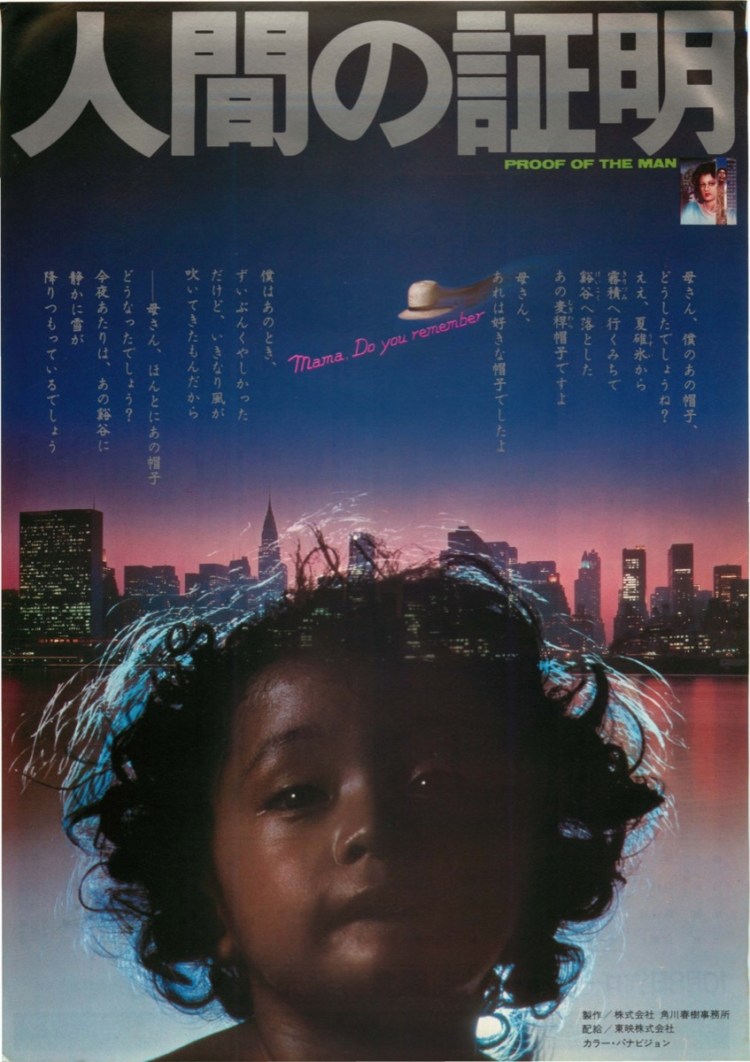
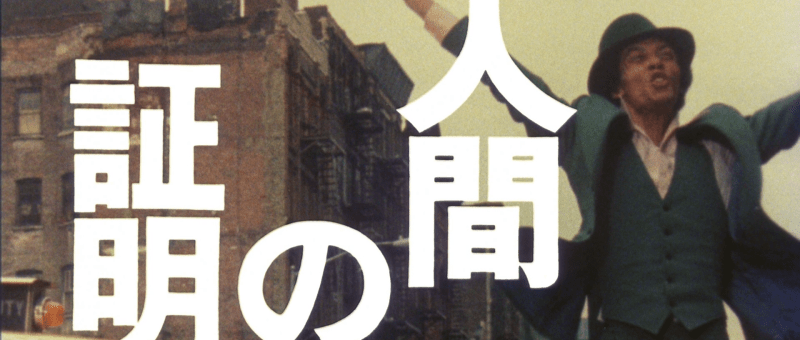
Proof of the Man (人間の証明, Junya Sato, 1977)

proof of the man posterOne could argue that Japanese cinema had been an intensely Japanese affair throughout the golden age even as the old school student system experienced its slow decline. During the ‘70s, something appears to shift – the canvases widen and mainstream blockbusters looking for a little something extra quite frequently ventured abroad to find it. Pioneering producer Haruki Kadokawa was particularly forward looking in this regard and made several attempts to crack the American market in the late ‘70s and early ‘80s before settling on creating his own mini industry to place a stranglehold around Japanese pop culture. Sadly, his efforts mostly failed and faced the same sorry fate of being entirely recut and dubbed into English with new Amero-centric scenes inserted into the narrative. Proof of the Man (人間の証明, Ningen no Shomei) is one of Kadokawa’s earliest attempts at a Japanese/American co-production and, under the steady hands of Junya Sato, is a mostly successful one even if it did not succeed in terms of overseas impact.

Based on the hugely popular novel by Seiichi Morimura, Proof of the Man stars the then up and coming Yusaku Matsuda as an ace detective, Munesue, investigating the death by stabbing of a young American man in Japan. The body was discovered in a hotel lift on the same night as a high profile fashion event took place with top designer Kyoko Yasugi (Mariko Okada) in attendance. After the show, an adulterous couple give evidence to the police about finding the body, but the woman, Naomi (Bunjaku Han), insists on getting out of the taxi that’s taking them home a little early in case they’re seen together. On a night pouring with rain, she’s knocked down and killed by a young boy racer and his girlfriend who decide to dispose of the body to cover up the crime rather than face the consequences. Kyohei (Koichi Iwaki), the driver of the car, is none other than the son of the fashion designer at whose show the central murder has taken place.

Like many Japanese mysteries of the time, Proof of the Man touches on hot-button issues of the immediate post-war period from the mixed race children fathered by American GIs and their precarious position in Japanese society, to the brutality of occupation forces, and the desperation and cruelty which dominated lives in an era of chaos and confusion. The only clues the police have are that the victim, Johnny Hayward (Joe Yamanaka), said something which sounded like “straw hat” just before he died, and that he was carrying a book of poetry by Yaso Saiji published in 1947. Discovering that Hayward was a working-class man of African-American heritage from Harlem whose father took a significant risk in getting the money together for his son to go to Japan (hardly a headline holiday destination in 1977), the police are even more baffled and enlist the assistance of some regular New York cops to help them figure out just why he might have made such an unlikely journey.

The New York cops have their own wartime histories to battle and are not completely sympathetic towards the idea of helping the Japanese police. Munesue, of a younger generation, is also harbouring a degree of prejudice and resentment against Americans which stems back to a traumatic incident in a market square in which he witnessed the attempted gang rape of a young woman by a rabid group of GIs. Munesue’s father tried to intervene (the only person to do so) but was brutally beaten himself, passing away a short time later leaving Munesue an orphaned street kid. In an effort to appeal to US audiences, Proof of the Man was eventually recut with additional action scenes and greater emphasis placed on the stateside story. Doubtless, the ongoing scenes of brutality instigated by the American troops would not be particularly palatable to American audiences but they are central to the essential revelations which ultimately call for a kind of healing between the two nations as they each consider the ugliness of the immediate post-war era the burying of which is the true reason behind the original murder and a secondary cause of the events which led to the death of Naomi.

Naomi’s death speaks more towards a kind of growing ugliness in Japan’s ongoing economic recovery and rising international profile. Kyohei is the son not only of high profile fashion designer Kyoko, but can also count a high profile politician (Toshiro Mifune) as his father. Spoiled and useless, Kyohei is the very worst in entitled, privileged youth driving around in flashy cars and going to parties, living frivolously on inherited wealth whilst condemning the source of his funds as morally corrupt citing his mother’s acquiescence to his father’s frequent affairs. Yet aside from anything else, Kyohei is completely ill-equipped for independent living and is essentially still a child who cannot get by without the physical and moral support of his adoring mother. 

Johnny Hayward, by contrast, retains a kind of innocent purity and is apparently in Japan in the hope of restoring a long severed connection as echoed in Saiji’s poem about a straw hat lost by a small boy on a beautiful summer’s day. The words of the poem are later repeated in the title song by musician Joe Yamanaka who plays Johnny in the film and is of mixed race himself. As in most Japanese mystery stories, the root of all evil is a secret – in this case those of the immediate post-war period and things people did to survive it which they now regret and fear the “shame” of should they ever be revealed. Some of these secrets are not surmountable and cannot be forgiven or overcome, some atonements (poetic or otherwise) are necessary but the tone which Sato seems to strike encourages a kind of peacemaking, a laying to rest of the past which is only born of acceptance and openness. Despite the bleakness of its premiss on both sides of the ocean, Proof of the Man does manage to find a degree of hopefulness for the future in assuming this task of mutual forgiveness and understanding can be accomplished without further bloodshed.


Original trailer (no subtitles) – includes major plot spoilers!

HENTAIDA (I am a Pervert) (変態だ, Hajime Anzai, 2016)

B2_0912_OLYou can’t call your film “I am a Pervert” and not expect a certain sort of reaction. Then again, the debut feature from illustrator Hajime Anzai isn’t quite sure what reaction it wants. Part indie journey movie about a conflicted folk singer and part coming of age comedy in which a middle-aged man is forced to own his “perversion” following a horrific bear attack, HENTAIDA (I am a Pervert) (変態だ) is nothing if not perverse.

The nameless protagonist (Kenta Maeno) begins his feature-length voiceover by letting us in on his ignominious teenage history. A shy and lonely boy, he had no girlfriends or even friends of any kind. He took to his room and practiced guitar while the others his age misspent their youths in more exciting ways. No great academic success either, he took a year out to resit his college exams but even then only got into a second-rate institution. It was, at least, in Tokyo – his dream city, and therefore a partial answer to his dreams but when he overslept and missed orientation he found himself on a different path altogether when a large woman with giant frizzy hair press ganged him into joining the university’s rock group.

Bored with his lessons, the protagonist starts to enjoy playing in a band even if he was kind of forced into it. When the bandleader is arrested, the remaining members form a new mini group – The Rejection Letters, and go on to some minor success. Life, however, comes to the protagonist’s bandmates who cut their hair and get regular jobs after uni like you’re supposed to. Now calling himself “Reject Letter”, (or just “Reject” to his friends), the protagonist has been married for five years and has a young son. He’s happy, but he cannot rid himself of the need to visit regularly with an old groupie, Kaoruko (Tsukifuna Sarara), who happens to be a dominatrix (and his sometime manager).

Shooting in black and white, Anzai breaks into colour only twice – during a lengthy and exaggerated sex scene, and then again on a scene of extreme violence. The implication is that Reject’s world is cold and grey, devoid of sensation outside of physical communion with his wife and the final, visceral shock which leads to the inevitable declaration that he is indeed a “pervert”. Truth be told, Reject’s “perversion” is not such a serious one – his early relationship with Kaoruko awakened him to sadomasochism and he has been unable to give up this part of his life or indeed share it with his wife, continuing an “arrangement” if not quite an affair whilst being consumed by shame.

Events come to a head when Reject is invited to perform at a Christmas gig way up in the snowy mountains with some other acts from the circuit both musical and variety. Under the twin tortures of a very boring coach companion and Kaoruko’s desire to provide some “excitement”, Reject’s mind begins to crack. Remembering his wife’s desire to come see him play, he becomes paranoid that she’s hiding somewhere in the (extremely sparse) crowd and will therefore discover the existence of Kaoruko. His shame is so great that he doesn’t seem to realise it might be perfectly normal for his wife to meet his manager and not realise she’s also a dominatrix, and so he steals Kaoruko away and runs off up a snowy trail to certain doom where a very strange adventure awaits him.

Anzai tries to have it both ways, so to speak, in mixing an arty, ironic aesthetic with strange sex scenes running from the semi-explicit weirdness of the consensual lovemaking between Reject and his loving wife, and the slightly less consensual one with a rapidly disintegrating Kaoruko in subzero, bear infested territories. Modesty fog couples with a man throwing vibrators at a rampaging bear as odd mirrors of the implicit and explicit while Reject progresses towards his end goal of being able to own his “perversion” though it’s far from clear whether it’s loud and proud or a grudging confession considering what there is lying in wait in the woods. Perhaps too strange and lowkey for its own good, HENTAIDA (I am a Pervert) does at least live up to its name if only in its bizarre tale of a repressed man’s passage to some kind of self acceptance through a surreal, shame filled adventure.


Original trailer (no subtitles)

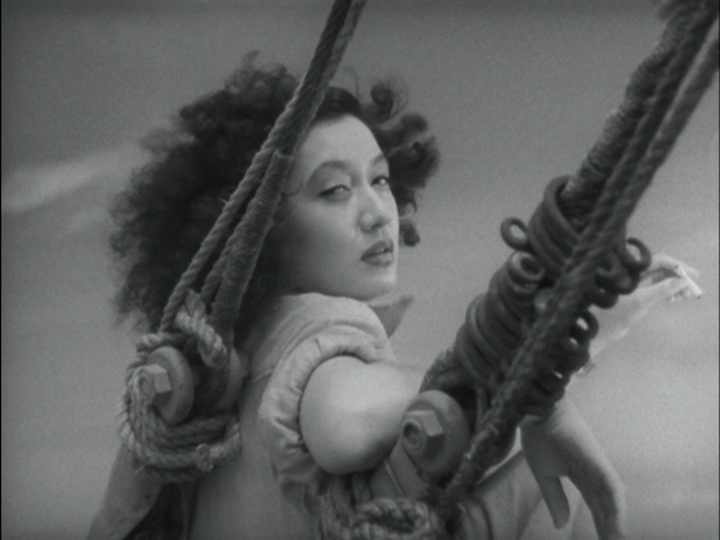
A Woman in the Typhoon Area (颱風圏の女, Hideo Oba, 1948)

vlcsnap-2017-12-14-23h50m20s302Setsuko Hara acquired the nickname “the eternal virgin” from her fans inspired by the genial ingenue roles she was most associated with especially in her long career with Yasujiro Ozu in which she often played a reluctant daughter finally getting married (though only at the end of the picture). The nickname took on something of an ironic quality after her abrupt retirement from the acting world in which, rather than getting married, she remained single and locked herself away in her quaint little house in Kamakura, refusing all subsequent requests relating to showbiz. Woman in the Typhoon Area (颱風圏の女, Taifuken no Onna) is a rare entry in her filmography in which she plays completely against type (and does so brilliantly) as a damaged, brassy, and sensual woman caught up in a storm of her own as the sole female between a gang of vicious smugglers and a nerdy group of weather scientists marooned on an island by a typhoon.

As the film opens, the smugglers have been spotted by the coastguard and are engaged in a lengthy firefight trying to escape. Eventually they manage to evade government forces, but they’re way off course and running out of fuel while one of their number is also badly injured. Luckily they eventually run into an island which is home to a Japanese weather station. Unfortunately, the weather station has received a telegram from the coastguard and works out who the smugglers are. There isn’t enough fuel or food for the smugglers to steal and escape, but even if there were the approaching typhoon means it would be unwise to try.

The set-up is uncannily close to that of John Huston’s Key Largo, released the same year, though the tiny band of smugglers is nowhere near as intimidating as Edward G. Robinson’s band of thugs, nor are they particularly emblematic of a persistent lingering threat of fascism in the rise of bullies making their way through fear. What the smugglers are is mildly pathetic and intensely self interested. The weather station staff, government officials, are the good guys but they’re also easily cowed by three men (and a sympathetic/indifferent woman) with a single gun. The major conflict is over control of the radio which the smugglers have temporarily broken in fear of someone calling the coastguard. The weathermen want to repair it because it’s imperative they let the surrounding area know that a dangerous typhoon is on the way.

Like many films of the immediate post-war era, the central theme is one of the common good vs selfish interest. The radio operator, Amano (Jun Usami), is determined to act for “the common good” and is confident that he is the sort of person who will do the “right” thing at the right time. The smugglers don’t particularly care if a lot of people end up dying because they weren’t warned about the storm as long as they don’t get caught by the coast guard. For Kijima (So Yamamura), the boss of the smugglers, all that matters is strength – a strong man will never kneel but Amano would kneel if it meant he could get up later and do the right the thing even if it then costs him his life.

Where gangster narratives are often about surrogate families, the band of smugglers actively rejects familial bonds and only maintains cohesion through shared suspicion. Kuriko (Setsuko Hara) is Kijima’s girl, but Kataoka (Isao Yamaguchi) continually goes behind his boss’ back to seduce her finally even attempting rape. Though second mate Yoshii (Eijiro Tono) may seem more loyal, he too holds little love for his boss and will betray him if he thinks Kijima no longer strong enough to rule. Trapped within the claustrophobic environment of the weather station, the gang destroys itself in petty rivalries and long standing suspicions. Kijima was right when he said you couldn’t trust anyone on a ship, but he can’t trust his guys on land either.

The war is an obvious and recurrent theme but Kuriko’s troubles were only exacerbated rather than caused by it. An abandoned child, she recounts eating cold rice with strangers at 11 and it doesn’t take a lot of imagination to figure out what she means when she says she remembers the name of her first man but not his face. Kuriko is a good girl turned bad by persistent social indifference and subsequent trauma experienced as a nurse in frontline field hospitals. She’s distant and embittered, living as a man on ship, dressing in slacks and shirts and chain smoking her life away. Trapped in the station and exposed to the “goodness” of Amano she starts dressing in more feminine fashions and reconsidering her gangster lifestyle. Though she starts to change, helps the weather station to save the locals, it’s clear that it’s already too late for her to save herself other than through a final act of sacrifice in service of a new ideal and an old love.

Only 70 minutes long Woman in the Typhoon Area is a taught, tense character piece which doesn’t quite manage to make the most of its intensely claustrophobic settings but still manages to reinforce its central message of selfishness being bad and altruism good. Hara is a revelation in such an unusual role, stealing each and every scene in steely uncertainty, giving the impression of a woman whose ongoing fall is as much a willing act of self harm as it is a natural consequence of her impossible circumstances.


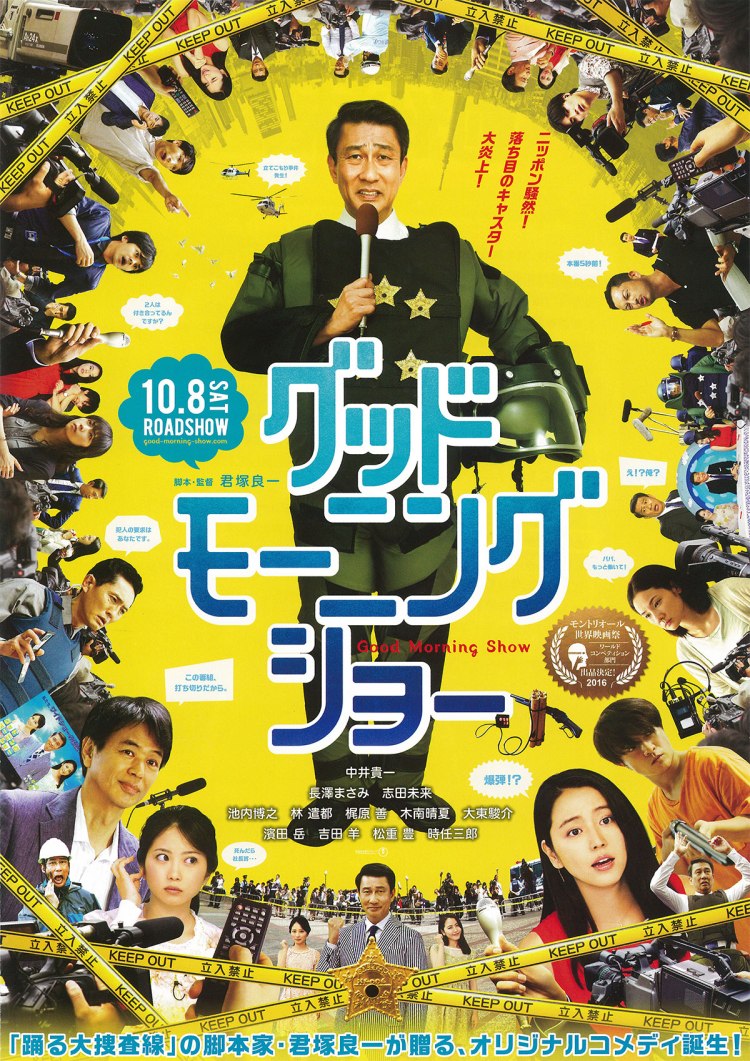
Good Morning Show (グッドモーニングショー, Ryoichi Kimizuka, 2016)

Good Morning Show posterThirty years before Good Morning Show (グッドモーニングショー), No More Comics showed us that the news is serious business and it seems the intervening three decades have not done much to change that. Good Morning Show is the kind of vacuous TV magazine programme that seems to have become popular the world over but Japan has mastered in its entirety. This is a news programme for people trying to avoid the news – there’s just enough of the essentials to keep the average viewer up to date with the big ticket item of the day, but the rest is horoscopes, cakes, and celebrity gossip. The morning news sets the mood for the rest of the day, and isn’t it in everyone’s interest if it’s blue skies all the way ahead? Perhaps so, but whatever happened to serious journalism?

Good Morning Show’s veteran anchor, Sumida (Kiichi Nakai), used to be a top talent on the evening news but a spot of “inappropriate” reporting from the scene of a disaster has had him relegated to the nonsensical early morning magazine show which involves getting up at 3am everyday and becoming something of an expert on pastries. Sumida’s day starts badly when he gets up to find his wife (Yo Yoshida) and son (Mihiro) still awake. As it turns out, there’s a family crisis. Sumida’s student son has got his girlfriend pregnant and has decided to do the right thing and get married, no matter what his dad might have to say about it. Sumida is definitely not happy but he’s also late for work. On the way, he finds out that his co-anchor, Keiko (Masami Nagasawa), with whom he apparently had some kind of drunken indiscretion, has decided that they’re now a couple and is about to announce as much live on air. Luckily for Sumida, a third crisis enters his life when a gunman (Gaku Hamada) takes a cafe hostage and asks directly for the Good Morning Show host to visit him at the scene.

The Good Morning Show exists entirely to cater to its audience’s baser instincts, but its simple charms are apparently going out of style and the show will be cancelled if they don’t get their numbers up soon. The hostage crisis is a godsend in this regard as is Sumida’s unexpected importance to the case which gets the show on the ground reporting live from the scene with exclusive access. Given this shift in broadcast tastes, it’s strange there’s no reference to social media though Good Morning Show is apparently viewable via the internet with a large portion of the audience tuning in on their smartphones during their morning commute. This sense of “community” seems to be key to the show’s appeal as the interactive poling which usually asks silly questions intended to spark debate such as whether or not to throw out gifts from old lovers, becomes central to the hostage case in deciding whether Sumida and the gunman should live or die live on air.

The gunman, like many, turns out to be just another angry young man frustrated that no one will listen to his complaints. At first it looks like Sumida may be in some way responsible, either because of his botched reporting on an earlier disaster or a connection to an incident in the cafe some years previously, but it turns out the major factor is a kind of hypocritical smugness that’s become the Good Morning Show’s trademark. For all of his frustrations with the format, Sumida is depressingly good at mindless twaddle and his fake “worry” about the future of the nation has got the gunman’s back up. The key issue is still more personal as the gunman feels himself excluded from the community feeling fostered by the show when he tries to make himself heard via its channels and is ignored.

A definite irony when Good Morning Show’s major selling point is “ignoring” the real news. Yes, they run a small item on the important headline of the day which provides Sumida a chance to “worry” about corrupt politicians misappropriating public funds etc, but then the show moves on to more cheerful areas like celebrity affairs and delicious cakes. Sumida ends up committing the newsman’s mortal sin – he becomes the news, much as the reporter at the centre of No More Comics did before him, though like the show itself it’s the personal which wins the day. Saying the things he couldn’t say to directly to his own son, Sumida tries to forge a connection with the gunman who is not a bad person, just another youngster at the end of his tether with an uncaring world. The connections are made through glass, but they are made all the same (even if imperfectly and with less than total honesty). Good Morning Show is, like its namesake, a fairly disposable effort but fun while it lasts. Then again sometimes the most harmless things do the most harm.


Original trailer (English subtitles)

Love Me Once Again (미워도 다시 한번, Jung So-young, 1968)

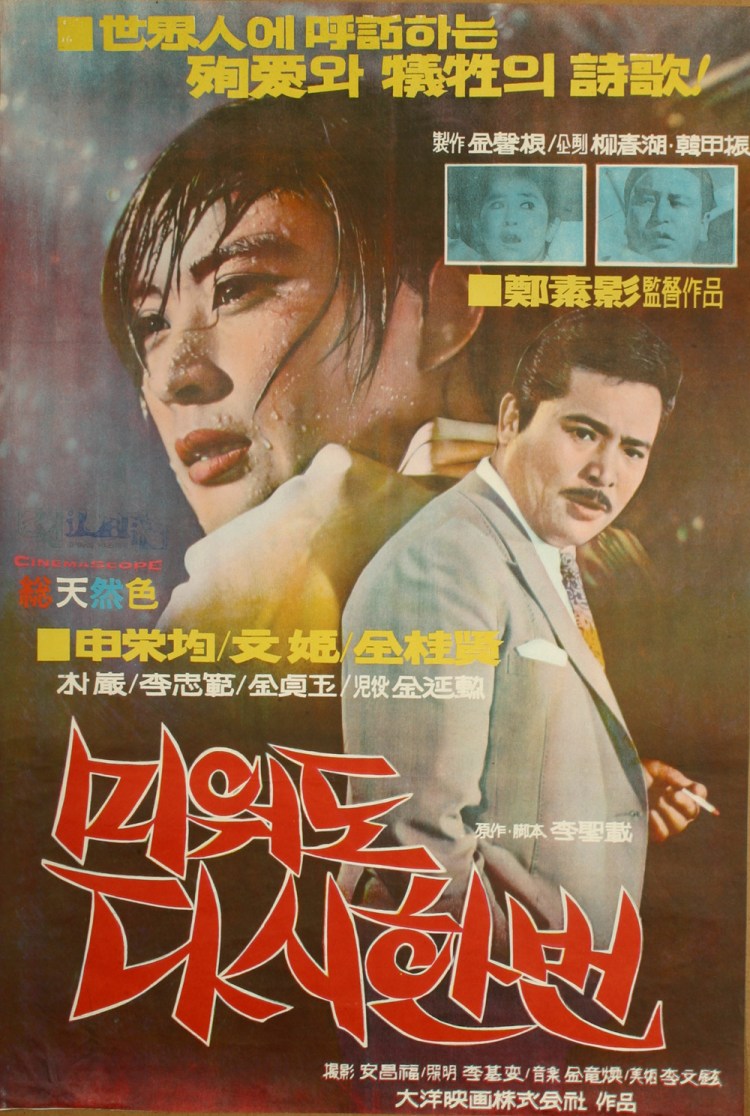
love me once again posterBy the late 1960s, Korean society was caught in a moment of intense social change. Though under the oppressive authoritarian regime of Park Chung-hee, the strict censorship regulations of the early 1970s had not yet taken effect and the 1962 Motion Picture Law which encouraged a shift towards commercial cinema intended for mass entertainment created a fertile ground for melodrama which itself enabled subtle commentary on modern society. The first in what would become a long running series with two sequels and a number of remakes stretching into the 1980s, Love Me Once Again (미워도 다시 한번, Miweodo Dasi Han Beon) is a prime example. A box office hit and pop culture phenomenon, Love Me Once Again is a somewhat unusual entry the melodrama canon in its broadly sympathetic treatment of adultery and attitude towards children born out of wedlock.

The film begins in the present as family patriarch Shin-ho (Shin Young-kyun) enjoys a pleasant family Sunday fishing with his son and picnicking with his wife (Jeon Gye-hyeon) and daughter but the scene is quickly interrupted by a servant who comes to fetch Shin-ho to greet an urgent visitor to the house. The visitor turns out to be an old friend of Shin-ho’s who has a distressing message for him – Hye-young (Moon Hee), a young woman with whom he had an affair eight years previously, is back in town and would like to meet.

Flashing back eight years, Hye-young is a young kindergarten teacher living in the lodging house where Shin-ho is staying while working away from home. The pair become friends and everyone seems to assume they are a couple, though Shin-ho insists Hye-young is just a friend. Nevertheless, he eventually begins an affair with her leading Hye-young to turn down a marriage arranged by her parents. Though Shin-ho discourages her to do this, Hye-young has no idea he is already married with two children and believes he will marry her at some point in the future. Shin-ho plans to tell Hye-young about his wife but can’t bring himself to do it, allowing her to find out in the worst possible way when his wife arrives with both kids in tow. Realising she’s been duped and feeling in the way, Hye-young takes off without warning leaving only a letter wishing Shin-ho well and letting him know that she is pregnant with his child and intends to raise it alone.

Hye-young is certainly a very “modern” forward thinking woman though she is also morally upright, only embarking on a relationship with Shin-ho because she believes he is the man she will spend her life with. Her family had arranged a marriage for her and express their frustration with Hye-young for not returning home immediately in a letter which also makes plain that they will suffer embarrassment if she refuses the marriage altogether – which she does. When she returns home pregnant with Shin-ho’s child, her brother (who seems to be the head of the family), throws her out. Hye-young’s mother seems more sympathetic, but is powerless to help. Hye-young will have to manage on her own without the assistance of friends or family.

Eight years on she has a lovely little boy, Young-shin (Kim Jung-hoon), whom she has raised alone in hardship but not unhappiness. Encouraged by her brother and seeing how Young-shin looks on enviously at other little boys playing with their fathers on the beach, Hye-young begins to wonder if it might not be better to have Shin-ho raise Young-shin alongside his other two children in a middle-class family home. As Shin-ho’s son he would have a life of material comfort, a paternal input, and be free of the stigma of being the illegitimate child of an unmarried single mother.

Though the situation is difficult, it is handled with calm and maturity on all sides, not least from Shin-ho’s wife who takes a while to think hard on the situation and then agrees to look after Young-shin but only as a full adoption. She asks that Hye-young refrain from writing to or seeing her son, leaving him entirely in the family’s care. Hye-young has made her decision and agrees that may be for the best, even declining the offer of written updates from Shin-ho’s best friend. Once Young-shin has become a part of Shin-ho’s family, his wife truly does her best to make him feel at home as the third of her children, treating him kindly and taking the older two to task for teasing their “baby brother”. The children however are not quite so accepting with Shin-ho’s eldest son particularly hostile, bullying little Young-shin mercilessly even though he has done nothing to provoke his anger other than try to be friends with him. Getting a new little brother is perhaps particularly hard for the children who now have to share everything with a virtual stranger, but despite the efforts of Shin-ho’s wife, she just can’t seem to make them accept him.

Shin-ho, feeling awkward and guilty, is not quite as committed as his wife is to making the new family work. He tries to treat Young-shin as his son, but never quite connects with or makes him feel at home. The major problem is that the family all insist Young-shin must forget about Hye-young and commit fully to his new family as they are committing to him but that’s a lot to ask for an eight year old boy who quite fairly misses his mother and does not understand why he is not allowed to see her. A crisis occurs when Shin-ho angrily confiscates a locket Hye-young had given Young-shin containing her photo as a memento, sending him off on a long journey trying to find a way back to his mother. Being only eight, Young-shin has no idea how to go about finding her bar knowing the name of the town where he used to live. Roaming around the city all alone calling his mother’s name, Young-shin stays out all night. Shin-ho and his wife are sick with worry, searching for him in the pouring rain, but when he finally returns drenched and miserable, Shin-ho treats him only with anger and not with tenderness.

Meanwhile, Hye-young is struggling to come to terms with her decision to “abandon” her son, having bad dreams that Young-shin is being mistreated or is miserable, missing her as much as she misses him. Obeying the family’s request to stay away, Hye-young cannot resist coming to visit and observing from far away, hoping to catch a glimpse of her son and find out if he is well and happy. Unfortunately she turns up just as he’s gone out looking for her and spots him cowering outside Shin-ho’s house, drenched in the rain. Afraid to go near him she urges him to go inside, calling out from the shadows only to be spotted by Shin-ho as she makes her escape.

Rather than wallow in misery, Jung does not refuse the inherent melodrama of the situation but addresses it realistically and with a degree of maturity and patience most real life situations can only aspire to. Hye-young believes that Shin-ho hates herself and her son and will never be able to accept them as members of his family, but even so he does appear to have developed at attachment to Young-shin and hopes that he can maintain contact with him even if it remains clear Young-shin cannot remain in their home. Shin-ho’s wife too makes a point of not blaming Young-shin for her husband’s mistake and displays compassion for Hye-young who meant her no harm and has incurred only suffering as a result of her involvement with Shin-ho. Where most melodramas would punish Hye-young for her transgressions, Jung is kinder to her, never condemning her for her “immoral” behaviour in sleeping with Shin-ho before marriage and making it clear that her decision to live independently as a single woman and raise Young-shin alone is not only valid but correct and to be supported. A controversial attitude for the Korea of 1968 but one which declares itself on the side of modernity rather than adherence to traditions which more often than not create more problems than they solve.


Available to stream for free via the Korean Film Archive’s YouTube Channel.
N@NIMONO (何者, Daisuke Miura, 2016)

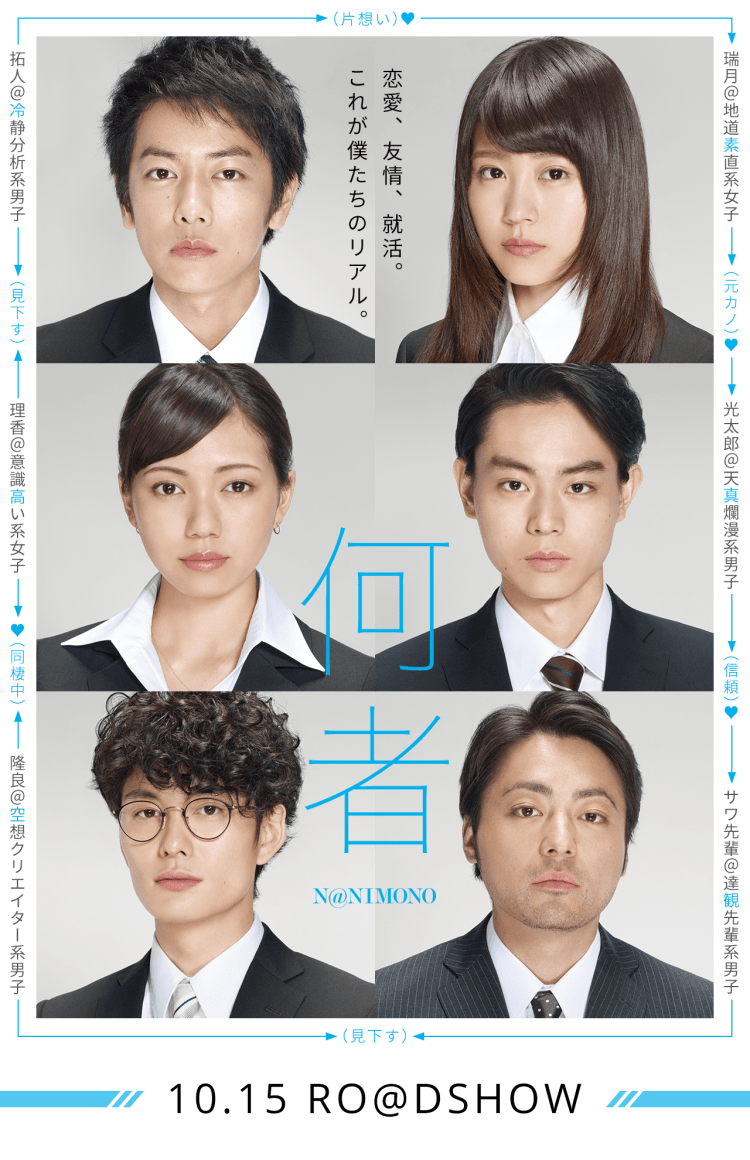
Nanimono posterGrowing up is a series of battles in Japan. Exam hell soon gives way to the freedom and liberation of university but students know that their carefree days of youth and discovery will be short lived. Job hunting is done en masse and takes place in the final year of study (or even before). The process of securing a work placement is much the same as deciding on which school to apply to – attending job fairs to meet with representatives, getting hold of brochures, talking to anyone and everyone you know about the various reputations of the big firms, and then figuring out what your best bets are. Many companies run written exams which are then followed by group interviews in which the applicants are made to answer humiliating questions in front of their fellow candidates. What this all amounts to is a gradual erasure of the self in order to become the perfect hire, making the same tired phrases sound interesting in an effort to say all the right things whilst trying not too seem calculating or too bland.

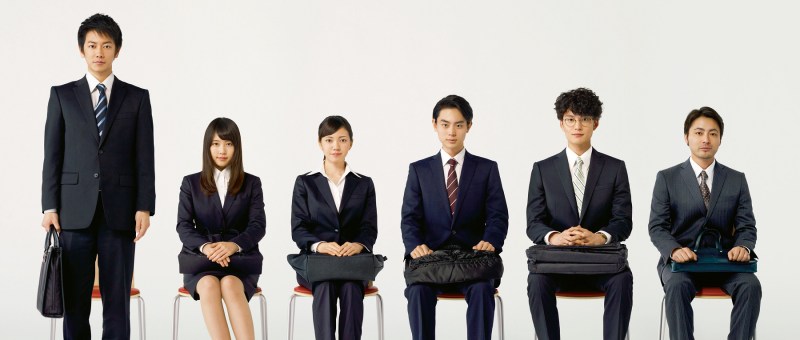
The group at the centre of Daisuke Miura’s adaptation of the Naoki Prize winning novel by Ryo Asai, N@NIMONO (何者, Nanimono, AKA Somebody / Someone), know this better than most. Protagonist Takuto (Takeru Satoh) used to be interested in theatre but has abandoned his dreams of the stage for the mainstream route into company life while his friend Kotaro (Masaki Suda) has played his last gig as the lead singer of a rock band, died his hair black again, and got a smart haircut in preparation for interviews. The boys are still good friends and roommates despite the fact that Takuto has long been carrying a torch for Kotaro’s former girlfriend, Mizuki (Kasumi Arimura), who has just returned from studying abroad. Mizuki is good friends with another girl, Rica (Fumi Nikaido), who happens to live upstairs from the boys and suggests that the four of them all get together to compare notes on the job hunting process. Rica lives with her boyfriend (still somewhat unusual in Japan), Takayoshi (Masaki Okada), who is working as a freelance journalist and is disdainful of the others’ passage into the regular workaday world but later tries to get into it himself.

There is a kind of sadness involved in this process, even if no one seriously thinks about fighting back. Everyone wants to get their foot onto that corporate ladder to become “someone”, at least in the eyes of society. There are a lot of rungs on the ladder to success, and if you miss your footing it’s near impossible to get it back – you’ll wind up one of the many crowded round the bottom staring up at the top even if you don’t want to admit it. University is the last time time there is real scope for indulging one’s personality before the corporate life takes hold – thus Takuto and Kotaro both accept that their artistic pursuits have to go in their quest for a regular middle-class life even if they inwardly struggle with their decisions to “sell-out”.

Takayoshi thinks of himself as above all this. He asks himself what all of this is for, why people put themselves through this humiliating ritual just to be locked into a nine to five that makes them miserable and turns them into soulless drones. There’s an obvious answer to that, and Takayoshi’s refusal to take it into account borders on the offensive, as does his often patronising attitude to those actively engaged in the job hunting process, but his hypocrisy is eventually brought home to him when he turns down a project to work with another artist because he thinks their work isn’t good enough. Maybe there’s courage in just putting something of yourself out there, even if it isn’t very good, rather than sitting at home looking down on everything and critiquing everyone else’s life choices whilst getting nothing done yourself.

It’s this conflict between interior and exterior life in which N@NIMONO is most interested. Main character Takuto begins as the everyman, depressed and stressed by his job hunting odyssey but aloof isolationism soon reveals itself as a kind of cowardice and self-involvement born of insecurity as he takes to a “secret” Twitter account for acerbic comments on his friends’ lives, sarcastically taking cruel potshots safe in the knowledge of his anonymity. Takuto’s entire concept of himself is a construction as his eventual descent into abstraction shows us in recasting his interaction with his friends as an avant-garde theatre show in which he finally begins to see the various ways his resentment of others is really just a way of expressing dissatisfaction with himself. This inability to fully integrate his own personality is offered as the final reason he hasn’t managed to find employment – his insincerity marks him out as a poor prospect. Takuto’s final realisation that he is unable to successfully answer the standard interview question “define your own personality in under one minute” for the perfectly sensible reason that the task is impossible kickstarts his own journey to a more complete life, even if it doesn’t do much to help the countless other “someones” out there hammered into a standard sized holes as mere cogs in the great social machine.


N@NIMONO seems to have been screened under the English titles of both “Somebody” and “Someone” but “N@NIMONO” is the one that features on the title card of the English subtitled Hong Kong blu-ray.

Original trailer (no subtitles)

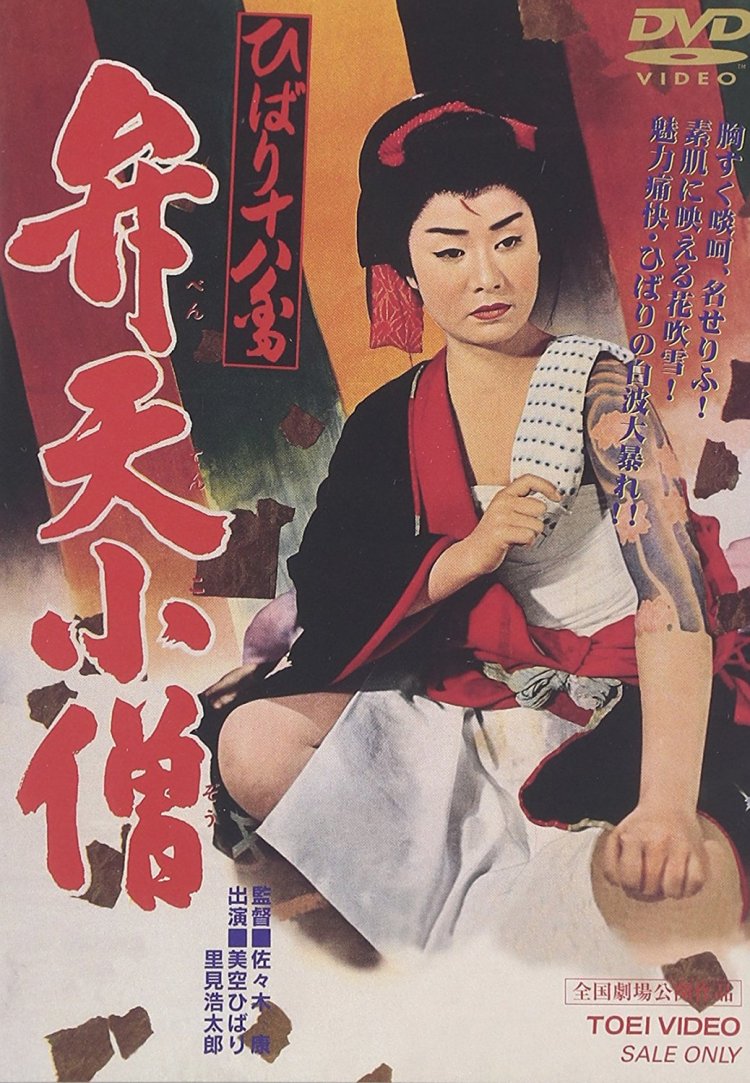
Hibari Ohako: Benten Kozo (ひばり十八番 弁天小僧, Yasushi Sasaki, 1960)

Benten Kozo dvd coverStarting out as a child actress, Hibari Misora was one of the biggest singing and acting stars of the post-war period whose songs are often pointed to as embodiments of the era’s melancholy yet determined spirit. Though it’s her singing career which has perhaps had the most historical impact, Misora made an immense number of films most of them in ’50s and ‘60s, many typical star vehicles of the time – silly comedies and softer musicals, usually finding an opportunity or two for a song even in straight drama. Hibari Ohako: Benten Kozo (ひばり十八番 弁天小僧), released in 1960 for Toei, is very much of this mould and showcases another somewhat interesting facet of Misora’s career in her readiness to play ambiguous gender roles.

Based on the well known kabuki play, Benten Kozo, which had also been adapted two years previously in a version starring male actor Raizo Ichikawa, Sasaki’s film stars Hibari Misora in the title role – a 13 year old boy who was given up at birth to be raised in a temple which specialises in performing Noh theatre. Kikunosuke (Hibari Misora) is their star, but there’s a dark side to temple performing companies in that they’re dependent on donations and it’s accepted practice to allow wealthy patrons to do whatever they like with the talent, no matter their age or gender. Kikunosuke knows this and isn’t having any of it. Pushed into a room with a lecherous, overly made-up older woman, Kikunosuke balks at the old monk’s attempts to pimp him out and tries to leave, much to the monk’s disappointment.

Unfortunately, just as Kikunosuke is leaving, a thief arrives to steal the money meant for the monk and kills the old woman in the process. Kikunosuke kills the thief but is accused of killing the old woman too and is forced on the run. Tracking down his birth mother, Ofuji (Mitsuko Miura), Kiku thinks he’s found a home but is betrayed, at which point he adopts the name “Benten Kozo” (lit. “Benten Kid” where Benten is the name of the goddess at the temple where he was raised) and joins a gang of Robin Hood-style outlaw thieves.

Like many period films of the time, Benten Kozo revolves around exposing the corruption of the samurai order. In this case, it’s a salt scam – the samurai elders have been stockpiling salt to push the price up, endangering the lives of ordinary people for their own financial gain and thinking nothing of it. The thieves, led by later Lone Wolf and Cub star Tomisaburo Wakayama, are dedicated to robbing the rich to feed the poor but they also aim to expose those in power for the reckless bullies they really are. Benten Kozo joins the “Shiranami Five Alliance” both out of self preservation and out of genuine sympathy with their cause, eventually encountering the same corrupt monk who turned a blind eye to his attempted molestation when he intervenes to save a woman forced into prostitution to pay her father’s debt whom the monk was attempting to rape.

Benten Kozo listens to the woman’s story and decides to give her his savings (which he no longer wants after being betrayed by his mother for whom he’d been saving the money) to pay off her family debt. In fact the pair met earlier when Benten Kozo was on the run and she helped him hide from the authorities. The woman, like several in the film, falls for Benten Kozo’s androgynous charms though he remains resolutely noble and indifferent. Benten Kozo would originally have been played by a male actor on the kabuki stage which did not allow female performers. The “onnagata” or actors who specialised in playing women were often effeminate younger men or boys much like Benten Kozo himself who plays these skills to the max throughout the film.

Hibari Misora, with her low, husky voice, effortlessly switches between the elegant upperclass women Benten Kozo impersonates on stage and in service of the gang’s scams, and the rough and ready dialect of a street ruffian. In a shocking display of bravado, Benten Kozo drops the top of his kimono to show his off his tattoos proving once and for all that he’s no lady but still his appeal lingers perhaps precisely because of his gender ambiguity.

Benten Kozo is not a musical but finds two occasions for Misora to sing – once as Benten Kozo takes off on the road, and the other at the end as he paddles a boat away back to his new found friends. The film ends with a giant mass brawl and also provides ample scope for Misora to escape across roof tops and fight off the unjust but it’s otherwise fairly straightforward fare and not exactly among the singer’s most memorable outings. It is however generally entertaining and interesting enough in its central theme of woman playing man playing woman to warrant attention from more than just diehard Misora fans.


Hibari Misora singing Benten Kozo in concert some years later.

Antiporno (アンチポルノ, Sion Sono, 2016)

Antiporno posterIf freedom exists in Japanese cinema, it exists only through sexual liberation. Only in this most private of acts can true individual will be expressed. Sion Sono, ever the contrarian, wants to ask if that very idea of “freedom” is in itself oppressive and he’s chosen to do that through his contribution to the Roman Porno Reboot Project in which five contemporary directors attempt to recreate Nikkatsu’s line in ‘70s soft-core pornography.

Opening in a room of bold primary colours – the sunlit walls of the yellow bedchamber and the garish red of the doorless bathroom, Sono homes in on the figure of Kyoko (Ami Tomite) who lies face down on a bed with her underwear around her ankles. She seems somehow broken and exhausted, staring into a piece of glass from a shattered mirror and making ominous statements to herself. Suddenly her mood changes, no longer the maudlin woman she transforms into the cute and quirky high schooler so beloved of certain genres of Japanese entertainment. When her assistant arrives, Kyoko delights in humiliating her, forcing Noriko (Mariko Tsutsui) to crawl around on all fours wearing a dog collar and then ordering her to allow herself to be raped by an (all female) team of newspaper reporters.

So far, so Petra von Kant, but Sono doesn’t stop here. He shows us that this brightly coloured room is a stand-in for Kyoko’s fracturing psyche, a failed attempt to order her chaotic world. Someone shouts “cut” and we’re on a film set – roles are reversed, Kyoko is no longer in control. Her memories enter free fall as she flits between an awkward (possibly imagined) childhood, and her present predicament as, alternately, plaything and dominatrix.

The roots of Kyoko’s confusion stem back to the contradiction in her parents’, or really her society’s, attitude to sex. During a very strange family dinner, Kyoko and her younger sister have a frank discussion with mum and dad about male and female genitals and how they fit together. The language is pointed, but Kyoko’s father has very clear ideas about what is obscene and what isn’t – “Cocks” are what men stick into prostitutes and they’re obscene, but he has no sensible answer when pressed on how exactly “cocks” and “male genitalia” can be all that different. Her parents tell her sex is indecent and shameful while continuing to talk about their own sex life openly and refusing to shield their daughters from their obvious appetites. They offer no answer for this continuing paradox, only the affirmation that Kyoko’s desires are “indecent” and must be rejected.

Kyoko’s sister finds her freedom in another way, but Kyoko pursues hers through sexuality, looking for a connection in midst of true liberation. She wants to become a “whore” which the adult version of herself describes as “a woman so pure it breaks her own heart”, but what she’s looking for is the freedom which eludes her in her day to day living. Kyoko and later Noriko repeat the mantra that they will dismantle the “annoying freedoms which restrict me”,  lamenting that there is no freedom of speech in a country like Japan and that no woman has ever been able to attain their own freedom in a world entirely controlled by men. A protest against the renewal of the ANPO security treaty runs on the TV while Kyoko’s sister holds up a book of butterflies, exclaiming that all the free things fly away. The women of Japan, according to Noriko, praise free speech but reject their own freedom, forced to chase false liberations and endlessly allowing themselves to be manipulated by a culture they themselves willingly create.

The fly away butterflies hit the ceiling, and Kyoko’s captive lizard cannot escape its bottle. Sono seems to suggest that there is no true freedom, that the very idea of “true freedom” as mediated through the idea of sexual liberation is itself another fallacy used to manipulate women into doing what men want. Kyoko ends up in a “Roman Porno” to empower herself, but is disempowered by it – rendered an anonymous object trapped inside an entirely different kind of tube. Blinded by colours and memory she searches for an escape but finds none, groping for the mechanism to set herself free from the delusion of liberation but grasping only empty air.


Antiporno is available to stream in the UK via Mubi until 8th January and will be released on blu-ray by Third Window Films in April 2018.

Original trailer (English subtitles)