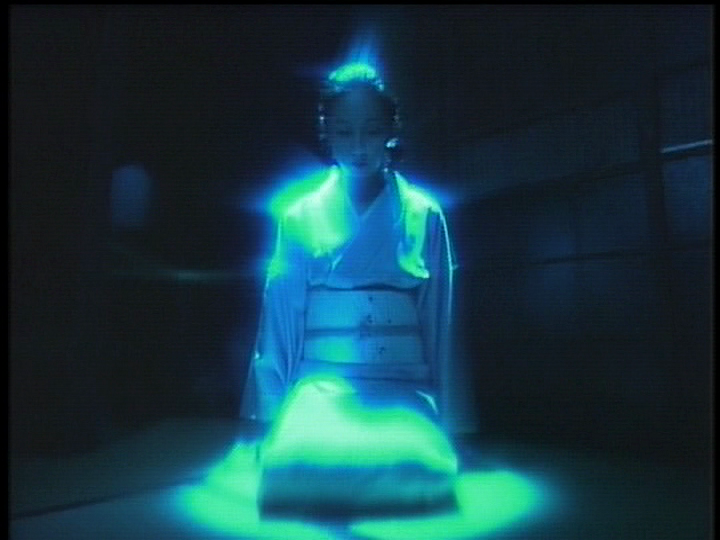
 Akio Jissoji had a wide ranging career which encompassed everything from the Buddhist trilogy of avant-garde films he made for ATG to the Ultraman TV show. Post-ATG, he found himself increasingly working in television but aside from the children’s special effects heavy TV series, Jissoji also made time for a number of small screen movies including Blue Lake Woman (青い沼の女, Aoi Numa no Onna), an adaptation of a classic story from Japan’s master of the ghost story, Kyoka Izumi. Unsettling and filled with surrealist imagery, Blue Lake Woman makes few concessions to the small screen other than in its slightly lower production values.
Successful artist Nagare had a serious following out with one of his oldest friends five years ago and is so rather stunned to receive an invitation to his wedding. Nagare had been invited to paint the portrait of Takigawa’s father and then asked to stay at his home for an extended period whilst Takigawa travelled in Europe buying art. Tokigawa’s father was old and frail and therefore retired to an annex each night at 8pm leaving Nagare entirely alone in the house alongside Takigawa’s wife, Mizue. The inevitable occurs when the lonely and neglected Mizue falls for the handsome painter but the romance turns dark when she talks Nagare into a double suicide at Blue Lake. Mizue drowns herself but Nagare survives only to be rescued and confined to a mental hospital.
Now five years later Takigawa wants to forget (if not quite forgive) the past and start again with a new wife by his side. The funny thing is wife number two, Ameko, is the spitting image of Mizue. When Takigawa once again asks him to stay alone in the house with his new wife whilst he jets off to America, Nagare begins to wonder exactly what’s going on. Staying at the house a second time, Nagare finds himself haunted by the ghost of the woman who died for him, but whose sacrifice he ultimately rejected. Mizue seems to want him to come to her at the bottom of Blue Lake, but Nagare still lacks the courage to take his own life, if not the inclination. Thinking of Mizue but inevitably becoming closer to Ameko, Nagare is trapped between the living and the dead but it turns out there may be more than supernatural intrigue to his darkly romantic adventures.
Jissoji creates an oppressive and creepy atmosphere for the woodland mansion noisy with the sound of a hundred ticking clocks, filled with shadows and shot from odd angles. Nagare begins to dream strange dreams in which Mizue comes to him, leaving watery footprints and her signature comb behind her to indicate that her presence is not limited to the dream world. Complaining that she’s “alive” beneath the mud next to Blue Lake where she’s cold and lonely, Mizue waits for him to make good on his promise and join her there. Nagare remains unsure if this Mizue is a manifestation of her grudge towards him, or simply a manifestation of his own guilt in allowing her to die alone.
Trapped in Vertigo-esque conundrum torn between the living Ameko and the dead Mizue, Nagare
finds himself in an impossible position unable to clearly distinguish between the two women, at one point physically attacking Ameko believing her to be Mizue’s ghost. It remains unclear if the resemblance between Mizue and Ameko is real or a figment of Nagare’s imagination prompted by both women’s position as Takigawa’s wife and by their watery names (“mizue” literally meaning “water picture” and “Ameko” “rain child”) both of which lead him straight back to Blue Lake. If it’s death Nagare is chasing rather than either women or friendship, he is ultimately unable to follow through on his desires all the while protesting that it’s “desire” which holds him among the living.
The supernatural elements are emphasised and undercut by turns as Nagare discovers their may be a more solid, real world cause for the strange events plaguing him. Still, the past continues to haunt Nagare in one form or another leaving unexplained and half remembered events to linger in his memory, rendering his reality continually unstable. As her name suggests, the ghostly Mizue is always shown in a hazy, watery blue, radiating waves of unease designed to pull Nagare back to the failure of his love suicide and at least as far as his art life in concerned, there’s part of him always submerged beneath the waters of Blue Lake. Even if not quite reaching big screen standards, Blue Lake Woman displays high production values for a 1980s television special anchored by naturalistic performances and innovative camera technique. Filled with Jissoji’s idiosyncratic surrealist imagery, Blue Lake Woman is a haunting, gothic ghost story which refuses to give up on its supernatural chills even whilst proffering a more rational explanation for all of its strange goings on.

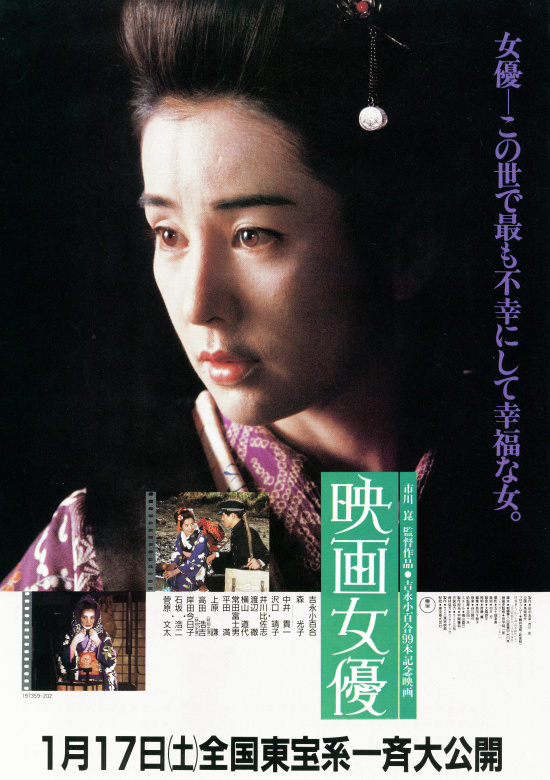 Kon Ichikawa was born in 1915, just four years later than the subject of his 1989 film Actress (映画女優, Eiga Joyu) which uses the pre-directorial career of one of Japanese cinema’s most respected actresses, Kinuyo Tanaka, to explore the development of Japanese cinema itself. Tanaka was born in poverty in 1909 and worked as a jobbing film actress before being “discovered” by Hiroshi Shimizu and becoming one of Shochiku’s most bankable stars. The script is co-written by Kaneto Shindo who was fairly close to the action as an assistant under Kenji Mizoguchi at Shochiku in the ‘40s before being drafted into the war. A commemorative exercise marking the tenth anniversary of Tanaka’s death from a brain tumour in 1977, Ichikawa’s film never quite escapes from the biopic straightjacket and only gives a superficial picture of its star but seems content to revel in the nostalgia of a, by then, forgotten golden age.
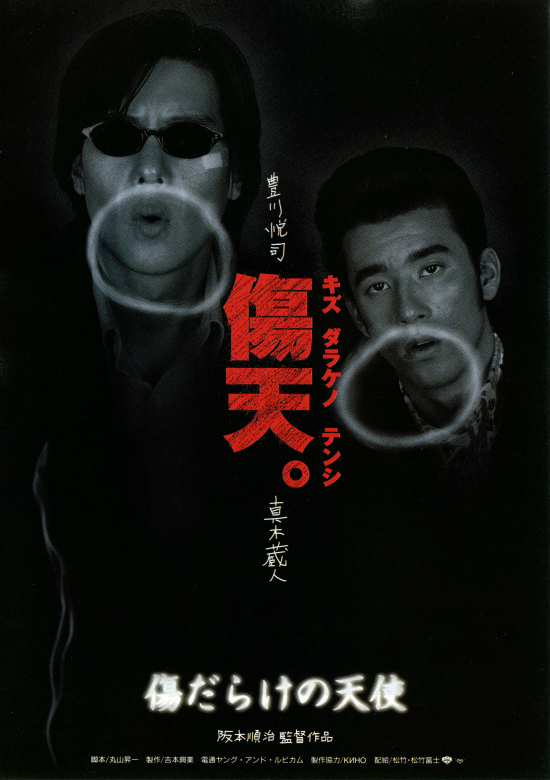 Despite having started his career in the action field with the boxing film Dotsuitarunen and an entry in the New Battles Without Honour and Humanity series, Junji Sakamoto has increasingly moved into gentler, socially conscious films including the Thai set Children of the Dark and the Toei 60th Anniversary prestige picture
 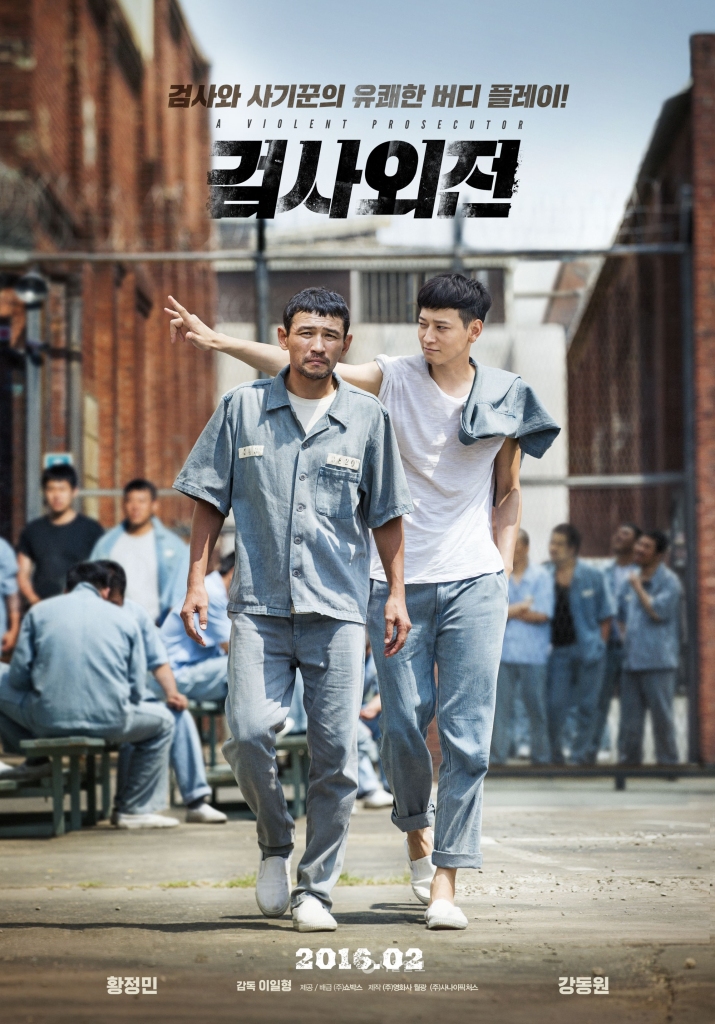 Review of Lee Il-hyeong’s A Violent Prosecutor first published by
 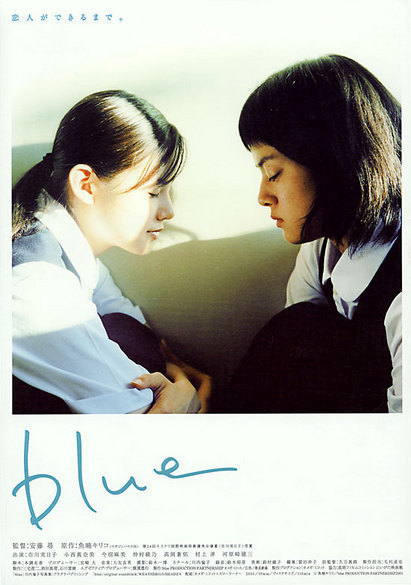 Growing up is hard to do. So it is for the teenage protagonists of Hiroshi Ando’s debut mainstream feature, Blue (ブルー), adapted from the manga by Kiriko Nananan. Like Nananan’s original comic, the cinematic adaptation of Blue is refreshingly angst free in its examination of first love and the burgeoning sexuality of two lonely high school girls. Shot with a chilly stillness which echoes the emptiness of this small town existence, Blue is no nostalgic retreat into cosy teenage dreams but a cold hard look at the messiness and pain of adolescent love.
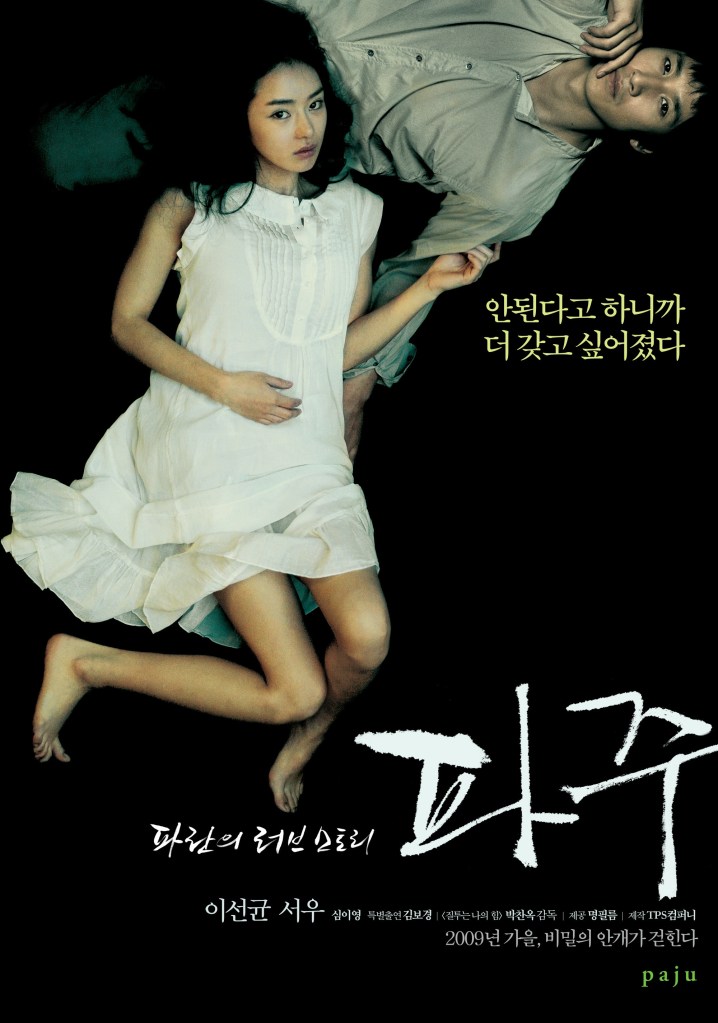 Paju (파주) is the name of a city in the far north of Korea, not far from “the” North, to be precise. Like the characters who inhabit it, Paju is a in a state of flux. Recently invaded by gangsters in the pay of developers, the old landscape is in ruins, awaiting the arrival of the future but fearing an uncertain dawn. Told across four time periods, Paju begins with Eun-mo’s (Seo Woo) return from a self imposed three year exile in India, trying to atone for something she does not understand. Much of this has to do with her brother-in-law, Joong-shik (Lee Sun-kyun), an local activist and school teacher with a troubled past. Love lands unwelcomely at the feet of two people each unable to make us of it in this melancholy coming of age tale shot through with tragic irony.
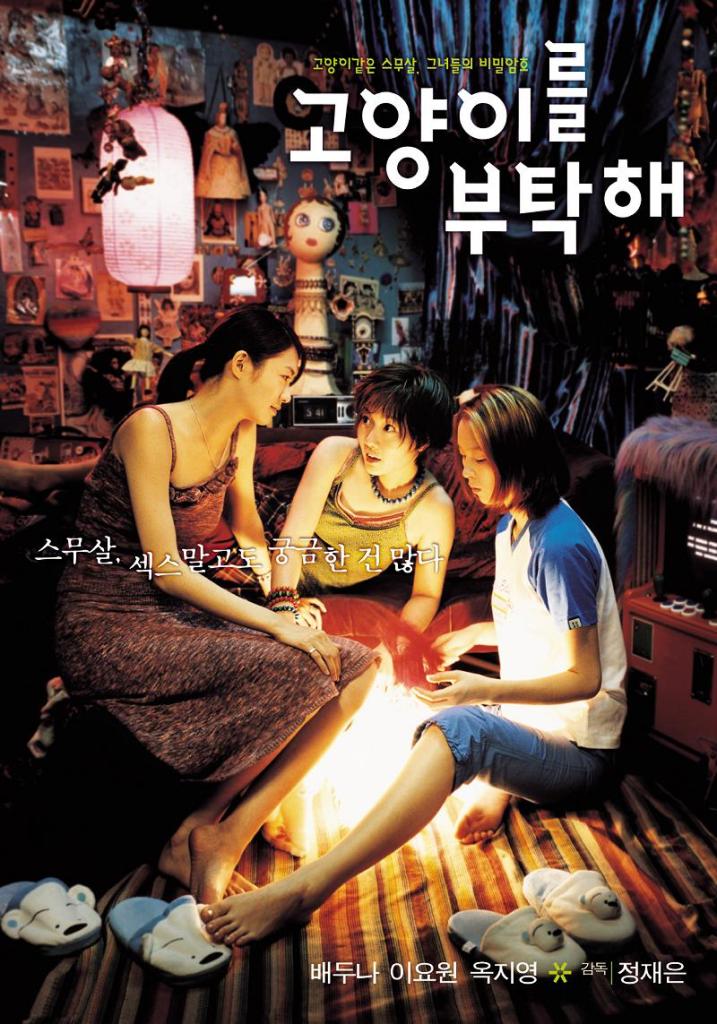 The time after high school is often destabilising as even once close groups of friends find themselves being pulled in all kinds of different directions. So it is for the group of five young women at the centre of Jeong Jae-eun’s debut feature, Take Care of My Cat (고양이를 부탁해, Goyangileul Butaghae). All at or around 20, the age of majority in Korea, the girls were a tightly banded unit during high school but have all sought different paths on leaving. Lynchpin Tae-hee (Bae Doo-na) is responsible for trying to keep the gang together through organising regular meet ups but it’s getting harder to get everyone in the same place and minor differences which hardly mattered during school grow ever wider as adulthood sets in.
