The Wailing (곡성, Na Hong-Jin, 2016)

wailingFor the world’s more full of weeping than you can understand – the residents of Goksung, the setting for Na Hong-jin’s nihilistic horror movie The Wailing (곡성, Goksung), might be inclined to agree with Yeats if only because the name of their town is also a homonym for the “sound of weeping”. There is plenty to weep over, and in places Na’s film begins to feel like one long plaintive cry reaching far back to the dawn of time but the main wounds are comparatively more recent – colonisation, not only of a landscape but of a soul. When it comes to gods, should you trust one over another simply because of its country of origin or is your faith to  be bestowed in something with more universal application?

Goksung is a sleepy little rural town way up in the mountains. This is the kind of place where nothing much ever happens but today all of that is about to change as a local man has committed a series of bloody murders and is now in a dissociative state. Bumbling policeman Jong-goo (Kwak Do-won) arrives late to the crime scene but quickly finds himself pulled in to the ongoing investigations as bodies begin piling up in the previously quiet town.

The rational explanation for the spate of violent killings is blamed on a tonic containing some funny mushrooms but others have another idea. All of this started happening after a Japanese guy (Jun Kunimura) moved to the town. Some say he’s a professor, some say he’s a Buddhist monk, but there also those who hold him responsible for the rape of a local woman, and there are even reports of him running about the forest dressed only in a loincloth and feasting on the remains of fallen animals.

Eventually, Jung-goo’s young daughter Hyo-jin (Kim Hwan-hee) falls under the curse, giving him an unavoidable impetus to find the truth. As well as the “suspicious” Japanese visitor, Jung-goo also comes into contact with a mysterious young woman dressed in white (Chun Woo-hee) who may be either friend or foe, whilst shamans and the Catholic Church are each approached for their advice on this singularly supernatural phenomenon.

This being quite a sleepy town, Jung-goo’s days most likely involved a lot of napping, eating, and card playing, broken up with chatting to old ladies. So unaccustomed to crime are they, they didn’t quite remember to put their gloves on before investigating a crime scene. Jung-goo and his partner are constantly branded “morons” by their boss and if the night they end up guarding the police station during a thunderstorm is anything to go by, they aren’t exactly the bravest of souls either. Not the best pair to be investigating a complex, supernatural mystery they decide to heed the rumours and pay a visit to the Japanese guy living way out in the woods.

Known only by the derogatory term “the Jap”, the new addition to the village quickly falls under suspicion thanks to the old fashioned crime of not being from around here. Whether out of resentment for historical crimes or simply because of being an outsider, everyone decides the Japanese visitor must, in some way, be responsible. Suspicions are compounded when Jung-goo, his partner, and his partner’s nephew who happens to be a Catholic priest in training with a solid command of Japanese, discover some very odd things whilst snooping around the man’s home. Is the mysterious visitor really, literally, a “Japanese devil” or just the victim of an ongoing campaign of intense xenophobia and the supernatural elements attributed to him a manifestation of that extremely offensive term?

Na keeps us guessing. Meanwhile, ancient remedies are sought when ancient ones are awakened, hence Jung-goo’s mother-in-law turns to shamanism to try and cure her granddaughter of her increasingly serious illness. The shaman (Hwang Jung-Min) arrives more like a TV evangelist than a witch doctor – smart suit and turtleneck, topped of with long hair tied into a bun. The exorcism scene itself is a furious battle between light and darkness (or so we presume) as the shaman dances wildly to the pulsating drum beats of his orchestra, sacrificing a chicken here and a goat there, all while Hyo-jin writhes in agony in the next room and his enemy performs a counter ritual from his recently refurbished lair.

“Believe in me and you shall be saved” is a message Jung-goo receives from just about everyone during the course of the film. The Catholic Church, however, is resolutely opposed to the idea of this demonic threat and informs Jung-goo that this is not a religious matter – he ought to take his daughter back to the hospital and instil his “faith” in modern medicine. Faith appears to be the central question, in what or whom should one believe? Can Jung-goo trust his shaman, is the Japanese guy an ally, threat, or just a neutral, ordinary man, and what of the oddly intense woman dressed in white? In the end, Jung-goo’s faith is questioned but he pays dearly for his final decision. Had he placed more faith in the old gods, his fate might have been very different but Jung-goo chose real world logic (not his strongest suit) over spiritual intuition and failed to heed the warnings.

Jung-goo, though presented as a broadly sympathetic presence, is partly responsible for his own downfall through his willingness to embrace the baser elements of his nature. In contrast to his otherwise laid-back character which sees him late to work because of family meals, Jung-goo has a violent streak first seen when he takes defending himself from an angry dog far further than he needed to. Later he rounds a group of friends to help him take out the Japanese man in a worrying stab at mob justice. Neither quality is very endearing but Jung-goo’s position as a slightly dim bruiser who mistakenly thinks he can smash his way out of a spiritual conundrum makes him an unlikely choice of saviour.

Na offers nothing in the way of hope, the forces of darkness are set to conquer the world helped only by humanity’s propensity towards doubt, its selfishness, and its fear. The dark humour fades as the pace increases until the film approaches its bleaker than bleak finale. This is a land of ghosts, both fleshy and otherwise but in order to bid them goodbye you must first accept their presence. In the end it’s all a question of faith but those most worthy of it may be among the most difficult to believe.


Reviewed at 2016 BFI London Film Festival

Original trailer (English subtitles)

The Vanished Murderer (消失的凶手, Law Chi-leung, 2015)

vanished-murderWhen The Bullet Vanishes was first released back in 2012, the film received unfair criticism in some quarters due to its enormous debt to Guy Richie’s then popular Sherlock Holmes. Derivative or not, The Bullet Vanishes remains an innovative and intricately plotted cerebral thriller, primed to launch the return of its central detective, former prison warden, Inspector Song (Sean Lau). Only slightly late, Song is finally back to address another series of baffling deaths and conspiracies in 1930s China only this time he’s landed in a pulpy LA noir rather than the cowboy-tinged action of the previous film.

The Murderer Vanishes (消失的凶手, Xiāoshī de Xiōngshōu) revolves around Song’s Irene Adler figure, Fu Yuan (Jiang Yiyan), whom we saw Song making frequent prison visits to in The Bullet Vanishes. Song is called to the prison because Fu Yuan has mysteriously disappeared from her cell leaving only a Shawshank Redemption inspired red herring behind her. The strange bond between Song and Fu Yuan in which they chastely dance around each other in the ultimate long distance romance, dictates that Fu Yuan send him a letter to tell him exactly where she is so he can come and arrest her all over again.

After a hot date at the cemetery, Fu Yuan takes Song to a philosophy lecture in which the speaker, Professor Hua (Gordon Lam), muses on a thought experiment in which he discusses the ethical problem of making an active choice to sacrifice one life in order to save multiple lives and whether making such a choice is any different from committing a murder – i.e. pushing another person in front of a moving train to stop it hitting a crowd further up the track. The experiment is eerily echoed when a body falls out of the sky just as Song is about to re-arrest Fu Yuan, allowing her to once again slip away.

Song investigates and is arrested only to be recruited to solve the mystery of why so many of the workers at evil corporate boss Gao Minxiong’s (Guo Xiaodong) string of factories are suddenly leaping to their deaths whilst wearing shirts bearing slogans which decry him as a slave driver.  Song is assisted by the girl he jilted at the alter eight years ago with whom he was improbably reunited on the train, Chang Sheng (Li Xiaolu), and a local policeman, Mao Jin (Rhydian Vaughan), as well as the philosophy professor but somehow this must all be linked to Fu Yuan’s mysteriously timed prison escape.

The biggest departure The Vanished Murderer has to deal with is the absence of co-star Nicholas Tse. Rather than give Song a new partner or attempt to ditch the buddy format altogether, Tse’s role has been awkwardly split into four with Song surrounded by his cohorts of varying stripes but never achieving the same kind of bond that made The Bullet Vanishes so satisfying. Many of the first film’s plot elements are also ported over wholesale, rehashing the same political subplots and betrayals but without the subtlety.

One again we have an exploited work force of factory workers suffering at the hands of a heartless capitalistic sociopath. Gao Minxiong is seen early on collaborating with a British businessman who warns him about the effects of the depression only for Gao to explain the “measures” he’s taken which include burning harvests to increase demand and therefore drive prices up, as well as closing factories to increase competition for jobs and therefore drive wages down. Gao also has a private militia he uses for strike breaking and indiscriminate massacre. The people suffer while the elites prosper, it’s an old story.

The Bullet Vanishes may have had one foot in the Old West, but The Vanished Murderer has stayed in the same geographical area whilst jumping fifty years into the future in terms of tone. Gone are the lawless, dingy back alleys and saloons – The Murderer Vanishes takes place under bright sunlight, in an airy city surrounded by green country estates. Song has even switched up his zany bowler hat from the first film for a wide brimmed fedora and the musical score also pulls in some Spanish guitar to ram home that West coast style. This is a land of flappers and jazz babies, filled with art deco elegance and international flair.

For all that it’s a pulp world too and as such exempts itself from the need to make any kind of real sense. The central mystery is nowhere near as compelling as that of The Bullet Vanishes and resolves in a less than satisfactory manner. In the great pulp tradition action set pieces become increasingly ridiculous until the point Song and Fu Yuan attempt to escape by riding a horse through a building. The film’s finale takes place entirely on a train and does at least make good use of its CGI budget even if it’s a disappointingly simple way to conclude.

A slight misstep after the well plotted charm of The Bullet Vanishes, The Vanished Murderer can’t live up to the promise of the first film. The relationship between Song and Fu Yuan ought to take centre stage but the pair spend too much time apart to make it work and the film kills off a promising ongoing plot strand for the sake of cheap melodrama in the closing moments. Still, The Vanished Murderer provides enough thrills of its own even if lighter in tone and with a weaker central mystery to make the continuing adventures of Inspector Song worth investigating.


Original trailer (Mandarin with English subtitles)

Creepy (クリーピー 偽りの隣人, Kiyoshi Kurosawa, 2016)

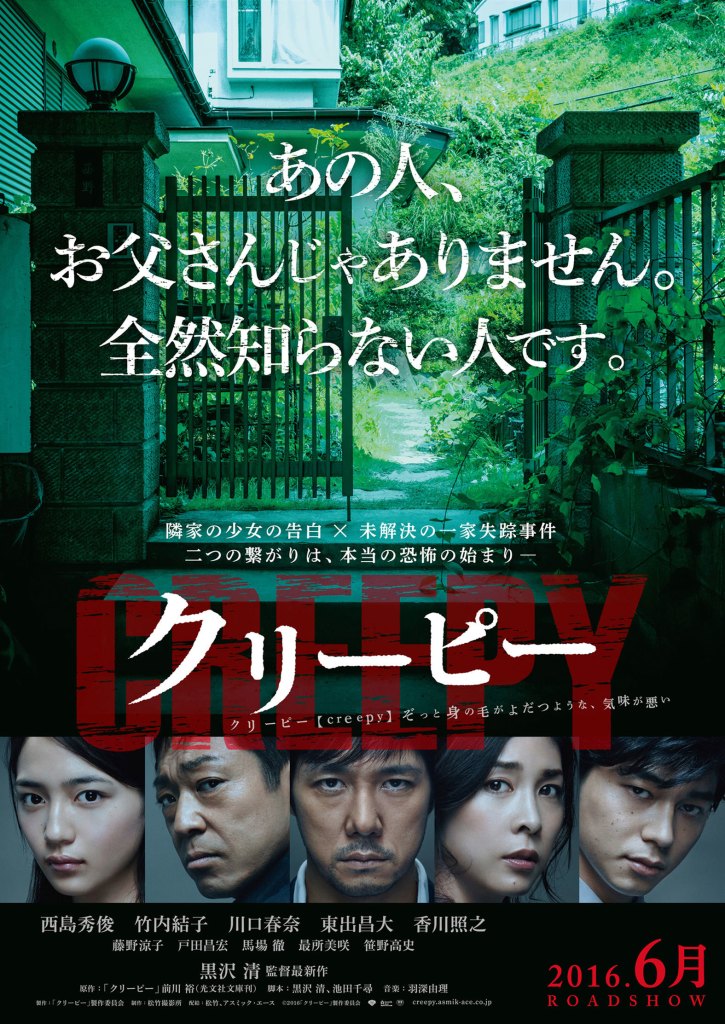
creepyHow well do you know your neighbours? Perhaps you have one that seems a little bit strange to you, “creepy”, even. Then again, everyone has their quirks, so you leave things at nodding at your “probably harmless” fellow suburbanites and walking away as quickly as possible. The central couple at the centre of Kiyoshi Kurosawa’s return to genre filmmaking Creepy (クリーピー 偽りの隣人, Creepy Itsuwari no Rinjin), based on the novel by Yutaka Maekawa, may have wished they’d better heeded their initial instincts when it comes to dealing with their decidedly odd new neighbours considering the extremely dark territory they’re about to move in to…
The Takakuras, Koichi (Hidetoshi Nishijima) and Yasuko (Yuko Takeuchi), have just relocated to the suburbs where Koichi will be taking a position at a local university teaching criminal psychology. A year previously, Koichi had been a member of the police force working on serial murder cases but after a serious miscalculation on his part during a negotiation with an escaped prisoner leaves an innocent woman dead and himself in the hospital, Koichi comes to the conclusion that he’s not quite cut out for the force after all.

Having just moved into the neighbourhood, Koichi and Yasuko attempt to make the expected visit to announce their presence to their neighbours only to find that the locals aren’t exactly friendly. After one neighbour slams the door in her face, Yasuko pays a visit to the other one, Nishino (Teruyuki Kagawa), but the way in which be begins talking to her is very strange indeed. Though unsettled, Yasuko just can’t let the idea drop and becomes intent on building up a more conventional relationship with her hard to read neighbour, ignoring all of her better instincts in the process.

Meanwhile, Koichi has become intrigued by a six year old cold case in which three members of a family abruptly disappeared leaving their young daughter, Saki (Haruna Kawaguchi), behind. Working with a former colleague, Nogami (Masahiro Higashide), Koichi tracks down the abandoned little girl (now a teenager) and attempts to get to the bottom of the mystery.

Japanese films are full of the parasitic interloper who wheedles his way into a family only to usurp control for himself and eventually colonise it. Generally, such families go back to normal once the interloper has had his fun but for the families of Creepy that would be quite difficult. In the modern world when the family unit has become so fractured and insecure that it renders once permanent communities only temporary, a chasm has been opened in human interactions which makes it easier for extreme horror to locate itself right next door to you. Nobody knows what goes on behind closed doors, and in a sense no one wants to know. Koichi attempts to use his scientific knowledge to reassure Yasuko that, as psychopaths are usually very good neighbours, Nishino must be fine, but this only goes to show superficial the couple’s interest in their environment really is.

Koichi has a mild obsession with serial killers. His desire to spend more time with a real life psycho contributed to this fall from grace at the beginning, but his investigative abilities leave a lot to be desired. Yasuko may have suggested that Nishino is the kind of person who “has no social skills” but Koichi is the archetypal interrogator – only interested in the facts and blind to the emotional subtext. After Koichi puts too much pressure on the traumatised Saki, she accuses him of tearing into people’s emotions as if dissecting a rat, and later asks him if he has any kind of heart or real human empathy at all. For all his highly prized science, most of Koichi’s clues are based on his intuition – he just “feels” the house seems like a crime scene, that Nishino is a bad guy, and that something strange is going on.

This almost supernatural “feeling” becomes the central spine of the film as creepiness travels through the air in invisible waves. Kurosawa adopts a swirling, floating approach to camera movement in the early part of the film which gives it a drunken, ethereal atmosphere, preventing any concrete attempt to grasp the reality. Playing with lighting levels Kurosawa emphasises and isolates the characters but also adds a note of uncertainty that hints at the darkness lingering at the edges of the frame. This sense of the ever present evil that exists within otherwise pleasant environments contributes to the Lynchian sense of the absurd which is also echoed by the anxiety inducing lingering camera shots of banal objects such as room thermostat or closed gates.

Despite the eeriness of the general tone, Kurosawa encourages a strain of black humour which helps to cover some of the more outlandish plot elements. The final conclusion perhaps strains credulity and is never fully explained but then the lack of concrete details adds to the already overwhelming creepiness of the events in play. Wonderfully atmospheric, beautifully photographed, and filled with a spirit of absurdism, Creepy is a very modern horror story though one not unafraid to step into the realms of the senses.


Reviewed at 2016 BFI London Film Festival

Original trailer (English subtitles)

After the Storm (海よりもまだ深く, Hirokazu Koreeda, 2016)

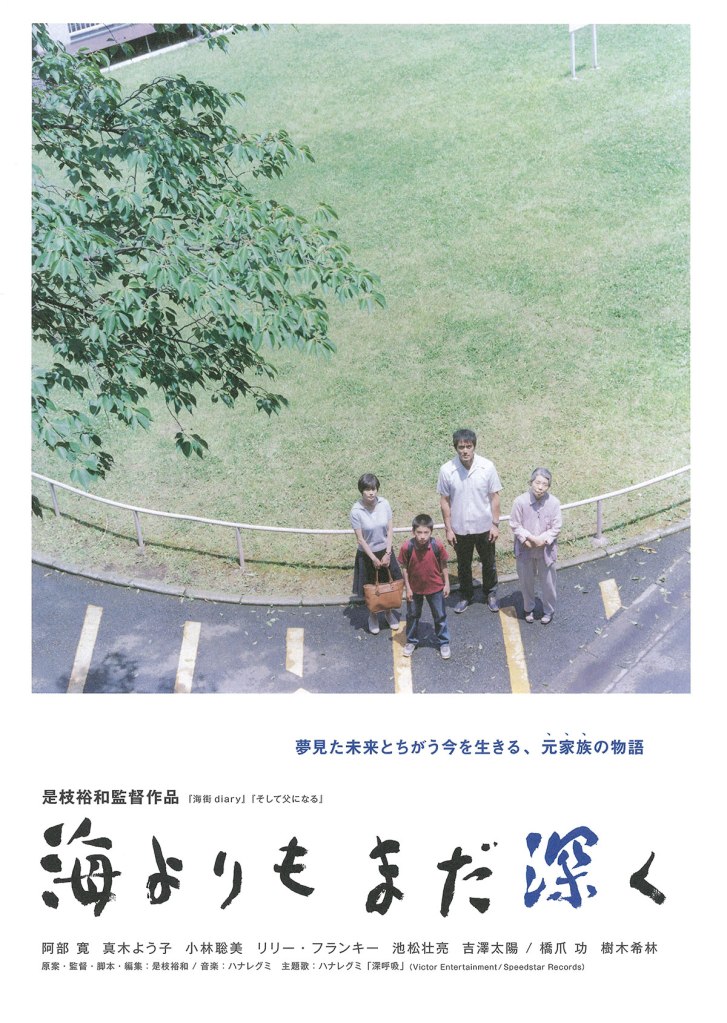
after-the-stormIt’s never too late to be what you might have been – a statement attributed to George Eliot which may be as fake as one of the promises offered by the protagonist of Hirokazu Koreeda’s latest attempt to chart the course of his nation through its basic social unit, After the Storm (海よりもまだ深く, Umi yori mo Mada Fukaku). Reuniting Kirin Kiki and Hiroshi Abe as mother and son following their star turns in Still Walking, After the Storm is, in many ways, a story of decline and lost potential though it leaves room for a new beginning if only the past can finally be left behind.
Ryota (Hiroshi Abe) is a one time prize winning novelist now working at a sleazy detective agency. He’s also a divorced father and well meaning deadbeat dad who never pays his child support but turns up every Sunday to hang out with his 11 year old son, Shingo (Taiyo Yoshizawa), much to the consternation of his ex-wife, Kyoko (Yoko Maki). Ryota hasn’t quite accepted that the marriage is over and has been using his detective skills to spy on Kyoko, discovering that she has a new man in her life who’s the exact opposite of him – successful, wealthy, and part of the elegant set.

Like father, like son (to echo another of Koreeda’s films), Ryota has inherited some of his worst qualities from his recently deceased dad. When we first meet him, Ryota has surreptitiously returned to his childhood home and let himself in with the spare key only to start rifling through draws, pocketing old lottery tickets and appraising the value of every object in sight. His mother, Yoshiko (Kirin Kiki), is actually a little bit relieved at her husband’s passing as she’s finally free of his unpleasant behaviour. Remembered as a liar and a cheat, an untrustworthy man whom everyone avoided, Ryota’s father is not the best role model leaving both of his children determined not to follow in his footsteps. This is Ryota’s first failure, and the one he’s most reluctant to acknowledge.

Desperately wanting to reclaim his place within his own family, Ryota goes to great lengths to get the money for his child support payments, somehow still hoping to be forgiven. Ryota’s eyes are always on the prize, but always on the unattainable rather than the real possibilities right in front of him. After double dealing on his clients by effectively blackmailing them, not to mention pressuring his colleague to lend him money, Ryota fritters it away on gambling trying to win it all, rather than settling for making the best of what he has. His quick fix approach to life has already cost him his wife’s faith as she is far less obliged to put up with the kind of nonsense Yoshiko was expected to grin and bear.

Yet Ryota seems to have the desire to be better, only lacking the faith to accept the possibility. When Ryota tries to blackmail a high school boy over an affair with a teacher, the boy declares that he’ll never grow up to be the kind of man Ryota is. Ryota, wounded, replies that it isn’t easy to grow up and be the man you wanted to be. As a child, Ryota wanted to be a civil servant because it was the exact opposite of his father, but he’s ended up becoming his father anyway. Shingo also claims to want to be a civil servant rather than something flashier like a professional baseball player but perhaps his desires are born more out of a sense of self realisation than an active opposition. When someone later asks Ryota if he’s the man he always wanted to be, he truthfully replies that he isn’t, but he’s working on it.

Events come to a head when Kyoko, Shingo, and Ryota end up staying over at Yoshiko’s apartment because of the oncoming typhoon. Played out with a quiet kind of restraint, old grievances are aired, understandings are reached, and each arrives at the next morning with a new sense of clarity.  After the storm has broken, there’s nothing left to do but assess the damage and then begin trying to rebuild as best you can.

Ryota’s epiphany comes to him as he’s wearing his father’s shirt and about to sign his own name with his father’s prized brush and ink stone. There’s something to be said for owning yourself, even if you can’t exactly be proud of it. Yoshiko asks why men can’t learn to love the present – if all you ever do is obsess over what you’ve lost or what you could gain, life will pass you by. Ryota may not have changed very much after coming through the storm, but he’s working on it. Who knows, he might even mean it, this time.


Reviewed at the 2016 BFI London Film Festival.

Original trailer (English subtitles)

The original Japanese title for the film, Umi yori mo Mada Fukaku, is taken from the lyrics to the Teresa Teng song Wakare no Yokan.

Grasshopper (グラスホッパー, Tomoyuki Takimoto, 2015)

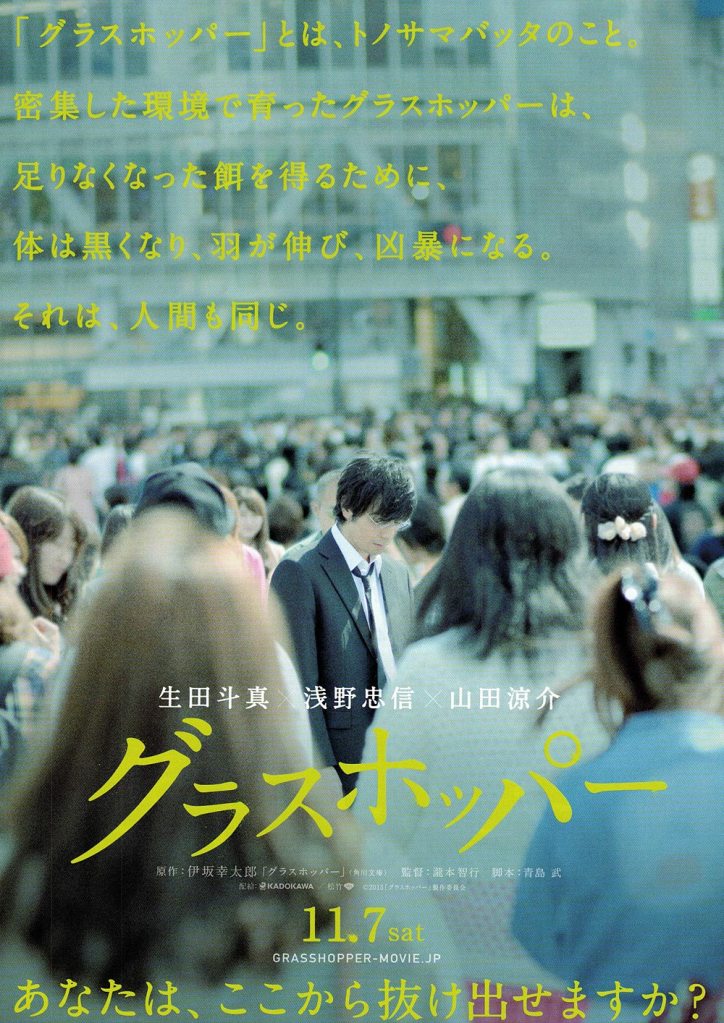
grasshopperThe best revenge is living well, but the three damaged individuals at the centre of Tomoyuki Takimoto’s Grasshopper (グラスホッパー) might need some space before they can figure that out. Reuniting with Brain Man star Toma Ikuta, Takimoto moves away from the more overtly sci-fi elements but maintains a level of everyday strangeness that adds weight to this standard B-movie affair. A revenge thriller in which revenge itself is shown to be a fallacy, Grasshopper manages to mix its grimy grind house violence aesthetic with an oddly hopeful view of human nature.

One tragedy connects three very different people. Halloween, Shibuya – a crazed man at the wheel of a 4×4 receives a phone call instructing him to “crush all those bugs”, because he’s “the saviour”. The man obeys and plows into the holiday revellers crushing them like insects under his wheels. One victim, Yuriko (Haru), who died pushing a child out of harm’s way happened to be the fiancée of middle school science teacher, Suzuki (Toma Ikuta). Revisiting the spot where she fell, Suzuki unexpectedly receives a letter informing him that the events which occurred at Halloween were not as straightforward as the media asserts and he should set about investigating the father and son working at “Fraulein”. His mind burning with thoughts of vengeance, Suzuki abandons his old life and launches himself headlong into the criminal underworld in search of answers.

Meanwhile, the evil kingpins at the centre of things have sent their ace hitman with a difference, Kujira (Tadanobu Asano), to silence a troublesome reporter. Kujira’s unusual assassination method involves a kind of hypnosis in which he forces his victims to acknowledge their darkest sins and eventually commit suicide. Though this sounds like the ideal plan for evading detection, the gangsters are nervous that Kujira has learned to much through his near death conversations with his targets and send a duo of slightly less competent killers on his trail. This leads us to our third strand – sociopathic blade wielding killer, Semi (Ryosuke Yamada), and his stray cat rescuing handler, Iwanishi (Jun Murakami).

Suzuki finds himself out of his depth in the murky, crime ridden underworld. Talking to yet another hitman he crosses paths with, Suzuki is offered the grasshopper analogy which lies at the centre of the film. Pusher (Hidetaka Yoshioka) tells him that unlike regular migratory locusts which are generally green, there is a mutant breed which undergoes a “swarm phase” in which their wings grown darker and longer, becoming ever more destructive in the quest to feed themselves in a crowded environment. People, Pusher claims, are no different. The film is filled with these mutant insects, crushing their fellow humans like roaches under boots, yet there’s something to be said for the migratory guys who keep moving and oppose the mutant breed through stealth and cunning.

Each of the three men is looking for a kind of revenge even if it’s ultimately self inflicted. Unusual hitman Kujira has hit the assassin’s version of angel wings in that he can see the faces of all the men and women he has killed, quite literally haunting his every move and offering a running commentary on his life. Setting out for vengeance against the men who’ve ordered his death, Kujira knows he’s nearing the end of his path yet before he gets there he will have to face off against Semi with whom he has no particular quarrel despite having just given Semi a reason to seek vengeance against him. Semi’s quest for revenge is pointed at Kujira but their mutual need for satisfaction will destroy each of them whilst also bringing them together as equals.

Everything prior to the fateful Halloween is bathed in golden light where warm colours predominate in Suzuki’s fond memories of his fiancée, but everything after is dark, reds and blacks tinged with insect green as grasshoppers swarm like harbingers of a great evil. Revenge itself is constantly frustrated and ultimately swept away from each party by shadowy forces secretly working against the darkness. Nothing is quite as it seems, no one is quite telling the truth. Yet as deep as the original conspiracy goes, the counter conspiracy consistently exceeds it.

Filled with impressive action sequences from Semi’s well choreographed balletic knife displays to large scale crowd scenes and good old fashioned fist fights, Grasshopper owns its down and dirty origins but reinvigorates them with a degree of modern sophistication. Yuriko, a soup chef, insists that the true secret ingredient in her cooking is genuine emotion – that this is what’s left behind when everything else is gone. Suzuki could choose to dive inside his cocoon of unresolved vengeance for the rest of his life but that would not have been what Yuriko wanted for him. In this anti-revenge drama, vengeance is the fallacy that detracts from the truth – that the ultimate form of revenge is learning to live with the past rather than wasting time settling scores.


Original trailer (no subtitles)

Seto and Utsumi (セトウツミ, Tatsushi Omori, 2016)

seto-and-utsumiThere are two very distinct sides to the career of Tatsushi Omori. Brother of the well known actor, Nao, Omori may be best known to certain audiences for his hard hitting, often gloomy and pessimistic dramas of human misery such as festival favourite Ravine of Goodbye or the little seen The Whispering of the Gods which proved so controversial that his only option of screening the film involved erecting a tent where he could show it himself. However, a closer look at his filmography discovers a steady strain of laid-back comedy such as the Tada’s Do It All House series in which two brothers played by Eita and Ryuhei Matsuda act as bumbling handymen-cum-detectives-cum-whatever-you-need-them-to-be. It might be less surprising therefore that his latest effort is an adaptation of Kazuya Konomoto’s comedy manga Seto and Utsumi (セトウツミ, Setoutsumi) which revels in the everyday absurdity of teenage life in Southern Japan.

Seto (Masaki Suda) and Utsumi (Sosuke Ikematsu) are ordinary high school boys heading into their final year with the exam season and the end of their youthful, carefree days looming. Utsumi is a quiet, serious sort who generally doesn’t like a lot of company. Seto, by contrast, is a real live wire and not exactly a top student. Nevertheless, they found each other by a river one day and have been more or less inseparable ever since. Every day after school they meet and hang out in the same spot over looking the water where they shoot the breeze about various ordinary things from a non-argument over a girl to venus fly traps, Buddhist terminology, and ghosts.

Like many teenagers, Seto and Utsumi kill time doing nothing in particular and their conversations are generally inconsequential. Yet for all of their inherent randomness and absurdity, there’s a layer of poignancy underpinning each of them as the boys let slip various aspects of their private, interior lives. Seto’s big life drama involves the possible separation of his parents following the illness of the family cat which everyone in the family decided to indulge seeing as the poor thing didn’t have long left, but against expectation it’s two years later, the cat is still alive and Seto’s father is growing ever more resentful at spending so much money on luxury cat food. Seto’s family are a rowdy bunch, just as prone to drama as he is yet for all their complaining they seem fairly close – close enough for Seto to complain about the constant random text updates from his mother (a trait which Seto seems to have inherited himself).

Utsumi, by contrast, is much more aloof and keeps himself to himself. When Seto complains after his mother spots the boys at the river with bags full of shopping in her hands he remarks sadly that he rarely eats at home, implying it must be nice to have someone cook you a meal everyday. His approach to life is cerebral, calculating odds and planning angles, as he reveals to Seto in a piece of possibly not very helpful dating advice. Utsumi’s unseen parents are, presumably, just as aloof as he is, austere and religious. Nevertheless, in Seto he’s found a true sparring partner and someone he can waste time with amiably.

Utsumi’s parents are useful for one thing, they belong to the temple in which Seto’s crush, Kashimura (Ayami Nakajo), lives. Seto has been secretly trying to brush up on Buddhist terminology to impress her, but predictably she prefers the cool indifference of Utsumi to his friend’s energetic banter. Utsumi isn’t interested in Kashimura in any case, but not even this possible subject of conflict is big enough to seriously risk damaging the two boys’ friendship. As one character remarks towards the end of the film, it really is a once in a lifetime connection.

Omori keeps things simple, mostly sticking to static shots of the boys sitting on the steps near the river but he makes the stillness add to the sense of the absurd running through the quiet backwater town. After beginning with accordion music and ride through the canals, Seto and Utsumi’s first conversation takes place in front of an unintentional audience of a perfectly motionless older man, staring vacantly out at the river. The man turns out to have a valid (if sad) reason for being where he is, but the presence of the balloon animal vending clown from Eastern Europe (called Mr. Balloon) is a little harder to explain given that other than Seto, Utsumi, the aforementioned man, a high school bully, Seto’s mum, and a senile grandpa, no one else comes anywhere near this tranquil spot for the entire film. Using occasional dissolves and superimpositions to create a fleeting, dreamlike atmosphere with a handful of cutaways and flashbacks for comedic context, Seto and Utsumi is a truly charming ode to teenage friendship in all its pleasantly ridiculous absurdity.


Reviewed at Raindance 2016.

Original trailer (English subtitles)

There are also a few bonus web episodes of Seto and Utsumi enjoying even more pointless conversations:

No. 1 – Kendama (a kind of Japanese cup and ball game) (English subtitles)

No. 2: Timing (English subtitles)

3. Standing Ovation (no subtitles but you don’t really need them)

Three (三人行, Johnnie To, 2016)

Johnnie To is best known as a purveyor of intricately plotted gangster thrillers in which tough guys outsmart and then later outshoot each other. However, To is a veritable Jack of all trades when it comes to genre and has tackled just about everything from action packed crime stories to frothy romantic comedies and even a musical. This time he’s back in world of the medical drama as an improbable farce develops driven by the three central cogs who precede to drive this particular crazy train all the way to its final destination.
Dr. Tong (Zhao Wei), is a tough as nails neurosurgeon. Having arrived in Hong Kong from the mainland at 17, she learned Cantonese, got into medical school and has built a fine career for herself but this same drive means she’s unwilling to delegate and constant overwork is beginning to eat into her statistics. She thinks her day can’t get much worse after an angry patient rants and calls her a quack because there has been a complication with his surgery and he’s currently unable to walk but her next patient, a man with a gunshot wound to the head brought in by the police, is about to add to her already long list of workplace stressors.

Shun (Wallace Chung) is actually almost OK except for having a bullet lodged in his brain. Against all the advice, Shun refuses the offer to have it removed surgically because he’s playing a long game with the police and it’s his one bargaining chip. The police’s story is that Shun grabbed a gun and tried to escape whereupon an officer shot him. However, this turns out to be not quite true and Inspector Chen (Louis Koo) has twin worries – finding Shun’s accomplices and covering up the extreme misconduct committed by his team members.

The original Chinese title of the film, 三人行 which means three people walking, is inspired by the traditional saying that among three people you will always find someone you can learn something from. However, the tragedy of these three is that they’re incapable of learning anything from anyone else and are actually quite disinterested in other people. Tong is always thinking of her targets and can’t bear the thought of losing again if Shun dies of his injuries, but rather than learning to step back and recharge, she continues to push herself to near breaking point. Chen is series of walking contradictions – a lawbreaking policeman, so certain of his own ability to counteract crime that he’s lost all accountability. Shun’s big personality flaw is taking far too much pleasure in his playful scams. He wants to make a phone call so he refuses surgery until he can (quoting Bertrand Russell and throwing the Hippocratic oath back at Tong, already nearing the boil), never quite realising that the delay could very well signal the end of everything.

Tong, Chen, and Shun are three pillars of society – the respectability of the medical profession, the authority of law enforcement, and the inevitability of crime. Tong, the most sympathetic, propels herself into overwork but her selfish need to prove herself to herself puts patients’ lives at risk. The police force which is supposed to represent protection under the law, is shown to be corrupt and little more than criminal in itself. Chen says he can break the law to enforce the law, but what he’s really trying to do is save his own skin after going too far. Shun is simply a sociopathic genius intent on showing off his cerebral prowess to anyone who will give him the slightest bit of attention but like all criminals he’s a goal orientated, short term thinker. Each of the three is, in a sense, moving in their own universe and driven only by their own certainty of primacy.

As much as Three is a crime thriller, psychological character piece, and medical drama, what lies at the heart of it is farce. In keeping with much of his work, To’s world is an absurd one filled with eccentric fringe characters who may be more important than they otherwise appear and, as usual, the final god is luck – a paralysed man attempts suicide by throwing himself down the stairs only to suddenly find he can stand up by himself at the bottom, and Chen’s gun jams several times preventing him from taking decisive action. At one very strange juncture, Shun even tries to escape the hospital by making use of the classic boys own adventure tactic of tying a number of sheets together and using them to climb out of the window. To’s true centrepiece takes the form of a tense, exciting shootout which looks like slow motion but was apparently filmed in real time with the actors moving slowly in perfectly choreographed formation. The improbable scene of carnage, prefaced by bombs going off right, left and centre, is conducted to a the strains of a genial pop song extolling Confucianist wisdom. Beautifully balletic, the bullets hit in real time but the actors react as if stunned, allowing us to fully experience all of their fear and confusion at the centre of such a shocking event.

The man who may have the most to teach us the genial old man with a key stealing habit who erupts into a bawdy song as he’s being discharged. He may have the right idea when he suggests that everyone follow his example and learn to laugh loudly to live a happy life. To reinforces his absurd intentions with intense realism, embracing the ritualistic, “theatrical” nature of the operating room with all of its various performances set atop the heated bloody scenes of bodily gore and coldly metallic nature of the surrounding equipment. To’s gleefully graceful aesthetic is back in force for this tale of lonely wandering planets pushed out of orbit by the imposing centrifugal forces of their rivals. Strange and tinged with absurd humour, Three is To is in a playful mood but nevertheless deadly serious.


Reviewed at Raindance 2016.

Original trailer (English/Traditional Chinese subtitles)

Revivre (화장, Im Kwon-taek, 2015)

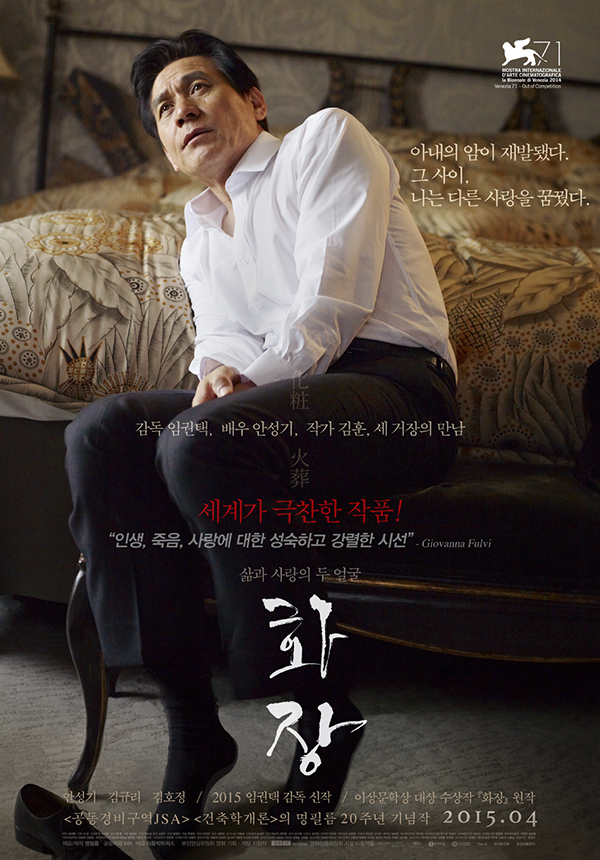
revivreThe 102nd film from veteran Korean film director Im Kwon-taek may appear close to the bone in its depictions death, suffering, and the long look back on a life filled with the quiet kind of love but Revivre (화장, Hwajang) is anything but afraid to ask the questions most would not want to hear as the light dwindles. The inner journey is just too hazy, as one man puts it, unknowingly commenting on the human condition, yet Im does manage bring us nicely into focus, if only for a moment.
Oh (Ahn Sung-ki), a successful salaryman working in marketing for a cosmetics company, finds himself slightly adrift as the brain tumour his wife, Jin-kyung (Kim Ho-Jung), had previously suffered from resurfaces. The treatment this time is apparently not as successful leading to prolonged hospitals stays as Jin-kyung’s condition deteriorates and she begins to require a greater level of medical care. While all of this is going on, Oh is still very much dedicated to his work but has also begun to indulge in an old man’s folly, fantasising about the pretty new girl at the office.

Much of Revivre is concerned with Oh’s inner life, the things he does not say (which are many because Oh is a quiet sort of man). Ahn Sung-ki captures this quality well in playing Oh with a kind of blankness that could be the numbing sensation of grief or an extension of his ordinarily reserved nature. This makes his impromptu verbal attack on the figure of his fixation, Choo Eun-joo (Kim Gyu-ri), all the more unexpected though his remorse over having acted in such an out of character way may actually help to generate a kind of relationship between the pair albeit more of a paternal than romantic one.

Oh’s continuing fixation on Eun-joo, the woman who becomes the accidental focus of his world even though his wife lying dies in a hospital, is intended to be a fantasy and nothing more. An early dream sequence sees Oh participating in an elaborate traditional funeral taking place in a desert in which all of the mourners are dressed in black, except, of course, for Eun-joo – the only fixed point of reference, clothed in vibrant purple and smiling back at him in contrast to the solemn faces of the other guests, each staring at the floor. In the real world time slows down for him as Eun-joo dances youthfully in a nightclub and as he leaves the party early, her’s is the lone still face, haunting him as he looks back at the other revellers still enjoying themselves heartily even outside the club.

Indeed, “looking back” with all of its various advantages and disadvantages becomes another central theme as Oh becomes a kind of Orpheus descending into his own personal hell in the hope of dragging back his departed Eurydice – an idea neatly recreated in one of the film’s few outright fantasy sequences in which Oh dreams himself into an avant-garde dance show. Like Orpheus, Oh cannot help but look back though he risks losing all in the process. What Eun-joo represents for him is perhaps not the woman herself but an image of his own youth and a desire to live again as he once lived before. The present and the past begin to overlap for him, Eun-joo becomes the future he cannot touch as well as the returning spectre of a past he cannot return to.

Oh’s daughter asks him at one point if he ever really loved her mother. His reaction to losing his wife is, it has to be said, restrained, practical. Yet this question is answered with an immediate cut to Oh helping his wife to the bathroom, performing the most intimate of tasks with unwavering devotion. As his wife fades, Oh’s fantasies become a shield against the growing fears of his own mortality as his body also begins to fail him. The melancholy sense of loss and loneliness coupled with the inevitability of the passage of time pervade as each of Oh’s points of reference slips away from him at exactly the same time.

Im opts for a non-linear approach beginning with Jin-kyung’s passing and thereafter moving freely, reflecting Oh’s fleeting memories and interior confusion as he deals with such a traumatic, life altering event. Neatly framing Oh’s dilemma within his work in which he faces a choice of sticking with the current marketing strategy or striking out in a bold new direction, Im plays with the eternal theme of transient beauty in a society which prizes bodily perfection above all else. The film’s Korean title plays on a pun involving a homonym which means both “cremation” and “makeup” perhaps harking back to the central theme that you dig a grave for yourself if you attach the wrong sort of importance to the impermanent, but is in a sense ironic as one represents a final acceptance and the other an attempt to hold off the inevitable. Poetic and intensely moving, Revivre is another characteristically multilayered effort from Im, still at his full strength even in this late career effort.


International trailer (English subtitles/captions)

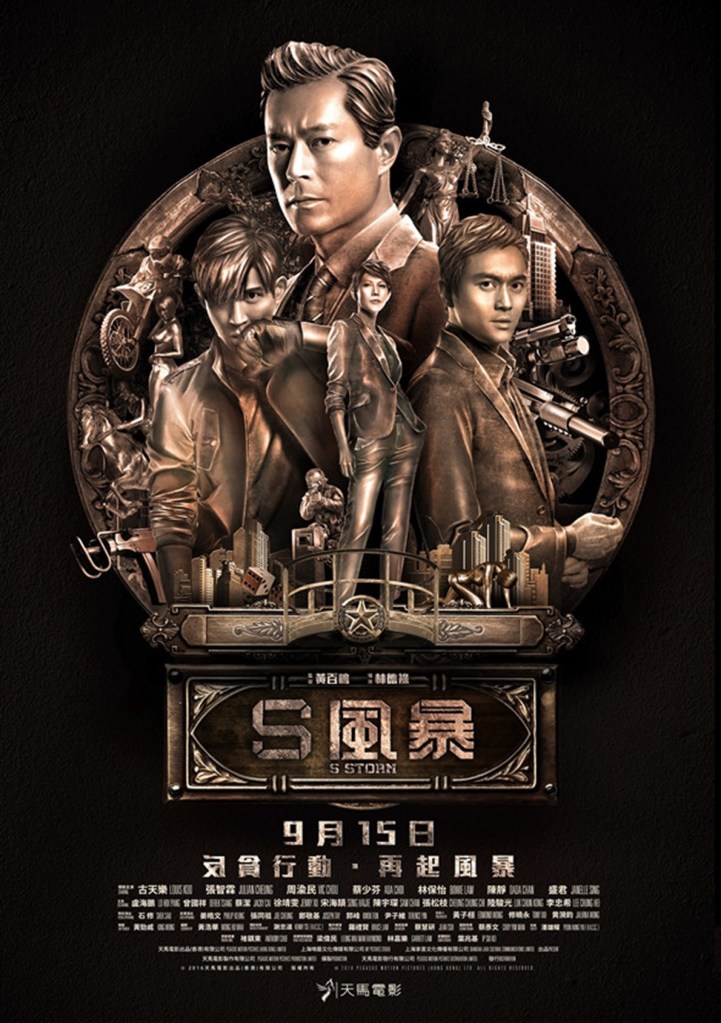
S Storm (S風暴, David Lam, 2016)

s-stormIt’s become almost a cliché to describe a sequel as “unnecessary”, but then assessing how any sequel or, indeed, any film might be deemed “necessary” (for what or whom?) proves more fraught than one might originally think. It might, then, be better to think of certain sequels as “unwise” – S Storm (S風暴), a followup to the similarly named Z Storm is just one such film. Z Storm’s critical reception was, shall we say, lukewarm and did not exactly inspire a burning desire to return to its world of corporate corruption vs different kinds of bickering policemen but, nevertheless, here we are.

Louis Koo returns as ICAC officer William Luk who has the misfortune to see one of his targets assassinated right in front of him. The trail leads him to Hong Kong’s famous Jockey Club and a trading scandal involving illegal behaviour in online football gambling. Being in the wrong place at the wrong time brings Luk into contact with depressed policeman Lau (Julian Cheung Chi-lam) whose sister just happens to work in the bar in which the mysterious hitman everyone is looking for is fond of taking a drink.

Refreshingly, S Storm’s plot is actually very straightforward – bets are being rigged and the people at the top of the tree are in on the plan. Some of them are willing to go try great lengths to stop anyone finding out and spoiling their fun. Cue gangster action and dastardly tricks as the anti-corruption guys try to clean things up. However, S Storm is very much a believer in the power of coincidence. Which is to say, Lau’s sister just happens to wind up fancying the hitman and Luk’s old boss just happens to be right at the centre of the action. Believability is not high on its list of priorities.

Added to the straightforward narrative spine, Lam throws in a number of subplots – the most interesting of them being with the mysterious hitman who visits a photography exhibition for some reason set up in a shopping mall which features scenes from global war zones. It seems our sad but noble hitman was some kind of child soldier (going by his flashback) though this is never fully explored and is rather crudely used to add some kind of spiritual quality to the hitman’s final journey.

Rather than mild rivals, ICAC and CID become awkward friends fairly quickly in the quest to investigate the mysterious deaths and corruption paper trail. Lau is a former gambler with a bad reputation hoping to make something out of himself by solving a high profile case. His relationship with his sister is somewhat strained as she recites the sad story of her upbringing which includes being gang raped by goons looking for a repayment on her brother’s gambling debts (as she improbably shouts out loud to the entire bar in which she works as a way of getting back at her policeman brother who’s asking too many questions). Luk and Lau eventually bond as their conflicting personalities complement each other well enough to create an unbeatable crime stopping team.

What the film lacks in intrigue it tries to make up for with action which it handles well though infrequently. A standout out scene features one of Luk’s female subordinates getting into a fight in a teahouse which is then followed by some fist fighting with the silent yet heroic hitman. Other standoffs are gun based but at least mildly interesting if not particularly original.

S Storm has some odd ideas about character arcs, shifting the most interesting elements to the fringes and thrusting the blandest to the front. plot elements are shoehorned in bluntly and without warning such as a forgotten tussle between Luk and a former associate over a woman which quickly becomes irrelevant. Luk is also given a rather odd character moment when he comes across the dying body of another major character and simply nods, as if identifying with their plight or sympathising believing that they’ve found peace now or some other such nonsense (given that he has never actually met this person and knows nothing of their backstory). The film’s rather abrupt ending in which justice is served but the bodies remain where they fell remains unsatisfying and testifies to the ultimate failure to make the scandal laden content as interesting as it strives to be.


Original trailer (English subtitles)

Flying Colors (ビリギャル, Nobuhiro Doi, 2015)

flying-colorsBelow average student buckles down and makes it into a top university? You’ve heard this story before and Nobuhiro Doi’s Flying Colors (ビリギャル, Biri Gyaru) doesn’t offer a new spin on the idea or additional angles on educational policy but it does have heart. Heart, it argues is what you need to get ahead (if you’ll forgive the multilevel punning) as the highest barriers to academic success are the ones which are self imposed. Arguing for a more inclusive, tailor made approach to education which doesn’t instil false hope but does help young people develop self confidence alongside standardised skills, Flying Colors is the story of one popular girl’s journey from anti-intellectual teenage snobbery to the very top of the academic tree whilst healing her divided family in the process.

Little Sayaka Kudo (Kasumi Arimura) got off to a bad start in her academic life, bullied and friendless at primary school. After the teachers refuse to help, Sayaka’s doting mother, Akari (Yo Yoshida), manages to get her into a more exclusive middle school which is affiliated with both a high school and a university which means that Sayaka’s academic destiny is fairly secure. However, though she does manage to make friends at her new school, she falls in with the “popular” crowd and begins dying her hair, rolling her skirt up, and wearing an inadvisable amount of makeup. Knowing that their entrance to high school and university is assured, the girls slack off completely and are at the very bottom of the class.

However, it all comes crashing down when Sayaka is caught smoking and threatened with expulsion. Bravely refusing to give up her friends and have them suffer the same fate, Sayaka is the only one who gets suspended but still risks missing graduation and losing her secured place at university. One of the few people to really believe in her, her mother Akari, arranges for Sayaka to attend an unconventional cram school where the well meaning teacher, Tsubota (Atsushi Ito), encourages her to have a goal, and it’s a lofty one – Keio University, one of the most prestigious institutions of higher education in Japan.

Despite her dismal academic prognosis, Sayaka is not lacking in ability, just the will and belief to see it through. After being so unhappy in primary school, Sayaka values her friendships and status as one of the popular girls and maintaining that side of her life is much more important than getting good grades. Written off by her teachers, no one is prepared to give her the permission to succeed and so she assumes she’s as dim as everyone says she is.

The situation isn’t helped by her home life in which her embittered father (Tetsushi Tanaka) ignores his two daughters in favour of devoting all his attention to his son, Ryuta (Yuhei Ouchida), whom he wants to become a professional baseball player. Vicariously thrusting his own dream on his unsuspecting son, Sayaka’s father is unprepared for the moment Ryuta realises he’s been denied the right to choose for himself and rebels against him as all young men are apt to do. In fact, many of the cram school students are there because of a grudge against an unfeeling father who has had quite an adverse affect on his child’s sense of self worth.

Tsubota is the first person other than her mother to show faith in Sayaka’s abilities and is able to convince her that she might be able to achieve something if she started to apply herself. Speaking to her in terms she can understand, Tsubota hunts down different kinds of study materials to help her along the way gradually raising her scores as she builds belief in her ability to reach her goal. Tsubota is the only teacher at the school and is able to take the time to get to know each of his pupils individually so he can tailor the course to bring out the potential in each of his charges. While the kids are studying to pass exams, Tsubota is studying pop culture so that he can talk to them on their own level and find out the best ways to keep them motivated.

As much as it’s the story of a persistent underdog finally discovering a well of self belief that will sustain them on a difficult path, Flying Colors is also an indictment on the modern educational system which only caters for the group rather than the individual and is so concentrated around rote learning and standardised tests that it fails to teach young people the critical thinking skills they need to succeed in life. Flying Colors probably is not going to influence public educational policy but it does offer an amiable and inspirational story that might give hope to those struggling under its often unreasonable demands.


Original trailer (English subtitles)