A Mere Life (벌거숭이, Park Sang-hun, 2012)

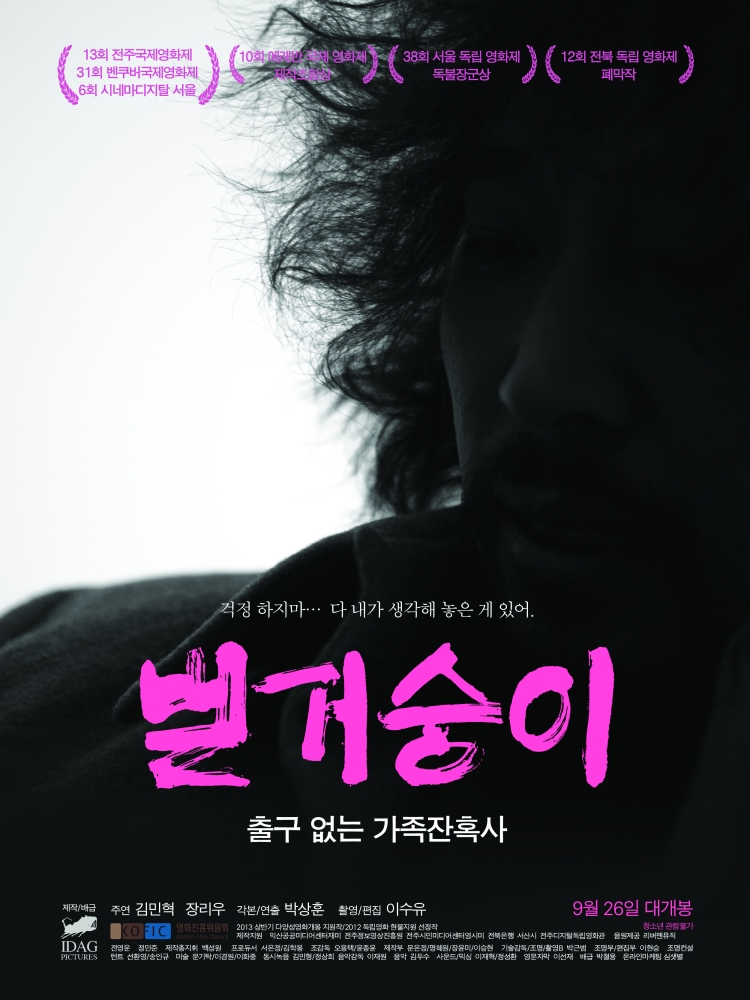
%e1%84%87%e1%85%a5%e1%86%af%e1%84%80%e1%85%a5%e1%84%89%e1%85%ae%e1%86%bc%e1%84%8b%e1%85%b5_%e1%84%91%e1%85%a9%e1%84%89%e1%85%b3%e1%84%90%e1%85%a5Anyone who follows Korean cinema will have noticed that Korean films often have a much bleaker point of view than those of other countries. Nevertheless it would be difficult to find one quite as unrelentingly dismal as A Mere Life (벌거숭이, Beolgeosungi). Encompassing all of human misery from the false support of family, marital discord, money worries, and the heartlessness of con men, A Mere Life throws just about everything it can at its everyman protagonist who finds himself trapped in a well of despair that not even death can save him from.

Park Il-rae (Kin Min-hyuk) and his wife Yurim (Jang Liu) own a small supermarket which isn’t doing so well. After approaching both of their parents for help and getting a flat no from both directions, the couple decide to throw all of their savings into buying a delivery van to increase their business potential. Il-rae excitedly travels into the city to sign the paperwork but gradually realises something is wrong when the salesman suddenly disappears. Having lost all of the family’s money, Il-rae travels home dejected and hits on a drastic solution – a family suicide. Poisoning his wife and son, Il-rae means to die too but survives even more burdened by guilt and regret than before. More failed suicide attempts follow as Il-rae attempts to come to terms with his actions, somehow surviving yet all but dead inside.

There really is no hope for Park Il-rae. At the very beginning of the film, the family visit a park in which his wife urges their son to make a wish by adding a stone to the top of a cairn, only to see the whole thing suddenly collapse in front of them like a grim harbinger of the way their lives are about to implode. Il-rae tries to repair the pile, but all to no avail. This quite awkward family trip in which Il-rae moodily strides on ahead will actually be the happiest they ever are, away from the destructive domestic environment where money troubles and male pride cast a shadow over an otherwise ordinary family life.

Both Il-rae and his wife seem to have strained relationships with their parents. Il-rae tries his own father first in the quest for help only for him to angrily tell his son to man up. When his wife visits her parents (alone with the couple’s little boy) it’s the first time she’s seen them in a decade and they are fairly nonplussed that it’s money she’s come for. After Yurim delicately states her predicament, her father tells her that he can’t help because he now has lots of hobbies which all require money. Offering perhaps the worst piece of fatherly advice ever uttered, he suggests she take up something fun herself and not worry about money so much.

The worse things get the more the family fragments. Il-rae drinks while the couple’s son seems to be addicted to video games. Faced with an obnoxious man who thoughtlessly parks his expensive car directly in the doorway of their store yet refuses to move because “he’ll only be a few minutes”, Il-rae is only saved from doing something stupid by his wife physically pushing him out of the way, but her physical dominance only worsens his sense of impotence. After making his drastic and irreversible decision, Il-rae is left alone and reeling from the worst kind of failure and regret. From this point on he’s marooned in his very own limboland, hovering on the brink of life and death.

Beginning with POV shots of a car dutifully following the only path laid out for it, A Mere Life states its bleak indie intentions right away as the gloomy lyrics of a folk tune run in the background constantly making reference to a despair which not even death could comfort. Recalling the great misery epics of the ‘70s, Park Sang-hun films with an anxious, unblinking camera save for the ominous shaky cam shots of a man facing the sea which begin and end the film. Il-rae may have made a decision as regards a future, but it remains unclear if there is any hope of salvation waiting for him. A Mere Life is never is never an easy watch thanks to its unshaking bleakness, but its strength of purpose and uneasy mix of morality play and character drama make for an unusual, interesting independent feature debut.


Reviewed at the 2016 London Korean Film Festival.

Original trailer (English subtitles)

Helpless (화차, Byun Young-joo, 2012)

121003-006_1211020310103Review of Byun Young-joo’s Helpless (화차, Hwacha) first published by UK Anime Network

Can you ever really know another person? Everything you think you know about the people closest to you is founded on your own desire to believe what they’ve told you is the fundamental truth about themselves, yet you’ll never receive direct proof one way or the other. Byun Young-joo’s Helpless is based on Miyuki Miyabe’s popular novel Kasha (available in an English translation by Alfred Birnbaum under the title All She Was Worth) which literally means “fiery chariot” and is the name given to a subset of yokai who feed on the corpses of those who have died after accumulating evil deeds, which may tell you something about the direction this story is headed. After his fiancée suddenly disappears, one man discovers the woman he loved was not who she claimed to be, but perhaps also discovers that she was exactly who he thought she was all along.

Mun-ho (Lee Sun-kyun) and Seon-young (Kim Min-hee) are newly engaged and on their way to deliver a wedding invite to his parents in person. They seem bubbly and excited, still cheerful in the middle of a long car journey. It’s doubly surprising therefore when Mun-ho returns to the car after stopping at a service station to find that Seon-young has disappeared. Seon-young is not answering her phone and has left her umbrella behind despite the pouring rain which only leaves Mun-ho feeling increasingly concerned. His only clue is her distinctive hair clip lying on the floor of the petrol station toilet. Reporting his fiancée’s disappearance to the police, Mun-ho is more or less fobbed off as they come to the obvious conclusion that the couple must have argued and Seon-young has simply left him, as is her right. Confused, hurt, and worried Mun-ho turns to his old friend, Jong-geun (Cho Seong-ha), a recently disgraced ex-policeman, to help him understand what exactly has happened to the woman he thought he loved.

Mun-ho, helpless as the title, has no idea what might have transpired – has she been abducted? Was she in trouble, was someone after her? Did she simply get cold feet as the policemen suggested? A trip to Seon-young’s apartment reveals the place has been pretty thoroughly turned over leaving little trace behind, the entire apartment has even been swept for fingerprints in chillingly methodical fashion. Another clue comes from a close friend who’d been looking into the couple’s finances and found some improprieties in Seon-young’s past which he’s surprised she wouldn’t have mentioned. Perhaps she was embarrassed or ashamed of her credit history, but running out onto the motorway in the pouring rain without even stopping to pick up an umbrella seems like a massive overreaction for such an ordinary transgression.

What transpires is a tale of identity theft, vicious loan sharks, parental neglect, and the increasingly lonely, disconnected society which opens doors for the predatory. Usurious loans become an ironic recurring theme as they ruin lives left, right and centre. Following the financial crash, a father takes out a loan from gangsters to support his business but promptly goes missing. His wife is so distraught that she becomes too depressed to care for their daughter who ends up in a catholic orphanage. Gangsters have their own rules, the debt passes to the girl, young as she is, who is then forced to pay in non-monetary services until she finally escapes only to discover the torment is not yet over. Meanwhile, another woman takes out a series of loans to cover credit card debt and is forced to declare bankruptcy, left only with a lingering sense of shame towards her ailing mother who then dies in a freak accident leaving her a windfall inheritance which she uses to buy a fancy headstone for the woman she was never able to look after whilst still alive.

The original identity theft is only made possible by this fracturing of traditional communities in favour of impersonal city life. Nobody really knows anybody anymore – Seon-young had claimed to have no family and no close friends so there was no one to vouch for her. Many other young women are in similar positions, orphaned and unmarried, living in urban isolation with only work colleagues to wonder where they’ve got to should they not arrive at the office one day. Loneliness and boredom leave the door wide open for opportunists seeking to exploit such weaknesses for their own various gains.

Byun hints that something is wrong right away by switching to anxious, canted and strange angles filled with oddly cramped compositions. The eerie score enhances the feeling of impending doom as Mun-ho continues to dig into Seong-young’s past, finding confusion and reversals each way he looks. Seong-young was not who she claimed to be, and her tragic past traumas can in no way excuse her later conduct, but even if Mun-ho’s faith in her was not justified, there is a kind of pureness in his unwavering love which adds to the ongoing tragedy. Mun-ho fell in love with the woman Seong-young would have been if life had not been so cruel, and perhaps that part of her loved him too, but life is cruel and now it’s too late. An intriguingly plotted, relentlessly tense thriller Helpless will make you question everything you ever thought you knew about your nearest and dearest, but it is worth remembering that there are some questions it is better not to ask.


Reviewed at the 2016 London Korean Film Festival.

International trailer (English subtitles)

Bad Film (Sion Sono, 1995/2012)

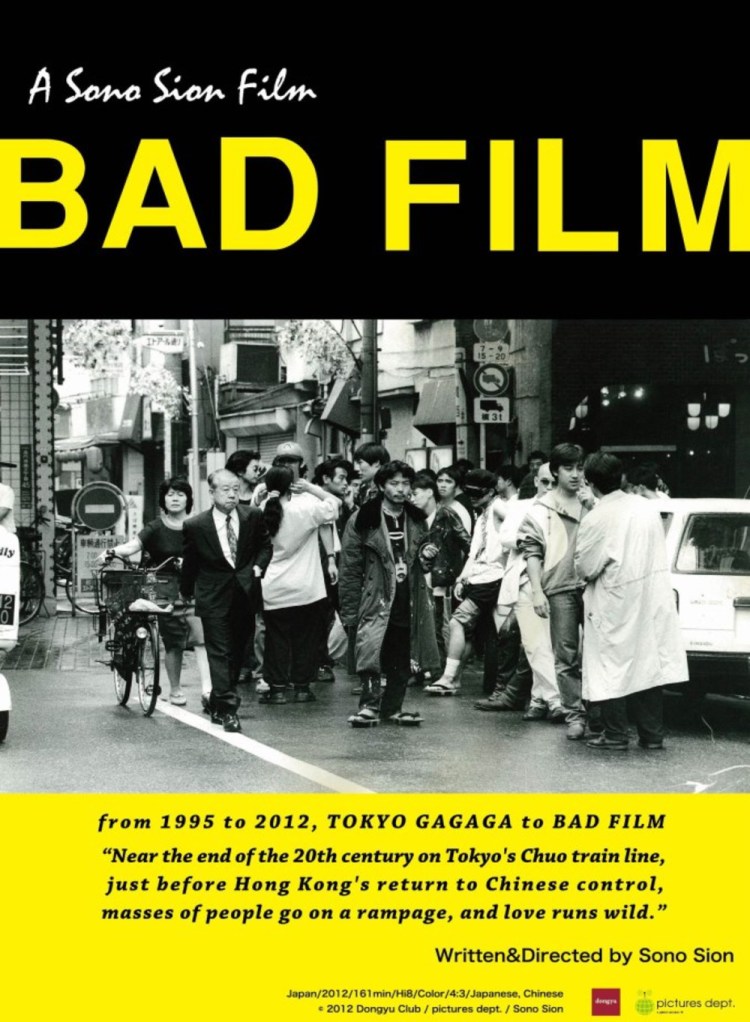
Bad_FilmThe recently prolific Sion Sono actually has a more sporadic film career dating back to the early 1980s though most would judge his real breakthrough to 2001’s Suicide Club. Back in the ‘90s Sono was most active as the leader of anarchic performance art troupe Tokyo Gagaga. Taking inspiration from the avant-garde theatre scene of the 1960s, Tokyo Gagaga took to the streets for flag waving protests and impressive, guerrilla stunts. Bad Film is the result of one of their projects – shot intermittently over a year using the then newly accessible Hi8 video rather the traditionally underground 8 or 16mm, Bad Film is near future set street story centring on gang warfare between the Chinese community and xenophobic Japanese petty gangsters with a side line in shifiting sexual politics.
Momentous things were at play in 1997, not least amongst them the looming handover of Hong Kong when it would cease to operate under British rule and embark upon the “one country, two systems” era with ultimate authority passing to Beijing. Fascism has bloomed in Tokyo with intense anti-foreigner activity targeting all non-Japanese including those from other areas of Asia. By 1997, the yakuza have infiltrated the fascist infrastructure and amped up gang violence between the Chinese community and the ultra-nationalist Japanese.

Fast forward a little and the Chinese and Japanese groups have managed to iron out some of their differences largely thanks to a different kind of divide which ultimately proves a unifying factor – many of the men and women on either side are gay and are sick of the prevailing “hetero hegemony”. Eventually the gay contingent manages to assume control of their respective factions and enact the gay alliance. This is very successful and brings peace and love to the city but unfortunately two members of opposing factions just can’t get over their cultural differences and are prepared to go to great lengths to restart the Japan/China gang war.

Sono shot the entirety of the movie back in 1995 ending up with around 150 hours before abandoning the project for financial reasons. In 2012 Sono re-edited his existing footage into something resembling a feature length film. The project was designed to make use of the entire Tokyo Gagaga company (over 2000 people took part) and was shot guerrilla style with no permits or warnings (you can see at least one face blurred out during their city centre protests). This goes someway to explaining why the narrative diverges unexpectedly at random junctures and the voiceover is there largely to corral the footage into some kind of coherent structure aided by the occasional on screen text. It’s a “Bad Film” in that it’s not quite a film at all but an activist’s poetic documentation of his artistic street warfare even including going so far as to include a justification for the visibility of the cameraman.

Hi8 was what it was – a convenient low-res format for the domestic market. Bad Film is not a pretty film, it looks rough and low rent though that often works in its favour and the film takes on a considered aesthetic that is never concerned with trying to be more than it is. Consequently, it makes the most of its roughness to bring out the grungy, time capsule-esque atmosphere that it’s looking looking for. Sono also experiments with fish eye lenses, odd angles and hand held multi-camera chaos to bring the streets to life. His world is weird, and it’s filmed weird, but it always makes sense in terms of its own particular look.

The action turns on the unexpected love story between two women – one Japanese, and one Chinese, and despite all of the resulting chaos and carnage, the final image we’re left with is one of love. The forces of destruction are those who cannot abandon their hate to live in harmony, subverting this very force for peace and using it to wreak vengeance. Sono launches into absurd mode at full throttle and, as per usual, it’s hard to tell when he’s in earnest and when just being facetious. Bad Film is, loosely speaking, an anti-prejudice themed performance art piece documenting the passion and commitment of the Tokyo Gagaga collective. An interesting case of a belated “director’s cut” Bad Film is necessarily an imperfect beast, but perhaps all the more interesting for it.


Opening sequence (no subtitles)

Cold War (寒戰, Longman Leung & Sunny Luk, 2012)

cold war

Reworked from a review first published by UK Anime Network in June 2013.


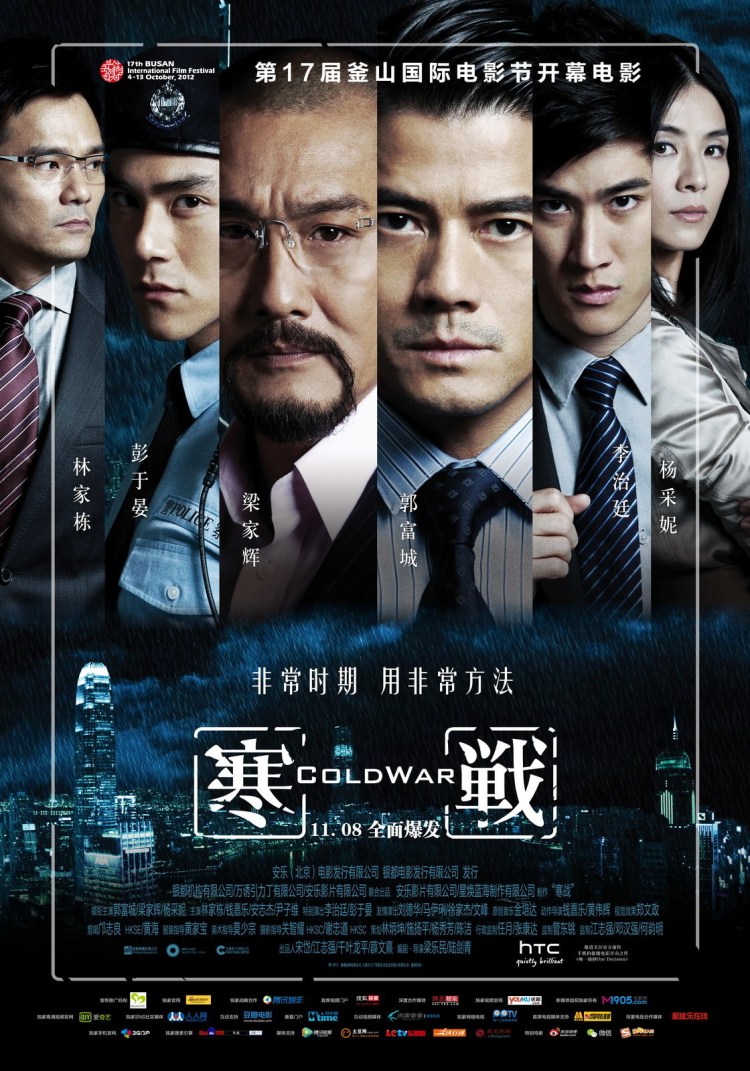
Listen up!  You’re going to have to pay attention to this review because there’s an awful lot going on this film. If there were a prize for most subplots squeezed into 102 minutes there wouldn’t even be room for any other candidates on the nominations list. If you like your HK action thrillers super complicated (if a little on the ridiculous side) and filled with some truly explosive (!) action sequences Cold War (寒戰) is definitely up your street.

Whilst a major explosion rocks a busy public area in Hong Kong, a crazed drunk hurtles through the streets before crashing his car into the central reservation in a quite spectacular manner. Apparently unharmed, he then rants at the traffic police that his uncle is a judge so they can’t touch him – a quick phone call seems to indicate he might be mistaken in his uncle’s feelings towards him but in any case the situation changes dramatically as the police are suddenly ambushed and kidnapped. The kidnappers then attempt to ransom the officers and equipment to the HK police authorities who are already a source of some press interest regarding possible corruption and general incompetence. It is imperative that they regain their men and capture the culprits as quickly as possible to avoid their reputation being even further damaged.

However, there is also considerable friction between the leading players at HQ and some uncertainty over who is favoured to become the new police chief – the young bureaucrat or the grizzled street veteran. This situation is further complicated by the fact that one of the missing patrolmen is the son of current section chief MB Lee (Tony Leung Ka-Fei). His subordinate, Sean Lau (Aaron Kwok), feels this makes him unsuitable to lead the current investigation and so seeks to have Lee removed from his post and take over the position himself. The pair also attract the attention of an officer at ICAC who’s convinced one or both of them must have more to do with the case than it seems, meaning each is effectively fighting a war on three fronts – firstly trying to rescue the police officers, then unmasking the perpetrators and finding out what they want with the HK Police force, and finally sorting out who’s up for the top job at police HQ whilst also keeping Internal Affairs off their backs.

No matter which way you put it Cold War is still extremely convoluted and fails to make all of its various plot elements hang together in a coherent way. It’s also unfortunate that the culprit is a little predictable (largely thanks to the actor’s mustache twirling performance) but when the final reveal does come it’s baffling in its pettiness, not to mention the total implausibility of such a complicated plan. Perhaps its unfair to criticise a film like this for having a problematic plot structure, perhaps fans of the action genre don’t look for finely crafted plotting as much as they look thrills and technically impressive action sequences – after all, we can’t all be Infernal Affairs.

It has to be said that Cold War does deliver in the action stakes with some extremely high production values which surpass even the heights of previous HK action films. From the opening car crash to the motorway car chase and explosive finale there are several simply jaw dropping moments throughout. When it comes to the big and brassy set pieces, Cold War is pretty much unrivaled but perhaps lacks the personal, intimate touch of other genre favourites. Tonally it walks a fine line between a sort of quirky humour and slightly absurd feeling where you can’t be sure whether you’re actually watching a comedy or not – some viewers may find all this a little too silly but others may revel in its ironic tone.

Cold War is certainly a flawed film, a little ridiculous but nevertheless enjoyable. It seems as if it also wants to make serious points about the justice system, media and police force but ends up pulling all its punches. If you stop to think about any of the plot, it makes very little sense but if you can let that go and just enjoy the superb action sequences and great performances from the leads Cold War is definitely one of the more impressive action thrillers to come out of HK in recent years.


 Original trailer (Cantonese with English subtitles)

Fish on Land (セイジ -陸の魚-, Yusuke Iseya, 2012)

fish on landYusuke Iseya is a rather unusual presence in the Japanese movie scene. After studying filmmaking in New York and finishing a Master’s in Fine Arts in Tokyo, he first worked as model before breaking into the acting world with several high profile roles for internationally renowned auteur Hirokazu Koreeda. Since then he’s gone on to work with many of Japan’s most prominent directors before making his own directorial debut with 2002’s Kakuto. Fish on Land (セイジ -陸の魚-, Seiji – Riku no Sakana), his second feature, is a more wistful effort which belongs to the cinema of memory as an older man looks back on a youthful summer which he claimed to have forgotten yet obviously left quite a deep mark on his still adolescent soul.
The unnamed narrator begins his tale as a disheartened salary man who tells us that his days simply pass monotonously. He no longer feels contentment but neither does he feel discomfort. Making an awkward phone call to a woman we assume is his wife, he reveals that a project has come up that he simply cannot ignore – one which takes him back to a particular summer he passed as a young man in which he encountered a lost soul and perhaps lost some of his own, too.

In the summer of 1990, the narrator was just about to graduate university and had already secured a job. Taking the final opportunity to indulge some wanderlust, he takes off riding his pedal bike across the country. However, after he gets knocked over and is taken to a local bar for some first aid treatment by its classically sad mama-san, he decides to stay and is given the nickname of “traveller” by the regulars at House 475. It’s here that he meets the titular Seiji – a cynical man with unusual presence which seems to inspire both admiration and exasperation in the small group of people who’ve come to regard the bar as a home from home.

Despite its genial, summery quality, the bar is home to several kinds of sorrow. Shoko, it turns out has her own reasons for her sadness and her relationship with Seiji is often a complicated one. It’s she who describes Seiji as a fish on land – completely at odds with his environment and entirely unable to live in the world or get along with his fellow humans. Carrying deep seated scars from his past, Seiji, she claims, is unable to feel joy so long he knows someone (anyone, anywhere) is suffering. Or, more to the point, he feels so intensely guilty that he will not allow himself to be happy and has, in some senses, given up living in this world in favour of his own filled with melancholy loneliness.

Indeed, the friendly grandfather from next-door remarks that Seiji sees things far too clearly and that’s why he’s given in to despair. According to him, our human defence against the powerlessness and fear inherent in being alive is simply becoming inured. Our insensitivity saves us, but men like Seiji feel too much and are unable to bear it. On the rare occasion Seiji smiles, it’s often to do with the little girl who lives next-door, Ritsuko, but tragedy is about to come crashing in, changing lives forever and shattering grandpa’s faith in the god he previously said granted us our lack of clarity to help us cope with life’s harshness. Seiji’s reaction is an extreme one, filled with a poetic weight that is difficult for those around him to understand but at the same time perfectly in keeping with his world view.

Framing sequence aside, Iseya opts for an interesting, slightly non-linear structure in which scenes jostle like memories, slightly disordered, sometimes repeated from a different angle and with greater insight. The framing sequence itself proves the least successful aspect of the film as it fails to marry itself to the implications of the central narrative and anchor its final scene to provide the necessary weight.

Mirai Moriayama imbues the unnamed narrator with an appropriate level of passivity whilst Hideyoshi Nishijima mirrors him with an equal and opposing force of presence which is by turns mysterious, intriguing, and occasionally threatening yet filled with vulnerability. Supporting roles are also well drawn notably by Hirofumi Arai’s local boy left behind and Kiyohiko Shibukawa’s up and coming businessman about to blow out of the small town for bubble era Tokyo, as well as the damaged bar owner Shoko played by Nae Yuki whose disintegration is slowed by Seiji’s presence but still very much in evidence.

If Fish on Land has a weakness, it’s that the invading dark forces it presents feel like a cruel, absurd, visitation on this otherwise idyllic place yet perhaps that’s entirely the point. Life is full of unpredictable cruelties which have to be accommodated no matter how difficult they may be to bear. Men like Seiji are carrying a heavy burden, one which was given to them when their arms were too weak to hold it, but still, you keep on living. Beautifully photographed, intricately plotted and rich with both character and philosophical detail Seiji: Fish on Land proves another interesting effort from Iseya who doubtless has even more to offer in the future.


Unsubtitled trailer:

Beautiful World (任侠ヘルパー, Hiroshi Nishitani, 2012)

ninkyo helperIn old yakuza lore, the “ninkyo” way, the outlaw stands as guardian to the people. Defend the weak, crush the strong. Of course, these are just words and in truth most yakuza’s aims are focussed in quite a different direction and no longer extend to protecting the peasantry from bandits or overbearing feudal lords (quite the reverse, in fact). However, some idealistic young men nevertheless end up joining the yakuza ranks in the mistaken belief that they’re somehow going to be able to help people, however wrongheaded and naive that might be.

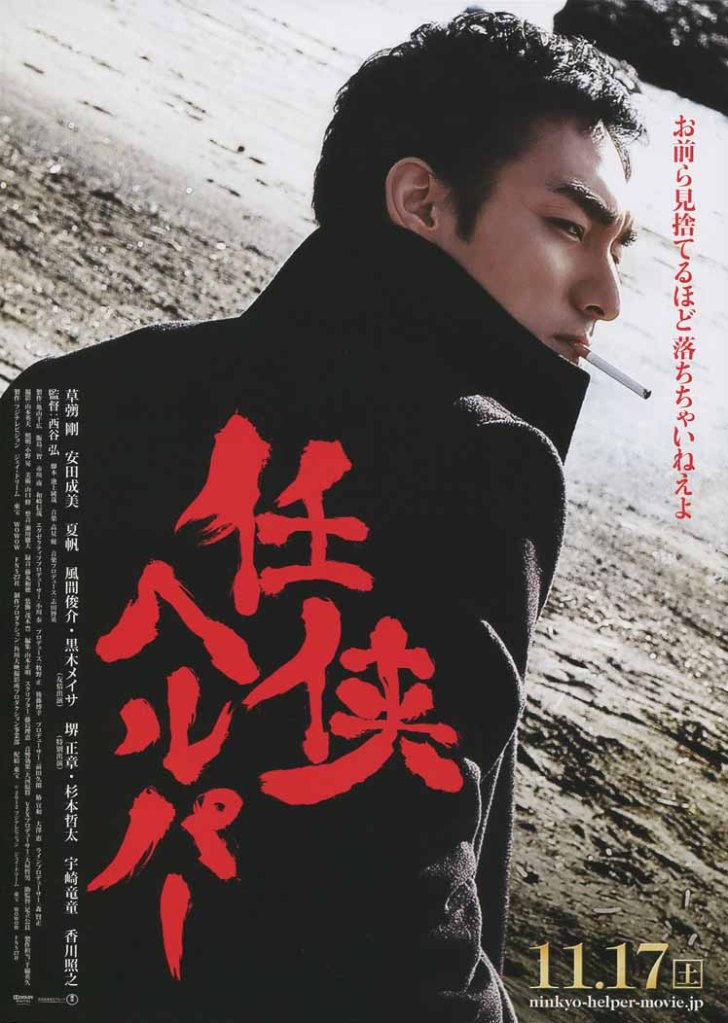
The hero of Hiroshi Nishitani’s Beautiful World (任侠ヘルパー, Ninkyo Helper) is just one of these world weary idealists turned cynics. We find him working a low rent convenience store job where he fills the shop with the kind of intensity that only a disappointed former yakuza can generate. Hikoichi (Tsuyoshi Kusanagi) was trying to make a go of things in the regular world, but when a sad little old man comes in with armed robbery on his to do list, Hikoichi shows his yakuza stripes by easily beating him down in front of his stunned colleague.

This might have earned him some brownie points at work, but overcome by pity for this pathetic old man reduced to robbing corner shops for petty change, he gives him the cash and tells him to run. The police soon turn up and arrest them both – during the robbery Hikochi’s colourful tattoos were caught on security camera and no one wants a yakuza working here, even if he did volunteer to pay back the tiny sum of money the old guy got from his own wages.

Meeting up in prison, Hikoichi and the armed robber eventually become friends and after his release, Hikoichi ends up in the old guy’s home town where he joins his former clan as an enforcer. Extremely bitter by this point, Hikoichi has decided to play the modern yakuza game to the max so when he finds out his assignment is running a dodgy “care” home which gets its residents by extorting old people through outrageous loans which send them bankrupt, he only briefly pauses.

The idea of a yakuza running a care home is a strange one. The Uminoneko residential care facility is far from what one would want from a old people’s home – there are no doctors, or even carers, the entire home is run by one nurse, herself an elderly woman who got her nurse’s certification and eldercare qualifications back in 1943!

With a rapidly ageing population, eldercare is a big topic in Japan as the birth rate has progressively fallen while lifespans have increased leaving many older people without family to look after them. With the nature of the family unit also changing, it’s become much harder to care for elderly relatives at home especially if they need around the clock attention. There are simply not enough facilities available to cope with the increasing needs of the older generation leaving families struggling to cope and social services overwhelmed. It’s not surprising that the yakuza have picked up on this as a growth area.

When Hikoichi arrives at the Uminoneko facility, which is just really a prefab shed with some futons in it, he finds a hellish place filled with unstimulated old people left on their beds to die. The place is filthy, and about the only attention the guests receive is the occasional offering of food to keep them alive so that the clan can keep claiming their pensions and welfare payments. Though Hikoichi goes along with this to begin with, it’s not long before his idealism rears its ugly head and he hits on the idea of reforming Uminoneko by turning it into a kind of old person’s commune in which the residents themselves will help out with the running of the place. What was a sad and gloomy prison of exploitation suddenly transforms as the older generation rediscover a place that they can belong, working together to build their own community. However, this of course means less money for the clan and more trouble for Hikoichi.

The clan aren’t his only problems as the town also has a progressive mayor who made a commitment to wipe out organised crime and turn the area into a tourist hotspot with a special focus on caring for the older generation. Teruo (Teruyuki Kagawa) has is own stuff going on which again causes a problem for Hikioichi as he also has a long standing crush on the older yakuza’s daughter, now a single mother with two young children and a mother of her own with senile dementia who needs expensive medical care. Yoko (Narumi Yasuda) has a grudge against yakuza after enduring decades of stigma and eventual abandonment by her father but is willing to deal with them if it will enable her to help her mother. Predictably she begins to develop a better understanding of her father as she bonds with Hikochi and warms to his noble tough guy ways.

Directed by Hiroshi Nishitani and inspired by a TV show (though functioning as a standalone movie), Beautiful World is a finely plotted drama which explores both the roles of the ageing population and eldercare explosion in Japan, and the conflicting role of the yakuza who seek to exploit those who are arguably the weakest in society. Hikoichi makes for a very Takakura-like, brooding presence as his innate idealism and desire to help those around him conflict with his experiences as a yakuza which teach him to distrust everyone and expect betrayal and exploitation at every turn. Resolving in an unconventional and unexpected way, this otherwise mainstream, if  beautifully photographed, drama develops into one of the more interesting character driven pieces of recent times.


Unsubbed trailer:

https://www.youtube.com/watch?v=Xyqd3v_-2oQ

The Monster Chronicles: Tiktik (Erik Matti, 2012)

Tik tik posterReview of Erik Matti’s Philippine folklore/comic book inspired horror movie The Monster Chronicles: Tiktik (also known as Tiktik: The Aswang Chronicles) up at UK Anime Network.


An “aswang” is a supernatural monster from Philippine folklore which is basically a vampire, zombie and were-creature all rolled into one. Appearing just like everyone else in everyday life, the aswangs can disguise themselves as various animals in order to trick unsuspecting people into letting their guard down so they can feast on their hearts and livers. Aswangs are particularly fond of the flesh of unborn babies and will even attempt to sneak into the homes of unsuspecting expectant mothers to suck the child from their very wombs as they lie peacefully asleep.

All of this is very bad news for metropolitan city slicker Makoy who’s managed to trek all the way out to a remote village backwater hoping to win back his heavily pregnant girlfriend who has left him after finally becoming fed up with his total uselessness. However, his efforts seem to have been in vain as Sonia, the possibly ex-girlfriend, doesn’t even want to see him and her domineering mother Feley is dead against this dead beat city boy who’s got her daughter pregnant coming anywhere near her family ever again. Luckily, Sonia’s father, Nestor, is a little more open to the idea of a reconciliation with his grandchild’s father and eventually invites him to stay for Sonia’s birthday celebrations.

At this point Makoy decides to make himself useful by haggling down the price of a pig for roasting at the party, only after managing to pay a whole lot less he ends up with a whole lot more than he bargained for. The local villagers all turn out to be a colony of aswang and now they know about Sonia’s unborn baby it’s not long before all hell breaks out at the prospective parents-in-law of the previously feckless Makoy!

Director Erik Matti (perhaps best known for his urban crime thriller On the Job) opts for a comic book inspired aesthetic by emphasising the artificiality of his studio bound film through noticeably fake CGI backgrounds. Playing out like a Philippine From Dusk Till Dawn, the film has an ironic, pop-culture filled humorous tone and further brings out its comic book trappings through the frequent use of split screens which divide the frame almost like panels do a comic book page. The slightly old fashioned appearance of the split screens coupled with the heightened colour scheme and CGI graphics also add a retro appeal which helps to create the crazy, almost cartoon-like universe in which the film takes place.

However, even if Tiktik has a Saturday morning toon aesthetic, it’s very much an adult affair filled with blood, guts and viscera. An old lady sitting next to Makoy on the cart into town ominously seems to be carrying a large bag of intestines which only seems to foreshadow events to come which will see Makoy wielding a large pitchfork with the guts of an aswang coiled around it like the messiest spaghetti you’ve ever seen.

The aswang might be known for their transforming powers but the real transformation we’re being asked to witness of that of Makoy himself as he plays the classic “stranger in town” role whose arrival is the catalyst for everything going to hell. In the beginning Makoy is an arrogant townie who can’t quite believe the backwardness of this tiny village with no cellphone signal or transport options. He arrogantly assumes he can haggle and barter with the locals by treating them with a superior attitude and the distain of a recent visitor from “civilisation”. This only earns him the additional ire of the aswang who are now, quite literally, out for blood. Sonia may have left him because of his laid back, slacker ways but if he wants to save her and their baby from being devoured by slavering, ugly monsters that no one quite believes in anymore, he’ll finally have to man up.

Makoy manages a little better than Sonia’s father, Nestor – a mild mannered and kind man who loves his fierce wife very much but still can’t quite find the necessary strength within himself to protect his family. If Makoy is to succeed he’ll have to jump into the shoes of a father with both feet, taking charge of a situation which he is not fully equipped to understand.

The film neatly divides itself into two halves with the set-up economically established early on giving way to the aswang assault. Though the action scenes are often exciting and inventive with a fair bit of humour thrown in, Tiktik loses momentum when it switches from the CGI enhanced actors to the completely CGI creatures which are never quite convincing. A genre affair throughout, Tiktik will undoubtedly play better to the Midnight Movie crowd (as it is intended to do) but uninitiated viewers may find themselves tiring of the gore tinged action long before the last aswang is split in twain.


The Monster Chronicles: Tiktik is out now in the UK from Terracotta Distribution following its appearance at the Terracotta Festival in 2014.


A Chorus of Angels (北のカナリアたち, Junji Sakamoto, 2012)

chorus of angelsAs you read the words “adapted from the novel by Kanae Minato” you know that however cute and cuddly the blurb on the back may make it sound, there will be pain and suffering at its foundation. So it is with A Chorus of Angels (北のカナリアたち, Kita no Kanariatachi) which sells itself as a kind of mini-take on Twenty-Four Eyes (“Twelve Eyes” – if you will) as a middle aged former school mistress meets up with her six former charges only to discover that her own actions have cast an irrevocable shadow over the very sunlight she was determined to shine on their otherwise troubled young lives.
Haru has been working as a librarian in the city for the last twenty years and has finally reached retirement age but before that she was a school teacher in Japan’s frozen north. Before she can even think about enjoying her new found freedom, a pair of policeman turn up at her door to ask her a few questions about one of her former pupils, Nobuto, who is a suspect in a murder case. It seems that they found Haru’s address amongst Nobuto’s possessions and are keen to find out what kind of relationship she had with him and anything she might know about his current whereabouts. Haru is shocked to the core but remembers that she always gets a New Year card from one of Nobuto’s classmates, Manami, and decides to return home at long last to try and put to rest some wandering ghosts.

Like much of Kanae Minato’s work, A Chorus of Angels is a perfectly constructed mystery only this time much more of the heart than of the head. Consequently, it would be wrong to reveal too much of the plot but suffice to say that a traumatic incident twenty years ago left a profound effect not only on each of the children but also on their teacher and others in the surrounding area. Re-encountering each of her six pupils again, Haru discovers that each of them has been harbouring a deeply buried sense of guilt and shame, believing themselves to have been responsible for what happened that day. That sense of unresolved trauma has prevented each of them from fully getting on with their lives, as if some part of each of them was frozen in time when they were just primary school children singing in a choir and feeling proud of themselves for the first time in their lives.

Their teacher, Haru, also left a part of herself behind in that snowy northern landscape. Having committed something which some would regard as a sin, she’s hounded off the island – or perhaps allows herself to be, giving in to a punishment that she sees as befitting her own sense of guilt. However, as is customary for Minato, Haru’s “crime” is not such a black and white affair. If she betrayed someone, that person understood and, ultimately, only wanted the best for her. That she sacrificed the things that might have allowed her to go on living a happy life is the kind of tragic irony Minato is known for and the lonely, cold and shut off appearance of Haru’s twenty years of librarianing exile is another perfect example. She didn’t really do anything wrong except for try to live, and yet she’s paid for that with the next twenty years of her life and not only that, in robbing the young children who’d come to see her as something of a guardian angel of her very presence, she’s left them to pay too. Guilt grows like a mountain until it eclipses even the brightest of suns.

Despite its unfeasibly starry cast which radiates around veteran actress Sayuri Yoshinga and includes such young talents as Hikari Mitsushima, Mirai Moriyama, Ryuhei Matsuda, Ryo Katsuji, Aoi Miyazaki and Eiko Koike, A Chorus of Angles is actually fairly ordinary in terms of its directorial style and though it manages to stay on the right side of saccharine, never quite manages to make its tear-jerking set-up quite as moving as it seems to want to be. That said, it does boast some extraordinarily beautiful scenes of the Hokkaido snowscape which is a perfect setting for this chilling, frozen ghost story in which no actual ghosts appear. The children’s childhoods are all blissful blue skies and sunny summer days but in the future there’s only snow and cold winter sunshine. Just stay alive, it would be enough – to live is to suffer, but you have to go on. The important thing to learn is that it’s one thing to forgive everyone else, but there comes a time when you have to forgive yourself, too.


The Hong Kong release of A Chorus of Angels includes English subtitles!

Unsubtitled trailer:

The Cowards Who Looked to the Sky (ふがいない僕は空を見た, Yuki Tanada, 2012)

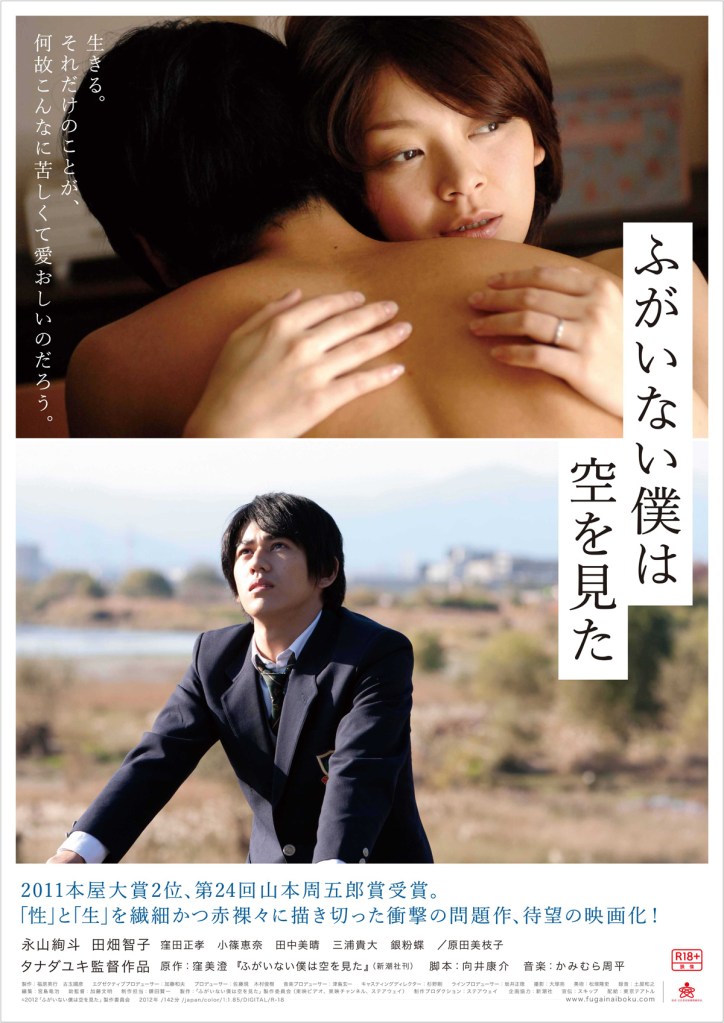
Cowards who looked to the sky posterThe work of director Yuki Tanada has had a predominant focus on the stories of independent young women but The Cowards Who Looked to the Sky sees her shift focus slightly as the troubled relationship between a middle aged housewife who escapes her humdrum life through cosplay and an ordinary high school boy takes centre stage. Based on the novel of the same name by Misumi Kubo, The Cowards Who Looked to the Sky (ふがいない僕は空を見た, Fugainai Boku wa Sora wo Mita) also tackles the difficult themes of social stigma, the power of rumour, teenage poverty, elder care, childbirth and even pedophilia which is, to be frank, a little too much to be going on with.
Told in a non-linear, overlapping structure the central spine of the film follows unfulfilled housewife Satomi who likes to dress up as her favourite character from the retro anime Magic Girl. Whilst dressed as its heroine, Anzu, she spots a high school boy at a convention who looks eerily like the anime’s hero, Muramasa. Takumi is only at the convention with a friend and has no particular interest in anime but as the two live in the same area “Anzu” convinces Takumi to come and try on a Muramasa outfit at her place. One thing leads to another and the pair embark on a proxy affair which takes the form of role-play between the two anime characters carefully scripted by Satomi. However, Satomi’s hitherto disinterested husband begins to notice a change in her behaviour and has spy cameras installed catching the hot cosplay action for all to see. When he uploads the video to the internet it causes a serious problem for the young and impressionable Takumi.

Actually, there’s a third person in Satomi’s marriage to her feckless husband Keiichiro in the form of his overbearing mother. So far, the couple have no children despite having been married for some time and this has distressed Michiko to the point that she’s the one dragging the couple in for IVF treatment and getting upset when it doesn’t work. Her son, Keiichiro, has weak swimmers and actively doesn’t want children but this doesn’t stop Michiko taking all her frustrations out on Satomi whom she brands as “defective” and gives the impression that she’d like to “fire” her if she could. A shy woman and probably quite bored as a stay at home housewife, Satomi retreats into fantasy by cosplaying as the familiar character from her favourite childhood anime Magic Girl. Becoming Anzu and having an affair with Muramasa isn’t quite cheating, after all, and perhaps she even hopes to have the child that her mother-in-law so desperately wants her to have even if her husband and medical science won’t help her.

Among the younger generation, Takumi lives with his mother, Sumiko, in a residential maternity clinic that she runs where pregnant women can come and be looked after in a more natural and homely environment than the comparatively cold and sterile hospital. Takumi is best friends with a boy who lives near by who, like him, has no father but unlike Takumi his mother is also an absent figure too so Ryota must work part-time at the combini whilst also looking after his grandmother who is suffering with dementia.

Sumiko tries to support Ryota by giving him occasional food parcels but as a young man Ryota sometimes finds this a little embarrassing and is offended by the idea of receiving charity. When it comes right down to it, he resents Takumi’s happy relationship with his mother and their relative financial security. The manager at the store brands Ryota a “ghetto kid” and even blames him for the increase in shoplifting by kids from the estate. He has little time to study even if he wanted to, but all he sees for his future is a great big dead end. Another worker at the store who previously worked as a teacher offers to help Ryota improve his grades and maybe even try for a university scholarship but turns out to have a dark side of his own.

Simply put, there are far too many plot strands in rotation here and the screenplay never manages to corral them into any kind of satisfying arrangement. There is a moment of unity where Ryota’s story meets Takumi’s but it’s a fairly brief point of intersection (though a hugely important one both in terms of themes and storyline) leaving Ryota’s entire subplot feeling like a distraction to the main high school boy meets damaged older woman narrative. That’s without all of the goings on at the clinic, the brief appearance of Takumi’s father and the disappearing act of Ryota’s deadbeat mother who makes off with all his savings. The film’s scope and ambition is admirable but it ultimately fails to unify its disparate plot strands into a convincingly focused form.

That said, other than running too long the The Cowards Who Looked to the Sky does have a lot of interesting elements and is always beautifully shot showing off a rarely seen side of suburban Tokyo. The performances are also of a high quality particularly given the film’s frank erotic content which is played with refreshing realism by the veteran former child actress Tomoko Tabata and the comparatively less experienced Kento Nagayama as the confused high school boy caught in the fire of his first affair. At once too superficial and too deep, The Cowards Who Looked to the Sky spreads itself too thin to make a lasting impact though does offer enough rewards to justify its lengthy running time.


Reviewed as part of the Japan Foundation Touring Film Programme 2016.


Kuro (はなればなれに, Daisuke Shimote, 2012)

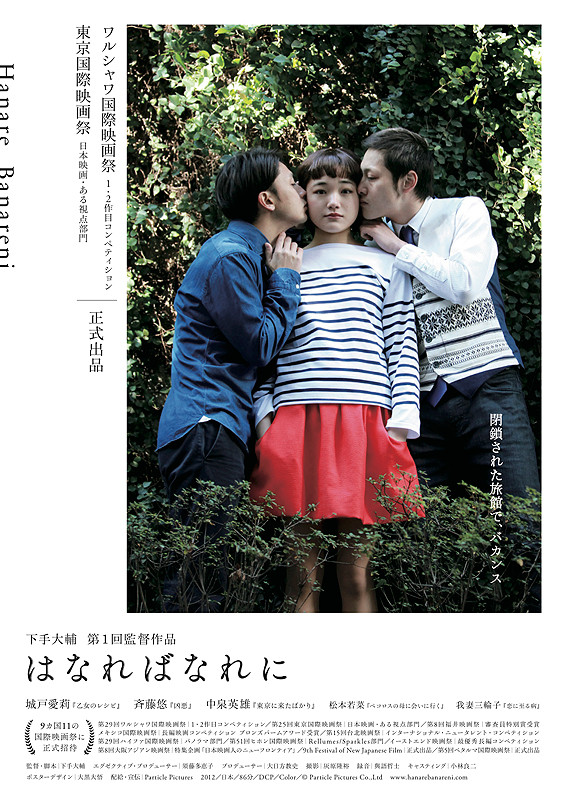
poster2All these years later, it’s easy to forget just how revolutionary the wheezy, breezy youthfulness of the French New Wave was. Kuro proves that there’s life in this whimsical, summer seaside feeling yet as three misfits find themselves holing up at a disused small hotel to think about what they’ve done until they learn to grow up a little.

Kuro starts our story as she mournfully chows down on some of the pastries at the bakery she works at whilst treating a customer in a very disdainful way. She wanted to be a baker but her boss never really lets her do anything and when they argue about her guzzling half the stock she quits in a fit of pique. Roaming around the city doing absurd things like partying with a jazz band before running off with their change can or messing around with a sharp suited guy in a hotel room she meets womanising stage actor Gou who’s had a tiff with his actress wife after paying to much attention to the new girl. He flirts with and eventually semi-kidnaps Kuro for a road trip where they meet photographer Eito who has also had a tiff with his woman over having neglected to file the marriage papers at city hall. He’s heading up to an old hotel his uncle used to own where he was meant to spend his honeymoon and invites Gou and Kuro to join him.

Kuro’s original Japanese title, はなればなれに “Hanarebanare ni” literally means “scattered pieces” and was, coincidentally, the same title used for Godard’s 1964 masterpiece Bande à part. First time director Daisuke Shimote wears his influences on his sleeve with an atmosphere that recalls early period Godard which is all whimsy minus Godard’s slightly arch, confrontational irony. Leading lady Kuro, played by Airi Kido, has a definite touch of Anna Karina running through her from the way her retro haircut neatly frames her child-like face to her striped top and colourful red skirt. Taking her cue from Karina’s innocent insouciance, her absurd, pixyish pranks take on a cute and quirky quality which is backed up by a youthfully punkish disregard for the normal order of things.

Kido dances with the jazz band like Karina dancing in the bar in Vivre sa Vie and the gang even fake die in a water gun and finger shoot out a la Franz and Arthur in Bande à part. There’s also something of Tati in the intricate way Shimote sets up what are actually quite small and simple jokes like the Wii tennis match that suddenly turns into an entirely different kind of “virtual” game. At this point, the photographer who’s been perpetually on the sidelines, observing, finds himself joining in and experiencing his very own Natasha at the dance moment which, perhaps, finally allows him to break through something that’s been causing a rift in his personal life.

Through their season at the sea, each of these disparate characters comes to a kind of personal realisation that leaves them, well, more or less the same but much more settled. Kuro learns that sometimes you just have to buckle down and do as you’re told, Gou perhaps learns to be nicer to his wife and Eito maybe realises that you don’t know what you’ve got until it’s leaving you. Each of the characters is quite depressed, in the best new wave tradition, or just filled with ennui but perhaps you can’t have these kinds of absurd adventures in any other mood. That said, the heavier side of new wave surrealism with its nihilistic overtones is almost entirely absent leaving the atmosphere light and bright with the feeling that everything will (probably) be alright in the end.

Light on conventional narrative and high on sight gags and surrealist humour, Daisuke Shimote has crafted a charming and amusing new wave inspired ensemble comedy that, yes, wears its influences on its sleeves but isn’t afraid to bring its own moves to the dance floor. It might seem a little bit like a curveball from someone who’s spent so much of his previous life studying the work of Ozu with his formalist compositions and inclusory tatami mat viewpoint, but then Ozu was also a master of subtlety who could make peeling an apple into one of the most profoundly moving scenes in cinema history and Shimote is able to harness a similar fastidiousness here only in more of a comedic bent. Charming, whimsical, absurd but absolutely internally consistent, cinematically literate and beautifully made Kuro is one of the most impressive feature length debuts of recent times and hints at a promising career for its still inexperienced director.


Bonus videos of people (mostly Anna Karina) dancing in Godard films: