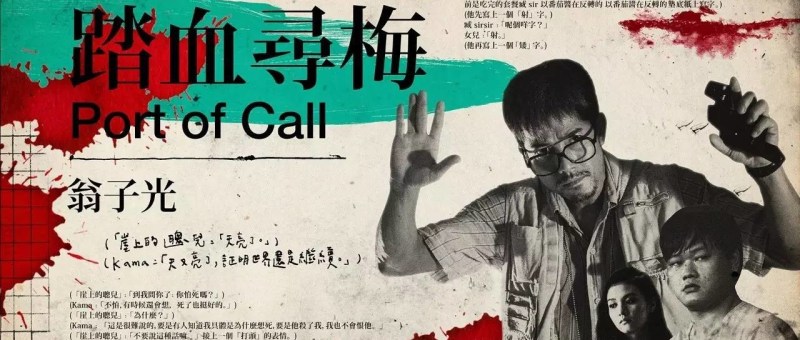
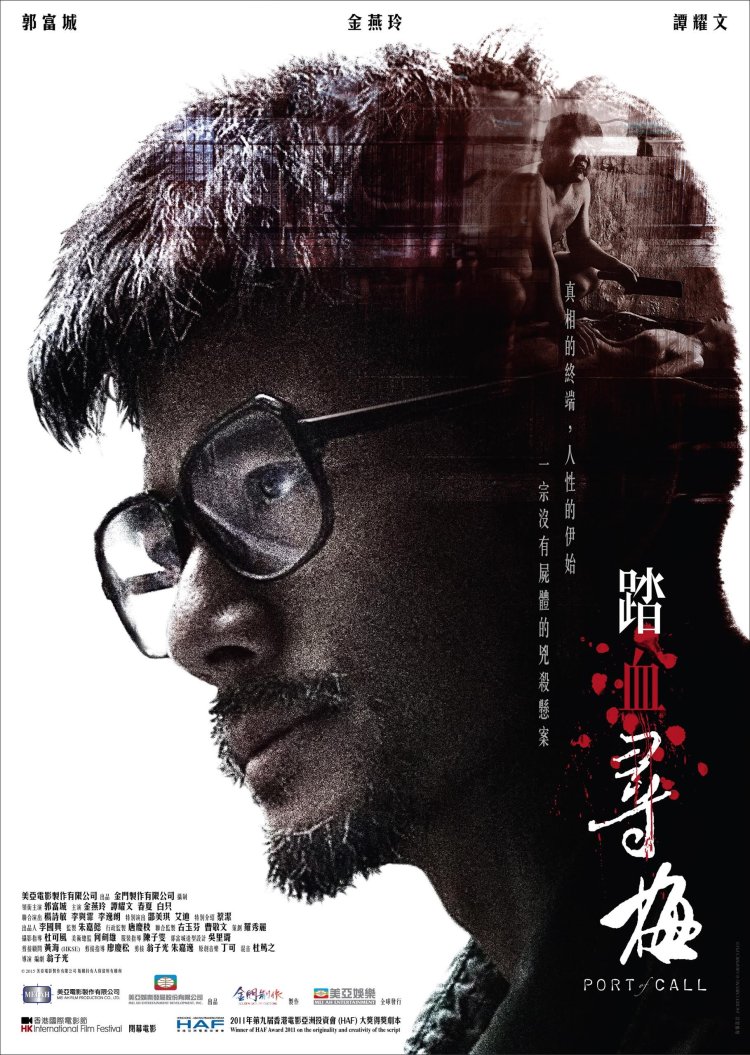
Port of Call (踏血尋梅, Philip Yung, 2015)

port of call posterBoy meets girl. Girl says she wants to die. Boy says OK. Philip Yung’s third feature, Port of Call (踏血尋梅), attempts to find out how such a thing could happen and does so by means of a state of the nation address. Shot by Christopher Doyle, Yung’s early 21st century Hong Kong is a place of broken dreams and empty promises in which past traumas become inescapable phantoms, hungry for blood and pain. More than the sum of its parts, Port of Call is a murder mystery and noirish crime thriller which rejects its procedural roots for a deeper investigation of how a young man and a young woman might have been brought to such a desperate and tragic end.

Eccentric detective Chong (Aaron Kwok) finds himself investigating the disappearance of a 16 year old prostitute believed murdered due to evidence of extensive bloodstains at the presumed scene of crime. The culprit soon turns himself in and confesses to both murder and dismemberment, avowing that he killed the girl because she asked him to. It seems like an open and shut case, at least to Chong’s superiors, but Chong cannot quite let it go. How could someone meet another person for the first time and take something as banal as “I wish I were dead” so literally as to decide to help them achieve their wish?

Chong, a divorced father to a young daughter, wants to know the why but what he discovers shakes his own already weary heart. The murdered girl, Jia-mei (Jessie Li), came to Hong Kong a little while after her mother (Elaine Jin) and sister, following the divorce of her parents. Her mother, a nightclub singer, has little money and is rarely present. Lonely, Jia-mei dreams only of becoming a model but this is a city which eats dreams and so she finds herself working admin jobs at a modelling studio as well as working at McDonalds in the hope of escaping her unsatisfying home environment. Eventually she is pulled into the world of escorts and compensated dating before winding up as a casual prostitute who forms an unwise romantic attachment to a client.

Neither Chong, Jia-mei, or the damaged killer Chi-sung (Michael Ning) is able to escape the weight of the pain and suffering they have seen or experienced. A long term employee of the Regional Crimes Bureau, Chong has seen the most gruesome, heinous, and incomprehensible crimes culminating in an unforgettable 1998 murder and kidnap case in which he discovered a small child tied up next to decomposing body covered in fattened maggots and swarming flies. Chong no longer sleeps because of the bloody nightmares which see him take the place of both victim and observer, laid low by an escaping Chi-sung whose crime is recreated in glorious technicolor.

Jia-mei’s world is bloodier still even at such a young age. A disturbing Facebook post recounts the loss of her virginity as a young teenager as a gory battlefield in which she and her boyfriend roll around in bloody sheets. Apparently not the only depressed young girl, Jia-mei’s classmate grabs her scissors and slashes her wrists all while Jia-mei does nothing. As she later tells an online friend, it’s sad when no one sees you. Separated from her home and father, Jia-mei’s model dreams are less a vacuous search for fame as they are a desperate attempt for connection. Looking for love in all the wrong places, Jia-mei’s world gradually shrinks away from her as the emptiness of her transactional relationships produces the opposite of what she wanted, eventually sending her straight into the arms of the equally lonely Chi-sung.

Chi-shung’s problems also stem back to childhood trauma and feelings of abandonment, but have taken on an additional layer of resentment following the failure of his first love affair. A melancholy, damaged man, Chi-sung almost sees his crime as a kind of salvation, rescuing Jia-mei from becoming what he hated and what she longed not to be. His icy practicality is chilling as he recounts how he dismembered and disposed of the body as if he were simply describing how to cook spaghetti but even as he seems to regard his crime as a kindness, there is something else lurking at the bottom of his coolness.

Yung’s Hong Kong is cold and unforgiving. The policeman, the victim, and the killer are all, in a sense, displaced – from their families, from the normal world, and from their homes. Jia-mei’s search for affection and an end to loneliness took her to the loneliest of places, while Chi-sung kills the things he loves to save them the pain of being alive, and Chong solves crimes but is powerless to stop them. Told in four acts and with a non-linear structure, Port of Call is a meandering voyage through life’s unpleasantness in which trauma stains, pain grows, and loneliness kills the spirit. Yung’s unflinching look at the dark underpinning of modern society is a sad and hopeless one yet there are brief flashes of hope, if only in stray cats finding unexpected safe harbours.   


Original trailer (Cantonese with English/Traditional Chinese subtitles)
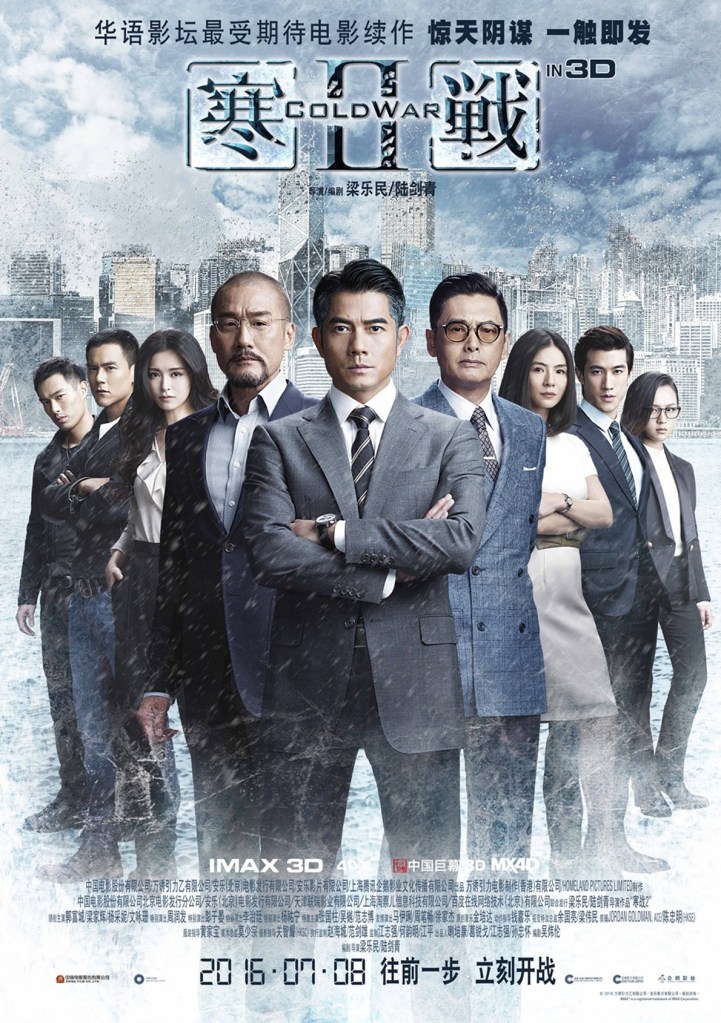
Cold War 2 (寒戰II, Longman Leung & Sunny Luk, 2016)

coldwar 2Cold War 2 (寒戰II) arrives a whole four years after the original Cold War rocked Hong Kong with police corruption scandals and fantastically convoluted internal plotting. Heroic policeman Sean Lau (Aaron Kwok) may have won the day, even if he ultimately had to compromise himself to do it, but the police van is still missing and MB Lee (Tony Leung Ka-fei) is still lurking in the background. As is his son, Joe (Eddie Peng) – languishing in prison but apparently still with the resources to cause trouble whilst behind bars.
Joe Lee has Lau’s wife kidnapped, forcing Lau to compromise himself by giving in to his demands all of which culminates in an intense subway set piece in which Lau inadvertently ends up handcuffed to an exploding smoke bomb while Joe Lee escapes. Embarrassing is not the word. Lau now looks bad, and old rivals have their eyes on the police chief’s chair. An enquiry is currently underway into goings on at police HQ lead by top lawyer Oswald Kan (Chow Yun-fat) but his impartiality is severely damaged when one of his own is caught in the crossfire whilst investigating Joe Lee’s nefarious activities.

Like the first film, Cold War 2 is an intense interpersonal thriller though this time the enemies are even closer as the old boys network becomes the means by which commissioners are unseated and installed. Service records are everything – Lau is unpopular with his colleagues because he started out at ICAC and has never served as a rank and file policemen. From one point of view, this makes him an ideal candidate because he has no personal ties to the body of serving officers but his rivals despise him for this very reason. He isn’t one of them, does not have first hand understanding of front line policing, and most importantly is not a part of their interconnected layers of military style brother-in-arms loyalties.

Lau’s predictable miscalculation regarding Joe Lee creates an opportunity to get rid of him and take back the force. “Save the police” is a message which is repeated over and over as the plotters attempt to win others over to their cause, insisting that Lau has lost the media battle for the hearts and minds of a public now trained to be afraid of their police force. Lau is the continuity candidate – mistakes have been made, but his stately manner and apparently steady hands may yet win the day. Those same hands are getting dirtier by the second, but they’ve been brushing the morally grey, not (yet, at least) immersed in the red of innocent blood like those of the corrupt top brass at police HQ.

If the plotting is intricate and filled with double crosses and betrayals, directors Luk and Leung have ensured a steady stream of explosive action sequences to accompany the ongoing cerebral games. Cold War also had its share of action packed spectacular set pieces but Cold War 2 may surpass them with the surprise factor alone including one shocking multi-car pileup inside a tunnel in which cars, buses and bikes go flying before an all out fire fight ensues. Lau’s constant gazing at the “Asia’s Safest City” signs which adorn police headquarters (right next to the metal detectors you need to pass through to get in) has never looked so melancholic and drenched in irony.

It’s a battle for the soul of the police service, but it’s being fought as a dirty war. Lau is the decent and honest man forced to behave in a slightly less honest and decent way, even if for the best of reasons. His rivals are running on pure ambition and pettiness. Despite their claims they do not have the interests of the people of Hong Kong as their foremost concern. The corruption stems far further back than anyone might have previously guessed and is more or less coded into the system. The police van and equipment are still missing and the central plotters are still in place. This is a partial victory at best but then what kind of action fest wouldn’t leave a door open for a sequel. The cold war maybe about to turn hot, but you can rely on the steely eyed Police Commissioner Sean Lau to be there, ready and waiting, when the first shots are fired.


Original trailer (English Subtitles)

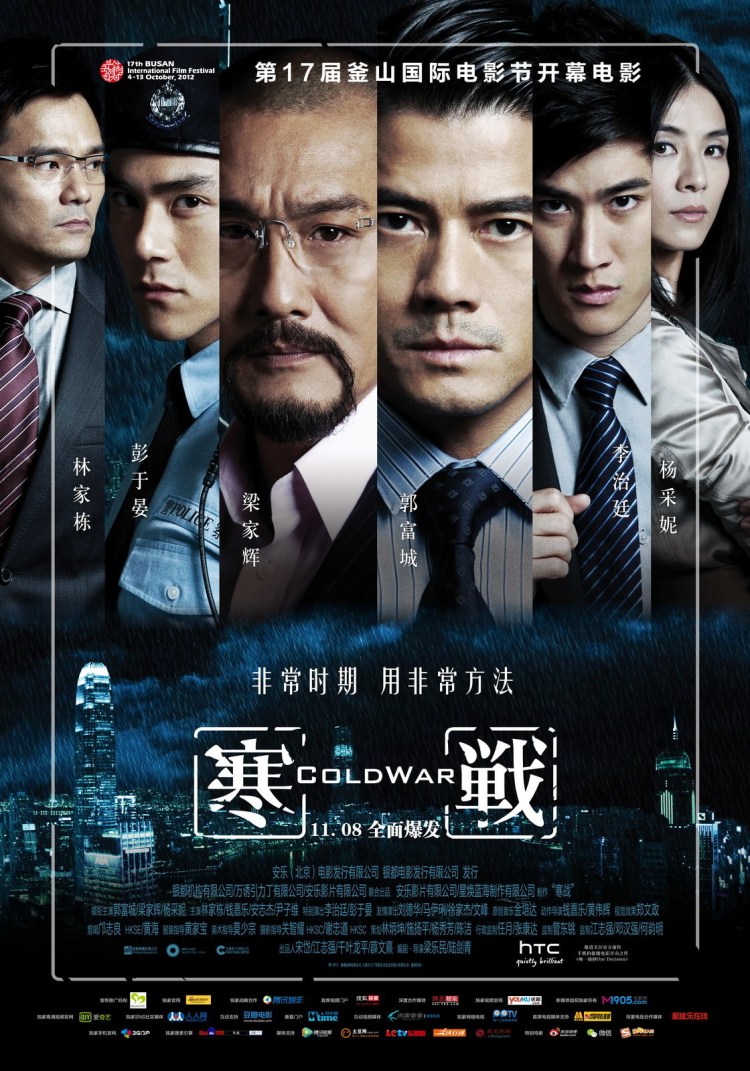
Cold War (寒戰, Longman Leung & Sunny Luk, 2012)

cold war

Reworked from a review first published by UK Anime Network in June 2013.


Listen up!  You’re going to have to pay attention to this review because there’s an awful lot going on this film. If there were a prize for most subplots squeezed into 102 minutes there wouldn’t even be room for any other candidates on the nominations list. If you like your HK action thrillers super complicated (if a little on the ridiculous side) and filled with some truly explosive (!) action sequences Cold War (寒戰) is definitely up your street.

Whilst a major explosion rocks a busy public area in Hong Kong, a crazed drunk hurtles through the streets before crashing his car into the central reservation in a quite spectacular manner. Apparently unharmed, he then rants at the traffic police that his uncle is a judge so they can’t touch him – a quick phone call seems to indicate he might be mistaken in his uncle’s feelings towards him but in any case the situation changes dramatically as the police are suddenly ambushed and kidnapped. The kidnappers then attempt to ransom the officers and equipment to the HK police authorities who are already a source of some press interest regarding possible corruption and general incompetence. It is imperative that they regain their men and capture the culprits as quickly as possible to avoid their reputation being even further damaged.

However, there is also considerable friction between the leading players at HQ and some uncertainty over who is favoured to become the new police chief – the young bureaucrat or the grizzled street veteran. This situation is further complicated by the fact that one of the missing patrolmen is the son of current section chief MB Lee (Tony Leung Ka-Fei). His subordinate, Sean Lau (Aaron Kwok), feels this makes him unsuitable to lead the current investigation and so seeks to have Lee removed from his post and take over the position himself. The pair also attract the attention of an officer at ICAC who’s convinced one or both of them must have more to do with the case than it seems, meaning each is effectively fighting a war on three fronts – firstly trying to rescue the police officers, then unmasking the perpetrators and finding out what they want with the HK Police force, and finally sorting out who’s up for the top job at police HQ whilst also keeping Internal Affairs off their backs.

No matter which way you put it Cold War is still extremely convoluted and fails to make all of its various plot elements hang together in a coherent way. It’s also unfortunate that the culprit is a little predictable (largely thanks to the actor’s mustache twirling performance) but when the final reveal does come it’s baffling in its pettiness, not to mention the total implausibility of such a complicated plan. Perhaps its unfair to criticise a film like this for having a problematic plot structure, perhaps fans of the action genre don’t look for finely crafted plotting as much as they look thrills and technically impressive action sequences – after all, we can’t all be Infernal Affairs.

It has to be said that Cold War does deliver in the action stakes with some extremely high production values which surpass even the heights of previous HK action films. From the opening car crash to the motorway car chase and explosive finale there are several simply jaw dropping moments throughout. When it comes to the big and brassy set pieces, Cold War is pretty much unrivaled but perhaps lacks the personal, intimate touch of other genre favourites. Tonally it walks a fine line between a sort of quirky humour and slightly absurd feeling where you can’t be sure whether you’re actually watching a comedy or not – some viewers may find all this a little too silly but others may revel in its ironic tone.

Cold War is certainly a flawed film, a little ridiculous but nevertheless enjoyable. It seems as if it also wants to make serious points about the justice system, media and police force but ends up pulling all its punches. If you stop to think about any of the plot, it makes very little sense but if you can let that go and just enjoy the superb action sequences and great performances from the leads Cold War is definitely one of the more impressive action thrillers to come out of HK in recent years.


 Original trailer (Cantonese with English subtitles)