Legend of the Cat Monster (麗猫伝説, Nobuhiko Obayashi, 1983)

Produced as a special marking the 100th episode of the Tuesday Night Suspense Theatre TV drama series, Nobuhiko Obayashi’s Legend of the Cat Monster (麗猫伝説, Reibyo densetsu) is preceded by a title card reading “Elegy for a Faraway Film”. Scripted by Chiho Katsura, the film is indeed in its way a lament for dying world albeit one which owes a heavy debt to Billy Wilder’s Sunset Boulevard with a little Fedora thrown in. Repurposing the classic ghost cat film it casts cinema itself as dangerous illusion, a vampiric compulsion that drowns all who encounter it in irresolvable longing. 

This sense of irrecoverable nostalgia is palpable from the opening sequence which, aside from the melancholy voiceover, introduces us to the world of Setouchi Cinema apparently a moribund studio complex once dubbed the Hollywood of Japan. The new arrival, Ryohei (Akira Emoto), is dressed in noticeably anachronistic fashion as if he were a 1930s newsboy rather than a young man living in the Japan of the early 1980s. His girlfriend, Ryoko (Jun Fubuki), who works as a stage hand dresses in a similarly old-fashioned style and in fact carries an oversize watch that was a heirloom from her late father, an unsuccessful film director. Ryoko remarks that she’s been hoping someone would come and rescue her from this half-dead island but she doubts Ryohei will be the one to do it because he has also come here in search of a dream. 

That dream is, however, already dead at least according to some. The film director working at the studio is berated by a woman of around the same age working as a manager for an idol star for still getting an allowance from his mother at 60 because he has failed to make it as a film director at least in financial terms. There is a poignant, largely unexplored subplot between that suggests the inability to reconcile the dream of cinema with the economic “reality” has kept them apart all these years and that their dream of love may now be over too. 

It seems that the reclusive actress at the film’s centre, Akiko (Wakaba Irie), is also living on a frustrated dream of love withdrawing from the world around her believing that her lover will someday return from “Hollywood” which seems to be another word for paradise or perhaps the world beyond on the other side of the silver screen. To her, film is but a dream with in a dream. A window or screen is a portal to the burdens of the heart, memories of days gone by, and the illusions we once saw that cannot be seen again.  She herself is trapped within her own dream of love, but it is not so much a dream of her that bewitches Ryohei but the impossibility of cinema.

When passing photographer, Tachihara (Toru Minegishi), who lost his own wife to the unobtainable magic of the movies, snaps a picture of Akiko at her window holding a cat and looking exactly as she did the day she abruptly walked out on an incomplete film, it spurs a cynical producer to get the idea of convincing her to make a comeback and in a ghost cat movie, no less. Obayashi’s casting coup is getting mother and daughter Takako and Wakaba Irie to play aged and youthful versions of the famous actress, Takako herself having been a huge star of the 1930s performing most notably for Kenji Mizoguchi in the The Water Magician. There is an undeniable poignancy in her reflection that is only her aging body which is dying, as if she were merely becoming an embodiment of her image migrating to silver screen which exists between this world and next. It’s this screen that is later ruptured by Ryoko as she makes her escape after failing to save Ryohei from the curse of cinema. 

As Akiko laments, he’s writing his script more for himself than for her and it’s the quest for art which has begun to drain and make him mad. When he, pale and zombie-like, attempts to proffer his scripts it appears to be nothing more than his own name written over and over again. Like the Max-esque butler Mizumori (Akira Oizumi) says, film is an eternal dream which by its definition can never realised and exists only a state of longing somewhere beyond the veil. Drawing inspiration from Nobuo Nakagawa in particular and harnessing the sense of gothic dread found in Sunset Boulevard, Obayashi captures the eternal nightmares of artistic creation with the maddening obsessions of unrequited love and the image of the ideal which exists eternally out of reach somewhere on the other side of the screen.


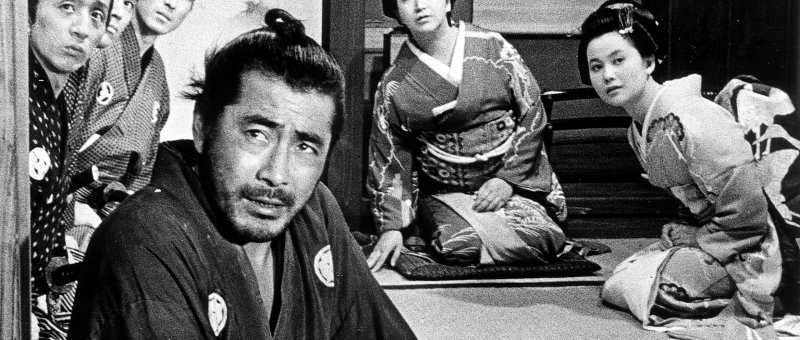
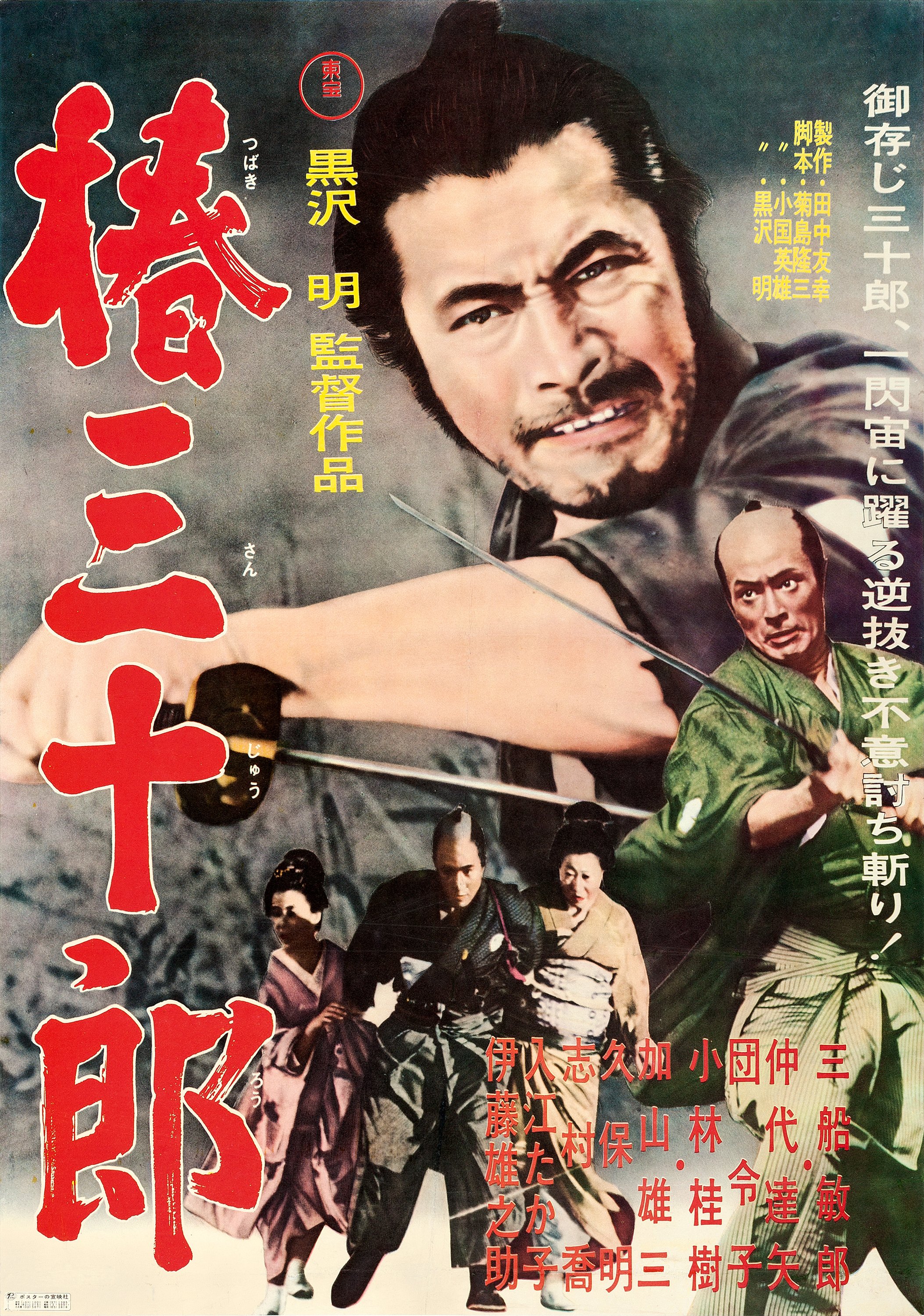
Sanjuro (椿三十郎, Akira Kurosawa, 1962)

Adapted from a novel by Shugoro Yamamoto, Akira Kurosawa’s Yojimbo had taken place in a world of collapse in which the foundations of the feudal order had begun to crack while the disruptive allure of hard currency had left ordinary people at the mercy of gang intimidation in place of exploitative lords. A quasi-sequel or perhaps more accurately termed a companion piece, Sanjuro (椿三十郎, Tsubaki Sanjuro) by contrast, takes place in a world that should be peaceful and orderly but suggests that the corruption was there all along and tolerated to the extent of being coded into the system. 

The accused man, Mutsuta (Yunosuke Ito), says as much at the film’s conclusion explaining that he meant to deal with the matter “more discreetly” after amassing incontrovertible evidence he could he could offer to his superiors in the capital if only his hot-headed nephew and the idealistic young samurai with him hadn’t jumped the gun by naively thinking they could expose conspiracy by force of will. This time around, the wandering ronin who gives his name as Sanjuro (Toshiro Mifune) finds himself adopting a fatherly position trying to convince the youngsters to think before they act. Overhearing their conversation, he explains to them that they have mostly likely been misled, Mutsuta is innocent and his attempt to warn them off well-meaning while the superintendent Kikui (Masao Shimizu) is the real villain and almost certainly intends to have the lot of them bumped off before they figure out what’s really going on. 

Unlike Yojimbo, Sanjuro takes place entirely within samurai society which ought to be an orderly place where everyone follows the same code and does their best to act honourably. This sense of stability is reflected in Kurosawa’s composition which leans closer to the classicism of the historical drama than the windswept vistas of the lonely ghost town in Yojimbo, and by the contrast so often drawn between the wandering ronin and the young samurai who are shocked by his rough way of speaking and wilful rejection of the politeness with which they have been raised. As a captured prisoner points out, Sanjuro has a sarcastic manner and a tendency to insult where he means to praise which further fuels the doubt some have in him, unsure whether they can really trust this “outspoken and eccentric” drifter fearing he will simply sell himself to the highest bidder and betray them. Mutsuta sympathises with this to some degree, forgiving the boys for having thought him a villain but lamenting that his long face has often got him into trouble. They thought he was the bad guy because he looked like one and trusted Kikui because he looked honest, laying bare the childish superficiality soon corrected by the well honed instincts of the veteran Sanjuro. 

It’s this superficiality that also leads them to dismiss the advice of Lady Mutsuta (Takako Irie) as “hopelessly naive” while only Sanjuro can see that she has a full grasp of the situation at hand and accepts her admonishment that he has the “bad habit” of killing too easily when another solution may be available. When the boys catch one of Kikui’s henchmen they suggest killing him because he’s seen their faces, but Lady Mutsuta decides to invite him into their home, assuring him he won’t be harmed and even giving him one of their fancy kimonos to wear. The man seems to have been won over by their hospitality, sometimes emerging from the cupboard where he is (voluntarily) imprisoned to offer a word of advice along with a defence of Sanjuro having observed him and figured out that he is a good man with an admittedly gruff manner that makes him a bad fit for conventional samurai society. “He would find it too confining here,” Mutsuta agrees, “he wouldn’t wear these fine garments or be a docile servant of the clan.”

In any case, the film doesn’t particularly reject samurai society only suggest that if you’re going to live within it you should follow the rules and if you can’t you should follow your own path as Sanjuro has been doing in a sense “freed” by his ronin status serving no master but himself. Lady Mutsuta had a point when she said that he glistened like a drawn sword, something he too concedes after facing off against his final foe, Heibei (Tatsuya Nakadai), whom he describes as much like himself another drawn sword in a society in which direct violence is inappropriate as the explosive spray of blood on Heibei’s all too matter of fact defeat makes plain. “The sword is best kept in its sheath” she reminds him, she and her husband both suggesting that this world is ruled by intrigue which is why Mutsuta hoped to handle the corruption “discreetly” though he won’t condemn the young men for their desire to enforce the rules of their society and stand up against corruption and injustice. Their rebellion has accidentally led to unnecessary deaths because of their youthful hot-headedness and tendency towards the simplistic solution of violence, but all things considered it has worked out well enough for all concerned. And so, his work done, Sanjuro is left to wander telling the boys not to follow him because he too is a disruptive and dangerous a presence in this codified world of peace and order in which a sword loses its value the moment it is drawn.


Sanjuro screened at the BFI Southbank, London as part of the Kurosawa season.

Original trailer (English subtitles)

Get ’em All (「みな殺しの歌」より 拳銃よさらば, Eizo Sugawa, 1960)

A recently released young man is forced onto a nihilistic path of meaningless violence when his bank robber brother is killed in a hit and run in Eizo Sugawa’s moody post-war noir, Get ‘em All (「みな殺しの歌」より 拳銃よさらば, ‘Minagoroshi no uta’ yori kenju yo saraba). Adapted from a novel from Japan’s hardboiled master Haruhiko Oyabu who also provided the source material for Sugawa’s The Beast Shall Die, the film is as much about defeated aspiration and personal despair as it is about the corrupting influence of money and the futility of vengeance.

After waiting a year to divide the loot from a bank robbery, a random syndicate of crooks is shocked to discover that it has gone missing from its hiding place in an ancestral tomb belonging to one of their members along with a gun connected to the crime which is presumably being kept for insurance purposes. Everyone is convinced someone else has taken it with Tanabe (Tetsuro Tanba), the owner of the tomb, most particular about getting his hands on his share as quickly as possible and directing his suspicion towards the heist’s mastermind, Koromogawa (Akihiko Hirata). 

Koromogawa is currently doing quite well for himself, having recently married and moved into a fancy new flat on a danchi. His brother Kyosuke (Hiroshi Mizuwara) has just been released from prison for an undisclosed juvenile crime and evidently has never met his sister-in-law Mamiko (Yukiko Shimazaki). Strangely buoyant and incredibly naive for someone who’s spent time inside, Kyosuke is determined to go straight and is intending to save money to buy a truck he can use to start his own business. He has no idea that his brother’s newfound wealth is down to robbing banks and is absolutely certain that he is a morally upright person who’d never have anything to do with criminality. When Koromogawa is killed in a hit and run after leaving to meet Tanabe, the suspicion is that he’s been murdered by one of the crooks in a dispute over the money though that would admittedly be quite a counterproductive move as if he really has taken it now that he’s dead no one knows where it is.   

Kyosuke is shocked by Mamiko’s apparently indifference to her husband’s death, even going so far as openly flirt with him. After discovering a receipt for a coin locker in his brother’s wallet, he opens it and finds a pistol first planting the seeds of doubt in his mind about Koromogawa’s life and death. The gun, however, begins to take him over. After reuniting with old girlfriend Yuriko (Akemi Kita), Kyosuke was beaten up by her new squeeze but when he tries the same thing again and notices the pistol tucked into Kyosuke’s waistband he immediately backs down. With the gun in his hand, Kyosuke is able to completely humiliate him, forcing the man to crawl on the floor like a pig and drink dirty water from a puddle in the road. This new sense of ultimate power fuels his desire for revenge setting him on a killing spree starting with Tanabe in an effort to figure out what happened to his brother, an exercise often frustrated by his killing those concerned before turning up any real information. 

Meanwhile, using the gun is also quite a stupid and naive thing to do as the police already have it on file from a shot that was fired during the robbery bringing the crime back into police consciousness and therefore making it impossible for any of the men to spend the money should they finally get their hands on it. Each has a different reason for wanting the loot, a clockmaker wanting to support a daughter left with disabilities after contracting polio, a former record producer realising that he’s aged out of his industry, a former boxer with a lame leg (Tatsuya Nakadai) dreaming of buying a small plot of land, and a couple of embezzlers looking for ways out along with in one case divorcing a wife to marry a bar hostess mistress. But then as in the last two cases and Koromogawa’s own it is perhaps the allure of rising consumerism that has already corrupted them. So much of the action revolves around big American cars, while we’re also told that the gun was one manufactured in Nazi Germany and was most likely bought or stolen from an American serviceman. 

So drunk is Kyosuke on the power of the gun that he doesn’t really take stock of what he’s doing until it’s already too late, realising he’s become an accidental serial killer and no longer has a possibility of leading a normal life. He had begun to feel that way before, especially in the wake of his brother’s death, as he finds each of his job applications failing when prospective employers learn of his criminal past. He’s repaid his debt to society, but if society refuses to give him a second chance then realistically he has no other avenue than heading deeper into crime. Kyosuke liked it that the gun made people fear him but is confronted by the illusionary quality of its power when a child suddenly grabs it in the middle of a game of cops and robbers, pointing the gun at him believing it to be a toy while passers-by laugh at the amusing sight of this little boy holding a grownup hostage. It seemed to confuse Kyosuke that Yuriko had not been afraid of him even with the gun in his hand, but her sudden terror on realising that he has killed and may yet kill her only shows him what he’s become. 

He wanted revenge for his brother’s death, but what if it really was just an accident? The gang begin to turn on each other after the money disappears, some believing Koromogawa took it for safekeeping to prevent them incriminating each other by spending it too early and others that he just took it for himself while each suspecting one another believing one of them is slowly killing the others to pocket the whole amount for themselves. But in the end it’s all for nothing, they couldn’t spend it anyway and several of them decide they’d rather not have the bother and are ready to live quiet lives in the country only it’s too late for that now. A final revelation confirming his brother’s criminality coupled with the betrayal of a friend’s well-meaning attempt to keep him in the dark lead only to an internecine confrontation with the futility of crime. With its noirish jazz score and photography reminiscent of contemporary American independent cinema Sugawa captures a sense of restless youth but also the latent desperation of those left languishing on the margins of an increasingly prosperous society.


Original trailer (English subtitles)

The Big Boss (暗黒街の顔役, Kihachi Okamoto, 1959)

By 1959, Japan was well on the way towards economic recovery but this transitionary period brought with it its own dilemmas and particularly for those whose main line of business had in a sense depended on instability and desperation. The first of Kihachi Okamoto’s early crime capers, The Big Boss (暗黒街の顔役, Ankokugai no kaoyaku) finds the yakuza at just this moment of crisis, prescient in a sense in perhaps prematurely implying that post-war gangsterdom was already on its way out. 

The film opens, however, with a piece of yakuza thuggery as a mysterious man guns down an industrialist before barreling down the stairs and into a waiting car occupied by getaway driver Mineo (Akira Takarada) who is inconveniently spotted by a passerby, 16-year-old ramen restaurant waitress Kana (Rumiko Sasa). As we discover, Mineo is the younger brother of veteran gangster Ryuta (Koji Tsuruta), a middle-ranking member of the newly rebranded, rapidly corporatising yakuza outfit Yokomitsu Trading who seem to specialise in legal debt collection and running the entertainment district. Torn between their desire for a degree of legitimacy and their thuggish instincts, Yokomitsu have evidently knocked off a rival using an external hitman but now have a problem on their hands especially as Mineo has apparently embarked on a career as a singer in a teen jazz bar located in the same area as Kana’s restaurant which is at the very least unwise. 

Mineo is in many ways the “innocent” seen in many other similarly themed yakuza dramas, still too young to have been corrupted by the underworld and only an accomplice in the crime for which he is being asked to pay. He wants to get out of the yakuza life and sees singing as his escape route, adopting the persona of “Eddie Mineo” and styling himself as a teen idol in the vein of the rock ’n roll American pop culture which seems to be dominiating the late ‘50s youth scene. Yet Okamoto is also clearly evoking the world of Hollywood crime cinema, the environment open and dusty while everyone seems to drive massive Cadillacs and his gangsters behave much more like those in American movies than traditional yakuza even as the traditional yakuza is also changing. 

“I can’t stand it anymore” Ryuta finally exclaims, “There’s neither righteousness nor rules among mobsters”, tipped over the edge by the gang’s plan to kill the teenage witness. He wants out too, but considers himself already too far gone while pulled in two directions in his desire to save both his brother and his young son who has a lame leg and is being cared for in a hospital. Ryuta wears his wedding ring throughout though there’s no mention of what happened to his wife, while he’s also pulled between two potential love interests in the sympathetic doctor who cares for his son, Sumiko (Yumi Shirakawa), and the brassy cabaret girl, Rie (Mitsuko Kusabue), who does her best to save him, but in the end is never very much interested in either of them. He’s constantly haunted by his crimes, knowing what happens to yakuza who fall from grace in his murder of a man who limped and walked with a crutch just like his son. 

The clan are also planning to off a former foot soldier, Ishiyama, who in fact commits suicide immediately after his release from prison realising the futility of his position. Ishiyama’s suicide note directly references that of notorious post-war gangster Rikio Ishikawa whose life inspired Kinji Fukasaku’s Graveyard of Honor 15 years later “I took too big a gamble. lt’s a big laugh. It’s been a thirty year long spree.“ Ryuta realises there’s no way out of his life of crime, but finds himself conflicted even in his desire to ensure his brother and son remain free of it. His sense of futility is however wider, witnessing the death and decline of the traditional yakuza in itself the film climaxing in a moment of yakuza apocalypse as those apparently sick and tired of violence and intimidation finally fight back making it clear that organised crime is no longer welcome in the increasingly prosperous society. 

Skewing darker in tone than Okamoto’s subsequent entries into the “ankokugai” or “underworld” series, The Big Boss is lighter on his characteristically absurdist sense of humour but does feature a little of the exaggerated, cartoonish violence otherwise his hallmark while adding a note of irony as in his use of a sign outlining the numbers for police and ambulance or the sight of a bunch of children playing with guns while a hitman has a go on the swings. There is perhaps a sense of resistance to the conventionality of the material or that his relative inexperience, this being only his third film (the first two both romantic comedy vehicles for Izumi Yukimura) prevented him from fully embracing his anarchic spirit but The Big Boss nevertheless sows the seeds of his later career in its insistence on the absurdity of violence. 


Original trailer (English subtitles)

The Last Gunfight (暗黒街の対決, Kihachi Okamoto, 1960)

“Times may change but there’s always a bunch of greed-blinded old men to rip you off” according to the sidelined noble yakuza pushed into the shadows of Kihachi Okamoto’s anarchic gangster romp The Last Gunfight (暗黒街の対決, Ankokugai no Taiketsu). Another of Okamoto’s early crime movies, Last Gunfight, adapted from the novel by hardboiled king Haruhiko Oyabu, as its name implies finds a stranger in town arriving at the tail end of a gang war in which the wrong side seems to have won hoping to offer a course correction for the post-war future. 

Branded a “dirty cop” and demoted to small-town Kojin, Fujioka (Toshiro Mifune) is a maverick officer exploring the local landscape by getting into fights with foot solders from differing outfits, quickly finding out that the Ooka gang are currently in the ascendent while old school Kozuka flounders. Improbably enough, the local flashpoint is over control of the gravel dredging business currently operated by Kozuka but contested by Ooka. Fujioka meanwhile is caught in a complex web at the nexus of which is Tetsu (Koji Tsuruta), a former Kozuka man who now runs a bar while he plots revenge for the death of his wife in a traffic accident he suspects may have been foul play possibly at the hands of Ooka man Niki, brother of brassy bar girl Sally (Yoko Tsukasa). 

Arriving on the same train as dodgy lawyer Tendo (Akihiko Hirata) and an exotic dancer destined for the club, Fujioka keeps his cards close to his chest leaving his loyalties all but clear. The station are less than thrilled to have him, especially as he spends his first night in town in one of their cells after starting a bar fight, waking up right under a sign which reads “stop violent crime”, while another earnest young officer reminds him that “policemen should never be involved in violence”. Fujioka continues to play both sides, cosying up to both Ooka and Tetsu, walking the line between cop and thug while seemingly scoping out the terrain on either side of the tracks. 

Meanwhile, the town is mired in a battle for its soul as the amoral Ooka gang slowly take over. As Kozuka foot soldier Yata (Makoto Sato) puts it, his boss is the sort who won’t have anything to do with yakuza who don’t obey the code which is why he won’t simply cut a deal with Ooka. According to Kozuka (Jun Tazaki), others might lump him in with “fools and trash” but he’s the old school kind of yakuza providing a genuine service to the community. He dredged the river to stop it flooding and was given the gravel business as a thank you so he resents having it stolen out from under him by the likes of Ooka who makes his money primarily through the drugs trade trafficking “China White” and has seemingly corrupted the entire city council. 

Then again, as Kozuka points out ties based on greed are the most fragile of all and it appears Ooka has secrets he’d rather weren’t exposed. Living in a Western-style mansion complete with open fireplaces and hunting trophies on the walls Ooka is laying claim to a fiefdom as the new inheritor of the feudal legacy. Tetsu’s bar, meanwhile, seems to have a Wild West theme which perhaps speaks of his love of freedom and independence as opposed to Ooka’s elitist authoritarianism. As a representative of legitimate authority Fujioka walks a tightrope between the two but eventually shuns a potential love interest in bargirl Sally, currently Ooka’s squeeze but playing her own game hoping to find out what happened to her brother, in favour of a bromance with the wounded Tetsu.  

Like Okamoto’s other gangster movies from this era however and in contrast to the heaviness of the title, Last Gunfight is imbued with a strong sense of irony and the director’s characteristically cartoonish sense of humour with its ridiculous fight scenes, elaborate production design, and playful subversion of gangster movie tropes right down to the frequent musical numbers starring a trio of minions clad in black suits and lip-syncing to songs about killing the moon. Ending as it began, Okamoto’s elliptical narrative sees the strangers leaving town, job done, but laying themselves bare as they go now shorn of their cover identities and headed back into the heart of corruption in search of new destinations.


Original trailer (no subtitles)

Big Shots Die at Dawn (顔役暁に死す, Kihachi Okamoto, 1961)

“Assassins make the world an unfit place to live in” according to a random gas station attendant clueing our errant hero in to the fact his small-town home is now a “den of yakuza” and unlikely tourist hotspot. An early, delightfully absurdist yakuza romp from Kichachi Okamoto, Big Shots Die at Dawn (顔役暁に死す, Kaoyaku Akatsukini Shisu) is part Nikkatsu parody, part ironic western, and all cartoonish fun as a prodigal son returns to find his father murdered and his uncle on the throne. Sound familiar? 

Jiro (Yuzo Kayama) has been working for the forestry commission in Alaska and has not returned to his small-town home of Kuraoka in some time which is why he didn’t even know his father, the mayor, was dead let alone that he was apparently assassinated in a manner which strongly anticipates the Kennedy assassination though the film was released in 1961. He also had no idea his father, a widower, had remarried and his family home is now occupied by his stepmother Hisako (Yukiko Shimazaki), a former secretary who scandalously lounges around in her underwear all day. His uncle Imamura (Eijiro Yanagi) is now the mayor, and as he explains to him, the town is a hotbed of gangster activity apparently a consequence of his attempt to turn it into a tourist hotspot. In trying to find out who killed his father, Jiro finds himself quite literally in the middle of a petty yakuza gang war aided and abetted by corrupt police. 

Quite clearly influenced by American cinema, Big Shots Die at Dawn situates itself in the new frontier of small-town Japan in which a war is being fought over the spoils of the post-war era. Uncle Imamura’s legacy is apparently a children’s theme park with the distinctly pregnant name Dreamland. Apparently a man who just loves the children but was unable to have any of his own, he’s also opened a pre-school for the local kids. Meanwhile, in the yakuza-backed casino, obsessive gamblers brush their teeth at the tables while local kingpin Goto (Akihiko Hirata) attempts to fend off the incursion of the rival Handa gang. Jiro’s return puts the cat among the pigeons as both sides attempt to use him as a way to take out the other.

The dark heart of small-town Japan is however present in the greed and double dealing which extends even to the police, a corrupt officer offering to sell Jiro a key piece of evidence he had concealed in the hope of profit. Just about everyone tries to sell the evidence to someone else at one time or another, leveraging an idea of justice alongside greed and self-interest. Meanwhile, Yoshiko (Kumi Mizuno), a quasi-love interest and former girlfriend of a fallen foot soldier, reports that she gave the police valuable evidence that her fiancé’s death wasn’t a suicide but they ignored her.

Jiro’s come to clean up the town, but the showdown takes place incongruously in the children’s theme park complete with its cutesy mascot characters and adverts for chocolate in the background making plain that these venal gangsters are really just boys playing war, taking pot shots at each other from tiny trains. What could be a dark comment on a loss of innocence is more cartoonish irony from Okamoto who shoots in extreme closeup with intentionally humorous composition and slapstick choreography. Nevertheless the message is unmistakable as we piece together the connections between small-town government and organised crime underpinned with a rather creepy all for the kids justification. 

Then again, the world has its share of misogyny, everything coming down to the incursion of transgressive femininity as one duplicitous woman manipulating her feminine wiles becomes the common link between each of the warring factions, as if this is all her fault and Jiro’s return is a way of clearing up the pollution her arrival provoked. Nevertheless as even he says, his father, and implicitly his father’s generation, must share some of the blame. Filled with stylish action sequences, car chases, self-consciously cool dialogue, and scored with a mix of moody jazz and dreamy childlike melodies, Okamoto’s cartoonish takedown of the zeitgeisty youth movie is very much in keeping with Toho’s spoofier side but chock full of charm even if its hero’s particular brand of smugness occasionally borders on the insufferable. 


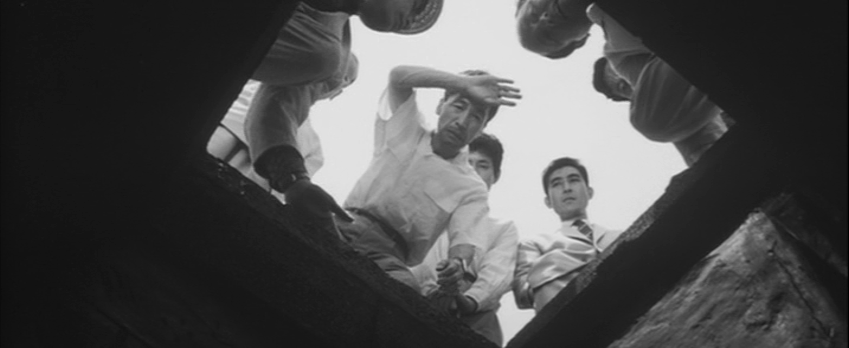
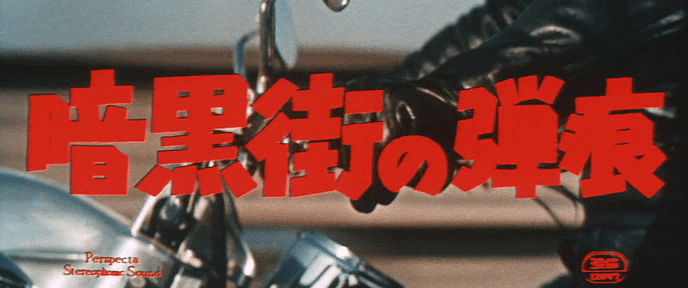
Blueprint of Murder (暗黒街の弾痕, Kihachi Okamoto, 1961)

Alongside its trademark tokusatsu Toho also had a sideline in genre-hopping B-movie comedy of which Kichachi Okamoto’s Blueprint of Murder (暗黒街の弾痕, Ankokugai no Dankon) is a prime example. Playing into a zeitgeisty anxiety about corporate corruption which led to several series of films revolving around industrial espionage such as Yasuzo Masumura’s Giants & Toys and the later Black Test Car, Okamoto’s ironic take on noir and globalisation anticipates the spy spoofs Toho would produce in the wake of Bond fever while quietly also perhaps poking fun at Nikkatsu’s crime melodramas.

The film opens with a young man, Kusaka (Ko Mishima), and his boss Komatsu (Ichiro Nakatani) testing an experimental car engine that would be ultra efficient and cheap to produce. The test goes well, but Kusaka is run off the road on the journey home, caught between a truck and a mysterious man on a motorcycle. Meanwhile, Kusaka’s brother Jiro (Yuzo Kayama), a whale hunter, is busy working on a new kind of harpoon when he gets a telegram from an old friend telling him to come home right away because his brother is dead. On meeting with Komatsu, Jiro starts to think perhaps his brother’s death wasn’t an accident. It seems there are a lot of people interested in this technology, some of whom would rather it not see the light because cheap, efficient engines are not good news for the oil industry. 

Hearing that Kusaka was recieving threatening letters, Jiro wonders why he wouldn’t go to the police, but Komatsu points out that it would have made no difference. Firstly, the police rarely get involved with cases of corporate espionage, and secondly if they did the blackmailers would win anyway because if there were a court case they would have to make full disclosure of their plans. Jiro tries going to the police himself and showing them that he has evidence, as well as the “instinct of a whale hunter”, which suggests that his brother was murdered, but nonchalant policeman Azuma (Tatsuya Mihashi) doesn’t seem very interested. Teaming up with an old uni friend, Sudo (Makoto Sato), who now runs some kind of scandal rag newspaper and is well connected around town, Jiro tries to investigate but soon becomes entangled in a complicated web of corporate intrigue.

Sudo, whose paper seems to be on the verge of bankruptcy, has some sort of game going with corrupt businessman Otori (Seizaburo Kawazu) who runs Goei Economic Reporting Agency which was one of three companies bidding for Komatsu’s engine. Later, Sudo’s main squeeze Tomiko (Kumi Mizuno) also tries to blackmail Otori by posing as the daughter of a man he drove to suicide after poaching technology from his company. Played at his own game, Otori is extremely disturbed to have this traumatic incident thrust in his face, and it quickly becomes clear that although he was onboard with various kinds of corporate duplicity, he had his lines and is worried to think someone might have crossed them on his behalf. 

Otori is right to worry, they are coming for him too. Eventually unmasked, it will come as no surprise to know that the big boss is from Hong Kong making this another quiet instance of Sinophobia betraying an essential anxiety about a newly global Japan. Meanwhile, Jiro’s problems are closer to home. He starts to doubt Sudo, warned off him as man only interested in money, and witnessing him play every angle to his own advantage. Sudo may be playing his own game but has his friend’s interest at heart and is simply trying to protect him from endangering himself in a world he does not understand. 

Rather than the fulfilment of a dangled romance, what we’re left with is the restoration of the friendship between the two men in which they ultimately re-inhabit their innocent student selves complete with a surreal game of air baseball while Tomiko and Komatsu’s sister Kyoko (Mie Hama) cheer excitedly from the sidelines. Okamoto throws in a killer punchline to an early whale hunting gag while piling on the absurdist humour in characteristic style with one unexpected pay off after another even as the guys find themselves in an increasingly murky world of corporate double cross, femme fatale nightclub singers with their own identical minions/backing bands, and rowdy gangsters while trying to ensure the little guy is still free to innovate outside of consumerist concerns.  


Original trailer (no subtitles)

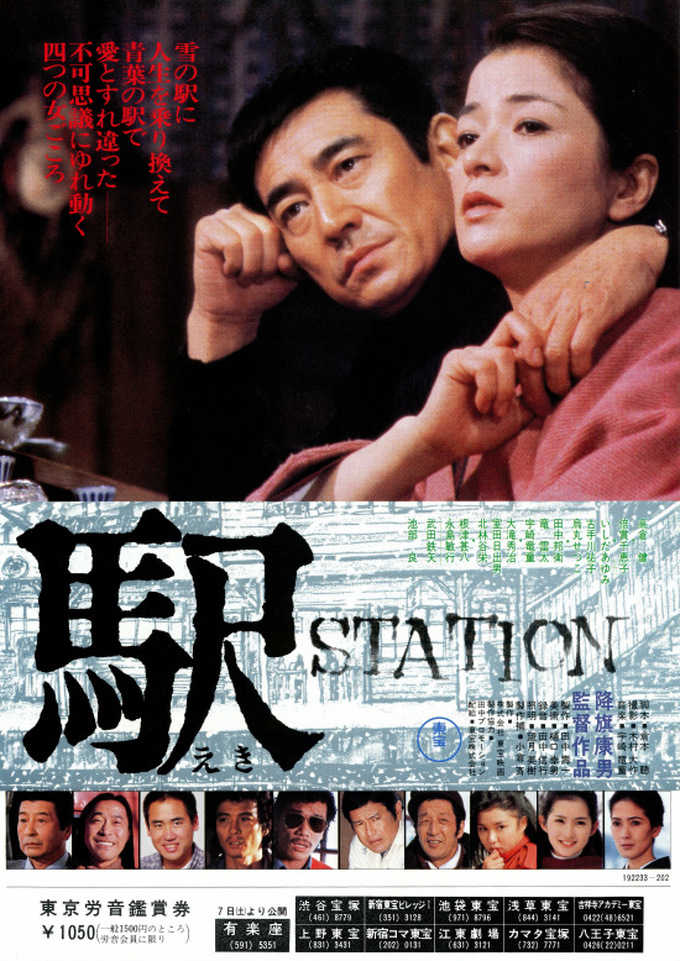
Station (駅, Yasuo Furuhata, 1981)

The thing about trains is, you can get off and wander round for a bit, but sooner or later you’ll have to go where the rails take you. You never have as much control as you think you have. The hero of Yasuo Furuhata’s Station (駅, Eki) is beginning to come to that conclusion himself, addressing the various stations of his life, the choices he made and didn’t make that have led him into a dejected middle-age, defeated, and finding finally that any illusion he may have entertained of living differently will not come to pass. 

In 1968, police detective Eiji Mikami (Ken Takakura) sends his wife (Ayumi Ishida) and son away for reasons which aren’t entirely clear. At this point in his life, he’s an aspiring marksman on Japan’s shooting team intensively training for the Mexico Olympics, which is perhaps why he felt he could no longer be a husband and a father, or at least not while also being a policeman. All that changes, however, when his friend and mentor is gunned down during a routine job, shot in the chest at point blank range by a man in a white Corolla while operating a check point to catch a killer on the run. In 1976, he goes to see his sister (Yuko Kotegawa) marry a man she might not love to escape a violent boyfriend and investigates a serial killer of women who rapes and murders girls in red skirts. In 1979, he’s haunted by the serial killing case coupled with his cool execution of hostage takers during a siege. Holing up in a small fishing village waiting for a boat home for New Year, he strikes up a relationship with a barmaid who is just as sad, lonely, and defeated as he is. 

When Mikami’s friend is shot, his wife tells the reporters that she thinks shooting at targets, which her husband had been training others to do, is a different thing than shooting at living beings. “One shouldn’t shoot at people” she tearfully insists, accidentally forcing Mikami into a double dilemma, knowing that his marksmanship skills were on one level useless in that they couldn’t save his friend while paradoxically told that they shouldn’t be used for that purpose anyway. But what really is the point in shooting holes in paper targets just to test your skill? Wandering into the hostage situation while posing as a ramen deliveryman, he cooly shoots the two bad guys without even really thinking about it, as if they were nothing more than paper. 

The Olympics overshadow his life. He gave up his wife and son for them, but no matter how hard you train, the Olympics eventually pass. Mikami is told he’s supposed to bring honour to Japan, representing not only the nation but the police force. He’s not allowed to investigate his friend’s death because they want him to concentrate on his shooting, but he is and was a policeman who wants to serve justice. While he’s waiting for the funeral, he sees a report on the news about a former Olympic marathon runner who’s taken his own life because he got injured and fell into a depression feeling as if he’d let down an entire nation. Mikami perhaps feels something the same, drained by responsibility, by the feeling of inadequacy, and by the potential for disappointment. After the Olympics he feels deflated and useless, wondering what the point of police work is while quietly rueful in suspecting the committee is about to replace him on the team after all. 

When he wanders into the only bar open on a snowy December evening, that is perhaps why he bonds so immediately with its melancholy proprietress, Kiriko (Chieko Baisho). The conversation turns dark. Kiriko tells him that a friend of hers who worked in a bar in the red light district killed herself last New Year, that it’s the most dangerous time for those who do this sort of work, not for any poetical reason but simply because it’s when their men come home. She tells him that she’s a lone woman, no virginal spinster but weighed down by the failure of old love. Swept up in the New Year spirit, Mikami starts to fall for her, but is also called back to the past by an old colleague who passes him his wife’s phone number and tells him she’s now a bar hostess in Ikebukuro. He starts to think about leaving the police and getting a local job, but fate will not allow it. Kiriko too sees her dream of love destroyed precisely by her desire to escape the pull of toxic romance. Back in 1976, Mikami had been party to a similar dilemma as the sister of his suspect kept her brother’s secret but secretly longed to escape its burden. Suzuko (Setsuko Karasuma) too lost love in trying to claim it and now works as a waitress in a small cafe in this tiny town, only latterly making an impulsive decision to try to leave and make a new future somewhere else. 

Mikami tears up the letter of resignation that declared him too tired of life to be a good policeman, once again boarding a train back to his rightful destination, knowing that a policeman’s what he is and will always be. He watched his wife wave goodbye from a station platform, saw a man betrayed on the tracks, and finally boarded the train himself, letting go of any idea he might have had about going somewhere else. Stations are after all transitory places, you can’t stay there forever. 


Original trailers (no subtitles)

Aki Yashiro’s Funauta which plays frequently throughout the film

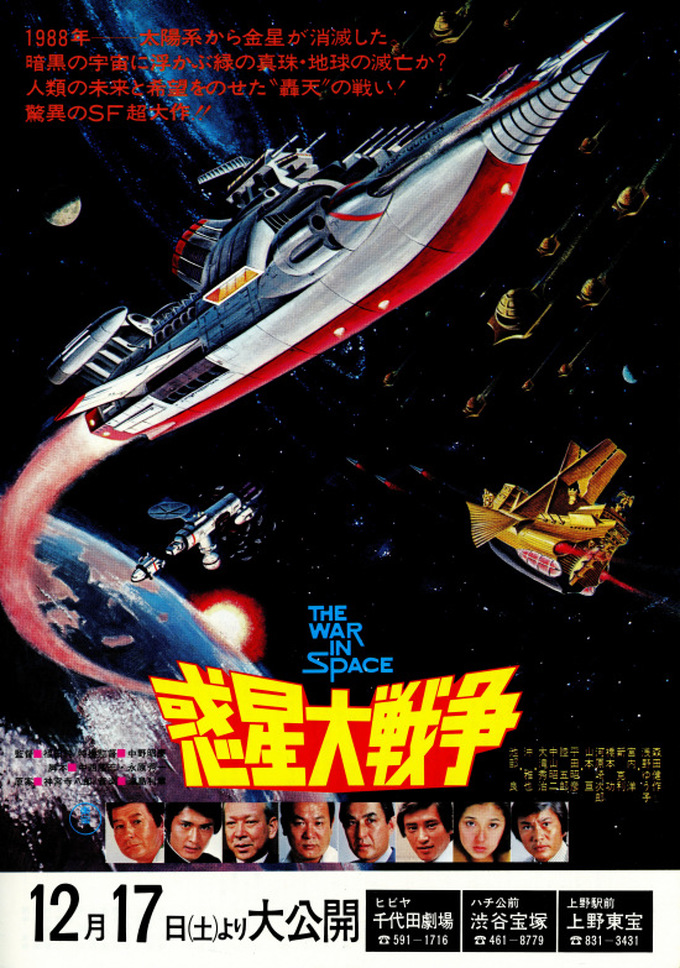
The War in Space (惑星大戦争, Jun Fukuda, 1977)

War in Space posterThe tokusatsu movie had been Toho’s signature line since the mid-‘50s, but 25 years later it was more or less played out. The late ‘70s saw the studio diversifying into other types of populist cinema while trying to find new directions in a rapidly changing industry. 1977’s The War in Space (惑星大戦争, Wakusei Daisenso), technically a “sequel” to Ishiro Honda’s Gorath from 1962, very much exemplifies the decline while trying to meld a fairly standard Star Trek-esque tale of interplanetary conflict with Star Wars-inspired fantasy.

In the distant future of 1988, the United Nations Space Force in Japan has been having trouble contacting the space station because of continued electromagnetic interference. Miyoshi (Kensaku Morita), a former team member making an unexpected return from America, tells them that they’d been having the same problem over there and not only that, there had been a worrying increase in UFO sightings across the nation. Making brief contact with the space station confirms their fears when the pilot suddenly starts screaming about a giant Roman spaceship approaching at speed before contact is lost once again. It seems that the Earth is now under attack from an extraterrestrial invasion, and the electromagnetic interference appears to be coming from Venus.

Miyoshi reconnects with his mentor, Takigawa (Ryo Ikebe), and tries to persuade him to resume an old research project to develop a high powered spaceship known as Gohten, but he remains reluctant. Part of the reason for his lack of enthusiasm is that Miyoshi had been his best student and Takigawa still bears him some resentment for his abrupt decision to leave for America rather than staying to contribute to Japan’s future while his feelings are further complicated by the fact that Miyoshi had been in a serious romantic relationship with his daughter, Jun (Yuko Asano), whose heart was broken when he left. A Space Force employee, Jun is now engaged to fellow officer Muroi (Masaya Oki) who is glad to see his old friend Miyoshi return, but also a little anxious.

With the Earth facing imminent destruction, however, there’s little time to worry about past heartache. Takigawa finds himself forced into restarting the Gohten project when he realises that the “Venusians” can pose as regular humans by possessing their bodies. As usual, everything rests on the team pulling together to finish the mammoth project in a record three days before the aliens obliterate their base just like they’re doing to most of the Earth’s major cities. Eventually, the team realise that the aliens aren’t from Venus at all, but from another major solar system and led by a man calling himself “Commander Hell” (Goro Mutsumi) who, for some reason, is dressed like a Roman emperor. Like the Romans, their aim is colonisation. They’ve worn out their home planet and are looking to move, but want somewhere kind of the same so they’ve set their heart on one three away from the sun, like the Earth. 

Aside from the classical trappings, War in Space was apparently rushed out to cash in on the success of Star Wars and even includes a scene which seems to anticipate Leia’s capture by Jabba the Hut in Return of the Jedi when Jun is kidnapped and forced into hotpants while chained to a Chewie-esque furry minotaur carrying a giant axe, which might be mixing their classical metaphors somewhat as Jun and Miyoshi, arriving to rescue her, attempt to escape from Commander Hell’s ship. Takigawa and co. make their way to Venus to try and take out Commander Hell’s base, but are faced with a terrible choice. The reason Takigawa didn’t want to finish the Gohten project is that the ship is armed with a terrifyingly powerful, universe destroying bomb which he worries it was irresponsible of him to invent. Hypocritically, he now knows he’ll have to use it but is hoping that in doing so it will be destroyed along with everything else except perhaps the Earth.

Unlike in Star Wars, it’s the good guys who blow up a planet to save their own though at least no one seemed to be living there, only Commander Hell’s evil minions. Bowing out with a slightly more bombastic evocation of the original tokusatsu messages about the dangers of irresponsible science, War in Space is a fairly generic exercise in genre but has its moments in its bodysnatching spy aliens, groovy ‘70s production design, and charmingly earnest sincerity.


Original trailer (no subtitles)

Girls of the Night (女ばかりの夜, Kinuyo Tanaka, 1961)

vlcsnap-2019-03-15-00h18m28s351

Working from a Keisuke Kinoshita script, Kinuyo Tanaka’s first film as a director, Love Letter, made a point of exploring the often hypocritical and contradictory attitudes towards women who had engaged in sex work or become the mistresses of American servicemen in the immediate aftermath of the defeat. For her fifth film, Tanaka returns to the same subject but this time adapting a novel by Masako Yana scripted by Sumie Tanaka (no relation) with whom she’d previously collaborated on The Eternal Breasts. Somewhat suggestively retitled Girls of the Night (女ばかりの夜, Onna Bakari no Yoru), Tanaka’s adaptation tones down the novel’s sensuality but dares to ask a series of subversive questions regarding female agency and sexuality in the rapidly changing post-war society.

Set in the contemporary era, the film opens with reportage-style voiceover and newspaper clippings highlighting the enforcement of the anti-prostitution laws of 1958. According to the voiceover, the red light districts of Japan may have all but disappeared but streetwalking and other forms of casual sex work are still very much a part of the post-war economy. In an attempt to bridge the gap between the old ways and new, those arrested by the police are divided into two camps – those deemed beyond “redemption” sent to prison, and the rest to reform centres such as the Shiragiku Protective Facility for Women which is where we find our heroines.

The reform centre itself is a fairly progressive place and much more forward looking that seen in the earlier Women of the Night though perhaps sometimes patronising even as it makes a strenuous attempt not look down on the women who enter its care. Our first entry into the facility is in the company of a similarly well meaning women’s association whose misplaced pity only reinforces their innately privileged position. They are as far from many of these women as it is possible to be and struggle to understand how it is possible that they found themselves engaging in a practice they find both shameful and degrading. Having got to know many of the women through trying to help them, the school’s headmistress Nogami (Chikage Awashima) and her assistant are better placed to understand even if they also apologise that many of the women in their care are of “low IQ” and fail to convey the kinds of pressures that many have been subject to from desperate poverty to bad family situations and abusive relationships.

Abuse and the trauma of abuse remains one of the barriers to the women moving on, as in the reason many of them found themselves in sex work was because of their relationship with an exploitative partner who either forced them to sell their bodies or left them with no other choice in order to support themselves through being unable or unwilling to work. Nogami, a compassionate and understanding woman, is at pains to insist that the reason many of these women see nothing wrong in sex work is that they have an insufficient level of self respect and value their bodily autonomy too cheaply in allowing others to buy and sell access to it without full consideration of everything that implies.

Then again, asked by one of her most promising cases, Kuniko (Hisako Hara), what is actually so “bad” about sex work, Nogami is forced to admit that she doesn’t know – only that it is now illegal and her job is to help these women live “honest” lives within law. It is difficult to evade the hypocrisy that Nogami is telling these women that they should exercise full agency over their bodies while simultaneously telling them what they shouldn’t be doing with them, but then for all the centre’s talk about “purity” Nogami herself is refreshingly frank and practical in her approach to helping these women towards reintegration into mainstream society in the assumption that that is something they would want rather than out of any quasi-religious ideas of moral goodness.

Shame and social stigma, however, become another barrier as Kuniko finds to her cost in her attempts to move on from the centre. At her first placement as a live-in assistant at a grocer’s, she is quickly outed by a nosy deliveryman already acquainted with the true nature of the Shiragiku centre. The exposure of Kuniko’s past provokes not only mild disgust and suspicion among “respectable” people but also unwanted male attention from those who assume her former life as a sex worker means that they are already entitled to her sexuality with or without her consent.

Thinking the direct approach might be better, Kuniko decides to share her past with the ladies in the dorm at her next job in a factory but they are not quite as supportive as she might have hoped. Despite the fact that many of these young women are sexually active and in fact involved in what might be thought of as acts of casual sex work, they collectively look down on Kuniko while also seeking to exploit her both for the practical knowledge they assume she must have and by attempting to pimp her out to other men they know. When the attempt fails (Kuniko humiliates the three men who try to pressure her into sex by frightening them off with nothing more than confidence and self-possession), the women turn on her and enact an extremely violent and sadistic revenge.

Despite what she observed at the centre, Kuniko learns to her cost that she cannot necessarily rely on female solidarity as a bulwark against male exploitation. Nevertheless, it is to female communities and friendships that she ultimately returns. The leader of the women’s group from the beginning turns out to be less of a dilettante than she first seems and eventually takes Kuniko in with a promising job in a rose a garden which seems to suit her perfectly. Roses, however, have thorns – this one’s being her tentative relationship with gardener Hayakawa (Yosuke Natsuki) who is aware of her past but falls in love with her anyway only for her romance to hit the barrier of entrenched social mores when she discovers that Hayakawa is in fact a member of a noble family. In another instance of women not helping women, Hayakawa’s mother puts the kibosh on her daughter-in-law being a former sex worker which both reinforces Kuniko’s sense of being irreparably damaged and makes her feel as if she has become a problem for a man with whom she has fallen in love. Vowing to live up to Hayakawa’s vision of her as a “pure” woman, Kuniko retreats once again to a supportive community of women – this time of pearl divers in what seems to be an act of spiritual cleansing.

In Kuniko’s final identification of the “disgracefulness” of her past and declaration that she does not hate the world but only herself, Girls of the Night shifts into a more conventional register than the broadly empathetic, subversively positive attitude it had hitherto adopted towards the idea of sex work and the women who engage in it, opting to blame the woman rather than engage with the various forces of social oppression which attempt to micromanage female sexuality. Nevertheless, Tanaka’s deft touch remains as sympathetic as it’s possible to be in affirming that there is a path forward for those who might feel trapped by past transgression even if it simultaneously insists that its heroine save herself only by rejecting her happy ending in atonement for her past “sins”.