 A Double Life (二重生活, Nijyuu Seikatsu ), the debut feature from director Yoshiyuki Kishi adapted from Mariko Koike’s novel, could easily be subtitled “a defence of stalking with indifference”. As a philosophical experiment in itself, it recasts us as the voyeur, watching her watching him, following our oblivious heroine as she becomes increasingly obsessed with the act of observance. Taking into account the constant watchfulness of modern society, A Double Life has some serious questions to ask not only of the nature of existence but of the increasing connectedness and its counterpart of isolation, the disconnect between the image and reality, and how much the hidden facets of people’s lives define their essential personality.
Tama (Mugi Kadowaki) is an MA philosophy student working on a thesis regarding the nature of existence in contemporary Japan. Discussing her work with her supervisor, Shinohara (Lily Franky), Tama reveals that she was drawn to her subject because she is unable to understand why she herself is alive. Her proposal was largely based on the tried and tested method of a survey but Shinohara is hoping for something more original. Catching sight of a Sophie Calle book on his desk, he suggests that Tama’s project might benefit from examining the life of one subject in depth and so he tasks her with following a random person and observing their daily activities in order to figure out what makes them tick.
Tama is conflicted, but when she catches sight of her neighbour at a book shop she makes an impulsive decision to follow him which will later develop into an all consuming obsession. Ishizaka (Hiroki Hasegawa) is a successful editor at a high profile publishing house with a pretty wife, cute daughter and lovely home just over the way from the apartment Tama lives in with her illustrator and game designer boyfriend, Takuya (Masaki Suda). However, while following Ishizaka to a local coffee shop Tama catches him illicitly meeting another woman. Not quite believing what she sees, Tama’s obsession with her target continues to grow until the fateful day that her cover is finally blown.
Tama, and her supervisor, both regard the exercise as essentially harmless because all Tama is supposed to do is observe. The nature of her experiment means that she must remain unseen so that the subject does not change his or her behaviour but Tama quickly becomes a passive observer to an unpleasant domestic episode when Ishizaka’s wife discovers the affair. Tama is, always, a passive presence. As she says herself, she carries a deep-seated sense of emptiness that prevents her from fully connecting with other people. Her stalking activities, however, reawaken a sense of connectedness that she had been unable to find in her everyday life.
While Tama is watching Ishizaka, she herself is also being watched. Firstly, of course, by us, but also by the busybody landlady whose obsession with the proper way to dispose of rubbish has led to her installing spy cameras to capture the offending tenants on film. Of course, the cameras capture a lot of other stuff too which, when used alongside other forms of evidence, paint a slightly different picture. The old lady is a classic curtain twitcher, albeit one with access to more sophisticated equipment, and looms big brother-like over her tiny domain, the possessor and disseminator of all information. Tama’s rules mean she must not be seen, but someone is always watching, collecting information to be repurposed and repackaged at the convenience of the collector.
Cameras capture images but humans conjure pictures. From the outside, the Ishizakas are the perfect model family – a successful husband, warm and friendly housewife who is quick to get involved in community events, and a lovely, well behaved little daughter. As we find out Ishizaka is not the committed family man which he first seems. After treating all of the women in his life extremely badly, Ishizaka adds Tama to his list after the affair is exposed and his life ruined. Tama was only ever a passive observer whose presence had no effect on the narrative, yet Ishizaka blames his predicament on her rather than address the fact the situation is entirely his own fault. He does, however, have a point when he accuses Tama of exploiting his secrets for her own gain.
Tama’s observations are limited to the public realm and so she’s left with a lot of unknown data making her conclusions less than reliable. The gap between her perception and the reality becomes even more apparent once she begins observing the life of her supervisor, Shinohara. In an elliptical fashion, the film begins with Shinohara’s presumed suicide attempt and for much of the first half we seem him struggle with the grief of his mother’s terminal illness. This again turns out to be not quite as it seems, undermining Tama’s whole research proposal as her conclusions on Shinohara’s reason for living were based on a deliberately constructed scenario.
Ironically enough, Tama’s attempts to connect eventually ruin her own relationship as she finds herself living “a double life” as a vicarious voyeur. Abandoning her sense of self and living through her subjects, Tama begins to connect with the world around her but it’s more overlapping than a true union of souls in which she becomes a passive receptacle for someone else’s drama. Hers is the life of a double, shadowy and incomplete. Take away a man’s life lie and you take away his happiness, so Ibsen told us. Tama would seem to come a similar conclusion, that the essence of life may lie in these petty secrets and projected images. An intriguing philosophical text in itself, A Double Life is an intense look at modern society and all of its various artifices which marks Kishi out as a promising new cinematic voice.
Reviewed at Raindance 2016
Original trailer (English subtitles)
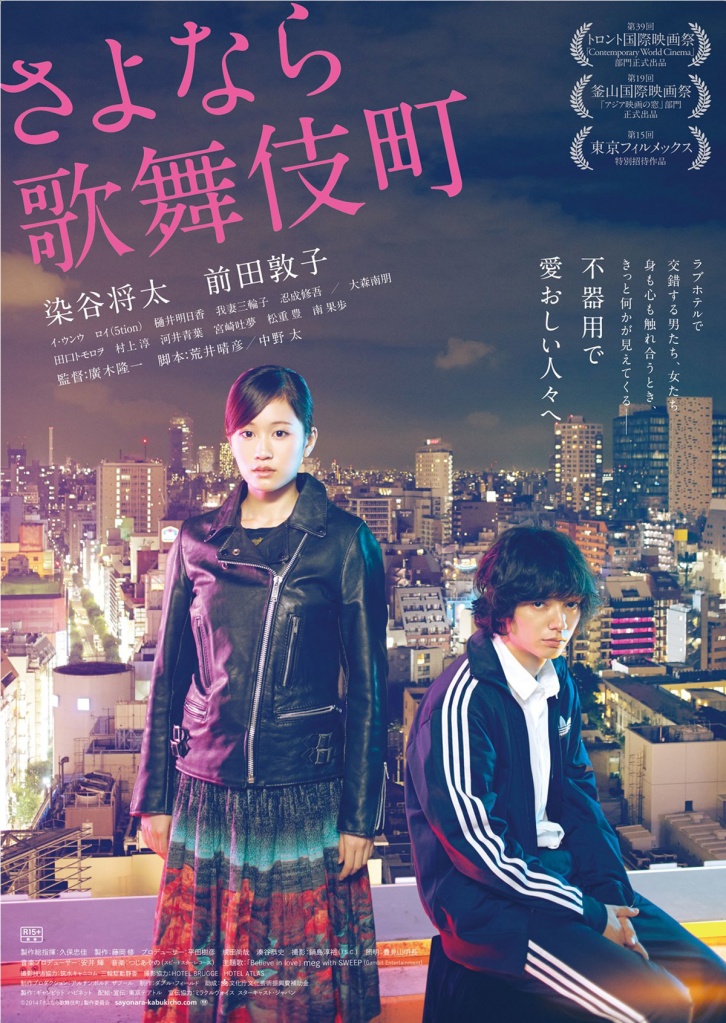 Kabukicho Love Hotel (さよなら歌舞伎町, Sayonara Kabukicho), to go by its more prosaic English title, is a Runyonesque portrait of Tokyo’s red light district centered around the comings and goings of the Hotel Atlas – an establishment which rents by the hour and takes care not to ask too many questions of its clientele. The real aim of the collection of intersecting stories is more easily seen in the original Japanese title, Sayonara Kabukicho, as the vast majority of our protagonists decide to use today’s chaotic events to finally get out of this dead end town once and for all.

