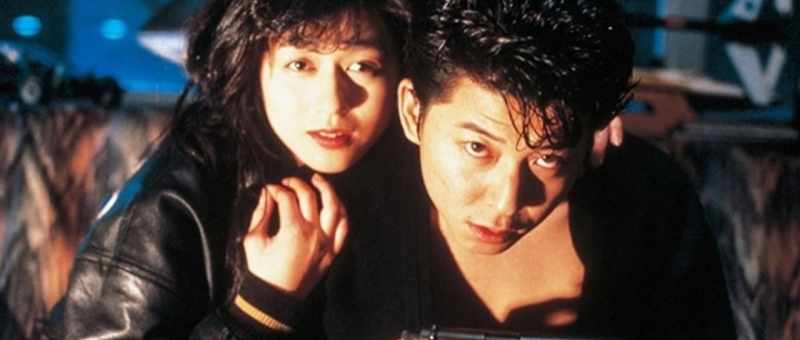
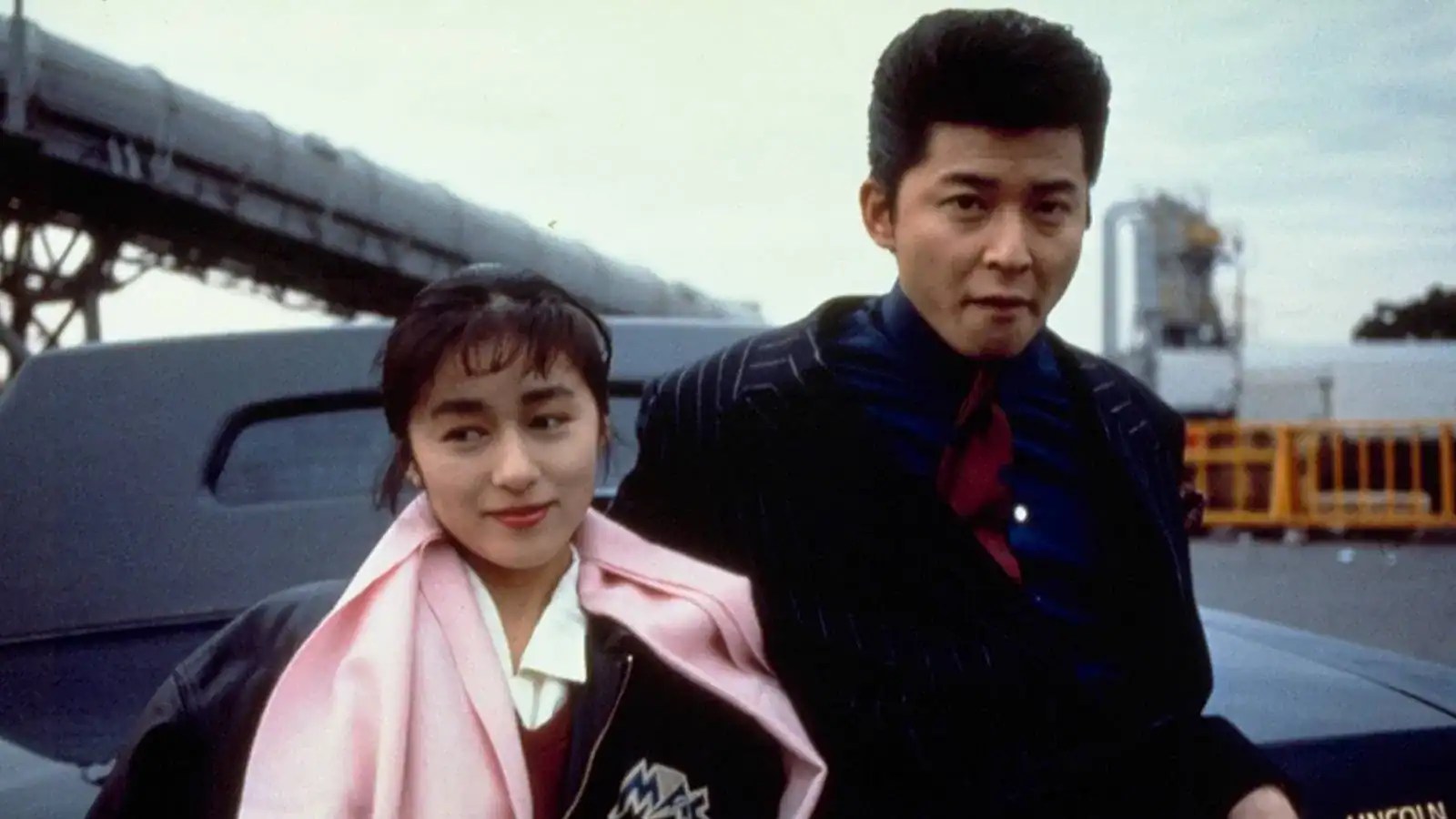
Neo Chinpira: Zoom Goes the Bullet (ネオ チンピラ 鉄砲玉ぴゅ~, Banmei Takahashi, 1990)

In the classic yazkua films of old, going to prison for the gang could be a badge of honour and one of the ways you could catapult yourself into the higher ranks. By the 1990s, however, the yakuza is a much depleted force and it seems few are willing to give up years of their lives on a point of honour for an uncertain reward. At least, that’s how it is for most of the gangsters at the centre of Banmei Takahashi’s Neo Chinpira: Zoom Goes the Bullet (ネオ チンピラ 鉄砲玉ぴゅ~, Neo Chinpira: Teppodama Pyu) , a slacker comedy in which a young hanger on faces a dilemma when he’s made the lookout on a squad sent to bump off a rival only for his squamates go to great lengths to injure themselves first so they won’t have to go through with it.

Junko (Sho Aikawa) is an unlikely hero. With a rockabilly quiff and a red jacket, he’s nominally the driver for gangster Yoshikawa (Toru Minegishi) which means he gets to drive his limo and act like a big man for a while making calls on his carphone. But as much as Junko shows off to his girlfriend Noriko, a hostess at a Korean bar, by instructing the landlady not to clear up his empty bottles because they’ll make a good weapon in an emergency, he’s otherwise something of a joke. The limo ends up getting “stolen” by a young woman who just likes American cars and sexually aroused by gunfire.

Even Yumeko (Chikako Aoyama) chuckles that Junko sounds like a girl when he says he wants to see the ocean while they’re driving around. “Junko” is ordinarily a girl’s name. He picked it up as a kind of hazing based on an alternate reading of his name kanji. She says the same thing again when he reveals he’s never brought a girl back to his place before, probably because it’s in a disused building he was given to manage where he’s surrounded by junk like an old barber’s chair and pinball machine while the figure of Humphrey Bogart in the Maltese Falcon looks down at him from a poster as if embodying his unattainable gangster dreams. As masculine icons go, Junko is also plagued by his uncle, Mizuta (Joe Shishido), a legendary gangster and representative of old school yakuza who take the code seriously and wouldn’t put up with people like Junko’s colleagues who engage in “zooming”, deliberately shooting themselves to get out of being ordered to carry out a hit. He’s not overly impressed by Junko either, unable to understand why he’d become an errand boy for a petty gangster rather than be his own boss as a small-time crook.

Junko’s dilemma is whether he’s really up to this task and will be to go through with it or will end up chickening out and injuring himself too. Crows are more cowardly than they seem, Yumeko explains in an obvious allegory for the yakuza. They pick a place and defend it as a group, while their numbers are way up lately so their individual turfs are shrinking. But now Junko’s all on his own and filled with uncertainty not knowing if he can pass this rite of passage and be accorded a man or will forever be trapped in a liminal space of adolescence never to be taken seriously or make any progress in his life. In an effort to toughen up, he swaps his red jacket for a suit and finally puts on a shiny leather overcoat, ripping off the buttons to bind it more tightly around him with the belt as if it were a kind of armour. 

Somehow the lighthearted ridiculousness of this world of bumbling yakuza and creepy corrupt cops lends an additional poignancy to Junko’s final gesture as he sets off on his path, not really believing he will return. He doesn’t even wait for the pictures he had taken at a photo booth. They won’t be much use to him where he’s going, but at the same time it’s like he’s treading water never quite getting closer to his destination but continuing along his long sad walk. Banmei Takahashi sticks firmly to his pink film roots, sticking in a weird sex scene at regular intervals as Yumeko becomes enraptured by pistols, but also has quite a lot of fun with his “uncool” gangsters and the lost young man who looks up to them while perhaps knowing that this image of stone cold masculinity only really exists in the movies.
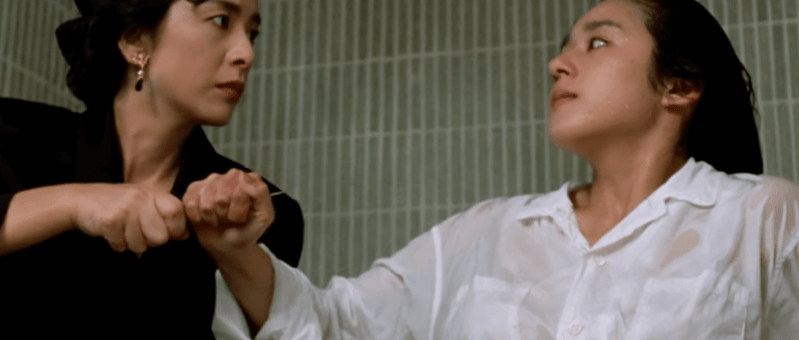

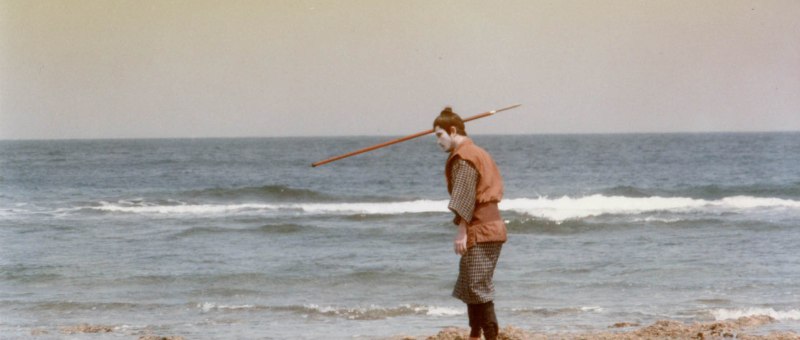
Door II: Tokyo Diary (Banmei Takahashi, 1991)

A sequel in name only, Banmei Takahashi’s Door II: Tokyo Diary has almost nothing to do with his previous film Door, the title was apparently tacked on at the behest of studio execs who noticed that it had sold well on home video. Nevertheless, the film has its own door motif as the aimless heroine searches for herself among the many available to her, temporarily trying on other personas while wilfully flirting with danger. 

A menacing voice message reminds Ai (Chikako Aoyama) that her work is dangerous, a woman telling her to back off but for unclear reasons either genuinely concerned for her safety or annoyed she’s infringing on her business. Ironically enough, Ai is a call girl who runs her own operation through the soon-to-be obsolete technology of a telephone answering service which unlike the phones in Door offer her a one way portal of communication that isolates her from her potential clients. She explains that she chooses the men for herself, watching idly having quadruple booked the same appointment until finally deciding which door to open though it seems unclear how far she is aware of her vulnerability given that working alone means there’s no one to call if something goes wrong as it eventually does. Even the first client we see her with changes the moment he steps over the threshold, becoming angry having realised that Ai doubled booked the appointment while playing rough with her and forcing her down onto the bed. 

Ai (whose name means love) seems to treat each of the doors as another world in which she must play her assigned role. As such, she submits herself to every degradation though it’s unclear if the act of submission is empowering or she is really just at the mercy of these wealthy mean who’ve paid to do what they like with her. Then again as Ai explains to sometime love interest Ichiro (Shingo Kazami), her real motive is sex and not money leading her to turn down an appointment with a sweet older gentleman who’s checking call girl experience off his bucket list but does not actually want to sleep with her only go on a date. Meanwhile, she finds herself bound and blindfolded while a man in heavy makeup and a nazi uniform dribbles wine down her face as part of a urination role-play. She later plays the piano for him while he curls up in a little ball at her side. 

Becoming involved with a mysteriously wealthy art dealer (Joe Yamanaka) who treats her with unusual tenderness seems to shift Ai’s world view, but equally does an incredibly dark encounter with a dangerous man who attacks Ai and her friend Tomoyo (Yukino Tobita) with a pair of scissors until Tomoyo bites one of his toes off so they can escape. This is the danger the middle-aged madam (Keiko Takahashi) tried to warn her about and causes her to reconsider her life as a call girl until she finally decides to try the same door again and bursts the fantasy bubble by telling the art dealer she loves him. 

A climatic and hugely inappropriate speech at a wedding which nevertheless earns the appreciation of the bride, allows Ai to begin to rediscover herself realising that it was the sense of anticipation that she craved not knowing what she’d discover beyond each and every door. She decides she’d like to swim in the great ocean of infinite possibility once again, ready to open more doors to find out what lies beyond possibly reassured by the art dealer’s assertion that though most of his paintings are fakes he’s discovered a handful of “originals” too restoring Ai’s sense of self as an individual rather than an anonymous call girl who comes when called and has no direction of her own. A melancholy tale of youthful anxiety in the fracturing economy of the Bubble on the eve of its implosion the film trades on Takahashi’s experience in pink film in its at times perverse eroticism but ultimately presents a tale of a young woman regaining control over her self and her life, willing to embrace new possibilities and their concurrent dangers so long as she chooses them for herself. 


Door II: Tokyo Diary is released in the UK on blu-ray 30th October courtesy of Third Window Films.

Restoration trailer (English subtitles)

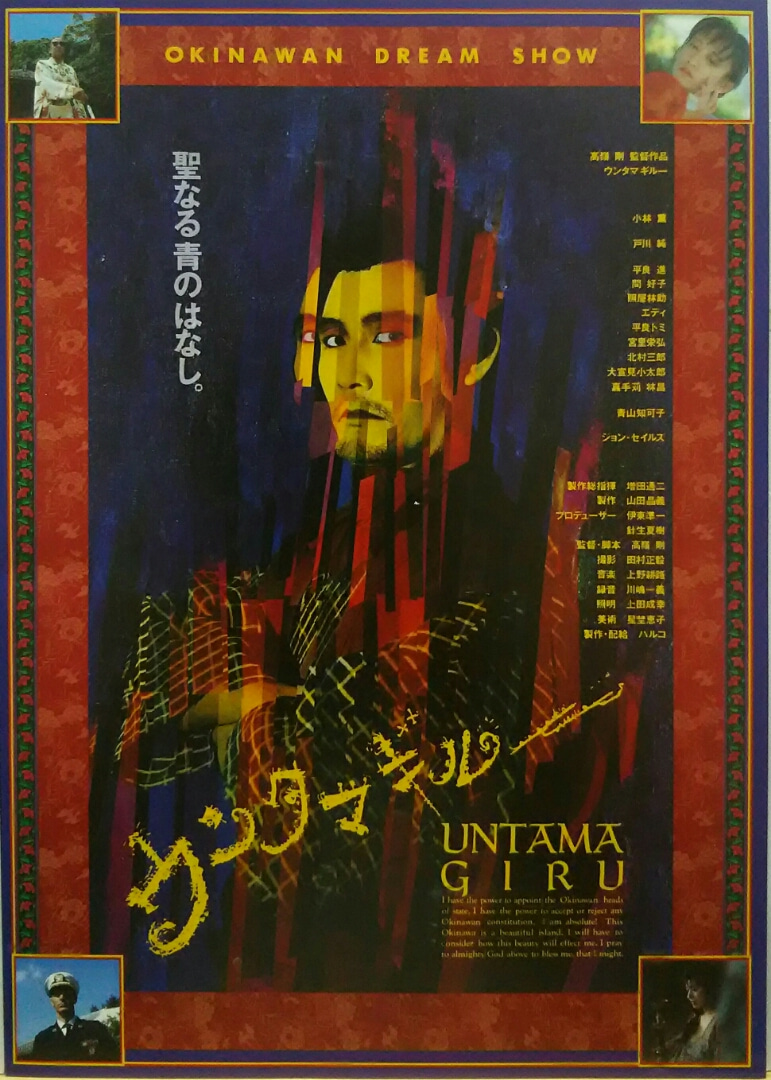
Untamagiru (ウンタマギルー, Go Takamine, 1989)

“My country is not part of America or Japan! I am a child of Ryukyu!” the hero of Go Takamine’s musical fable Untamagiru ( ウンタマギルー) finds himself shouting after having unexpectedly acquired godlike powers and used them to aid the Independence Movement. Apparently inspired by a legendary local figure, Takamine’s quasi-musical like his earlier Paradise View finds the Okinawan islands at a turning point considering three possible futures: to maintain the status quo under American rule, to return to Japanese sovereignty, or finally to acquire their independence though the last of these seems to be nothing more than an idealistic pipe dream. 

Takamine begins and ends with the same scene changing only the location and the identity of a key player while the hero, Giru (Kaoru Kobayashi), drives a tiny truck in a small circle to turn the grinder that presses the sugarcane. Giru is however mainly casting looks at Mare (Chikako Aoyama), the voluptuous daughter of his taskmaster boss Nishibaru, as she languishes under a small shelter smoking pigweed from a shisha pipe. Giru later finds the courage to ask her to accompany him to a beach party, which she does, the pair sneaking off to a secluded cove near the forest where they make love. The problem is that, as Giru discovers, Mare is actually an anthropomorphised pig that Nishibaru was raising as a wife for the Forest God so now Nishibaru has it in for him. Framed for starting a fire at the plantation he’s encouraged to flee to the forest by his sister, Chiru (Jun Togawa), who has a knack for animal dream divination, and is aided by a tree spirit whose child he once saved who grants him special demi-god powers that enable him to survive the curse which otherwise falls on all who sleep with Mare. 

It’s these new powers which give Giru a new sense of possibility allowing him to become a kind of Robin Hood playing both sides off against each other from the middle of the forest, pinching meat from Japanese companies and redistributing it to the local community, and pilfering weaponry from the American bases to give to the independence movement. The two sides are represented in the two respective bosses, the blind and castrated Nishibaru, and the American commissioner Kamajisar who as Chiru puts it cares for animals more than people but is also seen injecting himself with the blood of dogs and pigs. “I am absolute” Kamajisar insists, claiming that Okinawa is a possession of the American military pointing out that 90% of the population feels themselves to be different from the Japanese while simultaneously describing the possibility of independence as nothing more than a fairytale. 

Yet Untamagiru comes to represent the face of rebellion, resisting not just political oppression but social and economic in targeting Japanese businesses and redistributing their goods to the local poor becoming a folk hero in the process. Not everyone is as immediately happy about this, the owner of the brothel where his sister works asking him to stop giving money to the poor because their business can’t cope with the sudden demand while she personally looks down on their new clientele and fears they’re damaging her upscale brand. Even so even Untamagiru eventually falls victim to his own hubris, struck down while ironically enough agreeing to play himself in a traditional stage performance inspired by his life and deeds leaving only the idea of himself behind as a kind of talisman for those who had in him found a sense of hope and possibility. 

Then again could all of this have been a dream? “Poor people are terrible, aren’t they? They’ll even try to steal the end of people’s dreams” turncoat Utou chides Giru on catching him napping assuming that he dreams of Mare though her words have a degree of sense to them in the elliptical passage of time in which we move from one “dream” to another just as Okinawa itself shifts between two states, two different rulers, and finds itself in the middle once again driving round in circles looking at something it wants but can’t have and in the end it seems may be destroyed out of spite. A magical realist fable filled with its own strangeness in its dream divinations, ethereal forest deities, shapeshifting pigs, and the constant refrains of the barbershop band who narrate the whole show with caustic wit through traditional Okinawan musical performance Takamine’s oneiric tale ends in symbolic apocalypse, “From now on Okinawa is Japan”. 


Untamagiru screens at Japan Society New York May 21 at 7pm as part of Visions of Okinawa: Cinematic Reflections

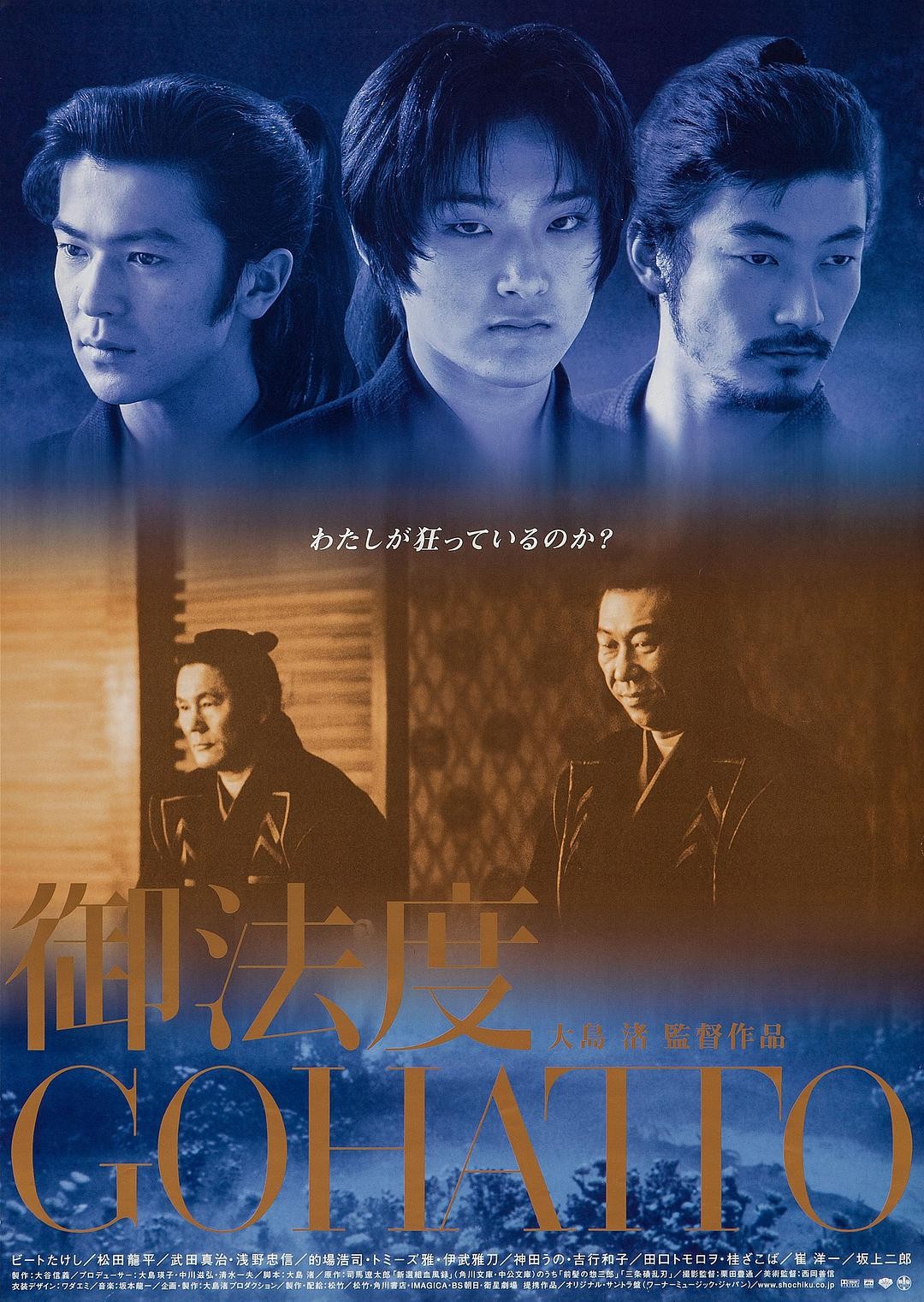
Gohatto (御法度, Nagisa Oshima, 1999)

Nagisa Oshima once said that his hatred of Japanese cinema extended to absolutely all of it, decrying the hackneyed nativism of “foggy beauty and stupid gardens”, yet his final film is filled with Mizoguchian mist and almost a paen to Japanese aesthetics which ends with a cherry blossom tree in full bloom cut down in its prime. Burdened by the slightly more salacious title “Taboo”, Gohatto is less about love between men in an intensely homosocial world even as it asks what it might mean by “forbidden” or “against the law” than it is about idealism and aesthetics as its band of contradictory conservatives unknowingly approach the end of their world in a coming modernity ushered in by dangerous beauty. 

Set in the Kyoto of 1865, a scant three years prior to the Meiji Restoration, the film opens with an audition of sorts as the Shinsengumi search for promising new recruits among talented swordsmen. Already a mess of contradictions, the Shinsengumi is, loosely, a kind of official police force dedicated to defending the Shogunate against the revolutionary forces set on restoring power to the emperor. Nevertheless, in an odd way and in contrast to the elite Mimawarigumi which was staffed only by direct retainers to the Shogun, the Shinsengumi was noted for its lowkey egalitarianism in that it made a point of admitting those of ordinary birth as well as lower level samurai and ronin. Of course, the notions of equality only went so far and perhaps only fuelled its reputation for merciless savagery, but also make it a strangely progressive force fighting against progress in defence of the feudal status quo. 

Only two of the hopefuls are thought to be any good, one a young ronin, Tashiro (Tadanobu Asano), and the other a beautiful boy, Kano Sozaburo (Ryuhei Matsuda), the third son of a wealthy merchant whose line were once samurai but are no longer counted among the noble retainers. A talented swordsman, Sozaburo’s dangerous beauty presents an existential threat to the Shinsengumi order, the steely Hijikata (Takeshi Kitano) looking on conflicted in witnessing the way his commander, Kondo (Yoichi Sai), looks at this vision of androgynous beauty remarking that he had not known him to be “that way inclined”.

Being that way inclined does not seem to be a particular issue within the Shinsengumi, it is not against their draconian rules and in fact appears to be tolerated at least as long as it causes no further problems. Kondo is however mindful of the chaos caused by a similar wave of homoerotic lust which took hold shortly before a climactic battle which would prove to be their last success. What Sozaburo seems to arouse in them is something more dangerous than the accepted patterns of love between military men which is in a sense sublimated as a mentor/student relationship, loyalty more than romance. Tashiro, who is of a similar age to the apparently 18-year-old Sozaburo, lets his desire be known, vowing to sleep with him before he dies ironically acknowledging Sozaburo for what he is, an angel of death. 

For his part, Sozaburo remains curiously passive in each of his encounters, aroused only it seems by the act of killing. Yet Hijikata discerns that he has indeed become Tashiro’s lover on witnessing them fight, Sozaburo losing clumsily despite being the more skilled in a dynamic that mimics their relationship in which Tashiro is the dominant partner. Aware of the danger in Sozaburo’s allure, Kondo suggests having a superior take him to the red light district to show him the delights of woman hoping to guide him back towards a less dangerous path, only the attempt backfires on several levels. Firstly, Sozaburo has no interest in women and continues to decline believing his commander is also hitting on him (like everyone else), thereafter determined to seduce him after all. Another retainer does indeed succeed in seducing Sozaburo, developing a mild obsession, but later ends up dead, Tashiro a main suspect in his murder with the motive of sexual jealousy though all of this additional violence is perhaps only an expression of Sozaburo’s dangerous beauty. 

As so often, sex if not love becomes the force which destabilises the social order only here it’s equated both with death and with an alternative mediation of male violence. Perhaps reflecting the way they look to the 18-year-old Sozaburo who makes a faux pas in accidentally suggesting at least one of them is of pensionable age, the ranking members of the Shinsengumi are played by actors already well into their golden years as if relics of a bygone era though in reality most were in their 30s. As Soji (Shinji Takeda), a filial figure like Sozaburo wearing long hair, puts it, there are no old men in their unit which is in essence an anti-revolutionary force. Nevertheless, the Shinsengumi is on the wrong side of history and already living in its end times, perhaps ushered towards its doom by the figure of the beautiful boy. “You were too beautiful”, Hijikata eventually laments as he finally perhaps understands the nature of the revolution he is witnessing. Perverse to the last, Oshima sets his ethereal finale in a stygian fog and pays an ironic tribute to the Mizoguchian classicism he so railed against in his youth, taking a sword to the cherry blossoms as he like Hijikata severs his own legacy in a moment of destructive beauty. 


Gohatto screens at Genesis Cinema on 25th September as part of this year’s Queer East

International trailer (English subtitles)

Au Revoir, Mon Amour (何日君再來, Tony Au Ting-Ping, 1991)

Love and Resistance go to war in Tony Au’s noirish romance, Au Revoir, Mon Amour (何日君再來, AKA Till We Meet Again). The evocative title sets the scene for a tale of love betrayed by changing times, but ultimately asks if love is a question of priorities and if you have the right to put your romantic destiny on hold to serve a greater good, even if that greater good is a shared ideal. Predictably, the answer may be no, because in the world of the movies at least love is an absolutist choice and you won’t be forgiven for resisting it. 

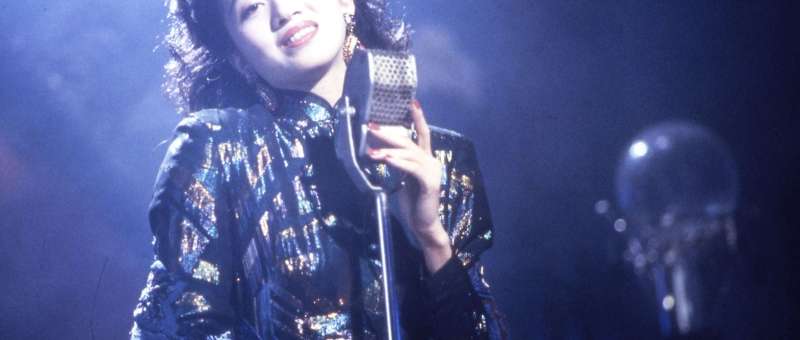
One fateful evening in the Shanghai of 1941, Resistance operative Sum (Tony Leung Ka-Fai) is an accidental witness to the murder of “notorious Japanese monks” which he later learns may have been set up by the Japanese authorities themselves. Chasing the perpetrator, Shirakawa (Jun Kunimura), through a series of back allies where he slices and dices his now redundant Chinese mercenaries, Sum is brought to a smoky nightclub where the singer, Mui-Yi (Anita Mui Yim-Fong), is none other than his one true love whom he met thanks to the Resistance movement some years earlier but was forced to leave behind with only a heartfelt letter explaining that he would return when the battle was done. Returning the favour Sum had done her in saving her life when she was about to be hit by a car, Mui-Yi tosses him a gun that allows him to defend himself against a crazed Shirakawa and thereafter shelters him in an abandoned garage until he is well enough to return to his mission. 

Heartbroken and embittered, Mui-Yi is still lowkey anti-Japanese and seemingly unafraid of telling the local goons where to get off despite her father’s attempts at collaboration. Her aunt Jing (Carrie Ng Ka-Lai), however, finds herself succumbing to the dubious charms of violent and thuggish turncoat Tit Chak-Man (Norman Chu Siu-Keung) who is working with the Japanese apparently because he thinks China is weak and unsophisticated. Tit Chak-Man thinks nothing of blowing up little children and blackmailing suspects which is how he begins to manipulate Mui-Yi after seizing her father’s bar and having him put in prison on a trumped up charge. Meanwhile, she flip flops in her relationship with Sum, at once resenting him for his tendency to disappear and then longing for his return, while he berates her in a mistaken assumption that she has decided to collaborate but promises that he will be hers and hers alone once the war is over. 

Unlike many similarly themed movies from both the Mainland and Hong Kong, the big bad is not the Japanese themselves but the Chinese who betrayed their country and sided with the enemy. Somewhat two dimensional, Tit Chak-Man is a thuggish brute who is prepared to do anything and everything to stamp out the Resistance but is at once humanised by his intense romance with Jing which continues even after she attempts to assassinate him and eventually proves his weakness when he refuses to abandon her to escape from a baying mob. Though Shirakawa is indeed crazed and bloodthirsty, we’re shown his opposite in the gentle, sensitive Noguchi (Hidekazu Akai) who has also fallen in deep and selfless love with Mui-Yi and is willing to facilitate her romance with Sum while doing everything he can to keep her safe. 

Years later, Sum irritably points out that Noguchi had a choice in serving his country and was therefore free to choose love instead which seems extremely disingenuous seeing as he was most likely (in some way) a conscript too but was in his own way resisting in order to serve the best interests of his country. Sum chose China over Mui-Yi. It’s unreasonable to expect someone to wait in line until you’ve finished being a revolutionary hero and have the proper time to devote to love, no one likes being second choice even if you’re right behind “freedom” when it comes to priorities. To save his love, Sum sent it into the arms of the enemy but failed to realise that she might also find a home there or at least a sense of relief in no longer needing to wait for someone who might never return. Can there be love in time of war? Yes, but love like revolution is a choice and it won’t wait for you forever, if you betray it you may not be forgiven. 


Fortune Star trailer (no subtitles)