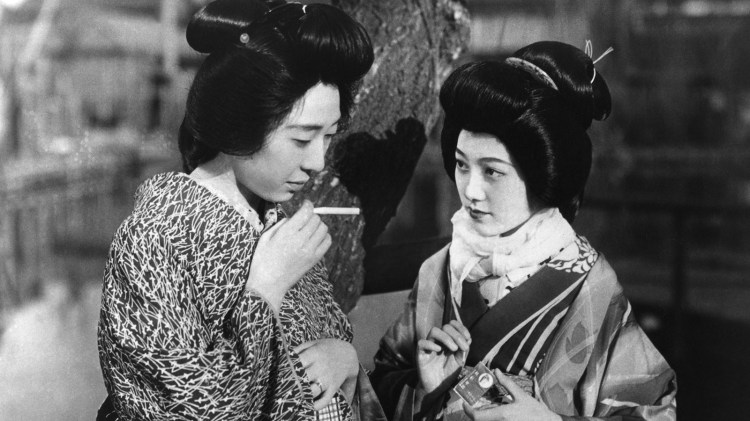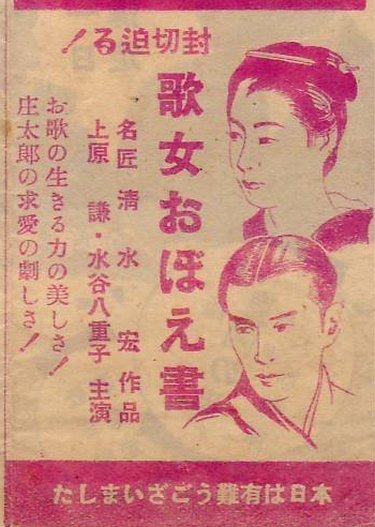
Notes of an Itinerant Performer (歌女おぼえ書, Hiroshi Shimizu, 1941)

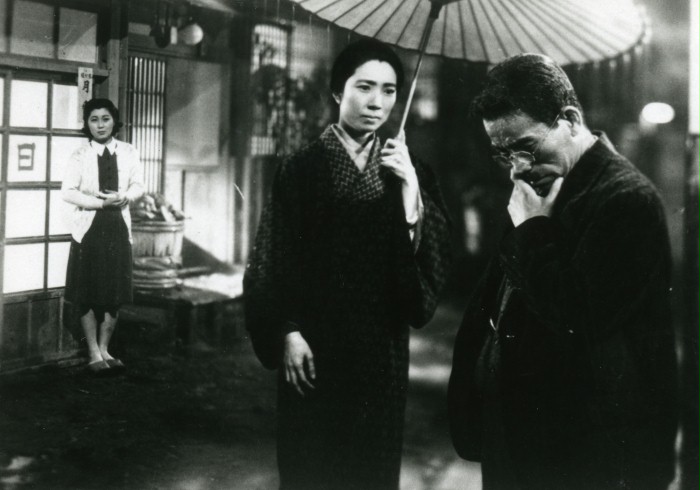
notes-on-an-itinerant-performerFilmed in 1941, Notes of an Itinerant Performer (歌女おぼえ書, Utajo Oboegaki ) is among the least politicised of Shimizu’s output though its odd, domestic violence fuelled, finally romantic resolution points to a hardening of his otherwise progressive social ideals. Neatly avoiding contemporary issues by setting his tale in 1901 at the mid-point of the Meiji era as Japanese society was caught in a transitionary phase, Shimizu similarly casts his heroine adrift as she decides to make a break with the hand fate dealt her and try her luck in a more “civilised” world.

At 25 years old, Uta (Yaeko Mizutani) jumps ships from one acting company to another having been promised better work by a roguish fellow performer. Tired of the strenuous life of travelling from village to village, putting on folk plays and street performances, Uta is thinking of quitting the business and looking for a job as a maid or something similar which is at least in the same place everyday. In a stroke of luck, she comes into contact with a kindly tea merchant who takes pity on her and suggests she come to live with him where she can teach his teenage daughter how to dance.

Uta becomes a member of the Hiramatsu household but not all of the inhabitants are as generous of spirit as Mr. Hiramatsu (Hideo Fujino) himself. The oldest son is away at college but the daughter, Nuiko (Kyoko Asagiri), has no interest in learning to dance and resents her father’s “adoption” of such a “common” woman. Youngest son Jiro (Haruhiko Tsuda) is similarly unimpressed with Uta’s presence, making her new home less than welcoming. To make matters worse, Mr. Hiramatsu abruptly dies leaving his business and household in disarray. Oldest son Shotaro (Ken Uehara) returns and feels as if he ought to abandon his studies and take over the company, but as a student he has no experience of running a business and lacks his father’s knowledge of the tea industry. Uta encourages him to return to university and finish his studies if only so that the prestige of a degree might help him later if he decides to restart the business. She also volunteers to act as a guardian for Jiro and Nuiko though Shotaro is wary seeing as they know each other so little. He then makes a surprising suggestion – that he and Uta marry, making it perfectly natural that she take care of everything at home while he’s away studying in the city.

Like many a Shimizu hero, Mr. Hiramatsu is a good hearted man but perhaps lacking in practical skills. Though he seemed to be prosperous and successful, the business was on the rocks and he dies leaving a number of debts behind him and total admin chaos for Shotaro as there is no clear successor to keep the business running in Mr. Hiramatsu’s absence. Luckily for Uta, Shotaro is also a kindhearted man like his father (in contrast to his siblings) and has no desire to suddenly throw her out when his father promised to look after her. He is, however, at a loss as of how to take care of everyone with no money coming in.

Even before Mr. Hiramatsu died, not everyone was happy about his decision to take in a travelling performer and an old friend begins to warn him about the danger of rumours. Friend of the family Kajikawa feels he has a stake in this as he intends his daughter Ayako to marry Shotaro and thinks it’s a done deal (though Mr. Hiramatsu does not seem particularly wedded to the idea). Ayako and Nuiko are also good friends and Ayako does seem like the ideal bride for Shotaro as a member of his own social class and a business connection for the family. Shotaro, however, proposes to Uta without really thinking things through. It is, in one sense, a purely practical decision but one that is likely to meet with a degree of social opposition.

Uta left her life as a travelling performer because she wanted something more conventional. Her mother died when she was six and she never knew her father. Her only happy memory of family is the time spent with her grandmother who died when she was twelve. Uta resents her lack of status as a member of a lowly order of entertainers and longs for something grander but has also internalised a deep seated sense of inferiority. Hence when Jiro and his school friends refer to her as a “monster” living in the house, she half accepts their prejudiced view of her. Nevertheless, she wants to honour the kindness that Mr. Hiramatsu offered her and also deeply respects his son, Shotaro, possibly even developing romantic feelings for him. Despite continuing to feel herself unworthy, Uta does the unthinkable by almost singlehandedly resurrecting the tea business when presented with an opportunity from a foreign company. Even after becoming a formidable business woman and winning the respect of Nuiko and affection of Jiro, Uta still feels herself out of place in the mercantile world and ultimately opts to leave in order to pave the way for the “proper” union of Ayako and Shotaro.

When Shotaro and Uta meet again she tells him that she left because she found his middle class world of “decency” too rigid and full of dull formality. Her “housewife” life was a hard one – getting up early, no smoking, no drinking. At least as a travelling performer she can sleep in and have her share of fun. This produces a quite shocking and strange scene in which Shotaro strikes Uta violently, knocking her to the floor. He repeats his earlier promise to marry her and invites her to come home as his wife, a “decent” woman, and full member of his social class whatever anyone else might have to say about it. Shotaro is apparently a man of his word but there is real feeling implied in his actions as opposed to duty or obligation. Nevertheless, this quite surprising scene of domestic violence used as a tool of coercion does not speak to Shotaro’s otherwise kindly personality and undercuts the “romantic”, if melodramatic, quality of the scene. This may be another instance of Shimizu’s aversion to romantic resolutions or romance as a solution to crisis, but one expects better from a director generally so keen to underline the hardships faced by women in his society.

Despite being filmed well into the era of the talkies and long after Shimizu himself had made the jump to sound, Notes of an Itinerant Performer makes use of frequent intertitles setting the scene or providing explanatory background material. Conversely, it also anticipates a more recent trend by allowing the discussions between the “American” (actually heavily accented European) and his interpreter to take place in English with Japanese sidetitles for parts not subsequently translated in the dialogue. In fact, this broadly positive foreign presence seems an odd inclusion for the fraught political world of 1941 (the film was released in March, just nine months before outright hostilities would commence with the USA which had been effecting a series of trade sanctions with the expansionist nation since 1938) even if the deal itself is taking place in the comparatively more open society of 1901.

In many ways about transitionary periods both in terms of society and of the self, Notes of an Itinerant Perfomer seems conflicted right up until its “Reader, I married him” inspired intertitle. Uta crosses a class border, transcending her lowly origins through selfless sacrifice, pure heartedness, and perseverance yet finally she is dragged across by violence and condescension rather than self acceptance or personal transformation. Filled with ambiguity, Notes of an Itinerant Performer reflects the uncertainties of its times and is noticeably less forgiving than Shimizu’s general outlook as its problematic finale demonstrates.
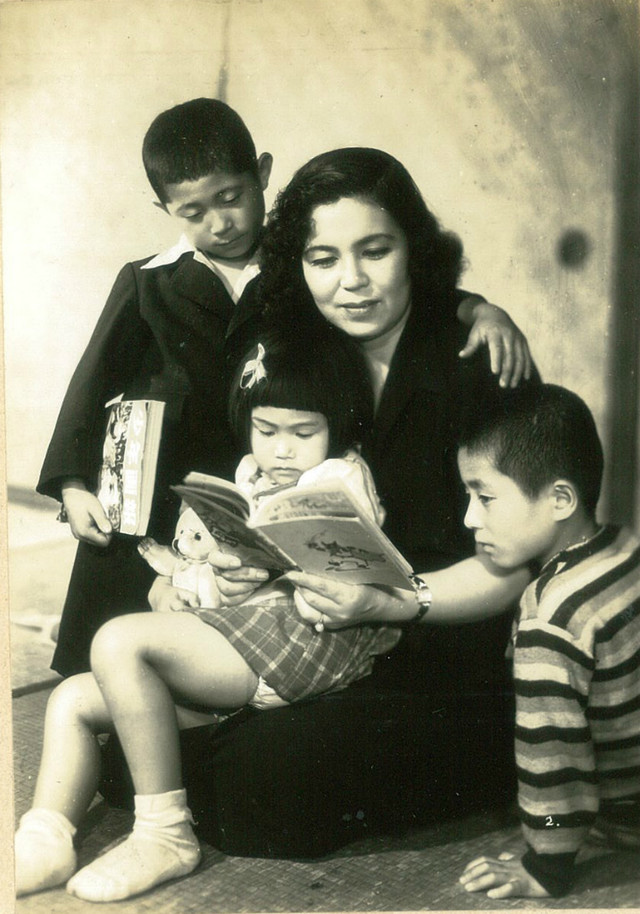


A Mother’s Love (母情, Hiroshi Shimizu, 1950)

mothers-loveShimizu’s depression era work was not lacking in down on their luck single mothers forced into difficult positions as they fiercely fought for their children’s future, but 1950’s A Mother’s Love (母情, Bojo) takes an entirely different approach to the problem. Once again Shimizu displays his customary sympathy for all but this particular mother, Toshiko, does not immediately seem to be the self sacrificing embodiment of maternal virtues that the genre usually favours.

Tellingly, when we first meet Toshiko she’s asleep on a bus as her three children badger a friendly artist who’s entertaining them by drawing a picture of their pretty mother. The boys are quick correct themselves when talking about the woman they’re with – she’s their “aunt” not their mother, but the artist sees through the ruse. Toshiko is heading to visit her brother in the country in the hope that he will look after her children for awhile offering the explanation that she wants to get married again. Her brother is sympathetic to her problems, but has six children of his own already (and perhaps a seventh on the way) so taking in three extra mouths to feed is not really an option. Agreeing to look after the youngest girl, they suggest trying an elderly uncle but remind her that he has a rather conservative mindset and may ask all sorts of questions about Toshiko’s recent past which she might not want to answer.

Not to worry, the uncle seems to have mellowed with age though he can’t take in two growing boys either and suggests asking a friend of his who’s been trying for a baby for years but has been unable to have one. When that doesn’t work out Toshiko deposits her second son at the uncle’s and travels on with just her oldest boy, Fusao, but as time goes on Toshiko begins to rethink her decision to have her children fostered out and wonders if just being together might be worth more than a stable economic life founded on the pain of abandonment.

The protagonists of “hahamono” which praise the idea of the noble, self sacrificing mother are not universally saintly but the one thing they never do is consider leaving their children. In this regard Toshiko is not immediately sympathetic. Rejecting the name “mother” for “aunt” in the hope of hooking a prospective husband, Toshiko has already marked herself as falling outside of the idealised mother standards and her rather cool, snappy way of addressing the children does not go in her favour either. Her brother greets her warmly (even if he seems to suspect that she’s probably come because she wants something) and has no desire to drag up the past but points out that other people might not be so charitable given that all three children have different fathers and Toshiko has never revealed how she supported herself towards the end of the war and in its immediate aftermath. Nevertheless, Shimizu refuses to judge her. Her life has been a hard one and she herself was fostered out herself as a child. Toshiko’s decision may not be one everyone would agree with but that doesn’t mean it was an easy one for her to make, or that she feels nothing in giving up her children.

The biggest tragedy is that the kids will be separated. Apparently often left to fend for themselves at home whilst Toshiko works, the children are a mini band of three and it seems even more cruel that they will be deprived not only of a mother but of their siblings too. Though the youngest girl tries to run after her mother and brothers, and the second son cries so much that his brother goes back to give him one of his comic books to cheer him up, Fusao is even more upset and anxious as the last remaining child. Constantly wetting the bed which costs him his place at a few prospective new homes, Fusao is plagued by the idea that his mother is about to abandon him and finally pleads with her that he can take care of his siblings by himself if only they can all stay together.

Fusao’s pleas eventually soften his mother’s heart though she begins to think again after coming across a band of itinerant performers, one of whom is nursing an infant despite her poverty and the harshness of her life. The young woman seems devoted to her child and is determined to take care of it even though she has no husband to help her. The child’s grandmother urged her daughter to give the baby up to someone with more resources to raise it but the girl refused, no matter how hard it may turn out to be. Moved, and feeling even more guilty in witnessing the hardships another mother is bearing for her child, Toshiko’s resolve begins to weaken.

When Toshiko is taken ill at an inn and her friend from the city, Mitsuko, comes to visit her it is revealed that Toshiko’s plan is not another marriage but that the two women are in the process of opening a bar – hence why she needs to farm out her children. Mitsuko has also sent her daughter to a relative so that she can plow all her time and money into the enterprise though no one knows how long it will take until the place is successful enough to support the full families of both women. It may be, therefore, that Toshiko’s desire to run her own business is for the ultimate benefit of her children who will finally have a degree of economic security. On thinking again, she wonders if it isn’t selfish vanity and that she’s sacrificing her children to fulfil her own desires.

Shimizu takes a more conservative viewpoint than that found in his other work by encouraging Toshiko to reject the prospect of being her own boss to embrace the traditional values of her natural maternity. The old nurse Toshiko visits in the hope that she will take in Fusao (which she almost certainly would have done) remarks that a full belly isn’t everything and being together might be enough, but that doesn’t quite explain what the obviously desperate Toshiko is going to do to survive from here on in. One can only hope that she somehow finds a way to make the bar work (even if it takes a little longer) rather than be left with nothing all over again. Focusing less on the children than on the maternal conflict as Toshiko becomes torn by the traditional values as seen in her rural hometown and the less forgiving modernism of the city, Shimizu retains an understanding tone but also eschews the concessions to pragmatism which so often went hand in hand with his forward looking idealism, for a reassertion of conservative values which fly in the face of his usually compassionate acceptance of the very real difficulties faced by women in a conformist and male dominated society.


Mr. Shosuke Ohara (小原庄助さん, AKA Ohara Shosuke-san, Hiroshi Shimizu, 1949)

vlcsnap-2016-09-25-01h34m07s636Ohara Shousuke-san (小原庄助さん) is the name of a character from a popular folk song intended to teach children how not to live their lives. The Ohara Shosuke-san of Aizu Bandaisan has lost all his fortune but no one feels very sorry for him because it’s his own fault – he spent his days in idleness, drinking, sleeping in, and bathing in the morning. The central character of Hiroshi Shimizu’s 1937 film has earned this nickname for himself because he also enjoys a drink or too and doesn’t actually do very much else, but unlike the character in the song this a goodhearted man much loved by the community because he’s a soft touch and just can’t refuse when asked for a favour. An acknowledgement of the changing times, Shimizu’s Mr. Shousuke Ohara is a tribute to the soft hearted but also an argument for action over passivity.
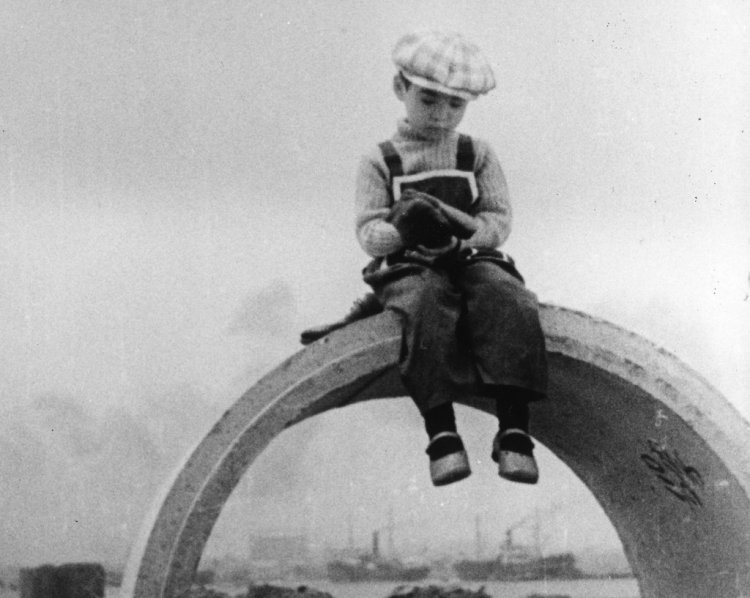
If you turn up one day and ask for directions to the Sugimoto household, everyone will look at you with confusion but if you ask for Mr. Shousuke Ohara everyone will gladly walk you over and introduce you. Saheita Sugimoto (Denjiro Okochi) is the head of a once proud samurai household but his fortunes are far from those of his ancestors. Despite his pecuniary difficulties, Sugimoto is good hearted man who wants to help everyone that he can (out of a sense of altruism rather than duty or vanity). Consequently he is deeply in debt and nearing bankruptcy yet he can’t give up any of his three vices – drinking, gambling, and generosity.

The nature of the changing times is at the centre of this 1949 film. As Sugimoto is fond of telling people, his noble house used to stand for something but all of that historical influence is next to meaningless now. Though Western dress is not uncommon, the village is pretty much as it’s always been – children play in the fields and Sugimoto travels everywhere by donkey. Other than the tale of Sugimoto’s fall from grace, the central narrative concerns an election for a new village chief. Yoshida, a youngish man, wants Sugimoto’s support for his election campaign. His main campaign policy is modernisation – the introduction of electricity, modern transportation and communications, as well as greater cultural involvement starting with opening Western style ballroom dance classes for the children. Unfortunately his policies are not that firm and his motto seems to be “I’ll do that first!” to all aspects of his plan which is not very encouraging but still the desire is very much to move away from old fashioned village life towards a more sophisticated urbanism.

This of course also means an end to the inherited influence of idle nobleman such as Sugimoto. Though he’s a kind man who likes nothing other than helping other people, Sugimoto has been a passive steward, more consumed with his own idle pursuits than with making an active attempt at leading the village. This passivity has contributed to his downfall as he’s neglected the business of maintaining his own fortune. After taking out numerous loans which he only ever uses to help the villagers, Sugimoto has let the estate which ancestors founded, and which he was supposed to look after in the names of all that have gone before and all were to come after him, slip away. The ultimate failure and a disgrace to his ancestors, this loss of the ancestral home is an unforgivable betrayal yet there is something in Sugimoto which seems to regard it as right and proper that it should go.

Change is coming to the village, even if it isn’t coming with the speed that a young man like Yoshida may be hoping for. Change is also coming to Japan which is in the progress of rebuilding itself anew following long years of folly followed by confusion. There is no room for genial idleness anymore. “If you can work honestly with your hands you can make a living”, Sugimoto tells two would-be-burglars that he invites in for a drink as a apology for not having anything left for them to steal, but means the advice more for himself than anyone else. It’s time to say goodbye to Shousuke Ohara and the burden of inherited privilege and chart a new course as Seihata Sugimoto. Finishing on another of Shimizu’s much loved road shots, Sugimoto, like his nation, walks confidently along the road to an uncertain future yet he is not alone as he goes and may make something of himself yet.


Every-Night Dreams (夜ごとの夢, Mikio Naruse, 1933)

Every Night DreamsFollowing on from Apart From You, Naruse returns to his exploration of working class women struggling to get by in a male dominated world in Every-Night Dreams (夜ごとの夢, Yogoto no Yume) also released in 1933. This time we meet weary bar hostess Omitsu who has a young son she’s raising alone after her deadbeat husband ran out on them a few years previously.

Omitsu doesn’t particularly like working in the bar, but as her mama-san grudgingly admits, she is quite good at it. She’s a modern woman who can drink and smoke and flirt to keep the guys buying drinks and wanting more though she’s finding it increasingly difficult to deflect some of the more intense interest such as that from a sleazy boat captain that her boss is eager to keep happy. Whilst at work, her son is looked after by a kindly older couple in her building who urge her to find a nicer line of business or get married again to a more reliable man.

The gentle rhythms of her life are disrupted when her long absent husband finally reappears. After first rejecting him outright, Omitsu eventually relents and lets him back into her life. However, despite his seemingly sincere pledges to change, get a proper job, start being a proper husband and father, Mizuhara fails to achieve any of his aims and also becomes increasingly jealous about Omitsu’s job at the bar. When their son, Fumio, is injured in an accident and requires expensive medical treatment, events reach a tragic climax.

Naruse would return to women alone facing a difficult economic future in many of his films but Omitsu’s situation is only made worse by the ongoing depression. Realistically speaking, there are few lines of work available to a woman in Omitu’s position and the more well regarded of them probably wouldn’t pay enough to allow her to keep both herself and her son, even as it stands she tries to borrow money from the bar to “reward” the older couple who watch Fumio while she’s working (though of course they wouldn’t take it). Omitsu herself feels there’s something degrading about her work and when her friend advises her to remarry, she exclaims any man worth a damn would run from a woman like her. Unfortunately, she may, in some senses, be right.

The man she ended up with, Mizuhara, is most definitely not worth a damn. It’s not entirely his fault he can’t find work – he does look for it and appears to want to find a job but in this difficult economic environment there’s not much going. Applying at factory, he’s turned down almost on sight because he’s a weedy sort of guy and doesn’t look like he’s cut out for physical labour. His inability to get ahead and provide for his wife and child sends him into a kind of depression and self esteem crisis which has him thinking about leaving again, especially as his increasing jealousy threatens his wife’s bar job which is their only form of income (whether he likes it or not). Fumio’s accident forces his hand into a series of bad decisions taken for a good reason but which again only cause more trouble for his family.

Naruse is a little flashier here than in Apart From You using canted angles, faster editing and even more zooms to hint at the panic felt by Omitsu in the increasingly distressing situations she finds herself in. Like the train accident in Flunky, Work Hard, the news that Fumio has been hit by a car is delivered in an expressionistic style beginning with his father putting down the boy’s toy car as a troupe of kids arrive and the screen is stabbed with a series of rapidly edited, alternating angle shots of intertitles mingled with the shocked reaction of the parents and the other children. If Naruse felt compelled to provide an ending with some sort of hint of far off promise in previous films, here he abandons that altogether as Omitsu laments her sad fate and instructs her son to grow up strong, not like his father, but like the mother who is doing everything she can to ensure his life won’t always be like this.


Every-Night Dreams is the fourth of five films included in Criterion’s Eclipse Series 26: Silent Naruse box set.

Apart From You (君と別れて, Mikio Naruse, 1933)

Apart From YouNaruse’s critical breakthrough came in 1933 with the intriguingly titled Apart From You (君と別れて, Kimi to Wakarete) which made it into the top ten list of the prestigious film magazine Kinema Junpo at the end of the year. The themes are undoubtedly familiar and would come dominate much of Naruse’s later output as he sets out to detail the lives of two ordinary geisha and their struggles with their often unpleasant line of work, society at large, and with their own families.
The older woman, Kikue, begins the film by asking her much younger friend and almost daughter figure, Terugiku, to pluck a grey hair from her head. Kikue also has a teenage son, Yoshio, who is becoming progressively rebellious, filled with anger and resentment over his mother’s line of work. Ignoring Kikue’s many sacrifices for him, Yoshio drinks, skips school and messes around with a gang of delinquents.

Feeling sorry for her mentor, Terugiku makes use of her good relationship with Yoshio to convince him that he should be more grateful for the kindness his mother shows him. Taking him on a trip to visit her impoverished family, Terugiku shows him the oppressive environment in which she grew up. Resenting having been sold to a geisha house to finance her drunken father’s violent outbursts, she is even more outraged that they now want to force her sister to undergo the same treatment. Terugiku is not prepared to allow this to happen and has decided to do whatever it takes to save her sister from suffering in the same way as she has had to.

Naruse highlights both the problems of the ageing geisha who sees her ability to support herself declining in conjunction with her looks, and the young one who only looks ahead to the same fate she knows will come to be her own. Both women are subjected to the humiliating treatment of their drunken clients who horse around and occasionally pull violent stunts with little to no regard for those who may even have been their wives, sisters, or daughters with a different twist of fate.

Kikue does at least have Yoshio, though their relationship is currently strained, but Terugiku has no one else to rely on. Her greatest fear is that her sister will also be sold off and have to endure the same kind of suffering as she has. In order to avoid this turn of events she agrees to undergo something far worse than even the unpleasantness of the geisha house to earn double the money in her sister’s place. She faces a future even bleaker than Kikue’s, yet in some sense it is a choice that she herself has made, actively, in sacrificing herself to save her sister.

Apart from You is much less formally experimental than either Flunky, Work Hard or No Blood Relation with its elegant, beautifully composed mise en scène. That said Naruse frames with a symbolist’s eye such as in a late scene where he shoots through the cast iron footboard of a sick bed to show the two women divided yet each imprisoned. This is a world filled with subtle violence, flashes of knives from clients and delinquents alike, raining blows from drunken fathers, and innocents wounded by misdirected arrows. Maternal love is both a force for salvation and of endless suffering but romantic love is always frustrated, ruined by practical concerns. Naruse rejects the kind of fairytale ending he succumbed to in No Blood Relation for something altogether more complex and ambiguous where there is both hope and no hope at the same time as a train departs in an atmosphere of permanent anxiety.


Apart From You is the third of five films included in Criterion’s Eclipse Series 26: Silent Naruse box set.

Clip featuring Terugiku’s visit to her family (with English subtitles)

Jubilation Street 歓呼の町 (Keisuke Kinoshita, 1944)

20138117_1_IMG_FIX_700x700The third entry in Criterion’s Kinoshita and World War II box set takes a decidedly darker turn than either of its predecessors. Made a little later in 1944, Jubilation Street is surprising addition, not least because for the majority of its running time it’s hard to see how it could have ever have fulfilled the propaganda requirements of the time. Its title is almost ironic, there’s nothing here but an inevitable sadness and eternal partings both between people and between eras. It’s not until the closing moments of the film that anything even remotely “inspirational” occurs, and even then it’s all a little bit tacked on and feels like a token epilogue to please the censors. With far less obvious comedy moments Jubilation Street is taking us somewhere significantly darker, but is not without Kinoshita’s characteristic sympathy.

Jubilation Street is an old-fashioned row of modest housing home to a small community of families who’ve each lived there for many years. Now they’re all being “relocated” because the government wants the land for the war effort. Some are ready to leave, others are not – either because they feel too old to start again somewhere else or simply because they don’t want to be split up from the people they’ve shared their lives with. The family who own the printer’s shop want to finish their last few orders and wait until their baby is born, the crotchety old man who runs the bath house just doesn’t want to go anywhere and Mrs. Furukawa is afraid to leave in case the husband who walked out on her and their son ten years previously finally comes home. Shingo, Mrs. Furukawa’s son, is a test pilot in the air force and wants to marry childhood sweetheart Takako, though her parents are against it given his family circumstances and dangerous work. Just in the knick of time, Mr. Furukawa makes a shocking reappearance, unbeknownst to his wife and son but will his ten years away with nary a word damage his chances of a happy reunion? With the evacuation date drawing nearer, important decisions will have to be made, and made in a hurry.

There may have been hope and happiness in this little street once, but now there’s just waiting and desperation. Towards the beginning of the film, the war still feels something far off – the relocation programme might as well be for a new dam or a modern housing development as much as being down to a war. Shingo is the only person directly involved with anything military and though his work is dangerous in one sense he gets to live at home with his mother and nothing seems very different than before. Towards the end, however, a traumatic event will drop the devastation of war right into the middle of this little community with as much force as any bomb. Doomed romance, shattered dreams, a lifetime’s work going for nothing – there’s nothing to celebrate here. Having undergone a tragedy and forced out of their homes, the community each vow they’re going to honour the sacrifices made by each doing their best for the war effort, but it comes dangerously close to being insulting. “So you’ve lost people, you might have lost your home or your business or a child but that just means you have to work even harder to make your loss mean something”. A fairly bleak message, if understandable given the circumstances, but it’s debatable that it’s one a worried populace would have wanted to receive in the normally escapist realms of the cinema.

It’s remarkably ambiguous for a film of its time. Perhaps because, again, he kept the war effort in the background, Kinoshita was able to get away with showing a less “jubilant” group of people each facing their various difficulties with an enviable degree of stoicism (coupled with their determined resolutions at the end). There’s no way you could read Jubilation Street as a “pro-war” film. Though it stops short of any kind of direct criticism, war (and even in one case the whole idea of Manchuria) has ruined each of these people’s lives, destroyed their community and cast them adrift in an uncertain world. What sort of glorious nation is this, and was it worth all this sacrifice?

Jubilation Street is not as well preserved as either Port of Flowers or The Living Magoroku, though the actual film is fine for the most part the soundtrack is very badly damaged with strong hiss and distortion throughout. However, it doesn’t detract from the experience too much and given that it’s a minor miracle it survives at all you can’t complain. Kinoshita has once again tried to put the lives of ordinary people up on screen with all the warmth, empathy and truth that was permitted to him at the time. The last days of Jubilation Street were not altogether happy ones, but as a metaphor for a place and time it’s about as close as you’d be allowed to explore.