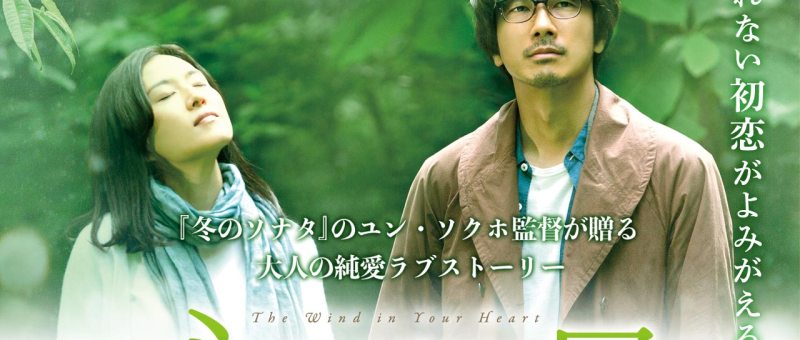
 Yoon Seok-ho is best known for his work in Korean television drama which included several of the series thought of as kickstarting the “Hallyu” wave. Chief among these is Winter Sonata which proved extremely popular in Japan and is also cited as a major inspiration for the short-lived boom of “junai” or “pure love” movies in the early 2000s. The Wind in Your Heart (心に吹く風, Kokoro ni Fuku Kaze) brings things full circle – making his feature debut, Yoon brings his brand of romantic melodrama to Hokkaido for a re-evaluation of first love, middle-aged regrets, and an escape from real world cynicism to a world of beauty and innocence.
Video artist Ryosuke (Hidekazu Mashima) has been in living in London for many years but is currently staying with a friend in Hokkaido on a working holiday. When his pick up truck breaks down in the middle of nowhere he chances in to a nearby cottage in the hope of using the phone, only to find a ghost from the past standing in the doorway – Haruka (Masumi Sanada), his high school sweetheart whom he has not seen in 23 years. Obviously a lot has happened – Haruka is married with a grown-up daughter, but seems sad and lonely. Ryosuke is only in town for a couple more days, but the pair make the most of their time to reconnect and think about what might have been and why it wasn’t, as well as what might still be if someone finds the courage to boldly pursue their desires.
Well, that might be a little strong – this is a story of innocent, chaste love, rather than a hot and passionate affair. The Wind in Your Heart does indeed share much in common with the classic “junai” in its nostalgic look back to innocent teenage romance and yearning to return to a time when everything seemed so simple and love was all that mattered. It is, however, sadder – we’re not told exactly what made Haruka decide to forget Ryosuke after he left for university in Tokyo, only that she went through some tough times. Likewise we don’t really know why Ryosuke didn’t try harder to find out, save that perhaps he thought that was what she wanted and respected her decision. Nevertheless, Ryosuke has remained unmarried and apparently still carries a torch 23 years later. All the pair have are mutual regrets and a shared sense of nostalgia for a future they feel they lost because of things that happened to them in their youths.
Now, things might be different. Haruka is obviously miserable in her marriage. Her daughter has left for university, her husband is working away in Taiwan, and she’s left at home all alone with her horrible mother-in-law. Ryosuke asks her if she’s happy and she can’t answer. She doesn’t want to talk about her husband whom she doesn’t seem to like very much. When we eventually meet him he is drunk, bossy, and insensitive. It’s no wonder Haruka might dream of running off with her idealised first love but when all is said and done she lacks the conviction to do it. She is simply too conventional, too bound by social obligation, to consider throwing caution to the wind and embracing her own happiness.
It might be patronising to suggest that Haruka is a stand-in for the expected audience – unhappy, under appreciated middle-aged women who perhaps feel trapped by a conservative society and long for escape from their humdrum lives through an innocent romance, but then that does very much seem to be the screenwriter’s intention. Haruka hesitates – her hand always hovering over door handles as if they were triggers, unsure which door to open and which direction to choose, ultimately making her decisions far too late. Unlike the more positive resolutions of a junai romance which allow the left behind to come to terms with their loss and resolve to live on with happy memories rather than sorrow, Haruka is left only with the crushing realisation that it really might be too late and she’s made a lifetime’s worth of poor choices though she does at least begin to find a degree of fulfilment in re-embracing her youthful dreams previously crushed by the unforgiving attitudes of her family.
Filming in Hokkaido, Yoon maintains a notably Korean sensibility in his static camera and straightforward composition which prioritises simple conversation between two people, only occasionally wandering off into poetic reveries in which the sun embraces the wind in a bracing Hokkaido spring. Reaching for something deeper than it manages to grasp, The Wind in Your Heart lands in standard melodrama territory, never quite managing to lend its central romance the weight it seems to want, but nevertheless doing its best to strain the heart with a tale of inescapable middle-aged misery in lives lived through the power of what might have been.
Original trailer (no subtitles)
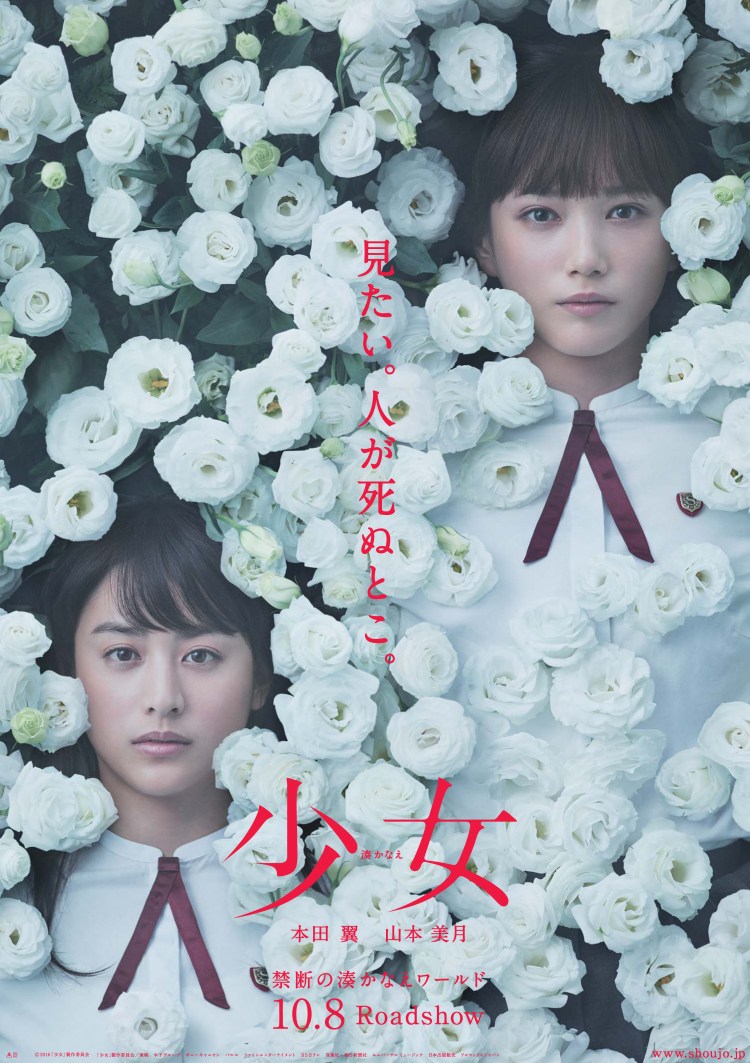 Kanae Minato is known for her hard-hitting crime stories from Confessions to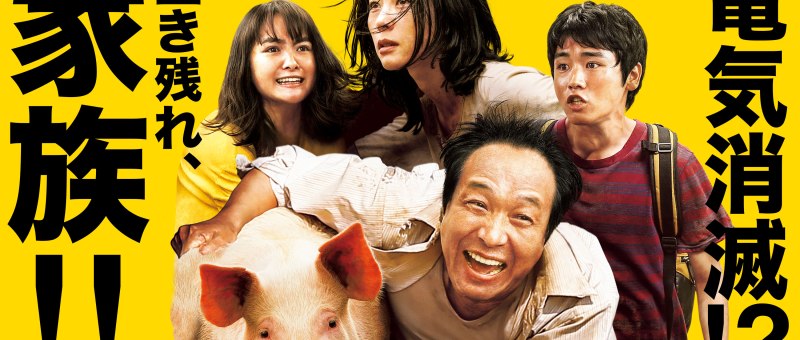
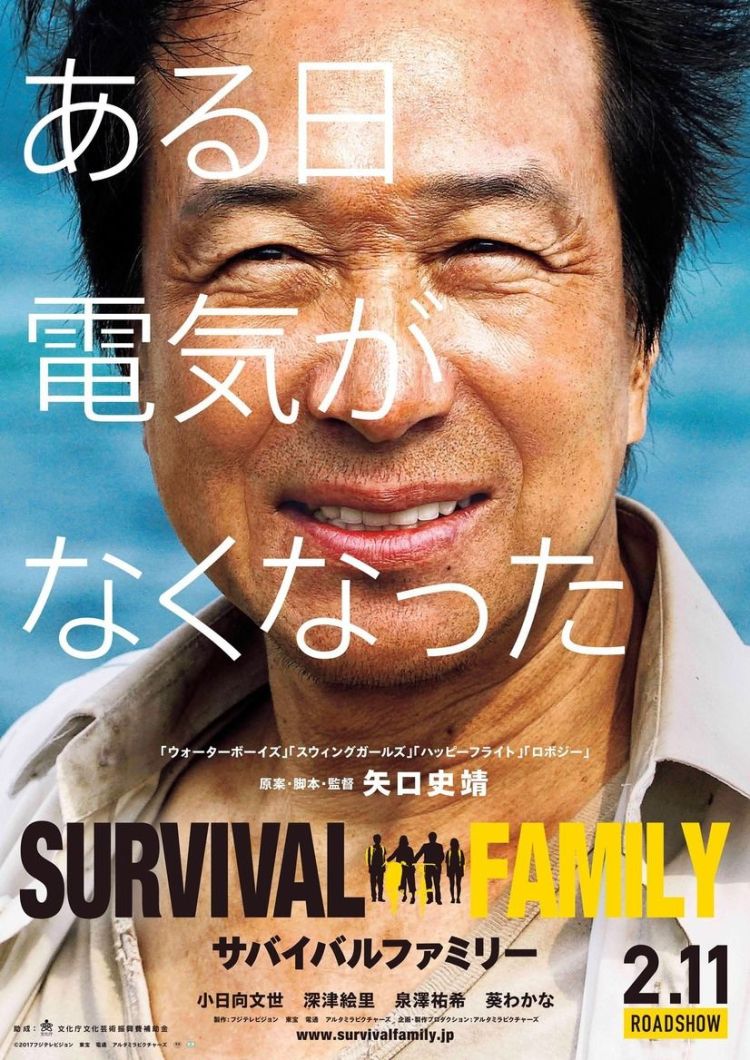 Modern life is full of conveniences, but perhaps they come at a price. Shinobu Yaguchi has made something of a career out of showing the various ways nice people can come together to overcome their problems, but as the problem in Survival Family (サバイバルファミリー) is post-apocalyptic dystopia, being nice might not be the best way to solve it. Nevertheless, the Suzukis can’t help trying as they deal with the cracks already present in their relationships whilst trying to figure out a way to survive in the new, post-electric world.
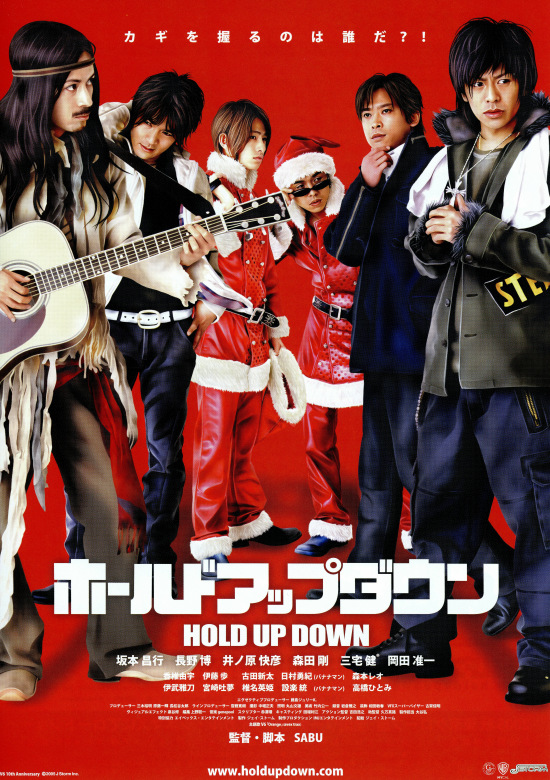 Reteaming with popular boy band V6, SABU returns with another madcap caper in the form of surreal farce Hold Up Down (ホールドアップダウン). Holding up is, as usual, not on SABU’s roadmap as he proceeds at a necessarily brisk pace, weaving these disparate plot strands into their inevitable climax. Perhaps a little shallower than the director’s other similarly themed offerings, Hold Up Down mixes everything from reverse Father Christmasing gone wrong, to gun obsessed policemen, train obsessed policewomen, clumsy defrocked priests carrying the cross of frozen Jesus, and a Shining-esque hotel filled with creepy ghosts. Quite a lot to be going on with but if SABU has proved anything it’s that he’s very adept at juggling.
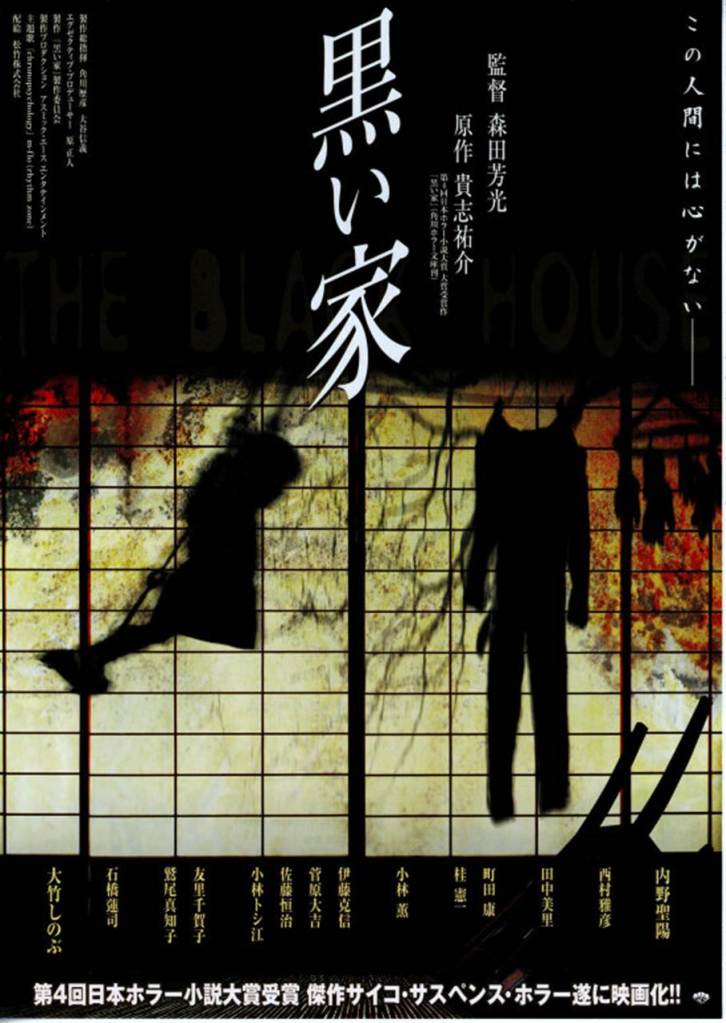 Yoshimitsu Morita, though committed to commercial filmmaking, also enjoyed trying on different kinds of directorial hats from from purveyor of smart social satires to teen idol movies, high art literary adaptations and just about everything else in-between. It’s no surprise then that at the height of the J-horror boom, he too got in on the action with an adaptation of Yusuke Kishi’s novel of the same name, The Black House (黒い家, Kuroi Ie). Though tagged as “J-horror” you’ll find no long haired ghosts here and, in fact, barely anything supernatural as the true horror on show is the slow descent into madness taking place inside the protagonist’s mind.
