Angel Guts: Red Flash (天使のはらわた 赤い閃光, Takashi Ishii, 1994)

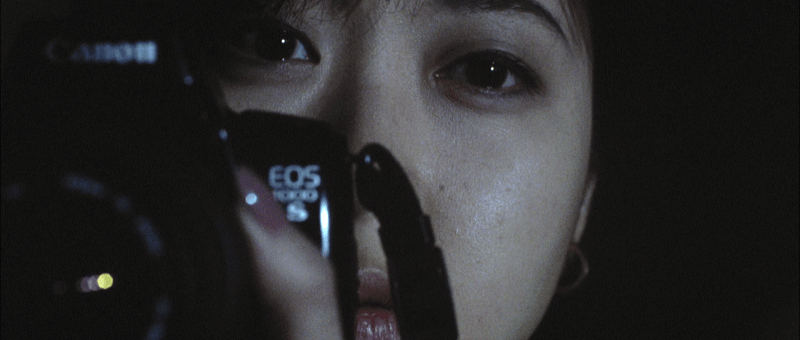
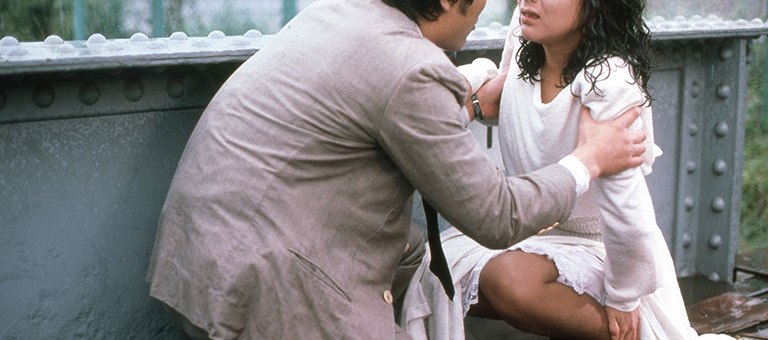
Sent to cover a pornographic movie shoot, a young woman finds herself confronted by the teenage trauma that continues to haunt her in the final instalment in the Angel Guts series, Red Flash (天使のはらわた 赤い閃光, Tenshi no harawata: Akai senko). Adapting his own manga, Ishii draws on giallo and classic noir as the heroine attempts to reclaim herself from the spectres that are haunting her even as Japan itself seems to be a land of predatory and dangerous men.

Nevertheless, as the film begins, Nami (Maiko Kawakami) seems to be holding her own aside from an apparent problem with alcohol that sees her drink far to much and end up in vulnerable, potentially dangerous situations. She has a job as an editor and ad hoc photographer where she’s regularly subjected to extreme imagery, while her sleazy boss is also sexually harassing her and in fact attempts to force himself on her in the lift. It’s being sent to take photos at a porno shoot featuring intense rape scenes that awakens her buried teenage trauma of having been abducted and raped on her way home from school.

Nami is haunted by the spectre of her attacker, though as her new ally Muraki (Jinpachi Nezu) tells her it’s only by killing this ghost that she might be able to “erase” the harmful memories of her rape and overcome the repulsion she feels towards sex with men. Perhaps problematically, the film then phrases Nami’s journey as one of repair in which the ultimate goal is being able to enjoy heterosexual sex which seems to be something Nami herself desires to the extent her inability to do so leaves her feeling as if there’s something wrong with her. Even so, it seems she is able to have successful and enthusiastic sex with bar owner Chihiro (Noriko Hayami) who seduces, or perhaps takes advantage of, Nami after bringing her home because she’d had too much to drink at the bar.

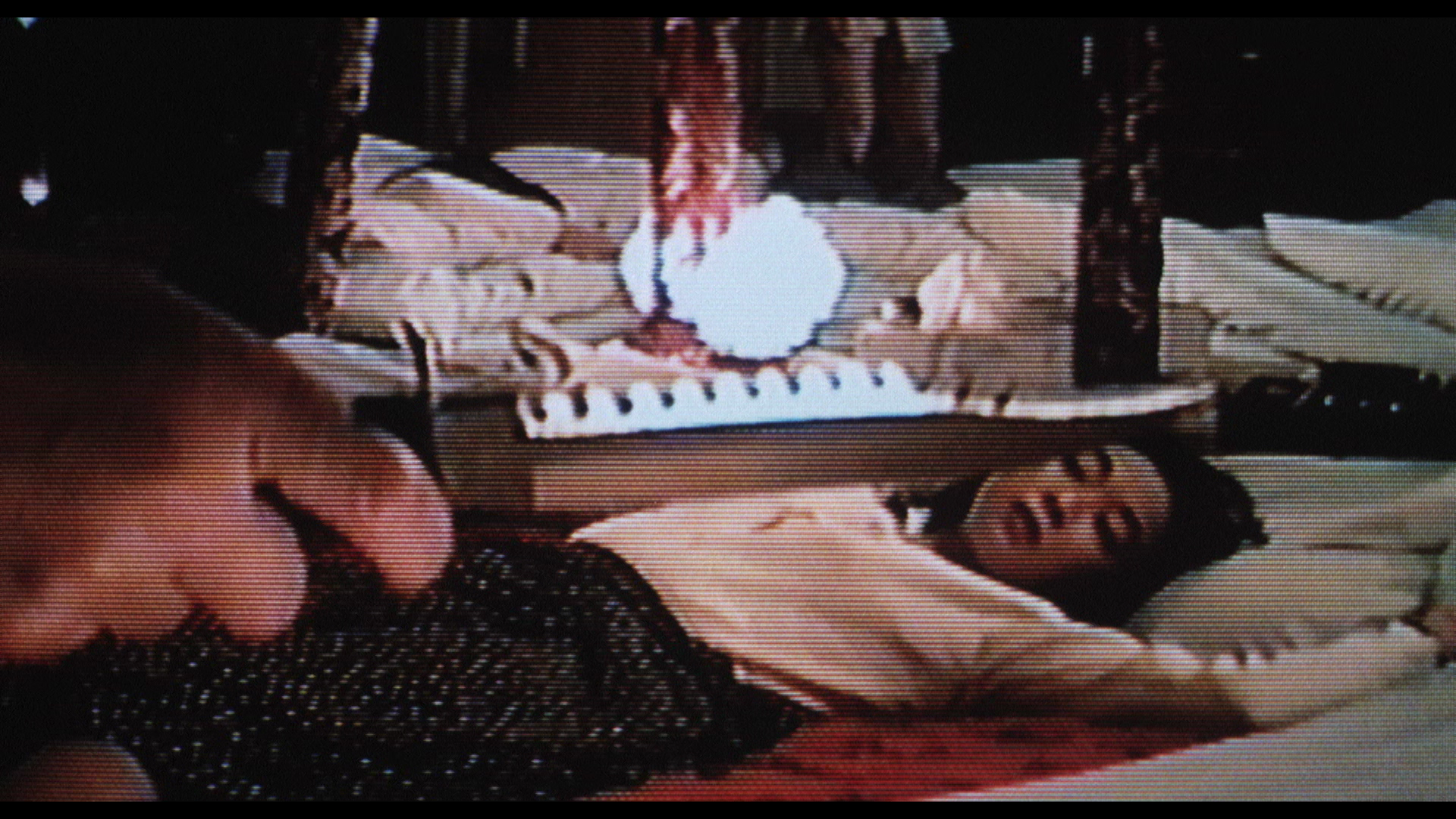
On another drunken occasion, Nami is ushered into a love hotel where she wakes up naked several hours later with no recollection of how she got there. Looking around, she spots not only a bloody knife in the sink, but the body of a middle-aged man hidden under the duvet, and camera which has apparently been filming the whole thing. The act of watching her assault, of which she has no memory, echoes the out of body experience of her rape in which she sees another version of herself save her by killing the attacker. What Nami is essentially trying to do is kill the attacker in her mind through discovering what really happened in the hotel room. As Nami has developed a fear of sex of men, she has a tendency to kick and punch violently in self-defence which, coupled with her drunkeness, lead her to fear that she killed this man after waking up during the assault. In another kind of haunting, Nami begins receiving unpleasant phone calls from someone using a voice disguiser who knows she was at the hotel and attempts to blackmail her in exchange for sexual favours. 

Her first suspect is Muraki, which makes sense because he was at the bar and saw her leave with the other customer so could easily have followed her and either observed her entering the hotel and put two and two together after seeing the crime on the news, or actually committed the murder himself while she was unconscious. She’s also been given a negative impression of Muraki by her jealous boss who tells her that his wife killed herself because his constant infidelities. But Muraki is also carrying traumas of his own in his guilt over his wife’s death which he acknowledges was influenced by his behaviour even if because of a misunderstanding or irrational jealousy rather than sexual or emotional betrayal. Thus, Nami becomes to him a means of atonement in the form of a woman he could save in place of the wife he could not.

Which is to say, Nami is pulled towards trusting the improbable presence of a “good” man even as Chihiro insists that they don’t exist. After they made love, Chihiro deepened the intimacy between them by revealing that she had been abused by her stepfather, though it does not prompt Nami to reveal her own traumatic memories of her rape and abduction. She is reluctant to go to the police not because she fears she is guilty of the crime and wants to avoid punishment, but feels ashamed and can’t bear the idea of the police watching the tape which would amount to a kind of second rape. She does eventually allow Muraki to watch it, but on realising that it may exonerate her is still reluctant to let the police see it while torn by her civic duty in knowing that she has evidence that may help catch the “real” killer. She and Chihiro wonder why it is men like to watch the rape videos she was sent photograph, but can’t come up with much of an answer though it hints and an ingrained misogyny, a desire for control and dominance of a woman and her sexuality. The fact that she was sent to photograph it all by this otherwise mainstream company again hints at a kind of desensitisation amid an overly sexualised atmosphere even as her boss tells her the UN has been critical of Japanese attitudes to sex. Nevertheless it seems that Nami is able to overcome her trauma, to an extent, through reclaiming her identity even if she still has the occasional red flashes of violent fantasy.


Angel Guts: Red Flash is available as part of Third Window Films’ Takashi Ishii: 4 Tales of Nami boxset.

Alone in the Night (夜がまた来る, Takashi Ishii, 1994)

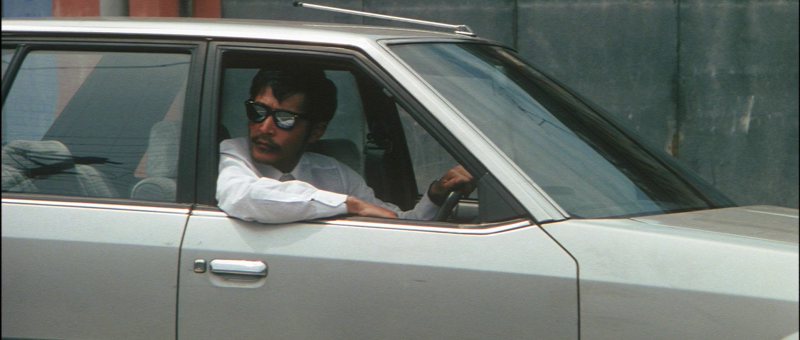
A woman enters the homosocial world of the yakuza in search of revenge for her murdered husband, but discovers only more degradation and hopelessness in Takashi Ishii’s rain-soaked noir, Alone in the Night (夜がまた来る, Yoru ga mata Kuru). Then again, perhaps it’s not really revenge Nami (Yui Natsukawa) is after so much as death itself, her relentless fall one of self-harm born of her sense of futility in world ruled by irony in which there is no such thing as truth or justice.

Indeed, one of the things that propels Nami on her mission is the injustice that her husband Mitsuru (Toshiyuki Nagashima), killed while working undercover investigating a gang dealing drugs, is then accused of taking the drugs he seized and selling them on himself. After her husband dies, she’s hounded by the press who paint him as a corrupt cop while she’s also denied his police pension because he died in disgrace. What she wants is to clear his name and thereby drag her husband back from the netherworld in an affirmation of their love for each other. 

But she too becomes corrupted by the darkness of the criminal underworld. Soon after the funeral, yakuza thugs break into her home and rape her while looking for the drugs they assume Mitsuru stashed somewhere. Amid the chaos, she attempts to take her own life by slashing her wrist with one of Mitsuru’s bones but is unexpectedly saved by a mysterious man. Reborn after her brush with death, she reinvents herself as bar hostess “Mitsuru” as a means of getting close to the gang boss, Ikejima (Minori Terada), she believes to be responsible for her husband’s death. Her attempts to kill him, however, prove unsuccessful. She’s once again raped, this time by Ikejima, and thereafter becomes his mistress until another opportunity arises which she then botches by stabbing him in a non-lethal way which only gets her beaten and tortured by his underling Shibata (Kippei Shiina) and eventually sold to a brothel in Chiba where they get her hooked on drugs to make her easy to control. 

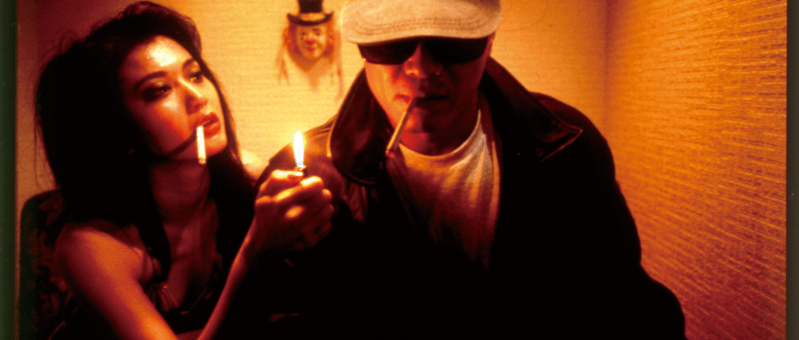
In fact, she’s only spared death once again thanks to the intervention of the mysterious man, Muraki (Jinpachi Nezu), a middle-aged yakuza seemingly weary of life and perhaps drawn to Nami as to death. He seems uncomfortable and out of place in this world of brutal masculinity while his modernity is singled by his association with the gun to counter Shibata’s with the sword. He has other reasons for his duality, but is charged with rooting out moles in the yakuza of which there seem to be an inordinately large number. Despite warning her off, he does what he can to help Nami, in part of out of guilt and a need for atonement, but also a kind of escape from his own entrapment within the purgatorial space of the yakuza underworld. 

Permanently raining and shot in an eerie blue, the world around Nami and Muraki takes on an etherial, dream-like quality as if taking place somewhere between sleeping and waking. After rescuing her from an attempt to drown herself, Muraki remarks that Nami slept like the dead or perhaps as if someone was calling to her from the other side. Death seems to be beckoning each of them, even as Muraki desperately tries to keep Nami alive by tenderly nursing her back to health and helping her beat drugs so she can finally free them both by achieving their mutual revenge.

But the film’s irony is that Nami cannot achieve her vengeance on her own. She’s constantly rescued by Muraki who achieves some if for her while each of her attempts only plunge her further down the cycle of degradation and in danger of losing herself entirely. She is and remains an ordinary woman venturing into hell in search of justice, but discovering only cruel ironies and futility. Muraki too is unable to transcend himself and meets a personal apocalypse in embracing his authentic identity. Nami has been chasing a ghost all along, though in some ways it may be her own as she tries to make her way back into the world of the living by reclaiming a vision of the world she had before in which her husband was a good and honest man and there was justice in the world even she declared herself largely disinterested in world outside of their romance and their private paradise just for two.


Alone in the Night is available as part of Third Window Films’ Takashi Ishii: 4 Tales of Nami boxset.

Scent of a Spell (魔性の香り, Toshiharu Ikeda, 1985)

Esaka (Johnny Okura) feels like someone’s watching him. He has this sense of being observed by some otherworldly force along with a generalised feeling of uneasiness. But his paranoia seems to melt away after rescuing a young woman, Akiko (Mari Amachi), whose attempted suicide he witnesses during a rainstorm on his way home. He takes her in and one thing leads to another. For a time, they’re blissfully happy but then something starts to nag at him. Is Akiko really who she claims to be, or a demonic force of monstrous femininity?

It’s this malevolent quality to which the title of Toshiharu Ikeda’s noirish romance Scent of a Spell (魔性の香り, Masho no Kaori) alludes. Esaka is captivated by a hint of mystery and his own white knight syndrome, bewitched by Akiko but also perhaps growing tired of her and fearful of romantic commitment. He has after all been married before and his friend’s comments seems to suggest the cause of marital breakdown may either have been his womanising or his wife’s baseless jealousy. Akiko tells him that she’s on the run from an abusive husband prone to jealous rages and that though she has escaped from Osaka to Tokyo he always manages to track her down. Her sense of being pursued and Esaka’s of being watched seem to perfectly align while he seems to appreciate the fact that she needs him and he is quite literally sheltering her from danger.

Nevertheless, there are cracks in Akiko’s story beginning with the fact the bridge she threw herself off wasn’t the kind to pose a serious risk to life. The drop is only a few feet and though she resolutely refuses to be taken to a hospital because her husband might find her, she may be exaggerating the extent of her injuries. Meanwhile, she seems to have something of a jealous streak becoming irritated when Esaka talks to the proprietress of a local bar, thereafter apparently submitting herself to the attentions of his over-friendly colleague. Perhaps she had a reason to be annoyed given that she didn’t previously know any of these people and he inadvertently excluded her from the conversation, but it’s difficult for Esaka to know if she’s actually being unreasonable or he’s overreacting to a threat to his male pride and autonomy.

It’s this threat to his freedom that’s inflamed when he overhears another man talking to the lady behind the counter at a cafe he regularly goes to about his own girlfriend who is also named “Akiko” written with the character for “autumn”. Though there must be dozens of women with this not all that uncommon name combination in the city, it plants the seed of doubt in him that perhaps his Akiko and the other are the same and she’s two-timing him with this other guy while he’s at work. It also adds to his feeling that she has some kind of malevolent supernatural quality as if she were deliberately targeting lonely men for nefarious reasons. When the man from the cafe is found dead at home having been bludgeoned to death, he can’t help but feel that Akiko must have been involved and possibly intends to harm him too.

Of course, this may just be his fear that she will hurt him emotionally and his growing paranoia is a defence mechanism designed to protect himself against her abandonment or an infringement on his freedom. Or, alternatively, Akiko really is a dangerously crazed and jealous woman and letting her into his life will mean not a moment’s peace until it’s over. Even so, the pair of them discover intimacy in connection in their raw, desperate love making. Every time Esaka’s doubts rise to the surface, Akiko seduces him or he her and he momentarily forgets. In this, the film may have a latent misogyny as a final twist suggests that in the end all women are prone to fits of jealous rage not to mention cunning and trickery directed against each other as much as men who are also, to be fair, faithless liars and cheats. Akiko’s tragic backstory suggests something similar, that she is the inheritor of a legacy of compromised maternity and paternal betrayal. In any case, Esaka is not quite the hero he imagined himself to be either and in the end cannot save Akiko who may also in a way be choosing to sacrifice herself for love of him. Echoing the ending of In a Lonely Place, Ikeda casts their romance as fatalistic tragedy and bathes the noirish closing scenes in a heavenly golden light that suggests true love ends only in futility.


Scent of a Spell is released in the UK on blu-ray 17th February courtesy of Third Window Films.

Doing Time (刑務所の中, Yoichi Sai, 2002)

Who ever thought that life in prison could be so…peaceful? Adapted from the autobiographical manga by Kazuichi Hanawa, Yoichi Sai’s 2002 drama Doing Time (刑務所の中, Keimusho no Naka) is a slice of life dramedy somewhat typical of the early 2000s save its unexpected setting in a state penitentiary. Unlike the average prison movie, the main thing that Hanawa discovers is that life inside is incredibly dull, yet he approaches his brief sojourn in this other world with anthropological precision observing and mimicking the behaviour of his fellow prisoners while making the most of this hopefully once in a lifetime experience reflecting that he’ll likely never have the opportunity to wear such worn out undergarments ever again. 

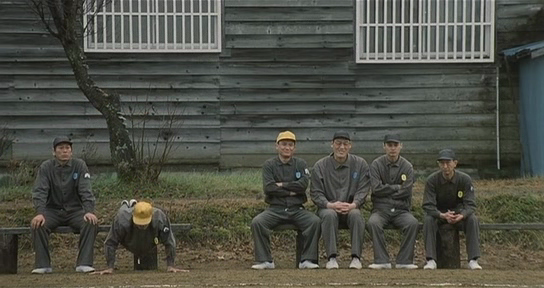
A quiet man already in middle age, Hanawa (Tsutomu Yamazaki) is no dangerous criminal merely a firearms enthusiast who liked to fire modified pistols into bottles of water. He’s got three years for illegal possession of weaponry and explosives, which seems to be quite a harsh penalty considering another man is doing seven for murder after shooting a man he says waved an axe at him when he went to collect a debt. There are clearly men who have committed violent crimes in Hanawa’s immediate vicinity, yet this is not a traditional tale of prison gangs and factional infighting, the only violence we witness concerns one prisoner who appears to have broken the rules accidentally in thoughtlessness or ignorance rather than direct rebellion. Rather it is, ironically enough, almost like a summer camp in which Hanawa and his four cellmates attempt to amuse themselves during the little free time they are offered for contemplation and relaxation. 

Even so, every inch of the prisoners’ lives is micromanaged by the guards from the way they walk to when they are allowed to move or speak. So entirely stripped of their dignity are they, that they must ask for permission even to use the toilet in their own cell while in solitary confinement and dutifully report back once they’ve finished. The communal squat toilets at the back of the workshop where Hanawa works crafting wooden tissue boxes are entirely open with only knee-height doors on each stall for privacy. The prisoners’ days are tightly ordered, early to bed and early to rise with work in-between and only the promise of rest to look forward to on weekends and holidays. 

Ostensibly a shy man, Hanawa dislikes having to ask permission all the time though not so much as an affront to his autonomy as simply bothersome. Surprisingly he begins to warm to the rhythms and routines of prison life discovering in them a kind of liberation, finding his time in solitary for “unauthorised communication” the most enjoyable of his sentence free as it is of the necessity of interacting with other people. Like the bug collector in Woman of the Dunes, he finds freedom in simplicity appreciating the mindlessness of his absurd new job folding paper bags for medical prescriptions. He can abandon any sense of responsibility for his life, submitting himself entirely to the guards’ authority and surrendering the need for control, happy to allow his existence to be managed for him without needing to decide on anything for himself. 

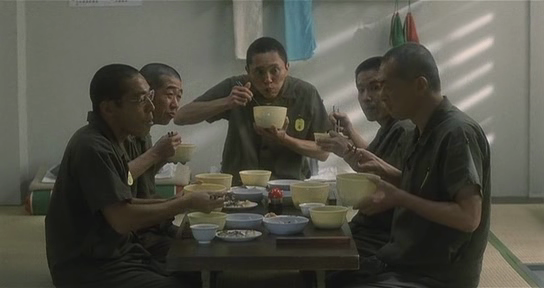
That aside, it’s difficult to see what other purpose prison could serve for a man like Hanawa who merely had an unusual if potentially dangerous hobby save providing him with a unique life experience he seems to be treating as a kind of adventure. He may at times look down on his cellmates who have their own routines, but otherwise appears grateful for their input and advice regarding prison life often listening to their explanations for behaviour he regards as strange such as removing one’s trousers before entering the bathroom and then deciding to do as they do. With so little stimulation the mundane becomes exciting, each meal a culinary adventure listening to a cellmate recount his group treat of a film screening (Takeshi Kitano’s Kid’s Return) as if he had returned from exotic land relishing his description of the chocolate biscuits and cola he was given to snack on. Time is what Hanawa is doing, but he does at least gain the opportunity of experiencing life in slow motion learning to appreciate the beauty of a single dandelion while observing the absurdity of the world all around him which is perhaps no more absurd than that which exists outside. 


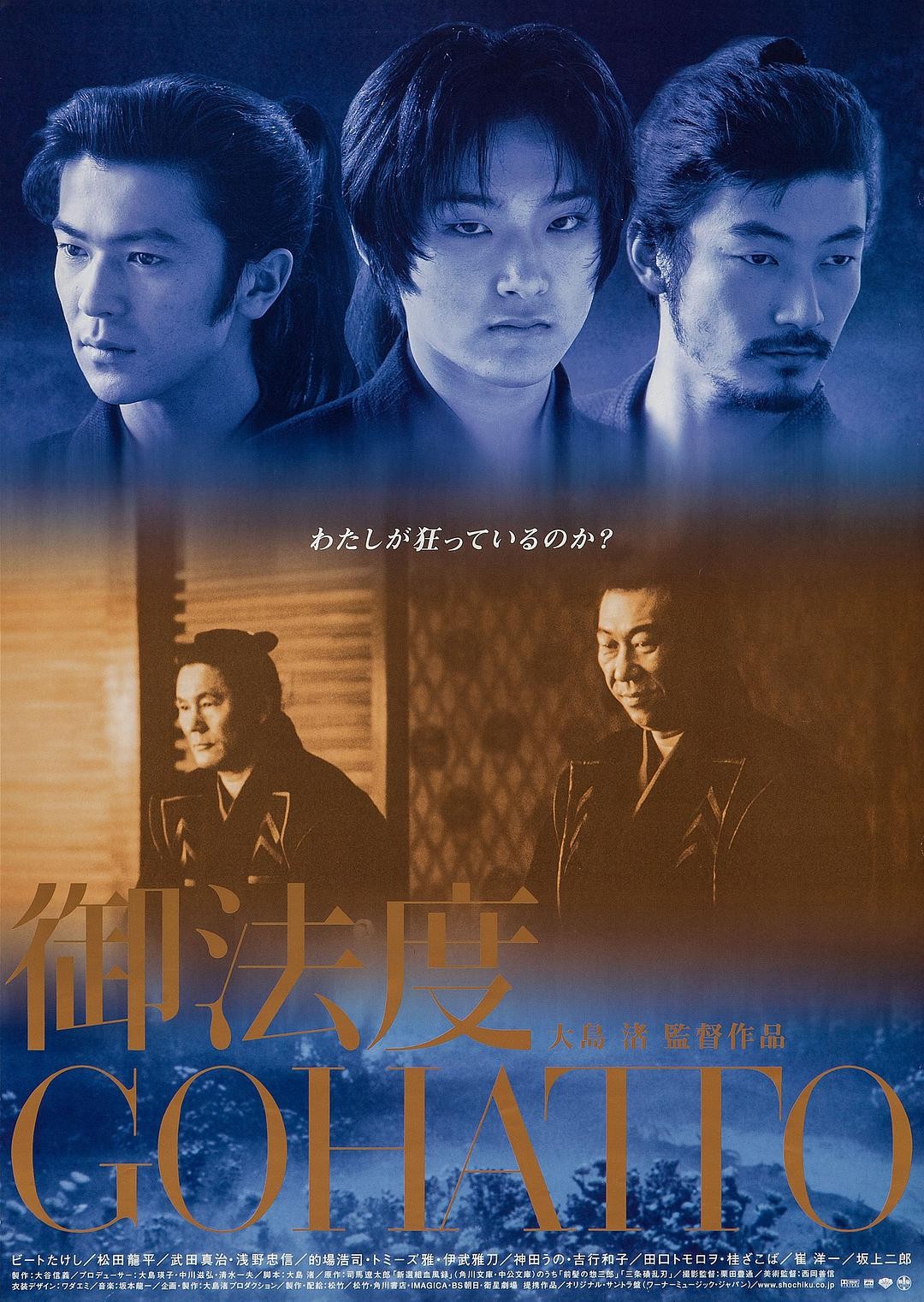
Gohatto (御法度, Nagisa Oshima, 1999)

Nagisa Oshima once said that his hatred of Japanese cinema extended to absolutely all of it, decrying the hackneyed nativism of “foggy beauty and stupid gardens”, yet his final film is filled with Mizoguchian mist and almost a paen to Japanese aesthetics which ends with a cherry blossom tree in full bloom cut down in its prime. Burdened by the slightly more salacious title “Taboo”, Gohatto is less about love between men in an intensely homosocial world even as it asks what it might mean by “forbidden” or “against the law” than it is about idealism and aesthetics as its band of contradictory conservatives unknowingly approach the end of their world in a coming modernity ushered in by dangerous beauty. 

Set in the Kyoto of 1865, a scant three years prior to the Meiji Restoration, the film opens with an audition of sorts as the Shinsengumi search for promising new recruits among talented swordsmen. Already a mess of contradictions, the Shinsengumi is, loosely, a kind of official police force dedicated to defending the Shogunate against the revolutionary forces set on restoring power to the emperor. Nevertheless, in an odd way and in contrast to the elite Mimawarigumi which was staffed only by direct retainers to the Shogun, the Shinsengumi was noted for its lowkey egalitarianism in that it made a point of admitting those of ordinary birth as well as lower level samurai and ronin. Of course, the notions of equality only went so far and perhaps only fuelled its reputation for merciless savagery, but also make it a strangely progressive force fighting against progress in defence of the feudal status quo. 

Only two of the hopefuls are thought to be any good, one a young ronin, Tashiro (Tadanobu Asano), and the other a beautiful boy, Kano Sozaburo (Ryuhei Matsuda), the third son of a wealthy merchant whose line were once samurai but are no longer counted among the noble retainers. A talented swordsman, Sozaburo’s dangerous beauty presents an existential threat to the Shinsengumi order, the steely Hijikata (Takeshi Kitano) looking on conflicted in witnessing the way his commander, Kondo (Yoichi Sai), looks at this vision of androgynous beauty remarking that he had not known him to be “that way inclined”.

Being that way inclined does not seem to be a particular issue within the Shinsengumi, it is not against their draconian rules and in fact appears to be tolerated at least as long as it causes no further problems. Kondo is however mindful of the chaos caused by a similar wave of homoerotic lust which took hold shortly before a climactic battle which would prove to be their last success. What Sozaburo seems to arouse in them is something more dangerous than the accepted patterns of love between military men which is in a sense sublimated as a mentor/student relationship, loyalty more than romance. Tashiro, who is of a similar age to the apparently 18-year-old Sozaburo, lets his desire be known, vowing to sleep with him before he dies ironically acknowledging Sozaburo for what he is, an angel of death. 

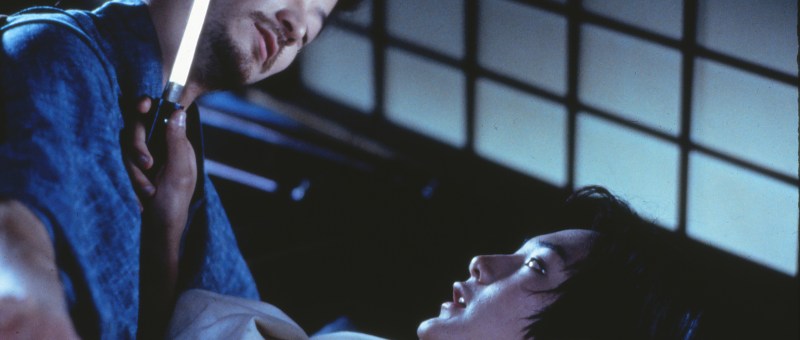
For his part, Sozaburo remains curiously passive in each of his encounters, aroused only it seems by the act of killing. Yet Hijikata discerns that he has indeed become Tashiro’s lover on witnessing them fight, Sozaburo losing clumsily despite being the more skilled in a dynamic that mimics their relationship in which Tashiro is the dominant partner. Aware of the danger in Sozaburo’s allure, Kondo suggests having a superior take him to the red light district to show him the delights of woman hoping to guide him back towards a less dangerous path, only the attempt backfires on several levels. Firstly, Sozaburo has no interest in women and continues to decline believing his commander is also hitting on him (like everyone else), thereafter determined to seduce him after all. Another retainer does indeed succeed in seducing Sozaburo, developing a mild obsession, but later ends up dead, Tashiro a main suspect in his murder with the motive of sexual jealousy though all of this additional violence is perhaps only an expression of Sozaburo’s dangerous beauty. 

As so often, sex if not love becomes the force which destabilises the social order only here it’s equated both with death and with an alternative mediation of male violence. Perhaps reflecting the way they look to the 18-year-old Sozaburo who makes a faux pas in accidentally suggesting at least one of them is of pensionable age, the ranking members of the Shinsengumi are played by actors already well into their golden years as if relics of a bygone era though in reality most were in their 30s. As Soji (Shinji Takeda), a filial figure like Sozaburo wearing long hair, puts it, there are no old men in their unit which is in essence an anti-revolutionary force. Nevertheless, the Shinsengumi is on the wrong side of history and already living in its end times, perhaps ushered towards its doom by the figure of the beautiful boy. “You were too beautiful”, Hijikata eventually laments as he finally perhaps understands the nature of the revolution he is witnessing. Perverse to the last, Oshima sets his ethereal finale in a stygian fog and pays an ironic tribute to the Mizoguchian classicism he so railed against in his youth, taking a sword to the cherry blossoms as he like Hijikata severs his own legacy in a moment of destructive beauty. 


Gohatto screens at Genesis Cinema on 25th September as part of this year’s Queer East

International trailer (English subtitles)

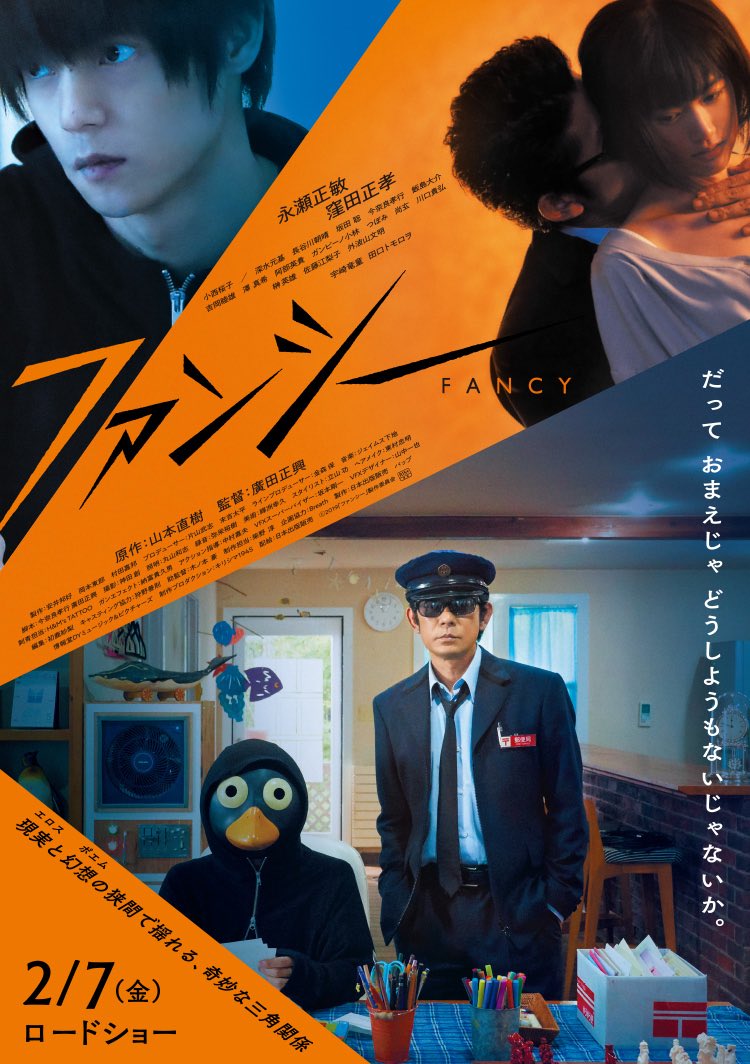
Fancy (ファンシー, Masaoki Hirota, 2020)

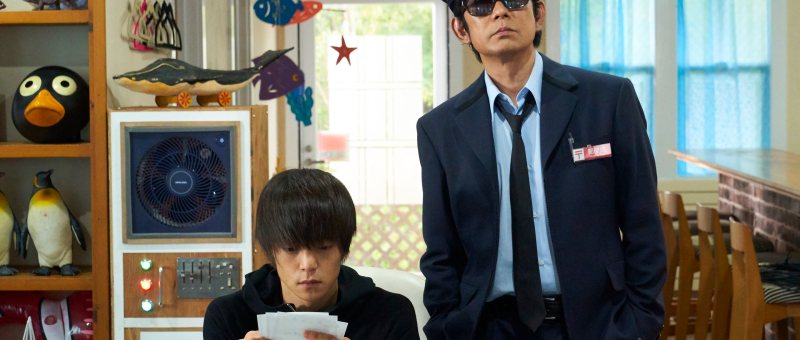
“Every minute of life is yours to make use of” according to the ultra cool hero of Masaoki Hirota’s Fancy (ファンシー), a laconic postman with a penchant for sunshades and a resigned attitude to transience. Adapted from the manga short story by Naoki Yamamoto, Fancy is indeed a transitory tale, a minor episode in the life of a poet who thinks he’s a penguin, his best friend the postman, and his penpal seeking her own kind of escape in an impromptu and probably unwise proposal of marriage. 

The postman, Takasu (Masatoshi Nagase), is also a tattooist, a former yakuza now reformed and living quietly in an old-fashioned hot springs town which seems to be stuck in the Showa era. As Takasu’s colleague Tanaka (Tomorowo Taguchi) puts it, it’s pretty “standard” now for everyone to have two jobs, his side hustle being a shooting gallery which is a front for the sex trade. Even the local Buddhist priest is intent on trying to sell everyone he meets a funerary monument, while Southern Cross Penguin (Masataka Kubota) is a best-selling poet particularly popular with high school girls in addition to being a flightless aquatic bird in human form. Penguin doesn’t expect us to believe him, but tells us that a penguin is just what he is and there’s no particular reason for it. So completely does he take his penguinhood that he opens the door in a full penguin mask, dresses only in black and white, mainly eats raw fish, and keeps his home ice cold with the aid of several industrial-size air conditioners. Penguin prides himself on answering the many fan letters he gets, explaining that they’re not so much “fans” as “comrades” who are also looking for the “shining country”. In any case, his fan mail is how he met the postman, his only friend, who is content to shiver in his home putting whisky in his tea to stave off the cold. 

Penguin’s life begins to change, however, when he gets a letter from “Moon Night Star” (Sakurako Konishi), a fan with whom he’d been corresponding. Moon Night Star pretty much insists on becoming his “wife”, failing to take Penguin’s hints that she might not be very happy “married” to an aquatic animal who can’t go outside. As we will later discover, Moon Night Star is in her own way rebelling against her fate, taking refuge in Penguin’s igloo and engaging in a delusion that she loves him in order to make it work. For his part, Penguin perhaps comes to like her too, but he can also see that she’s quite “depressed” stuck in the cold with him, pushing her towards the outside and into the arms of the postman. 

Takasu, meanwhile, finds himself on a series of borders as he begins to confront his past in the form of his absent father and the family he seems to have lost, sympathetically telling his pained former wife that her life is hers to do with as she wishes, perhaps in a sense cuttingly refusing her apology but also accepting her right to seize the present. Another man with two jobs, Takasu’s childhood friend is both yakuza gang boss and hotelier, confiding that the gangster stuff is too stressful and he wishes he could just focus on the hotel in the same way the Takasu has now become a postman. It’s his strange relationship with a yakuza drifter, however, that threatens to drag him back into gangsterdom as he learns that there’s been a schism in his former clan. With a turf war brewing, the loyalists have taken over his friend’s hotel, unreconstructed Showa-era yakuza on the streets of a pleasant hot springs resort. 

“We’re doomed anyway, do what you like” one of the goons intones, in one sense subverting Takasu’s mantra but in another perhaps embracing it. A memory of his father reminds him to “make very second count” while also catching him in an endless moment of gaze, unable to forget the back of the woman his father was tattooing at the time. Takasu looks and does eventually touch, but admits his jealousy obsessed with skin as canvas only latterly taking off his shades in a willingness to see and be seen. Penguin, meanwhile, who wanted to swim in a sea of words, finds himself floating free, braving but eventually succumbing to the heat before exclaiming that he’s going to close his eyes to allow a new story to start. The love of a poet is fleeting, Takasu reflects as each of the various protagonists shifts towards their “main” identity, edging back towards conventionality in abandoning the “fancifulness” of their sometimes strange existences. There will, however, be more strange adventures because even if it falls apart beneath your feet, life’s what you make it, be you a postman or a penguin. 


Fancy screened as part of Camera Japan 2020.

Original trailer (no subtitles)

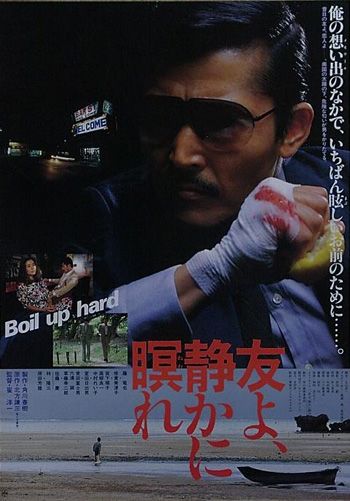
Let Him Rest in Peace (友よ、静かに瞑れ, Yoichi Sai, 1985)

“There are times when you need to stand for something” according to an ultra masculine avenger giving a few lessons in manliness to the already defeated teenage son of a friend. A noirish, stranger in town affair, Yoichi Sai’s Let Him Rest in Peace (友よ、静かに瞑れ, Tomo yo, Shizukani Nemure) locates itself in an awkward frontier landscape, moribund small-town Okinawa seemingly devoid of life now that the Americans have pulled out and moved on. The Americans have, however, been “replaced” by beefed up corporate thugs backed by yakuza muscle and corrupt police. Sometimes you have to take a stand, if only to show them that you won’t be pushed around because if you give in once you’ll never be free. 

Disgraced doctor Shindo (Tatsuya Fuji) has come to Okinawa in search of the Freein, but every time he tries to ask someone for directions, he is met with intense hostility, the last man even telling him “You shouldn’t go there, that place is no good”. This is not because the Freein is mostly home to a collection of brassy sex workers, but because its owner and Shindo’s old friend whom he has come to help has become a local pariah. Sakaguchi (Ryuzo Hayashi) is currently in jail because he apparently went crazy and started waving a knife around at construction magnate Shimoyama (Kei Sato). As Shindo quickly finds out, Shimoyama is in the process of buying up the whole town and Sakaguchi is the last remaining hold out. As such, he is hated by most of the other residents and the subject of persistent harassment by Shimoyama goons who have not only thrown bricks through the windows but gone so far as to kill his son’s dog, later kidnapping the boy to put pressure on the pair of them. 

What’s not lost on Shindo is the extent to which Shimoyama’s corruption has already seeped into the town. Meeting Sakaguchi’s son Ryuta (Makoto Mutsuura) by chance, Shindo takes the boy to see his dad but is again met with hostility by the local bobby, Tokuda (Hideo Murota), who tells him that “Shimoyama Construction is the savour of this town”. “There’s no other company that is so giving”, he goes on, “to have the employees of a company like that working here, I can’t have a wild man like Sakaguchi running about”. According to Tokuda, Sakaguchi is the odd man out, an inconvenience to all those around him who believe in Shimoyama and are trying to save the town. Tokuda looks sheepish when Shindo asks him why he’s so into Shimoyama, confirming the mild suspicion aroused by his improbably fancy watch. 

Tokuda’s warning is however borne out by the townspeople who continue to shun and ignore Shindo while the other kids mercilessly bully Ryuta, calling him the “craziest kid in Japan” and calling for his dad to get the death penalty despite the fact that all he seems to have done is aggressively wave a fruit knife at the wrong person. The local cafe owner describes him as an embarrassment and accuses him of holding out to get more money. After all there’s no future in this tinpot town which seems to exist in the ruins of the post-war era and Shimoyama is already offering triple the going rate so Sakaguchi is only being greedy and selfish. Komiya (Ryoichi Takayanagi), the bellboy, if you could call him that, at Freein, spins it slightly differently, explaining that no one supported Shimoyama in the beginning but they’ve all been harassed themselves and have long since given in. Shindo convinces Ryuta to talk about his kidnapping, but Ryuta tells him that on his return he told his father they should leave, that it was pointless to resist. Shindo asks him if he’s ever been in a fight, but the boy asks what the point is if you know you’re going to lose, “the strong are always strong”. 

That kind of defeatist thinking is anathema to Shindo’s conception of manhood. Despite his father’s incarceration, Ryuta is too afraid of being kidnapped again to go to school. Trying to be nice about it, Shindo calls him a coward for telling his father to leave even though he wants to stay because he allowed himself to be threatened into sumbmission. He tells him that he has to stand up for himself, report his kidnapping to the police. Ryuta tells him he’s crazy, the police are in on it, but Shindo counters that it’s worth trying to get his father out of jail because if they don’t they’ll never know. Ryuta snaps back that he knows already, and indeed bottles his chance when Shindo manipulates Tokuda into “helping” him oppose Shimoyama’s cult-like hold over the town.  

Shindo might not be that much better, he’s prepared to fight dirty, getting hard evidence of Tokuda’s corruption and trying to use it against him but even these methods prove ineffective against such a vast and entrenched mechanism of control. Shindo also realises that Shimoyama’s minion Takahata (Yoshio Harada) is another old university classmate, a member of the boxing club, bringing this widening drama down to the level of three men who went to the same prestigious university but all ended up here, pretty much at rock bottom. Though ironically enough Shindo’s broody silence and dedication to his friend have a few of the women wondering if he might be gay, his preoccupation is with a failure of masculinity. He doesn’t think Shindo was actually capable of threatening anyone, and knows that he had reasons that he might have wanted to try and sort this out sooner rather than later. His son’s words pushed him over the edge. He used his body as a weapon, tried to make Shimoyama damn himself, but his efforts were frustrated. Shindo acknowledges that “saving” his friend might look quite different than one might think, inadvertently teaching young Ryuta a few problematic lessons about what it means to be a man. Still, the town might have been “saved” in one sense at least in being freed of this particular oppressor. A stand has been taken, and a man’s self worth restored, but as Sakaguchi’s wife (Mitsuko Baisho) points out even while fully understanding the codes by which the men around her live, what is to become of those left behind?


TV spots (no subtitles)

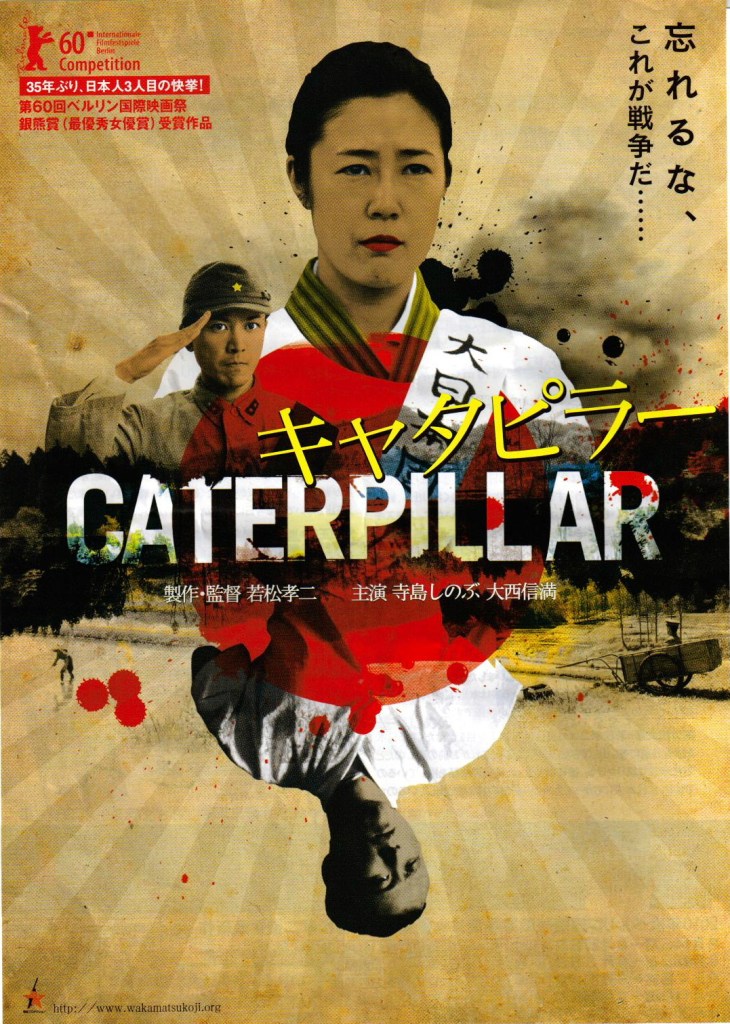
Caterpillar (キャタピラー, Koji Wakamatsu, 2010)

Koji Wakamatsu made his name in the pink genre where artistic flair and political messages mingled with softcore pornography and the rigorous formula of the genre. Wakamatsu rarely abandoned this aspect of his work but in adapting a well known story by Japan’s master of the grotesque Edogawa Rampo, Wakamatsu redefines his key concern as sex becomes currency, a kind of trade and power game between husband and wife. Caterpillar (キャタピラー), aside from its psychological questioning of marital relations, is a clear anti-war rallying call as a small Japanese village finds itself brainwashed into sacrificing its sons for the Emperor, never suspecting all their sacrifices will have been in vain when the war is lost and wounded men only a painful reminder of wartime folly.
Kyuzo Kurokawa (Shima Onishi) has returned from the war. This makes him luckier than many of the other young men who disappeared from the village over the last few years. His return, however, provokes howls of fear and disbelief from his long suffering wife, Shigeko (Shinobu Terajima), who refuses to believe the creature they’ve brought back from the battlefield is really her husband. Kyuzo has lost all of his limbs, has facial disfigurement from burns, and has also lost his voice and hearing. Sitting across from the remnants of her brother, Shigeko’s sister-in-law remarks that she’s glad they didn’t “send Shigeko back to her family” because she is obviously the one who will have to look after this entirely helpless though apparently conscious battle scarred man.

This being early in the war, the village is in a fury of patriotic zealotry, determined to make Japan glorious again in the name of the Emperor. Far from letting the case of Kyuzo dissuade them from their warlike fervour, his sacrifice becomes a totem. He’s not a man destroyed by war but a “war god” and the pride of the village, a testament to their love and devotion that they would send a son of theirs to war who would return to them even in such a ruined form. Shigeko, quickly getting over her initial revulsion, comes to realise that her husband’s new-found status is also her own. As the wife of the war god, she becomes his voice and mistress in a way she had never been permitted before.

Truth be told, the war did not ruin Kyuzo’s character. The marriage of Kyuzo and Shigeko was never a happy one and perhaps her initial reeling, wailing flight on learning of her husband’s return was more out of fear than disbelief and compassion. Despite a lengthy marriage the couple had no children (perhaps an explanation for that early “sent back” comment), and Kyuzo regularly beat his wife for her failure to bear him a male heir. Now his carer, the roles are reversed as Shigeko babies her defeated husband, lamenting that all he is is urge – sleep, eat, sex. Kyuzo’s needs are animal and definite despite the signs of intelligent communication in his eyes. Shigeko, constrained to satisfy them, bends his need to her own advantage.

Emasculated in a deeper way by Shigeko’s increasing dominance, Kyuzo first attempts to assert himself in resentment at being trotted out to sell the virtues of war in his pristine uniform even as a man destroyed by nationalised violence. Spitting in Shigeko’s face as she dresses him, he attempts to refuse but is powerless to reject her authority. As time wears on and Kyuzo submits to female authority, memories of his atrocities haunt him as the fire which marked his face mingles with the faces of the Chinese women he raped and killed as a brave son of Japan on Manchurian soil.

For Wakamatsu war and sexualised violence are synonymous as the local women train for defending their village by repeatedly penetrating hey bales with long spears crying out patriotic slogans as they go. The flag waving and furore never waver despite the evidence of Kyuzo’s suffering and the numerous young men who will never come home or have done so in square boxes wrapped with white cloth. Only nearing the end is Shigeko left wondering what will become of her war god husband when no one needs a talisman. What will the nation do with these men who’ve sacrificed so much and received nothing in return?

Wakamatsu’s message is an unmistakably anti-war one though the curious inclusion of the executions of the lower class war criminals “hanged by the country they fought to protect” almost undercuts it even if his sympathy lies with those who succumbed to a national madness and have been made to pay a personal price. Kyuzo becomes the literal caterpillar of the title, taunted by Shigeko as he writhes and crawls around, condemned to eternal undulation, but it’s Shigeko who has been in a chrysalis all this time waiting to emerge from the fear and tyranny which has marred her married life into something with more freedom and autonomy – much like a nation waking up and realising that its Emperor is just a man and the long years of suffering nothing more than brainwashed madness.


Original trailer (English subtitles)

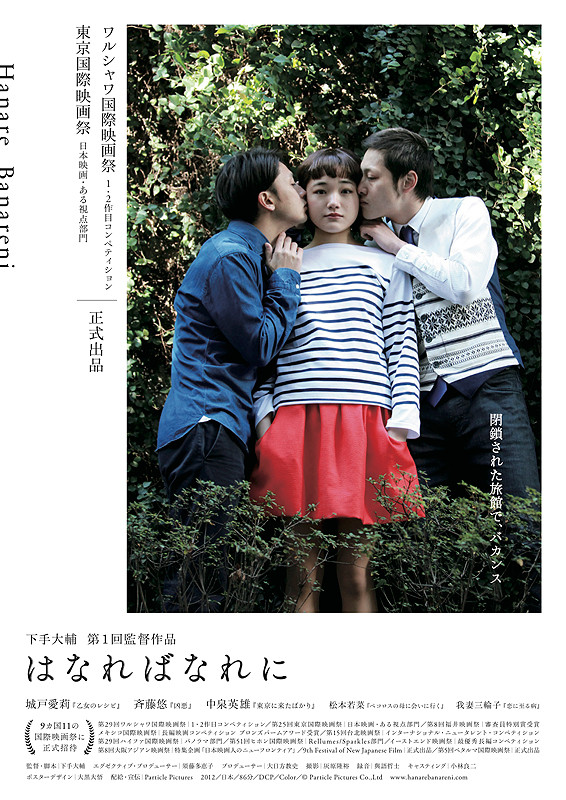
Kuro (はなればなれに, Daisuke Shimote, 2012)

poster2All these years later, it’s easy to forget just how revolutionary the wheezy, breezy youthfulness of the French New Wave was. Kuro proves that there’s life in this whimsical, summer seaside feeling yet as three misfits find themselves holing up at a disused small hotel to think about what they’ve done until they learn to grow up a little.

Kuro starts our story as she mournfully chows down on some of the pastries at the bakery she works at whilst treating a customer in a very disdainful way. She wanted to be a baker but her boss never really lets her do anything and when they argue about her guzzling half the stock she quits in a fit of pique. Roaming around the city doing absurd things like partying with a jazz band before running off with their change can or messing around with a sharp suited guy in a hotel room she meets womanising stage actor Gou who’s had a tiff with his actress wife after paying to much attention to the new girl. He flirts with and eventually semi-kidnaps Kuro for a road trip where they meet photographer Eito who has also had a tiff with his woman over having neglected to file the marriage papers at city hall. He’s heading up to an old hotel his uncle used to own where he was meant to spend his honeymoon and invites Gou and Kuro to join him.

Kuro’s original Japanese title, はなればなれに “Hanarebanare ni” literally means “scattered pieces” and was, coincidentally, the same title used for Godard’s 1964 masterpiece Bande à part. First time director Daisuke Shimote wears his influences on his sleeve with an atmosphere that recalls early period Godard which is all whimsy minus Godard’s slightly arch, confrontational irony. Leading lady Kuro, played by Airi Kido, has a definite touch of Anna Karina running through her from the way her retro haircut neatly frames her child-like face to her striped top and colourful red skirt. Taking her cue from Karina’s innocent insouciance, her absurd, pixyish pranks take on a cute and quirky quality which is backed up by a youthfully punkish disregard for the normal order of things.

Kido dances with the jazz band like Karina dancing in the bar in Vivre sa Vie and the gang even fake die in a water gun and finger shoot out a la Franz and Arthur in Bande à part. There’s also something of Tati in the intricate way Shimote sets up what are actually quite small and simple jokes like the Wii tennis match that suddenly turns into an entirely different kind of “virtual” game. At this point, the photographer who’s been perpetually on the sidelines, observing, finds himself joining in and experiencing his very own Natasha at the dance moment which, perhaps, finally allows him to break through something that’s been causing a rift in his personal life.

Through their season at the sea, each of these disparate characters comes to a kind of personal realisation that leaves them, well, more or less the same but much more settled. Kuro learns that sometimes you just have to buckle down and do as you’re told, Gou perhaps learns to be nicer to his wife and Eito maybe realises that you don’t know what you’ve got until it’s leaving you. Each of the characters is quite depressed, in the best new wave tradition, or just filled with ennui but perhaps you can’t have these kinds of absurd adventures in any other mood. That said, the heavier side of new wave surrealism with its nihilistic overtones is almost entirely absent leaving the atmosphere light and bright with the feeling that everything will (probably) be alright in the end.

Light on conventional narrative and high on sight gags and surrealist humour, Daisuke Shimote has crafted a charming and amusing new wave inspired ensemble comedy that, yes, wears its influences on its sleeves but isn’t afraid to bring its own moves to the dance floor. It might seem a little bit like a curveball from someone who’s spent so much of his previous life studying the work of Ozu with his formalist compositions and inclusory tatami mat viewpoint, but then Ozu was also a master of subtlety who could make peeling an apple into one of the most profoundly moving scenes in cinema history and Shimote is able to harness a similar fastidiousness here only in more of a comedic bent. Charming, whimsical, absurd but absolutely internally consistent, cinematically literate and beautifully made Kuro is one of the most impressive feature length debuts of recent times and hints at a promising career for its still inexperienced director.


Bonus videos of people (mostly Anna Karina) dancing in Godard films: