
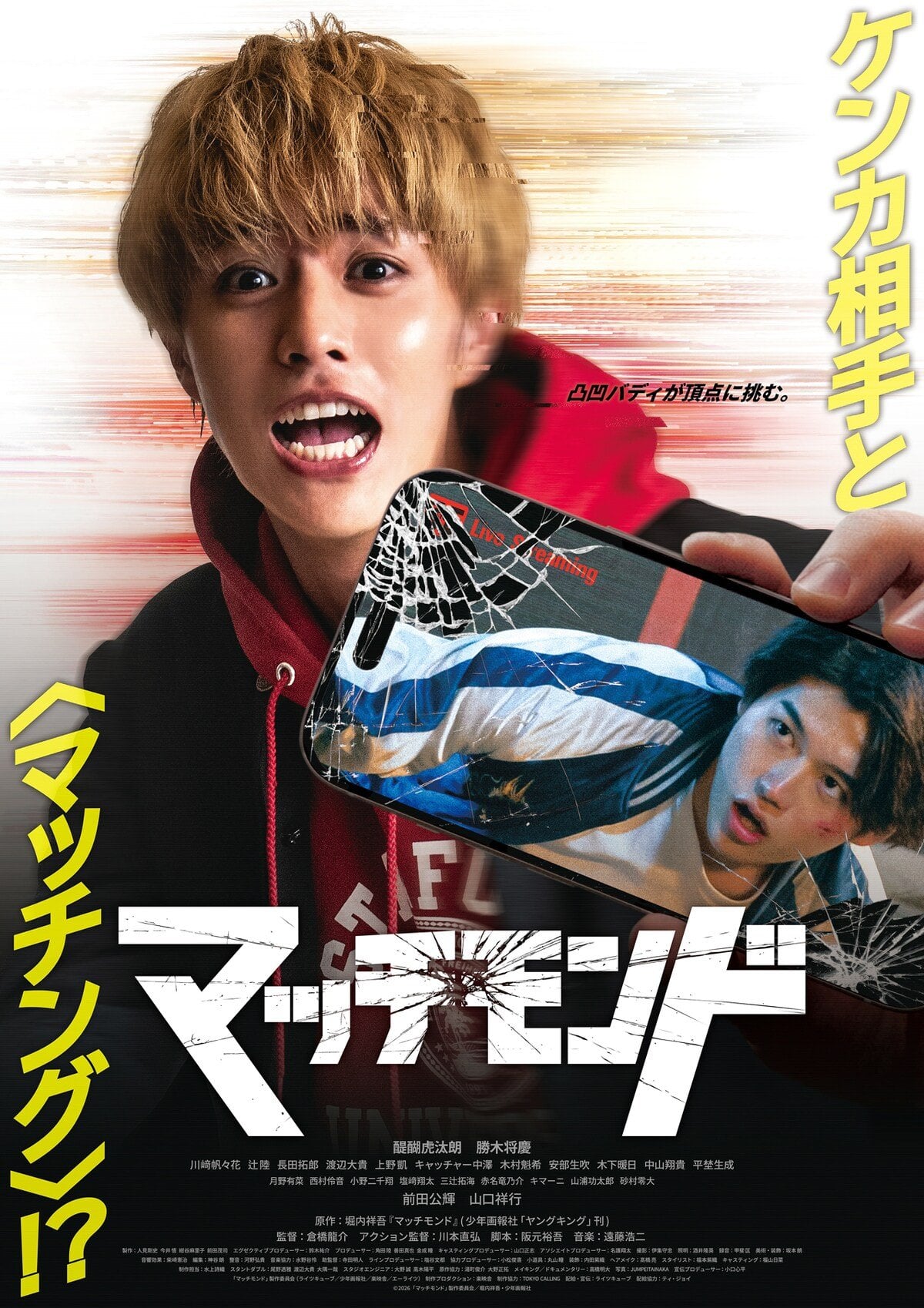
Scripted by Yugo Sakamoto, Ryusuke Kurahashi’s low-budget adaptation of the Shogo Horiuchi manga Match Monde seems to be aiming for a Baby Assassins vibe while placing a contemporary spin on the classic high school delinquents fighting manga. Unlike many similarly themed films, high school never actually features and most of the users of fighting app Match Monde appear to be long past high school age even if it’s supposed to be limited to those 18 and under.
The title is a kind pun in that Match Monde operates in the same way as a dating app, though it allows members to find worthy opponents for fighting. Users can also monetise their pugilistic talents though taking the “bounty” from defeated opponents, or pick up tips through live streaming. It’s not really clear why Mikio (Kotaro Daigo) is on this app as he dislikes fighting and seems to be something of a coward. In the opening sequence, he waits outside pretending to play on his phone while his best friend Yuta is beaten up by a bullying gang of older kids that Mikio later hides in a bin to avoid. It’s while running away, however, that he bumps into Mahiro (Masayoshi Katsuki) who can’t really be bothered to fight anyone but gives Mikio some life advice to the fact that he should be fighting to protect something important rather than just to protect himself.
Mahiro is a bit a stock character in these kinds of stories, walking around with a beatific smile permanently on his face and carrying a strangely vacant aura. Obviously, it turns out that he’s a top fighter and high school drop out who is willing to fight for Mikio after seeing him develop his resolve to stand up to the bullies rather than let his friend get beaten up on his own again. Like Baby Assassins, however, the film is perhaps a little bit more interested in the boys’ mundane lives than it is in the fighting. Mahiro ropes Mikio in to help out at a part-time job working in his childhood friend Suzuna’s cafe because he says he seems kind earnest, which is broadly true, while Mahiro struggles to knuckle down and work and fears letting his friend down in that way.
While it may have strongly homoerotic undertones, particularly in the relationship between sometime villain Mairu and his late “best friend” Kitano who was murdered after becoming a delinquent, the film’s humour is distinctly old school and in some ways spills over into sexism as the defeated bullies are seen acting in stereotypically feminine ways such as knitting scarves for each other. Meanwhile, Mahiro and Mikio aren’t really afraid of getting into fights with the delinquents, but are apparently terrified of being told off by Shizuna.
The focus is indeed on traditional masculinity which is rooted in protecting those weaker than oneself, especially women, though here also avoiding becoming someone who deliberately picks on picks on easy targets to assert their dominance as Mikio had been doing. Perhaps the only reason he was on the app was to prove Yuta wrong when he called him a coward, though he quickly ends up being exploited by the bullies who force him to fight so they can take his winnings, as optimistic as that might be. As the so-called “Penniless King”, Mahiro comes to occupy the space of an underdog hero who isn’t even technically in the game, but ends up winning it anyway just by virtue of being a cool guy who’s good with his fists.
Speaking of which, the fight scenes are sometimes unpolished but generally well choreographed. There seems to be some attempt to set up a continuing series with repeated references to a friend who is no longer on the scene as well as an incongruous appearance by Danhi Kinoshita, the star of Takashi Miike’s Blazing Fists, seemingly in a background, non-speaking part as a random member of Mairu’s gang. The potential there is quite interesting given that the natural result of all these boys fighting is that they end up becoming friends, even as Mairu insists he wants to defeat all the delinquents in revenge for his friend’s death so he’ll be the only one left and they’ll cause no more harm. Who knew that what they were really fighting was loneliness? Maybe Match Monde is friendship app after all.
Match Monde screens 23rd August as part of Big Bad Film Fest.
Trailer (no subtitles)


 Windows on Worlds