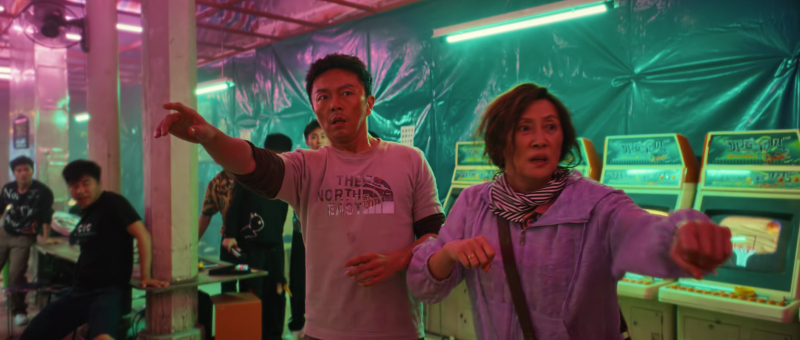

Fight Against Evil 3 (东北警察故事3, Yang Bingjia, 2026)

Top cop Li Hongqi (returns for another holiday gone wrong in the third instalment of the Fight Against Evil series, and there is indeed some serious evil to be thought. Directed this time by Yang Bingjia rather than Qin Pengfei, Fight Against Evil 3 (东北警察故事3, Dōngběi jǐngchá gùshi)received a theatrical release in Mainland China rather than premiering on IQYI’s streaming service and so benefits from slightly higher production values and features a mild tonal shift that sends the film into action comedy territory.

In fact the first “fight” takes place off-screen as Honqi casually takes down a man who’s taken his wife hostage so that he can finish a telephone call with the rather demanding mother-in-law (Diama Lin Xiaojie) he hasn’t actually me though he and his wife Touzi have already been married for two years. Having become estranged from her birthmother, Touzi tells him not to bother with her because she’s a handful, though Hongqi is keen to be a good son-in-law and hopes to broker a reconciliation by agreeing to his mother-in-law’s madcap plan to stage a second wedding in her hometown without actually telling Touzi until she gets there. 

In any case, Hongqi is immediately distracted when Xinxin (Ma Qianyi) , a cheerful teenage girl he met on the plane, is reported missing, suspected of having fallen victim to traffickers after failing to reach her grandfather’s house. Hongqi feels personally responsible because he said he’d take her, but had to leave after hearing that his mother-in-law had been arrested for causing trouble in a cafe. Nevertheless, the mother-in-law proves to be unusually well connected and helps him track down the local crime kingpin whom she apparently knew when he was a snivelling child getting beaten up for his lunch money. 

On his arrival in the town, Hong’s old friend Sun Biao (Cui Zhijia) tells him that times are different now and they have to do law enforcement in a more “civilised” way, which might suggest that things work differently here compared to the city, though as it turns out Hong’s skills are still in demand as he finds himself repeatedly getting into brawls with the local bad guys. Even Baio also gets into the swing of things wanting to prove that his fighting skills are still as good as Hongqi’s. This is, however, violence very much in the service as justice as everyone involved in the fights is already an active participant in the world of crime and the violence is being used to subdue rather than interrogate them.

Meanwhile, the trafficking gang seems to be an offshoot of some kind of cult that attracts people who’ve encountered financial ruin due to contemporary social issues from being scammed to failing in business or developing a gambling problem. Most of the lower-ranking members are doing this more out of desperation and have abandoned their humanity as a means of survival, not that it excuses what they’ve done. The leader, meanwhile, experienced a tragedy of her own which seems to have affected her mind and has made her especially attached to young Xinxin who otherwise proves plucky and resourceful with her repeated attempts to escape from the gang.

Despite the grimness of the subject matter, the film finds plenty of opportunities for comedy not least in the zany antics of Hongqi’s mother-in-law who also has a justice-loving heart and at one point takes off to catch the kidnappers herself on her moped. There’s a fundamental absurdity to Hong’s existence in which he’s been yet again drawn into a case while supposedly on holiday while attempting to keep his demanding mother-in-law happy and keeping the whole thing secret from wife in the hope he can either bamboozle her into taking part or she will arrive and talk her mother out of it. This sense of absurdity also carries over into some of the fight scenes in which Hongqi has to fight off an entire gang while his mother-in-law hides under a table in a pool hall or has to go undercover in a club, despite looking the most like a policeman it’s possible to look without actually wearing a uniform.

It is not, however, all slapstick and still features some seriously impressive action sequences. The film also makes some attempt to mine humour in the decidedly unfunny customary series of title cards explaining that the nation is taking measures to combat human trafficking and explaining that everyone was caught and punished in accordance of law before finishing on a note that explains China has over two million police officers, which is intended to be reassuring but perhaps is also the exact opposite. Nevertheless, the film is a great deal fun as Hongqi and his mother-in-law fight off bad guys while simultaneously planning a wedding.


Fight Against Evil 3 screens 23rd August as part of Big Bad Film Fest.

Trailer (Simplified Chinese subtitles only)
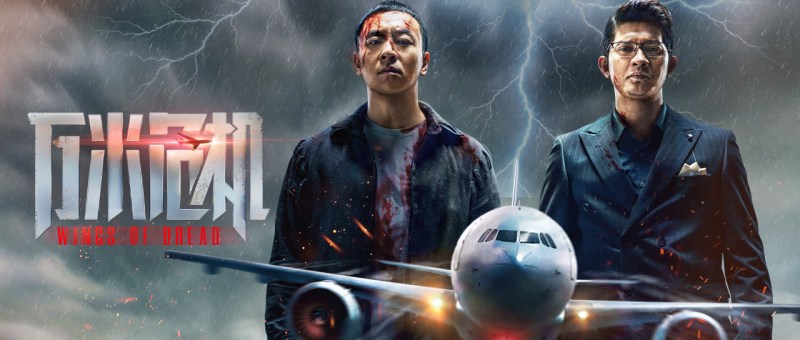
Wings of Dread (万米危机, Ashton Chen Xiaolong & Qin Pengfei, 2026)

Perhaps surprisingly, aeroplanes seem to be dangerous places in recent Chinese cinema. From the hardware failure of The Captain to Oxide Pang’s hijacking drama High Forces, something always seems to go seriously amiss when it comes to air travel. Streaming actioner Wings of Dread (万米危机, wàn mǐ wēijī) is the latest in this growing genre and once again carries a mildly patriotic message in praising the Chinese air police who are willing to put their lives on the line to ensure passenger safety.

Then again, former cop Chaoyang (Ashton Chen Xiaolong) may feel a little bit inferior after giving up his police career to become an aeroplane security officer in order to spend more time with his girlfriend, air stewardess Dong Lu (Nita), who also gave up her opportunity to work abroad. Dong Lu has evidently had enough of Chaoyang’s grumpy behaviour and moved out their flat, though he is carrying a ring he still hopes to give to her. Rushing to the airport in an attempt to convince her to move back in before her next flight, Chaoyang becomes distracted by a drug user and decides to take down their entire gang first. From a certain point of view, his priorities may be all wrong, though the main problem in the relationship seems to be that Chaoyang expects Dong Lu to be in stewardess mode all the time by being constantly cheerful and treating him like a prince without seeing her as a real person who needs to be able to switch off and relax after a long shift.

This relationship issue is never resolved in a concrete way but only through the action movie trope of Chaoyang’s proving his heroism by saving Dong Lu when the plane they’re both on after he flew to her destination to win her back is hijacked by a criminal gang. One of China’s most wanted has been arrested in a fictional South East Asian nation and is being escorted back to the mainland. Among the passengers, there are both undercover members of the gang planning to break him out and plain-clothes security officers ready to deal with any trouble. Slightly confusingly, the gang have also brought a bomb and are threatening to blow everyone up if the captain doesn’t fly to their chosen destination, which at the very least seems counterproductive and a little bit reckless on behalf of the crooks.

That the bomb got on board along with a lot of 3D printed plastic guns can be attributed to lax security procedures at the airport in the fictitious South East Asian nation, but the point is that this plane is well protected by Chinese air police. Villain Paquet (Iko Uwais) sneers that Chinese police are “pathetic”, which proves quite irritating to Chaoyang who immediately bounces back to win the fight and prove that they are willing to do whatever it takes to ensure passengers reach home safely even at the cost of their own lives. The passengers too are unusually co-operative after being made aware of the bomb threat, giving up their bags to form a barrier and even joining in with the final fight against the bad guys. 

Qin, who is known for his skill in shooting action sequences in confined spaces, does some of his finest work in a fight between a female officer and gang member set entirely within a toilet cubicle, while otherwise making full use of the environment as passengers grab tray tables to attack the hijackers who equally throw opponents over shelving units and smash their heads into arm rests. Casting top international action star Iko Uwais as the villain adds a degree of prestige unusual for a streaming film, though choosing to dub his voice seems like an odd decision, especially as all his dialogue is in English. Nevertheless, the film is impressively put together and largely transcends its streaming origins in scope and ambition despite the looseness of its plot and occasionally awkward attempts at humour. 


Wings of Dread screens 21st August as part of Big Bad Film Fest.

Trailer (no subtitles)

Match Monde (マッチモンド, Ryusuke Kurahashi, 2026)

Scripted by Yugo Sakamoto, Ryusuke Kurahashi’s low-budget adaptation of the Shogo Horiuchi manga Match Monde seems to be aiming for a Baby Assassins vibe while placing a contemporary spin on the classic high school delinquents fighting manga. Unlike many similarly themed films, high school never actually features and most of the users of fighting app Match Monde appear to be long past high school age even if it’s supposed to be limited to those 18 and under. 

The title is a kind pun in that Match Monde operates in the same way as a dating app, though it allows members to find worthy opponents for fighting. Users can also monetise their pugilistic talents though taking the “bounty” from defeated opponents, or pick up tips through live streaming. It’s not really clear why Mikio (Kotaro Daigo) is on this app as he dislikes fighting and seems to be something of a coward. In the opening sequence, he waits outside pretending to play on his phone while his best friend Yuta is beaten up by a bullying gang of older kids that Mikio later hides in a bin to avoid. It’s while running away, however, that he bumps into Mahiro (Masayoshi Katsuki) who can’t really be bothered to fight anyone but gives Mikio some life advice to the fact that he should be fighting to protect something important rather than just to protect himself. 

Mahiro is a bit a stock character in these kinds of stories, walking around with a beatific smile permanently on his face and carrying a strangely vacant aura. Obviously, it turns out that he’s a top fighter and high school drop out who is willing to fight for Mikio after seeing him develop his resolve to stand up to the bullies rather than let his friend get beaten up on his own again. Like Baby Assassins, however, the film is perhaps a little bit more interested in the boys’ mundane lives than it is in the fighting. Mahiro ropes Mikio in to help out at a part-time job working in his childhood friend Suzuna’s cafe because he says he seems kind earnest, which is broadly true, while Mahiro struggles to knuckle down and work and fears letting his friend down in that way.

While it may have strongly homoerotic undertones, particularly in the relationship between sometime villain Mairu and his late “best friend” Kitano who was murdered after becoming a delinquent, the film’s humour is distinctly old school and in some ways spills over into sexism as the defeated bullies are seen acting in stereotypically feminine ways such as knitting scarves for each other. Meanwhile, Mahiro and Mikio aren’t really afraid of getting into fights with the delinquents, but are apparently terrified of being told off by Shizuna. 

The focus is indeed on traditional masculinity which is rooted in protecting those weaker than oneself, especially women, though here also avoiding becoming someone who deliberately picks on picks on easy targets to assert their dominance as Mikio had been doing. Perhaps the only reason he was on the app was to prove Yuta wrong when he called him a coward, though he quickly ends up being exploited by the bullies who force him to fight so they can take his winnings, as optimistic as that might be. As the so-called “Penniless King”, Mahiro comes to occupy the space of an underdog hero who isn’t even technically in the game, but ends up winning it anyway just by virtue of being a cool guy who’s good with his fists.

Speaking of which, the fight scenes are sometimes unpolished but generally well choreographed. There seems to be some attempt to set up a continuing series with repeated references to a friend who is no longer on the scene as well as an incongruous appearance by Danhi Kinoshita, the star of Takashi Miike’s Blazing Fists, seemingly in a background, non-speaking part as a random member of Mairu’s gang. The potential there is quite interesting given that the natural result of all these boys fighting is that they end up becoming friends, even as Mairu insists he wants to defeat all the delinquents in revenge for his friend’s death so he’ll be the only one left and they’ll cause no more harm. Who knew that what they were really fighting was loneliness? Maybe Match Monde is friendship app after all.


Match Monde screens 23rd August as part of Big Bad Film Fest.

Trailer (no subtitles)