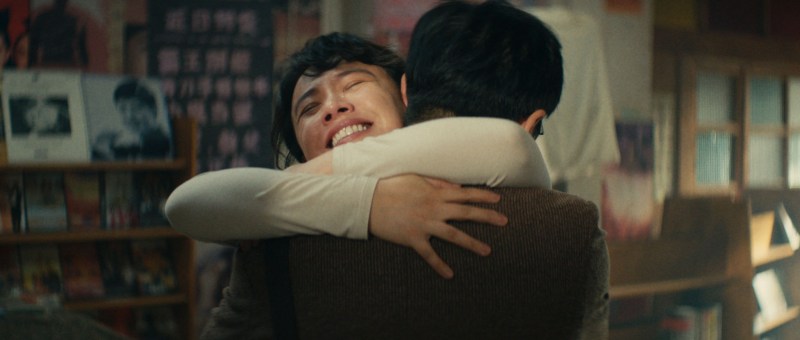
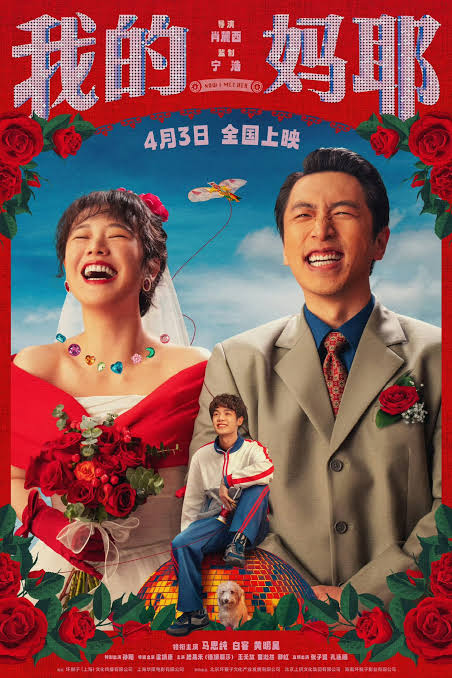
Another in the recent trend of filiality-themed dramas such as Hi, Mom and Give Me Five, Xiao Luxi’s heartwarming comedy Now I Met Her (我的妈耶, wǒ de mā ye) is essentially a coming of age tale in which the hero confronts the lingering trauma of his mother’s death in childbirth after being presented with her diary on his 18th birthday. Paradoxically, it also taps into a sense of nostalgia among those of the parents’ generation for the bygone days of China from the 1980s to early 2000s, yet without engaging in any sort of critique or mention of the wider social issues besides youthful poverty and the rise of cross-border smuggling in the late 90s.
Though Eleven Zhang’s (Huang Minghao) doting father Xue (Bai Ke) still talks to his late mother Dongyu’s (Ma Sichun) portrait on the altar, Eleven often says things to the effect of not having a mother at all seeing as he never knew her. In some ways, he’s been reminded of her every day, though these are sometimes negative associations such as his curly hair for which he was made fun of as a child. Meanwhile, as a teenage boy, Eleven is also a little resentful of his father and wants to separate himself further from the familial domestic environment and achieve greater independence. Xue, too, seems to think this might be the time for change, irritated that Eleven doesn’t really want to have a birthday dinner with him, but equally suggesting that maybe they should try somewhere new rather than going to McDonald’s as usual, acknowledging that Eleven has probably outgrown this tradition.
More or less forced to read his mother’s diaries which are pressed on him by some sort of spiritual power, Eleven finally has to acknowledge that he did have mother who lived a whole life before he was born, though what’s actually written is a chronicle of three periods of romance. In the first, she’s Eleven’s age, and develops a crush on a classmate who dreams of dancing glory. Because hers is a selfless love, she helps him win a dance competition knowing that if he does he’ll get the opportunity to study in Shenzhen and leave her behind. Next, she’s a university student in Guangzhou who embarks on a serous relationship with a waiter who saves her from a creep in a karaoke bar, but the pair have no money and the guy eventually turns to desperate measures in order to try and provide a more comfortable life for her. Later she marries Xue after connecting with him at her office job and returns to her hometown after her mother has a stroke to open a restaurant.
Xue’s special gift to his son is the last of the diaries which detail the time between Dongyu’s early pregnancy and her death, keying Eleven in to the sacrifice his mother willing made for him which allows him to overcome his feelings of abandonment in knowing that he was loved and wanted. Nevertheless, the vision of his mother in the diaries is perhaps somewhat idealised and partially of his own creation. What she eventually becomes is a figure of maternal sacrifice. Nevertheless, the diaries also allow Eleven to reacher a greater understanding of his father that would otherwise perhaps take a little longer to arrive, learning to appreciate the love and devotion Xue had for his late wife and their family while raising his with the help of his own mother.
It seems in a way that Dongyu may have her own issues with abandonment in her memories of her father, apparently ending up marrying a man much like him but one who was at least able to turn his life around and devote himself to his family. Though it might actually be Eleven’s vision rather than Dongyu’s, there is something quite poignant in seeing her live out the rest of her life in her last eleven minutes while encouraging a future Eleven to live to the fullest and be happy rather than dwelling on the past. In any case, in getting to “meet” his mother through her diaries, he realises that his parents had whole lives, or maybe several of them, that he never knew about, but equally that he did coexist with each of them no matter how briefly while his father is still here with him in the present day. Painting a warm and fuzzy vision of China in the late 20th and early 21st century, Xiao’s cineliterate first feature is a loving tribute to maternal devotion and the enduring nature of familial bonds.
Now I Met Her screened as part of this year’s San Diego Asian Film Festival.
Trailer (English subtitles)

