The People Upstairs (윗집 사람들, Ha Jung-woo, 2025)

A moribund marriage finds itself haunted in the reflective image of the couple upstairs in Ha Jung-woo’s take on the Spanish film, Sentimental. A very ’70s sex farce, the film is, in other ways, a refreshingly modern examination of contemporary relationships that ultimately comes down on the side of sexual freedom and personal fulfilment rather than encouraging its unhappily married protagonists back into a socially conformist cage of merely settling for an unsatisfying existence.

You can tell Jeong-ah (Gong Hyo-jin) is unsatisfied by the way she accidentally embarrasses the life model at the art class where she teaches part-time to the point he feels he has to cover himself up even though it defeats the purpose of him being there. Her work as a temporary art teacher is also a symbol of her defeated hopes having given up on her creative practice to focus on more practical concerns while her husband, Hyun-soo (Kim Dong-wook), is a struggling film director who is currently on the 48th draft of a project to turn an unsuccessful film pitch into a TV drama that he’s been working on for the last four years. 

Neither of them are getting much sleep because the rambunctious nightly lovemaking of the couple upstairs keeps them up at night, but these days Hyun-soo sleeps on a fold up mattress in his office which is full of empty boxes of instant ramen like some student bachelor pad. Though they’re only in adjacent rooms, they communicate through Kakao talk and are otherwise leading separate lives. That might be why Jeong-a is drawn to the self-help YouTube channel run by Soo-kyung (Lee Hanee), her upstairs neighbour, which assures that no one can cure the loneliness inside you and the fastest way to better relationships is to stop expecting too much from other people. 

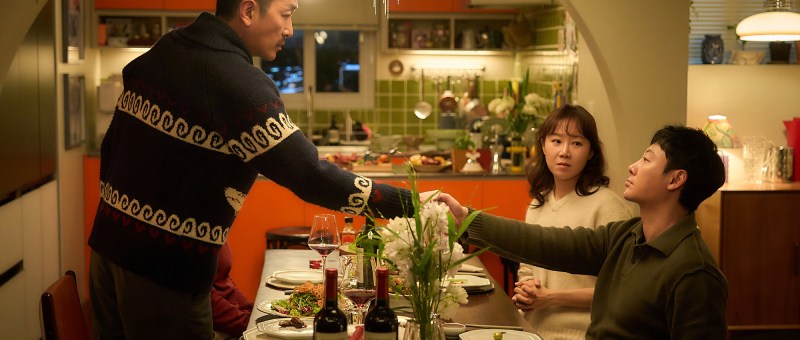
But it’s clear that Jeong-a, at least, is looking for something more which is likely why she decides to invite the upstairs neighbours over for dinner. Hyun-soo isn’t keen on the plan and tries to force her to cancel, then only agreeing to stay an hour while making passive-aggressive comments and veering close to telling the Kims that they can hear everything that’s going on upstairs and they don’t like it. Soo-kyung and her husband Mr Kim (Ha Jung-woo) are, however, the inverse of Jeong-a and Hyun-soo in their hyper-sexualised relationship and apparently solid marriage. They’ve come with something to say too, but while Jeong-a is increasingly receptive to their entreaties and open about her dissatisfaction, Hyun-soo is rude and indignant, resentful of what he sees as a perverse intrusion into his otherwise very “normal” life.

Indeed, part of this is that Mr Kim keeps making subtle digs at his masculinity in needling him about his lack of career success and inability to get this TV drama off the ground after apparently working on it for four years. This is also the root of Hyun-soo’s own insecurities and withdrawal from Jeong-a, unable to see himself as a man in the wake of his dissatisfying career. But Mr Kim is also a contradictory picture of masculinity. A teacher of Chinese characters who really wanted to be a calligrapher, he cuts a fairly authoritarian figure, but is otherwise a modern new man who is domesticated and open with his feelings. The Kims bring a dish to the dinner that Mr Kim has made while he orgiastically tears into pomegranate and suggestively squeezes lemons. He fixes drinks, makes tea, and gets out of the way while his wife does her work. 

But at the same time, the film seems to dial back on the inherent queerness of the Kims’ sexual practice by eliding the homoeroticism between Hyun-soo and Mr Kim who is keen to recruit him because his apparently explosive essence. This internalised homophobia is also a manifestation of Hyun-soo’s conventionality and desire for middle-class properness to bring order to his life, if only superficially, by continuing to live in a simulacrum of a marriage that leaves husband and wife unhappy. The recently remodelled flat is full of the signs of aspiration from the posh china to elegant modern decor. But it’s a row about the curtains that most obviously signals the cracks in their relationship. Jeong-a doesn’t want any because she wants a more open and transparent marriage, while Hyun-soo can’t live without them because he craves repression and can’t understand a life without it.

In any case, during their incredibly weird evening with the Kims, the couple hit rock bottom that is also a kind of epiphany liberating them from their misconceptions and the inertia of their married life. Hyun-soo, finally, begins to realise that Jeong-a is right when she says he uses sarcasm to run away from his problems and if he wants to save his marriage, he’ll have to be a little more emotionally honest and open to compromise. Despite his squeamishness, the film seems to come down on the side of the Kims who are living happy and fulfilling lives in embracing their sexuality, while it is Hyun-soo, by contrast, who must learn to open up even if he’s not quite ready to get in the lift.


The People Upstairs screened as part of this year’s LEAFF.

Trailer (no subtitles)
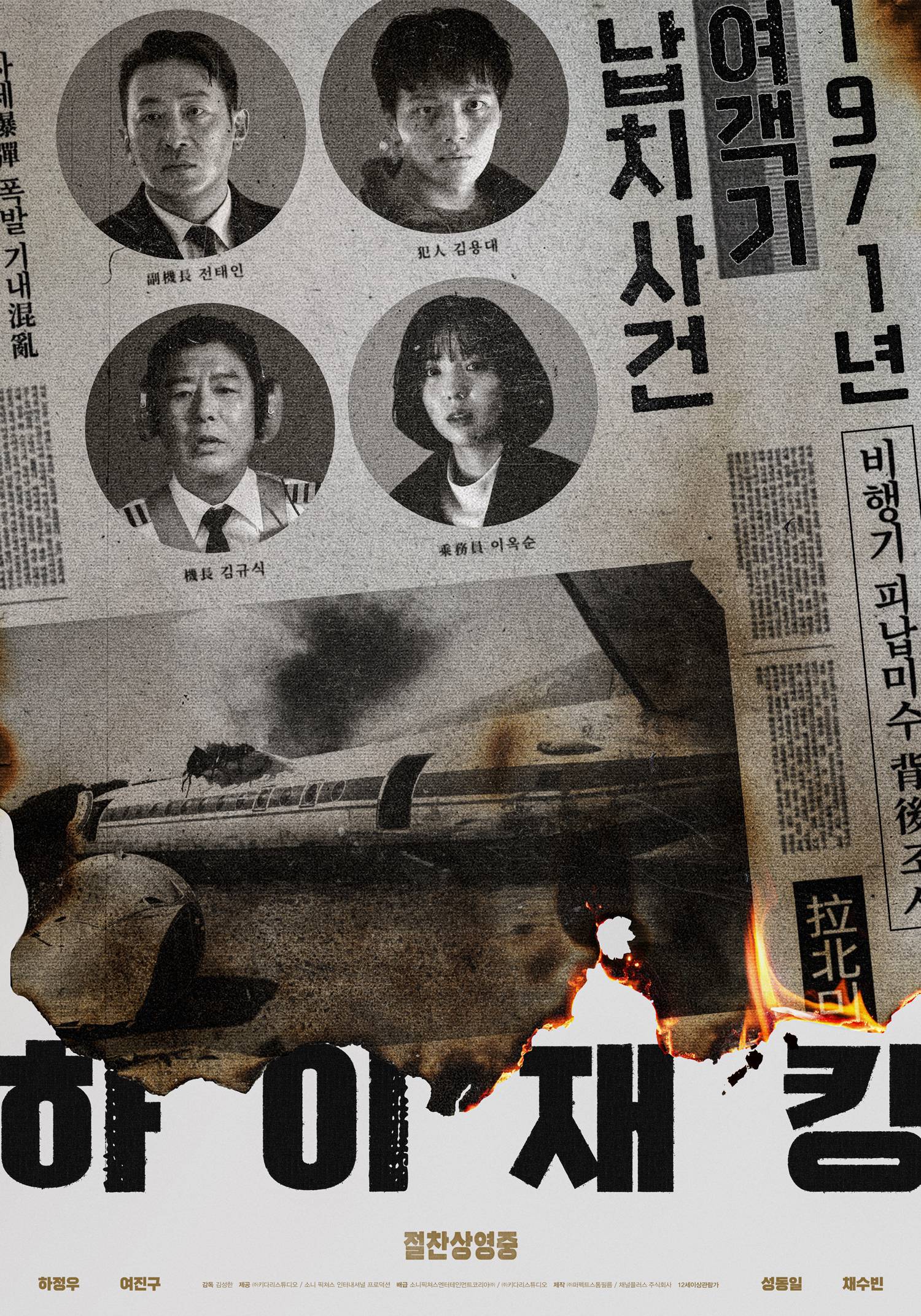
Hijack 1971 (하이재킹, Kim Sung-han, 2024)

Newspaper-style Korean-language poster featuring a stock photo of a burning place and circular photos of the cast members in black and white.

When a passenger plane is hijacked and forced to fly to North Korea in 1969, the Korean Air Force pilot ordered to fire on it refuses. He recognises the pilot and realises there is something wrong. If there is a hijacker on board, he fears that that he may kill the pilot and crash the plane, killing everyone on board, and while his commanders remind him that the plane should be able to land on just one engine, he knows that if he hits the fuselage instead, the plane could blow up. Even if they land in North Korea, isn’t it better everyone survives?

Not according to some in Kim Sung-han’s Hijack, 1971 (하이재킹, Hijacking), inspired by a real life incident. Tae-in (Ha Jung-woo) is summarily dismissed from the air force for his insubordination while otherwise ostracised as the man who allowed the plane to reach North Korea. As he predicted, most of the passengers are returned home shortly afterwards, but 11 never see the South again including his friend the pilot, Min-su (Choi Kwang-il). Meanwhile, Min-su’s wife (Kim Sun-young) continues to face harassment for supposedly being a communist sympathiser. Now working for a commercial airliner, Tae-in also faces discrimination from his new colleagues who, ironically, don’t trust him to properly protect passengers. All their assumptions are tested, however, when a young man sneaks a bomb on board and threatens them to fly to the North apparently inspired by the previous case in which the hijacker was given a hero’s welcome for successfully kidnapping so many useful people.

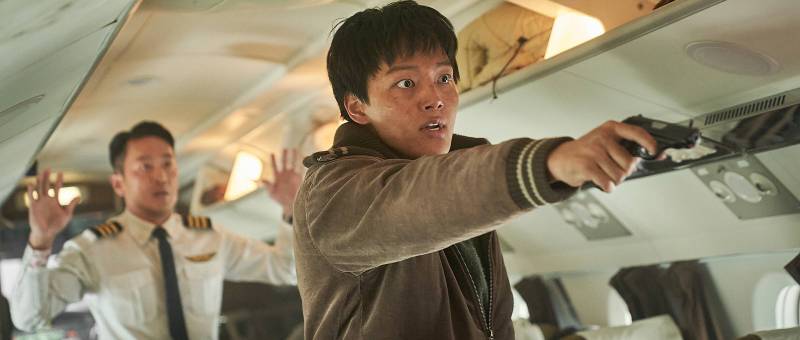
What’s immediately obvious is how easy it still was to get a bomb on a plane. Yong-dae (Yeo Jin-goo) simply packs them into some tin cans and wraps them up like a picnic. When boarding opens, the passengers literally sprint past each other to get the best seats because they weren’t yet reserved, and when we see a passenger start smoking, we assume the stewardess will tell him not to yet she simply points out the ash tray in the arm of the seat and asks him not to drop ash on the floor or woman sitting next to him. One woman also delays the flight because she’s brought a live chicken with her to make a soup for her daughter whom she’s travelling to see because she’s ill. Tae-in scores an early win and the goodwill of (most of) the passengers by defusing the chicken situation and allowing the woman to keep it on the condition she has it on her lap for the duration of the flight. 

Letting the old lady keep the chicken signals Tae-in’s consideration for his passengers’ welfare and happiness, while the air marshal becomes so preoccupied with this minor breach of the rules that he fails to notice the suspicious behaviour of the hijacker. The presence of the air marshal, a precaution taken after the previous incident, also proves counterproductive when he’s injured when the first bomb goes off, allowing Yong-dae to steal his gun. Granted, this is a fairly minor flight from a provincial airport to Seoul so maybe no one really thought there was much need for advanced security, but they really are woefully underprepared for this kind of incident, especially after the pilot is seriously injured and can’t see well enough to fly alone, meaning Tae-in also cannot do very much to respond to the hijacker’s threats. 

But what we come to realise is that it’s really society that’s been hijacked by the extreme prejudice directed towards “communists” and the North. The passengers from the first plane were returned, but spent time in interrogation to make sure they hadn’t been turned. A newlywed passenger also remarks that a fisherman friend of his was abducted and the police haven’t stopped hassling him about being a spy ever since he got back. Yeong-do’s motive is that he faced constant and unwarranted harassment, including being scalded with boiling water as a child, because his older brother defected to North Korea. His mother later died when he was carted off to prison for being a supposed sympathiser, while other passengers on the plane are similarly worried that their families will starve if they end up in North Korea or are detained when they return. 

A minor subplot, meanwhile, explores the prejudice faced by an older woman travelling to Seoul with her son, who has become a prosecutor. She is deaf and unable to speak, but her son tells her to stop signing because it’s embarrassing him after noticing disapproving looks from another woman in hanbok across the aisle. The old lady had also taken her shoes off after getting on the plane as if she were entering someone else’s home signalling both her politeness and lack of familiarity with modern customs. Her son had repeated the stewardess’ instructions to put them back on, but addresses her like stranger when telling her not to sign. In a way, this casual prejudice is the same and directed at someone simply for being different. Even so, there’s something quite tragic about her son being ordered to tear up the prosecutor ID card she was so proud of. Eventually she swallows it herself to make sure no trace of it remains, telling her son not to worry she will always protect him even in North Korea though he has not done very much to protect her here.

Tae-in later does something similar when he encourages Yong-dae that they should all go on living to ensure no one else endures the mistreatment he has and we don’t end up with any more incidents like this. Though his behaviour is increasingly deranged, it becomes easy to sympathise with Yong-dae for enduring so much suffering for something that was really nothing to do with him while we’re constantly reminded that if the plane lands in North Korea everyone on the plane and all their relatives will also suffer the same fate. At least facing this disaster together eventually forces the passengers to set aside their petty prejudices and pitch in to save the plane so they can get home to their families even if it’ll take them a bit longer to get to Seoul. Though the outcome is already known to the home audience, Kim Sung-han keeps the tension high and defines heroism largely as compassion and selflessness in Tae-in’s continued efforts to ensure the safety of his passengers rather than playing politics or allowing himself to be swayed by those who think landing in North Korea is a fate worse than death.


International trailer (English subtitles)

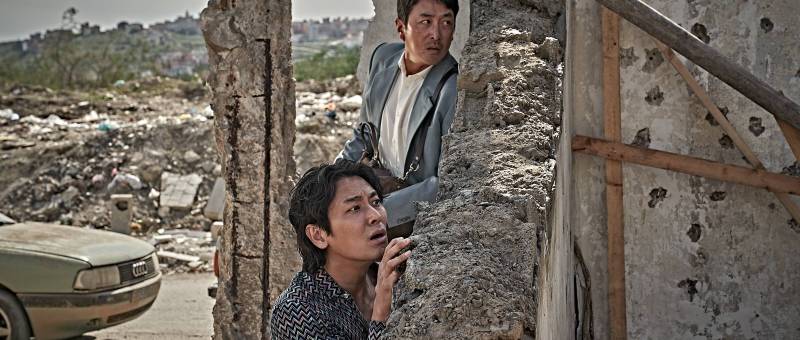
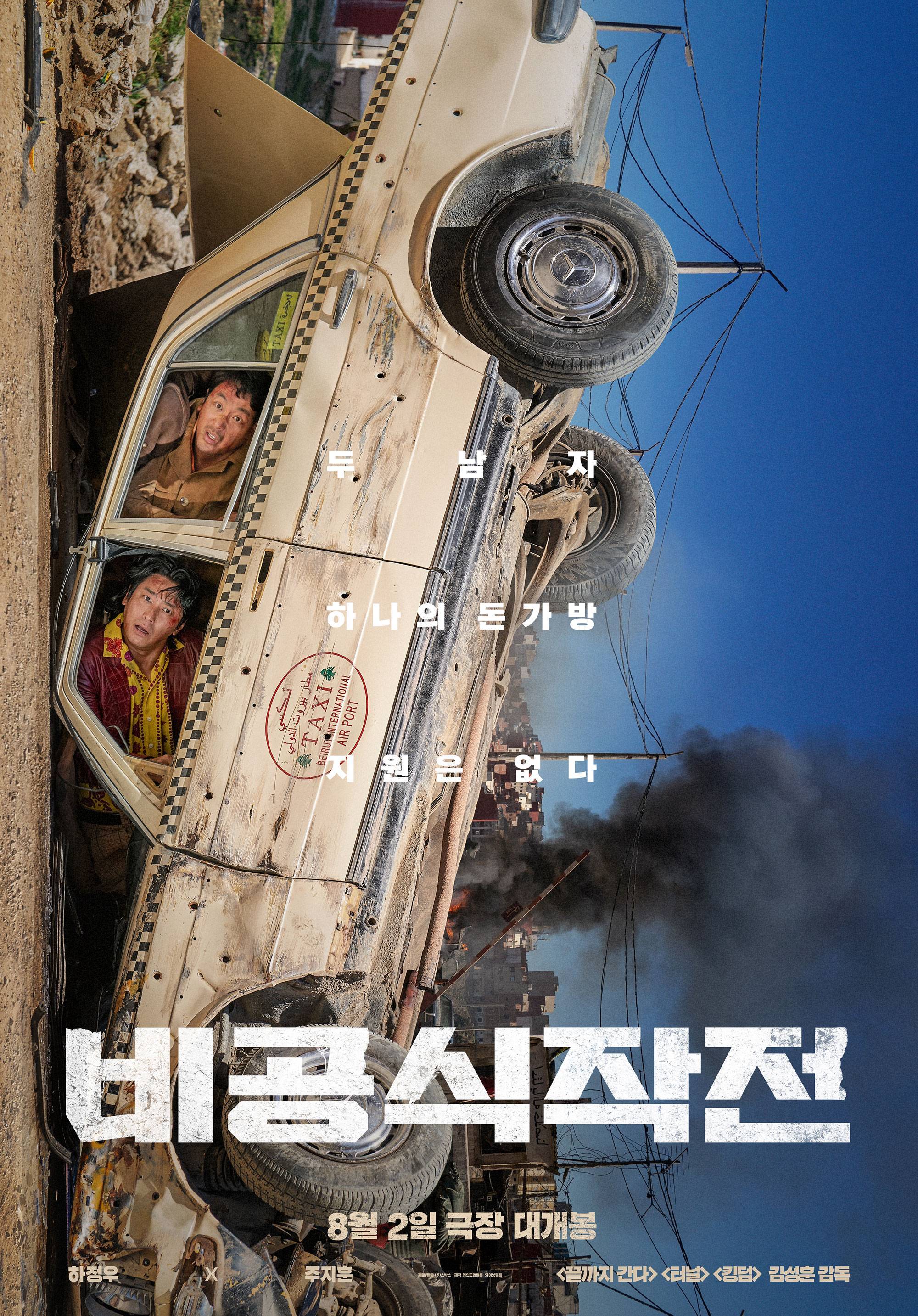
Ransomed (비공식작전, Kim Seong-hun, 2023)

A jaded diplomat finds himself caught between competing factions both at home and abroad while trying to rescue a kidnapped colleague in Kim Seong-hun’s action dramedy, Ransomed (비공식작전, Bigongsigjagjeon). Inspired by true events, the film ironically echoes the recent Chinese hit Home Coming which was itself at least incredibly indebted to Escape from Mogadishu in praising the efforts of a civil servant who braved a war zone to rescue a stranded colleague but received little support from his conflicted government.

During the time the film takes place, Korea is caught in a moment of transition technically still under the military dictatorship of Chun Doo-hwan but with the first democratic elections already scheduled and the 1988 Olympics in the offing. Diplomat Oh Jae-seok (Lim Hyung-guk) is kidnapped in during the civil war in Beirut in 1986 and believed dead after efforts to retrieve him fail. Nearly two years later, jaded Foreign Office Middle East specialist Lee Min-jun (Ha Jung-woo) picks up a call and hears a message in morse code including a special diplomatic password and the claim the that it comes from Jae-seok who is alive and requesting rescue. The problem is that both the Foreign Office and the KCIA are on the fence about taking action, each wanting the glory of bringing Jae-seok home but fearful of being professionally embarrassed if it turns out that the call is a hoax and they pay a ransom for a man who’s already dead. 

Min-jun finds himself caught between the two while essentially forced to set up a secret covert operation through former US CIA officer Carter (Burn Gorman) and a wealthy Swiss businessman with connections in Lebanon. The irony is that both he and Pan-su (Ju Ji-hoon), a Korean taxi driver he inexplicably runs into in Beirut, only want to go to the US, Min-jun desperate for a more prestigious positing to advance his diplomatic career while Pan-su, technically undocumented, seeks a better life in a more stable environment. As such, Min-jun’s motivations for rescuing Jae-seok are only partly a sense of responsibility as a fellow diplomat and the man who took the call that Jae-sook was alive, hoping to prove himself to his superiors only agreeing to the job on the promise of a transfer to a major US city resentful of having been passed over for a position in London in favour of an elite graduate of Seoul University. 

The irony is that once in Beirut he’s faced with a further series of kidnap threats, another random militia hot on Min-jun’s trail hoping to capture at least one Korean in the hope of a major payout though Min-jun’s problem is that the government only agrees to send more money after each step has been completed endangering the efficacy of the rescue mission while leaving him at the mercy of the militia leader the government has secretly and perhaps questionably agreed to pay to broker the negotiations to secure Jae-seok’s release and passage out of the country. Caught between competing militias in Beirut, Min-jun is also a victim of the push and pull between the waning influence of the KCIA and the Foreign Office with his fate decided largely by political infighting while in the end it’s his colleagues who eventually take a stand each chipping in three months’ salary to fund his rescue out of a sense of solidarity in the reflection that their job is only really possible given their government’s assurance of protection when they undertake dangerous work overseas for the national good. 

As expected, Min-jun soon rediscovers his sense of duty as does shady taxi driver Pan-su though more thanks to the shaming of his Lebanese girlfriend who points out that it’s not a good look to run off with millions of dollars intended to save to save a man’s life. Despite the constant precarity of the situation, what arises is an awkward brotherhood between the two men brokered by an uneasy trust and genuine fellow feeling as they try to rescue Jae-seok while evading the militia trying to kidnap them along with the wider civil war. Undercutting the seriousness of the situation with a healthy dose of irony and black humour, Kim lends his otherwise grim tale of citizenry held hostage by a bureaucracy in flux a degree of positivity if only in proving the power of the individual over a dysfunctional system. 


International trailer (English subtitles)

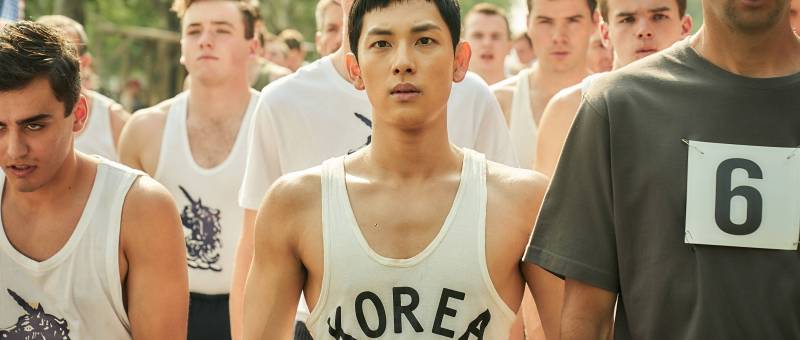
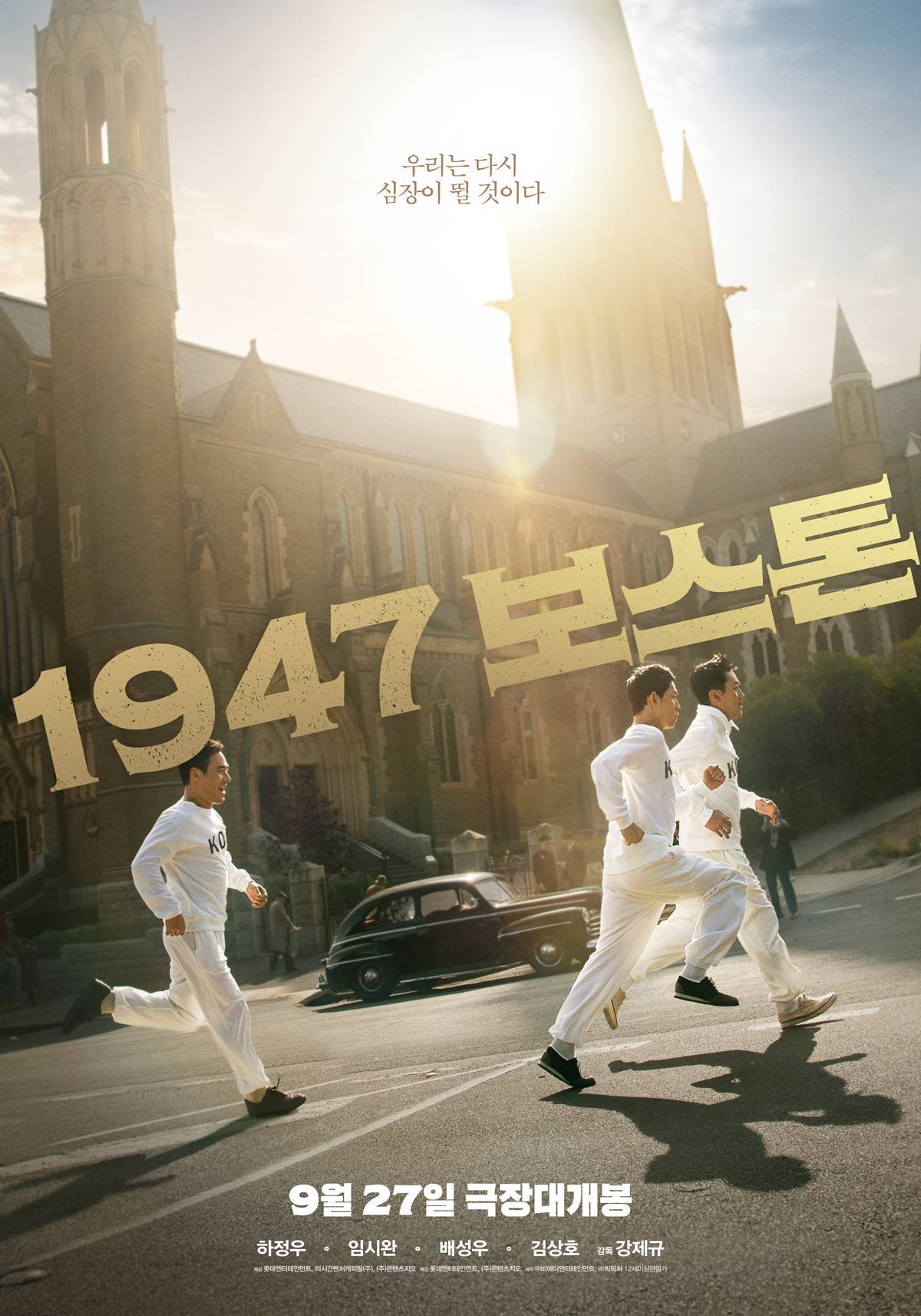
Road to Boston (1947 보스톤, Kang Je-kyu, 2023)

The right to participate in a foreign marathon becomes a victory for the Korean in people in Kang Je-kyu’s sporting period drama, The Road to Boston (1947 보스톤, 1947 Boston). Skewing towards the nationalistic, the film finds two brands of exceptionalism colliding while hinting at the sense of destabilisation in a nation which has not only been divided but rather than the promised liberation only re-colonised by an entirely different military regime who insist that Korea is not a real country merely a protectorate. 

In 1936, Sohn Kee-chung (Ha Jung-woo) won a gold medal for marathon running in the Berlin Olympics but when he stood on the podium they played the Japanese anthem and flew the Japanese flag. They announced his name pronounced the Japanese way, and when Kee-chung covered the Japanese emblem on his uniform he was banned from sports and put under police surveillance. Japan had annexed Korea in 1910, and the victories were accredited to the Japanese Empire. The country had been liberated from Japanese rule at the end of the war, but the nation was divided in two with the Americans occupying the South and the Soviets the North. 

Part of Kee-chung’s bitterness is that his family are trapped over the border and he’s been unable to bring them South, but it’s also that he was not able to run “freely” under the flag of his nation or in his true name. Yet now that they’ve been liberated, it’s as if only the names have changed. Loutish American GIs make trouble in the streets bullying the locals much as the Japanese had while the nation in general remains poor. There’s a chance that Korea could compete in the 1948 Olympics in London, but they’ve been told they don’t qualify because Korea doesn’t really exist and even in the way it does it’s only for a couple of years so they have no track record of international competition, all their previous successes are still attributed to Japan. To qualify, they decide to enter the Boston Marathon, but are told there are additional hurdles because Korea is a “refugee country” and the authorities are worried they might just stay there. 

When they do actually arrive in the US, they get a similar attitude told that winning the Boston Marathon might help them gain US citizenship as if that were some ultimate prize they must be secretly longing for when all they want is to be recognised as Koreans. Because the Military government signed off on their participation, the shirts prepared for them carry American flags, but Kee-chung does not want his protege Yun-bok (Im Si-wan) to suffer the same fate as him and compete under a flag that is not his own as he outlines in a powerful speech to the person in charge of the marathon while cheered on by outraged Asian Americans who also suffer racism and discrimination in the so-called land of the free.

At the press conference, reporters ask offensive and embarrassing questions such as whether Korea has universities, newspapers, or even electricity. The US guarantor Nam-hyeon (Kim Sang-ho) also states that even when he says he’s Korean, people ask him if he’s from China or Japan while Yun-bok receives racial slurs from a runner representing America. America is also presented as the land of immoral capitalism in which the only thing that matters is money in direct contrast to Kee-chung’s claims that runners aren’t in it for the cash. He originally rejects Yun-bok for his “arrogance” and lack of interest in anything that isn’t about money but later changes his mind on realising his crushing poverty and desire to help his ailing mother. 

On the other hand, the runners are constantly reminded how different the US (and elsewhere) is from Korea, asked if they know how to sleep on a Western-style bed or use a shower while reminded that everything in the mini bar you’ll be charged for. Yun-bok comically washes his face in the toilet seeing only a basin of water little knowing what taps are or how to use them. On his first taste of Coca Cola, a symbol of American capitalism, he is captivated and wonders if they should just accept the American flag for the right to run and a quiet life while Kee-chung will not be put through that humiliation again. The right to participate in the marathon under the Korean flag becomes a victory for the Korean people as a whole who had chipped in to crowdfund it in the face of resistance from the US military government. A big wig who made his money in dubious ways might have a point when he asks if it’s right to spend so much on a marathon when people are starving in the streets, but then what Kee-chung is trying to reclaim is national pride which to some at least is worth the price. In any case, the historical victory becomes a crowning moment of Korean independence, no longer a refugee state but (symbolically at least) a sovereign nation and finally free to run just as far as it can go.


Road to Boston screened as part of this year’s London East Asia Film Festival.

International trailer (English subtitles)

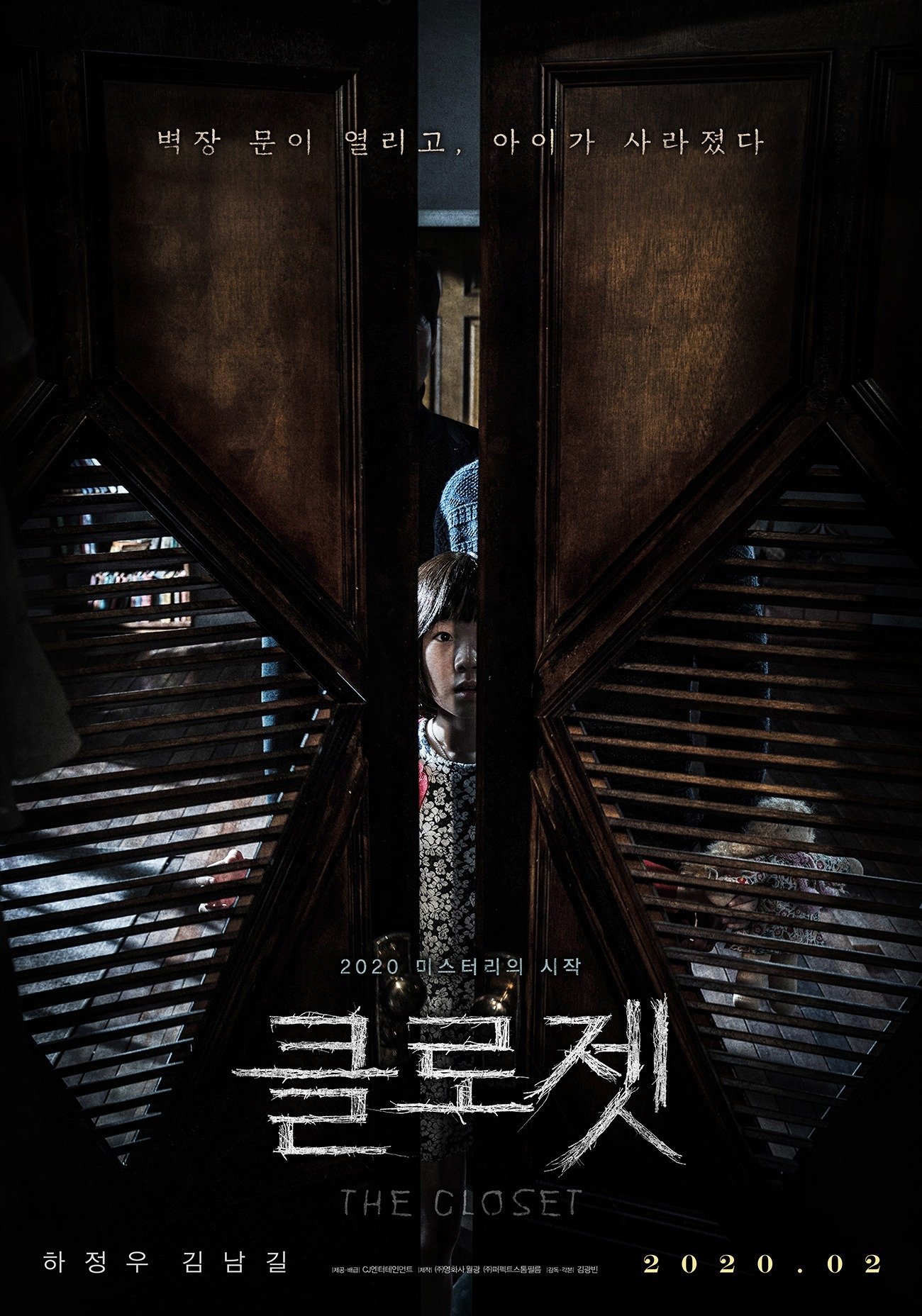
The Closet (클로젯, Kim Kwang-bin, 2020)

Parents in Korean horror films are often uniquely flawed but go to great lengths to redeem themselves through saving their children from supernatural peril. This much is true for the narcissistic hero of Kim Kwang-bin’s grief-stricken ghost story, The Closet (클로젯). The title, perhaps in contrast to its first implications, has a poignant quality as it represents in one sense a place of safety for children trying to protect themselves from the things that frighten them but of course it is no safe place and only leaves them trapped, vulnerable, and traumatised by a world of adult cruelty they are far too innocent to understand. 

Architect Sang-won (Ha Jung-woo) lost his wife in a car accident in which he was driving. He has just bought a large house in the country where it’s quiet and the air is clean to help his young daughter Ina (Heo Yool) recover from her trauma, but his decision is causing trouble in his professional life because his firm prefer their architects to be onsite during in builds and Sang-won obviously needs to be with Ina until he can find a nanny. Ina is generally avoidant around her father, something which probably isn’t helped by her overhearing him blame all his problems on her while arguing with work on the phone, but her personality undergoes an abrupt change after she opens the closet door in her new bedroom, rendering her suddenly cheerful while carrying around a strange doll. 

Sang-won’s first concern is the manky old toy which irritates him because he’d gone to trouble to buy Ina a fancy limited edition doll as a present which she hasn’t played with. Ina is probably ageing out of dolls, and doubtless not that impressed with the supposed pedigree of her father’s gift seeing as neither is she old enough to appreciate a purely decorative present, but in any case Sang-won’s gesture was largely for himself as he proves flagging up how much trouble he went to to get it without, it seems, thinking about what Ina might actually like. When the accident happened, Sang-won was having a minor argument with his wife because he hadn’t made it to Ina’s school concert. He was faintly dismissive, superficially apologetic but clearly unrepentant in choosing his career over his family. Still traumatised over his role in the accident, Sang-won fails to connect with his daughter out of a mix of emotional unavailability, guilt, and intense resentment.

Facing potential humiliation at work on learning he’s been “paired” with a younger architect, Sang-won gets a random local woman to watch Ina, telling her he’ll be away for two months but will visit at weekends. With all of the craziness in the house the “nanny” quits and Ina goes mysteriously missing soon after. Sang-won goes to the police and then the media, but once they catch sight of his medication and mental health profile, he all but becomes a suspect in his daughter’s disappearance, some thinking he killed her and is covering it up and others pitying him as a madman who simply doesn’t remember having harmed his child. An exorcist (Kim Nam-gil), however, has another explanation and Sang-won, though originally sceptical, is forced to trust him because he is the only one who doesn’t think him guilty of murdering his little girl. 

As might be expected, Sang-won’s paternal failures are the root of all his problems. Not only did he neglect his family before the accident, but continues to reject his paternity while rendered a single parent, hoping to palm his daughter off on a nanny so he can go back to concentrating on his career. Questioned by the well-meaning but insensitive exorcist, Sang-won is forced to realise he knows nothing about his little girl. He has no idea if she likes K-pop or if she has any friends. Faced with her continued indifference, he was planning to send her away to an art therapy camp, throwing his hands up in the air and declaring fatherhood too difficult. As the exorcist points out, kids are smart and they know when they aren’t wanted. It’s precisely this feeling of insecurity which has invited in the supernatural. Sang-won will have to prove his paternal love if he truly wants to bring his daughter home. 

The grudge-bearing ghost, it seems, is trying to provide a refuge for all those other children bullied, mistreated, or neglected by the adults who were supposed to protect them, but all Sang-won can do is apologise on behalf of failed fathers everywhere which is, it has to be said, not much of a victory even if refocuses our attention on the true villainy which is sadly much more societal than it is supernatural. In any case, Sang-won doesn’t seem to have changed very much even if he’s had something of a humbling and been superficially restored as a “good” father rededicating himself to raising his daughter. The final sting, however, is perhaps a little on the flippant side even as it reminds us of the evils still lurking in the dark corners of our societies. 


International trailer (English subtitles)

Miss & Mrs. Cops (걸캅스, Jung Da-won, 2019)

When the Burning Sun scandal exploded in early 2019 it promised but perhaps did not deliver a reckoning with the generalised misogyny at the heart of a fiercely patriarchal society. Almost a year previously, 12,000 women had assembled at Hyehwa Station to protest the prevalence of “molka” or spy cam pornography in which footage captured of ordinary women through the use of hidden cameras in ladies’ bathrooms, changing areas, and fitting rooms had been uploaded to the internet without their knowledge or consent. Despite all of this, there has been relatively little progress. Miss & Mrs. Cops (걸캅스, Girl Cops), a lighthearted comedy dealing with the weighty issues of molka, date rape, and the indifference with which they are treated by an overwhelmingly male police force obsessed with targets and performance, was filmed before the Burning Sun story broke but drops neatly into the post-scandal society as two women discover that they’re on their own when it comes to taking down a vicious drug gang. 

Mi-young (Ra Mi-ran) was once an ace detective well known for her ice cool arrests, but after marrying a feckless man who repeatedly failed to pass the bar exam she was forced to leave active policing and take an admin job in the complaints department for higher pay. Her sister-in-law, Ji-hye (Lee Sung-kyung), has since joined the force as a rookie officer but has little support amongst her colleagues and is often in trouble for her worryingly aggressive policing which eventually gets her “demoted” to complaints where she ends up working with Mi-young. While they’re busy bickering, a young woman arrives looking lost and confused but is frightened off by a rowdy group of men before she can say anything. As she’s left her phone behind, Mi-young chases after her, but the woman immediately steps out into traffic and is hit by a car. Obviously extremely concerned, Mi-young and Ji-hye get their tech expert colleague to Jang-mi (Choi Soo-young) to help them crack the phone and discover a compromising photo of the young woman posted on an illicit web channel promising to release the full video when it reaches 30,000 likes. 

Talking to her friend, Mi-young and Ji-hye realise that the young woman has tried to take her own life out of shame because of what these men did to her. Yet their attempts to report the matter to the legitimate authorities fall on deaf ears. Ji-hye’s colleagues joke and complain about having to investigate “perverts” instead of doing “real” policing, as if it’s all just meaningless silliness. Back when Mi-young was on the force she was placed into a special woman’s squad dedicated to dealing with crimes against women. Ji-hye quite rightly points out that times have moved on and the woman’s squads were in their own way essentially sexist in that they were created because the male police force did not regard crimes against women as “serious”, nor did they regard female officers as “real” police, so they killed two birds with one stone to allow them to get on with more “important” matters. 

The women realise that they’ll have to deal with this on their own, but even once they do discover that the male officers are only too keen to take the credit for exposing a drug ring while leaving the “peeping toms” to the ladies as not worth their time. Ji-hye’s boss even lets his mask slip in irritatedly suggesting she’s being over emotional because she is a woman and should let the boys get on with their jobs, but it’s only when she has a moment of impassioned rage explaining to them that they’re consistently failing in their duty to protect the women of Korea that they are finally shamed into realising the consequences of their lack of concern. 

Meanwhile, each of the women has been in some way been deliberately obstructed in their career solely for being a woman. Mi-young was forced off the force and is now in danger of losing her complaints job because of budget cuts. An older woman doesn’t tick any boxes on the employment quotas and so they have no reason to keep her. Ji-hye, meanwhile, is ignored by most of her team and left without support, and even Jang-mi, we discover, had NIS training but quit in resentment after they put her on a pointless Twitter monitoring programme. Their much maligned boss was also a part of the woman’s squad and wanted to continue in the police after having children, but they put her in charge of complaints instead. 

Yet Mi-young says she isn’t on the case because of female solidarity but because it makes her so angry that most of the women this happens to, like the woman who stepped in front of a moving car, blame themselves. The woman’s friend blames herself too for getting her friend into a dangerous situation because she convinced her to come to a private party with guys in a club thinking “they seemed OK”. In that sense it’s a shame that the villain concerned turns out to be a drug-addled sociopath who apparently only does the date rape stuff “for fun” because the real reason for all those clicks is data collection, rather than a perfectly ordinary guy who is probably someone’s son, brother, or even husband, not to mention chaebol kid or Kpop star. Still even if a little flippant in presentation (including some extremely unfortunate racist “humour”), Miss & Mrs Cops maybe no Midnight Runners but has its moments as its determined heroines strike back against patriarchal indifference by refusing to give up on justice.


International trailer (English subtitles)

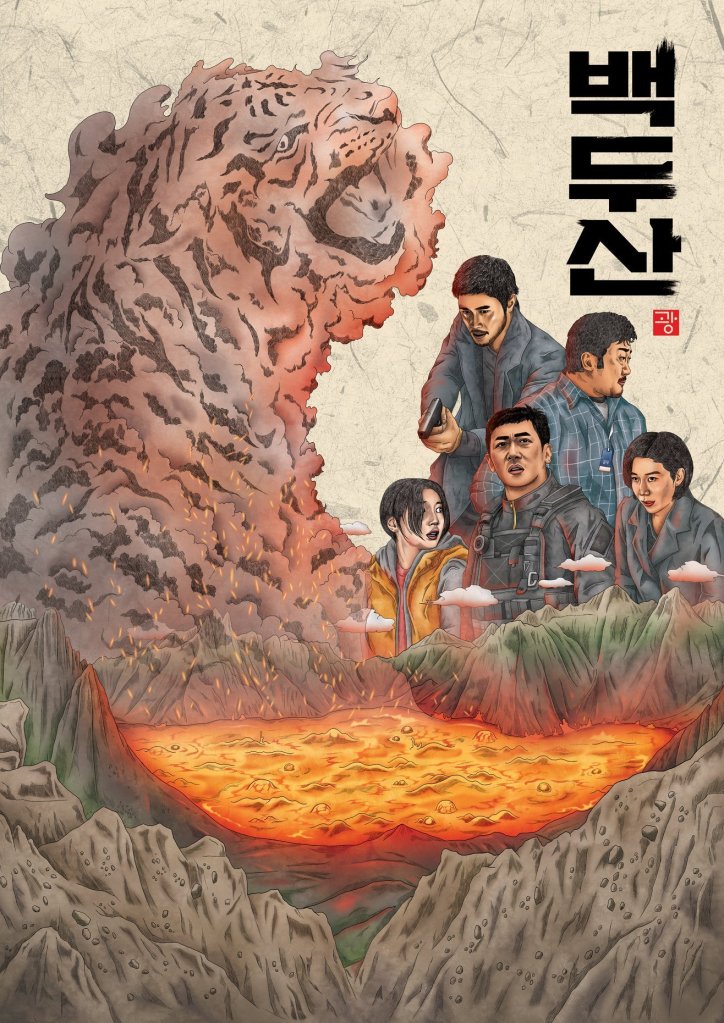
Ashfall (백두산, Lee Hae-jun & Kim Byung-seo, 2019)

The Korean Peninsula once again faces existential threat though this time of a natural genesis, and ironically the only way to save it might be nukes from the North. Ashfall (백두산, Baekdusan) is the latest and the largest of Korea’s big budget disaster movies featuring a veritable host of A-list talent and action sequences on an epic scale, but also doubles down on the less palatable sides of the genre in an overt and sometimes uncomfortable nationalism which nevertheless has its positive sides in its temporary elision of the North/South divide as the heroes pursue their cross-border mission to save the people of Korea not only from volcanic threat but from becoming mere pawns in geopolitical brinksmanship. 

The most obvious problem, however, is that long dormant volcano and pregnant national symbol Mt. Baekdu has erupted, provoking massive earthquakes which quickly reduce most of the high tech capital to mere rubble. This is particularly bad news for heroic army bomb disposal expert Captain Cho (Ha Jung-woo) because, in true disaster movie fashion, today was supposed to be his last day. Cho’s wife (Bae Suzy) is heavily pregnant, and it seems he’s opted for a safer occupation in the light of his impending fatherhood. According to the predictions of previously derided Korean-American scientist “Robert” Kang Bong-rae (Ma Dong-seok, cast brilliantly against type), Mt. Baekdu will continue erupting with the third and most powerful wave taking out most of the peninsula, but he has a plan to stop it. He wants to use nuclear weapons to blow a hole in the side of the chamber, relieving the pressure. To do that, they need to hijack some of the uranium from very recently decommissioned North Korean missiles, which means sending a small military expedition over the border in secret to track down a possible double agent who knows where all the nuclear material is before loading up their own detonators and driving them into a mine under the volcano. 

All of this takes place against the backdrop of North Korea’s long awaited denuclearisation which is in the process of being witnessed by American forces who are very much not in favour of Kang’s plan seeing as it effectively means detonating a nuclear bomb right on the Chinese border. Once again, the film suggests, Korea finds itself the battleground in a proxy war, its sovereignty denied as it attempts to use whatever means it has to save itself but is actively prevented by various kinds of outside forces. Kang, who idolises America to the point that he rejects his Korean name and tries to leave the country as soon as possible on his US passport, eventually makes the ironic statement that the ensuing chaos is all down to this “incompetant government that can’t decide its own fate” as the American army shutdown a Korean operation to put his plan in action while Cho and his guys also find themselves actively targeted by US military acting covertly in North Korea. 

Somewhat unexpectedly, Cho is not quite the heroic action hero one would expect. He’s anxious and inexperienced, out of his depth as a man unused to being in the field, trained to defuse bombs not launch them and unfamiliar with standard weaponry. Because his guys are the good guys, the North Korean mission is supposed to be “non-lethal”, so they’re wading into this with tasers and rubber bullets while his opposing numbers have no such scruples. Ri (Lee Byung-hun), the North Korean double agent, runs rings around them, playing every advantage while his motives remain unclear until finally sitting comfortably within the realms of action movie melodrama as he and Cho develop an awkward mismatched buddy dynamic, bonding over paternal worries and North/South pop-cultural exchange. 

The familiar message is that all things are possible when working together for a common cause, making a possibly subversive argument that North/South solidarity is the most powerful weapon against entrenched American imperialism and a resurgent China while advocating strongly for a greater national sovereignty less beholden to foreign powers for military support. It comes as little surprise that Kang eventually decides to go back to his original name and stay in Korea for good rather than return to a discredited US, having rediscovered his Koreaness thanks to his role in saving the nation. Subtle this is not, but then who ever asked for subtlety from a big budget disaster movie?


Ashfall is available to stream in Europe until July 4 as part of this year’s Udine Far East Film Festival.

International trailer (English subtitles)

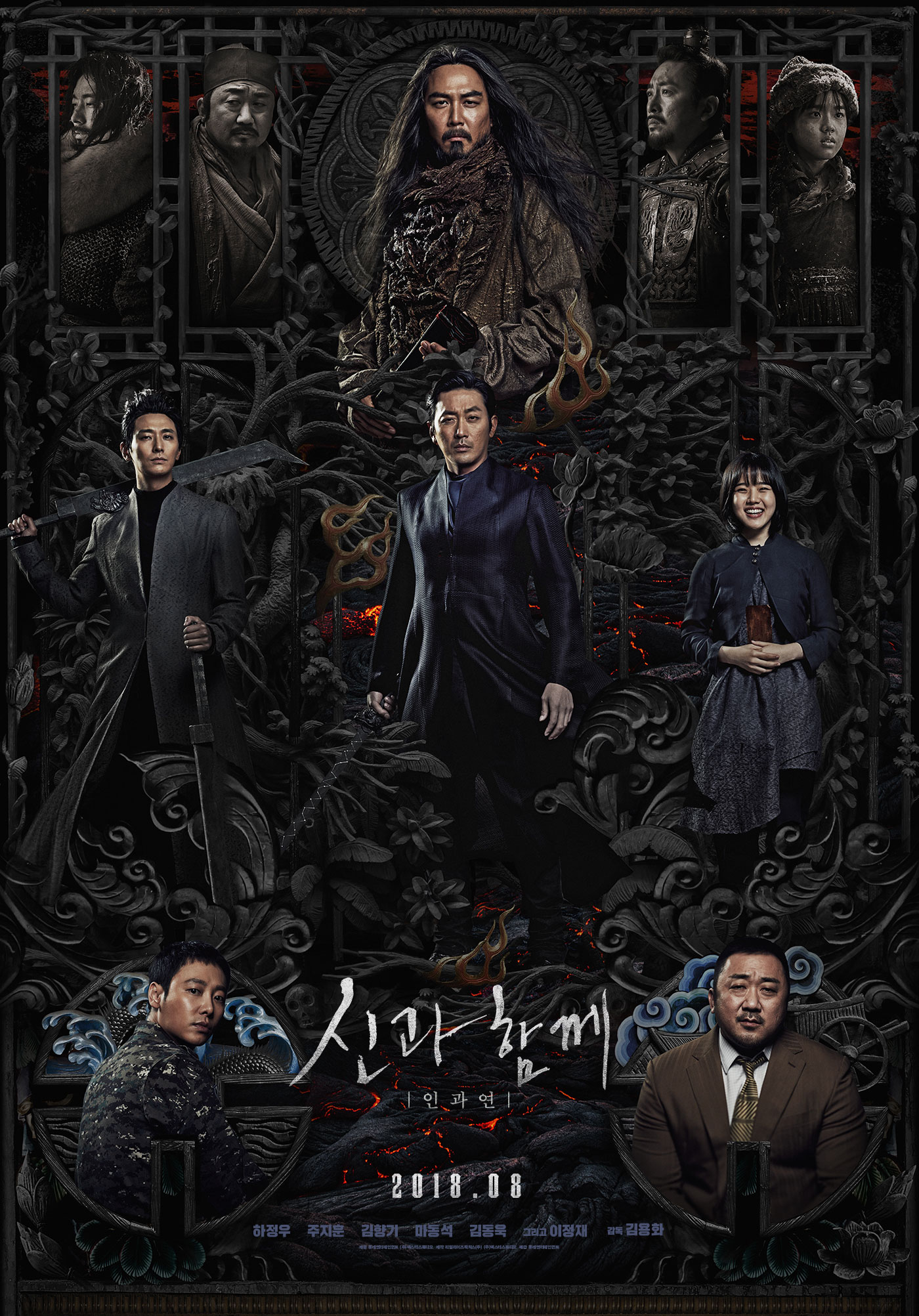
Along With the Gods: The Last 49 Days (신과함께-인과 연,Kim Yong-hwa, 2018)

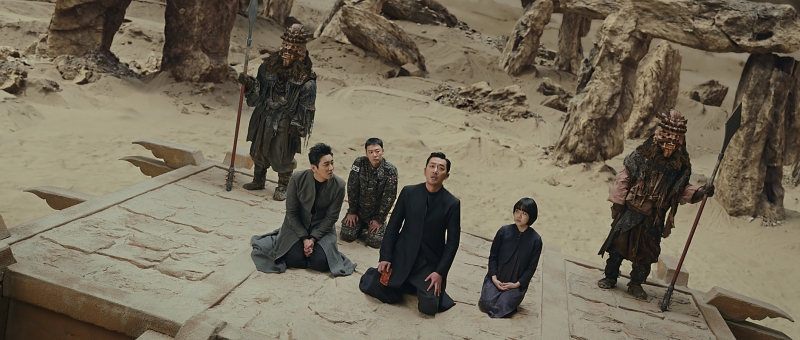
Along with the gods 2 posterKarma is a bitch, and Korean hell is apparently full of it. You don’t have to be guilty to work here, but it certainly seems to help. Picking up straight after the conclusion of the first film, Kim Yong-hwa’s Along with the Gods sequel, The Last 49 Days (신과함께-인과 연, Singwa Hamgge: Ingwa Yeon) sees stern grim reaper/celestial defence lawyer Gang-lim (Ha Jung-woo) make good on his promise to clear the name of a once vengeful spirit now cheerfully deceased, but willingly or otherwise it’s himself he’s putting on trial as the facts of his client’s case veer eerily close to his own. King Yeomra (Lee Jung-jae) is up to his old tricks once again.

Brother of the first film’s “paragon” Ja-hong, Kim Su-hong (Kim Dong-wook) is headed nowhere good – after being accidentally shot by one friend and then buried alive by another to cover it up, Su-hong became a vengeful spirit creating havoc in the mortal and underworlds. Gang-lim, however, is convinced that Su-hong’s death was “wrongful”, that he died as a deliberate act of murder rather than simply by a tragic accident, and commits himself to clearing Su-hong’s name so that he can be reincarnated immediately. He manages to win King Yeomra over, but there is one condition – an old man, Hur Choon-sam (Nam Il-Woo), is an overstayer in the mortal world and should have been “ascended” long ago but his household god, Sung-ju (Ma Dong-Seok), keeps despatching the Guardians to keep the old man safe. If Gang-lim and his assistants Hewonmak (Ju Ji-Hoon) and Deok-choon (Kim Hyang-Gi) can clear Su-hong’s name and ascend Choon-sam within 49 Days King Yeomra will at last set them free and allow them to be reincarnated.

Having dealt so thoroughly with the mechanics of hell in The Two Worlds, Kim expands and deepens his canvas to delve into the lives of our various Guardians. As it turns out Sung-ju was once a Guardian himself and so he knows a thing or two about our two underlings – Hewonmak and Deok-choon, whose memories were wiped when they became employees of King Yeomra. As Sung-ju spins a yarn, it becomes clear that the fates of the three Guardians were closely linked in life and death, bound by a series of traumatic events over a thousand years ago during the Goryeo dynasty.

As in the Two Worlds it all comes down to family. Gang-lim’s memories are fractured and confused, he’s convinced himself he’s a righteous man and wilfully misremembered his death (or at least misrepresented it to his cohorts). Stiff and lacking in compassion, Gang-lim was at odds with his gentle hearted father who, he thought, had found a better son in a boy orphaned by the cruelty of his own troops. These broken familial connections become a karmic circle of resentment and betrayal, enduring across millennia in the knowledge that even to ask for forgiveness may itself be another cruel and selfish act of violence. The circle cannot be closed without cosmic justice, but justice requires process and process requires a victim.

Gang-lim plays a bait and switch, he walks the strangely cheerful Su-hong through the various trials but it’s himself he’s testing, working towards a resolution of his own centuries old burdens of guilt and regret. There are, however, unintended victims in everything and the fate of orphans becomes a persistent theme from the orphaned foster brother Gang-lim feared so much, to those who lost their families in the wars of Goryeo, and a little boy who will be left all alone if Hewonmak and Deok-choon decide to ascend Choon-sam. Choon-sam’s adorable grandson is only young but he’s already been badly let down – his mother sadly passed away, but his father ran up gambling debts and then ran off to the Philippines never to be seen again. He didn’t ask for any of this, but there’s no cosmic justice waiting for him, only “uncle” Sang-ju who has taken the bold step of assuming human form to help the boy and his granddad out while trying to come up with a more permanent solution.

Nevertheless, compassion and forgiveness eventually triumph over the rigid business of the law, finally closing the circle through force of will. Kim doubles down on The Two Worlds’ carefully crafted aesthetic but perhaps indulges himself with a series of random digressions involving psychic dinosaur attacks and lengthy laments about stock market fluctuations and failing investments. Along With the Gods: The Last 49 Days may lack the narrative focus of its predecessor but is undoubtedly lighter in tone and filled with the sense of fun the first film lacked, which is just as well because it seems as if hell is not done with our three Guardians just yet.


Along with the Gods: The Last 49 Days is currently on limited release in UK cinemas.

Original trailer (English subtitles)

1987: When the Day Comes (1987, Jang Joon-hwan, 2017)

fullsizephoto931939The political history of Korea is long and complex and oftentimes sad. The events depicted in 1987: When the Day Comes (1987), pivotal as they were, occurred just 30 years ago. Yet the recent past has also been one marked by protest, public anger, and political scandal though this time around with far less fear or danger. The protests of 1987 were a different story. The rule of Chun Doo-hwan, a military dictator who had seized power following the assassination of the previous dictator, Park Chung-hee, was one of extreme oppression which had already seen a widespread massacre of peaceful protestors by the state in Gwangju in 1980. Chun’s term, under the constitution, was set at seven years after which many hoped for a path to modern democracy but those hopes were dashed when he announced an intention to appoint his successor rather than call a free and fair election.

In depicting the climactic events of that summer, Jang Joon-hwan begins with chaos as a doctor is summoned to a mysterious room where a young man lies unconscious in a pool of water. The police have gone too far, and boy has died during interrogation. Aware of the potential danger of the public finding out that the state has in effect murdered a suspect in an act of torture, the head of the ACIB, Park (Kim Yun-seok), orders the body to be quickly cremated. This, however, needs a certificate signed by a prosecutor and Prosecutor Choi (Ha Jung-woo) is fed up with the ACIB and unwilling to cooperate especially as he smells a rat with the cause of death for a healthy 22-year-old listed as a “heart attack”. Not wanting to be on the wrong side of it if it does get out, Choi refuses the cremation and orders an autopsy which in itself triggers a series of other events eventually bringing the government to its knees.

The state remains cruel and duplicitous. The death of Park Jong-chul (Yeo Jin-goo) would become a catalyst and a rallying call, not just for the injustice of it but for the injustice of covering it up. Park’s family are denied their basic rights, his mother and sister literally dragged away from the morgue screaming while his traumatised father looks on in silent agony. They say that Park was a communist, that he died of fear because he weak while claiming all along to have done no wrong. Only when the “truth” begins to emerge does the ACIB decide to hang a few of its guys out to dry, urging them to “patriotically” take one for the team and head to prison for a while with a hefty compensation package to help sweeten the deal.

The death in custody becomes just one event in a situation spiralling out of control. Paranoid in the extreme, the Chun regime is also working on bringing down a “North Korean Spy Network” controlled by a democracy activist on the run who, unbeknownst to them, is also working with the Catholic Church who will eventually prove pivotal in delivering the truth to the people. Meanwhile, the press has also decided to jump ship, ignoring the government’s carefully crafted guidelines in favour of running actual news. Chun’s iron grip is slipping.

Jang’s biggest takeaway is that corrupt regimes crumble when enough people find the strength to go on saying no. It begins with Choi refusing to stamp a certificate then travels to the reporter who won’t back down, passes on to the secret revolutionaries bravely carrying messages at great personal costs, the not so secret clergy who perhaps have more protection to speak their minds (up to a point) than most, and of course the students in the streets who risked their lives to build a better future. One of the few completely fictional characters, the niece (Kim Tae-ri) of a prison guard (Yu Hae-jin) charged with conveying messages to an activist in hiding, proves the most illuminating in her inward struggle towards the democratisation movement. Afraid of the consequences and preferring to remain politically apathetic, she is eventually radicalised through witnessing the brutality of the regime first hand and suffering personal loss because of it.

Playing out as a taut thriller, 1987: When the Day Comes has a lived in authenticity from the motif of being constantly deprived of one shoe by a cruel and absurd regime to the deadly serious ridiculousness of men like Park who hate “the enemy” enough to destroy the thing they claim to love in pursuit of it. Timely and filled with melancholy nostalgia, Jang’s depiction of the pivotal events of 30 years ago is also a rallying cry in itself and an important reminder that the fight for justice is never truly won.


Screened at the 20th Udine Far East Film Festival.

International trailer (English subtitles)

Along With the Gods: The Two Worlds (신과함께-죄와 벌, Kim Yong-hwa, 2017)

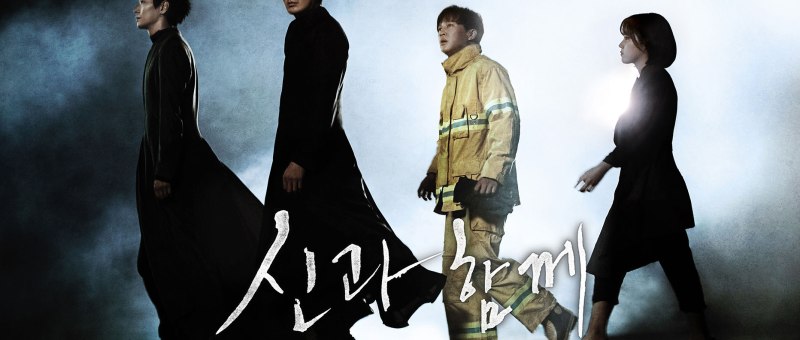
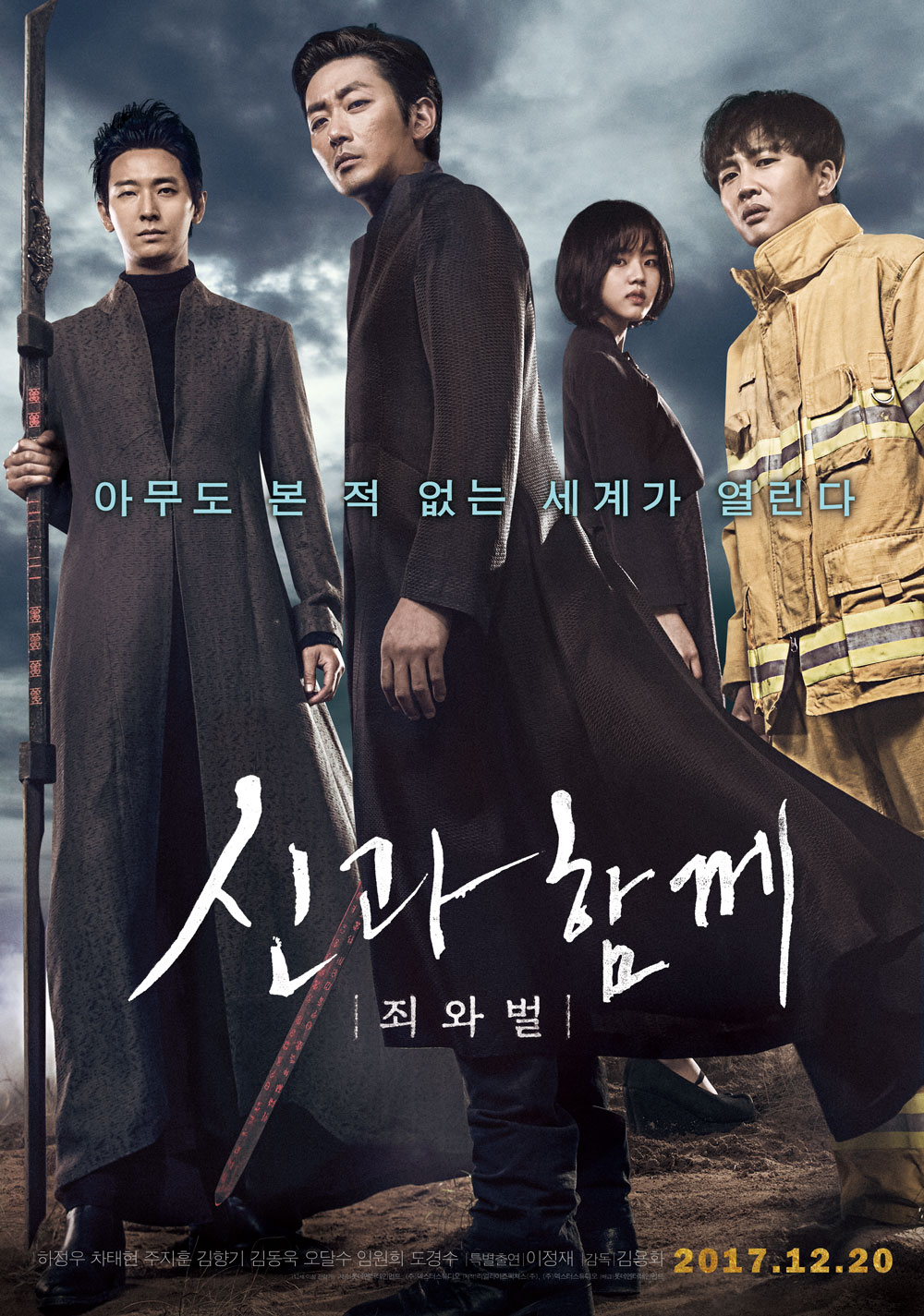
Along With the Gods- The Two Worlds posterThere’s nothing like death to give life perspective. If life is a series of tests, death is the finals but if you pass you get to come back and do it all again, otherwise you’ll have to spend some time in the afterlife thinking hard about what you’ve done and presumably studying for some kind of resits. At least, that’s how it seems to work in the complicated Buddhist hell of Kim Yong-hwa’s fantasy epic Along With the Gods: The Two Worlds (신과함께-죄와 벌, Sin gwa Hamkke – Joe wa Beol). The first in a two part series, The Two Worlds takes a saintly man and tries to pull him down only to build him back up again as a potent symbol of filial piety and wounded selflessness.

Firefighter Kim Ja-hong (Cha Tae-hyun) is killed leaping heroically from a burning building with a little girl wrapped in his arms. He doesn’t realise he’s dead until he’s greeted by two neatly suited, official looking types who explain to him that they are his “Guardians” and will be looking after him on his journey through the afterlife. It turns out that Ja-hong’s heroic death has earned him a “Paragon” badge – a rare occurrence, and he has a good chance of reincarnation before the 49th day if he can successfully pass each of the seven trials which mark passage through Buddhist Hell.

As the Guardians point out, it would be extremely difficult for a “normal” person to pass these seven trials and achieve reincarnation but as a Paragon Ja-hong should have an easier ride. Ja-hong is, however, an ordinary person with an ordinary person’s failings even if his faults are comparatively small. Ja-hong is literally on trial seven times – represented by his team of defence lawyers, the Guardians, he is charged with various sins each “judged” by a god presiding over a custom courtroom. Murder Hell is fiery chaos, indolence is assessed by a stern older lady (Kim Hae-sook), and deceit by (who else) a small child (Kim Soo-ahn) licking a large lollipop.

Ja-hong is indeed a “good person” but he has also been to dark places, wilfully deciding to turn and walk away from them in order to repurpose his rage and resentment into a determination to care for his seriously ill mother (Ye Soo-jung) and younger brother (Kim Dong-wook). Working tirelessly, Ja-hong has been selfless in the extreme, saving lives and saving money for his family whilst sacrificing his own life and prospect of happiness in order to provide for others. That’s not to say, however, that there isn’t a degree of “sin” in the selfishness of Ja-hong’s selflessness or that he hasn’t also been cowardly in making a symbolic recompense for a guilty secret rather than a personal apology.

Kim Yong-hwa weaves in a series of subplots including a lengthy shift into the life of Ja-hong’s brother Su-hong, a possibly gay soldier with an intense attachment to a comrade which eventually has tragic results. Su-hong’s mild resentment towards his brother becomes a key element in his trial, eventually developing into a more literal kind of spectre haunting the proceedings while perhaps creating even more turmoil and confusion in the living world thanks to a moustache twirling villain whose desire to “help” is probably more about saving face – the kind of “betrayal” which is not “beautiful” enough to get a pass from the Goddess.

In the end the court seems to bend towards Ja-hong’s moral philosophy, excusing his human failings through moral justification even when that justification remains flimsy as in the case of his “fake” letters intended to make people feel better through the comfort of lies. The essence of the judgement, however, looks for forgiveness – if a sin is forgiven in the mortal world, it is inadmissible in a celestial court. The message seems clear, face your problems head on and sort out your emotional difficulties properly while there’s time else you’ll end up with “unfinished business” and get bogged down in Buddhist Hell being attacked by fish with teeth and having old ladies asking you why you spent so much time watching movies about death rather than living life to the fullest.

Ambitious in its use of CGI, Along With the Gods: The Two Worlds acquits itself well enough in its carefully drawn (if lifeless) backgrounds and frequent flights of fancy which allow Ha Jung-woo’s enigmatic Gang-lim ample opportunity to whip out his fiery sword of justice. Narratively, however, it’s comparatively clumsy and content to revel in the melodrama of its tearjerking premise. A post-credits teaser linking part one and part two through the recurring figure of an old man who can see the Guardians presents a familiar face in an extremely unfamiliar light and hints at a great deal of fun to be had next time around – appropriate enough for a film about reincarnation, but then again it’s as well to have some fun in this life too, something The Two Worlds could have used a little more of.


Currently on limited UK cinema release courtesy of China Lion.

Original trailer (English subtitles)