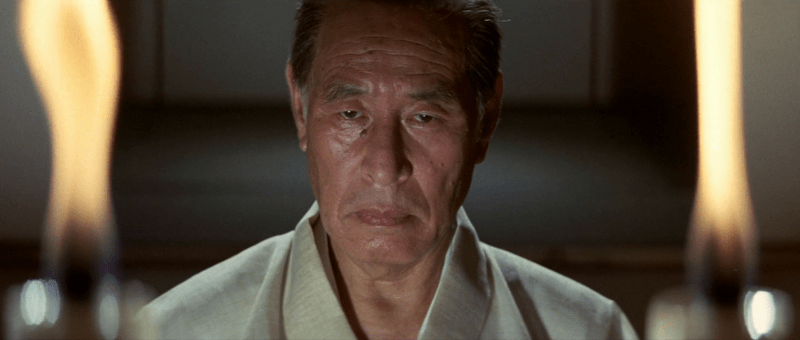
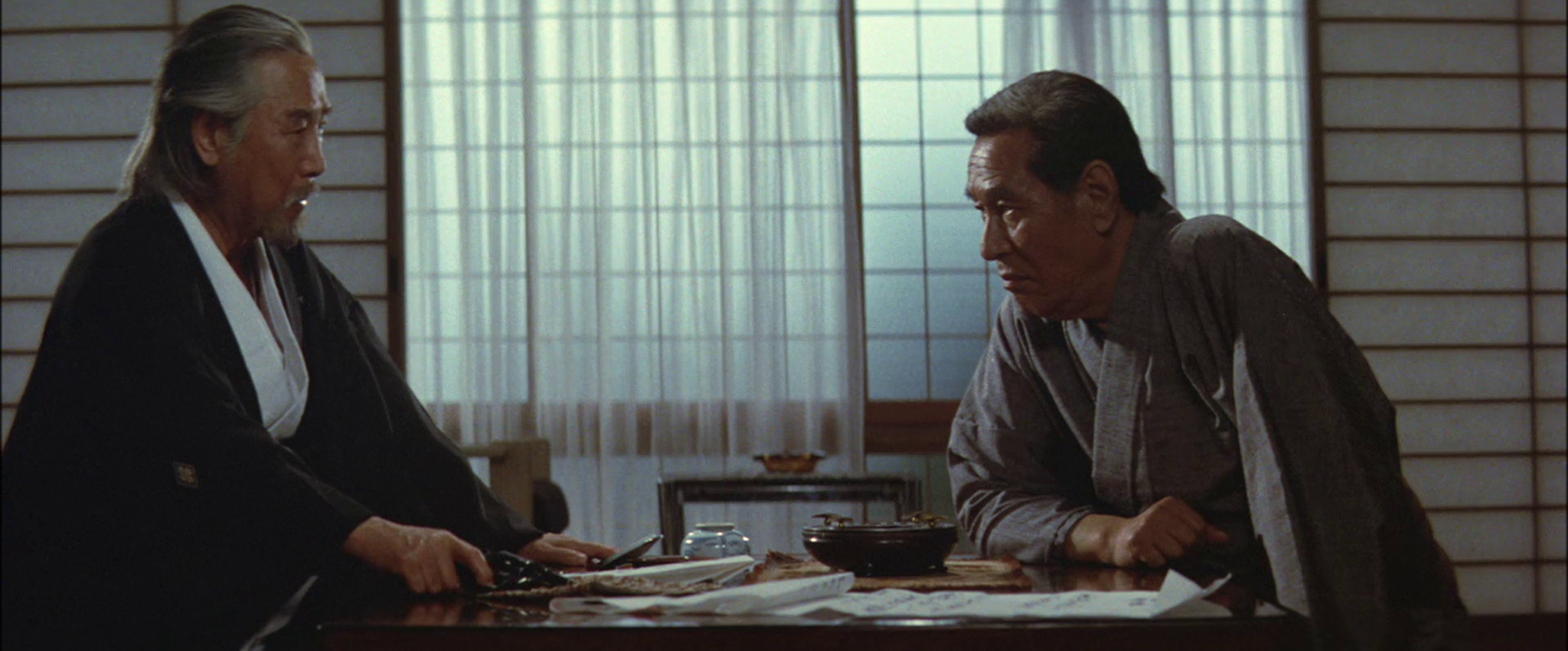
Big Time Gambling Boss (博奕打ち 総長賭博, Kosaku Yamashita, 1968)

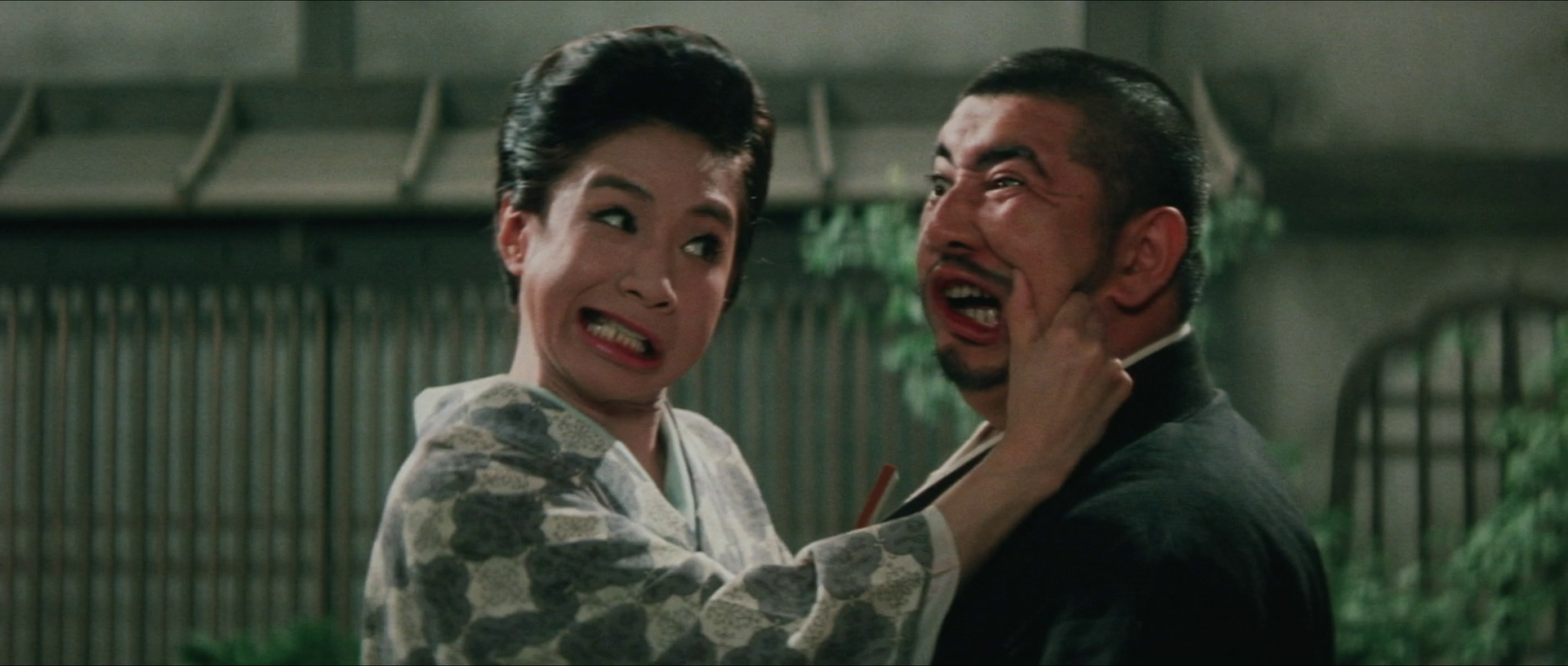
A Shakespearean tragedy of blood and honour, Kosaku Yamashita’s Big Time Gambling Boss (博奕打ち 総長賭博, Bakuchiuci: Socho Tobaku) discovers only fatalism and futility in the nobility of the yakuza code. The tragedy is that at any moment anyone could make a free choice to walk away, to abandon these arbitrary notions that convince them they must kill their friends and let their enemies go free, but they don’t because spiritually they cannot. Abandoning the yakuza code would in its own way a kind of death and mentally unsurvivable. 

There is however a greater tragedy in play. The film opens in the spring of 1934 with a villain remarking that it’s absurd to restrict oneself to one’s home terrified while a sword and the Japanese flag appear behind him. The catalyst for all this drama is Japan’s imperialist expansion. Yakuza fixer Senba (Nobuo Kaneko) and the shady Kawashima have hatched a plan to get all the yakuza clans to unite in a “patriotic” mission to traffic drugs to the frontlines looting as they go. Noble boss of the Tenryu Awakawa refuses, reminding them he’s just a simple gambling man and has no desire to get involved with politics before collapsing with a stroke. With Awakara alive but bedridden and no longer able to communicate effectively, the Tenryu decide to nominate a successor. The ideal candidate, Nakai (Koji Tsuruta), declines the offer on the grounds that he is a transplant from another gang in Osaka and thinks it would be inappropriate for an outsider to lead the clan. He proposes that his sworn brother, Matsuda (Tomisaburo Wakayama), should be appointed, though he is currently surviving a prison sentence so a caretaker should serve in his stead until his release. Most think this sensible though the proposed caretaker, Ishido (Hiroshi Nawa), also declines given the rules of seniority despite the fact that he is Awakawa’s son-in-law and so dynastic succession would also seem permissible. 

It’s during all of this finagling that Senba begins manipulating events to his advantage, gently manoeuvring the other lieutenants towards accepting Ishido as the new boss while he has no idea he’s being used as a pawn in Senba’s nefarious nationalist plotting. When Matsuda is released early, the entire situation kicks into overdrive in his outrage that the codes of rank have not been respected and that a man who is his inferior now sits at the head of the clan in a place he think’s rightfully Nakai’s but in light of his honourable refusal no one’s but his own. Even Matsuda later recognises his hot-headed recklessness in directly challenging Ishido over his decision to accept, insisting that the proper thing to do in his position would have been to persuade Nakai to take the job. Meanwhile, his own righthand man who’d been slumming it as a mere labourer in his absence, is dragged into intrigue in foolishly defending his honour by recklessly attacking Ishido’s men incorrectly believing they had provoked another gang’s attack on Matsuda little knowing it was all part of Senba’s plot. 

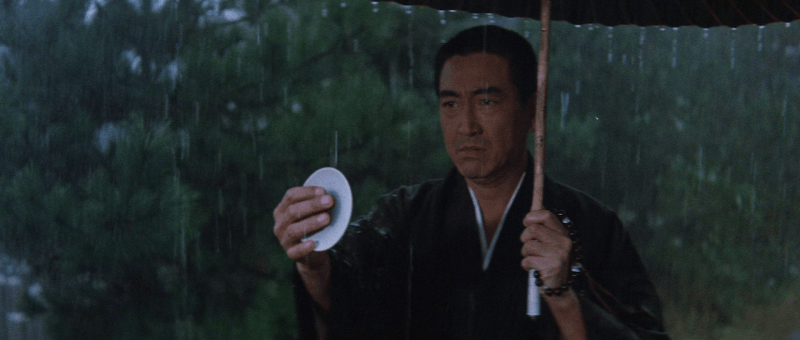
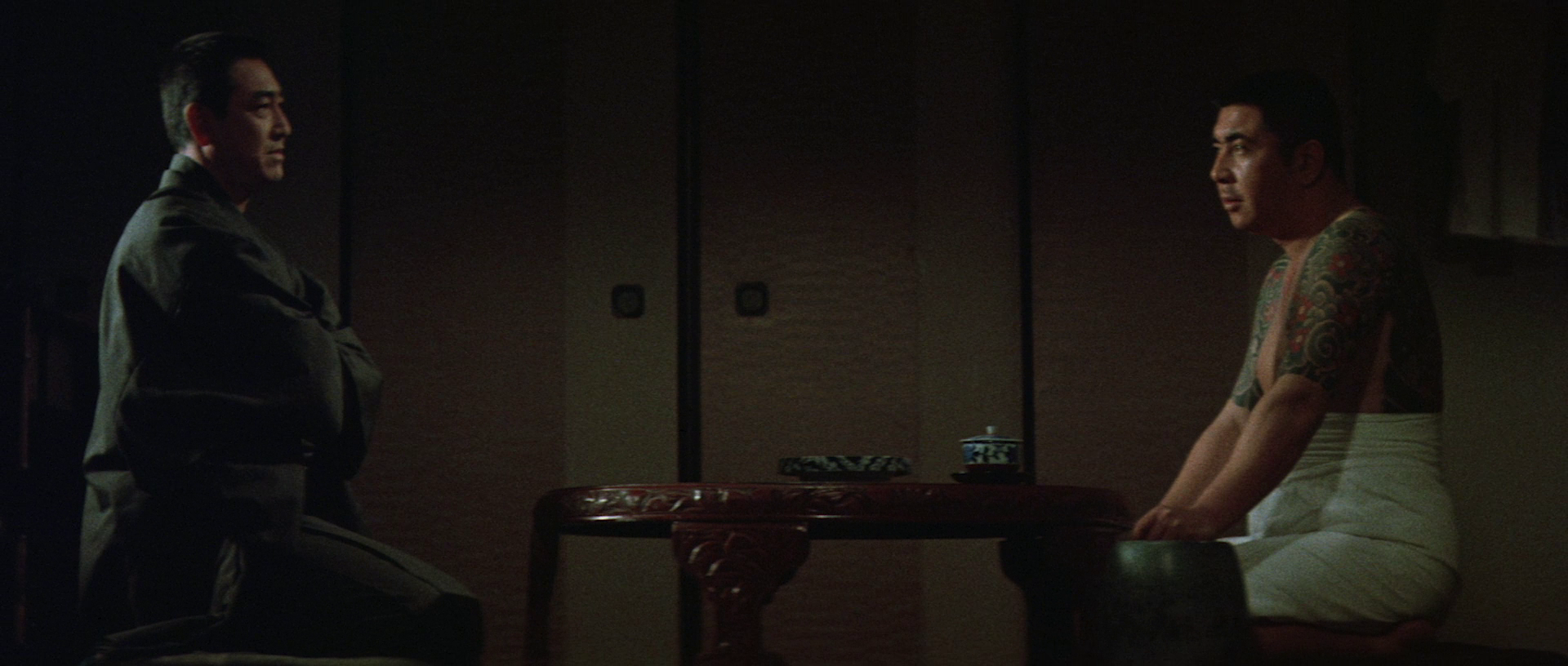
Nationalist trappings aside, Senba’s villainy is obvious from the moment he tells Nakai he thinks Matsuda was foolish for going to prison on the clan’s behalf and that he should have just found a scapegoat and put the blame on them, signalling himself a member of the new amoral yakuza who does not believe in giri and has no ninjo. Nakai rather is the opposite, as his old boss confirms in praising him for his correct decision to turn down the succession as it would not be right for him to accept as one who did not originate in their gang. Matsuda meanwhile pays too much attention to the letter of the code and not its spirit, obsessed with Ishido’s transgression and unable to let the matter drop to live a quiet life even as Nakai tries to convince him that the decision has been ratified by the lieutenants and the boss and so he must obey it. In a poignant moment, Nakai brings out the cup they used to seal their friendship and tells him that he will choose the clan, breaking the cup if Matsuda does not agree to accept a minimal degree of humiliation in returning with the intention of lying low and subtly reminding him that if he does not Matsuda will be placing a heavy burden on him that he may be forced to inflict lethal violence on his best friend and in fact brother-in-law. Realising the gravity of the situation, Matsuda immediately backs down, but events are now in motion that neither of them are capable of stopping. 

Of course, they could walk away but they don’t. Nakai offers the opportunity to Matsuda’s remorseful foot soldier Oto, telling him to leave the clan and take the woman he loves far away to live a peaceful life but of course he can’t because of his debt of loyalty to Matsuda. They are all trapped by the code which they follow and the villains ignore, laughing at them all the way. Then again, that’s what men like Nakai are for, born to set things right even if it comes at great personal cost. Even he finally snarls that he’s merely a murderer, rejecting any sense of honour in his actions while throwing a sword at the symbol of the system which has defined his life and submitting himself to the automatic operation of law of the state as a kind of martyr for system in which he may no longer believe. 


Trailer (English subtitles)

Jeans Blues: No Future (ジーンズブルース 明日なき無頼派, Sadao Nakajima, 1974)

Nihilistic lovers on the run make a break for the sea only to find their pathway blocked in Sadao Nakajima’s anarchic love tragedy, Jeans Blues: No Future (ジーンズブルース 明日なき無頼派, Jeans Blues: Asu naki Buraiha). As the title suggests, the heroes find themselves devoid of hope, pressing the accelerator as far it’ll go with no clear destination in sight and nothing really left to lose while discovering a twisted kind of salvation in their unlikely connection.

Sensing danger in the air, grave-digging drifter Jiro (Tsunehiko Watase) decides to run off with all the money after his gangster friends off a moneylender on the orders of a businessman. Meanwhile, across town, bar lady Hijiriko (Meiko Kaji) decides to walk out on her unsatisfying life taking some money from the till and her boyfriend’s car for good measure. The pair quite literally collide, but realise that they are much the same in their growing sense of emptiness and impossibility. Nothing really really interests Hijiriko anymore, and watching the car burn after Jiro tossed a cigarette is the only thing that’s made her feel alive in eons. Running through his many and various jobs, Jiro reflects that work is “no fun” either and that the reason he wanted the money was for his sister who he says has run up huge debts paying for medical treatment for a close friend and is now facing the threat of being forced into sex work. 

His sense of impotence is palpable in his desperation and the knowledge that there is no good way to come by large amounts of money especially for a young man from the country with limited prospects. At one point he is beaten by a man with a golf club, a symbol of the class privilege and middle class success that will always elude him. The money, much more than he needs for his sister, gives him a new sense of confidence and possibility even if he remains somewhat frugal, picking up an old banger from a second hand car salesman that immediately blows a tire and apparently belonged to “Koji the murderer” which explains the huge dent in the bonnet. Yet he does at least pay his way, even leaving a collection of notes next to the body of a man he ran over intended to pay for medical treatment which casts him as something of a naive innocent cast adrift in a corrupt society and driven into criminality by desperation.

Trapped inside a shipping container and fearing he may be about to die, Jiro comes to see his fate as karmic retribution for having taken the money that was earned by killing others. Inside the container, the pair are in a sense already dead but also undergo a kind of rebirth if only one fuelled by desperation and the connection that has arisen between them. Hijiriko appears to be suffering from some kind of trauma, experiencing a flashback to the orgy going on at the bar which she had been invited to join but declined much to her customer’s disappointment. He remarks that she always did before, a comment which seems to annoy her though perhaps not as much as the arrival of an older woman a male voice tells her on the phone is a actually quite wealthy and doesn’t need the money but does sex work as a kind of hobby. 

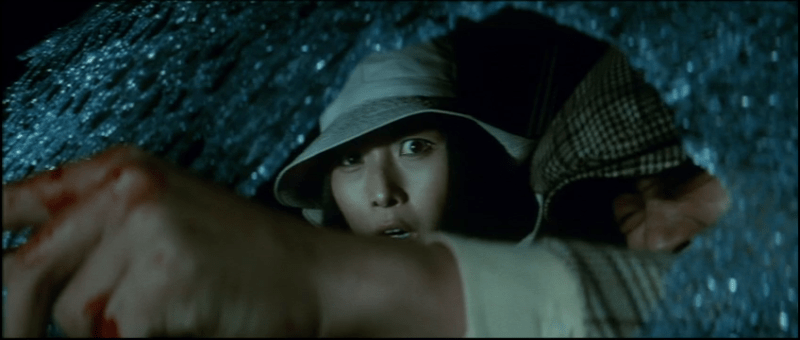
It’s Hijiriko who begins to fight back against the world, dressed in the stylish black leather suit Jiro buys her while he struts around in a cap and three-piece tartan suit. Jiro does not actually kill anyone, but Hijiriko does without a second thought perhaps because she herself is already dead. Using her sexuality as a weapon, she asks a hunter if she can hold his gun and trying his luck he lets her only to end up getting shot when he tries to fight back. The pair rob a petrol station for money but come up with only a few notes and coins while the attendant reveals they’ve already made their daily deposit at the bank signalling just how out of luck these lovers really are. They’re bound for the sea, but travel to the mountains and find there only danger and disappointment. Nakajima lends their flight from a dissatisfying existence a kind of desperation in its breakneck pace and frenetic camera work but equally injects a sense of cosmic irony in the many coincidences and reversals that frustrate the lovers’ escape and in the end leave them only one way out from the society which constrains them.


Original trailer (no subtitles)

Wicked Priest (極悪坊主, Kiyoshi Saeki, 1968)

A bunch of corrupt monks get a lesson in business ethics from one of their own in the aptly titled Wicked Priest (極悪坊主, Gokuaku Bozu). The first in a series of five films starring Tomisaburo Wakayama as a rogue Buddhist monk who enjoys fighting, drinking, and women but deep down has a powerful sense of moral righteousness, Wicked Priest is in its own way another take on classic ninkyo only this time it’s temples acting like yakuza clans rather than actual gangsters with “wicked priest” Shinkai the ironic symbol of nobility. 

Set in early Taisho, the film opens with a prologue set five years before the main action in which Shinkai breaks up a fight between another violent monk, Ryotatsu (an incredibly gaunt Bunta Sugawara), and some yakuza he challenged while they were hassling a young man for supposedly messing with the wrong girl. Predictably, it’s Shinkai who ends up in trouble. Relieved of his duties, he’s exiled to another temple and sentenced to spend a whole year in isolation thinking about what he’s done. Five years later we can see that the conclusion he’s mostly come to is that the religious world is full of hypocrisy anyway and he might as well live his life to the full while he can.

Indeed, the opening scene sees him ironically reciting a sutra with his head between a woman’s legs and preparing to drink holy water from her belly button. The problem here seems to be one of inter-temple politics that sees Shinkai hassled by officious monk Gyotoku (Hosei Komatsu) who objects to Shinkai’s behaviour and to the leniency which is shown to him by head priest Donen (Kenjiro Ishiyama). Of course Gyotoku is later discovered to be the source of corruption, wanting to depose Donen and take control of the temple in part to facilitate a sex ring he’s running that involves live peep shows literally on temple grounds. Shinkai, meanwhile, has a particular dislike for abusers of women and especially for pimps eventually rescuing some of the women indentured by a local brothel and unfairly kept on after redeeming their contracts with bogus loans, and starting a women’s refuge in the temple where they can find “honest” work and eventually lead “normal lives” as farmers or waitresses free of the abuse and oppression they faced in the “hell” of indentured sex work.

Wandering around the town, he saves one young woman newly arrived in Tokyo from falling victim to a scam and being forced into sex work by getting her a waitressing job at a local restaurant. To keep her safe, he jokes with the cafe owner that he’s already slept with her which in the bro codes of the time makes her his woman and owing to his famously violent nature no one else is going to bother her. For what it’s worth, women young and old come to admire him greatly for his gallantry though he never abuses his position. All of his sex partners are at least of his own age and fully consenting even if he is not exactly faithful in love. 

Meanwhile there’s some minor commentary more familiar from post-war gangster films that sees the temple as a refuge for orphaned men. The fatherless Shinkai finds a beneficent paternal authority in Donen and is, he says, “reformed”, if living to a code that seems to be mostly his own but informed by a kind of moral righteousness not found in others at the temple. Having discovered that a wayward young man Shinkai is attempting to save from his life of petty crime exploiting women for his own gain is a son he never knew existed, Donen would have left the temple to fulfil his familial role but is prevented from doing so by the intrusion of temple politics. Unless undertaking specific vows, Buddhist priests are not necessarily expected to practice celibacy and are permitted to marry yet Donen’s father objected to his choice of bride and she left not wanting to disrupt his temple career. Shinkai entrusts the boy to Donen, talking him into accepting a new paternal authority as a means of returning him to the “proper” path while himself swearing that he will leave the temple in order to ensure justice is served against the true “wicked priest” Gyotoku. Directed by ninkyo specialist Kiyoshi Saeki, the film ends in an outburst of bloody violence as Shinkai takes revenge on institutional corruption but once again leaves its hero a lonely wanderer in an unjust world.


Original trailer (no subtitles)

Dissolution Rites (解散式, Kinji Fukasaku, 1967)

“We’re all legitimate businessmen now” as a former yakuza explains to a recently released foot soldier stepping out into a very different Japan in Kinji Fukasaku’s Dissolution Rites (解散式, Kaisan Shiki, AKA Ceremony of Disbanding). The funereal opening scenes feature the first in a series of dissolution rites as a man dressed in black reads from a scroll and explains that all the local yakuza clans will be disbanding because despite “working day and night for the benefit of the world and humanity in the spirit of democracy” times have changed and they find themselves unnecessary.

There at the beginning of that change, Sawaki (Koji Tsuruta) served eight years in prison for the murder of a rival gang boss to ensure his gang got hold of a local landfill site where they later built an oil complex. While he was inside, his boss died and his clan disbanded leaving him with nowhere to go but thankfully looked out for by an old friend, Shimamura, who has since become a construction magnate. On his arrival at Shimamura’s office, however, he’s ambushed in a suspected case of mistaken identity while the man driving him is killed. 

Shimamura (Fumio Watanabe) tells him he’s gone straight, but it soon becomes clear that even as yakuza forsake the streets for more organised crime they still behave like thugs using the same old tactics to get what they want. Shimamura is in cahoots with a corrupt local politician, Kawashima (Asao Uchida), and is determined to get access to another stretch of bombed out wasteland owned by an egalitarian doctor, Omachi, who refuses to sell because he’s set up a community there of marginalised people, including Sawaki’s former girlfriend Mie (Misako Watanabe), who work on his chicken farm. Meanwhile, Shimamura is targeted by rival “legitimate businessman”, Sakurada (Hosei Komatsu), who pulls a few dirty tricks of his own in an effort to cut Shimamura out of the picture.

Once again Tsuruta plays a man who is out of step with his times, partly because he’s been in prison but also in his fierce commitment to a now outdated code of gangsterdom. “The chivalry that we were taught was just a way for bosses to use their soldiers” Shimumura insists, “you’ll look foolish if you don’t get rid of it”, disingenuously casting his transformation into a legitimate businessman as a way of freeing himself from yakuza oppression. Sawaki turns down his offer to join the business because it seems a bit dodgy while intensely disappointed to discover another former colleague, Kubo (Kyosuke Machida), running a trafficking ring masquerading as a management studio for cabaret singers and strippers by tricking women with the offer of good jobs then getting the hooked on drugs and shipping to them to Okinawa to do sex work near the US bases.  

On his return, Sawaki is also stalked by the man whose arm he severed in killing the rival boss who turn out to be, like him, an old school gangster which is why he insists on his revenge only to find an unexpected kindred spirit as the two men find themselves each adrift in a world in which no one really cares about humanity and honour. Sakai (Tetsuro Tanba) chooses to walk a different path, conducting his disbandment ceremony in protest of yakuza corruption. Like many Tsuruta heroes, Sawaki also has the possibility of walking away and living a conventional family life as a husband and father having been forgiven by Mei but inevitably is pulled in a darker direction by the necessities of his code. The oil complex he helped to create is only a symbol of the duplicities of the post-war society allowing men like Shimamura to get rich while literally choking the life out of those like Mei whom they now want to kick out of her home to add insult to injury. 

There’s no one more tragic than a yakuza Sawaki admits, knowing there is no longer any place for him in an amoral gangster society while unable to simply leave it and enjoy a quiet life with the woman he loves. An indictment both of corporatised yakuza and the equally duplicitous practices of “legitimate” businesses and corrupt authorities, the film ends in another righteous assault filmed handheld with Fukasaku’s characteristically canted angles amid the chaos and confusion of a rapidly changing society. 

The Tattooed Hitman (山口組外伝 九州進攻作戦, Kosaku Yamashita, 1974)

The close brotherhood between two men is disrupted by changing times in a more contemporary gangster drama from Kosaku Yamashita, Tattooed Hitman (山口組外伝 九州進攻作戦, Yamaguchi-gumi gaiden: Kyushu shinko-sakusen). As many are fond of saying, times have changed and the yakuza must try to change with them or else meet a melancholy end. But as the hero admits, change is something he has no intention of doing even as his old school gangsterism leaves him increasingly at odds with the corporatising ways of the contemporary yakuza. 

The change in the times is obvious from the film’s opening sequence set in 1957 in which an attempt is made on the life of petty boss Ishino (Tatsuo Umemiya) by a gunman who shouts “die, for the good of the world” before firing a pistol and running away. Ishino has been targeted in a dispute over construction rights connected with the regeneration of hot springs resort, Beppu. The hit seems to have been ordered by rival gang, Sakaguchi (Eizo Kitamura), the leader of which is also a prominent local politician who is content to abuse his power for his own financial gain. So confident is he in his safety, that Sakaguchi even gets the police involved rather than deal with it himself. 

Ginji (Bunta Sugawara) has been Ishino’s sworn brother since their teenage delinquent days and determines to get revenge by raiding the Sakaguchi offices and killing one of their high ranking officers. Seeing as he’s already wanted by the police for a previous murder, Ishino sends Ginji to Osaka to lay low while working for an associate, Daito, mainly as a debt collector. It’s this act of separation which introduces a rift between the two men. While Ginji waits patiently to be recalled, Ishino climbs the ranks of corporatised gangsterism by learning to play by the new rules. 

To fill the void, Ginji takes on a new “brother” or perhaps surrogate son in the wayward Ken (Tsunehiko Watase) whom he first meets cheating at pachinko at a parlour where his pregnant wife Fusako (Mayumi Nagisa) is working. It’s Ken who first drags him into a brewing turf war as Korean gang Soryu threaten to disrupt the local equilibrium not least by selling drugs of which Ginji does not approve. Ginji “saves” Ken from joining Soryu by essentially making him his one of his guys though he doesn’t really have much of a position in Daito’s gang, offering him a sense of grown-up responsibility by handing him a pistol with the only the instruction to make sure he shoots with two hands. Unfortunately, Ken will follow his advice but otherwise ends up almost causing an incident with another gang by shooting a man who disrespected him in the street. Ginji marches straight down there to sort things out, but on arrival discovers an arrangement has already been made with his boss which further strains his sense of pride and confidence in his position as a yakuza.

Ginji feels something similar on being invited to a party to celebrate Ishino’s promotion only to be seated with the lowly footsoldiers and ignored by Ishino all night. Ishino rejects him still further in agreeing to plan to send him back to Kyushu out of the way hoping that his old school hotheadedness can finally be tempered. Others meanwhile voice concern that Ginji may have forged a relationship with rival Kobe gangs during the 18 months he abruptly disappeared from Osaka and has only come back to cause trouble. Ginji perhaps knows that he has no more future in the contemporary society, others remarking that seems like someone who is in a sense already dead for having accepted that he will die and most likely in Hakata, the town he had wanted to conquer with Ishino who had crushed his dreams in his newfound pragmatism by calmly explaining that they would never have the power to take it. 

Koji Takada’s screenplay positions Ginji’s gradual decline as an allegory for the yakuza himself while citing the new legislation that this particular series of incidents made necessary creating the new offence of assembly with dangerous weapons as a decisive moment in weakening the yakuza as an institution. Ginji remains a man displaced by his times unable to move forward into a new society in the way that Ishino has but stuck in a permanently post-war mentality despite the constant reminders that “times have changed”. Yamashita adopts the trappings of the jisturoku drama with frequent references to real life events and narrative voiceover but otherwise maintains his classicist formalism while ending on a note of ambivalence that tells us a certain kind of justice may have been served but the cycle of violence may not yet be completed.


Original trailer (no subtitles)

Yakuza Graveyard (やくざの墓場 くちなしの花, Kinji Fukasaku, 1976)

“We don’t resort to violence. We observe the law.’ The hero of Kinji Fukasaku’s Yakuza Graveyard (やくざの墓場 くちなしの花, Yakuza no Hakaba: Kuchinashi no Hana) is berated by a superior officer for excessive use of force, but his criticism is in some senses ironic because it is the police force itself which becomes a symbol of the societal violence visited on those who can find no place to belong in the contemporary society. By this time the yakuza was already in decline and in the process of transforming itself into a corporatised entity while as a police chief explains increasing desperation has led to escalating gang tensions. 

Recently transferred maverick cop Kuroiwa (Tetsuya Watari) finds himself caught between two worlds in attempting to enforce the law through methods more familiar to yakuza. Soon after he’s had his gun taken away for exercising excessive force on a suspect he’d been independently tailing in the street on whom he’d found bullets designed to be used with a remodelled toy gun, Kuroiwa is pulled aside by another senior officer, Akama (Nobuo Kaneko) who takes him to a meeting with local yakuza boss Sugi (Takuya Fujioka). It seems obvious that Akama has cultivated a relationship with the Nishida gang which may not be strictly ethical for a law enforcement officer and hopes to bring Kuroiwa on board as a potential asset. They attempt to bribe him in return for information on the Yamashiro clan, the dominant organised crime association in the area, which has been hassling Nishida in an attempt to take over their territory. But Kuroiwa ironically tells them that they should “act like yakuza” and sort out their own problems rather than relying on the police before dramatically walking out much to to the consternation of everyone else present. 

Nevertheless, he eventually comes to sympathise with them as a symbol of the little guy increasingly crushed by corporate and authoritarian forces outside of their control. He finds out from a briefing that the police’s goal is the disbandment of the Nishida gang but when he asks why they aren’t going after the Yamashiro too he’s told to mind his own business and begins to realise that the police are in cahoots with organised crime. Whether they justify themselves that managing the Yamashiro to prevent a turf war is the best way to protect the public or are simply corrupt and in the pocket of big business, Kuroiwa can’t help but balk at the blatant hypocrisy of the law enforcement authorities. 

Later Kuroiwa reveals that he became a police officer after being bullied as a child in order to exert power over his life, or perhaps becoming an oppressor in order to avoid being oppressed. He was bullied because he had been born in Manchuria and even years later remains a displaced person at least on a psychological level. It’s this sense of displacement which allows him to bond with the Nishida gang’s accountant, Keiko (Meiko Kaji), whose father was Korean. Kuroiwa agrees to accompany Keiko to visit her husband (Kenji Imai) who is serving a lengthy prison term in order to tell him that the gang want to promote someone else to a position he viewed as his by right. The husband explodes in rage and uses a word some would regard as a slur to reference Keiko’s Korean heritage while she later attempts to walk into the sea feeling that there really is no place for her in the contemporary society. 

Just as she claims that she is neither Korean nor Japanese or much of anything at all, Kuroiwa is neither cop nor thug and similarly excluded from society at large. He ends up bonding with old school Nishida footsoldier Iwata (Tatsuo Umemiya), who is also ethnically Korean, for many of the same reasons and attempts to mount a doomed rebellion against their mutual oppression, but is hamstrung by his otherness which is only deepened when he’s taken prisoner by loan shark Teramitsu (Kei Sato) and given a mysterious truth drug developed by the nazis later becoming a user of heroin. Already marginalised, forced into crime by economic necessity and social prejudice, Iwata and Keiko like Kuroiwa himself struggle to escape their displacement while pushed still further out by systemic corruption and the amoral capitalism of an era of high prosperity. Shot with jitsuroku-esque realism and characteristically canted angles, Fukasaku injects a note of futility even within the hero’s tragic victory as he quite literally sticks two fingers up to the corrupted “brotherhood” that has already betrayed him.


Yakuza Graveyard is released on blu-ray on 16th May courtesy of Radiance Films. On disc extras include an in-depth appreciation of the film and the work of screenwriter Kazuo Kasahara from Blood of Wolves director Kazuya Shiraishi, and an informative video essay from Tom Mes on the collaborations of Meiko Kaji and Kinji Fukasaku. The limited edition also comes with a 32-page booklet featuring new writing by Miko Ko plus translations of a contemporary review and writing by Kasahara.

Original trailer (no subtitles)

Japan Organized Crime Boss (日本暴力団 組長, Kinji Fukasaku, 1969)

A yakuza just out of jail emerges into a very different Japan in Kinji Fukasaku’s proto-jitsuroku gangster picture, Japan Organized Crime Boss (日本暴力団 組長, Nihon Boryoku-dan: Kumicho). A contemporary Oda Nobunaga is trying to unify the nation under his yakuza banner while fostering a nationalist agenda and colluding with corrupt politicians to prop up the 1970 renewal of the Anpo security treaty, but as it turns out some people aren’t very interested in revolutions of any kind save the opportunity to live a quiet life they once feared would elude them. 

As the film opens, a narratorial voice explains that the nation has now escaped from post-war chaos, but Japan’s increasing prosperity has led to a natural decline of the yakuza which has seen some try to ride the rising tides to find new ways to prosper. Exploiting its control of local harbours, the Danno group has quickly expanded though Osaka and on to the rest of the nation thanks largely to its strategist, Tsubaki (Ryohei Uchida), and his policy of convincing local outfits to ally with them and fight as proxies allowing Danno to escape all responsibility for public street violence. 

Perhaps strangely, the Danno group and others are acutely worried about optics and keen to present themselves as legitimate businessmen while using a prominent politician as a go-between to settle disputes between gangs. The yakuza already know they’re generally unpopular and fear that attracting too much attention will only bring them problems from the authorities. The politician needs Danno to look clean so that they can back them in opposing the protests against the Anpo treaty, while the yakuza organisation is later depicted as a militarised wing of the far right hoping to correct “misguided” post-war democracy while eradicating communism and instilling a sense of patriotic pride as they go. Of course, all of that will also likely be good for business while quite clearly marking these new conspiracy-minded yakuza as “bad”, hypocritical harbingers of a dangerous authoritarianism. 

Tsukamoto (Koji Tsuruta), the recently released lieutenant of the Hamanaka gang, is conversely the representative of the “good” yakuza who still care about the code and are genuinely standing up for the little guy against the oppressive forces now represented by bad yakuza. Hamanaka had allied with Danno while Tsukamoto was inside and was thereafter targeted by the local Sakurada group who have joined the Tokyo Alliance of yakuza clans opposed to Danno who continue to fight them by proxy. After his boss is killed and tells him that joining Danno was a mistake, Tsukamoto’s first thought is to rebuild the clan which he does by remaining neutral, refusing to engage in Danno’s proxy wars while protecting his men from their violence as mediated by the completely unhinged, drug-addled Miyahara (Tomisaburo Wakayama) and the anarchic Hokuryu gang. 

Miyahara comes round to Tsukamoto precisely because of his pacifist philosophy after he kidnaps one of his men and Tsukamoto stands up to him while making a point of not fighting back. As crazed as he is, Miyahara is a redeemable gangster who later also turns on Danno regretting having agreed to do their dirty work for relatively little reward. After a gentle romance with the sister of a fallen comrade, Tsukamoto, who lost his first wife to suicide while inside, begins to dream of leaving the life behind but as he and others discover there is no real out from the yakuza and the code must always be repaid. In failing to protect his clan he fails to save himself and becomes a kind of martyr for the ninkyo society taking on politicised yakuza and their lingering militarism. 

Fukasaku takes a typical ninkyo plot of a noble gangster standing up for what he believes is right against the forces of corruption and begins to undercut it with techniques such as voiceover narration and onscreen text that he’d later use in the jitsuroku films of the 1970s which firmly reject the idea of yakuza nobility seeing them instead as destructive forces born of post-war chaos and increasingly absurd in a Japan of rising economic prosperity. Men like Tsukamoto are it seems at odds with their times, unable to survive in the new society in which there is no longer any honour among thieves only hypocrisy and self-interest. 


Blood of Revenge (明治侠客伝 三代目襲名, Tai Kato, 1965)

An earnest yakuza trying to walk a more legitimate path faces off against a thuggish businessman in Tai Kato’s late-Meiji ninkyo eiga, Blood of Revenge (明治侠客伝 三代目襲名, Meiji kyokyakuden – Sandaime Shumei). Though set in the confusing world of 1907, Kato’s tale is in some ways not so different from contemporary gangster dramas in its suggestion that even in the early days of the 20th century the yakuza were already somewhat out of date while the fancy capitalist who calls them so is not so far off from the corporatised gangsters of the high prosperity era. 

Kato opens with a tense scene at a festival in which local boss Kiyatatsu is knifed by an impassive assailant who later claims to have been acting alone and that he did it to make a name for himself by stabbing a big time yakuza boss. Kiyatasu’s hot-headed son Haruo (Masahiko Tsugawa) suspects that rival businessman Hoshino (Minoru Oki) is somehow behind the attack but is talked out of a self-destructive bid for revenge as his father reminds him that they are “not a mob” but “honest businessmen” and acts of violence would impact their business negatively. 

Kiyatatsu may once have been a big time yakuza boss but it’s clear he’s made an attempt to go straight by founding a legitimate business that began trading lumber and now sells construction supplies that are helping to expand the rapidly modernising late-Meiji economy. He is closely involved with a construction project to introduce a modern water distribution system for the good of the people of Osaka organised by another former yakuza, Nomura (Tetsuro Tamba). Hoshino, who was indeed behind the attack and is secretly backed by his own band of mercenary yakuza, had Kiyatatsu knifed in the hope of getting his hands on the contract, later stooping to other dirty tricks such as ruining their cement supply so that he can swoop in with a special deal on his own.  

Just like yakuza, businessmen appear to have a code and letting personal feelings interfere with business is just as bad as letting ninjo get in the way of your giri. Hoshino is a bad yakuza in a business suit, his Western clothing just another symbol of his villainy. Kiyotatsu’s guys including noble retainer Asajiro (Koji Tsuruta) all wear kimono with the young son Haruo later shifting to a suit after taking over the business in a bid to appear less like a yakuza and more like a serious young professional. Though Hoshino sneers at Asajiro that yakuza are already out of date and that he hates their tendency to solve every problem through violence he is little more than a thug himself keeping a small band of yakuza onside to do his dirty work.

Yet there is something in what he says that the yakuza belong to an earlier age and are unable to travel into the new post-Meiji society men like Normura are building. Insiting that Japan must embrace international trade, Nomura builds piers as a kind of outreach to a new world and does so for the good of the people rather than himself, living up to an old yazkua ideal in trying to ensure prosperity for all. Kiyotatsu is already distancing himself from the gangster way of life, explaining to a travelling gambler to whom he grants hospitality that he does not allow gambling in his home and believes that modern gangsters should find new ways to live, but is constantly tarred by the yakuza brush unable to fully escape the legacy of his tattoos. When Asajiro is appointed the new head of the clan it comes as quite a shock to the young Haruo who is outraged having believed it was his birthright to succeed his father. Ever noble, Asajiro suggests that he succeed as the head of the clan and Haruo as the heir to the legitimate business saving him from a sordid yakuza existence. 

Even this cannot save the clan from destruction in the light of Hoshino’s avaricious greed forcing Asajiro on a bloody path of revenge while forced to give up the woman he loves because of his code of duty. Asajiro’s kindness is signalled by his decision to buy a geisha for three days so she can visit her dying father in the countryside but Hatsue (Junko Fuji) remains otherwise entirely trapped. Her contract is bought out by boorish assassin Karasawa (Toru Abe) who treats her cruelty and buys her complicity in insisting that should she disobey he will turn on Asajiro. Asajiro’s eventual arrest makes it clear that he is not a man who can survive in the new times because his brand of nobility is clearly out of fashion even as he takes revenge on an increasingly corrupt society by standing up against the duplicitous Hoshino ironically taking a leaf out of Haruo’s book that by appeasing men like Hoshino they only enable their own oppression. Kato’s characteristic low level photography reflects the anxiety of the times dwarfing these old-fashioned men with an awkward modernity they are ill-equipped to survive.


The Sand City in Manchuria (砂漠を渡る太陽, Kiyoshi Saeki, 1960)

A pure hearted doctor stands strong against the forces of imperialism if somewhat ambivalently in Kiyoshi Saeki’s wartime drama The Sand City in Manchuria (砂漠を渡る太陽, Sabaku wo Wataru Taiyo). “Why isn’t there just one country? I don’t want a country” a young Chinese woman exclaims towards the film’s conclusion in what is intended as an anti-war statement but also invites the inference that the one country should be Japan and that China is wrong to resist the kind of “co-existence” that the idealistic hero is fond of preaching. 

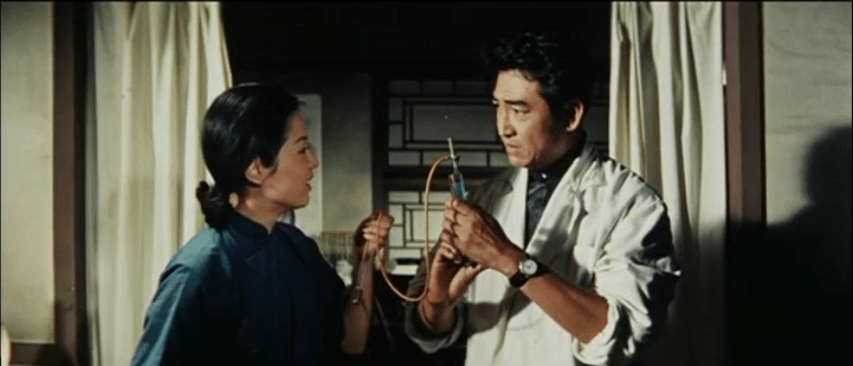
Dr. Soda (Koji Tsuruta), known as Soh, has been in Manchuria for two years running a poor clinic in a trading outpost on a smuggling route through the desert. He came, he later tells another Japanese transplant, after being talked into it by a pastor who told him about US missionaries who endured hardship in the Gobi desert and lamented that no Japanese people had been willing to take on such “thankless” work in the midst of the imperial expansion. There is a kind of awkwardness in Soda’s positioning as the good Japanese doctor which perhaps reflects the view from 1960 in that he objects to the way the Japanese military operates in Manchuria and most particularly to Japanese exceptionalism which causes them to look down on the local Chinese community as lesser beings, but within that all he preaches is equality and co-existence which suggests that he sees nothing particularly wrong in Japan being in Manchuria in the first place while implying that the Chinese are expected to simply co-exist with an occupying force to which they have in any case been given no choice but to consent. 

Nevertheless, it’s clear that the Japanese are in this case the bad guys. Soda is at one point accosted by a drunken soldier who takes against his choice to adopt Chinese dress while rudely refusing to pay his rickshaw driver. The animosity of some in the town is well justified as we hear that their mother was murdered by a Japanese soldier, or that they were raped by Japanese troops and now have nothing but hate for them to they extent that they would withhold vital medical treatment from a child rather than consider allowing Soda to treat them. Soda’s main paying job is working at an opium clinic hinting at the various ways imperialist powers have used the opium trade to bolster their control over the local population, while it later becomes clear that one of the Chinese doctors has been in cahoots with a corrupt Japanese intelligence officer to, ironically, syphon off opium meant for medical uses and sell it to addicts in a truly diabolical business plan. 

Though Soda is well respected in the town because he offers free medical treatment to those who could never otherwise afford it, he is sometimes naive about their real living conditions. Outraged that a young woman has been sold into sexual slavery, he marches off to the red light district to buy her back but is confused on his return realising her family aren’t all that happy about it because they cannot afford to feed her and were depending on the money she would send them because the father has become addicted to opium and can no longer work. The girl, Hoa (Yoshiko Sakuma), becomes somewhat attached to Soda but he is largely uninterested in her because she is only 17, while her affection for him causes tension with the daughter of an exiled Russian professor which is only repaired once they all start working together for the common good after the town after it comes under threat from infectious disease. 

In an echo of our present times, it seems not much has changed in the last 80 years or so, the townspeople quickly turn on Soda once it become clear that he’s putting the town on lockdown to prevent the spread of infectious meningitis after a Russian soldier stumbles in and dies of it. The disease firstly exposes the essential racism even among those Japanese people who have lived in Manchuria longterm such as the mysterious Ishida (So Yamamura) who remarks that diseases like that only affect the Manchurians and they’ll be fine because they are “more hygienic”, while simultaneously painting the infection as a symptom of foreign corruption delivered by the Russian incursion. Soda visits a larger hospital to get the samples confirmed but is told that the disease has not been seen in Manchuria before and so they have no vaccine stocks leaving him dependent on the smuggling network to get the supplies he needs. As the town is a trading outpost whose entire economy is dependent on the business of travellers just passing through, the townspeople are obviously opposed to the idea of keeping them out fearing that they will soon starve going so far as to tear down Soda’s quarantine signs while throwing stones at his house. 

In another irony, it’s Ishida’s pistol that wields ultimate control immediately silencing the mayor’s objections in a rude reminder of the local hierarchy. Many of the townspeople including inn owner Huang (Yunosuke Ito) and Hoa’s sister Shari (Naoko Kubo) are involved with the resistance to which Soda seems to remain quite oblivious and in any case adopts something of a neutral position but gains a grudging respect from Huang thanks to his humanitarianism that eventually saves him from brutal bandit Riyan (a rare villain role for a young Ken Takakura). In any case, as the corrupt Japanese officials pull out to escape the imminent Russian incursion, Soda decides to stay in part to atone for the sins of the Japanese in an acceptance of his responsibility as a Japanese person if one who has not (directly) participated in the imperialist project even if he was in a sense still underpinning it. Essentially a repurposed ninkyo eiga starring Koji Tsuruta as a morally upright man surrounded by corruption but trying to do the right thing to protect those who cannot protect themselves, there is an undeniable awkwardness in the film’s imperialist ambivalence but also a well intentioned desire to look back at the wartime past with clearer eyes and a humanitarian spirit. 


Terror of Yakuza (沖縄やくざ戦争, AKA Okinawa Yakuza War, Sadao Nakajima, 1976)

An old-school yakuza finds himself cornered on every side while caught in the confusion of Okinawa’s reversion to Japan in Sadao Nakajima’s jitsuroku gangster movie Terror of the Yakuza (沖縄やくざ戦争, Okinawa Yakuza Senso, AKA Okinawa Yakuza War). Where similarly themed Okinawa-set gangster pictures such as Sympathy for the Underdog had largely presented the islands as an appealing place for mainland gangsters because the conditions of the occupation which had allowed them to prosper were still in place, Sadao reframes the debate in terms colonisation and conquest as the hero finds himself increasingly marginalised as an island boy contending with amoral city elitists. 

Nakazato (Hiroki Matsukata) has just been released from prison after serving seven years for the murders of two rival gang bosses that allowed his boss, Kunigami (Shinichi Chiba), to rule the roost in Koza. But now that Okinawa has reverted to Japan, everything has changed. Kunigami has formed a loose alliance with another regional gang to oppose the incursion of mainland yakuza but behind the scenes the higher-ups are intent on a mutually beneficial alliance with the Japanese perhaps seeing the writing on the wall and assuming that it’s better to work with the new regime that against it. For his part, Nakazato is more loyal to the clan than he is opposed to Japan but he’s also resentful towards to Kunigami for failing to live up to his side of the bargain now that he’s been released while fearing the influence of his new sidekick Ishikawa (Takeo Chii) whom he suspects of murdering one of his former associates while he was inside. 

As such, much of the drama unfolds as in any other yakuza picture with Nakazato, regarded by some of the other bosses as a loose cannon and potential liability, reluctant to move against Kunigami for reasons of loyalty even while Kunigami becomes increasing unhinged and dangerous, deliberately running over an Osakan foot soldier who was apparently just on holiday with no particular business in town. Kunigami’s recklessness in his hatred of the Japanese threatens to start a turf war the Okinawan gangs fear they couldn’t win, sending snivelling yakuza middleman Onaga (Mikio Narita) along with Nakazato to negotiate in Osaka only to be told the price of peace is Kunigami’s head. Inspired by the Fourth Okinawa War which was still going on at the time of the film’s completion (in fact, the release was blocked in Okinawa in fear that it would prove simply too incendiary), the conflict takes on political overtones as the mainland gangsters assume their conquest of Okinawa is a fait accompli while those like Onaga are only too quick to capitulate leaving Kunigami and Nakazato as two very different examples of resistance. 

Yet Nakazato finds himself doubly marginalised because he is from one of the smaller islands with most of his men also hailing from smaller rural communities (one uncomfortably wearing extensive makeup to ram the point home that he is from the southern reaches) with the result that they are often pushed around by the city gangsters who view them as idiot country bumpkins. On his trip to Osaka, Nakazato even describes himself as such in an attempt to curry favour apologising in advance should he make a mistake with proper gangster etiquette. Like a good platoon leader, Nakazato’s primary responsibilities are to his men which is one reason why he takes so strongly against Ishikawa, one of the new breed of entirely amoral yakuza who care nothing at all for the code and think nothing of knocking off his guys for no reason. Consequently he finds himself caught between the invading mainlanders, the unhinged chaos of Kunigami, the coldhearted greed of Ishikawa, and the spineless venality of turncoats like Onaga. 

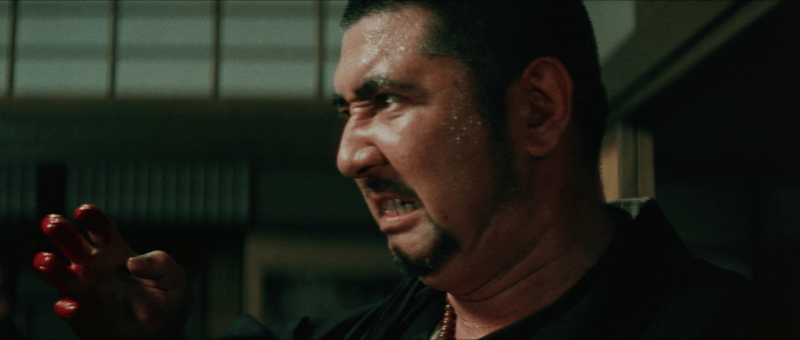
It’s no wonder that he eventually loses his cool, going all out war and like Kunigami dressing in vests and combats in an internecine quest for vengeance precipitated in part by Kunigami’s attempt to discipline one of his men for encroaching on his territory by removing his manhood with a pair of pliers. “Someone will get to you someday too” Nakazato is reminded though having lost everything including his loyal wife who insisted on selling herself to a brothel to get the money to fund his war of revenge he may no longer care so long as he cleans house in Okinawa to the extent that he is really able to do so. “Okinawa is such a scary place” one of the Japanese guys admits, though showing no signs of backing off in this maddeningly chaotic world which turns stoic veterans and hotheaded farm boys alike into enraged killers fighting on a point of principle in a world which no longer has any. 


Terror of Yakuza screens at Japan Society New York May 20 at 7pm as part of Visions of Okinawa: Cinematic Reflections

Original trailer (no subtitles)

Images: Terror of Yakuza © 1976 Toei