Produced by Toho and Chosun Film Production Corporation, Suicide Troops of the Watchtower (望楼の決死隊, Boro no kesshitai) was intended as a piece of imperial propaganda promoting a sense of unity between Koreans and the Japanese who had annexed their country in 1910 and thereafter ruled in an oppressive and often brutal fashion. Not that you would know any of that from the film which is directed by committed communist Tadashi Imai while equally surprisingly crediting Choi In-gyu as an “assistant director”, though Choi was already an established and successful director of colonial films such as Tuition (1940) and Angels on the Street (1941).
Like Tuition the film is almost entirely in Japanese, Korean having been banned onscreen by this point, though small smatterings of Korean are heard in the background. The film is set in 1935, but there are signs visible at certain points reminding people to “use only the national language,” eg. Japanese, though one of the Japanese officers has apparently learned Korean to better communicate with the local community. Likewise, though Korean actors also appear in the film, they are mainly in smaller parts with the most prominent roles being played by well-known Japanese stars. Nevertheless, Korean characters have not generally taken Japanese names, but are referred to by the Japanese reading of the Chinese characters with which their names are written. Thus, the sister of the Korean border patrol officer who is killed is referred to as Eishuku (played by Korean actress Kim Shin-jae), rather than as Yong-suk. Meanwhile, another man remarks that if he called himself “Hayashi” he might feel more Japanese, while his wife has become accustomed to wearing Japanese kimono.
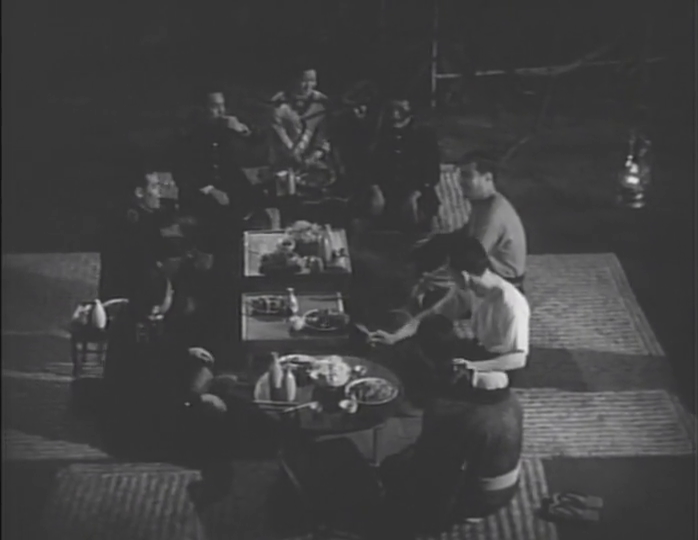
The earliest scenes of the film capture the idyllic pastorality of the Korean landscape and are intended to extend a degree of exoticism to the mainland Japanese audience who are likely less familiar with Korea or Korean culture. This is also true of the early scene in which members of the border patrol hold a welcome party for Asano (Hideo Saito) which takes place at a traditional Korean home. The men eat and drink outside sitting at low tables while the Japanese soldiers attempt to learn a Korean folksong taught to them by Kin. These scenes seek to paint colonial life as a more genial form of cultural exchange brokered by friendliness and respect even though in reality expressions of Koreanness are generally discouraged while the people are brutally oppressed and economically exploited.
Unlike some similar films, however, Suicide Troops of the Watchtower presents Korean and Japanese people as equals who are fighting for the Japanese empire together. Though they are also portrayed as simple, rural people, the Koreans are never seen to be stupid or incapable and are overall honest and kind if grateful to the Japanese border patrol officers for protecting them from the bandits. In some surprising ways, the film at times presents a more progressive view of society than might be expected as the border patrol is universally supportive of Eishuku’s desire to become a doctor with one of the officers selling off his rice field to ensure she can continue her education after her brother’s death. The implication might be that this is an opportunity afforded to her by the “civilising” force of Japanese colonialism, but she is nevertheless encouraged to become an independent working woman who will also use her skills in support of the empire.
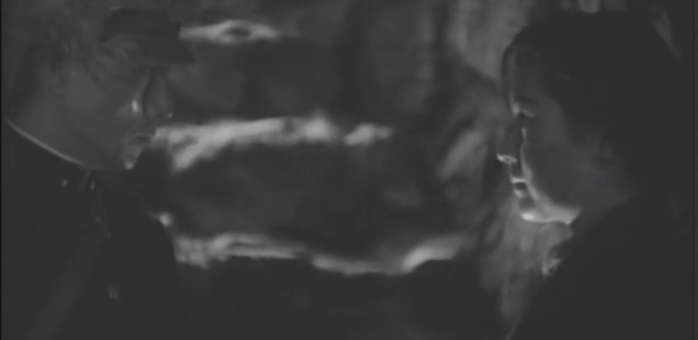
On the other hand, the Chinese characters seen in the film are all played by Japanese actors and are generally viewed with a degree of suspicion. Cafe owner Wanryu (Ichiro Sugai) has crossed the border expressly to escape the violent bandits of Manchuria, but is still mistrusted by the border patrol despite repeatedly pledging his loyalty to them. When a man in stereotypical Chinese dress with a wounded arm turns up in Wanryu’s cafe and ends up killing officer Kin when challenged, suspicion falls on Wanryu. The Chinese population has essentially been characterised as the “other” and the force against which the Japanese and Koreans are unified, which somewhat undermines the final pronouncement that the bandit problem has been solved by the elimination of the border now that Japan has conquered Manchuria.
Though they are described as “bandits” and it is said that they have been pushed into Korean territory by Japanese soldiers pursuing them, it easy to read these insurgents as Korean Independence fighters many of whom had gone into exile in China, particularly in Shanghai. Wanko, the estranged son of Wanryu, is not just a young man who ran off to live a life of banditry, but a guerrilla fighter resisting Japanese imperialism. His eventual conversion born the desire to avenge the death of his father at the hands of bandit leader Koryo who meant to kill Wanryu fearing he had betrayed them by warning his father of the imminent attack, is then depicted as a kind of homecoming as border patrol chief Takatsu (Minoru Takada) agrees to release him so that he can fight alongside them.
To that extent, it might seem surprising that the film makes the bandits seem so powerful to the degree that they pose a genuine threat the security of the empire. Their assault is staged in a way that resembles Hollywood westerns. At the film’s conclusion, it really appears as if all is lost and the border patrol will be wiped out by the bandits, partly because they are clearly understaffed which would seem to be a strategic failure on the part of the authorities. Takatsu’s ever capable wife Yoshiko (Setsuko Hara) is seen lugging weaponry around bearing out the all hands on deck mentality. At the lowest moment, Takatsu gives his pistol to his wife with the intention that she use it on herself when they are overrun while the Korean residents make similar plans with a new mother preparing to smother her baby if the need arises.
In the end they are saved by the timely arrival of reinforcements thanks to the efforts of the new arrival Asano who had been unable to cope with the harsh life on the border and was determined to quit. Even the one Korean who had subversively complained about being exploited as free labour by the entitled Japanese occupiers chips in to help so that the bandits are eventually defeated by the united force of Koreans and Japanese officers fighting side by side. Even so, the closing speech insists that the colonial authorities will now continue with their ideal of bringing “order” to Korea. Commander Takatsu proves his commitment by giving up the opportunity to return home to see his dying mother, while his wife becomes a maternal figure to the local community. Released in 1943, the film is perhaps an advocation for unity born of increasing desperation as Japan suffered repeated defeat and domestic strain, preparing its audience for the necessity of defending themselves against a similar onslaught while suggesting that all must work together to save the nation.