Female Prisoner #701: Scorpion (Intro)

Text of an intro given at the Prince Charles Cinema, 5th October 2023

There can be few faces in Japanese pop culture as iconic as that of Meiko Kaji. Contemporary Western audiences may have been first introduced to her indirectly through her undeniable influence on Quentin Tarantino’s Kill Bill which not only featured the song, performed by Kaji herself, which appears the beginning and end of each instalment in the Female Prisoner #701 Scorpion series that launched her into stardom but also drew inspiration in particular from her role as another vengeful heroine, Lady Snowblood. 

Kaji had begun her career at Nikkatsu under her birth name of Masako Ota where she generally played a supporting roles in the studio’s signature output of rebellious youth films. By the early 1970s, however, the studio system that had dominated the Japanese cinema industry was in terminal decline with attendance figures falling drastically in the face of competition from television. In response, Nikkatsu shifted its approach wholesale into what it termed “Roman Porno”, essentially softcore sex films that were nevertheless screened in ordinary cinemas and were intended for a mainstream audience as opposed to “pink film” which was a more rigorously defined genre screened in dedicated venues and aimed quite squarely at male viewers.

Kaji was one of many actresses who didn’t fancy joining the Roman Porno revolution and so jumped ship, firstly for television but then accepting an offer to join rival studio Toei which then had a giant hole to fill as its major star, Junko Fuji who had led the Red Peony Gambler series and more or less bankrolled the studio, had retired from acting to marry a kabuki performer, though she would later resume her career under the name Sumiko some years later. Kaji was considered a potential replacement but Toei really had its thinking back to front. The studio’s stock-in-trade at that time had been the ninkyo eiga, tales of gangster chivalry usually set before the war, but audiences had already become tired of the genre and were looking for something more contemporary which was certainly something Kaji could provide if she were allowed to create her own space rather than attempt to fill that left by Junko Fuji. 

Unlike rival studios such as Nikkatsu, Toei had a reputation for churning out very cheap period and contemporary action dramas that were largely aimed at a younger male audience and were, in that sense, already heading towards the same territory as Nikkatsu’s Roman Porno in their salacious taste for sex and violence. Now, we have to be a bit careful in using the term “pink film” which is itself something clearly defined by an adherence to a certain set of rules and was generally independently produced not put out by a studio, but we also have to acknowledge that the retrospective term “pinky violence” which was coined later rather than something actively used by Toei’s marketing department takes its from name the erotic associations of pink cinema coupled with the violence inherent in Toei’s exploitation films. 

Just as Nikkatsu had shifted into Roman Porno, so Toei pushed its line of female-led revenge and girl gang movies largely built around its roster of stars which aside from Kaji included Reiko Ike and Miki Sugimoto who were often played off against each other as studio rivals at times even appearing in the same film bringing that offscreen baggage with them as in the first instalment of the Terrifying Girls’ High School series or the genre highlight Criminal Woman: Killing Melody. Kaji was however largely uninterested in this kind of cinema and reluctant to take on the role of Female Prisoner #701 Nami Matsushima especially after clashing with neophyte director Shunya Ito who made no secret of his lack of confidence in her ability to play it while she objected to his demands for nudity which was after all what she’d left Nikkatsu to avoid.

Nevertheless, the pair later developed a fruitful working relationship bonding over their shared desire to move beyond the confines of the studio’s exploitation cinema into something with more artistic weight. More than any other of the films later tagged with the Pinky Violence label, the Scorpion series undermines the problematic “male gaze” inherent in the genre and found a strong female following who saw in Matsu an embodiment of their own silent rage towards a patriarchal society.  

Even so, as much as the Pinky Violence films can be seen as empowering they were also largely made for male titillation and structured in ways men can enjoy the transgressive qualities of female rebellion and aggression. Many of them are rape revenge dramas which necessarily feature scenes of sexualised violence that are sometimes presented in salacious rather than harrowing terms if otherwise sympathising with the heroine’s desire for revenge which is generally successful though it may incur further cost or moral ruin. The contradiction reaches its height in Norifumi Suzuki’s visually stunning, psychedelic foray into nunspolitation School of the Holy Beast which sees a liberated young woman enter a convent to gain revenge for the death of her mother who was killed by repressed nuns during a sexualised punishment session. The confines of the convent are styled like a prison and the film plays out like a women in prison film yet just as in the Female Prisoner #701 Scorpion series, it’s only really a metaphor for the patriarchal superstructure under which all women are imprisoned. 

One of the key directors of the genre, Norifumi Suzuki’s films are often highly stylised though in general like most of Toei’s output at the time most pinky violence movies often aim for a kind of heightened realism If one tempered by the hallmarks of 70s exploitation. By those standards, the film you’re about to see tonight is highly unusual in its bold visual style which incorporates elements of surrealism along with composition influenced by that of manga and the gothic overtones of the classic horror movie. By the end of the original Scorpion series, Matsu has taken on a mythical, supernatural quality of her own as an embodiment of rage and vengeance even at times rising from the water like the iconic long-haired ghosts most familiar to contemporary audiences from films like The Ring. Kaji would eventually move on from the series, but Toei could not, attempting to reboot it on more than one occasion though without the original incarnation’s striking visuals nor the intensity of Kaji’s unearthly glare. More than fifty years on from its original release Female Prisoner #701: Scorpion continues to resonate in an age where not nearly enough has changed.
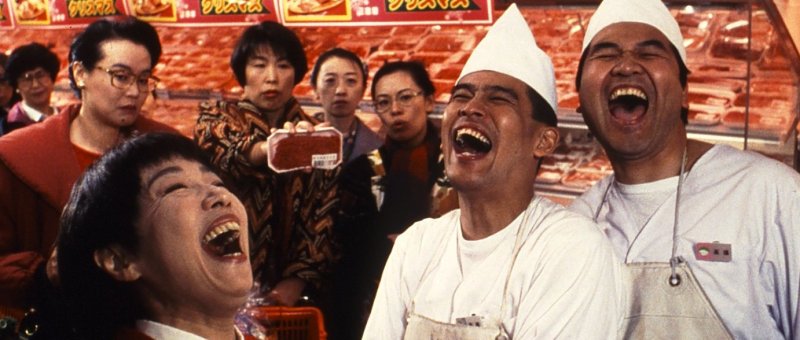
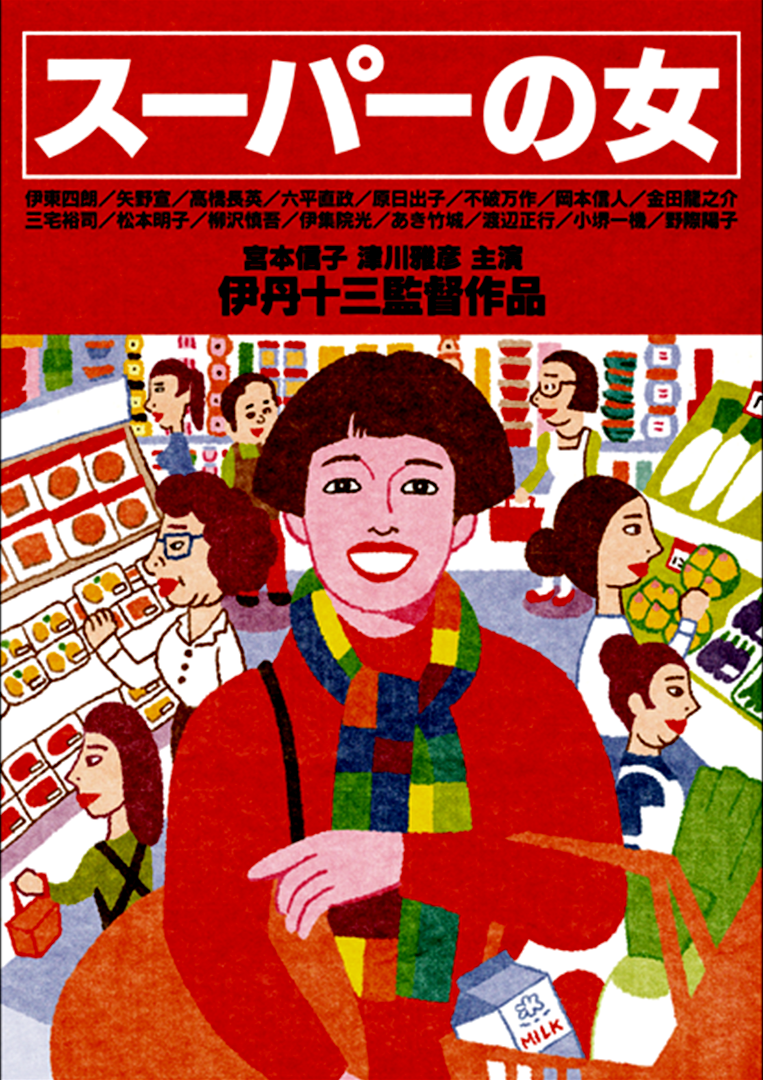
Supermarket Woman Intro

Juzo Itami was born the son of a film director, Mansaku Itami, who made his name directing ironic samurai satires at a company owned by the actor Chiezo Kataoka who was a big name in jidaigeki or period films even in the 1920s. A slight stain on his legacy is that in 1937 Mansaku Itami worked on a co-production with Nazi Germany called The Daughter of the Samurai that starred Setsuko Hara, but he remained quite a popular as a director until he died of tuberculosis at the young age of 46 when Juzo was only 13. 

In any case, Juzo Itami began his career initially as an actor on the stage and then in films such as Nagisa Oshima’s Sing a Song of Sex which is where he met his second wife and the star of this film, Nobuko Miyamoto. For reasons I’ll get into later, Itami also unfortunately died quite young in somewhat mysterious circumstances and started directing comparatively late in his career so he only made 10 features in all. Nobuko Miyamoto features in all of them and is the lead the vast majority aside from a couple of later films like The Last Dance which stars Rentaro Mikuni as a film director dying from terminal cancer (it’s a comedy!) and A Quiet Life which is an adaptation of a novel by Kenzaburo Oe who happened to be a childhood friend of Itami’s and also his brother-in-law. Itami doesn’t appear as actor in any of the films that he directed but he did co-star with Miyamoto in the 1989 video game adaptation Sweet Home which was directed by Kiyoshi Kurosawa. Itami produced the film which was made his own production company and was unhappy with the end result so decided to re-shoot some of it himself and re-edit the film for the home video release which led to him being sued by Kurosawa. Kurosawa lost the lawsuit, so Itami’s version of the film remains the only version available.

Anyway, the film you’re about to see tonight, Supermarket Woman, is part of a series that in the Japanese anyway all have the word “woman’ in their title and star Nobuko Miyamoto in the lead. There’s A Taxing Woman (Marusa no Onna), in which she plays an accountant in the tax office, Minbo no o=Onna or The Gentle Art of Japanese Extortion, in which she plays a fearless lawyer going up against the yakuza and my personal favourite Woman in Witness Protection (Marutai no Onna) in which she plays a ditzy, attention-seeking actress who has to go into hiding when she inadvertently witnesses a murder. So you can guess how well that goes. 

The Gentle Art of Japanese Extortion created a lot of problems for Itami. The film satirises the yakuza and makes them look incredibly silly in that the main thrust is that they don’t actually like going to prison because it’s really bad for business so it’s really unlikely they’re actually doing to carry out any of their threats if carry you on saying no to them. Unfortunately, yakuza quite like films and they’re actually very sensitive so they didn’t take kindly to this at all. Six days after the film opened, a yakuza gang attacked Itami close to his home beating him up and slashing his face. The attack backfired in a way in that Itami was so loved by the general population that there was mass outrage and the government instituted a further crackdown on the yakuza. 

It did lead to the couple receiving police protection, though, which inspired Woman in Witness Protection. Sadly, however, not long after the film’s release Itami fell from the roof of his office building. A note was found stating that he was taking his own life to clear his name because a tabloid was about to publish an exposé revealing an affair with a much younger woman. Obviously, you can never know what’s going on someone’s mind, but this surprised most of his friends and family who didn’t believe he would have killed himself over something as trivial as an affair even if he had been having one. It’s long been suspected that he may actually have been killed by the yakuza because his next film would have been about their connection with the Buddhist cult Soka Gakkai which has a strong influence on politics in Japan.

Itami’s films did after all have a taste for skewering Japanese traditions and mores and Supermarket Woman is no different in that regard in going in hard on the heartless consumerism and entrenched sexism of the contemporary society. Family-run neighbourhood supermarket Honest Mart is facing an existential threat presented by the reopening of Discount Demon, a dishonest and underhanded chain store than artificially inflates prices to discount them and sells imported meat as discount wagyu. The film was released in 1996 which is in the middle of the so-called lost decade not too long after the economic bubble burst. For most of the 1980s, Japan had been in a state of unprecedented prosperity in which there was so much money around no one really knew what to do with it. But times are very different now which is why you’ll see people making reference to a straitened economy and using the impossibility of finding new jobs as a tool to manipulate the workers into accepting poor pay and conditions and going along with improper work practices such as repacking unsold produce with the next day’s date.

It’s also a time in which people have had to rapidly relearn how to be thrifty. As supermarket woman Hanako says, they just want something that’s a little bit nice but not too expensive. They want to shop somewhere they can trust with their family’s health and wellbeing without breaking the bank, which is something Honest Mart can give them while all Discount Demon offers is depressing frugality and the mild irritation of feeling like you’ve been ripped off. Hanako knows all of this because of her extensive experience as a supermarket customer during her long years as a regular housewife. It’s her housewife skills, the very thing that are the most dismissed and derided in a fairly sexist society that stand her in good business stead. By contrast Goro, the owner of Honest Mart, has no real experience of ever being a customer in a supermarket and has no idea what people want from them or how they might prefer to shop. Japanese men of his generation rarely did anything like food shopping or taking care of the domestic space, which you’ll immediately notice if you take a look at the state of his apartment since his wife has died.

Masahiko Tsugawa who plays Goro was the grandson of Shozo Makino who is often described as the father of Japanese film. He was incredibly good-looking when he was young and after making his film debut at 16 in Ko Nakahira’s Crazed Fruit, he went on to star a lot of youth dramas in the 1960s including several for Nagisa Oshima such as Night and Fog in Japan and The Sun’s Burial. He appeared in most of Itami’s films from Tampopo onwards.

You see the gender divide several times throughout the film as Hanako becomes a figurehead for the women who work on the shop floor in direct opposition to the men who run the supermarket while Goro is more of a neutral figure caught between the two. All of the pros who work on the fish and meat counters are men who are rather precious about their craft and deeply resent the intrusion of a woman telling them how to do their jobs as does the store manager even as Hanako begins to turn Honest Mart around by changing the culture so they live up to their name. She gets the local community involved by holding focus groups for the neighbourhood ladies and empowers the other women to stand up against dishonest business practices when the men tell her that honesty makes no sense in business and “everybody does it.” In many ways, it’s the “everybody does it” philosophy that the film is trying to undercut as Hanako and Goro commit to making Honest the supermarket with the happiest shoppers rather than the biggest or richest mainly by just being nice to people, treating everyone equally, and creating a pleasant stress-free environment for both customers and staff. We could all really do with a few more Hanakos in our lives, but at least we have her for the next 127 minutes and I hope you enjoy it. 


Text of an introduction given at the Rio cinema 20th November 2025.

Howdy!

Well hello there, welcome to my probably sporadic and essentially experimental film blog! The idea of this really is just that I watch too many films so I thought I thought I’d write about them mostly as a way of getting my own thoughts in order, possibly aided by the kindness of strangers. I should point out I’m just someone that’s seen a lot of movies, I’ve never taken any film courses and as you’ll see I’m clearly not an expert and have almost no knowledge of the proper technical terminology, so please be kind future trolls for I seek only to learn. Also, in the interests of full disclosure I ought to say that if I review a DVD/Blu ray etc it will be something I have purchased myself, if I should happen to receive something in any other way I will of course say so! Obviously this blog is just a hobby and I’m harbouring no pretensions that I’ve magically become a official critic or anything like that, but I hope some people may come to find my humble ramblings interesting, or even in time diverting.

Until that day, enjoy the trailer for this hilarious film from 1938