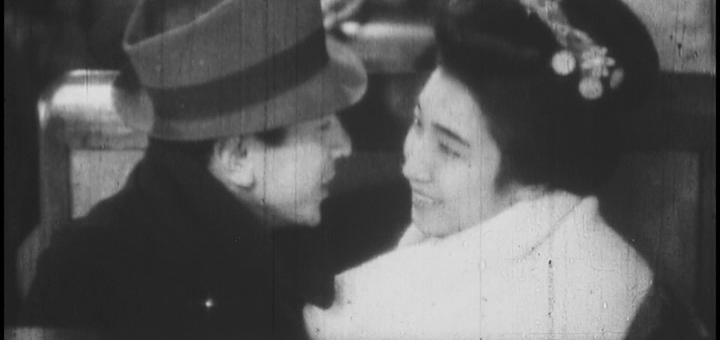
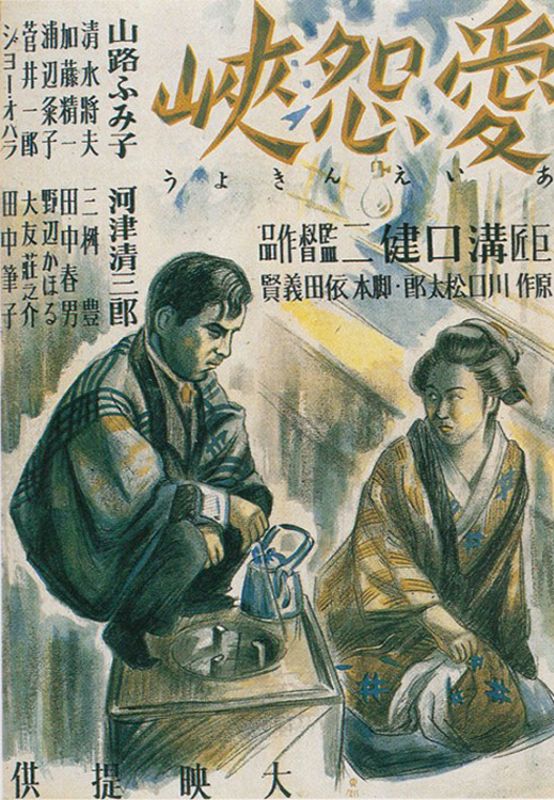
The Straits of Love and Hate (愛怨峡, Kenji Mizoguchi, 1937)

straits of love and hate poster“Tokyo is a dangerous city that traps innocent people like you” the heroine of Kenji Mizoguchi’s 1937 melodrama The Straits of Love and Hate (愛怨峡, Aien kyo) is told, but it’s not so much the darkness of the city streets as the world’s cruelty which threatens to consume her soul. Loosely inspired by Tolstoy’s Resurrection, then particularly popular in Japan and a frequent source for adaptation in the silent era, Straits of Love and Hate is a familiar tale of an innocent maid seduced and betrayed by the weak willed son of her social superiors, but rather than see her beaten by a broken heart Mizoguchi allows to her to find new strength in the determination to move forward in a direction of her choosing.

Kitchen maid Ofumi (Fumiko Yamaji) is in love with Kenkichi (Masao Shimizu ), the son of local hotel owners. Now that he’s finished his studies, his parents were expecting him to take over the inn so they’re not exactly pleased when he tells them he plans to go to Tokyo to become a teacher, nor would they be very happy about the idea of him marrying a lowly maid. After arguing with his father, Kenkichi more or less gives up on the idea of leaving, deciding to postpone until his parents come round or perhaps going on his own and sending for Ofumi when he’s financially stable. Twin pressures, however, force him to accept that it’s now or never. Ofumi is a few months pregnant and will soon be showing so his hand is in a sense forced. Meanwhile, Ofumi is keen to leave as soon as possible because her uncle, Murakami (Seiichi Kato), has turned up extremely drunk and is talking to her employers about taking her away to join his troupe of travelling players which she is desperate to avoid because she remembers her mother telling her he was no good and would sell her to a brothel as soon as look at her.

Kenkichi relents and the pair elope to Tokyo, but once there his general fecklessness resurfaces. The couple have begun to outstay their welcome at the apartment of a friend whose wife is becoming thoroughly fed up with Kenkichi who lounges about all day not looking for work, while an increasingly pregnant Ofumi is out job-hunting alone in the unforgiving city. A naive bumpkin, she’s nearly scammed by a street pimp who claims to be saving her from someone in fact just like him, but is rescued by Yoshi (Seizaburo Kawazu) – a wandering accordion player regarded by all as a petty thug. Kindhearted by nature, Yoshi takes pity on her and sets Ofumi up with a job in a cafe but is soon arrested for stabbing the pimp who was bothering her. Meanwhile, the irritated wife of Kenkichi’s friend has wired his dad who promptly arrives to retrieve his son. Spineless, Kenkichi walks out on his pregnant girlfriend leaving her only with a note that says “sorry, good luck with the rest of your life”, and an insultingly small amount of compensation money.

It’s easy enough to think that Kenkichi wasn’t really invested in his romance, got cold feet, or simply rejected adult responsibility, but the truth is more that he’s just as trapped by patriarchal social codes as Ofumi is and no more free even with his comparatively comfortable class background. He lacks the will to defy his father, and is simply too lazy to consider living an ordinary life in the city with a regular job where no one calls him “young master”. Ofumi, by contrast, fights for love. She breaks the class barrier, naively believes that Kenkichi’s parents will accept her because they cannot reject their grandchild, and forgives Kenkichi’s fecklessness because she truly believes in him. One word from his father, and he crumbles. Left alone Ofumi is forced to send her son out to foster parents and has no other choice than to become a bar hostess.

Unlike Kenkichi, Yoshi is patient and kind. He truly means to protect Ofumi and her son, but also has a self-destructive violent streak as manifested in his over the top attack on the pimp and later altercation with a remorseful Kenkichi. Ironically enough, Uncle Murakami whom she so feared becomes an unlikely source of salvation, inviting Ofumi and Yoshi to join the company as a standup double act. Witnessing Ofumi reenact her romantic tragedy on stage as part of a routine forces Kenkichi to confront his moral cowardice. While the intervening years have seen Ofumi become cynical and bitter, still angry and resentful, Kenkichi has become weary and resigned. His parents have moved to the country, and he now runs the hotel, but he’s still not free. Hoping to convince Ofumi to come back, he invites his dad to meet their son but it becomes clear to her that Kenkichi will never change. He lacks the strength to reject his father’s authority, and as he’s abandoned her before he will likely do so again.

Kenkichi, perhaps meaning well, offers to take the child, pointing out that growing up among travelling players is an inauspicious start in life whereas he can bring the boy up with all the advantages of middle-class comfort. Ofumi is guilty in her immediate refusal, acknowledging that she may be denying her son a “better life” than she can give him, perhaps selfish in her reluctance to be parted from her child, but equally certain that she doesn’t want her son to grow up like Kenkichi, a spineless product of a patriarchal social order unable to stand up to his father or seize his own agency. She tells Kenkichi that she’s fallen in love with Yoshi because theirs is a partnership of equals, they understand and support each other, moving forward as one. He won’t abandon her by choice, but he isn’t perfect either and his foolish self-destructive impulses and selfless nobility threaten his new hope for the future as he embarks on a high risk strategy to prompt Ofumi to accept the “better life” that Kenkichi can offer her. Nevertheless, the point is that the choice is finally hers – no man is going to make it for her, not even her son. What she chooses is a kind of independence, stepping boldly forward into a future that’s entirely of her own making.

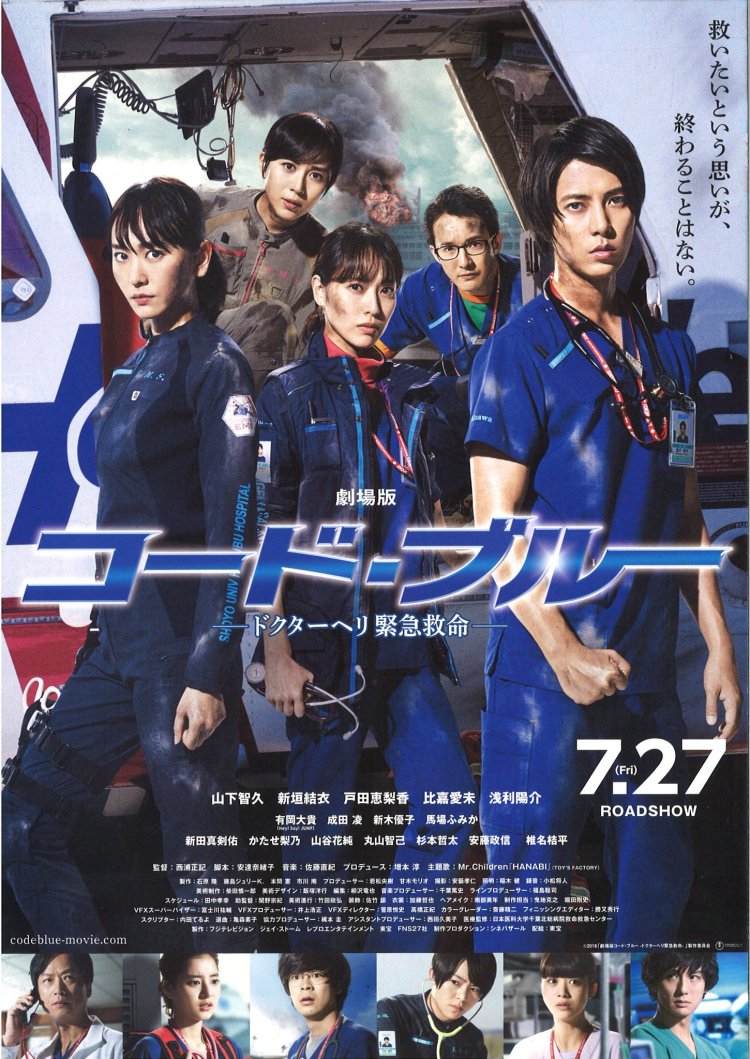
Code Blue: The Movie (劇場版コード・ブルー –ドクターヘリ緊急救命–, Masaki Nishiura, 2018)

Code Blue posterThe common complaint plaguing popular Japanese cinema is that it’s increasingly dependent on existing source material, not in only the prevalence of manga adaptations, but the continuing influence of TV drama. Ever since the massive success of the Bayside Shakedown franchise, big screen outings for popular series have been a mainstay of the Japanese film industry, the problem of course being, from a certain point of view, that their nature as an extension of an already existing narrative universe makes them not only impossible for export but also a potential audience turn off to those not already invested.

Code Blue is itself comparatively unusual in being one of the few Japanese TV dramas to head into multiple series. That being so, a movie was something of an inevitability, but like many medical shows which generally adopt a case of the week formula, Code Blue thrives on finely crafted characterisation. Rather than jump this obvious hurdle, director Masaki Nishiura opts for the time-honoured solution of a brief flashback highlighting the key events of the previous three seasons and otherwise tries to avoid too many references to past events. It remains true however that viewers already acquainted with the Doctor Heli team will be best placed to navigate the complex interpersonal relationships informing the rest of the action.

Those would be, chiefly, the unexpected return of aloof doctor Aizawa (Tomohisa Yamashita) who is about to take up a research position in Toronto, while Dr. Hiyama (Erika Toda) is also preparing to follow her dream by moving on to head up the perinatal department at a nearby hospital. As is stressed in the opening sequence for those who might not be aware, the Doctor Heli program does not airlift passengers by helicopter but drops doctors into emergency situations where they are most urgently needed. Aizawa’s arrival coincides with the forced return of a flight originally heading to Vietnam which experienced heavy turbulence with multiple casualties needing evacuation from the plane or treatment on the ground. One such patient turns out to be an especially difficult case seeing as she has not only sustained serious injuries, but is also suffering from stage 4 stomach cancer and was trying to take a last vacation in her final days.

The Doctor Heli team are deeply touched by Tomizawa’s (Kasumi Yamaya) plight, knowing that though her injuries would otherwise not be regarded as serious, she may well end up spending her remaining time in their ICU rather than doing the things she wanted while she could. A talk with her parents reveals a painful breakup and canceled wedding, neatly echoing a conflicted nurse desperately trying to get out of the, in her view unnecessary, wedding ceremony her fiancé has organised. Tomizawa’s former boyfriend (Mackenyu) eventually returns and apologises, hoping to make up for lost time, but she isn’t sure she should let him, not only because he let her down by running away, but because she fears that if she does she might prevent him moving on with his life after the inevitable occurs.

Despite being skilled at fixing the human body, the doctors confess they are often at a loss when it comes to the human heart. They struggle to communicate their true feelings to each other, keeping their minds on the job with well practiced practicality, but are all too aware of the precariousness of being alive. What they all advise is that it’s best to let the people you love know your true feelings because you never really know if there will be another opportunity. Dependable leader Shiraishi (Yui Aragaki) can’t quite find the words to express her feelings for her soon to be departed best friend Hiyama, while she struggles with her essential “awkwardness” yet has a knack for the good kind of “direct”, always knowing the right words to help people feel better.

Aizawa, who had no family of his own, is stoical and patient with those of others, comforting a young man who’s gotten into a car accident with the abusive father he’d tried to reconnect with, letting him know that there was nothing wrong in his rage or resentment but also nothing wrong in his desire to tell him that he has become a fine man on his own and that his father’s violence has not destroyed him. Likewise, a young nurse, Futaba (Fumika Baba), gets an unexpected shock when her older sister brings their alcoholic mother (Rino Katase), from whom she’d become wilfully estranged, into the hospital after she fell and got a kitchen knife stuck in her head. Aizawa tells her that she did what she needed to do and shouldn’t feel guilty about “abandoning” her mother, but also gives her the space to reconnect with her as she begins to understand a little of her mother’s suffering.

You can’t deny that Code Blue: The Movie (劇場版コード・ブルー –ドクターヘリ緊急救命–, Gekijoban Code Blue Doctor Heli Kinkyu Kyumei) is basically a two hour TV special, shot exactly like the TV series with seemingly no increase in budget or production values, but it topped the Japanese box office and obviously provided fans with exactly what they were looking for. A little less melodramatic than might be feared, the series’ big screen finale (?) is unabashedly emotional but celebrates as much the close bonds between the Doctor Heli team as those with their patients as they face the unthinkable time and again but get through it together.


Teaser trailer (no subtitles)

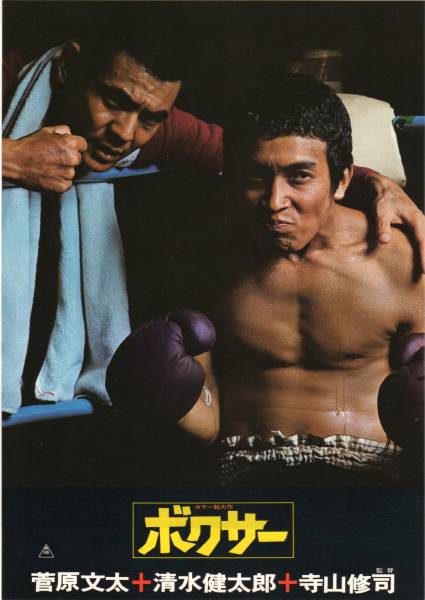
Boxer (ボクサー, Shuji Terayama, 1977)

Boxer posterArtistic polymath Shuji Terayama was fond of claiming that more could be learned about life from boxing rings and race courses than from conventional study. Immersing himself in the countercultural epicentre of mid-century Shinjuku, he became known for iconoclastic street theatre before shifting to film, instantly recognisable for his striking use of colour filter and theatrical, avant-garde aesthetic. 1977’s Boxer (ボクサー) is, however, his most conventional experiment, a generic tale of a struggling boxer yearning to be a champion and battling himself, along with his society, in the claustrophobic arena of the ring, but for all the expected triumph it’s futility which marks his life and the ropes which restrain rather than liberate.

Former boxing champion Hayato (Bunta Sugawara) now lives a lonely existence alone with his beloved dog in a rundown boarding house. His brother is about to be married and wanted him to be in the engagement photos, but he told the young couple to go ahead without him. He may come to regret that because his brother quickly becomes the victim of an accident that may not have been quite that at the construction site where he and his fiancée worked. It seems that another employee, Tenma (Kentaro Shimizu) – an aspiring boxer with a limp, had taken a liking to the same girl and, either distracted by the news she intended to marry someone else, or not thinking clearly, he allowed his digger to hit Hayato’s brother and kill him. Of course, Hayato is not happy about that and determines to track Tenma down, looking for him at a neighbourhood bar where a small boy guides him to the gym, which he is eventually expelled from by the other boxers. Nevertheless, Tenma, having heard about Hayato’s past and been dismissed by his trainers because of his disability, is determined to overcome the debt that exists between them and become Hayato’s mentee hoping to go on to boxing glory.

Like many a Shinjuku tale, this is one of scrappy chancers longing to escape the vice-like grip of an underworld that refuses to release them. In the land of broken dreams, the hopeless man is king, and Hayato is nothing if not hopeless. Years ago, we’re told, he was a champion, yet he suddenly quit boxing mid-way through a bout that he was clearly winning. He had a wife and daughter, but now lives alone (except for the dog), making a living by pasting up flyers. In response to Tenma’s request, Hayato recounts to him the histories of boxing champions in Japan all of whom met a sticky end: dying of typhus in Manchuria, drowning after demobilisation, dying under a bridge, hit by a train, suicide after revenge on a yakuza who’d killed his brother, killed when a runaway truck hit his home, car accidents etc. The boxing match which opens the film is preceded by a minute of silence for a champion who died just a few days previously. So what, Hayato seems to say, we fight but we all die in the ring anyway. What’s the point?

Still, for all the meaningless of his success, he too finds a kind of purpose in Tenma’s quest even if he knows it’s futile and that it is perhaps perverse to commit to saving the man who killed his brother either by accident, as he claims, or out of romantic jealousy. Tenma tells him that he wants to be a champion to appear on TV and be famous. He has, it seems, something to prove. Hayato tells him that boxing’s not for everyone, cruelly echoing the words of the president of the boxing society in his letter explaining to Tenma that there is no place for him in the boxing world because of his disability. His reasoning is however different. He asks him if he is able to hate, to which which he replies that yes, he hates his mother, father, brother, and in fact “the whole damn world” which makes him a perfect mirror for his defeated mentor.

Terayama opens the film with a melancholy black and white sequence in which a boxer walks down a long corridor towards a door filled with light while other contenders pass him from the opposite direction, some badly beaten and others unable to walk. This is the price, he seems to say, a literal manifestation of life’s battery. Even the denizens of the strangely colourful, warm and cheerful little neighbourhood bar with its Taisho intellectual, former actress turned streetwalker, smoking child, and bookmakers who don’t pay their bills, are fighting a heavy battle, crushed under the weight of their broken dreams. Hayato tries to offer encouragement from the sidelines, “Get up if you refuse to be a loser”, he yells to a barely conscious Tenma struggling raise himself from the mat, but even if he does what will he gain? Suitcase in hand the women leave looking for better lives, while Tenma struggles to escape from the ring, chasing hollow victories of illusionary manhood but finding salvation only in the struggle.


Opening sequence (no subtitles)

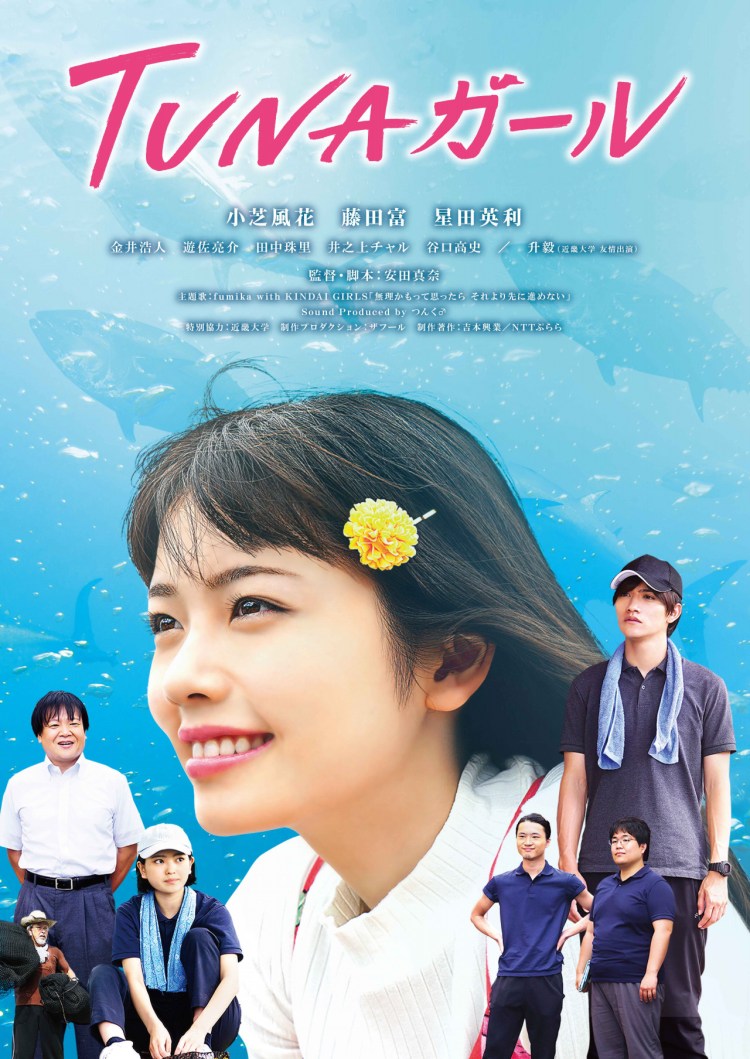
Tuna Girl (TUNAガール, Mana Yasuda, 2019)

Tuna girl posterIn perhaps the greatest book review ever written, a young girl in 1944 remarked “This book gives me more information about penguins than I care to have”. After viewing Mana Yasuda’s Tuna Girl (TUNAガール) which is equal parts docudrama about the growing tuna farming industry in contemporary Japan and coming-of age tale about a plucky young girl who, just like the famously impetuous fish, has a habit of rushing headlong into things she doesn’t understand fuelled only by unstoppable enthusiasm and a good heart, you may feel something similar about the titular fish.

Minami (Fuka Koshiba), an excitable young woman, is a fisheries student from Osaka on a short course at a research facility where they pioneer tuna farming. Minami’s big problem is that she hasn’t figured out what her speciality should be which means she’s been put on general fish farming duties but is beginning to think perhaps she’s not cut out for this after all seeing as she’s extremely squeamish when it comes to the real blood and guts of animal husbandry.

Meanwhile, she’s become a little smitten with the handsome but geeky Sudo (Tom Fujita) who gets a bit teary eyed every time he mentions tuna which he describes as the “diamonds of the sea”. Unlike Minami, most of the other students are of the serious sort and all have their particular reasons for attending the facility. Kuroda, an earnest young woman, becomes increasingly fed up with Minami’s thoughtless antics, resenting the extra work and potential for ruin involved with someone like her permanently overexcited friend. As she later reveals, however, that’s largely because she comes from a much more conservative family in which most believe that a woman’s education is a pointless extravagance. Her comparatively progressive grandfather felt differently and left money in his will to make sure she could study to become whatever she wanted to be, only she’s obsessed with fish and it’s difficult to sell a career in fish farming as being of great importance to the future of the human race so she needs to make sure she doesn’t mess this up and risk giving her judgemental relatives additional ammunition.

Kuroda therefore is somewhat unsupportive when Minami goes way over the top in characteristic fashion and ends up on TV introducing the school to a film crew who seem to have some kind of ecological agenda. Dressed in a cheerful summer outfit and plush tuna hat, Minami actually proves quite a capable host providing easily accessibly explanations of the running of the facility and various facts about tuna but tragically makes a huge mistake when she trips and spills valuable specimens live on air, trending on Twitter as a fish killer in the process. Unfortunately, her mistake could have serious consequences for everyone in that the facility, though operating as a commercial venture selling their farmed tuna, is largely reliant on grants which may be revoked if they come under ill repute.

As another student tearfully explains, classmates ought to be supporting each other not acting like bullies when one of them messes up. Kuroda later regrets her actions, explaining that she hates herself for being so serious with other people and secretly wishes she could be more like Minami. They are, after all, all quite unusual people who are passionate about something most people would find strange. Sudo thinks that their mission of perfecting tuna farming in Japan is akin to a sacred duty which lends the whole thing an uncomfortably nationalist bent, while parasite specialist Hosoda is told that by eliminating diseases in fish they can prevent conflict over fishing rights and somehow bring about world peace. Which is all to say that, though this is a bloody business entirely geared towards the efficient consumption of living creatures, everyone has their heart in the right place even if it might take a beat or two to figure it out.

Despite repeated failures and getting dumped by her selfish long distance boyfriend Minami remains steadfast and enthusiastic. She might never figure out her speciality, but learns a valuable lesson from her mentor who tells her that there is no “goal” in research, merely an intention to keep moving forward, much like a tuna rushing endlessly towards the future. Filled with fish facts and possibly too authentic detail of fish farming in Japan, Tuna Girl is far from original but cheerful enough as its enthusiastic heroine gets a few humblings but never gives up on herself or her friends as she charges forth towards her own bright future as a champion of Japanese tuna.


Currently available to stream on Netflix in the UK (and possibly other territories)

TV spot (no subtitles)

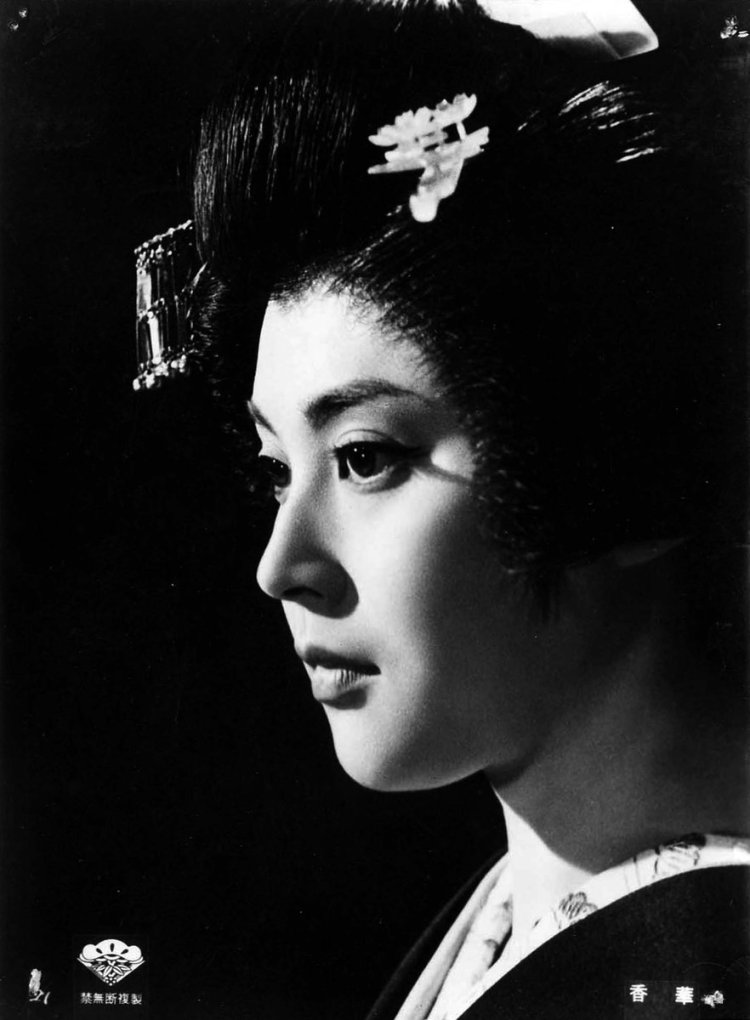
The Scent of Incense (香華, Keisuke Kinoshita, 1964)

Scent of Incense still 1Sometimes regarded as overly sentimental, Keisuke Kinoshita’s later career grew progressively harder around the edges, as if he began to lose faith in the efficacy of human goodness but never it seems in its capacity for endurance. Spanning more than 50 years in the turbulent history of mid-20th century Japan, The Scent of Incense (香華, Koge) reverses the path of the hahamono in dramatising the complicated relationship of two women – a “selfish” mother and her “self-sacrificing” daughter who finds herself unable to give up on maternal approval despite the many disappointments of her life.

We open in late Meiji with a funeral interrupted by news from the Russo-Japanese war. Shortly after, young widow Ikuyo (Nobuko Otowa) argues with her mother, Tsuna (Kinuyo Tanaka), over custody of her five-year-old daughter Tomoko. Ikuyo is planning to remarry and her new husband has three children of his own. Fearing Tomoko would be an inconvenience, Ikuyo proposes to make her heir to her mother’s family, leaving her behind in her grandmother’s care. Though Tsuna loves Tomoko dearly, she resents her daughter’s intention to abandon them just because she’s got a better offer, and perhaps privately wonders how long she’ll actually stick it out for seeing as, as we later see, she has a strong tendency to give up when the going gets tough.

The prediction proves accurate. Ikuyo persuades her new husband to abandon his existing children and family home for the bright lights of Tokyo, while Tomoko and her grandmother live on alone in the country. Ikuyo has another daughter, Yasuko, but the couple quickly become impoverished without access to her husband’s family money. When Tsuna dies, Ikuyo decides to fetch Tomoko from the family residence, but then sells her to a geisha house. A few years later, she too falls into the sex trade but as a less exulted “oiran”, embarrassingly re-encountering her daughter from the other side of a brothel. Despite her abandonment and shame over her mother’s profession, Tomoko (Mariko Okada) continues to try to help her, maintaining an awkward familial relationship with a woman who only pays attention to her when she needs something.

Perhaps ironically, in one sense, Tomoko ends up becoming a successful, independent woman in pre-war Japan but is forever denied the kind of familial life she craves as a conventionally respectable wife and mother of the kind her own was not. In the course of her work, she meets dashing military cadet Ezaki (Go Kato) and, despite the warnings of her madam (Haruko Sugimura) who cautions her that she’s the type to fall in love too deeply, embarks on a longterm affair with him. Though he is obviously aware that she is a geisha, he is confident that his family would accept a marriage, but Tomoko’s hopes are later dashed when his pre-marital investigations turn up the fact that Ikuyo has worked as a “common prostitute”. Heartbroken, she resents once again paying the price for her mother’s transgressions, but does not break with her completely.

Tomoko’s liminal status is further brought home to her when her elderly patron, who has set her up with a geisha house of her own, suddenly dies and not only is she informed some days later by the madam at another house, but she’s not even permitted to attend the funeral. Another man, Nozawa (Eiji Okada), who’d had his eye on her but honestly admits that men of his class do not engage in “serious” relationships with geisha, asks her to become his mistress but she has had enough of the shadow life, vowing both that she doesn’t want to be “owned” anymore, and that her next man (if there is one) will have to marry her.

Loneliness renders that particular vow void as she finds herself embarking on a casual affair with Nozawa while Ikuyo considers getting married for the third time – this time, rather transgressively, with the family’s recently widowed former servant, Hachiran (Norihei Miki), who married into a wealthy family and apparently made something of himself. Hachiran, however, finds it difficult to shake off the old class attitudes, treating Ikuyo like a goddess while she bosses him around and makes a pretence of leaving every time she gets fed up.

Later we might wonder if Ikuyo’s sudden exit from Hachiran’s distant home is more that she missed her daughter than it was boredom with her husband. “I don’t think of her as a mother” each woman says, Ikuyo on learning that Tsuna is dangerously ill, and Tomoko when Nozawa suggests making a detour to visit Ikuyo and Hachiran. Ikuyo, it is true, is a cold woman who abandoned her daughter only to reclaim her in order to sell, later giving up two more children one of whom apparently disappears without trace. The proof of her love is found only in its end, while Tomoko suffers on all the long years otherwise alone, until in an immense act of circularity she at last becomes a kind of mother to another woman’s son.

Forever haunted by the spectre of soldiers, Tomoko loses everything in the Great Kanto Earthquake of 1923, but perseveres and rebuilds. She loses everything again in the firebombing of Tokyo, only later remembering her foresight in burying a large collection of crockery in the cellar which might allow her to open a restaurant. She resents her mother but keeps her close, while Ikuyo’s affections seem to ebb and flow as she disappears off to greener pastures only to resurface again when they’ve been thoroughly grazed. A flighty, perhaps selfish woman, Ikuyo too proves unable to sever connection from her daughter. Tomoko disapproves of her mother’s gaudiness, her unbridled lust for life and disregard of social conventions, but the two women are more alike than they first seem – each in their own way fiercely independent and unwilling to allow their desires to be defined or defeated by the world around them.


Original trailer (no subtitles)

Shippu Rondo (疾風ロンド, Teruyuki Yoshida , 2016)

Shippu Rondo posterIn this new age of anxiety, can we find the time to laugh about the possible release of a deadly bioweapon illegally developed and then stolen by a disgruntled employee who then finally gets hit by a truck before he can reveal what he did with it? On watching Shippu Rondo (疾風ロンド), your answer may be a predictable no. Adapted from a novel by Keigo Higashino, who is not particularly known for his sense of humour, Shippu Rondo fails to capitalise on the inherent absurdity of its premise, lurching between broad comedy and existential dread before making a late in the game shift towards sentimental family melodrama.

The trouble begins when a disgruntled employee (Shigeyuki Totsugi) fired for his zeal in creating a virulent bioweapon returns and steals its only sample, skiing out into the woods and burying it in a canister which will open automatically should the temperature rise above 10ºC. Hoping for a hefty ransom, he nails a teddybear containing a radio signal to the nearest tree and sends an email asking for cash in return for the location. Unfortunately, he gets hit by a truck before he can give more detailed information but does at least leave a radio transmitter and a photo as a clue.

Hapless widowed researcher Kuribayashi (Hiroshi Abe) is the one charged with bringing the extremely dangerous K-55 back under control, taking his 14-year-old son Shuto (Tatsuomi Hamada) along as a kind of guide/cover in the exciting world of Japanese ski resorts. The problem is, Shippu Rondo can’t decide if it wants to be an absurd black comedy about the potential death of thousands because of self-centred, selectively stupid scientists, a serious crime thriller, or a tearjerking melodrama of emotional repression and filial misconnection.

Thus, after arriving at the ski resort, we largely forget about the urgency surrounding the missing canister of deadly toxins while becoming involved in the various dramas of the otherwise peaceful town. The younger sister of one of the local teens apparently died of flu, leaving a nasty rumour behind that her depressed mother, who runs the local cafe, secretly plots revenge against the youngsters who “spread” the disease. Meanwhile, a man in a funny hat (Tsuyoshi Muro) keeps following Kuribayashi around while he looks for the canister, and the ski patrol guy (Tadayoshi Okura) tries to encourage his friend (Yuko Oshima) and probable love interest that she should fight for her sporting dreams while she wonders if to do so is irresponsible in the wake of mass tragedy like the 2011 earthquake and tsunami.

The irony of the flu proving deadly while the threat of mass death from incurable anthrax looms over the heads of everyone is never lost, though its eventual resolution is underbaked in the extreme. Despite the fact we’re repeatedly told that the lid on the canister is designed to dissolve if the temperature exceeds 10ºC, someone carries it in their pocket for an undetermined amount of time while considering whether to use it to poison all their friends in the hope of cheering someone up and rising in their estimation. It’s a peculiarly Higashino-esque touch in its bizarre mean-spiritedness, but then gives way to broad sentimentality as the beneficiary of the action reminds the would-be mass killer that they shouldn’t wish misfortune on others but rather should double up on happiness for all. Meanwhile, Kuribayashi’s jaded middle-aged cynicism rubs up against his son’s adolescent idealism as he tries to process the fact that his dad works in illegal weapons, has lied to everyone around him by telling them they were looking for an experimental vaccine needed to save a terminally patient, and is planning to brush the whole thing under the carpet to save his own skin.

More gentle comedy than disaster thriller, the crisis eventually works itself out if in continually farcical episodes of swapped vials and villains falling off cliffs, while Kuribayashi’s self-interested boss Togo (Akira Emoto) dances maniacally around his office. Low budget in the extreme, Teruyuki Yoshida’s direction is of the TV special variety, veering between broad comedy and a cynical drama in which the day is saved largely because a teenage boy has entirely lost faith in his feckless father to do the right thing. Still, it all ends in a positive message as the champion snowboarder resolves that the best way to help people might lie in embracing your unique skillset while her bashful friend supports from the sidelines, the older generation remember their responsibility to lead by example, and evil corporate mad scientists are forced to own their casual disregard for public safety.


Original trailer (English subtitles)

Sada (SADA〜戯作・阿部定の生涯, Nobuhiko Obayashi, 1998)

Sada poster“Facts can easily become fiction when recounted by someone, even by oneself. But with a bit of sincerity lies can become truth”, our genial guide explains, paradoxically telling us that the heroine, a woman he regards as a loveable kid sister, wants to tell us her story herself. Apologising in advance for her “rudeness”,  he reveals to us that the woman is none other than the “notorious” Sada Abe, a woman who, apparently now forgotten, was once a front page sensation for having killed her lover and cut off his penis to carry him with her always.

Despite the narrator’s claims that Sada’s fame has faded, her story has proved fertile cinematic ground, most famously inspiring Oshima’s In the Realm of the Senses which sees her claustrophobic descent into sexual obsession as a reaction to the intense austerity of militarism. Obayashi, however, is keen to remember that that aside from the newspaper headlines, the salaciousness and peculiar romanticism of her story, Sada was a real woman who suffered in an intensely patriarchal society and was perhaps seeking something that the world was unable to give her.

As she reminds us, Sada too had a childhood. Obayashi opens the film with a young Sada innocently throwing hoops over a tall phallic object. Six years later, her life changes when a college boy drags her off the street into a nearby inn and rapes her, claiming that she is well known as a good time girl and that he is perfectly entitled to behave in the way he is behaving. Deed done, the college boy leaves but Sada (Hitomi Kuroki) is rescued by the gentlemanly figure of sickly medical student Okada (Kippei Shina) who has a patch over his eye and a romantic disposition. Okada gives her not only a lifelong and strangely erotic attachment to donuts, but a junai foundation in an eternally unrealisable longing for a pure and innocent love.

Okada, as Obayashi later tells us, is also a “real” person though he has no real evidence that he and Sada ever crossed paths. He gives her the knife she will later use to sever her lover’s penis and tells her to use it to cut out his heart, which belongs to her. Okada, claiming that he will forever watch over her, introduces a secondary theme in that he is a sufferer of Hansen’s disease, or leprosy, then thought incurable and “treated” only by exile. Sada loses her pure love and never knows why, but sadly chooses not take his advice to remember that she is an honest girl and refuse to be corrupted by her trauma. Now unable to marry and it remaining a virtual impossibility to enter any other kind of profession, Sada becomes a geisha, later giving that up for the more lucrative world of casual sex work.

Perhaps ironically, it’s through her life as a sex worker that Sada begins to find a degree of freedom amidst the impassioned atmosphere of increasing militarism. While the men are caught up in destructive games of martial glory, Sada is just trying to live her many lives and dreaming her dream of love. It’s that dream of love that brings her to Tatsuzo (Tsurutaro Kataoka), a married, poetic ladies’ man with whom she eventually retreats into an isolationist kingdom of two. Yet their intensely co-dependent relationship is never quite enough for her because it fails to marry her physical need with the emotional, and the figure of Okada, the innocent, romanticised white knight of her youth, lingers in her mind. Sada kills Tatsuzo not quite by accident, attempting to take ownership of something which can never be hers in her fiercely patriarchal world where her clients coldly chide her for not being “polite” enough and despite the earning potential of her profession, she remains dependent on men to escape it.

Sada’s “crime” might not quite be revenge for all she’s suffered but it is a pointed act of rebellion towards a conformist society. She laments that her notoriety soon faded, that if being forgotten is like dying then she died long ago, but for a short time all of Japan was captivated not by the outrageous horror of her transgression but by an idea of “romance” that stood behind it as if Sada had moved beyond double suicide into new territories of eternal love through seeking to possess her lover even in death. The narrator, Sada’s sometime pimp, tells us that few remember Sada now and suggests that Japan is once again in a dark age, stopping only to remark that people were beautiful then too despite or perhaps because of the darkness. Fittingly the figure of the “real” Sada retreats and we’re left again with her legend, an imagined future for a woman who faded into pre-war tragedy as a symbol of its dangerous intensity. Even so, Obayashi is intent to show us that there was indeed a woman named Sada Abe who found herself at the mercy of her times but tried to live all the same, dreaming of impossible love in a world of corruption.


Original trailer (English subtitles)

Blue Ribbon Awards Announces Nominations for 62nd Edition

Katsuben still 1Presented by film critics and writers in Tokyo, the Blue Ribbon Awards has announced its nominations for the 62nd edition which honours films released in 2019. In addition to nominating a “best” picture, the best film long list will also be whittled down to a “best 10” when the polls close later this month. Winners are usually announced in advance of the prize giving ceremony which this year takes place on 18th February.
Best Film / “Best 10” 

This slideshow requires JavaScript.

  • The Great War of Archimedes – wartime drama from the director of The Eternal Zero starring Masaki Suda as a maths genius trying to expose corruption in the military.
  • Welcome Back, Tora-san – 50th anniversary tribute to Yoji Yamada’s long running Tora-san series.
  • It Feels So Good – steamy drama from screenwriter Haruhiko Arai in which a bride-to-be (Kumi Takiuchi) reconnects with an old flame (Tasuku Emoto)
  • Talking the Pictures – Masayuki Suo’s tribute to the age of the “benshi” silent movie narrator.
  • Hit Me Anyone One More Time – latest from Koki Mitani in which a man gets a blow on the head and loses his memory only to be told he is actually the prime minister of Japan!
  • Kingdom – “wuxia” manga adaptation from blockbuster maestro Shinsuke Sato.
  • The Confidence Man JP – big screen outing for a TV drama starring Masami Nagasawa as a conwoman.
  • The Bucket List – Isshin Inudo’s remake of the US comedy starring Sayuri Yoshinaga and Yuki Amami as two terminally ill women who find the bucket list of a 12-year-old girl and decide to follow it.
  • 12 Suicidal Teens – 12 depressed teens meet in a disused hospital to die but discover new will to live after investigating a murder.
  • The Journalist – political thriller starring Shim Eun-kyung as a reporter attempting to expose governmental corruption and Tori Matsuzaka as a conflicted civil servant.
  • Typhoon Family – family drama in which siblings reunite 10 years after their parents robbed a bank and disappeared.
  • Weathering with You – latest animation from Makoto Shinkai in which a boy runs away from home and meets a girl who can control the weather.
  • Fly Me to the Saitama – broad comedy in which the residents of Saitama have become an oppressed minority.
  • Sea of Revival – drama from Kazuya Shiraishi in which a man moves back to his partner’s home town but finds that trouble follows him.
  • Another World – Three high school buddies reunite in their small-town home hoping to restore the easy bond of their adolescence while battling middle-aged disappointment in the latest from Junji Sakamoto.
  • One Night – drama from Kazuya Shiraishi in which a scattered family reunites 15 years after one traumatic night.
  • Closed Ward – drama in which a murder occurs at a psychiatric hospital.
  • Masquerade Hotel – mystery starring Takuya Kimura as a detective working undercover at a hotel where he clashes with front desk manager Masami Nagasawa as they try to catch a serial killer.
  • Listen to the Universe – adaptation of Riku Onda’s novel following four aspiring concert pianists directed by Kei Ishikawa (Gukoroku: Traces of Sin)
  • From Miyamoto to You – sequel to a TV drama directed by Tetsuya Mariko (Destruction Babies) starring Sosuke Ikematsu as a shy salesman who falls for Yu Aoi’s office worker.

Best Director

Best Actor

  • Shingo Katori (Sea of Revival)
  • Masaki Suda (The Great War of Archimedes)
  • Kiichi Nakai (Hit Me Anyone One More Time)
  • Ryo Narita (Talking the Pictures)
  • Tori Matsuzaka (The Journalist, Iwane: Sword of Serenity)

Best Actress

  • Yu Aoi (A Long Goodbye)
  • Masami Nagasawa (The Confidence Man JP)
  • Fumi Nikaido (Fly Me to the Saitama)
  • Mayu Matsuoka (Listen to the Universe)
  • Riho Yoshioka (Blind Witness)
  • Sayuri Yoshinaga (The Bucket List)

Best Supporting Actor

  • Go Ayano (Closed Ward)
  • Itsuji Itao (My Father, the Bride; The 47 Ronin in Debt)
  • Kiyohiko Shibukawa (Another World, Closed Ward)
  • Ryo Narita (Chiwawa, Fly Me to the Saitama, Farewell Song, No Longer Human)
  • Tori Matsuzaka (Listen to the Universe)
  • Ryo Yoshizawa (Kingdom)

Best Supporting Actress

  • Yuki Amami (The Bucket List)
  • Chizuru Ikewaki (Another World)
  • Nana Komatsu (Samurai Marathon, Closed Ward)
  • Masami Nagasawa (Masquerade Hotel, Kingdom)
  • Mayu Matsuoka (One Night)
  • MEGUMI (Typhoon Family; Little Nights, Little Love; One Night)

Best Newcomer

Sources: Eiga Natalie, Sports Hochi

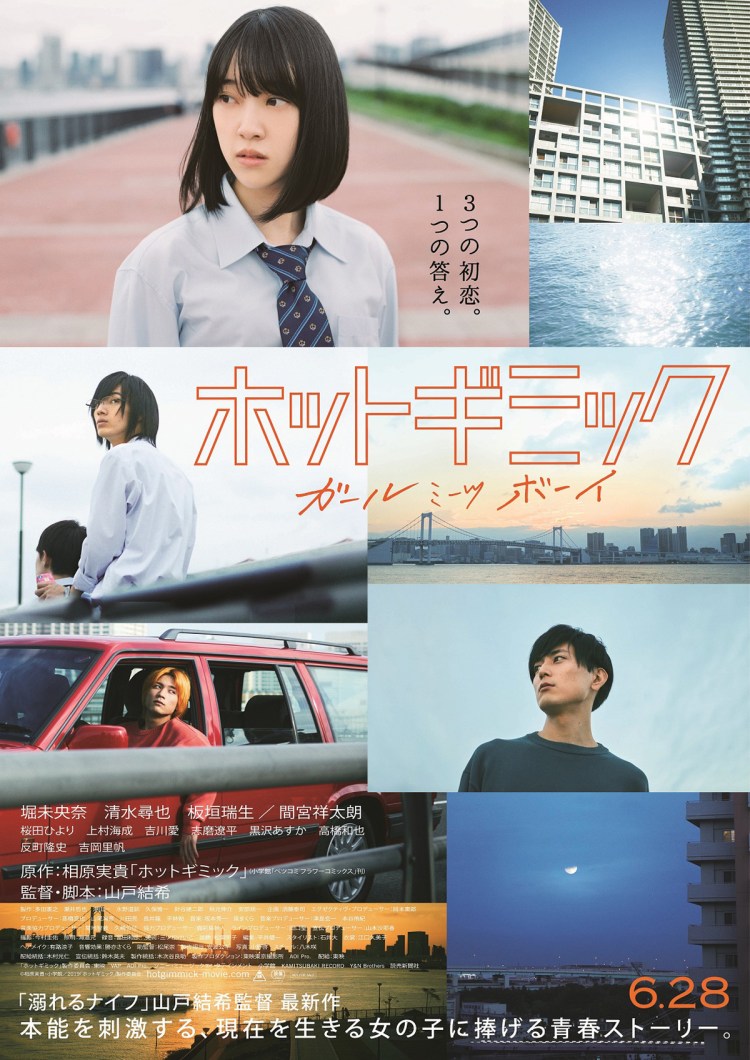
Hot Gimmick: Girl Meets Boy (ホットギミック ガールミーツボーイ, Yuki Yamato, 2019)

Hot Gimmick posterStrangely enough, shojo manga adaptations can in fact be among the most problematic exercises in contemporary Japanese cinema. Targeted very specifically at adolescent girls, the romantic world that they present is often consumed by its own sense of blind innocence as the shy heroine eventually finds love with a “handsome prince” who, though sometimes an inappropriate figure, is either improbably gentlemanly or a “difficult” Mr. Darcy type who more or less bullies her into submission. Yuki Yamato’s adaptation of Miki Aihara’s Hot Gimmick, given the subtitle “girl meets boy” (ホットギミック ガールミーツボーイ), however, seems to be well aware of the genre’s uncomfortable tendency to reinforce conservative social norms and normalise unhealthy relationship dynamics, even if it perhaps fails to entirely reject it in its broadly positive yet ambivalent conclusion.

Innocent and naive high schooler Hatsumi (Miona Hori) has been charged with secretly picking up a pregnancy test for her younger yet much more worldly sister Akane (Hiyori Sakurada) who ends up losing it on their way home from school. Unfortunately, it’s found by a schoolmate, Ryoki (Hiroya Shimizu), who uses it to blackmail her, forcing her to become his “slave” or he’ll send the test straight to her mother. For reasons not entirely clear besides her natural diffidence, Hatsumi goes along with it but is still carrying a torch for a childhood friend, Azusa (Mizuki Itagaki), who has since gone on to become a top idol. Unbeknownst to her, Azusa has in fact returned, apparently missing them all at the estate where he used to live. Increasingly terrorised by Ryoki, Hatsumi is more worried that Azusa will get the wrong idea and assume she is romantically involved with him. Meanwhile, her brother Shinogu (Shotaro Mamiya) is worried about both guys, overprotective in a disappointingly patriarchal way.

This is indeed a very patriarchal world. Unlike her sister, Hatsumi is romantically naive and terrified of the consequences of someone finding out about the pregnancy test even if Akane is fairly unfazed, simply brushing off questions from her mother by implying that someone is probably playing tricks on them. Hatsumi is preoccupied with the nature of “cuteness” and intensely insecure, which is perhaps why she allows herself to go on being manipulated by Ryoki even while knowing that is exactly what he’s doing. “I’m just stupid and unattractive” she’s fond of saying, fully believing that she has no right to her own agency because she is unable to see her own worth.

That essential insecurity seems to make her a magnet for all the creepy guys in a 10 mile radius. Talking to another somewhat imperfect boy, Akane tells him that guys like girls like Hatsumi who seem “vulnerable”, lamenting for a moment that that’s something she definitely is not (ostensibly, at least), but stopping short of reflecting on how dark a comment that might actually be or how the whole concept of “kawaii” is built on the idea of disempowered femininity. Azusa, who is originally posited as the “innocent” love interest, later turns out to be anything but, while Ryoki is later redeemed (to a point) in leading Hatsumi towards an awareness of an agency over her own body, while she, again problematically, turns to her protective brother rather than engage with the various ways in which all three guys have continually misused and manipulated her.

A intense subplot concerning the legacy of illicit romantic relations in the previous generation binds all of the troubled teens inside a net of moral resentment in which they embrace a kind of conservatism they reject their parents for rejecting. They are all, in a sense, attempting to break free of familial legacies, but find themselves paying for their parents’ mistakes while the parents themselves remain more or less absent, occasionally resurfacing to enforce obedience through shame. What Hatsumi comes to realise, however, is that the lesson they were teaching her was not quite wrong but misguided. Where they told her that she should guard her body because not to do so was shameful, she discovers that there is power in owning herself, that she is free to decide what she does and does not do with her body and has the right to grant or refuse access to it.

Nevertheless, her final sense of empowerment is undercut by her continued relationship with Ryoki who, while perhaps growing to accommodate a less misogynistic world view, is still a boy who tried to make her his slave and repeatedly calls her stupid even if eventually agreeing that the whole world turns in her. Yamato’s stylish visuals add to the sense of absurdity which defines the closing moments as Hatsumi at once affirms an awareness of herself as a being with worth and agency, yet also embraces her “stupidity” as she takes her first few diffident steps towards an assurance of adulthood.


Currently available to stream via Netflix in the UK (and possibly other territories)

Original trailer (no subtitles)

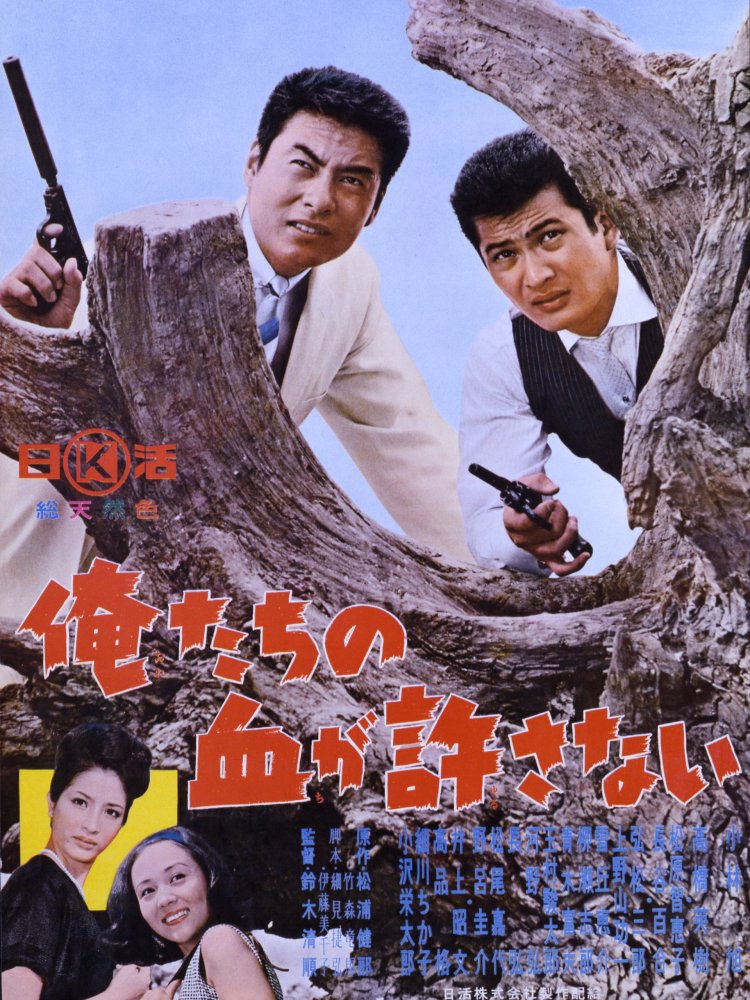
Our Blood Will Not Forgive (俺たちの血が許さない, Seijun Suzuki, 1964)

Our blood will not forgive posterIn Japan, “kaeru no ko wa kaeru”, or “a frog’s son is also a frog”, is an often heard idiom, sometimes disparaging but often affectionate. Can a yakuza’s son become anything other than a yakuza, or does your blood define you in ways you cannot defy? Our Blood Will Not Forgive (俺たちの血が許さない, Oretachi no Chi ga Yurusanai), an early semi-absurdist gangster drama from Seijun Suzuki’s mid-period at Nikkatsu, asks just that question as two brothers battle the legacy of their slain father whose dying wish it was that the yakuza line die with him.

After their father was assassinated at home by sword, the Asari brothers were raised by their mother, Hatsu (Chikako Hosokawa), who did her best to keep them out of the underworld. After the war, however, times were tough. Older brother Ryota (Akira Kobayashi) had to work as a delivery boy to keep the family fed, studying hard at the same time and getting in to a good university. Now grown up, he’s a smart suited night club manager. His younger brother Shinji (Hideki Takahashi), meanwhile, is a clownish goof-off with a good job at an ad agency he’s always in danger of losing (like a fair few jobs before). Today, Shinji was meant to collect his bonus, but he’s bunked off to take part in a local festival which is unfortunate, because he’s got a visitor – Tobita (Akifumi Inoue), the man who killed their father without knowing why and now regrets it. He’s managed to track Shinji down thanks to the fact he looks just like his dad and has a habit of doing stupid things that get his picture in the papers like winning eating competitions and getting lucky on the horses only to get mugged outside.

Tobita’s desire to apologise to the boys exposes their father’s sordid yakuza past and forces them to deal with the legacy of their gangster blood. Though Ryota is more sanguine and simply declares that he “hates all yakuza” before asking Tobita to leave and never come back, Shinji immediately attacks him but then becomes enamoured of the romanticism of the gangster life and considers restarting the Asari clan after getting fired when a picture of him fighting with thugs on the company away trip makes the papers with the headline “yakuza’s son”.

The central irony is that Ryota, who was his mother’s favourite and ostensibly the steady, respectable son, has secretly been a yakuza for quite some time. The club he runs is a yakuza front, which is why he tries to talk Shinji out of trying to get a job there, leading him to feel rejected enough to have too much to drink and start a bar fight, causing problems for Ryota with his boss.

“All yakuza are the same,” Ryota confesses to Shinji as they argue in a car incongruously surrounded by roaring waves, “they’re violent because they’re afraid”. Despite graduating from Tokyo University, Ryota couldn’t get an honest job because they always found out his dad was a yakuza. Out of other options, he decided he had no other choice but to become one too, that he could not escape his blood but might be able to make sure his brother could. Shinji has romantic dreams of the yakuza lifestyle (his bedroom wall’s covered in pictures of Al Capone et al), but Ryota knows what it means, which is why he hates all yakuza, including himself. He’s planning to marry his secretary girlfriend, Yasuko (Chieko Matsubara), but his emotions are so corrupted that he isn’t quite sure if he really loves her or is only making a bid for respectability as a kind of atonement to his mother. In any case, he also feels guilty, knowing that just as his father eventually made his mother miserable, no woman can be happy with a yakuza.

“Yakuza are so stupid, you’re all obsessed with dying – what’s the point?” Shinji eventually exclaims, finally thoroughly disillusioned as his brother goes out in search of an honourable ending rather than trying to escape from certain death at the hands of his vengeful boss. “It may not be easy to live, but there’s nothing honourable about dying!” he tells him, undercutting a series of cultural signifiers, but finally crawling out of the yakuza trap and vowing to live on muddling through with his mother and perky girlfriend, Mie (Yuri Hase) whose birthday party he’s currently missing. Blood does not forgive, but it does eventually release if only you can learn to see it for what it is and choose to be free of it.


Opening (no subtitles)