Empire of Kids (ガキ帝国, Kazuyuki Izutsu, 1981)

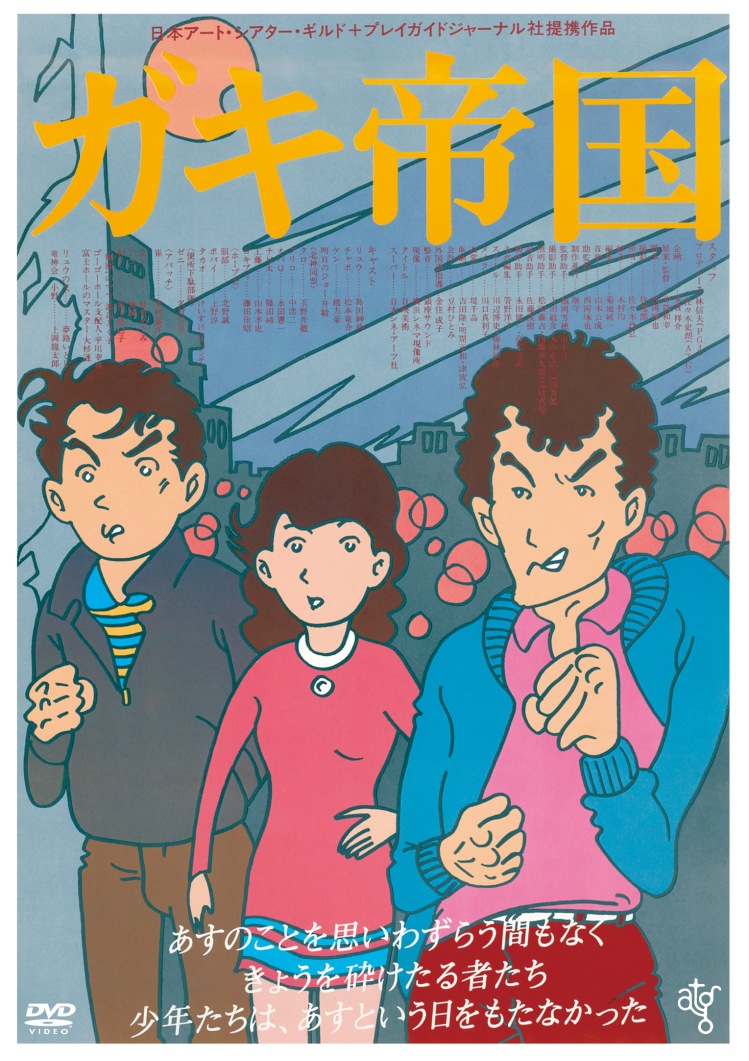
Empire of Kids posterJapan in 1981 was a vastly different place than the Japan of 1967. Rising economic prosperity had produced an amiable social calm in which desire for conventional success and increasingly aspirational consumerism had replaced the firebrand need for social change which had defined the previous decade. Filmmaker, film critic, and sometimes outspoken TV personality Kazuyuki Izutsu was presumedly not a huge fan of consumerism and for this, his first “mainstream” film made for ATG, retreats back to the Osaka of 1967 in which petty street punks lamented their lack of opportunities by banding together and battling for control of their respective neighbourhoods like boys in the schoolyard only armed with knives and filled with nihilistic desperation.

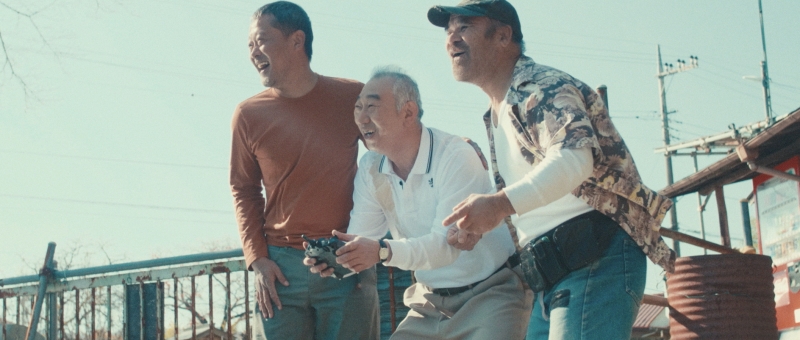
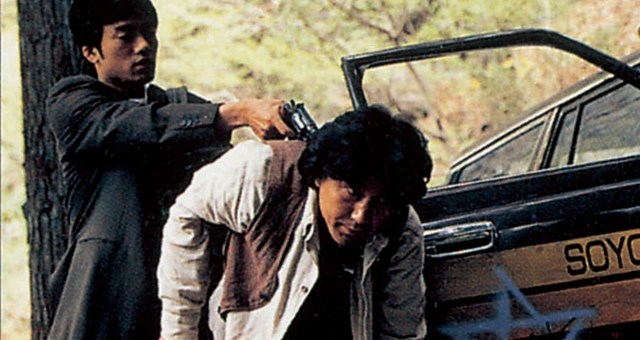
The film opens with our “hero”, Ryu (Shinsuke Shimada), being released from juvie after presumably getting into trouble for his petty punk antics. Waiting for him are his two best friends – soulful zainichi Korean Ken (Cho Bang-ho), and rockabilly Chabo (Ryusuke Matsumoto). Ryu is released alongside another boy, Ko (Takeshi Masu), whom he tries to recruit into their mini gang but quickly becomes an enemy, teaming up with the boys’ rivals – the Hokushin Alliance, while also becoming a potential rival for Ryu’s old girlfriend with dancing dreams, Kyoko (Megumi Sanuki). The boys, still in their last year of high school, become obsessed with trouncing their competition, proving their manhood on the streets while asserting their rightful place as the dominant forces in their native area, but as it increases in intensity the game becomes frighteningly serious and its dangers all too apparent.

Izutsu’s film fits comfortably into the “delinquent” genre but perhaps takes its cues from the Hollywood cinema of alienation more than the tough guy antics of the youth movie past. From Chabo’s bright red jacket and neatly greased quiff, the starting point is Rebel Without a Cause as these otherwise not too bad kids struggle with their place in the world, unable to see a clear path and direction for themselves in the society of 1967 which seemed both frustratingly open and closed to unremarkable lower middle-class boys. Ryu’s brother is going to give up football to go to cram school so he doesn’t end up like Ryu, while Ryu has taken to reading brain training books to try and get back on the academic path to success which he fears may have already passed him by. Ken, idly talking of the future, can’t see much beyond winding up in the yakuza, opening a bowling alley, or maybe becoming a comedian (this is Osaka after all). None of these guys is going to university or getting a salaryman job, they know not much awaits them outside of low-paid manual work, marriage, children, family and death, so they take their frustrations out on each other playing at gangsterism out on the streets.

For Ryu, Ken, and Chabo the reasons for their violence are “honourable” – they want to keep their local space local and are committed to defending it from the “external” threat of the shadier street punks from uptown. Apparently from stable economic backgrounds, the boys’ acts of street justice have no particular economic component, in contrast to those of the Hokushin Alliance which positions itself as a yakuza training school with a brutal hazing regime for new recruits and a business plan which involves hunting young women and trapping them through rape and blackmail to force them into prostitution. 

Aside from lack of direction, Ken – the most introspective of the boys, also has to deal with the constant threat of discrimination due to his roots as an ethnic Korean living in Japan. One of the reasons he hates the Hokushin Alliance and distrusts some of the other gangs is that they deliberately target Koreans in racially motivated attacks. One of his old friends, Zeni (Masaaki Namura), is a member of an all Korean street gang which attempts to defend itself against the strong anti-Korean sentiment out on the streets but finds itself outgunned by the sheer weight of numbers. Ken speaks Korean openly with his friends (even when there are non-Koreans close-by) and has no interest in hiding his ethnic identity even if he uses his Japanese name in his every day life, while Ko (whom we later realise is also ethnically Korean) hides his ethnicity completely and subsumes himself into the Hokushin with a view to finally joining the yakuza even whilst knowing that the gangs he has joined are extremely prejudiced against “foreigners” and Koreans in particular. Ken would never out someone deliberately, but finds Ko’s attitude difficult to stomach, not only in his willingness to hide his roots to fit in with gangster thugs, but in his willingness to persecute his own in order to do it.

The atmosphere that surrounds the boys is one of intense futility. They fight each other pointlessly, like children in the playground, and it’s all fun and games until someone reaches for a knife. Petty disputes quickly escalate when the yakuza gets itself involved in children’s games – an assault rifle, after all, has little place in a kids’ disco where teenagers come to drink Coca Cola and slow dance to a terrible covers band singing the “uncool” music of the day. Despite the melancholy air of frustration and inevitability, Empire of Kids (ガキ帝国, Gaki Teikoku) adopts the otherwise warm and nostalgic tone of the Japanese teen movie, embracing the typically Osakan need for spiky comedy even as our guys fall ever deeper into the hole their society has cut out for them. There are few rays of sunshine to be found here, friendships are broken, trusts betrayed, and futures ruined but then again, that was only life, in Osaka, in 1967.

Fireworks (打ち上げ花火、下から見るか? 横から見るか?, Akiyuki Shinbo & Nobuyuki Takeuchi, 2017) [Fantasia 2018]

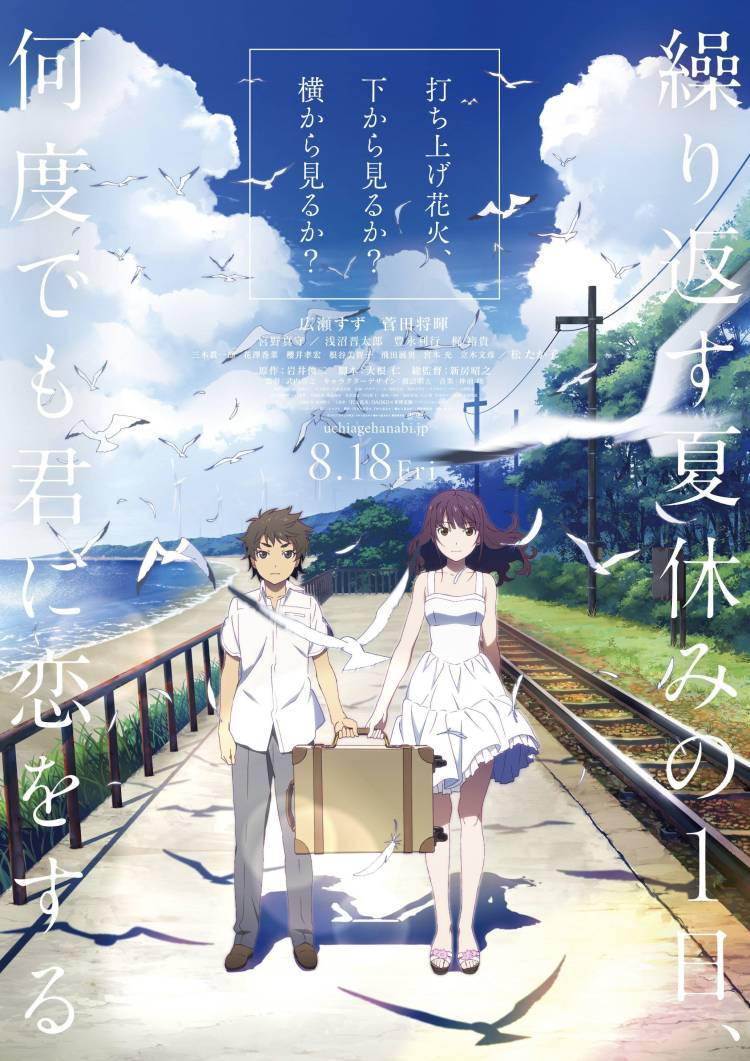
Fireworks posterBack in 1993, Fireworks, Should We See it From the Side or From the Bottom? (打ち上げ花火、下から見るか? 横から見るか?, Uchiage Hanabi, Shita kara Miru ka? Yoko kara Miru ka?), became something of a sliding doors moment for the young Shunji Iwai who received an award from the Directors Guild of Japan for what was in essence a single episode in an anthology TV series dedicated to the idea of “what if”. “What if” is, it has to be said, a constant theme in nostalgic Japanese cinema as slightly older protagonists look back on the hazy days of youth and wonder what might have been if they’d only known then what they know now. Scripted by Hitoshi One (Scoop!) and produced by Shaft, the anime adaption attempts to do something similar, floating in with a gentle summer breeze that could easily be from 30 years ago or yesterday while its conflicted hero ponders where it is he ought to stand to get the most beautiful view of life passing him by.

The central dilemma that seems to obsess the boys this particular summer is whether fireworks are flat or three dimensional and whether your perception of them changes depending on where you stand. Norimichi (Masaki Suda) risks falling out with his best friend Yusuke (Mamoru Miyano) and so has avoided revealing the fact that they both have a crush on the same girl – Nazuna (Suzu Hirose), who (neither of them have noticed) has a dilemma of her own. A chance meeting at the swimming pool seems primed to dictate the romantic fate of all concerned. Norimichi and Yusuke race for the affections of Nazuna who, in the original timeline, ends up asking Yusuke to see the summer fireworks with her even though it’s Norimichi she went there to meet.

Unfortunately Yusuke is a flake and nothing goes to plan. He stands Nazuna up to hang with his buddies and figure out the answer to their inane riddle leaving her to run into Norimichi who gets an unexpected glimpse at her inner turmoil. A mysterious orb salvaged by Nazuna from the nearby sea gives Norimichi a chance to start over, be braver, do things differently thanks to the benefit of hindsight, and so he begins a path to idealised romance by manipulating the events around him to finally “save” Nazuna from making a rash decision (or at least from making it alone).

In 1993, Nazuna’s dilemma was perhaps a little more unusual than it might seem now. Her twice married single-mother (Takako Matsu) is planning to marry again which requires the teenage Nazuna to leave her home behind to live with a strange man in a strange town. Though her new step-dad seems nice and is obviously trying his best, Nazuna is not of a mind to give in. She consents to accepting one of the ice-creams he’s bought to curry favour (after all, there’s no need to be “rude”), but is not about to go so far as to say thank you or to enjoy eating it together with the rest of the family when she could guzzle it sulkily in the comfort of her bedroom. Nazuna wants to escape, but her ideas of doing so are childishly naive even if she puts on a sophisticated front by joking about going to Tokyo to work on the fringes of the sex trade by lying about her age. Hence, she asks a boy she likes but barely knows to take her away from this place, but the boy is just a boy and not quite equipped for rescuing damsels in distress from suffering he doesn’t understand.

Like many Japanese teen dramas, Norimichi’s interior monologue takes on a rueful quality, as if he’s eulogising his youth while still inside it. He doesn’t know whether there’s a difference if you look at things from one angle or another because he’s not particularly used to thinking about things and his first few experiments with the orb are pure reactions to events rather than thought through decisions about effects and consequences. Nevertheless, use of the orb shifts him into a philosophical contemplation of what it is to live a life. Finally realising he should probably ask Nazuna what it is she really wants, the process the pair undergo is one of learning to live in the now rather than obsessing about the end of something that might never begin if you never find the courage to start.

In the end their beautiful dream world is ruptured by a drunken old man, shattering into a thousand shards of memory of things that never were. Fireworks wants to ask if you can have a more fulfilling life by simply changing your perspective, but its central messages never quite coalesce. There is something about Iwai’s original concept which inescapably of its time, sliding neatly into the melancholy world of early ‘90s teen drama drenched in nostalgia for an era not yet past. Reaching for poignant philosophising, Fireworks falls short through, ironically enough, focussing too heavily on a single point of view. An oddly “flat” exercise, Shinbo’s adaptation misses the mark in its climactic moments but perhaps manages to offer something to the lovelorn teens of today if only by yanking them back to a more innocent time.


Fireworks was screened as part of Fantasia International Film Festival 2018.

International trailer (English subtitles)

The original 1986 Seiko Matsuda song reprised by Nazuna at a climactic moment.

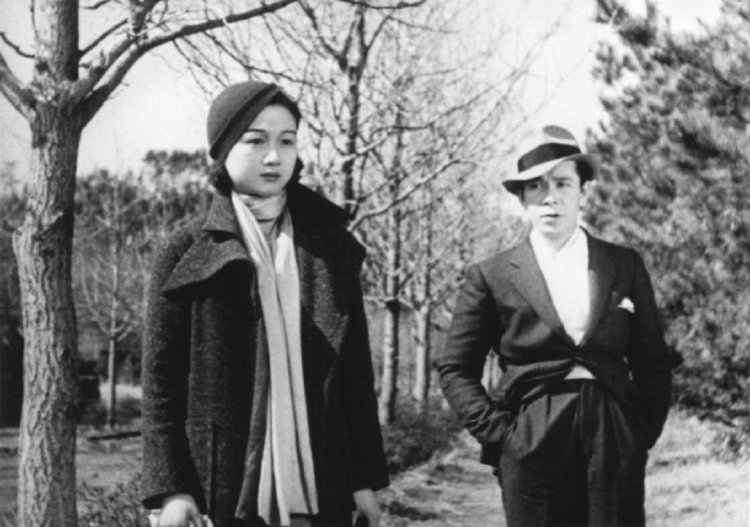
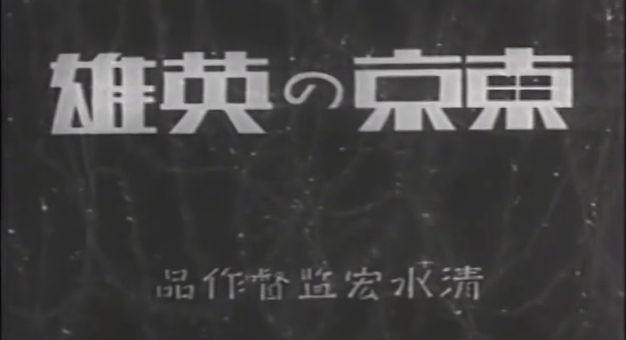
A Hero of Tokyo (東京の英雄, Hiroshi Shimizu, 1935)

Hero of Tokyo still 1Hiroshi Shimizu’s ‘30s films, made against the backdrop of the increasingly censorious militarist regime, had an ambivalent attitude to Japan’s wider foreign policy, its economic impact, and prospects for the future. His final silent film, A Hero of Tokyo (東京の英雄, Tokyo no Eiyu), the title of which is perhaps either deceptive or mildly ironic, is among the bleakest of Shimizu’s depictions of a changing society he perhaps saw as increasingly corrupted by greed and inhumanity. A hahamono of sorts, Hero is not as crushing as Forget Love For Now, but ends on a note of frustrated ambiguity in which wrongdoing has been exposed and justice served but at a terrible cost, leaving the institution of the family itself and therefore the entire social order lying in pieces and broken beyond repair.

The film begins among Shimizu’s familiar milieu of small boys as they watch the trains that will eventually bring their fathers home to them coming and going. Some of the boys stay to play but eventually only one is left behind – Kanichi (Tomio Aoki), whose widowed father constantly works late and leaves him alone in the care of their maid. Kanichi’s father, Nemoto (Yukichi Iwata), is engaged in a local mining concern and, berated by the maid who reminds him that his son is often lonely, decides to marry again to bring order to his house. After placing an ad which states he is a widowed CEO with a good salary, Nemoto marries Haruko (Mitsuko Yoshikawa) – a widow with two children of her own, Hideo (Jun Yokoyama) and Kayoko (Mitsuko Ichimura). A short time later it is discovered that Nemoto’s business is a scam and he flees town leaving his family to face the music alone. Haruko, committed to raising all three children equally, must now find a way to support herself but as a woman with young children and few qualifications there are few jobs available to her. Soon she falls into bar work which may not be “respectable” but allows her to support her family.

10 years later, Haruko owns a fine suburban house and the children appear to be leading a fine middle-class life. Trouble begins when Kayoko (Michiko Kuwano) marries a nice middle-class young man only to be “sent back” soon after the wedding when his family find out about Haruko’s “shameful” past. Though Haruko had told the children that she worked “in a club where executives come to relax” when they were small, Kayoko is shocked and appalled to discover her mother is tainted with the stigma of the sex trade and even more so when her mother’s past threatens to destroy her future. Haruko begs her not to tell her brothers, but Hideo (Koji Mitsui) finds out from his girlfriend, who also dumps him on hearing the rumours, and goes off the rails. Only Kanichi (Mitsugu Fujii), the step-son, stands by the mother he regards as the “best in Japan”, feeling both profound gratitude and sorrowful empathy for the sacrifice she has made on his behalf.

At heart a hahamono, A Hero of Tokyo fits neatly into Shimizu’s career long interest in female oppression in casting Haruko’s trials as entirely caused by being badly let down by a patriarchal society. Having lost one husband and being betrayed by the second, Haruko is forced to stand alone in a society which refuses to forgive her for it. As a “married” woman, she can gain no “honest” work and the necessity to care for her children means that she cannot take a role in service which in effect means dedicating oneself to a family which is not one’s own. She lacks qualifications or connections and has no family to support her and so she is forced into the only remaining line of work available to women in her situation. Haruko makes a great success of herself and becomes an upright businesswoman running her own establishment even if she cannot be exactly proud of the achievement which does (to her own shame and regret) rely on the degradation of other women just like her, though she tries to do the best for them that she can.

Yet her children, as all ungrateful children of a hahamono, are unable to forgive her for the transgressions she was forced to make entirely for their benefit. Having cast their mother as a saint of elegance and decorum, they cannot accept this new information which renders her a mere woman at the mercy of a cruel society. Kayoko, having run away from home, ironically finds herself in the same, or perhaps a worse, position, becoming a streetwalker – by her own admission “famous” and an accidental subject for one of Kanichi’s episodes of investigative reporting as a rookie newspaper man. Meanwhile Hideo has crossed to the other side and joined the ranks of exploiters of women in joining a gang only to get himself into trouble for trying to leave it when he realises he has become a hired goon for one of Nemoto’s stooge companies. The children are “ruined” not by their mother’s “sin” but by the conservative society that forced her into it and by the paternal failures of Nemoto whose abandonment reduced them to dire desperation.

It is, in this sense, Haruko rather than Kanichi who is the “hero” of the title – valiantly battling against the prejudices and cruelties of the city whilst retaining her innate sense of honour decency and steadfastly shielding her children from suffering. Her attempt to protect them perhaps backfires, leaving them without the necessary perspective and humanitarian spirit to feel empathy for others rather than succumbing to the judgemental attitudes of the age. Thus both of the biological children are condemned to suffer in the very way Haruko suffered to prevent and then find themselves too ashamed to return to her. Only Kanichi who had already suffered in his childhood loneliness, in his shame for the transgression of his father, and his position as a step-son doubting his place in a family which was not his by blood, is able to accept and sympathise with his mother’s suffering and experiences only guilt and gratitude that she had chosen to sacrifice herself for his greater happiness.

Yet Kanichi’s role as the good son is also tainted by his filial opposition to his father as it necessarily conflicts with his desire for social justice as a crusading reporter. Kanichi’s desire to expose corruption is ultimately for the common good – to save innocent people being deceived by his father’s dishonourable scheming, but it’s also an act of revenge aimed squarely at a symbol of broken patriarchal responsibilities. In the various names Shimizu attaches to Nemoto’s sham businesses, he aligns him with the expansionist Japanese state which was currently attempting a similarly dishonourable attempt to sell the economic gains of its imperialist project built on the back of international exploitation and dishonesty. It is not just a father who has failed his family, but “the” father which is failing its people in leading them down a dark and disturbing alleyway in which honour and morality no longer have any currency.

Kanichi too profits from his father’s crime – his first bonus is a direct result of the exposé of his father’s company and so he also becomes part of a system of corruption. His actions, however, are not entirely accepted by Haruko who is ashamed and troubled by Kanichi’s crime against filial piety and therefore by his betrayal of the social codes which define his society. Kanichi has picked a side, but in doing so he has also damned himself and emerges not victorious but compromised. Despite the “happy” ending, in which justice has been done and the emotional bonds of the true family restored, the concluding scenes remain ominous as the newspaper boy delivers the sorry news all over town and ruptures the tranquil middle-class peace of Haruko’s once happy suburban home.


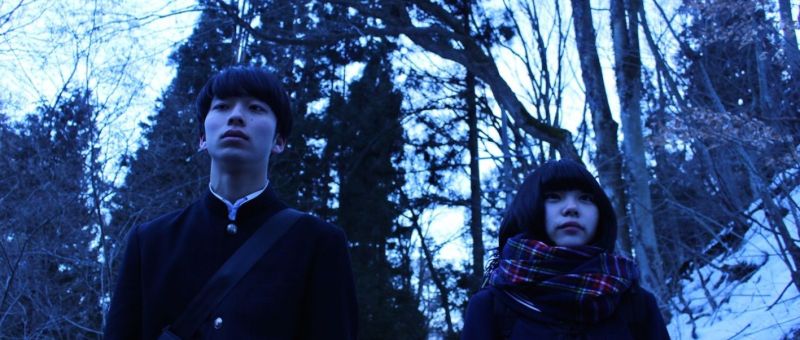
Amiko (あみこ, Yoko Yamanaka, 2017) [Fantasia 2018]

Amiko PosterSome meetings are pivotal, others merely seem so. To melancholy high school girl Amiko (Aira Sunohara), consumed by youthful ennui and a sense of the long dull years stretching out before her, Aomi (Hiroto Oshita) seemed like some kind of heaven sent emissary – a good looking guy who seems to share her existential despair, her taste in music, and her lack of motivation for the business of living. Yet the meeting comes to nothing. After a single night of walking and talking, baring their souls and confessing their anxieties, the pair never talk again. Amiko continues to pine for Aomi, turning him into some kind of absent god, though months have passed with no real contact save her semi-stalking of him online. Eventually, almost a year later, Amiko learns that her one true love has deserted her and run off to Tokyo with another girl. Stunned, she resolves to follow him in the hope of finding out why he chose to renounce all it was she thought they meant to each other to embrace the mediocrity he once claimed to hate.

Amiko is not completely alone, she has a best friend – Kanako (Maiko Mineo), though she confesses that deep down they don’t really understand each other. Aomi too seems to think that Kanako is closed off, not really trusting anyone and living a superficial life. Nevertheless, Kanako does at least provide Amiko with the opportunity to experience the regular high school girl world of gossiping about boys on the telephone and silently resenting other, more popular girls. Claiming that “ordinary poor souls” could never understand the innate connection between herself an Aomi, Amiko decides to keep her long night walk of the soul a secret from her best friend in order to secure its purity.

Amiko, based on their intimate conversation, is convinced that Aomi feels the same way she does, understands her intense sense of existential despair, and is just as bored and disconnected as she feels herself to be. Confessing that he doesn’t actually like sports, in fact he hates being outside, Aomi offers the excuse that it’s easier being told what to do than trying to figure things out on your own. Carried along by the fact he’s good at football and can’t quite find the energy to protest, Aomi drifts on a cloud of his own apathy – one of the cool set of handsome and aloof high school boys popular with those who like unattainable guys. Like Amiko he likes “deep” music, instantly recognising the Radiohead track on her phone, but eventually runs off with the kind of girl Amiko (not so) secretly despises – an airhead popular girl and the “embodiment of mass culture”.

Aomi’s betrayal isn’t just romantic heartbreak, but the severing of a spiritual connection which never really existed in the first place. Rather than deepen the engagement, Amiko opts to leave her night of connection as a mythic encounter, sanctified by its unique quality. Aomi therefore becomes a mythic figure, a composite of Amiko’s various projections of her ideal soulmate, mirroring her own sense of ideological purity. Her new god, however has feet of clay and after tracking him down in the city she’s forced to confront the distance between the image and the reality. Was their connection as real as she thought it was, or only superficial musing on a cool crisp night when there was nothing much else to do?

Deep into her teenage apathy, Amiko talks about those manic, one off days where you just might find yourself doing something crazy out of a sense of cosmic despair. Aomi puts this idea back on the table as a possible motive for his abrupt flight to the city, and Amiko’s random pursuit of him is perhaps its aftershock. Wandering around having mad adventures – joining in with a madman’s (Hisato Takahashi) condemnation of a world of lies and the non-existence of real love, testing the ability of Japanese people to dance spontaneously, and stalking Aomi’s girlfriend, Amiko begins to accept that she may have been mistaken in placing such cosmic importance on what may just have been an inconsequential night filled with accidental profundity. Preferring to maintain the “purity” of her ideal, Amiko remains trapped within her own sense of despair but with a new sense of clarity and a determination not to let the phoniness of the world destroy her essential self.


Amiko was screened as part of Fantasia International Film Festival 2018.

Original trailer (no subtitles)

Room Laundering (ルームロンダリング, Kenji Katagiri, 2018) [Fantasia 2018]

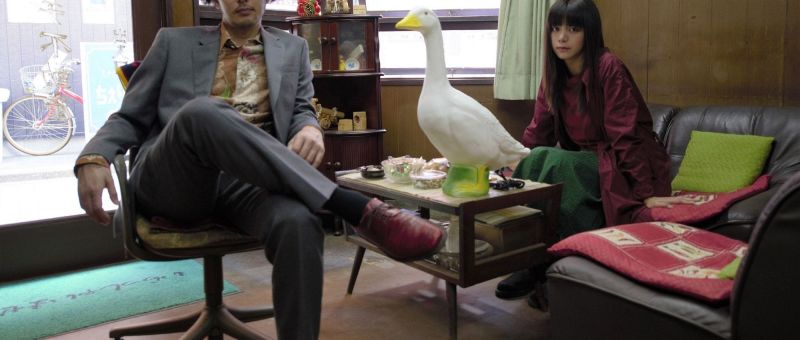
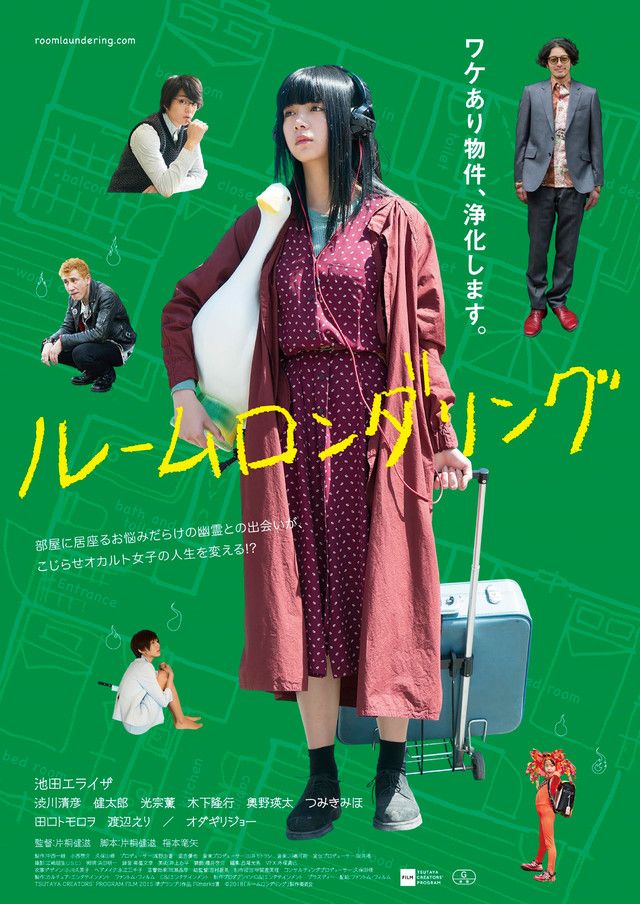
Room Laundering posterIn the olden days, when there had been a traumatic incident, holy people would be brought in to perform some kind of ritual to “purify” the air so life could go back to “normal”. These days people don’t believe in ghosts, or at least not in ghosts of that kind, but there is still a degree of discomfort involved in spending time in a place where something unpleasant has happened. Japanese rental laws state that a prospective renter/buyer should be informed if something untoward has occurred in the property, but the law only requires you to tell the next person in line. Therefore, if you can find a person willing to spend a few days in an apartment with a troubled past, they could be quite a useful asset to the unscrupulous estate agent.

Miko Yakumo (Elaiza Ikeda) is just such a woman and has therefore found herself falling into a “room laundering” career thanks to her uncle Goro (Joe Odagiri), a roguish real-estate-broker-cum-underworld-fixer with a sideline in fake IDs for undocumented migrants. Miko’s father died when she was five, and her mother disappeared without warning a few years later leaving her with her grandmother who died when Miko was 18. She’s now 20 and is nominally in her uncle’s care but having dealt with so much loss and abandonment, she prefers to keep to herself, always closed off with a pair of headphones blocking her ears, speaking to no one. The apartment “job” therefore suits her well enough with its clear stipulation to avoid mixing with the neighbours, but there’s one big drawback. Miko has recently developed the ability to see ghosts which is sometimes a problem given the circumstances her new places of residence became vacant.

A tale of learning to deal with the past, Room Laundering (ルームロンダリング) takes its heroine on some long, strange journeys but despite its death laden themes and Miko’s emotional numbness it has its essential warmths even if they’re sometimes harder to see. Miko’s travels chart a course of modern loneliness as she encounters those who’ve found themselves passing away alone, in pain and in sadness – old ladies whose bodies weren’t found until they’d almost all rotted away, neglected children who starved to death after being abandoned, businessmen who killed themselves after getting into debt, a catalogue of human misery seemingly without end. Miko doesn’t find the ghosts scary because she thinks real people are scarier. They lie, and they leave, and they let you down. At least the ghosts will stick around even if you wish they wouldn’t.

Even so, interacting with the recently deceased begins to reawaken Miko’s sense of vitality. Drinking with (or more accurately on behalf of) an insecure punk rocker (Kiyohiko Shibukawa) who took his own life before sending off his demo tape proves an oddly fulfilling experience for the otherwise introverted young woman, while staying in the apartment of a murdered cosplayer (Kaoru Mitsumune) gives her a sense of purpose when she decides to help the unfortunate woman move on by unmasking the real killer. Meanwhile, she also breaks her non-fraternising rule to chat to the geeky boy next-door (Kentaro Ito) and starts to wonder if maybe not all the living are so bad after all.

In dealing with the legacy of abandonment while literally living a transient life, Miko is forced to confront the ghosts of her past and exorcise them in order to escape her self imposed limbo. Only by being on her own can she reach the realisation that she is not alone. Meanwhile, Uncle Goro’s originally shady looking services for migrants without the proper papers begin to look more altruistic than they first seemed. He, like Miko, is helping himself by helping others who are also trapped in a kind of limbo only a more prosaic earthbound one of rigid bureaucracies and xenophobic exploitation. Goro maybe a dodgy estate agent with a sideline in forcing grannies out of their homes to pave the way for “redevelopment” but at least he’s found a better system of room laundering than his colleague who generally just rents to foreigners and visa overstayers he can either evict or extort if things go wrong. It just goes to show a little bit of empathy goes a long way. After all, you’re a long time dead.


Room Laundering was screened as part of the Fantasia International Film Festival 2018.

Original trailer (no subtitles)

Being Natural (天然☆生活, Tadashi Nagayama, 2018) [Fantasia 2018]

Being Natural posterModern life is stressful and perhaps does not offer the kinds of material rewards that previous generations took for granted. Moving back to the country to experience a simpler, more sincere kind of life has become a mini trope in contemporary Japanese cinema as the young men and women of Japan become disillusioned with a stagnating economy and, feeling trapped within a conformist society, decide to embark on a life of self sufficiency free of material burdens. What such stories have not yet asked is if the influx of outsiders from the city amounts to a colonisation of so far untouched land as the newcomers bring with them their newfangled desires and attitudes. Tadashi Nagayama’s gentle satire Being Natural (天然☆生活, Tennen Seikatsu) is partly an attack on rampart xenophobia and small scale colonialism but also a mild condemnation of corporatised hippiedom and its tendency to destroy the thing it claims to honour in remaking it to fit a city dweller’s ideal of idyllic country life.

Shy and awkward, Taka (Yota Kawase) is an unemployed middle-aged man who lives with his elderly uncle in the ancestral family home. Taka’s uncle suffers from dementia and, it seems, was always a “difficult” person even in his youth which is perhaps why the rest of the family have abandoned him with only the gentle Taka prepared to stay behind and look after the ageing patriarch. When his uncle dies, Taka’s world threatens to collapse but thankfully his embittered cousin Mitsuaki (Shoichiro Tanigawa) is talked round by his sister and decides to let Taka stay in the family home as a thank you for taking care of everything for so long. Not only that, Mitsuaki also gets Taka a job working at the local fishing pool alongside another old friend, Sho (Tadahiro Tsuru).

Reverting to childhood, the three men generate an easy camaraderie, looking after turtles, having barbecues, and making music together under the moonlight. The idyllic days are not to last, however. The harbingers of doom are a hippyish family from Tokyo who moved into the village with the intention of opening a coffee shop. The Kuriharas – Keigo (Kanji Tsuda), his wife Satomi (Natsuki Mieda), and daughter Itsumi (Kazua Akieda), are into the “natural” way of life and have moved from Tokyo for the benefit of their health. Rather than shop at the supermarket like everyone else, they’re keen to buy from Sho’s grocery store even when he explains to them that all his veg is old and shrivelled rather than freshly plucked from local fields. Still, the family are determined even if it means projecting their vision of “rural life” onto the evident reality.

The Kuriharas are literally intrusive – rudely opening the sliding doors of Taka’s house without permission and waking him up, offering the excuse that they were unable to find the “intercom” on this traditional Japanese house that they claim to admire so much. The original site having fallen through, they’ve set their sights on setting up shop in Taka’s home, exploiting the “traditional” architecture for their warm and welcoming cafe. This is all very well but it does of course mean displacing Taka from his natural habitat. As shy and mild mannered as he is, there’s only so much a man can take and Taka resents being evicted from his family home by a bunch of invading interlopers with commercial concerns.

While Satomi natters on about organic veg, Itsumi skips the English classes her controlling mother makes he go to and guzzles additive loaded instant ramen when she thinks no one’s looking. Wanting to preserve the “natural beauty of glorious Japan”, Keigo goes slightly nuts when he realises Taka’s pet turtles are a non-native breed, exploding with xenophobic fury over the dangerous presence of a disease laden predator whose presence threatens the safety of the true Japanese amphibian. Wondering exactly who or what is the “non native” threat, Taka launches a full scale resistance movement, papering the house in giant graffiti posters reminiscent of the student protest era reminding all that turtles, no matter where they’re from, have a right to life too and must be defended. Yet the corporately minded hippies will stop at nothing to get what they want – manipulating Mitsuaki with a new girlfriend and then turning the town against Taka by means of a heinous, life ruining rumour. 

Forced out and heading to the city, Taka is reminded that he is now the hostile foreign element – that the park is not his “home” but belongs to “everyone”. When his beloved bongos are ruptured, Taka’s rage turns radioactive and sends him off on a quest of vengeance only to recede as his better nature regains control and he commits himself to using his new found powers to improve the lives of those around him in small but important ways. A satirical take on the romanticisation of country life by self-interested city dwellers, Being Natural eventually takes a turn for the macabre that possibly undercuts rather than reinforces some of its central concerns but makes a case for according the proper respect to the natural world as well as the people who live within it rather than attempting to exploit it for oneself whilst wilfully ruining it for others.


Being Natural received its international premiere at Fantasia International Film Festival 2018.

Original trailer (English subtitles)

Liverleaf (ミスミソウ, Eisuke Naito, 2018)

(C)押切蓮介/双葉社 (C)2017「ミスミソウ」製作委員会

Liverleaf poster“How have things turned out this way?” Asks the heroine of Eisuke Naito’s Liverleaf (ミスミソウ, Misumisou) after receiving a poignant (non)explanation for the cause of all her sufferings. Adolescence is cruel at the best of times, but when you’re stuck in a tiny no horse town with nothing to do, violence can become an easy pastime. The kids of Liverleaf take the art of bullying to all new heights, stopping not at humiliation, ostracisation, or conspiratorial acts of emotional ruin but allowing their petty games to run all the way to arson and murder.

Haruka (Anna Yamada), unlike most of her classmates, is a relatively new resident of a small rural town where she and her family have moved for her father’s job. Her only friend at school, and the only one to stand up for her against the gang of popular kids making her life a misery, is another transfer student, Aiba (Hiroya Shimizu), living alone with his grandmother for mysterious reasons. The usual high school girl tricks of making another girl feel unwelcome – stolen shoes, name calling, silent stalking etc eventually progress into direct violence at which point her father (Masahiro Toda) tries to go to the school to complain. Unfortunately, Haruka’s teacher (Aki Morita) is an almost absent, hollow source of authority who cannot control the kids and nor does she try. She tells Haruka’s dad that as the school will be closing down at the end of the academic year it’s hardly the time to make waves and she sees no need to get involved in such trivial matters. Matters come to a head when the kids, egging each other on, set fire to Haruka’s house with her mother (Reiko Kataoka), father, and little sister Shoko (Sena Tamayori) trapped inside.

It’s true enough to say Haruka reacted to her bullying in the way that society expects – she kept her head down and tried to put up with it without making a fuss. Some may read Liverleaf as a tale of vengeance, but it isn’t. As passive as she’s always been, Haruka’s acts of violence are a matter of extreme self defence. She doesn’t go looking for the ones who’ve done her wrong, but they come looking for her and thereafter pay a heavy price for their continued campaign of subjugation.

Haruka became an easy subject for bullying because she was a literal outsider – Aiba escaped this particular fate through being male, conventionally attractive, and with a confidence and maturity which set him apart from the bratty kids trying to prove their status by belittling others. Once Haruka decides to sit out the rest of the school term rather than put up with constant torment, she activates an extreme chain of events when the next likely target, a strange girl with a stammer (Rena Ohtsuka), decides to do whatever it takes to become one of the bullies rather than their latest victim. Morality goes out the window when fear takes over and some will to whatever it takes to make sure it’s someone else in the firing line rather than themselves.

Yet for all the fear and violence, there’s another, perhaps more interesting, story buried under all the senseless bloodletting. It’s not so much that teenage emotions are running wild, but that they barely have them at all and those they do have find no available outlet. Romantic jealousy spirals out of control, turning in on itself as love denied masquerades as hate. Unable to freely voice their innermost anxieties, the kids take their resentments out on each other, getting their kicks through cruel games which bind them with complicity in the absence of real feeling.

Naito attempts to lend an air of realism to the increasingly bizarre middle school warfare but cannot escape the manga origins of his source material. The violence itself is cartoonish and absurd, but there’s also an unpleasant layer of fetishisation which takes over as the blood starts flowing, almost revelling in acts of extreme cruelty as a young man exults in beating the face of a young girl to a bloody pulp. Unremittingly bleak, Liverleaf makes a bid for pathos in its closing coda as it takes us back to a case of ruined friendships and broken dreams but it can’t overcome the uneasy stylisation of all that’s gone before in swapping emptiness for wistful melancholy.


Liverleaf screens as part of New York Asian Film Festival 2018 on 8th July, 7pm with director Eisuke Naito in attendance for a Q&A.

Original trailer (English subtitles/captions)

Midnight Bus (ミッドナイト・バス, Masao Takeshita, 2018)

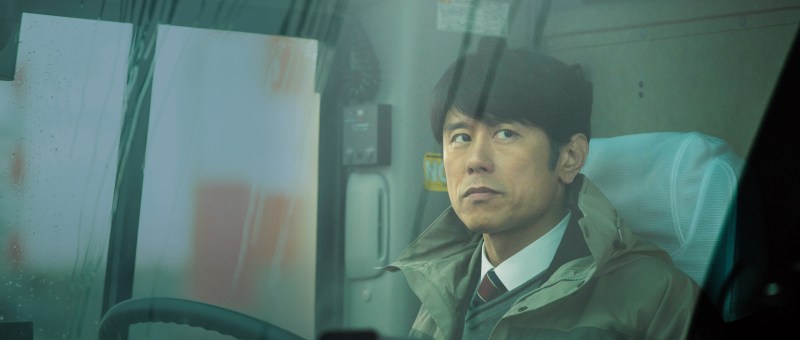
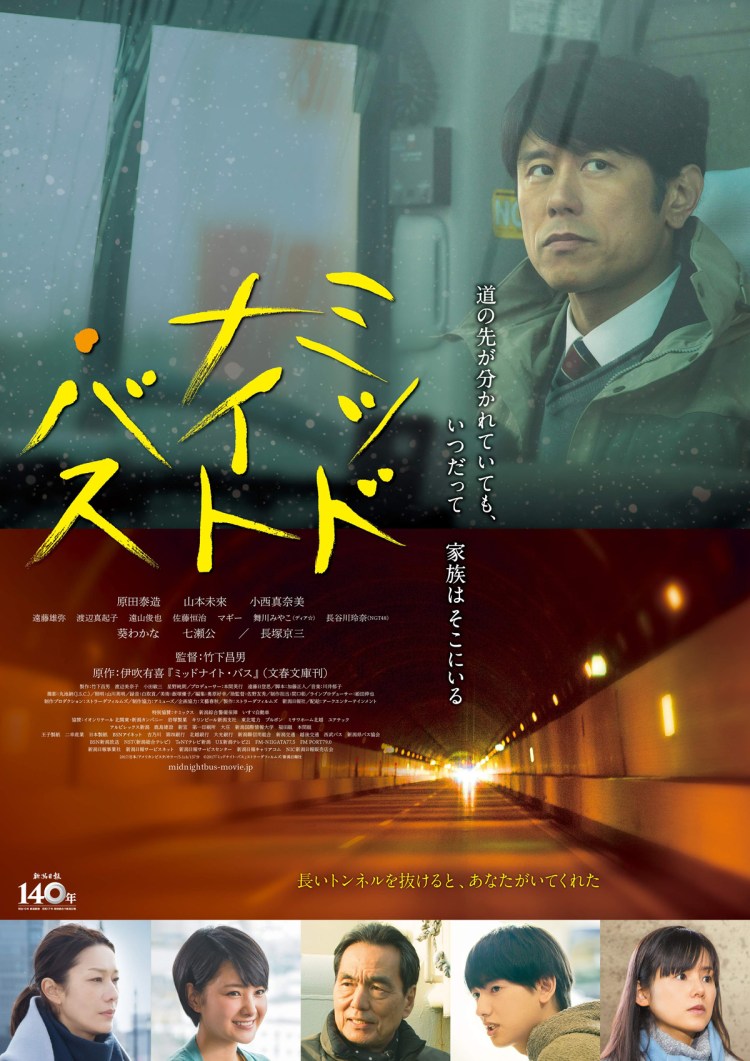
midnight bus posterYou know how it is, you coast along empty inside for what seems like a millennia until you finally decide to change your life and life says no, not like that. The hero of Masao Takeshita’s adaptation of the Naoki Prize nominated novel by Yuki Ibuki Midnight Bus (ミッドナイト・バス) must be well acquainted with phenomenon as his attempts to move a new relationship to the next level are scuppered by the unexpected arrival of not only boomerang children, but an estranged ex-wife and in-laws to boot. Caught between two places, two families, and a number of possible futures it might be time to head off road but the courage to leave the familiar route behind is a hard thing to find when you’ve been used to the security of travelling in tunnels.

Riichi Takamiya (Taizo Harada) drives the overnight bus from Niigata to Tokyo. In the capital, he has a tentative relationship with a younger woman, Shiho (Manami Konishi), who runs a small cafe/bar but his attempts to introduce her to his home life back in the country run aground when grown-up son, Reiiji (Ko Nanase), picks exactly the wrong moment to come home after having abruptly given up his lucrative IT job and moved out of his Tokyo flat. Meanwhile, Riichi’s daughter, Ayana (Wakana Aoi), has embarked on a wacky cosplay career and is thinking about marrying her longterm boyfriend. At this extremely sensitive time, Riichi spots a familiar face on the bus one day – his estranged former wife, Miyuki (Mirai Yamamoto), who has returned to Niigata to visit her ailing father and take care of “family” business.

All three Takamiyas are in a sense adrift, never having properly dealt with the abrupt exit of Miyuki who left when both the children were small. As a young scrappy couple in post-bubble Tokyo, Riichi and Miyuki had been happy but when Riichi decided to move the family back to Niigata for a “less stressful” existence everything began to go wrong, largely because of Riichi’s unforgiving mother who made her daughter-in-law’s life a misery. Now Reiji is facing a similar dilemma in finding city life too demanding, but unlike his father he can afford the time to take a break and figure things out seeing as he is single and unburdened by the need to support a family. Ayana, meanwhile, is about to find herself in a similar position to her mother as she discovers when she plans to introduce her intended to her father only to have him bring his snooty parents along unannounced and change the venue to an upscale restaurant more in keeping with their tastes. Poking into family details, looking down on Riichi’s job, and finally making a pointed comment about Reiji’s stress-related skin condition and a “concern” regarding her son’s children being “contaminated”, it’s obvious Ayana and her boyfriend’s mother will never get on.

Riichi is a kind and patient man, though sometimes a little insensitive in his far seeing plan to ensure everybody’s happiness. He bears no ill will towards Miyuki and hopes that she will be able to rebuild a relationship with her children, engineering a plan to bring them together while he helps her cope with the events that have brought her back to Niigata. Meanwhile, he also tries to keep things going with Shiho who has been hurt before and understands the reasons for Riichi’s hot and cold attitudes but is increasingly frustrated by the abrupt changes in his feelings and intensions. Riichi will have to make a choice between past and future, but if he chooses to put his family back together again it must be short lived as he prepares to push his children back out into the world with a little more direction and confidence after having addressed their deep seated familial traumas.

The bus journey becomes a point of transition in more ways than one – between city and country but also between two personas and two ways of being. In Niigata Riichi is “dad”, the family lynchpin, while Tokyo affords him the opportunity to be a “man” in relative freedom, free to pursue a second chance at romance with all his baggage safely stored at home. Like his children he will need to find a way to integrate his past self with his future one if he wants to forge a way forward, but in order to do that he’ll have to accept the risks a putative future entails and make peace with his old life in order to start all over again. A sometimes poignant family drama, Midnight Bus is a restrained affair but one filled with empathy and a generosity of spirit as its various protagonists learn to free themselves from familial legacy in order to pursue their individual destinies with kind eyes and clear hearts. 


Midnight Bus screens as part of New York Asian Film Festival 2018 on 11th July at 6pm.

Original trailer (no subtitles)

Smokin’ on the Moon (ニワトリ★スター, Kanata Wolf, 2017)

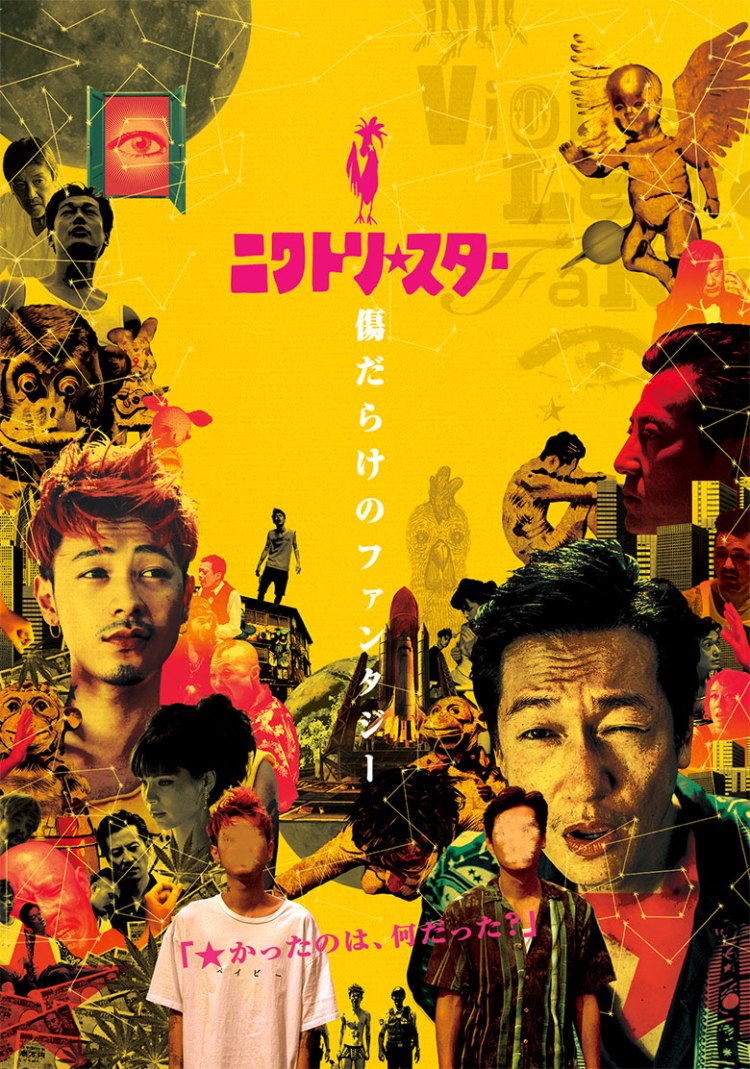
Smokin' on the Moon posterSlacker drama has become a mainstay of the Japanese indie scene as aimless young men drift freely in a society which promises them little and threatens to take much. Even so they’ve rarely been quite so genially lost as the pair at the centre of Kanata Wolf’s Smokin’ on the Moon (ニワトリ★スター, Niwatori★Star) whose relatively serene life of stoner bliss is radically derailed after a dramatic encounter with a psychotic yakuza drug dealer. Dreaming of escape, a better life somewhere else, the pair find themselves taking very different paths as they reflect on their familial pasts, broken dreams, and future promises.

34-year-old Sota (Arata Iura) and his younger unofficial roommate and official best friend Rakuto (Ryo Narita) live a “simple” life of casual work which pays for rent and getting stoned if not much else. They are broadly “happy” with their aimless drop out lives and determined not to get involved with the shadier sides of their underworld existence by avoiding the pull of hard drugs and gangster hang outs. All that ends up going by the wayside when their dealer, Jay (Peron Yasu), is offed by sadistic yakuza Hatta (Kanji Tsuda) who makes a point of dropping in on the boys to ask them if they know where Jay might be in order to make sure they don’t. Being directly confronted with gangster violence sparks Sota into a series of epiphanies as he suddenly realises that the stoner life is not a good fit for a man of 34, while Rakuto, who has few other options, considers throwing his lot in with Hatta if only to remain on the sidelines of organised crime.

Sota, son of an Osakan okonomiyaki restaurant owner (Eiji Okuda), left home in flight of family legacy, bored with boring small-town life and resentful of his “destiny” as the heir to a family business. Eight years in Tokyo, however, have been largely wasted, squandered away on constant evasion with nothing more to show for his time than a few crazy stories and a deeply held friendship. Sota does at least have a safety net, he can always go home to a family that will welcome him with open arms. Rakuto is not so lucky. Harbouring deep seated resentment towards his mother who was unable to protect him from a violent step-father, Rakuto fled Okinawa to escape the memory of a traumatic childhood which is perhaps why he finds himself becoming a surrogate father to a little boy whose mother, as it turns out an old friend of his, desperately tries to kick a crack habit given to her by an unforgiving city even as it crushed her dreams of musical success.

Discovering an old report card on which he’d written that his greatest ambition was to work hard for his family, Rakuto decides he needs to buck up and become a responsible husband and father who can provide a stable home for a woman and a child. There are, however, few opportunities for middle-school dropouts and even those there are Rakuto has already disqualified himself from thanks to his stoner looks which include fiery red hair and several prominent tattoos (prohibited in almost every conceivable “decent” job in Japan). Thus he feels his only option is to become a kind of errand boy for Hatta, naively believing he will allow him to remain in the shallower end of the gangster pool just dealing weed and making deliveries rather than pushing hard drugs or getting involved in violence. While Sota finds peace in the country, Rakuto begins to build the family life he’d always dreamed of while trying to cope with the constant anxieties of being an underling to a bunch of unhinged crooks.

Wolf shifts registers throughout – starting off in stoner comedy where our heroes inhabit a bohemian world of gay bars and randy landladies, shifting into crime thriller as the nasty gangsters rear their heads, and then finally ending up in masculine melodrama as Sota recounts the sad story of his friend who, despite his good heart, finds himself a victim of fate rather than of himself or even of his society. Mixing strange animation and surrealist diversions with an affecting tale of friendship, Smokin’ on the Moon is another sad story of those unable to find their place in the world taking refuge in each other only to find a melancholy compromise even as fate threatens to rob them of the little joys they’ve found.


Smokin’ on the Moon screens at New York Asian Film Festival 2018 on 10th July at 9.15 pm plus Q&A with director Kanata Wolf

(Kanata Wolf (かなた狼) previously known as Yuichiro Tanaka (たなか雄一狼). Surname is Wolf as per official website).

Original trailer (no subtitles)

Kamikaze Taxi (Masato Harada, 1995)

Kamikaze Taxi DVD coverAlmost 25 years later, Masato Harada’s post-bubble critique of a society failing to deal with its traumatic past feels oddly relevant. Xenophobia, misogyny, class oppression, and political corruption are far from unique problems but find fertile ground in a society in flux in which recent economic trauma has forced tensions to the fore. 1994 was a period of marked political chaos in which a corruption scandal had brought down a Prime Minister while the country debated electoral reform and attempted to deal with the ongoing recession, finding itself caught between the problems of past and future as the Showa era legacy continued to gnaw at the promise of Heisei.

Lowly goon Tatsuo (Kazuya Takahashi) has been charged with finding girls for corrupt politician Domon (Taketoshi Naito), but his world is turned inside out when Domon badly beats a prostitute leading his girlfriend Renko, a madam, to kick up a fuss which eventually gets her killed by sadistic mob boss Animaru (Mickey Curtis). Insensitively ordered to dispose of Renko’s body, Tatsuo’s resentment intensifies until he is shouldered with caring for the injured prostitute, Tama (Reiko Kataoka), who tells him that Domon keeps a large amount of cash hidden in his house. Seeing a chance to escape from the yakuza world whilst getting revenge on everyone involved in the death of Renko, Tatsuo enlists a few of his trusted guys and stages a heist. It goes badly wrong, leaving everyone except Tatsuo dead.

Meanwhile, on the run, Tatsuo gets a lift from Peruvian returnee Kantake (Koji Yakusho) now working as a taxi driver after being unable to find any other kind of work in the middle of a recession in a society not always welcoming of overseas workers. Although he was born in Japan and spent most of his childhood in the country, Kantake’s grasp of the language has become corrupted and he finds himself unable to communicate in his “homeland” despite being “Japanese”. Even without verbal communication, the two men bond and Kantake returns to collect Tatsuo despite becoming aware of his gangster past, forging a kind of brotherhood in their shared outsider status.

When Tatsuo is first introduced to Domon, the first thing he asks him is if he is “fully Japanese”. Domon “hopes” he is, but has his doubts because his name “sounds a bit Korean”. Harada opens the film with some on screen testimony from migrant workers in Japan, some of whom are, like Kantake, of Japanese birth if raised overseas but nevertheless find themselves regarded as foreigners – turned down for housing and employment, cast out from regular mainstream society. In the bubble era when it was all hands to the wheel, the migrant workers were an essential part of a well functioning economy, but now the bubble’s burst and they are no longer “needed” as construction dwindles and the demand for casual labour decreases, men like Domon begin to suggest simply sending them all “home”. 

A fierce nationalist, Domon is also a misogynist whose sexual proclivities run to extreme violence. Sadly, his views are not so far from the mainstream as might be hoped – the heartless yakuza think nothing of silencing Renko and then disappearing her body, while Tama’s assault is something bought and paid for. On TV, Domon appears on a panel discussing the comfort woman issue and unsurprisingly refuses to acknowledge it while the increasingly exasperated female contributor points out that the use of comfort women was not only a state sponsored crime but a crime against women which speaks volumes about current social attitudes. Domon insists that the Japanese women who “served” as prostitutes overseas were soldiers, while the “foreign” women were soulless money hungry mercenaries who deserved everything they got. In his view, all of today’s problems are down to “selfish” career women who should get back in their boxes as quickly as possible so everything can go back to “normal”.

The wartime legacy hangs uncomfortably over modern Japan as ultra nationalists like Domon harp on about their time in service, exploiting their fallen comrades for personal and political gains. Kantake too, it seems, has fought in a war and is the son of a former kamikaze pilot of the kind despised by men like Domon who themselves have continued to live even in defeat. Drugs and foreign wars link two eras and two continents, not to mention two men, as Kantake reflects on the true “kamikaze” spirit as seen in the beautiful flight of the Condor coasting on the winds above the Andes. It is indeed a gust of wind which saves him as he decides to fulfil Tatsuo’s quest for vengeance, remaining true to their brotherly bond and attempting to wipe the slate clean by eliminating the corrupting forces which deny each of them the right to live as full members of their society. Asked for his life story by a dying man, Kantake begins to speak but all too quickly is urged to “forget about Showa” – a partial plea for making peace with the past, getting rid of nationalism, the yakuza, the hierarchical and patriarchal society in favour of something kinder and more honest built out of its ashes.


Kamikaze Taxi screens at New York Asian Film Festival 2018 on 1st July at 6pm plus Q&A with director Masato Harada.

HD re-release trailer (no subtitles)