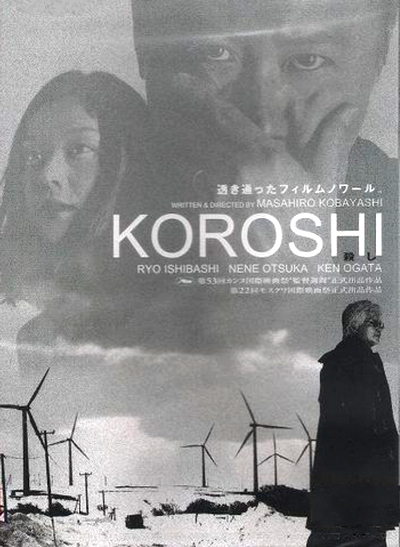
Film Noir (殺し, Masahiro Kobayashi, 2000)

Koroshi-2000Existential tales of hitmen and their observations from the shadows have hardly been absent from Japanese cinema yet Masahiro Kobayashi’s Film Noir (AKA Koroshi, 殺し) perhaps owes as much to Fargo as it does to Le Samouraï. Taking place in the frozen, snow covered expanses of Northern Japan, Kobayashi’s story is an absurdist one filled with dispossessed salarymen leading empty, meaningless lives in the wake of late middle age redundancy.

Hamazaki starts us off with a very Film Noir style voice over in which he likens being alive to be trapped on a long coach tour with strangers. You may fight and scream and argue with them right the way through, but in the end you will crave their understanding. Like many men of the era following the recent economic turbulence, he’s lost his job and, being a cowardly if kindly soul, he’s too afraid to tell his wife about it. Consequently he leaves for work everyday as normal but drives to a near by strip mall and wastes the day away playing pachinko. That is until one fateful morning when he finds the entire area deserted only for a mysterious man to climb uninvited into his car.

This unnamed man has a business proposition for Hamazaki – kill a guy, get a lot of money. As anyone would be, Hamazaki is a little shocked, confused and uncertain but eventually accepts. His first hit (like all of his subsequent hits) is on a man just like him – a middle aged loser who’s lost his job and is hiding out in the pachinko parlour hoping to figure something out before he runs out of money. Hamazaki likes his new line of work, it makes him feel like a man again and even helps him rebuild a bond with his wife (or so he thinks) but when he discovers one of his targets is someone he knows it all starts to go wrong.

Amusingly, the mysterious man gives Hamazaki a number of videos to watch as a kind of instructional guide to killing which includes a fair few from Melville including Army of Shadows and other classics of shady French cinema. This is a well worn tale and we know it isn’t going to end well for Hamazaki but we can also see from his voiceover that he’s consistently at odds with the situation as it is almost as if he’s constructing a film noir-esque reality all of his own.

Hamazaki is an unlikely fit for this kind of work – all the way through he’s berated for being “too nice”, notably in an argument with his former boss towards the end and then again by his wife who, it seems, cares more for her social standing and middle class lifestyle than she does for her kindhearted husband. The couple have a teenage daughter whom they’ve sent abroad to study in America (presumably at great expense) and only seems to contact them to ask for more money. Though she’s apparently only in high school, they seem to treat their daughter with a high level of adulthood – sending the money for her to budget with by herself (the implication is that she runs through quite a bit) and her mother even takes care to remind her of the importance of using a condom (not just the pill – America is the AIDS hub of the world, apparently) which is obviously good advice from an enlightened parent but perhaps a surprisingly frank way of talking to a teenage girl.

In many ways Hamazaki is a man without a place. Now he’s lost his job he’s become quite useless to just about everyone. As the mysterious man tells him, everyone is playing a role, in that case “killer” and “prey” but as it transpires Hamazaki was playing a role all along – that of salaryman husband and father. The couple seem happy, but in having sent their daughter overseas the Hamazakis have already broken their happy family in favour of increasing their social status. Kazuko is perhaps only playing the role of the middle class housewife and may have little use for a man who proves too soft hearted to get ahead. After Hamazaki tragically declares he wants to give up the life of a contract killer because he’s realised the importance of family, he may find that “family” had long ago abandoned him.

In this deserted, snow covered town the hearts of men are as cold as the wind that blows through the depressingly empty expanses. A man’s worth is measured by the money he makes and status he can claim, a man with no job is worth nothing at all. No love, no family, no morality – this is the archetypal film noir world filled with nothing but eternal darkness despite the bright sunshine which bounces lightly off the crisp white snow. As much about the death of the spirit as it is about the taking of life, Film Noir paints an eerily bleak picture of modern society with its rigid social codes which prize only the acquisition of money and status rather than the contents of a man’s soul.


Unsubtitled trailer:
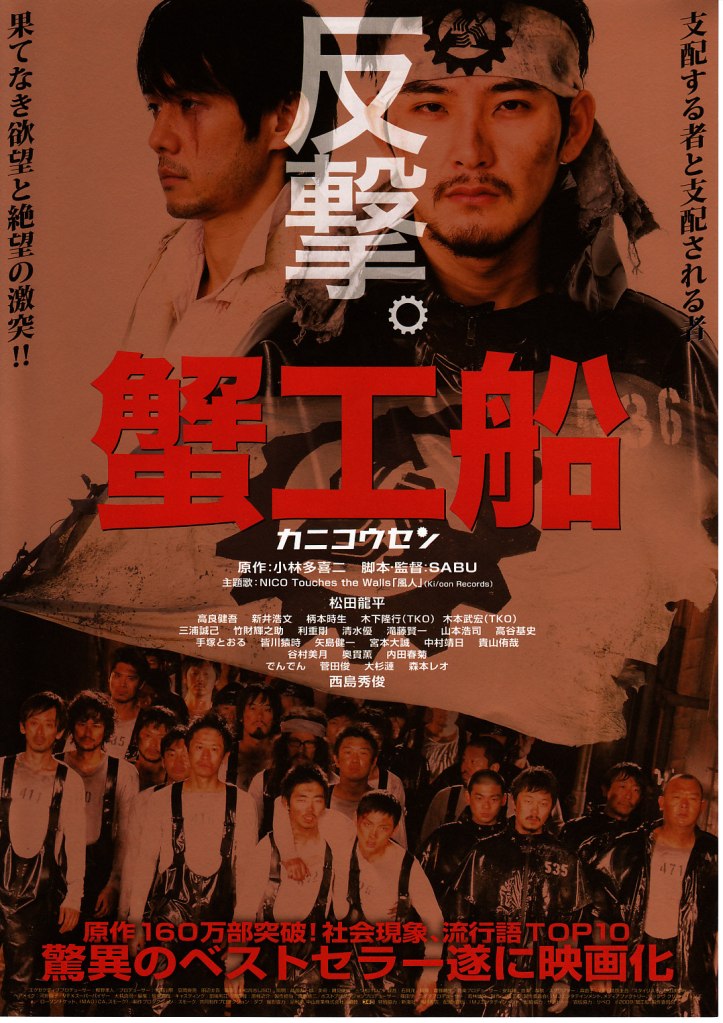
Kanikosen (蟹工船, SABU, 2009)

kanikosenBack in 2008 as the financial crisis took hold, a left leaning early Showa novel from Takiji Kobayashi, Kanikosen (蟹工船), became a surprise best seller following an advertising campaign which linked the struggles of its historical proletarian workers with the put upon working classes of the day. The book had previously been adapted for the screen in 1953 in a version directed by So Yamamura but bolstered by its unexpected resurgence, another adaptation directed by SABU arrived in 2009.
As in the book the film follows the lives of a group of men virtually imprisoned on a crab canning ship anchored near Russian seas in the 1920s. The men on the boat are of various ages and come from various different backgrounds but each is here out of necessity – nothing other than extreme poverty and lack of other options would ever persuade anyone to take on this arduous and often unpleasant line of work. Technically speaking the boat has a captain but it’s the foreman who’s in charge – dressed like a European officer in a white frock coat and riding boots and with a vicious looking scar across his left eye, Asakawa rules the waves, barking out orders and backing them up with a walking stick.

SABU films the workers’ struggles through the filter of absurdist theatre beginning with a darkly comic segment in which each of the men recount their poverty riddled circumstances and dreams for social advancement before one, Shoji, emerges and posits another idea. They will make a bid for everlasting freedom by committing mass suicide in protest to poor working conditions and consistent exploitation of their class by those above. Predictably, this fails when everyone realises they didn’t actually want to die in the first place. Later Shoji and another man are picked up by a Russian boat after being stranded at sea and after seeing how happy the Russian sailors seem to be, they return determined to enact the revolution at home.

Conveying the workers’ plight through production design, SABU opts for a packing room which is both oversized yet claustrophobic, filled with giant cogs and gears of the capitalist system in motion. The men are little more than fleshy gears themselves, just another piece of the production line to be thrown out and replaced once worn through. Gradually the workers start to realise that this system is only sustainable because of their own complicity. The foreman is, after all, only one man and the workers have made a decision to obey him – they also have the ability to decide not to. That said, the spanner in the works is that the foreman also represents the larger mechanism at play which is the imperial state itself and can call on its resources to defend himself against a potential mutiny.

Having decided to rebel and seen their revolution fail, the workers come to another realisation – that the only true path to social change is a movement for the people lead by the people as one, i.e. with no leaders and therefore no head which can be cut off to disrupt all their efforts. Hand in hand and with the bloody flag raised high do they march into battle to put an end to unfair exploitation of those without means by those that have. Ever since they’ve been on this boat, they’ve been told that they’re at war, that their services are necessary for the survival of the Imperialist state – and now so they are, engaged in the class war to end the imperialist hegemony.

In the end, SABU’s message is a little confused – he advocates collective action, but not the collective, as his revolution is born of individual choice rather than the workers linking hands behind a faceless banner. It works as a semi-effective call to arms, but more often than not undermines itself and has a tendency to pull its punches when it really counts. That said, even if it wasn’t perhaps quite what Kobayashi meant, the more general message that the revolution begins in the heart of the individual and that one has the possibility to choose to live in hell (as a slave of the state) or create a heaven for one’s self (as a free person) is one that has universal merit and appeal.


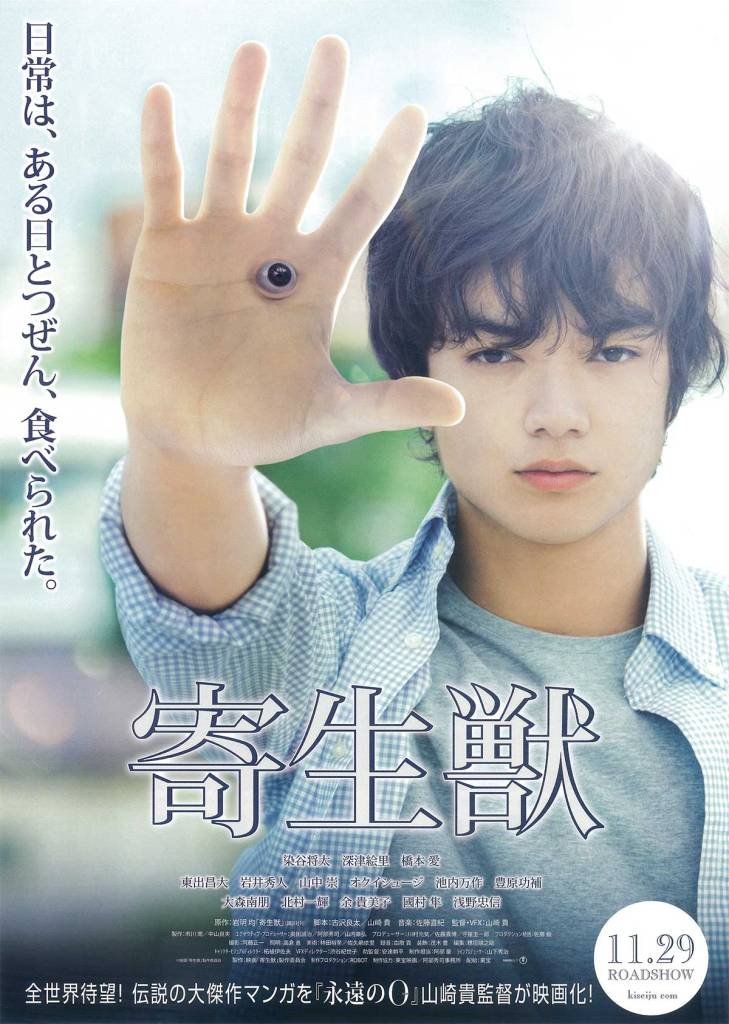
Parasyte The Movie Part 1 (寄生獣, Takashi Yamazaki, 2014)

parasyte part oneReview of Takashi Yamazaki’s adaptation of Hitoshi Iwaaki’s manga Parasyte – Parasyte: The Movie Part 1 (寄生獣, Kiseiju) first published by UK Anime Network.


Humans – are we the biggest threat to our planet and ultimately our own survival? If the world population were halved, would we also halve the number of forests that are burned and the damage that we’re doing to our natural environment? These thoughts run as a voice over beginning the full scale blockbuster adaptation of Hitoshi Iwaaki’s classic manga which was also recently adapted into a critically acclaimed anime. The Parasyte of title most obviously refers to the extraterrestrial microbes which are climbing into the driving seat of an unsuspecting host’s brain with nothing less than the colonisation of our entire species on their “minds”, yet, is it we ourselves who are the real parasites feasting on the corpse of our dying planet? Parasyte is that rare blockbuster treat that is content to give us man-eating, shapeshifting, monsters and gore filled destruction but also wants us to dig a little deeper into our own souls at the same time.

Shinichi Izumi’s (Shota Sometani) mum (Kimiko Yo) probably told him not to sleep with his headphones on but luckily they’re about to save his life as a weird little bug tries to crawl into his ears but finding them blocked opts for the arm instead. Wrapping the cord around his elbow tourniquet style, Shinichi is able to stop the bug’s progress but the parasite has taken root and Shinichi is horrified to find his right hand is no longer his own but is now controlled by a dispassionate alien that eventually names himself “Migi”.

Shinichi and Migi develop an odd kind of partnership born of their mutual dependency which is threatened only by the presence of other Parasytes who have successfully infiltrated a human brain and can blend in with the general populace (aside from their cold and robotic natures). To his horror, Shinichi discovers a new teacher at his school is actually a Parasyte stooge who recognises the “research” potential of a hybrid team like Shinichi and Migi. Becoming very keen on “experiments” Ryoko Tamiya (Eri Fukatsu) has also mated with one of her fellow Parasytes in the hopes of exploring what will happen with the birth – will it be purely a human child seeing as it’s born of two human bodies or will something of the Parasyte get through? However, Ryoko’s “network” of Parasytes aren’t all as committed to scientific research as she is and Shinichi and Migi quickly find themselves becoming humanity’s last line of defence against the invading creatures.

Shinichi is the teenage lead of the picture but in this first part at least it seems to be Ryoko leading the show. She gives us the original voice over and it’s her burgeoning motherhood that gives the film its clearest ideological standpoint. As the dispassionate Ryoko comes to develop the beginnings of maternal pangs and a desire to ensure the survival of her child (or perhaps just her “experiment”), so Shinichi finds his humanity being erased by the parasitical “child” he is gestating in the form of Migi. At the same time Migi begins to take on a protective mentality towards his host which may be more than simple self preservation particularly after a traumatic near death experience bonds the two even tighter together, in a biological sense at least.

Though the film obviously references former genre classics, in particular Invasion of the Bodysnatchers with its difficult to detect pod people, it steers clear of the “red scare” inspired sense of paranoia and the feeling of intense mistrust that exists even between supposedly good friends. Migi is able to sense (to a degree) his own kind making the presence of potentially dangerous Parasytes easier to detect but the fact that the Parasytes are able to colonise and use the form of someone all too familiar to confuse their enemies restores something of their power to lurk unsuspected in the shadows.

All this seems to suggest that the big screen live action adaptation of Parasyte would be a fairly serious affair yet the tone is often lighthearted, maintaining the darkly humorous buddy comedy side of the relationship between normal teenager Shinichi and the almost omniscient yet strange Migi. Migi, as played by veteran actor Sadao Abe who is perhaps most closely associated with comedic roles, has a thirst for a different kind of “brains” than his fellow Parasytes and quickly devours any and all knowledge he can get his “hand” on though he lacks the emotional intelligence to make sense of everything he learns and thus is dependent on his host Shinichi to get a fuller understanding of the human world.

Like the blockbuster mainstream films of recent times Parasyte boasts generally high production values on a par with any Hollywood movie though it has to be said that the film is often undermined by unconvincing CGI. However, this is mainly a problem with the action scenes and Migi himself is generally well integrated into the action and oddly adorable to boot. In some ways it might have been interesting to see a fully “in camera” take on the effects ala Cronenberg whose spirit is most definitely evoked throughout the film which also harks back to ‘80s body horror with its synth score highlights and generally gruesome scenes of carnage. Though it’s hard to judge the overall effect from just this first instalment of a two part film which drops a decent number of threads to be picked up in part two, part one at least serves as a tantalising appetiser which only heightens expectations for its final conclusion.


Parasyte: The Movie Part 1 is currently available on DVD and blu-ray in the UK from Animatsu Entertainment with Part 2 to follow in June 2016.

Death Powder (デスパウダー, Shigeru Izumiya, 1986)

death powderCyberpunk, for many people, is a movement which came to define the 1980s and continues to enjoy various kinds of resurgences and rebirths even into the new century. Beginning the the ‘60s and ’70s in dystopian science fiction afraid of the impact of advancing technologies in society, it’s not surprising that the genre began to actively embrace influences from the East and especially that of the more technologically advanced and economically superior Japan. However, when Japan made its own cyberunk cinema, the “punk” element is the one that’s important. These movies sprang from the punk music scene and often star punk bands and musicians as well as featuring high energy punk rock inspired scores.
Death Powder (デスパウダー) is among the first of these tech themed experimental films and is the only feature to be directed by folk singer and poet Shigeru Izumiya who had also starred in Sogo Ishii’s massively influential Burst City in 1982. Hugely indebted to Blade Runner, it takes that film’s noir stylings and terminology to create an experimental surrealist film loosely themed around two bounty hunters in search of a “replicant”.

After beginning with a chase sequence past neon signs and through a contemporary Tokyo where the faces of passersby have been pixelated out, the story focuses in on the pair of street punk robot hunters, Kiyoshi and Noris, who have been charged with investigating a gang hideout which used to belong to an artist who keeps trying to come back. However, when the duo arrive they find that the reason the artist, Harima (played by Izumiya himself), keeps trying to attack the place is that they’ve been holding his girlfriend, Guernica – an android, in the basement. After Guernica is killed in the resultant fighting, her body turns into a kind of powder which Kiyoshi later snorts. This “Death Powder” allows Guernica to colonise his body producing changes in both his mind and physiology.

This is what passes for a plot summary, though in keeping with the best of cyberpunk film making from Japan the narrative is irrelevant. One character even says to another “Like life itself, this makes no sense” – that being the point in a sense, creating meaning from the meaningless. Though it starts off with a Blade Runner-esque aesthetic bearing all of the hall marks which would come to be associated with cyberpunk from the neon signs, darkened streets and noir tinged atmosphere right down to the shades and trilbies costuming, the film quickly moves into the experimental realm with strange robotic sperm flying across the screen and melting vistas of city scenes and memories.

Kiyoshi begins to merge with Guernica’s consciousness, inheriting her memories and what may or may not be android fears and emotions. He “remembers” a flashback sequence featuring the very strange figure of Dr. Loo – a rock god mad scientistic who built Guernica for some undisclosed reason and then passed her on to Harima on whom it, apparently, depends whether not not she can become human which requires showing her love that transcends human love and will become “memories”. Like the replicants in Blade Runner she has a limited four year lifespan but when she dies her body will become a powder which gives life to other things.

Guernica is a created being, devoid of human flesh, but can she become human through experiencing human emotions and can she overcome death by downloading her experiences into another being’s consciousness? All fundamental questions found in cyberpunk explorations of what in means to be human in a world of advancing technology but once again Death Powder offers no clear answers so much as a surrealist and experimental exploration of the individual changes undergone by the individual rather than the society in the face of increasing mechanisation.

The borders between life and death, consciousness and unconsciousness, man and machine have all become so hopelessly blurred that concept of reality itself has become corrupted and no longer carries any kind of currency. While it may not have the raw and sophisticated artistic power of Tsukamoto’s later Tetsuo the Iron Man which has come to define the genre, Death Powder is a surprisingly accomplished low budget cyberpunk body horror extravaganza which places sensory experience ahead of narrative. Undoubtedly hugely influential yet now little seen or remembered, Death Powder is an essential addition to the cyberpunk canon and one which deserves to be as widely distributed as the classics which later followed it.


Opening sequence of the film (very trippy but dialague free until right near the end. Fast forward to around four minutes in for the nighttime chase through Tokyo!):

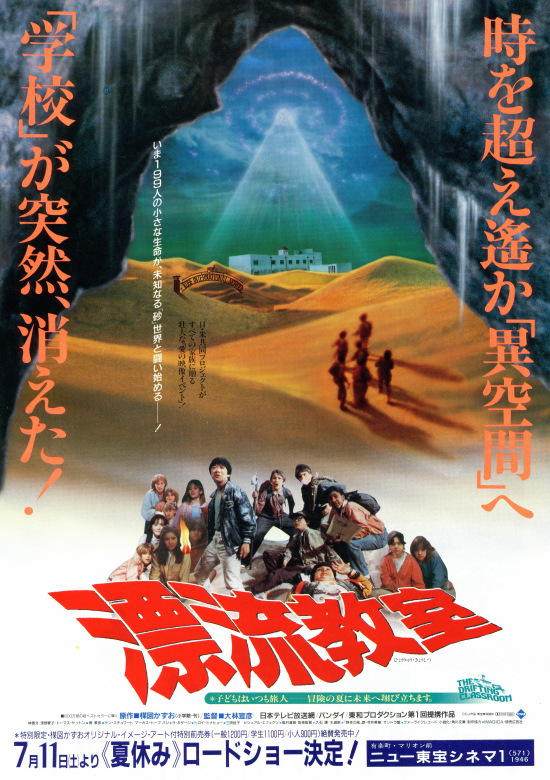
The Drifting Classroom (漂流教室, Nobuhiko Obayashi, 1987)

Drifting ClassroomNobuhiko Obayashi may have started out as an experimental filmmaker and progressed to a lengthy narrative film career but he remains best known for his “what the hell am I watching?” cult classic Hausu. Aside from his 1983 take on The Girl Who Leapt Through Time, very little of his other work has travelled outside of Japan. In the case of 1987’s The Drifting Classroom (漂流教室, Hyoryu Kyoshitsu), this is doubly surprising firstly because it’s based on a hugely popular manga by the godfather of horror comics Kazuo Umezu and secondly because it’s set in an international school so around 80% of the dialogue is in English.
Obayashi jettisons most of Umezu’s original plot which involves an ordinary Japanese school being suddenly and mysteriously uprooted from its city centre location leaving only a gaping hole to mark its place. This time our hero is Shou – a teenage boy who has recently returned from living in LA and is attending Kobe International School until his Japanese improves enough to get into a normal establishment. Having lived abroad for so long, Shou is a totally Americanised boy with a rebellious, individualistic streak and just wants to hang out with his cool American pals rather than study like his parents want him to do so he can get a foot on the all important ladder of the Japanese educational system. Consequently he argues with his mother and says some very harsh things which leads to her telling him to get out and not to bother coming back – sentiments which both are about to spend the rest of their lives regretting.

Right before taking the register some weird shit goes down and there’s an intense storm which fills most of the school building with sand. Looking out of the windows, everything seems to have become desert. The kids and the two remaining teachers think about what to do and settle on practical things like rationing the food and water left in the school canteen. Back in Kobe, there’s just a giant hole in the ground and a whole lot of confusion….

For some reason, Obayashi decided to set the story in an international school which means that most of the dialogue is in English (though judging by the accents and languages there are some Europeans and students from other parts of Asia around too). This is the single worst decision of the adaptation as the dialogue, which is overly silly to begin with, is offered in stilted, halting tones by its disappointing child actors with the native English speakers not doing very much better than the Japanese kids who are at least trying their best. Perhaps for these reasons (or just out of operational necessities) the film is entirely shot in non-sync sound and the dubbing never quite links up either.

It almost seems as if Obayashi is targeting an overseas audience as his tone is very much indebted to ‘80s kids’ movies with its cast of slightly plucky (sometimes irritatingly so) youngsters trying to solve the mystery of their own disappearance. However, it doesn’t seem as if the film was ever released outside of Japan (where it has never even been released on DVD) despite the presence of one time American star Troy Donohue leaving the strange Americanisms as a sort of exotic plot element with no real resolution.

Though the story seems to be aimed at older children with the usual themes of perseverance in times of adversity and the importance of teamwork and friendship, there are a few scary moments including a psycho style gag where a teacher’s head spins round before dissolving into sand. However, the majority of the special effects are extremely unconvincing resembling an ‘80s kids TV programme with a host of matte paintings, bad green screen, early digital effects and even some tokusatsu style people in rubber suits playing strange cockroach-like monsters. Arguably the best of these is the friendly creature who hangs round with the kids from school and most closely resembles a disgruntled potato with legs (but may actually be giving the most accomplished performance in the entire film).

All of this could have added to the film’s kitsch, “bad movie” vibe but Obabyashi opts to get serious every now and then and ruins everyone’s fun in the process. Weirdly, everyone just seems to accept the “timeslip” argument right away as if that’s a perfectly normal thing that happens every now and then like sinkholes or spontaneous human combustion – there’s even a geologist (?) being interviewed on the news who just says “yes – it is probably a timeslip” when asked to provide some “scientific commentary” on the disappearance of the school children. Completely bizarre but not in a very interesting way, The Drifting Classroom is a misfire on all levels neither making a good adaptation of its source material or an entertaining movie in its own right. Camp classics enthusiasts or Obayashi fanatics only.


The Drifting Classroom was also adapted into a TV drama in 2002 under the title of Long Love Letter which is much better than this movie.

A short scene from the film starring its best character whom I have decided to name “Spuddy” (English dialogue):

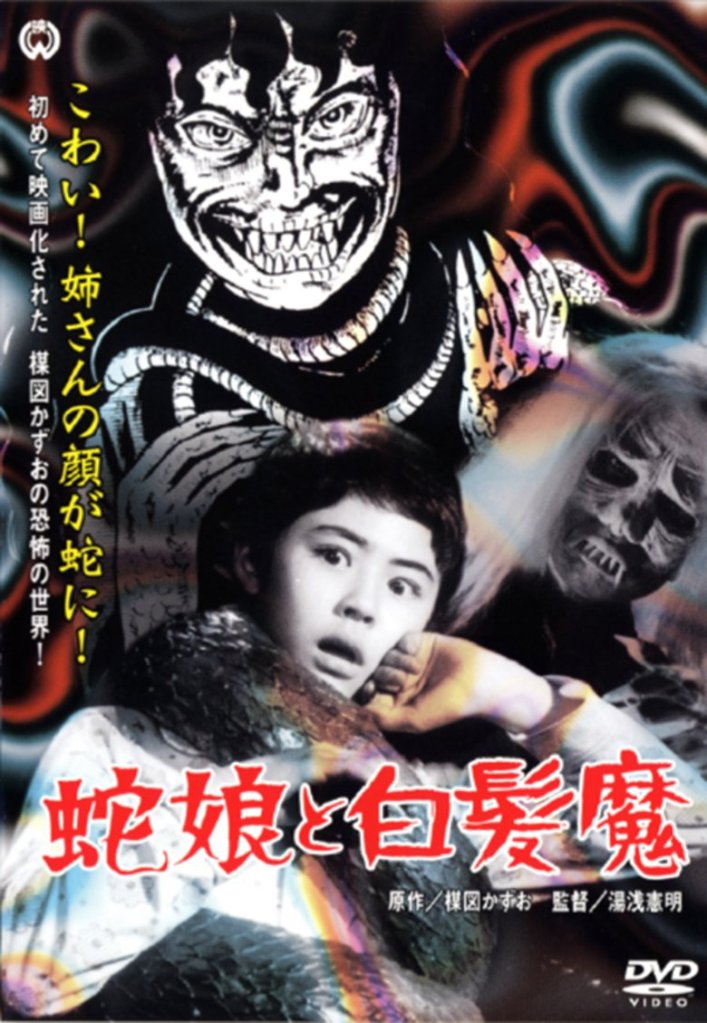
The Snake Girl and the Silver-Haired Witch (蛇娘と白髪魔, Noriaki Yuasa, 1968)

snake girl and the white haired witchLittle Sayuri has had it pretty tough up to now growing up in an orphanage run by Catholic nuns, but her long lost father has finally managed to track her down and she’s going to able to live with her birth family at last! However, on the car ride to her new home her father explains a few things to her to the effect that her mother was involved in some kind of accident and isn’t quite right in the head. Things get weirder when they arrive at the house only to be greated by the guys from the morgue who’ve just arrived to take charge of a maid who’s apparently dropped dead!

If that weren’t enough her “mother” calls her by the wrong name and then dad gets a sudden telegram about needing to go to Africa for “several weeks” to study a new kind of snake! On her tour of the house, Sayuri finds a room full of snakes, reptiles and insects (and also for some reason a large vat of acid?!) as well as a room with a buddhist altar where the food seems to disappear just as if Buddha himself were really eating it. Eventually, Sayuri is introduced to her secret sister, Tamami, who has slight facial disfigurement and a wicked disposition which has seen her locked away from view for quite some time…..

Based on the manga by Kazuo Umezu, Snake Girl and the Silver-Haired Witch (蛇娘と白髪魔, Hebi Musume to Hakuhatsuma) is, apparently, aimed at a younger audience which explains its child’s eye view of events but the film makes no concessions to the supposed softness of little minds. With a host of surreal imagery including dream sequences full of creepy, hypnotic spirals, and moments of shocking violence such as a large frog being suddenly ripped in half right in front of Sayuri’s eyes the film certainly doesn’t stint on blood, horror and general freakiness.

Sayuri herself seems largely unperturbed by these strange goings on outside of her nightmarish serpentine visions. She seems to have been well cared for at the orphanage and is happy to have found her family rather than just to be escaping the institution. On getting “home” she does her best to fit in right away, acting politely and trying to bond with her mother even in her confused state. She even tries to get on well with her mysterious sister despite the ominous warning to keep her very existence a secret from her father. Tamami, however, is a nightmare child with homicidal tendencies who isn’t interested in playing happy families with the girl who’s come to usurp her place in the household.

There’s a little more to the set up than just snake based horror (the clue being the Silver-Haired Witch of the title) but the secondary message seems to be one of remembering that the true beauty of a person lies not in their external appearance but in the goodness of their soul. The previously deformed Tamami is later said to be looking sweeter after having “redeemed” herself and Sayuri pledges to honour Tamami’s sisterly sacrifice by always remembering to hold fast and true to the beautiful things in her own soul without being swayed by worldly charms.

Snake Girl and the Silver-Haired Witch is more of a psychological horror tale than some of the effects laden efforts of the period. However, there are a fair few practical effects on show most notably during the dream sequences – one of which sees Sayuri actually fighting a giant snake with a sword, as well as the creepy spirals and the appearance of weird vampire-like snake women, dancing oni masks and the Silver-Haired Witch herself.

A children’s film that no one in their right mind would actually show to a child, Snake Girl and the Silver-Haired Witch is a freakishly psychological horror show seen through the eyes of a little girl. Part dreamscape and part terrifying reality, the film mixes the real and the imagined with a fiendish intensity and it just goes to show that sometimes you really do need to pay attention to the strange fancies of intrepid young ladies.


This trailer doesn’t have any subtitles but it is actually quite scary…..

My Little Sweet Pea (麦子さんと, Keisuke Yoshida, 2013)

My Little Sweet PeaHow many times were you told as a child, someday you will understand this? There are so many things you don’t see until it’s too late, and children being as they are, are almost programmed to see things from a self directed tunnel vision. Such is the case for Mugiko – a young woman with dreams of becoming an anime voice actress who is suddenly reunited with her estranged mother of whom she has almost no memory.

Mugiko (Maki Horikita) has a part time job in a manga store and is saving money to go to voice actress school. Raised by her father who has since passed on, she lives in a small flat with her older brother Norio (Ryuhei Matsuda) who also has a low wage job in a pachinko parlour. The pair’s lives change entirely when their long absent mother, Saiko (Kimiko Yo), arrives on their doorstep one day and begs to live in with them. Norio is dead against it but eventually Mugiko is persuaded and Saiko moves in. However, right after, Norio moves out to live with his girlfriend leaving Mugiko alone with the virtual stranger who is also her mother. Mugiko has a difficult time adjusting to living with a maternal figure and harsh words follow frequent misunderstandings until Saiko suddenly dies. Mugiko then travels back to Saiko’s hometown to inter her ashes and begins to forge a connection with the mother she barely knew.

The “haha mono” or “mother movie” is a subset of Japanese melodrama which focuses on the pain and heartbreak inherent in being a mother. Making countless sacrifices, the often saintly mothers do everything they can to ensure the best for their children even if their efforts cause nothing but suffering for themselves. My Little Sweet Pea (麦子さんと, Mugiko-san to) turns the genre on its side to look at things from the point of view of one of the “ungrateful” children, Mugiko, who is filled with resentment over having been “abandoned” only to have her mother suddenly return as if expecting to forget all the years of absence with one home cooked meal.

On journeying back to her mother’s remote rural town, Mugiko begins realise they weren’t so different from each other after all. Everyone in the village is stunned by Mugiko’s appearance which turns out to be the spitting image of her mother at around the same age. Saiko had also been something of a local celebrity thanks to her beauty, charm and popular presence. She left the town for the city with dreams of becoming a famous singer just like Seiko Matsuda and her rendition of the singer’s famous song Akai Sweet Pea is fondly remembered by the older generation.

Saiko’s dreams of hitting it big in the music business were never fulfilled though we know almost nothing about what happened to her between the end of her marriage and reappearance in her children’s lives save that she obviously had enough financial security to be able to send them money every month. Through meeting her mother’s old friends (and more than a few admirers), Mugiko comes to see something of herself in the distant figure of her mother as a young woman. Even if she couldn’t be there for reasons which are never fully explained, it wasn’t because she didn’t want to be or because she’d forgotten about or rejected her children, she suffered everyday thinking of and missing them and was tragically unable to rebuild that connection even at the very end.

Mugiko has been a little unsettled in her life, floating from one dream to the next and who really knows if voice acting is really the thing that she was meant to do. Saiko may have been more certain in her objective but whatever happened later it seems she found fulfilment in being a mother even if her dream of becoming a singer didn’t work out. Having been able to meet her mother even if vicariously, Mugiko is able to understand something about herself and perhaps repair a relationship that never quite took place. Striding out boldly with her mother in spirit beside her, Mugiko is finally able to step into the adult world and everything that is waiting out there for her with a new found confidence that comes with embracing the beauty of a distant scar.


Trailer (with English subtitles)

and here is the hit song from Seiko Matsuda – Akai Sweet Pea (1982)

Robinson on the Beach (砂の上のロビンソン, Junichi Suzuki, 1989)

Robinson on the Beach

“Family Drama” is often said to be the mainstay of Japanese film. From Ozu to Koreeda, drama in the basic social unit has often been exploited to create a wider dialogue about society at large. However, In the wake of Yoshimitsu Morita’s condemnation of modern family values in The Family Game the nature of the conversation shifted. As Japan eased into its bubble era, concerns began to grow about what exactly the rise of consumerism meant for traditional values. Robinson on the Beach (砂の上のロビンソン, Suna no Ue no Robinson, AKA A Sandcastle Model Family Home) takes things one step further than The Family Game in that it repackages the entire idea of “the ideal family” as something that can itself be bought and sold and therefore manipulated as the perfect marketing tool.

At the beginning of the film, the Kidos are a fairly ordinary lower middle class family of five all living a modest apartment. They’re a little cramped – in fact so much so that mum and dad have to sneak into the wardrobe to get some alone time together just watching movies on a tiny TV set and sharing a set of earphones between them. The kids are always at each other’s throats but broadly they’re happy. However, when both husband Shouhei and wife Ryoko spot an advert for a new scheme which promises a “free” house to a “model family” they decide that this is their best chance at a new life. The deal does have a few drawbacks – they all have to play the part of a perfect family for a whole year and let the public into their lives to prove it.

Things were a little more innocent back in 1989. Reality TV hadn’t yet kicked in and the Kido’s don’t quite understand what it is they’re letting themselves in for when they agree to this too good to be true offer. The house they’ve been given is a veritable mansion – a huge, sprawling Western style home with a bedroom each for the children, a dedicated study for Shouhei and as many walk-in closets as anyone could wish for. However, the cars in the garage are only for show and even if the house is in the same general area as their old flat, Shouei still has to cram himself inside the sardine tin of the morning commuter train every day just like before.

He does at least have the luxury of being allowed to leave the house, unlike Ryoko who becomes a bizarre “first lady” to this new show home empire expected to play a role somewhere between real estate agent and princess as she welcomes prospective buyers and allows them to poke and prod all over her nice new home spreading thinly veiled judgement wherever they go. Suddenly she has people going through her fridge and oggling her washing left hanging up to dry . The liaison lady from the company even has the gaul to criticise Ryoko’s nightwear as “frumpy” and orders her to buy something a little more glamorous which will match the “upmarket” appeal of the house.

After she gives in and does this she just has to listen as two visitors describe the new nightwear as “slutty” and wonder how a “respectable” wife could wear such a thing (it’s just a regular pink negligee nightdress, nothing unusual about it at all save for being a little more career woman than mumsy in appeal). In fact, the family’s new found circumstances only cause resentment in those around them and Ryoko in particular is plagued by nuisance callers who repeatedly accuse her of having prostituted herself to win the house.

In the economic reality of Tokyo at the time, there was just no feasible way a family like the Kidos would ever be able to afford to own their own house. They probably wouldn’t even be able to rent one or get anything bigger than the apartment they occupied at the beginning of the film. Shohei provokes the ire of his boss after moving into the show home because it’s already better than anything his boss could afford and he already owns a small home far out in the suburban commuter belt. Now everyone has it in for Shohei and he does get a kind of demotion as the company send him to demonstrate their “super slicer” kitchen gadget in a local department store. This is doubly worrying as Shohei is a very shy and nervous man who is not well suited to public speaking leaving the company’s excuse of making use of his new found celebrity as an ironic way of taking revenge on his jumping up the social order through unorthodox means.

All of these stresses gradually build up as even the children are subject to attacks from outside (and some of them very cruel and disturbing in nature). Before long this once happy family begins to buckle under the strain of pretending to be what they once really were. One particularly perverse episode sees them sitting down to a pre-scripted dinner while an audience of onlookers silently judge them as if they were engaged in some kind of performance art – which, of course, they are albeit almost unconsciously. Having gained everything they’d ever wanted, they discover that the costs far outweigh the benefits with Shohei hit hardest after he succumbs to a streak of selfish individualism that has dire consequences for everyone.

Eventually the value of the traditional family is reinforced as everyone starts to realise that the fancy house was never as important as the simple happiness they felt being crammed together in their tiny apartment. Though there is a hopeful resolution at the end, whether or not the damage can be repaired may be a matter for debate though the overriding message of caution about the corrupting influences of rampant consumerism including classism, petty jealousy and a growing tendency towards the voyeuristic is one which finds its way into many of the films from this period and is sadly still worth restating even today.


Scene from near the beginning of the film (with English subtitles):

Dr. Akagi (カンゾー先生, Shohei Imamura, 1998)

Dr AkagiA late career entry from socially minded director Shohei Imamura, Dr. Akagi (カンゾー先生, Kanzo Sensei) takes him back to the war years but perhaps to a slightly more bourgeois milieu than his previous work had hitherto focussed on. Based on the book by Ango Sakaguchi, Dr. Akagi is the story of one ordinary “family doctor” in the dying days of World War II.
As Dr. Akagi (Akira Emoto) puts it, much of the the life of a family doctor involves running. If he breaks one leg, he’ll run on the other, if he breaks both legs, he’ll run on his hands, but he’ll do whatever it takes to get to his patients. Some of the villagers have branded him as a quack and nicknamed him “Doctor Liver” because his most frequent diagnosis is for hepatitis. Doctor Akagi is convinced that there really is an epidemic of contagious hepatitis plaguing the population and even has the evidence to back his theory up but with the war in crisis and so much else going on he’s having trouble getting anyone to listen to him. Nevertheless, Akagi fearlessly tries to find out what it is that’s causing this deadly disease to spread and hopefully put an end to it for good.

Imamura strikes an oddly comic tone here. Though the above synopsis may sound overly serious, for the vast majority of its running time Dr. Akagi is the story of a small fishing village going about its everyday life with the war just simply background. The town narrowly escapes being bombed by an American raid because it’s known that there’s prisoner of war camp nearby filled with allied soldiers and red cross personnel and there are certainly a lot of troops on the ground more or less running the show. However, despite the obvious hardships – lack of food being the biggest one, the townspeople are getting on with things in a fairly cheerful way.

Following a spot of pastoral care, Dr. Akagi ends up taking in a local girl as his assistant and housekeeper after her father has died leaving her to support her two younger siblings. Though a married woman with a husband away at the front, Sonoko (Kumiko Aso) has been making ends meet through prostitution with the rather unwelcome result that one of her regular customers wants to marry her (she does not reciprocate and after all already has a husband). Akagi doesn’t necessarily disapprove of the idea of prostitution or of openly expressed sexuality, but accepts that society does object to these ideas and takes Sonoko in so that she won’t have to sell herself (though she actually didn’t really mind very much and still finds herself called upon to provide her “services” even after she’s officially given up).

Akagi’s other supporters include a fellow doctor, Tomomi, who has become addicted to morphine after his wartime service and a drunken and lecherous buddhist monk who proves an essential ally when it comes to body snatching a recently buried corpse. Akagi gets himself into even more trouble when he takes in and treats an escaped Dutch POW who bears the scars of extreme torture by Japanese forces who are paranoid about possible spy action. Imamura is never afraid of raising the spectre of wartime brutality as his soldiers flit between righteous zealots committed to the letter of the law and bumbling idiots who can’t see that each of their actions is entirely counterproductive to their cause.

The most surprising moment comes when Akagi has a dream about his son who is an army doctor serving in Manchuria. After Akagi and his friend have conducted an autopsy to gain a fresh liver sample, Tomomi starts talking about his time in the army and a rumour about a group of doctors doing live dissections and possibly researching chemical weapons. Akagi is aghast and horrified but recounts his dream in which he stood before his son whose bloodied hands are extended towards him with a living patient writhing below. Akagi reminds him that he is a doctor and urges him to stop this barbaric practice but the nightmarish vision of this gloomy, blood-soaked room persists.

At the end of the film Sonoko and Akagi unwittingly end up viewing the giant mushroom cloud which arises after the atomic bomb blast in Hiroshima. Not knowing what it is, Akagi predictably sees it as a giant infected liver and wonders if the donor for his liver sample is angry with him but then thinks again and says the cloud is a representation of everybody’s anger towards this war. Akagi loses himself a little in the quest to solve the hepatitis question and after it leads him to neglect a patient he begins to question himself over his true motives and whether there’s really any point to what he’s trying to do. However, Dr. Akagi is a good and a kind man and eventually remembers what his true calling is – as a family doctor, running from one emergency to the next but always making sure his patients are well looked after. War or no war, life goes on – people get sick and they need to know there are men like Akagi out there that can always be relied upon to do the very best they can.


Dr. Akagi was originally released in the US by Kino Lorber but seems to be out of print. The good news is that the region free Korean disc comes with English subtitles.

Unsubbed trailer:

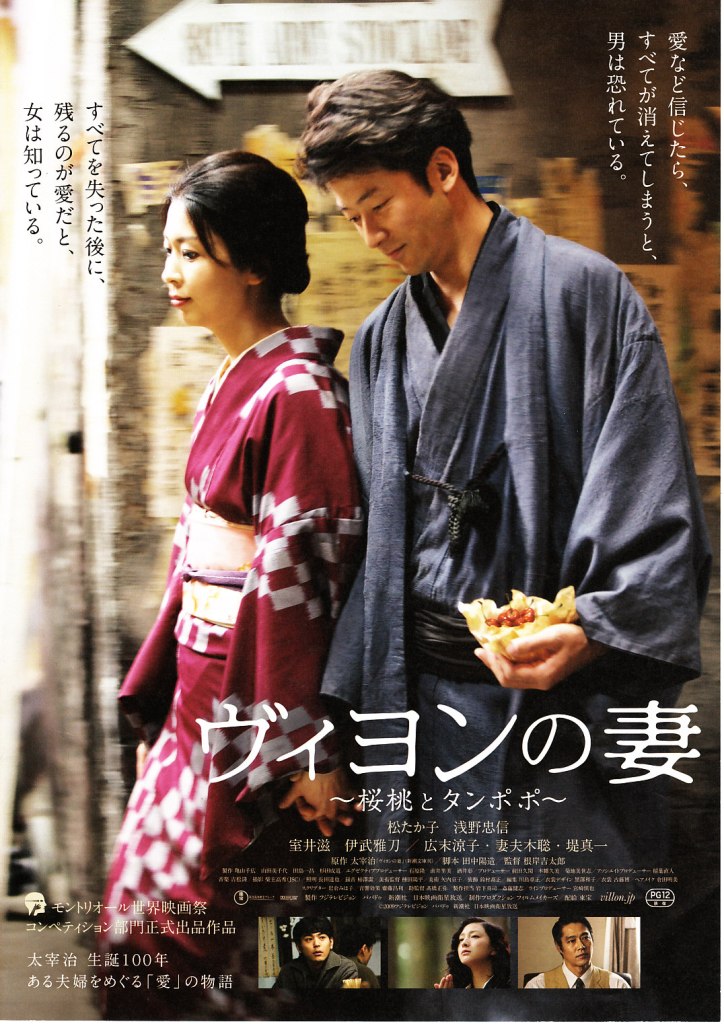
Villon’s Wife (ヴィヨンの妻 〜桜桃とタンポポ, Kichitaro Negishi, 2009)

Villon's Wife2009 marked the centenary year of Osamu Dazai, a hugely important figure in the history of Japanese literature who is known for his melancholic stories of depressed, suicidal and drunken young men in contemporary post-war Japan. Villon’s Wife (ヴィヨンの妻 〜桜桃とタンポポ, Villon no Tsuma: Oto to Tampopo) is a semi-autobiographical look at a wife’s devotion to her husband who causes her nothing but suffering thanks to his intense insecurity and seeming desire for death coupled with an inability to successfully commit suicide.

Beginning in the immediate post-war period of 1946, Sachiko (Takako Matsu) is a fairly ordinary housewife with a young son who generally waits around the house for her husband’s return. Only, she’s married to one of the most brilliant writers of the age, Joji Otani (Tadanobu Asano), whose book on the French poet François Villon is currently a best seller. Despite his obvious literary talents, Otani is a drunkard who spends most of his time (and money) in bars and with other women. When he crashes home one night only to be pursued by two bar owners who reveal that he ran off with their takings (around 5000 yen), Sachiko is not exactly surprised but still embarrassed and eventually takes matters into her own hands by volunteering to offer herself as a “hostage” by working at the bar until the debt is repaid.

“Men and women are equal now, even dogs and horses” says one customer, impressed with this sudden arrival of a beautiful woman in a low life drinking spot. To her own surprise, Sachiko actually enjoys working at the bar, it gives her purpose and proves more interesting than being stuck at home waiting to see what her drunken fool of a husband has got up to next. She’s good at it too – Sachiko is a beautiful and a fundamentally decent and kind person, in short the sort of woman that everyone falls a little bit in love with. That said, she isn’t a saint. She’s perfectly aware of the power she is able to wield over men and is unafraid to make use of it, though only when absolutely necessary.

Otani himself is a fairly pathetic figure. He may be a great artist but he’s a hollow human being. He admits the reason for all of his vices is fear – he’s a afraid to live but he’s also afraid to die. He seems to love his wife, though he’s insecure about losing her and dreads the embarrassment involved in becoming a cuckold. So afraid to face the possibility of failure, Otani satisfies himself in an underground world of drunks and easy women rather than facing his own self loathing as reflected in the faces of his unconditionally loving family.

Perhaps because Villon’s Wife is a commemorative project, the film has been given the prestige picture treatment meaning the darker sides of Dazai’s original novella have been largely excised. The chaos of the post-war city with its starving population, soldiers on the streets and generalised anxiety is all but hidden and some of the more serious travails Sachiko undergoes in devotion to her husband as well as Otani’s tuberculosis (from which Dazai also suffered in real life) have also largely been removed. What remains is the central picture of a self destructive husband and the goodly wife who’s trying to save him from himself but risks her own soul in the process.

The one spot of unseemliness of post-war life that the film lets through is in a brief scene which features a group of pan pan girls hanging around ready to try and snag some passing GIs. Sachiko buys some lipstick from them to use in attempt to convince an ex who is also a top lawyer to try and help her husband after his latest escapade lands him in jail on a possible murder charge. After visiting him, Sachiko wanders out slightly dazed to see the pan pans atop a military jeep cheerfully waving and shouting “goodbye” in English. Sachiko is confused at first but eventually shouts “goodbye” back in a way which is both excited and a little bit sad, perhaps realising she is not so different from them after all. Finally she wipes the lipstick from her face and leaves the small silver tube behind where the pan pans were sitting, hoping to bury this particular incident far in the past.

In actuality the pan pan girls are depicted in a fairly matter of fact way rather than in the negative light in which they are usually shown, just another phenomenon of occupation. At the end of the film Otani calls himself a monster whilst acknowledging that he’s a terrible father who would steal the cherries from his own son’s mouth. Sachiko replies that it’s OK to be a monster – as long as we’re alive, it’ll be alright. Oddly for someone so suicidal, this fits in quite well with Dazai’s tenet of embracing the simple gift of a dandelion. The film ends on an ambiguous note in which there seems to have been some kind of restoration but it’s far from a happy one as the couple remain locked in a perpetual battle between light and darkness albeit with the balance a little more equalised than it perhaps was before.


The R3 Hong Kong DVD release of Villon’s Wife includes English subtitles.