Kisses (くちづけ, Yasuzo Masumura, 1957)

tumblr_nwj79ycwjz1tvmqcgo1_500The debut film from Yasuzo Masumura, Kisses (くちづけ, Kuchizuke) takes your typical teen love story but strips it of the nihilism and desperation typical of its era. Much more hopeful in terms of tone than its precursor and genre setter Crazed Fruit, or the even grimmer The Warped Ones, Kisses harks back to the more to wistful French New Wave romance (though predating it ever so slightly) as the two youngsters bond through their mutual misfortunes.

The film begins as Kinichi and Akiko experience a meet cute whilst visiting their respective fathers who’ve both landed up in gaol. Kinichi’s dad is a politician who’s been accused of “electoral fraud” which he swears is some kind of plot (even though this is the third time he’s been accused of it) whereas Akiko’s father is a government official who’s embezzled a large sum of money in an act of desperation to pay for her mother’s medical treatment. Just as Kinichi is leaving the prison, Akiko is getting into a situation with the rather rude receptionist because she owes something for her father’s room and board. Kinichi becomes offended on Akiko’s behalf and plonks down more than enough money alongside a few choice words for the lady on the counter before flouncing out. Akiko chases after him with his change even though he tells her to get lost in no uncertain terms. Eventually the two end up spending the day together though things turn a little sour towards the end. In this unlucky world, can two crazy kids ever make it work?

In essence, Kisses is an innocent film. Though there may be a few hints of darkness lurking around the edges, its tone is more or less cheerful and fuelled by the idealism of youth. Both Kinichi and Akiko are realists, they’re both older than their years, put-upon and a little desperate but also a little naive. Kinichi’s grumpy and sullen, perhaps nursing a wound from his mother walking out on him. Even when he asks her for the money to bail his father out of gaol she tells him to grow up before treating him like a child by declaring that he himself is collateral on the loan. Akiko’s mother is hospitalised with TB – the misfortune that’s had her father reduced to this shaming state of affairs. To make matters worse it’s not as if she can even tell her mother why her father hasn’t visited for a couple of weeks or explain why the nurse was complaining that their insurance has expired. Her father is also in poor health and likely will not cope very well with remaining in prison hence why she (briefly) considers becoming someone’s mistress or going on a date with a dangerous and unpleasant man to get the money to bail him out.

In any other seishun eiga this situation would be a recipe for a disaster, but somehow it rescues itself from the brink of despair and becomes almost more of salty rom-com than anything else. After the initial cute sea-side and roller skating date, there are crossed wires, mislaid messages and a last minute dash to work out a forgotten address but the film never loses its youthful energy and guileless wit. The world outside might be cruel, but in here it’s just normal, and if a boy and a girl want to blow some time at the races or the beach, who can blame them. They’re young, they’re kind of unhappy but they’ll figure it out and probably be OK which is a lot more than you can say for the usual protagonists of these kinds of film.

Kisses doesn’t have the searing, angry eyes of Masumura’s later work. Yes there is dissatisfaction with the world as it is, but also hope and acceptance, rather than an attempt at rebellion. Neither of the two young lovers is trying to change the world. Forced to be older than they are, both are savvy and realistic but not quite old enough to be fearful or self-centred. Full of youthful nonchalance, Kisses is a tale of innocent romance which is only improved by its layer of ironic whimsy.


Kisses is available with English subtitles on R2 UK DVD from Yume Pictures.

The only (short) clip I could find only has Russian subs…but it’s of a song which is very pretty.
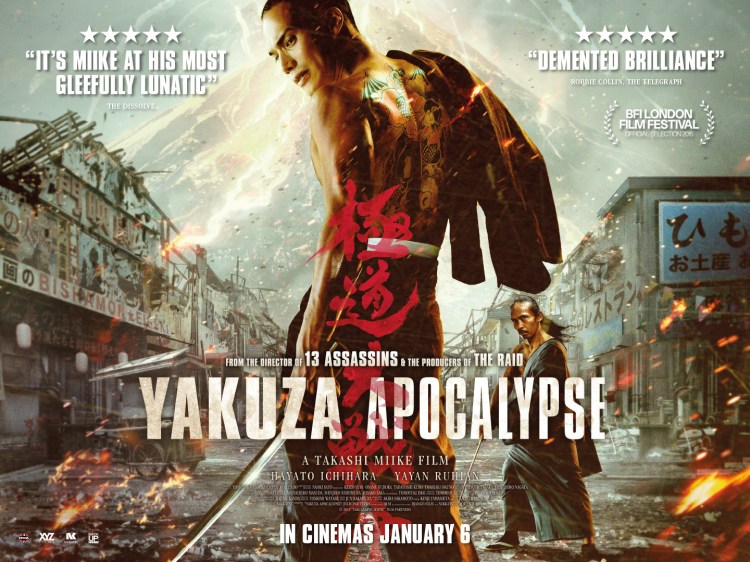
Yakuza Apocalypse (極道大戦争, Takashi Miike, 2015)

Yakuza-Apocalypse-Quad-HalfSize-NEWBelated review from the 2015 London Film Festival – Yakuza Apocalypse is released in UK cinemas for one day only on 6th January 2016 courtesy of Manga who will also be releasing on home video at a later date.


Takashi Miike shuffles back towards the yakuza plains in the western inspired horror comedy Yakuza Apocalypse (極道大戦争, Gokudo Daisenso) trailing ever more zany humour behind him. Yakuza gungslingers, bloodsucking, high school girls running away from things and, finally, a guy with a magic belly button wearing a frog suit who just happens to be “The World’s Toughest Terrorist”.

We open in media res as vampire yakuza boss Kamiura (Lily Franky) cuts up a storm in settling some local disputes. There’s a handy voice over from our soon to be protagonist, Kageyama (Hayato Ichihara), lamenting the old yakuza world of tough guys and honour codes but things don’t really take off until a very geeky looking guy and a Van Helsing type in 17th century attire suddenly turn up hoping to re-recruit the boss to “The Syndicate”. When he refuses, they fight and the geek twists Kamiura’s head right off. Using his last ounce of strength and in a touch right out of Hausu, Kamiura clamps onto Kageyama’s neck turning him into a vampire. However, in his just turned state, the honourable Kageyama turns a few more vampires of his own – and not only vampires, the bite also transmits yakuzaism too. This increase in bloodsucking gangsters is a bit of a problem for the regular guys as it does mean their pool of victims is being steadily depleted…

Not making much sense is not generally much of a problem in a Miike film. In fact, it’s a pretty much a given at this stage of the prolific director’s career. However, in the case of Yakuza Apocalypse it’s even more pointless than usual to pay any attention at all to any kind of narrative. Looking over Kageyama’s shoulder, we move from set to piece to set piece as, first of all, the non-vampire yakuza guys struggle for power between themselves and then with the vampire variety before the giant frog turns up to ruin everything.

There are some rules, Miike takes a while explaining to us how this yakuza business works with Kamiura as the “good” kind of yakuza committed to protecting his townspeople above all else – essentially, he’s the sherriff around these parts. He’s a vampire, yes, but he only feeds on yakuza who he’s “reforming” by means of an underground knitting circle held prisoner in his basement. Apparently yakuza blood tastes bad and isn’t very good for you but eating civilians is dishonourable and anyway, limited in supply, because when you turn someone they also become a foul mouthed yakuza fighting machine.

The world building is shaky at best, none of this really hangs together making for a fairly disappointing series of one note jokes. There is an attempt at a bit of more sophisticated satire with the regular gangsters suddenly lamenting that there will be no one left for them to prey on if everyone turns yakuza vampire but otherwise it’s crazy piled on crazy. Not a bad thing in itself but somewhat lacking in substance.

Despite that, the film offers some quality performances notably from its lead, Kageyama, played by Hayato Ichihara, as the yakuza who’s so sensitive his delicate skin won’t allow him to get a proper yakuza tattoo. That is, until he becomes a brooding, conflicted vampire mourning the loss of his boss and of those long held tough guy ideals. Lily Franky also offers a high impact though short lived appearance as the honourable vampire boss with a hinted at backstory, though the much publicised cameo of The Raid’s Yayan Ruhian feels a little wasted as he’s just generally hanging around for a handful of fight scenes. That said, the action scenes themselves are extremely impressive, both exciting and often funny too.

Yakuza Apocalypse is not one of Miike’s most well thought out efforts. Its collection of crazy ideas feels thrown together and there’s disappointingly little depth to its world building. Even its media res conclusion looks more like running out of ideas than a deliberate decision. However, that’s not to say it isn’t heaps of fun, which it often is. A crazy frog riding a bicycle who somehow wakes up the giant king of the crazy frog people after some kind of emergency plaster is ripped off his belly button – really, what could be more fun than that? That really is all there is though and those who prefer their absurdist action thrills with a little more substance had best look elsewhere.


Yakuza Apocalypse is in released in UK cinemas for one night only on 6th January 2016. Luckily the film is playing across the UK even if it’s only the one night and you can see if it’s on anywhere near you by checking out this handy link! If it’s not, don’t despair! It’ll also be available in all the normal ways from Manga later in the year.

Reviewed at the 2015 BFI London Film Festival.


Capone Cries a Lot (カポネおおいになく, Seijun Suzuki, 1985)

1040003_lNever one to be accused of clarity, Seijun Suzuki’s Capone Cries a Lot (カポネおおいになく, Capone Ooni Naku) is one of his most cheerfully bizarre movies coming fairly late in his career yet and neatly slotting itself in right after Suzuki’s first two Taisho era movies, Zigeunerweisen and Kageroza. Though not part of the so called “Taisho trilogy” (this would be completed with Yumeji in 1991), Capone Cries a Lot begins its tale in the short lived period between the ages of Meiji and Showa when the world seemed open and foreign influence flooded into this once isolated nation. Could that influence also travel upstream? Naniwa-bushi, for example, could could a Naniwa-bushi singer on the run make something of himself in the New World?
Like most of Suzuki’s movies, plot is a secondary concern. However, loosely speaking, our protagonist is Jun – a man who wanted to learn the art of Naniwa-bushi from its accepted master but ultimately ran off with another man’s wife and ended up in 1920s America. Once there he hooks up the Japanese gangster Gun-tetsu who makes use of Jun’s sake making experience to assist in his bootlegging business during prohibition. This brings them in contact with the Capones, firstly with Frank and eventually with Al (who Jun amusingly mistakes for the president of the United States). Meanwhile, Jun’s girl, Kozome, has left him (to an extent) and become a prostitute. However well things seem to be going for Jun, he’s still a foreigner in a strange, and sometimes unkind, land. Is this the sort of place where dreams can survive?

Suzuki films the whole thing in Japan at an abandoned theme park which is 100% Americana – the Old West tricked out with cowboys, saloons and guns. Now it’s strange kind of new city populated by runaway Japanese criminals gambling and whoring their way through life. Jun wants to sing Naniwa-bushi in this odd place even if no one understands him. Originally he’s annoyed by the foreigners laying a hand on his shamisen or making attempts to join in with their jazz inflected modern music, but eventually he’s singing new Naniwa-bushi songs about the plight of the Native Americans and finally joining the jazz band for a full on musical fusion number. Suzuki does not shy away from the racial politics and problems inherent in his critique of American imperialism even up to an including the KKK and the Japanese internment camps.

In contrast to the previous two Taisho set films, Capone is much lighter in tone and obviously more playful even if it includes a similar level of oblique surrealism. Chaplin references and slapstick humour mix with absurdist dialogue and cosmic silliness to create a popcorn candy world that’s still somehow sad and strange. It’s a vision of America filtered through ‘20s gangster pics and B-movie westerns, equal parts bubblegum and tommy guns. It doesn’t make a great deal of literal sense but offers plenty of Suzuki’s psychedelic eye for colour, surprising editing choices and all round idiosyncratic approach to storytelling.

There may be ample reasons why Capone Cries a Lot has never found an overseas audience, it’s a little overlong for one and its comments on race are perhaps a little uncomfortable from several different angles. Nevertheless, it’s another characteristically zany effort from Suzuki and full of colourful pop aesthetics that are much more playful than the rather heavier Zigeunerweisen and Kageroza. Well worth the long strange ride, Capone Cries a Lot is a trip to 1920s candy land that few of the directors devotees will be able to resist.


(Unsubtitled) Scene from midway through the film


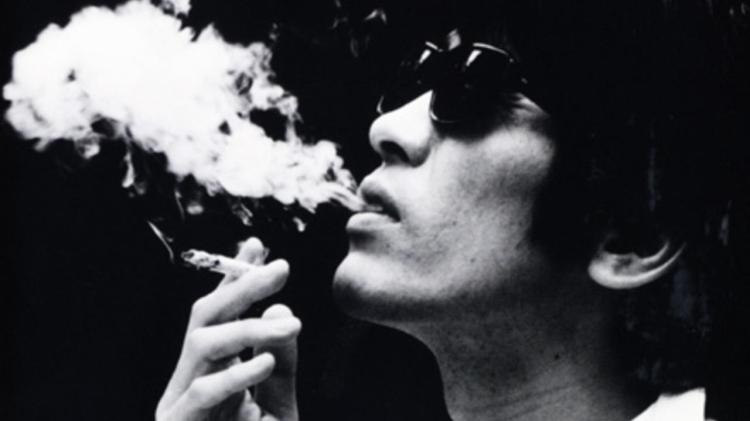
Kabukicho Love Hotel (さよなら歌舞伎町, Ryuichi Hiroki, 2014)

165709_02Kabukicho Love Hotel (さよなら歌舞伎町, Sayonara Kabukicho), to go by its more prosaic English title, is a Runyonesque portrait of Tokyo’s red light district centered around the comings and goings of the Hotel Atlas – an establishment which rents by the hour and takes care not to ask too many questions of its clientele. The real aim of the collection of intersecting stories is more easily seen in the original Japanese title, Sayonara Kabukicho, as the vast majority of our protagonists decide to use today’s chaotic events to finally get out of this dead end town once and for all.
The first couple we meet, Toru and Saya are young and apparently in love though the relationship may have all but run its course. She’s a singer-songwriter chasing her artistic dreams while he longs for a successful career in the hotel industry. He hasn’t told her that far from working at a top hotel in the city, he’s currently slumming it at the Atlas. Our next two hopefuls are a couple of (illegal) Korean migrants – she wants to open a boutique, he a restaurant. She told him she works as a hostess (which he’s not so keen on but it pays well), but she’s a high class call girl well known to the staff at the Atlas. Our third couple are a little older – Satomi works at the Atlas as a cleaner but she has a secret at home in the form of her man, Yasuo, who can’t go outside because the couple is wanted for a violent crime nearly 15 years previously. In fact, in 48hrs the statute of limitations will pass and they can finally get on with their lives but until then Satomi will continue to check the wanted posters on the way to work. That’s not to mention the tale of the teenage runaway and the hard nosed yakuza who wanted to recruit her as a call girl but had a change of heart or the porn shoot on the second floor which stars a lady with an unexpected relationship to one of the hotel’s employees…

It’s all go in Kabukicho. The punters come (ahem), go and leave barely a mark save for the odd tragedy to remind you that this is the place nobody wanted to end up. In fact, the picture Hiroki paints of Kabukicho is the oddly realistic one of someone hovering on its fringes, acknowledging the darkness of the place but refusing to meet its eyes. Everybody is, or was, dreaming of something better – Toru with his job at a five star hotel and a sparkling career in hospitality, Satomi and her romance or the Korean couple who want to make enough money to go home and start again. In short, this isn’t the place you make your life – it’s the one you fall into after you’ve hit rock bottom and promptly want to forget all about after you’ve clawed your way out.

However, while you’re there, you’re invested in the idea of it not being all that bad, really. There’s warmth and humour among the staff at the hotel who treat this pretty much the same as any other job despite its occasional messiness. In fact, the agency for the which the Korean hopeful works is run by an oddly paternalistic “pimp” (this seems far to strong a word somehow) who sits around in an apron and chats, offering comfort and fatherly advice in between dispatching various pretty young girls off to any skeevy guy who wants to rent them for an hour or two.

That’s not to say anyone is happy here though, all anyone’s focussed on is getting out and by the end the majority of them decide it’s just not worth it and the time to leave is now. Kabukicho Love Hotel may be one of Hiroki’s most mainstream efforts (despite its far less frequent than you might expect though frank sexual content) but its overlong running time and its failure to fully unify its disperate ensemble stories make it a slightly flawed one. An interestingly whimsical black comedy that takes a humorous view of Kabukicho’s darkside, Kabukicho Love Hotel is perhaps one it’s fairly easy to check out of well before the end of your stay but does offer a few of its own particular charms over the duration of your visit.


Or perhaps, you can check out any time you like, but you can never leave? We are all just prisoners here, of our own device….

Ryuji (竜二, Toru Kawashima, 1983)

ryujiWhen you learn someone has died, suddenly everything they have ever done becomes tragic. No matter how old they were, this fact remains. Ryuji is a film which is always going to be overshadowed by the fact that its leading actor and screenwriter sadly passed away at the extremely young age of 33 from a terminal illness only days after the film’s release.  Well, in actuality, the film was only “released” in a very limited sense, perhaps no one really had the heart to go on with it. However, it left its mark on all who saw it and eventually became a cult hit and influential classic on VHS. On paper, its tale is conventional – an existential yakuza drama about a man torn between conflicting desires and his own nature but on film, it’s something else.

In fact, the film takes its time about setting its scene as Ryuji goes about his regular yakuza business of beatings and whoring but eventually things come to a crisis as he becomes a father and winds up in prison. His dutiful wife pulls some strings to get him out. However, when released, she explains that she only got the money from her father for a divorce as he wasn’t going to bail out a yakuza. After kicking up a fuss (literally) Ryuji realises his wife is just too good for a yakuza’s moll, so he sends her and their daughter back to his father-in-law. The fact is, Ryuji misses them. He’s tired. Of the life, of the violence, of the threat. He’s ready to try something more ordinary if it means he can go back to his wife and his child. Living honestly is hard too, though. Physically exhausting, and much less financially comfortable. Things are going well, for a time, before a familiar face from the past appears and the ghost of the old Ryuji begins to rise up again.

In many ways, Ryuji is caught in a confused cycle of frustration. He’s a violent man, a yakuza, but one who’s becoming bored with the constant threat and violence inherent in his world. He misses his wife and daughter but he doesn’t know of a path that leads back to them. Eventually he starts walking, unsure of where he’s headed and once he’s home he feels at peace, at last. However, such peace is not meant to last, the past will not let you rest. Old friends turn up one after the other, your decision to help them or not will carry more weight than you first realise. After these cracks appear, the old Ryuji, filled with rage and violence, bubbles to the surface. In the end, you can’t evade your nature, you’re either one thing or something else and however much you long to be the other thing, it can’t be done.

Shoji Kaneko was a talented stage actor who was looking for a cinematic epitaph. He wrote the script, played the leading role and brought the production together. He temporarily joined a real gang to learn just what it’s like to be a yakuza and brought some of his existential despair to his on screen persona. Ryuji is a hard man and a bruiser yet often tender with his wife and cute little girl (played by Kaneko’s real life daughter in another moment of filmic symmetry). He has to decide which side of himself is the one he values most and the film’s final scene is one of the most heartbreakingly moving in all of cinema. The sound disappears entirely, sentiment is conveyed by look alone and a man makes an irrevocable decision that is instantly understood even the absence of words.

If it be not now, yet it will come – the readiness is all. There is actually very little death in Ryuji considering it’s a yakuza picture (if an unconventional one) but the spectre of endings is hovering all around. Knowing what it’s impossible not to know, it’s hard not to read that ever present threat of eclipse into every scene. Ryuji’s decision is a permanent one, taken once it defines everything. Kaneko was also a father with a young daughter facing the end of his life, also weak but tender. Graceful yet robust, Ryuji’s story is one of a man who couldn’t reconcile the two sides of himself into something whole and so sacrificed the things he wanted most. Beautifully made and perfectly realised, Ryuji is a film that should have been more widely appreciated and now, perhaps, will finally be accorded the respect it deserves.


La La La at Rock Bottom (AKA Misono Universe, 味園ユニバース, Nobuhiro Yamashita, 2015)

プリントNobuhiro Yamashita has made something of a career out of championing the underdog and La La La at Rock Bottom (味園ユニバース, Misono Universe) provides yet another foray into the lives of the disposed and degraded. With a lighter touch than some of his previous work, the once again musically inflected film is another testament to the power of redemption and that you can still turn your life around if you only have the courage to take the chance.

The film begins with a young man being released from prison. The guard apologises about the smell of mothballs emanating from the man’s jacket, usually the family bring clean clothes. No family has come for this inmate though – just a couple of cool seeming characters who profess their gratitude for “what you’ve done for us” but the reunion is anything but warm. A little while later the man is unceremoniously bundled into a car and taken off to a quiet place where he is beaten half to death by thugs using baseball bats. After waking up, he stumbles around and eventually chances on a summer festival with a band playing on the mainstage. Zombified, the man grabs the mic and starts singing before promptly collapsing again.

The band’s manager, a young girl, takes the man home whereupon she discovers he’s lost his memory. Giving him the ironic nickname of “Pooch” (Kasumi also has a habit of picking up stray dogs), the band and local villagers quickly “adopt” the confused stranger and let him work at their karaoke rooms and studio whilst coaching him to become their new lead singer. However, as Pooch’s memories start to return it seems that his former life may not have been as tranquil as his laid-back amnesiac persona might suggest.

Like much of Yamashita’s previous work, music plays a central role with the one thing that Pooch remembers from his former life being the lyrics to a particular song and his innate singing talent. The leading role of Pooch himself is played by real life singing star Subaru Shibutani of Kansai based idol band Kanjani Eight who proves himself more than capable of belting out these hard rock/enka tracks as well as being able to imbue Pooch’s amnesiac blankness with his own specific character. He is ably supported by the popular young actress Fumi Nikaido who turns in yet another impressively nuanced performance as the older than her years Kasumi.

The beginning of the film gives us quite an idea of the man Pooch may have been and the kind of life he’s led. As the revelations pile on and Pooch’s memories inevitably return threatening the new life and personality he’s begun to build with the band and the possibility of fulfilling a long abandoned dream of being a singer, his dark side begins to break through and we’re shown a man lost in rage and violence left with nowhere to turn. At the end of the day, “Pooch” has been given a valuable opportunity to start all over again but it requires him to make the choice to do so. Go back to being “Shigeo”, a self hating thug who’s alienated absolutely everyone in his life or choose to become Pooch and earn a second chance to be the man he always wanted to be.

Like Yamshita’s previous film, Tamako in Moratorium, with which it also shares a lot in terms of style, La La La offers no great revelations or technical bells and whistles but revels in the simple pleasure of a tale told well. Like much of his other work, the central message is that it’s never too late to begin again (even if there are bridges which have been burned beyond repair) only that it requires you to make the sometimes scary choice to take a chance on something new. That choice rests with one person but is greatly aided by the support of others and the unusual bond between the two central characters (which stops short of romance) plus the uncompromising faith which Kasumi places in Pooch are some of the greatest joys of the film.

Perhaps not a career best from this still vastly underrated director, La La La at Rock Bottom is nevertheless another beautifully constructed addition to his filmography. Offering an extreme depth of performance from each of its ensemble cast, the film is rich with detail whilst also reflecting Yamashita’s trademark cinematic naturalism. Once again a musical feast for the ears, La La La at Rock Bottom is destined to become one of the director’s best loved films even in a career which has already offered so many as yet undiscovered gems.


100 Yen Love (百円の恋, Masaharu Take, 2014)

165856_02Actress of the moment Sakura Ando steps into the ring, literally, for this tale of plucky underdog beating the odds in unexpected ways. It would be wrong to call 100 Yen Love (百円の恋, Hyaku Yen no Koi) a “boxing movie”, it’s more than half way through the film before the protagonist decides to embark on the surprising career herself and though there are the training sequences and match based set pieces they aren’t the focus of the film. Rather, the plucky underdog comes to the fore as we watch the virtual hikkikomori slacker Ichiko eventually become a force to be reckoned with both in the ring and out.
Ichiko Saito is a 32-year-old woman with no job who still lives at home in her parents’ bento store where she also refuses to help out. With unkempt hair, slobbish pyjamas and a bad attitude, she stays in all day playing video games with her nephew other than running out to the 100 yen store late at night for more cheap and nasty snacks. Her sister has recently moved home after a divorce and to put it plainly, the two do not get on. Finally the mother decides the sister is the one most in need and more or less throws Ichiko out onto the streets. She gets herself a little apartment and a job in the 100 yen store where she’s perved over by a sleazy colleague and amused by a crazy old lady who turns up each night to help herself to the leftover bento.

Ichiko also becomes enamoured with a frequent customer who they nickname “Banana Man” because he just comes in, buys a ridiculous number of bananas, and leaves without saying anything. He’s even more awkward than Ichiko though he seems to kind of like her too. Banana Man is an amateur boxer and eventually ends up staying in Ichiko’s apartment following a rather complicated chain of events. When this too goes wrong, Ichiko decides to try her hand at boxing herself, hoping to make the next set of matches before she passes the age threshold.

We aren’t really given much of a back story for Ichiko, other than that her polar opposite sister thinks she’s too much like their father who also seems to be a mildly depressed slacker only now in early old age. Her mother is at the end of her tether and her sister probably just has problems of her own but at any rate does not come across as a particularly sensitive or sympathetic person. Getting kicked out at this late stage might actually be the best thing for Ichiko though it’s undoubtedly a big adjustment with her family offering nothing more than possible financial support.

Working in the 100 yen store isn’t so bad but it doesn’t really suit Ichiko with her isolated shyness and lack of work experience. Mind you, it seems like it doesn’t suit anyone very well as her manager quits right away and her only co-worker is a lecherous criminal who literally will not stop talking or take no for an answer. Ichiko’s only real relationship is with Banana Man but even this is strange with Ichiko becoming infatuated and coming on too strong for the rather immature amateur boxer who’s just hit the end of his career. If Ichiko is going to get anywhere she’ll have to do it on her own and on her own terms, no one is going to help her or be on hand to offer any kind of life advice.

That is, until she starts boxing where she gets some coaching, if only inside the ring. The gloves give her a purpose, in getting to a real match before the age limit passes (it’s 32 and she is already 32) she finally has something concrete to work towards and strive for. She just wants to win, once, after all the awful and humiliating things that have happened to her, she just wants to hit back. Even if she falls at the final hurdle, these seemingly small elements have caused a sea change within her. No longer holed up at home, too fearful to engage with anything or anyone, Ichiko has her self respect back and can truly stand on her own two feet.

Indeed, the film might well be called sympathy for the loser – what attracts Ichiko to the sport to begin with is the mini shoulder hug at the end between the victorious and the defeated. With the idea that it’s OK to lose, there are no hard feelings between athletes and even a mutual respect for those who’ve done their best even if they didn’t quite make it, this moment of catharsis seems to give Ichiko the connection she’s been craving. However, the film’s ending is a little more ambiguous and where this rapid transformation of the “100 yen kind of girl” might take her may be harder to chart.


100 Yen Love is Japan’s submission for the 2016 Academy Awards.

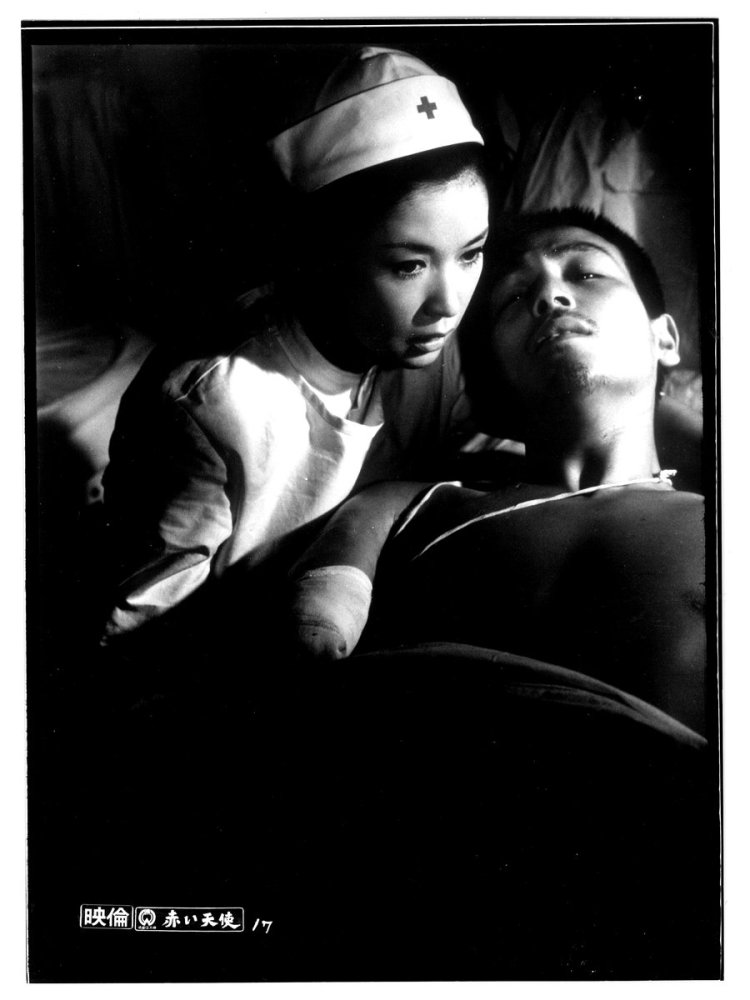
Red Angel (赤い天使, Yasuzo Masumura, 1966)

_1_image_size_900_xRed Angel (赤い天使, Akai Tenshi) sees Masumura returning directly to the theme of the war, and particularly to the early days of the Manchurian campaign. Himself a war veteran (though of a slightly later period), Masumura knew first hand the sheer horror of warfare and with this particular film wanted to convey not just the mangled bodies, blood and destruction that warfare brings about but the secondary effects it has on the psyche of all those connected with it.
The story begins as idealistic young nurse Sakura Nishi is sent to a military hospital in mainland China as the Japanese army continues its expansion into Manchuria. At this point the situation isn’t desperate, however, Nishi has barely settled into her new work when she’s grabbed by a patient who attempts to assault her. Far from coming to her rescue or raising the alarm, some of the other patients hold her down or guard the door while Nishi is raped. Reporting the incident to her superior the next morning, Nishi finds out she’s the third nurse this has happened to and only now the matron decides to have the patient (whom she brands a malingerer with mental problems) shipped back to the front lines. The soldier even has the audacity to say goodbye before he leaves whilst leering unpleasantly and if that wasn’t enough the friend also remarks that he enjoyed “the show” and is looking forward to “his turn”.

Things only get worse as Nishi is sent to the front line field hospital which is overrun with the dead and dying. The new patients are delivered by the truckload and the resident surgeon, Dr. Okabe, has to make split second decisions about who is most likely to survive and will receive treatment. Operations here generally result in amputations (whether strictly necessary or not) as this is the best way to prevent the onset of gangrene and other life threatening infections. Okabe was a top surgeon before the war but now he wonders if he’s even a doctor at all – let them die or mame them for life, these are his only options. Eventually, Nishi and Okabe develop a bond but in this desperate and dangerous environment, can you really trust anything or anyone or is every action simply part of the final death throws of those facing the ultimate horror of war?

The frontline field hospital is barely distinguishable from a charnel house as limbs are severed with terrifying efficiency by the conflicted Okabe. There’s little anaesthetic or even medication available and the men scream in agony, asking for their mothers until they finally pass out. Nishi retains some of her youthful compassion wanting to do the best for her patients but Okabe is already lost to a kind of fatalistic blankness.He knows the war itself is hopeless and repeatedly exclaims that China is just too big with too many people in it and they’ll make no impact at all here. At home at least he felt as if he could do something positive, save people’s lives, but here even if he manages to help someone they’ll be sent straight back to fight. They won’t even let the amputees go home for fear that the sight of so many limbless men will damage the nation’s morale.

Okabe, like most of the other men in the film, also has a preoccupation with sex and specifically how these men’s injuries may impact their later quality of life. As for himself, he’s been addicted to morphine for some time which has made him impotent and also places a barrier between himself and his developing relationship with Nishi. Perhaps for this reason he suddenly changes his mind about operating on a patient because it would mean interfering with an area of nerves directly related to sexual arousal and with so little time he’s worried it may be botched and ruin the man’s life so, as it’s likely he may survive without the surgery, he opts to leave it to the more capable hands of a homeland surgeon at a later date. Similarly, a sympathetic patient of Nishi’s who’s lost both of his arms later asks her to provide the “relief” that he is no longer able to supply for himself. Nishi comes to regard this as another of her duties of care and gives the man a few last minutes of comfort. However, this abundance of kindness proves to much for the man and only leaves Nishi feeling even more conflicted than before.

Despite the harshness of the environment, Nishi maintains her youthful and idealistic vision of the world. Okabe cautions her not to get attached to the patients and that the only way through is to view everybody as a stranger, she however refuses. Gradually, Nishi’s love and perseverance reawaken Okabe’s desire for life but in a world as chaotic and fragile as this one all human connections are fleeting and born of the proximity to death.

Red Angel plays out like a horror film full of blood and mangled bodies. Having opened with a series of broken skeletons, the film does not skimp on the macabre imagery and the scenes of buckets full of limbs and corpses being flung from sheets into mass graves are some of the most hauntingly authentic captured on screen. It’s raw and it’s grim, the frankness of its desire to address the murky sexual life of the wartime forces is also surprising from a film made in 1966. Yet there is passion and real connection here too. Throughout it all, Nishi never loses her desire to help or her commitment to love even in the darkest hours. She doesn’t, and cannot, win but her spirit remains unbroken. A harsh look at the animalistic nature of war and its destructive effect on basic human civility, Red Angel is one of the few films to deal with wartime sexuality in a frank way and is still, unfortunately, well ahead of its time.


Red Angel is available with English subtitles on R1 DVD from Fantoma and in the UK from Yume Pictures.

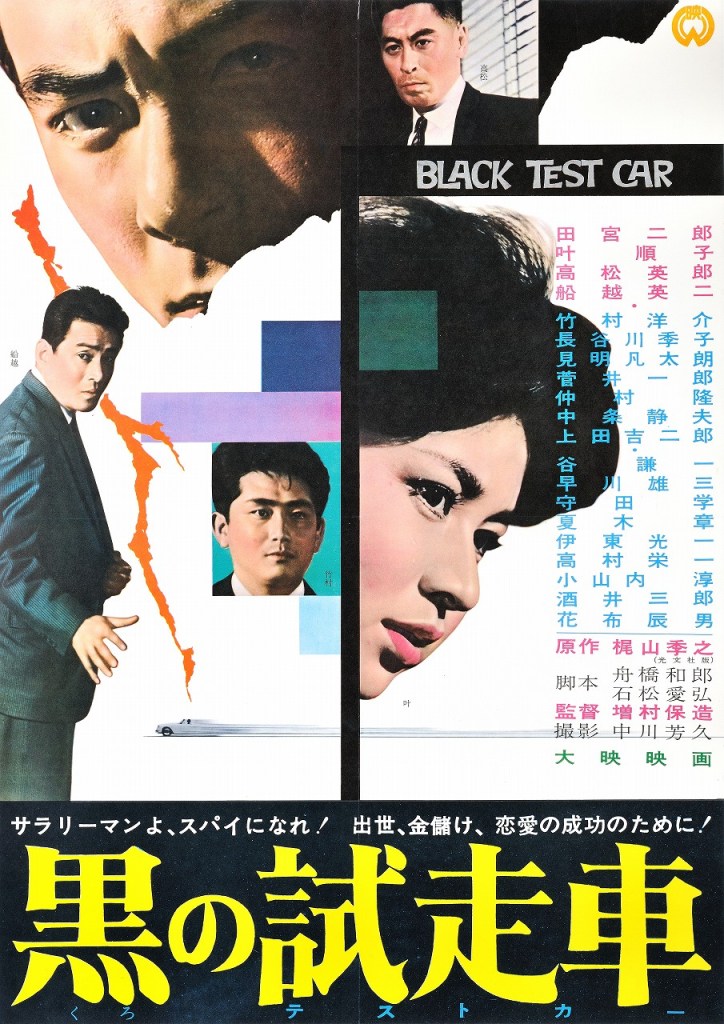
Black Test Car (黒の試走車, Yasuzo Masumura, 1962)

tumblr_n2w2l2mX1a1tvmqcgo1_1280The automobile business is a high stakes game. Do you want to play faster, shinier and sleeker, or safer, family friendly and reliable? Family cars are the best sellers – everyone one wants something that’s reliable for getting to work every morning, getting the grocery shopping done and that you won’t worry about taking your kids to the park in. However, it’s the 1960s and lifestyles are shifting, men (in particular) are marrying later and they want to have fun before they do – hence having quite a lot of disposable income they can blow on a flashy two-seater sports car with no wife to complain about it. Tiger have just finished a new prototype called the Pioneer they plan to launch as a revolution in commercial sports cars which is super speedy but with the convenience of an everyday sedan. However, the Yamato company are also set to launch a new car and it keeps looking suspiciously like the Pioneer – does Tiger have a mole?

Black Test Car (黒の試走車, Kuro no Test Car) begins with the prototype model of the Pioneer bursting into flames during a test run. Not the best start, but it’s early days and at least the driver wasn’t hurt. The guys at Tiger suspect sabotage as they can’t find anything wrong with car’s design. Onoda, the man who’s in charge of the project, has summoned some of his best employees to become the “industrial spying” department to flush out the mole. However, their first few plans fail and Yamato always seems to get there ahead of them. Yamato’s “chief of spying” is a slightly sleazy older man by the name of Mawatari who lost his wife and daughter during the Manchurian campaign (where he also may have been a more official kind of spy). Luckily (for some more than others), Onoda’s protege, Asahina, is dating a girl who works in the hostess industry and it’s suggested to him that he get his girlfriend to spy on Mawatari as he has a particular fondness for a certain hostess bar. The shady dealings only get worse from here on in, blackmail, bribery, pimping and prostitution – is this the yakuza or the automobile industry?

Yasuzo Masumura turns his cynical eye to big business and finds just as must drama as in your cold war spy epic. Onoda is a fanatical company man whose primary reason for living is his work. He barely comes home, rarely sees his children and views his precious Pioneer as his legacy. As such, he’s determined to find the man who’s betraying all his secrets and has become something of a petty dictator in the process. “We’re industrial spies!” he keeps declaiming, as if those words had any kind of authority. He’s not a policeman, he’s not a warrior for justice, he’s just a guy at a car firm who’s poured altogether too much of himself into a few scraps of metal.

His assistant, the up and coming Asahina, seems set to follow in Onoda’s footsteps. He’s young and ambitious, he wants to get the head of department job so he can marry his girlfriend who is still working as a bar hostess (which he doesn’t actually seem to mind about if she doesn’t mind about it either). The girlfriend, Masako, worries that work is changing him. When Asahina asks her to spy on Mawatari she refuses, but when he half jokes that he might not want to marry her she if won’t do as he says, she eventually agrees. Later he asks her for more than that which might just be enough to nip this young love story well and truly in the bud.

Having lost out several times already, the Tiger guys think they’ve got an angle and decide to launch the Pioneer way ahead of schedule to undercut Yamato’s price and release date. However, right away there is a scandalous accident which ends up all over the papers as the driver of the car (who survived unscathed, there were no serious injuries involved) drags the wreck all over town with a loud speaker to announce just how dangerous he believes the car to be. Of course, he’s a stooge, set up by Yamato and aided by another undiscovered mole in the Tiger camp. This incident is the last straw for those who still have a moral backbone at Tiger – culminating in violence and suicide, it leaves the fresh faced executives wondering whether they’re on the career ladder at a respectable firm or among the ranks of thuggish gangsters prepared to lie, cheat and extort to get along.

Shot in a noirish black and white with a moody jazz score, Black Test Car has its film noir overtones with the immorality of big business at its centre. At the beginning of the film everything is for the company – no one thinks of themselves or their own soul, they just want in and to climb the ladder while its there. Or so it seems because everyone is also taking kickbacks whilst blackmailing other people for doing exactly the same thing. There are spy cams interpreted by lip readers, undercover prostitutes masquerading as nurses and men in bushes with microphones – not a dignified way of doing business. At one point Onoda scoffs “you can’t get hung up on  morals. You’ll just have remorse” – this is the choice that presents itself, would you rather have the flashy sports car or retain your humanity?


Black Test Car is available on R1 DVD with English subtitles courtesy of Fantoma.

(unsubbed trailer)


Princess Jellyfish (海月姫, Taisuke Kawamura, 2014)

b7dec6a631e5ad87baf2ff601d6b4872Originating as an ongoing manga series by Akiko Higashimura which was also later adapted into a popular TV anime, Princess Jellyfish adopts a slightly unusual focus as it homes in on the sometimes underrepresented female otaku.

Tsukimi is an extremely awkward young woman who has an all encompassing obsession with jellyfish. Luckily for her, she’s managed to find a group of likeminded women of a similar age to room with. That is, they aren’t all as crazy about jellyfish as she is, but they all have their particular order of special interest, are fairly socially awkward with an extreme fear of “fashionable” women, and no formal form of employment. At the Amamizukan boarding house, the girls can all enjoy their otaku lives together (well, kind of separately) and, crucially there are no boys allowed!

However, one day Tsukimi finds herself at a crisis point when she notices one of the jellyfish she likes to visit at a nearby pet shop is in danger! The idiot shop boy has only gone and put a Moon Jelly in with a Spotted Jelly – does he just not know how dangerous that is?! Tsukimi will need to act fast to save her friend, but the guy behind the counter is a clueless pretty boy – absolutely the worst case scenario for Tsukimi. Despite her extreme anxiety she valiantly marches into the shop yet her confused mini lecture on jellyfish keeping only succeeds in convincing the shop boy that she’s some kind of nutcase. On being expelled from the shop, Tsukimi finds herself at the feet of an extremely glamorous looking woman who comes to her defence. What kind of strange parallel world is this? Tsukimi’s universe is about to undergo a sea change!

Though based on a manga and intended as a comedy, crucially, Princess Jellyfish casts its series of “different” heroines (and hero) in a favourable light – they are never the butt of the joke and sympathy is always placed with those who experience difficulty in their lives because they feel themselves to be different. Each of the girls is so deeply involved in their own particular obsession that they find it difficult to fit into the regular world and particularly to cope with conventional femininity. Tsukimi herself finds it particularly difficult to talk to men and the fact that no men are permitted at Amamizukan makes it clear that she is not alone in her fears.

This brings us to her new friend who is apparently a fashionable young woman – the sort who would never usually be seen dead talking to the likes of Tsukimi. However, this one not only acknowledges Tsukimi’s presence as another human of equal standing, but even lends her confidence and power as an attractive woman to Tsukimi’s predicament. There is, of course, more to this mysterious saviour than there might seem at first sight. In addition to being a fabulously well dressed lady, Kuronosuke is also a boy. This is something of a problem for Tsukimi as she only realises after letting him stay over at the strictly no boys allowed residence. The ruse also has to be maintained a little longer when Kuronosuke decides to stick around, eventually becoming known as “Kuroko”.

The situation intensifies as the girls’ secret haven comes under threat when a gang of ruthless developers want to buy up most of the town and redevelop the area. The group home is owned by one of the girl’s mothers who is also an otaku only her obsession is with top Korean actor Lee Byung-hun and she’s skipped off to Korea to be able to stalk him better. There’s no telling what she might do if it brings her closer to the object of her affections and things are looking a little desperate. Eventually a possible solution is found which plays to everyone’s strengths and offers the faintest glimmers of hope for the girls (and boy!) of Amamizukan.

Princess Jellyfish is the ultimate tale of acceptance, both in personal and societal terms. The residents of Amamizukan may be a little different, but that doesn’t mean they have nothing to offer the world and there’s no need for themselves to maintain a position of self imposed exile if the only reason is a belief in their own inferiority. This is a lesson taught to them by the exuberant rich boy and politician’s son with a traumatic past of his own, Kuronosuke. Truly unafraid to be who he is, Kuronosuke teaches the girl’s that almost any obstacle can be overcome with a combination of forthrightness and sincerity.

Though it runs a little long and gives in to some very over the top performances and melodramatic plotting, Princess Jellyfish is an enjoyably offbeat manga inspired tale. Very much not interested in demonising anyone other than those who seek to suppress individuality, it’s a cheerful celebration of the value to be found in difference offering plenty of laughter and warmth along the way. Perhaps not for those who prefer their cinematic experiences on the subtle side, Princess Jellyfish is nevertheless a fun filled film which carries its message of universal acceptance right into the closing credits.


The anime adaptation of this is actually really fun too.