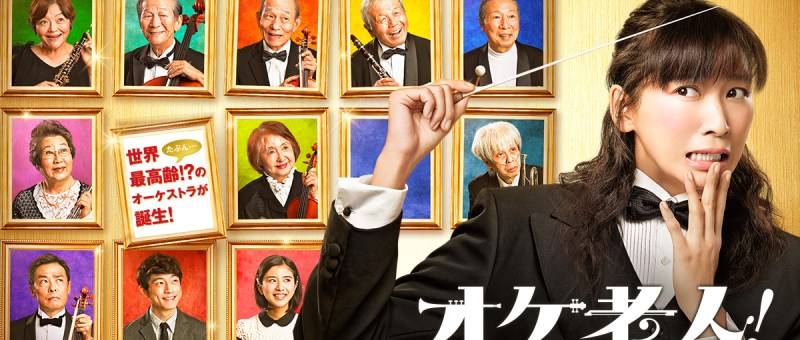
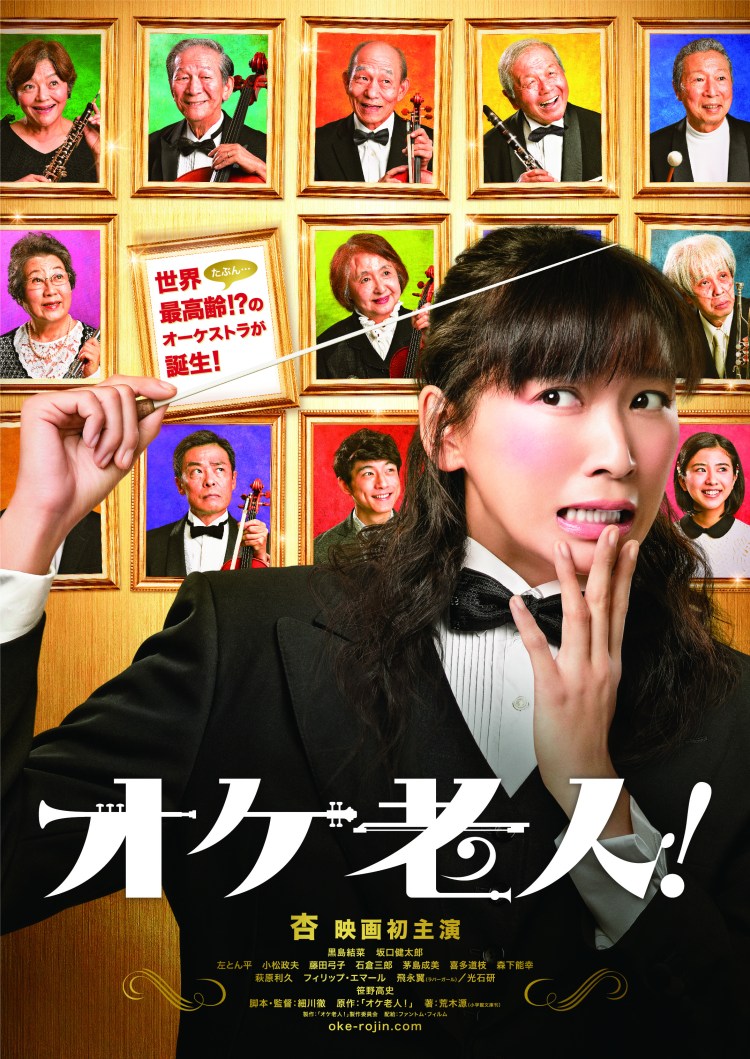
Golden Orchestra! (オケ老人!, Toru Hosokawa, 2016)

ƒIƒP˜Vl_ƒeƒBƒU[ƒ`ƒ‰ƒV•1C³_ƒAƒEƒg‚È‚µIt might never be too late to follow your dreams, but if following your dreams makes you very unhappy perhaps you need to spend some more time figuring out what they are. Golden Orchestra (オケ老人!,  Oke Rojin!) is one in a long line of Japanese fish out of water / underdog comedies, but addresses some very contemporary concerns from the ageing society to a perceived loss of community in the face of soulless commercialism. Our stuck-up school teacher is about to learn a few lessons, chief among them being that it’s much better just having fun with nice people than being caught up in a vicious and unwinnable game of elitism with a bunch of permanently scowling snobs.

20-something school teacher Chizuru (Anne Watanabe) harbours a longstanding dream of playing in an orchestra but gave up the violin when she got a job. A visit to a classical music concert in provincial Umegaoka reignites her musical passion and she quickly becomes determined to dust off her instrument and ask for an audition. However, as she was so excited she can’t quite remember the orchestra’s name and, assuming there couldn’t be two in this tiny town, signs up for the wrong one. Only realising her mistake when a bunch of old people turn up instead of the well turned out collection of musicians she was expecting, Chizuru tries to back out but the old people are so happy to have her that she can’t quite work up the courage to tell them no.

As it happens there’s a People’s Front of Judea situation going on between Ume-sym and Ume-phil. The conductor of Ume-sym, Nonomura (Takashi Sasano), is also the owner of a family-run electronics shop – a relic of a bygone era made all the more lonely by the flashy electronics superstore that’s been set up right next door. The owner of the electronics superstore, Osawa (Ken Mitsuishi), used to be a member of Ume-sym but stormed out to form his own orchestra – Ume-phil, so he’s betrayed Nonomura twice over and there’s bad blood between them which isn’t helped by Osawa’s constant overtures to Nonomura’s son about buying up the shop in order to close it down.

Chizuru is, it has to be said, a somewhat clueless woman approaching middle age who is also a bit of a snob. She’s harboured musical dreams ever since she can remember, giving them up because, after all, that’s what you’re supposed to do in order to accept a conventional, ordered life. If playing music was all she wanted to do, there was nothing stopping her doing it at home in her free time, but Chizuru wants to be among the best. She looks down on the old people in the orchestra – firstly because they’re “old” and therefore “bothersome” (as she notes turning off a tap left running by an absent-minded older lady), and then because they’re just not any good, and finally because their aim isn’t really becoming a successful orchestra so much as it is participating in a community activity. The old ladies have brought snacks which must be indulged and appreciated, while the old men all enjoy the after practice drinking sessions perhaps more than they do the music.

Turning her back on this anarchic friendliness, Chizuru practices night and day to get into Ume-phil, but Ume-phil isn’t about love of music either, it’s just about being superior and giving yourself an excuse to look down on people. Chizuru finds out for herself how stressful and unpleasant it can be as a “member” of just such a community when they grudgingly grant her a spot. Ume-phil runs on a survival of the fittest policy – not everyone gets to play, only whoever is deemed most worthy. When push comes to shove, Osawa buys himself success by hiring a world-famous French conductor for the biggest concert of the year. Only the professional conductor is true music lover and quickly quits Osawa’s ersatz orchestra, charmed by the down-home wisdom of Mr. Nonomura who manages to fix his treasured cassette player when Osawa advised him to throw it out and buy something more up-to-date. Some people just can’t see what’s really important.

As expected, Chizuru finally realises that it’s just much nicer (not to mention less stressful) having fun making music with the old people rather than putting up with the soulless rigour of the Osawa brigade for whom nothing will ever be good enough. In the end Ume-sym decides to practice Dvorak’s Largo which is, as anyone who’s seen a Japanese film knows, an instantly warm and nostalgic tune familiar as the inspiration for (in some cities at least) Japan’s five ‘o clock chimes (British viewers may well experience the same surge of wistful melancholy thanks to the same tune’s iconic use in a series of Hovis adverts from the ‘70s and ‘80s). It’s an apt choice for a film which harks back to a simpler time when people took care of each other and rejoiced in ordinary pleasures like home-made pickles and fixing things that were broken rather than throwing them out to buy new ones. In true community spirit, it’s not so much that one side wins and another loses, so much as that the joy of sharing a dream with others becomes infectious, producing a rapprochement between the old and the new which allows a peaceful coexistence of the two. Cosy cinema at its finest, Golden Orchestra may not offer anything new to a well-worn formula but in many ways that is the point and its harmonious charms prove hard to resist.


International trailer (English subtitles)

The original Hovis ad from 1973 (which was directed by Ridley Scott)
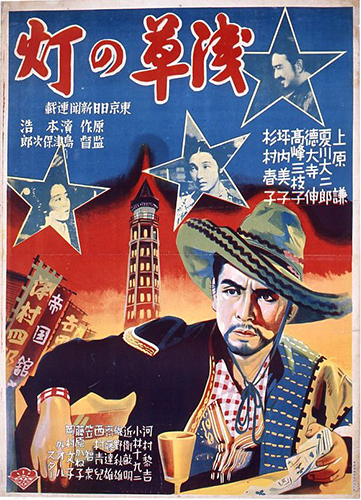
The Lights of Asakusa (浅草の灯, Yasujiro Shimazu, 1937)

Lights of Asakusa posterThe lights of Asakusa (浅草の灯, Asakusa no Hi) still shone bright before the war. In this tiny corner of Tokyo well known for “low” entertainment, actors mingle with gangsters, lonely owners of amusement stalls, starving artists, bar girls, and wealthy industrialists each just trying to survive in an increasingly jittery city. Yasujiro Shimazu had been a pioneer of the “shomingeki” – stories of ordinary lower middle class people, and brings his characteristic wit and humanity to a tale of backstreet life where danger and ruin lurk on every corner and the only way to ensure one’s safety is to ensure you have the right defenders.

The main stage, if you will, is that of the Nippon-za “opera” company. This is, however, no great opera house but a run down little theatre presenting classical European opera for vaudeville audiences. The currently running show is Carmen, which will turn out to be appropriate for the events at hand. The trouble starts (or perhaps merely intensifies) when a young chorus member, Reiko (Mieko Takamine), begins attracting a range of wanted and unwanted male attention. Reiko, an orphan, had been taken in by a local bar mistress who later pushed her into the opera company but still expects her to make good on her investment by becoming a casual prostitute and taking on “customers” who present themselves at the bar (Reiko is around 16 or so, and therefore has just reached the age her foster mother thinks appropriate to join the business). The complication is that the man who’s taken a fancy to Reiko, Handa (Shunro Takeda), is a steel magnate who also finances the opera troupe meaning it’s not just the bar owner who’s coming under pressure but the financial security of the troupe too.

Being so young, Reiko finds her foster mother’s demands hard to refuse but is rescued by Sasaki (Seiji Nishimura) – the leading actor, married to leading lady Marie (Haruko Sugimura). The situation with Reiko exposes cracks already present in the group when Handa sends his goons in to disrupt the show, irking Sasaki to the point he takes off in a fit of artistic temperament. Meanwhile, another actor Yamagami (Ken Uehara), gets together with the rest of the troupe to ensure Reiko’s safety by hiding her with a feeble minded fan, Pokacho (Daijiro Natsukawa), so that she won’t be forced into a potentially life ruining situation.

Reiko’s plight is perhaps all too common on the streets of Asakusa. Having been orphaned she feels herself indebted to the bar mistress who took her in even if the relationship between them is not especially warm. She also feels grateful to have found a third family in the opera troupe and is afraid to lose her place there. Nevertheless, she is under extreme pressure to submit herself to this system of reciprocal arrangements and sleep with Handa solely to save making trouble for everyone else. Meanwhile her (sometimes) sympathetic roommate Beniko (Kayako Fujiwara) knows exactly what’s at stake through having been in a similar situation herself. She’s long been in love with the pure hearted Yamagami and is harbouring a degree of jealously in believing that Yamagami has a soft spot for Reiko, but she also half wants things to work out between them seeing as she has lost the “right” to love a man like Yamagami because she is no longer a virgin.

Shimazu had often been of a progressive mind, but sadly Beniko falls by the wayside, merely a sacrificial lamb prepared to give up on her dreams on Reiko’s behalf, so we never find out the limits of Yamagami’s justice loving heart or if he would be as bothered about Beniko’s past as she seems to fear he might be. Yamagami, brooding but righteous, would become one of matinee idol Ken Uehara’s best known roles though he too is teetering on the brink in Asakusa. Committed to defending the innocent, he tries to save Reiko’s honour but fails to declare a personal interest, entrusting her to the rather odd painter Pokacho who claims that his love for Reiko is of a spiritual, rather than carnal kind. Yamagami may succeed in his primary goal but still ends up in defeat, running away from the most important fight by retreating from Tokyo completely with a rebound girlfriend in tow, hoping to find kinder light in Osaka than he had on the dog eat dog streets of Asakusa.

Based on a novel by Hiroshi Hamamoto, Shimazu’s portrait of backstreet life sparkles with authenticity but also with a kind of hopelessness as each of these down on their luck “opera” stars laments their sorry fates and longs for a better gig somewhere less down and dirty. Meanwhile, the spectre of war lingers – when Carmen comes off the next show is to be “Two Honourable Soldiers”, filled with maudlin anthems of war which push the messages of patriotism and the glorification of offering one’s life for one’s country. The slimy Handa may have been defeated for now, but his kind are in the ascendent and the streets of Asakusa are unlikely to improve with only war and depression on the horizon.


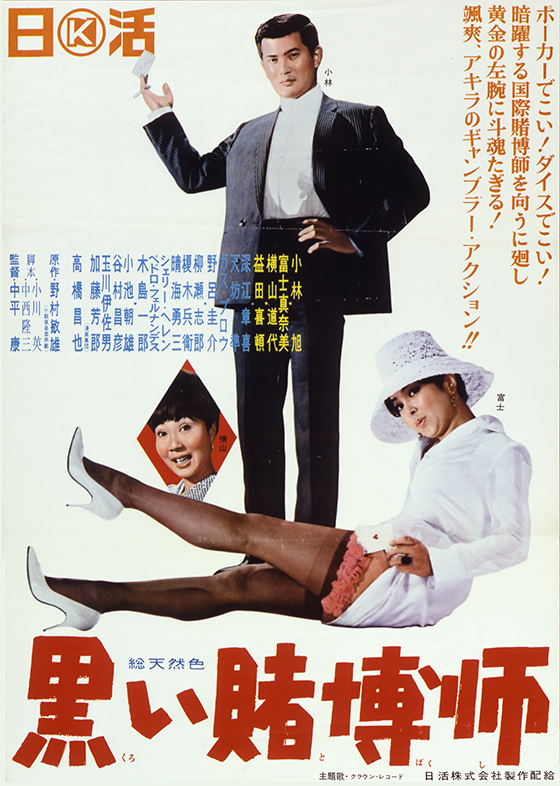
The Black Gambler (黒い賭博師, Ko Nakahira, 1965)

Black Gambler poster

Nikkatsu’s “Mighty Guy” Akira Kobayashi occupied a very particular space in the studio’s collection of leading men. Where Yujiro Ishihara was known for his roguish cheek, Tetsuya Watari for his bruiser nobility, and Joe Shishido for his detached efficiency, Kobayashi’s chief selling point was his gentlemanly charm and unflappable decency. The “Gambler” series which ran to eight films in all cast him as a James Bond-esque wandering cardsharp with a well tailored suit and keen intellect capable of defeating even the most devious of opponents. The sixth in the series, simply titled The Black Gambler (黒い賭博師, Kuroi Tobakushi), finds Koji Himuro (Akira Kobayashi) returning to Tokyo and straight into the middle of international intrigue as he gets mixed up with a global gambling syndicate hellbent on bringing its particular brand of funny business to the Japanese capital.

Himuro, renowned for his skills at the gaming table, is called to an exclusive gambling party where he entertains the French Ambassador and ruins a cheating rival in the process. Inumaru (Asao Koike), humiliated by his defeat, sends his mistress Reiko (Manami Fuji) to spy on Himuro and figure out all his secrets so they can get their revenge. However, Himuro gets himself mixed up in a bigger crisis when he comes to the rescue of a foreign woman in a park running away from a scary looking gangster. The woman, Nina, claims to be an air stewardess flown in from Hong Kong who has fallen foul of a Chinese gangster named Yang. Yang has apparently tricked her into amassing vast debts and thereafter attempted to recoup his investment in other ways. Himuro is a noble sort of guy and so decides to pay off Nina’s debt by defeating Yang in a game of cards, but Yang is a different kind of opponent than he’s hitherto faced and Himuro finds himself floundering unable to figure out Yang’s particular cheat.

Nikkatsu’s action line was famous for its “borderless” approach, making an international milieu one of its many selling points. This is not to say its vision of global Japan was altogether positive – in fact the reverse was often true. Once again, the Chinese have been designated the criminal element of choice with Yang painted as a villainous cheater complete with a horrible Fu Manchu beard and delirious cackle, sure that his unique method for ensuring victory cannot be beaten. Meanwhile, Himuro’s first engagement dropped him straight into a world of international diplomacy and it comes as no surprise to learn that Yang’s activities are merely a facet of a wider conspiracy which turns out to be run by a Jewish gambler who apparently used his ill gotten gambling gains to finance the Nazis during the second world war. Perhaps it’s wise not to even start trying to unpack that one.

Himuro’s upscale world of high stakes games played in well appointed rooms by men wearing tuxedos and drinking martinis may be a world away from the dirty backstreet shenanigans of Nikkatsu’s other gambling adventures, but there is bite in its defiant bid for frivolity. When Himuro first rocks up at the French Ambassador’s residence, his assistant doesn’t really want to let him in. He is infuriated that with a war going on in Vietnam his boss is taking time out to play silly games of chance rather than getting on the with real business of diplomacy. Vietnam is referenced again in the ironic closing freeze frame in which Himuro covers his face with a newspaper bearing the headline “America bets on bombing North Vietnam” – politics itself is now a game played by men in smart suits trying to stave off the boredom of being alive by using the lives of real men and women as gambling chips with little more feeling for them than for the tiny scraps of plastic which stand in for meaningless little bits of paper in the centre of a table covered in green felt.

Women, it seems, are a more immediate casualty of a gambler’s vice. Reiko, sent to spy on Himuro but drawn to his cardsharp’s acumen, was herself gambled away by her father who lost her to Inumaru in a bet. She holds no affection for the man who won her, but feels bound to him all the same and has vowed to become a top gambler as an odd kind of revenge. Nina too suffers at the hands of gangsters and criminals, drawn to Himuro because of his heroic nobility and unable to escape the underground world of grifters and chancers without the help of a seasoned player.

Sticking to a house style, Nakahira finds little scope to express himself in another B-movie adventure for the sophisticated gambling man. Nevertheless, there’s enough Bond-inspired silliness to keep the franchise fans happy from Himuro’s ball bearing loaded car to the gaming intrigue and intricate cheats that define it. The Black Gambler is a fairly typical example of Nikkatsu’s regular programme picture with little to distinguish it but it does what it sets out to well enough and with crowd pleasing style.


Opening scene (no subtitles)

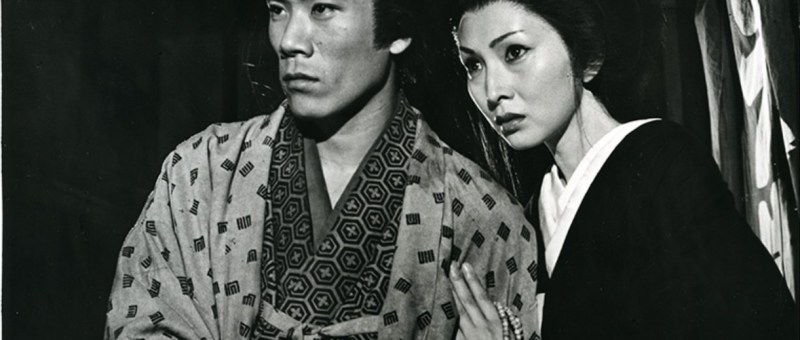
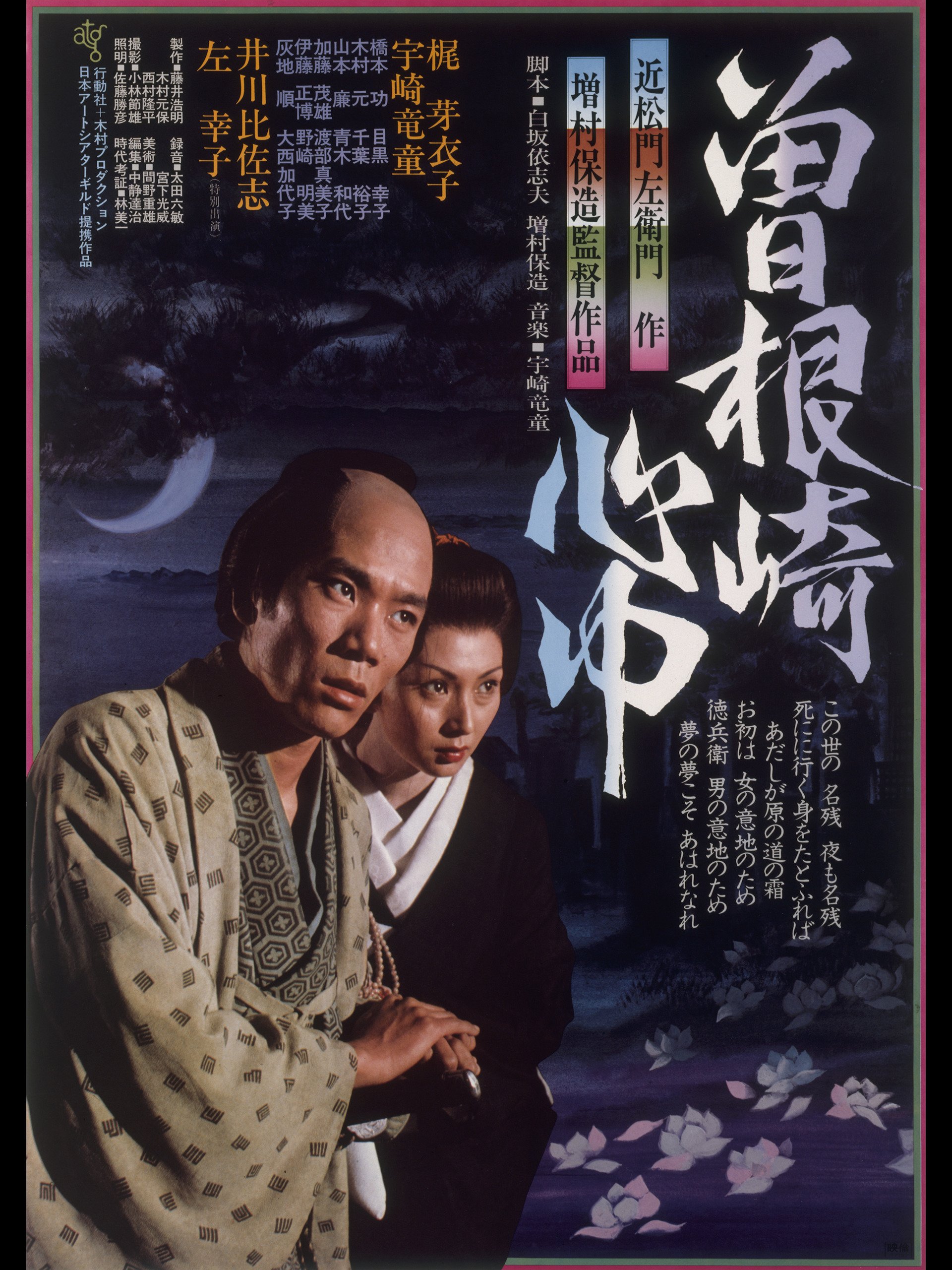
Double Suicide at Sonezaki (曽根崎心中, Yasuzo Masumura, 1978)

Love Suicides at Sonezaki posterAfter spending the vast majority of his career at Daiei, Yasuzo Masumura found himself at something of a loose end when the studio went bankrupt in the early ‘70s. Working as a freelance director for hire he made the best of what was available to him, even contributing an instalment in former Daiei star Shinataro Katsu’s series of period exploitation films, Hanzo the Razor: The Snare. There is, however, a particular shift in the famously fearless director’s point of view in these later films as his erotically charged grotesquery begins to soften into something more like an aching sadness in the crushing sense of defeat and impossibility which seems to consume each of his heroes. Maintaining the contemporary groove of Lullaby of the Earth – an uncharacteristically new age inflected tale of a naive orphan from the mountains tricked into the sex trade through a desire to see the sea, Double Suicide at Sonezaki (曽根崎心中, Sonezaki Shinju, AKA Love Suicides at Sonezaki / Double Suicides of Sonezaki, Double Suicide in Sonezaki) is a melancholy exploration of the limitations of love as a path to freedom in which the demands of a conformist, hierarchical society erode the will of those who refuse to compromise their personal integrity on its behalf until they finally accept that there is no way in which they can possibility continue to live inside it.

Ohatsu (Meiko Kaji), the geisha, has fallen in love with a client – Tokubei (Ryudo Uzaki), who is a humble man taken in by an uncle with the intention that he take over his soy-sauce shop. No longer the relationship between a prostitute and a customer, Ohatsu refuses to take Tokubei’s money which begins to cause friction with her “master” at the brothel to whom she still owes a significant debt. Tokubei does not possess the resources to redeem her, nor is he ever likely to. Matters are forced to a crisis point when each of them is offered what would usually be thought the best possible option for their respected social paths. Tokubei is offered the hand in marriage of his aunt’s niece and the chance to set up his own shop in Edo but it isn’t what he wants because he wants Ohatsu. Similarly, Ohatsu is sought by a wealthy client who wants to buy her and take her home as a mistress – she tries to refuse but has to play along given her relative lack of agency, longing to be with Tokubei or no one at all. Tokubei is thrown out by his uncle for refusing the marriage and finds himself the difficult position of having to reclaim dowry money from his greedy step-mother only to be conned out of it by an unscrupulous “friend”, Kuheiji (Isao Hashimoto), who later frames him to make it look like Tokubei cheated him. Beaten and ostracised, Tokubei sees no escape from his shame other than through an “honourable” death and Ohatsu sees no life for herself without her love.

Inspired by Chikamatsu’s world of double suicides, Masumura adopts a deliberately theatrical method of expression in which the cast perform in a heightened and rhythmic style intended to evoke the classical stage of Japan. Yet he also makes a point of scoring the film with contemporary folk and jazz as if this wasn’t such an old story after all. Times may be more permissive, but perhaps there’s no more freedom in love than there ever was and the pure dream of happiness in romantic fulfilment no more possible.

The forces that keep Tokubei and Ohatsu apart are only partly those unique to the feudal world – debt bondages and filial obligations being much weakened if not altogether absent in the post-war society, but are almost entirely due to their lack of individual agency and impossibility of freeing themselves from the various systems which oppress them. Tokubei is a poor boy from the country whose father has died. He has been taken in by an uncle and trained up as an heir – something he is grateful for and has worked hard to repay, but will not sacrifice his individual desire in order to accept the path laid down for him.

Ohatsu, in a more difficult position, is oppressed not only by her poverty but by her gender. Sold to a brothel she is subject to debt bondage and viewed only as a commodity, never as a person. When she intervenes to stop Tokubei being beaten by Kuheiji’s thugs, her patron panics but only because he will lose his money if she is “damaged”. Similarly, the brothel owner complains for the same reason after some ruckus at the inn. Neither of them are very much bothered about Ohatsu in herself but solely in her functionality as tool for making money or making merry respectively.

“Money is better, money means everything” claims Tokubei’s angry step-mother and she certainly seems to have a point as both of our lovers struggle through their lack of it. In the end it’s not so much money but “shame” which condemns them to a sad and lonely death as they realise they can no longer live with themselves in this cruel and unforgiving world which refuses them all hope or possibility for the future. An honourable man, Tokubei cannot live with such slander – men die for honour, and women for love, as Ohatsu puts it. Ironically enough there was a chance for them but it came too late as Kuheiji’s machinations begin to blow back on him and Tokubei’s uncle begins to regret his overhasty disowning of his nephew, but the world is still too impure for such pure souls and so they cannot stay.

Unlike some of Masumura’s earlier work, there’s a sadness and an innocence implicit in Double Suicide at Sonezaki that leaves defiance to one side only to pick it up again as the lovers decry their love too pure to survive in an impure world. The world does not deserve their love, and so they decide to leave it, freeing themselves from the “shame” of living through the purifying ritual of death. Softer and sadder, the message is not so far from the director’s earlier assertions save for being bleaker, leaving no space for love in an oppressive and conformist society which demands a negation of the soul as the price for acceptance into its world of cold austerity. 


Opening (no subtitles)

Orange (orange-オレンジ, Kojiro Hashimoto, 2015)

Orange posterPerhaps it isn’t possible (or even desirable) to live a life without regrets, but given the opportunity who wouldn’t want a second chance to tackle some of those thorny adolescent moments where you said something you shouldn’t have or didn’t say something that perhaps should have been said. The heroine of Kojiro Hashimoto’s Orange (orange-オレンジ) gets exactly this opportunity when she receives a letter from her future self asking for her help in “erasing” some of her teenage regrets by using the information in the letter to save a friend she hasn’t yet met. Though the letter contains little information about the life she is leading ten years from now, it is clear that something happened all those years ago which has profoundly affected the lives of a tight group of high school friends.

16-year-old Naho (Tao Tsuchiya) receives the letter at the beginning of her second year of high school, reading it under the vibrant pink cherry blossoms. A little creeped out, she doesn’t read it fully but is surprised when, just as the letter said, a new student, Kakeru (Kento Yamazaki), transfers into her class and occupies the previously empty desk next to hers. A shy and quiet girl Naho is nevertheless part of a group of five friends which includes sportsman Suwa (Ryo Ryusei), geek Hagita (Dori Sakurada), and two other girls Takako (Hirona Yamazaki) and Azusa (Kurumi Shimizu). For reasons unexplained, the group quickly takes Kakeru into their fold only for him to suddenly disappear for a couple of weeks. On closer inspection of the letter, Naho is disturbed by the news that Kakeru is “no longer around” at the time of her future self’s writing.

Orange fits neatly into the popular tragic high school romance genre in which an older version of the protagonist looks back on a traumatic event and tries to come to terms with their own action or inaction in order to move forward with their adult lives. 26-year-old Naho, as we quickly find out, has moved on – she is married to Suwa and has a young son she has named Kakeru but she and the others are still finding it difficult to come to terms with what happened to their friend and the possibility that they could have done something more to help him if they’d only known then what they know now.

So far so “junai”, but Orange tries to have things both ways by introducing a slightly clumsy time travel/parallel universe theory in which the protagonists realise that they won’t be able to change the past but are hoping that their friend is happy in an alternate timeline created by their efforts to influence their younger selves with more mature thinking coupled with the benefit of hindsight. Unlike other examples of the genre, Orange undercuts the usual need to deal with the past and find closure through a mild fantasy of denial in which the older protagonists can believe in an alternate future in which they were able to do things differently and save their friend from his unhappy destiny.

Saving their friend is, however, only a secondary goal – the first being to ease their own sense of guilt in not having seen that Kakeru was in trouble and needed their help. All this emphasis on personal “regret” cannot help but seem somewhat solipsistic – everyone is very sorry about what happened in the past and wishes that they could have acted differently but is also somewhat preoccupied with their own role in events rather than a true desire to have in someway eased their friend’s suffering. Though there is the true selflessness of real, grown up love such as that displayed by Suwa who has always loved Naho but supports her love of Kakeru despite his own feelings, the actions of the group remain childishly goal orientated as Kakeru’s survival becomes an end mission flag rather than an expression of love and care for a friend in trouble.

The teenagers are, despite advice from their older selves, still teenagers and so it is only to be expected that they respond to a very grown up problem with a degree of immaturity, but it is also true that Kakeru’s ongoing, mostly well hidden, depression plays second fiddle to the various romantic subplots currently in action. Though the friends rally round with fairly trite phrases about helping to carry Kakeru’s burden and always being there him, Orange almost tries to argue that kind words are enough to pull a strained mind back from the brink – not that kind words ever hurt, but some problems are bigger than superficial pledges of friendship can handle especially when you’ve half a mind on who loves who and who is trying to get in the way of someone else’s romantic destiny. In spending so much time worrying about their friend, they have, in a sense, left him to deal with all his problems on his own while revelling in their own “concern”.

Superficial and melodramatic, Orange’s insistence on the power of teenage friendship can’t help but ring a little false and the parallel universe solution an overly convenient narrative device which allows for two differing resolutions both of which essentially frustrate the attempts of the older protagonists to accept their own sense of guilt and responsibility for their friend’s death in order to move on with their lives. Kakeru, in a sense, gets forgotten in his friends’ need to absolve themselves of his fate – a particularly ironic development in a cautionary tale about the enduring legacy of regret and the necessity of communicating one’s true feelings fully in the knowledge that there may not always be another opportunity to do so.


Original trailer (no subtitles)

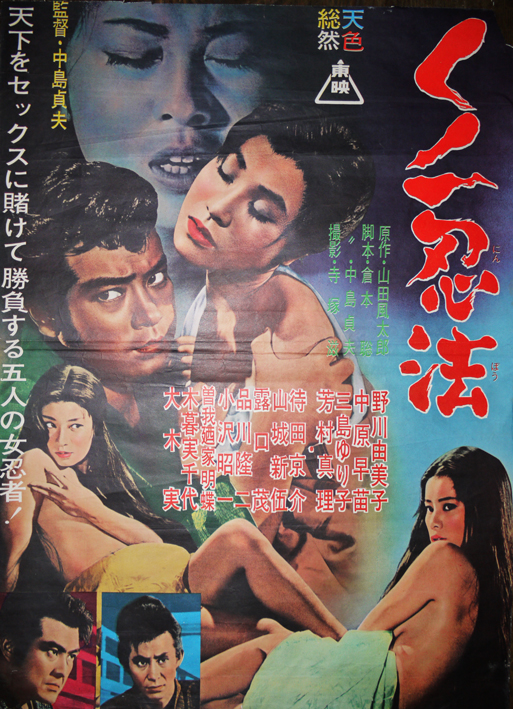
Female Ninja Magic (くノ一忍法, Sadao Nakajima, 1964)

female ninja magic posterSadao Nakajima, a veteran director and respected film scholar, is most often associated with his gritty gangster epics but he made his debut with a noticeably theatrical fantasy tale of female ninjas and their idiosyncratic witchcraft. Adapted from a novel by Futaro Yamada, Female Ninja Magic (くノ一忍法, Kunoichi Ninpo) is an atypically romantic take on the ninja genre, infused with ironic humour and making the most of its embedded eroticism as a collection of wronged women attempt to change the course of history and mostly pay with their lives.

The night before the fall of Osaka castle in 1615, Sanada Yukimura (Eizo Kitamura) comes up with a cunning plan to ensure the survival of the Toyotomi clan. Following the death of Hideyoshi, his son Hideyori had inherited the title but he was sickly and had no children of his own. His wife, Princess Sen (Yumiko Nogawa), was not able to bear an heir and so Sanada has hit on an idea. He wants to send five women of Iga to Hideyori’s bed chamber in the hope that one of them will become pregnant and ensure the survival of the Toyotomi line. Princess Sen is very much in on the plan and hopes to raise the child herself. However, she is by birth a member of the Tokugawa which is where she is eventually sent following fall of Osaka. Refusing to return to her birth clan, Sen rejects her father and insists on remaining true to the memory of her (now departed) husband and his unborn child. Tokugawa Ieyasu (Meicho Soganoya), however, has learned of the Toyotomi heir and is determined to see it killed…

Nakajima opens in grand fashion with a ghostly sequence in which Sanada outlines his plan. The ninjas sit silently before magically fading from the frame and being replaced by Sasuke, Sanada’s messenger. Soon enough, both Sanada and Sasuke are cut down by a rogue assassin but rather than going straight to heaven they decide to hang around and see how well the plan works out, becoming our narrators of sorts, hovering around in the background and occasionally offering the odd ironic comment from beyond the frame.

The ghostly effects don’t stop with the two undead commentators but comprise a key part of Nakajima’s deliberately theatrical aesthetic. Like many ninja films, Female Ninja Magic is filmed almost entirely on studio sets but never pretends otherwise. Its world is unrealistic and deliberately over the top, filled with with visual motifs both from traditional Japanese and classical European art. The female ninjas dance, topless, beckoning and seducing but they do it against a stark black background moving firmly into the film’s magical space in which all things are possible.

Meanwhile, Tokugawa Ieyasu has sent five male ninjas to take care of our five female witches, making use of their own, devious, ninja magic to combat that of our heroines. The first nefarious male ninja technique involves the murder and identity theft of a trusted maid, while another tries a similar trick by “projecting” himself into the consciousness of a handmaiden he has figured out is pregnant by listening for additional heartbeats, and convincing her to commit harakiri. His villainy is eventually turned back on him as the female ninjas make use of the most important of their spells – the “Changing Rooms” technique which effectively shifts the foetus from one womb to another.

Deliciously named – Rainbow Monsoon, Dancing Snow, Robe of Wings etc, the spells run from the sublime to the ridiculous with the self explanatory Eternal Gas which sends noxious purple smoke billowing from under the skirts of an elegant princess. Each has its own erotic component, even if it doesn’t necessitate a shift into the film’s elegantly designed dreamscape, but by and large the female ninja fight with supernatural rather than earthly powers. Facing such extreme threat, the women form a tight group of mutual support in order to ensure the survival of the child which Princess Sen will raise but not birth. Though her quest originated as a fierce declaration of her loyalty to the Toyotomi, she later recants on her tribal zealotry. Shocked by her father’s cruelty and sick of a persistent suitor, she admits that she has come to loathe the world of men and prefers to think of the baby as belonging to her band of women alone. Nevertheless, male violence eventually saves her as her aggressor, ironically enough, is moved by her devotion to the new life in her arms – he is “defeated by her strength as a woman”, and turns on his own kind. Female Ninja Magic eventually achieves the revenge it sought, allowing a princess to survive in triumph while the male order quakes in its boots.


A Woman Crying in Spring (泣き濡れた春の女よ, Hiroshi Shimizu, 1933)

woman crying in spring still 1The later legacy of Hiroshi Shimizu has largely been one of melancholy humanism shot through the unjaded eyes of children who have found themselves for one reason or another excluded from mainstream society. His first talkie, 1933’s A Woman Crying in Spring (泣き濡れた春の女よ, Nakinureta Haru no Onna yo, AKA The Lady Who Wept in Spring) is among his more pessimistic efforts, adopting the trappings of the classic melodrama but repurposing them as a coming of age tale for a woman who is already a mother herself set against the backdrop of the precarious contemporary economy among migrant workers and self-trafficking women. Though the overall tone is one of defeat and resignation in which the only possible salvation lies in learning to accept one’s fate, Shimizu does at least allow his heroines the possibility of a brighter future having actively decided on its course.

The film begins with a collection on men being counted onto a ship, onto which they are eventually followed by a collection of women. The men are going north to Hokkaido to work in the newly opened mines, while the women are following them to work in the newly opened bars. This is not a western, but it is a frontier town being made anew by the ongoing economic flux of ‘30s Japan.

The foreman reads out some rules for migrant workers arriving at the mines which boil down to – no women, no sake, no gambling, and the foreman’s word is law. The first two of these will turn out to have been good advice which was not followed, but it is the foreman himself who kicks off the drama by taking two of the miners, Kenji (Den Obinata) and Chuko (Shigeru Ogura), to the local bar run by one of the boat’s female passengers, Ohama (Yoshiko Okada). Ohama has a small daughter, Omitsu (Mitsuko Ichimura), whom she often neglects while she operates her slightly taboo business. Meanwhile, bar girl Ofuji (Akiko Chihaya) has taken a liking to the handsome and sensitive Kenji who tried to comfort her while she was crying on the boat. Ohama, however, has also taken a liking to him which has created an awkward situation among the women at the bar, though Kenji himself is a solitary sort and perhaps not really thinking of taking up with either woman.

The dilemmas are romantic, largely, but their implications wider. The first “issue” stems from the running of the mine itself which is shown to be inefficient and unsafe. The owners care only for money and not for the men who are all poor migrants unable to secure other, safer work in more palatable industries. The same is largely true of the women at the bar who have “fallen” into this line of work through poverty and lack of other options. Ofuji, possibly new to this world of casual prostitution, weeps on the boat despite having come to terms with her decision while a letter from home letting her know that her mother is seriously ill continues to weigh on her mind. She is touched by Kenji’s kindness and perhaps sees in him a possible escape from the increasingly oppressive nature of her life as a lowly bar girl.

Ohama, however, thinks something similar though her conflict is a slightly different one. Already a mother, Ohama is a middle-aged woman and the bar’s owner, which is to say she is in part the oppressor of these other women and in the business of marketing them to the local miners. Demonstrating his continuing sympathy for lonely children, Shimizu lets Ohama’s daughter Omitsu take centrestage through her mother’s continuing emotional distance. Ohama continually shuts Omitsu out of her bedroom (which is, technically, a place of work) as somewhere which is “unfit for children”, but ignores the inconvenient fact that this world is completely unfit for raising a child. Cast out, Omitsu wanders alone around the physically dangerous mine while she is surrounded by rough men who are often drunk and violent – all dangers her mother refuses to see in being entirely self-involved and overly conscious of the illicit nature of her business.

Ofuji and Ohama both see Kenji as a way out of their dead end lives, but Ohama is gradually made to realise that her opportunity for escape through romance has already passed. Like the later A Mother’s Love, Shimizu seems to suggest that a woman must cease to be a woman when she becomes a mother and that Ohama’s salvation is not a man but in accepting her role as Omitsu’s guardian and protector. Thus, chided by Kenji who has befriended the lonely little girl and noticed how keenly she feels her mother’s coldness towards her, Ohama begins to abandon her romantic fantasies and accept herself as a middle-aged woman with a child. Though this evidently means that she has both the right and the duty to continue on “alone” as a single woman raising a daughter, it is also a mild endorsement of the notion that single women with children must dedicate themselves entirely to childrearing and have lost all rights or hopes for future romantic fulfilment through the slightly taboo idea of “second” marriage.

The Japanese title is noticeably ambiguous and could as easily be a general statement on the unhappy state of 1930s women told through the melancholy tale of two trapped in the Hokkaido snows long after “spring” has supposedly sprung. Ohama, accepting her fate, sacrifices herself for Ofuji, enabling Ofuji’s flight in the knowledge that for her the ship has already sailed. His first talkie, Shimizu makes interesting use of sound in his frequent musical motifs but makes sure to leave space for the mournful sound of the boats departing as a woman watches sadly from an open window while the snow continues to fall silently before her.


Poetry Angel (ポエトリーエンジェル, Toshimitsu Iizuka, 2017)

poetry angel posterLife is confusing. You think you know what you want, only to realise it wasn’t what you wanted at all. What you really wanted was the very thing you convinced yourself you didn’t want so that you could want something else. The characters at the centre of Toshimitsu Iizuka’s Poetry Angel (ポエトリーエンジェル) are all suffers of this particular delusion, lost and alone in a small town in rural Japan without hope or direction. That is, until they discover the strange sport of “poetry boxing”.

Our hero, Tsutomu (Amane Okayama), is a 21-year-old farm boy with dreams of becoming an author. His illusions are, however, shattered when he checks the board in the community centre and discovers he hasn’t even placed in a local history essay writing contest which appears to have been won by a child. In this delicate state, a pretty girl suddenly approaches him and begs for his help but then drags him into a seminar room where he is forced to listen to a lecture on “poetry boxing”. Almost everyone else leaves straight away but Tsutomu is intrigued – after all, semi-aggressive literary sport might be just the thing to get an aspiring author’s creative juices flowing.

Tsutomu’s problems are the same as many a young man’s in Japanese cinema – he resents having his future dictated to him by an accident of birth. His father owns a large orchard and is a well respected producer of salt pickled plums. As the only child, Tsutomu is expected to take over but he hates “boring” country life and the repetitive business of farming, his thinly veiled jealousy all too plain when an old friend returns from Tokyo on a visit home between university graduation and a new job in the capital. Tsutomu thinks of himself as special, as an artist, but no one seems to be recognising his genius.

This might partly be because his only “poem” is an alarming performance art piece in which he laments his tendency to destroy the things he loves with his “weed whacker”. The sport of poetry boxing has no physical requirements but it has no limits either. It’s more or less like performance poetry or a less directly confrontational kind of slam, but participants are encouraged to step into the boxing ring and express themselves in whichever way they see fit. Once both participants have concluded their “poems” a panel of judges votes on the winner. Like Tsutomu, the other members of the poetry boxing team are dreaming of other things or claiming to be something they’re not. Rappers who really work in cabaret bars, lonely girls who fear they’re plain and long to be “cute”, civil servants longing to kick back at inconsiderate citizens, and old men who really do just want to write poetry and appreciate the time they have left.

Yet through the endlessly wacky tasks set by Hayashi (Akihiro Kakuta), the leader of the group, each of the participants begins to gain a deeper understanding of who they are and what they really want. Not least among them An (Rena Takeda), a gloomy young girl who spends her life scowling at people and refusing to speak. She’d been into boxing for real and first met Tsutomu when she punched him in the face because his unexpectedly sexist friend from Tokyo was harassing her in the street. Poetry, however, begins to unlock even her deepest held desires which can finally be voiced from the ironically safe space of the poetry boxing ring.

There may be nothing particularly original about Iizuka’s delayed coming of age tale, but it has genuine warmth for its confused no hopers as they look for connection through formalised language and ritual play, discovering new depths to themselves as they do so. As it turns out mostly what you want was there all along, only you didn’t want to look. Annoyingly, other people may have figured it out before you but that can’t be helped and is, after all, only to be expected. Poetry is a doorway to the soul but it’s also one that might need a good kicking to get it open. Maybe the boxing ring is a better place to start than one might think.


Original trailer (no subtitles)

The Lady in a Black Dress (黒いドレスの女, Yoichi Sai, 1987)

Lady in a Black Dress posterHaruki Kadokawa had become almost synonymous with commercial filmmaking throughout the 1980s and his steady stream of idol-led teen movies was indeed in full swing by 1987, but his idols, as well as his audiences, were perhaps beginning to grow up. Yoichi Sai’s first outing for Kadokawa had been with the typically cheery Someday, Someone Will Be Killed which was inspired by the most genre’s representative author, Jiro Akagawa, and followed the adventures of an upperclass girl who is suddenly plunged into a world of intrigue when her reporter father disappears after dropping a floppy disk into her handbag. A year later he’d skewed darker with a hardboiled yakuza tale starring Tatsuya Fuji as part of Kadokawa’s gritty action line, but he neatly brings to two together in The Lady in a Black Dress (黒いドレスの女, Kuroi Dress no Onna) which features the then 20-year-old star of The Little Girl Who Conquered Time, Tomoyo Harada, in another noir-inflected crime thriller again adapted from a novel by Kenzo Kitakata.

We first meet the titular “lady in a black dress” walking alone alone along a busy motorway until she is kerb crawled by a yakuza in a fancy car. Declaring she intends to walk to Tokyo (a very long way), Reiko (Tomoyo Harada) nevertheless ends up getting into the mysterious man’s vehicle despite avowing that she “hates yakuza”. The yakuza goon does however drive her safely into the city and drop her off at her chosen destination – a race course, where she begins her quest to look for “someone”. By coincidence, the yakuza was also heading to the race course where he intended to stab a rival gangster – Shoji (Bunta Sugawara), who makes no attempt to get away and seemingly allows himself to be stabbed by the younger man. Shoji, as it happens, is the temporary responsibility of the man Reiko has been looking for – Tamura (Toshiyuki Nagashima), a former salaryman turned bar owner with fringe ties to the yakuza. Putting on her little black dress, Reiko finally finds herself at his upscale jazz bar where she petitions him for a job and a place to stay, dropping the name of Tamura’s sister-in-law who apparently advised her to try hiding out with him.

Reiko is, after a fashion, the dame who walked into Tamura’s gin joint with the (mild) intention to cause trouble, but, in keeping with the nature of the material, what she arouses in Tamura and later Shoji is a latent white knight paternalism. Curious enough to rifle through her luggage while she’s out, Tamura is concerned to find a pistol hidden among her belongings but when caught with it, Reiko offers the somewhat dark confession that the gun is less for her “protection” than her suicide. Not quite believing her, Tamura advises Reiko not to try anything like that in his place of business and to take it somewhere else. Nevertheless, Reiko stays in Tamura’s bar, eventually sharing a room with melancholy yakuza Shoji who is also hiding out there until the plan comes together to get him out of the country and away from the rival gangsters out for his blood.

As it turns out, Reiko had good reason to “hate yakuza” but she can’t seem to get away from them even in the city. Tamura’s life has also been ruined by organised crime as we later find out, and it’s these coincidental ties which eventually bring Reiko to him through his embittered sister-in-law who had been the mistress of Reiko’s lecherous step-father. The codes of honour and revenge create their own chaos as Shoji attempts to embrace and avoid his inevitable fate while his trusted underling (the yakuza who gave Reiko a lift) tries to help him – first by an act of symbolic though non-life threatening stabbing and then through a brotherly vow to face him himself to bring the situation to a close in the kindest way possible.

Meanwhile, a storm brews around a missing notebook which supposedly contains all the sordid details of the dodgy business deals brokered by a now corporatised yakuza who, while still engaging in general thuggery, are careful to mediate their world of organised crime through legitimate business enterprises. Reiko, like many a Kadokawa heroine, is an upperclass girl – somewhat sheltered and innocent, but trying to seem less so in order to win support and protection against the forces which are pursuing her. Though the film slots neatly into the “idol” subgenre, Harada takes much less of a leading role than in the studio’s regular idol output, retaining the mysterious air of the “lady in a black dress” while the men fight back against the yakuza only gradually exposing the truths behind the threat posed to Reiko.

Consequently, Reiko occupies a strangely liminal space as an adolescent girl, by turns femme fatale and damsel in distress. Wily and resourceful, Reiko formulates her own plan for getting the gangsters off her back, even if it’s one which may result in a partial compromise rather than victory. Though Kadokawa’s idol movies could be surprisingly dark, The Lady in a Black Dress pushes the genre into more adult territory as Reiko faces quite real dangers including sexual violence while wielding her femininity as a weapon (albeit inexpertly) – something quite unthinkable in the generally innocent idol movie world in which the heroine’s safety is always assured. Sai reframes the idol drama as a hardboiled B-movie noir scored by sophisticated jazz and peopled by melancholy barmen and worn-out yakuza weighed down by life’s regrets, while occasionally switching back to Reiko who attempts to bury her fear and anxiety by dancing furiously in a very hip 1987 nightclub. Darker than Kadokawa’s generally “cute” tales of plucky heroines and completely devoid of musical sequences (Harada does not sing nor provide the theme tune), The Lady in a Black dress is a surprisingly mature crime drama which nevertheless makes room for its heroine’s eventual triumph and subsequent exit from the murky Tokyo underground for the brighter skies of her more natural environment.


TV spot (no subtitles)

Theme song – Kuroi Dress no Onna -Ritual- by dip in the pool.

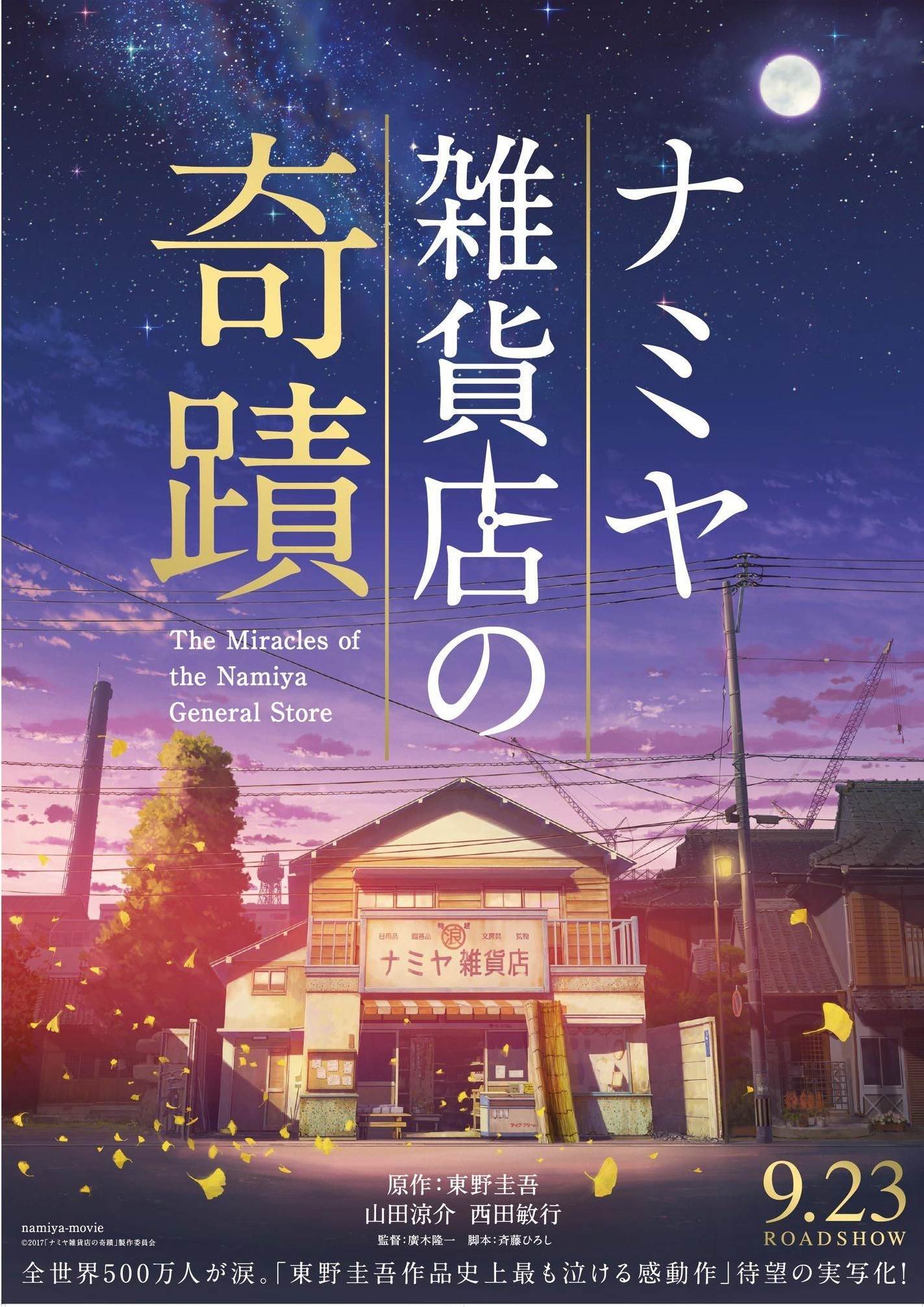
Miracles of the Namiya General Store (ナミヤ雑貨店の奇蹟, Ryuichi Hiroki, 2017)

Miracles of the Namiya General Store posterKeigo Higashino is probably best known for his murder mysteries, most particularly the international best seller The Devotion of Suspect X. His literary output is however a little broader than one might assume and fantastical hypotheticals are very much a part of his work as in the bizarre The Secret in which a mother wakes up in her daughter’s body after a fatal accident. Miracles of the Namiya General Store (ナミヤ雑貨店の奇蹟, Namiya Zakkaten no Kiseki) is indeed one of his warmer stories even if it occasionally veers towards the author’s usual taste for moral conservatism in its yearning for a more innocent, pre-bubble Japan that is rapidly being forgotten.

Back in 1980, Mr. Namiya (Toshiyuki Nishida) runs the local store and is a much loved member of the community. As an older man with plenty of life experience, he also offers an agony uncle service. People with problems can simply write him a letter and drop it through his box. He’ll have a bit of a think about it and then either paste up a response on the village noticeboard outside or, if the question is a little more delicate, place his reply in an envelope in the milk box.

32 years later, a trio of delinquent boys end up taking refuge in the disused store after committing some kind of crime. While they’re poking around, what should pop through the letter box but a letter, direct from 1980. Freaked out the boys try to leave but find themselves trapped in some kind of timeslip town. Eventually they decide to answer the letter just to pass the time and then quickly find themselves conversing with an earlier generation by means of some strange magic.

At the end of his life, what Mr. Namiya is keen to know is if his advice really mattered, and if it did, did it help or hinder? His introspection is caused in part by a news report that someone he advised on a particularly tricky issue may have committed suicide. Mr. Namiya isn’t now so sure he gave them the right advice and worries what he told them may have contributed to the way they died. This itself is a difficult question and if it sounds like a moral justification to point out that no one was forced to follow Mr. Namiya’s “advice” and everyone is ultimately responsible for their own decisions, that’s because it is but then it doesn’t make it any less true. Then again, Mr. Namiya’s advice, by his own admission, was not really about telling people what to do – most have already made a decision, they just want someone to help them feel better about it. What he tries to do is read between the lines and then tell them what they want to hear – the decision was always theirs he just helped them find a way to accommodate it.

The boys have quite different attitudes. Kohei (Kanichiro), who takes the initial decision to write back, is compassionate but pragmatic. As we later find out, the three boys are all orphans and Kohei counsels a melancholy musician who wants to know if he should give up on his Tokyo music career and come home to run the family fish shop that he should count himself lucky to have a place to come back to and that if he was going to get anywhere in music he’d have got there already. Mr. Namiya’s philosophy proves apt – the musician writes back and argues his case, he wants to carry on with music but feels guilty and hopes Mr. Namiya will tell him it’s OK to follow his dreams. For the boys however, “dreams” are an unaffordable luxury and like a trio of cynical old men they tell the musician to grow up and get a real job. That is, until he decides to play them a tune and they realise it’s all too familiar.

Similarly, a conflicted young woman drops them a letter wanting advice on whether to become the mistress of a wealthy man who claims he will help her set up in business. The boys say no, do not debase yourself, work hard and be honest – that’s the best way to repay a debt to the people that raised you. Again she writes back, she wants her shot but it is a high price. That’s where hindsight comes in, as does advance knowledge about Japan’s impending economic boom and subsequent bust.

As expected, everything is connected. Higashino maybe romanticising an earlier time in which community still mattered and the wisest man you knew ran the corner store, but then there’s a mild inconsistency between the idealised picture of small town life and the orphanage which links it all together – these kids are after all removed, even perhaps exiled, from that same idea of “community” even if they are able to create their own familial bonds thanks to the place that has raised them. The most cynical of the boys once wanted to be a doctor, but as another boy points out it takes more than just brains to get there. While it’s a nice message to say that there are no limits and nothing is impossible, it is rather optimistic and perhaps glosses over many of the issues the kids face after “graduating” from the group home and having nowhere else to go. Nevertheless, seeing everything come together in the end through the power of human goodness and the resurgence of personal agency is an inspirational sight indeed. The world could use a few more miracles, but as long as there are kind hearted people with a desire for understanding, there will perhaps be hope.


Original trailer (English/simplified Chinese subtitles)