The Wandering Princess (流転の王妃, Kinuyo Tanaka, 1960)

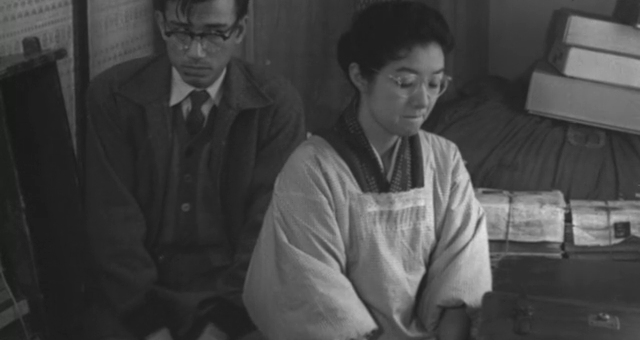
Wandering Princess posterAs in her third film, The Eternal Breasts, Kinuyo Tanaka’s fourth directorial feature, The Wandering Princess (流転の王妃, Ruten no Ouhi), finds her working with extremely recent material – in this case the memoirs of Japanese noblewoman Hiro Saga which had become a bestseller immediately after publication in 1959. Tanaka’s filmic adaptation arrived mere months later in January 1960 which was, in an ironic twist, a year before the real life tale would meet something like the conventional romantic ending familiar from classic melodrama. Nevertheless, working with Daiei’s top talent including Kon Ichikawa’s regular screenwriter (and wife) Natto Wada, Tanaka attempts to reframe the darkness of the preceding 20 years as the defeat of compassionate idealism at the hands of rigid austerity and unstoppable oppression.

Tanaka opens with a scene taking place in 1957 which in fact depicts a somewhat notorious incident already known to the contemporary audience and otherwise unexplained on-screen in which the older Ryuko (Machiko Kyo) tenderly bends over the body of lifeless schoolgirl. The camera then pulls back to find another girl in school uniform, Ryuko, twenty years earlier. A young woman with innocent dreams, Ryuko’s life encounters the usual kind of unwelcome disruption in the unexpected arrival of a marriage proposal but this is no ordinary wedding. Ryuko, as the oldest daughter of a prominent noble family, has been selected as a possible bride for the younger brother of the former Qing emperor now installed as the symbolic leader of the Japanese puppet state of Manchuria. Against the odds, Ryuko and her new husband Futetsu (Eiji Funakoshi) are well matched and endeavour to build a happy home together just as they intend to commit themselves to the creation of a new nation born from the twin legacies of the fallen Chinese empire and the resurgent Japan.

Foregrounding Ryuko’s experience, the film does its best to set “politics” aside but the inescapable truth is that each of our protagonists is a prisoner of the times in which they live. The second scene finds Ryuko in 1937 as an innocent schoolgirl gazing at the young men in uniform as they march past her. She remains out of step with them, walking idly and at her own uneven rhythm while they keep rigorous and seemingly unstoppable time. The family are understandably wary of the implications of the marriage proposal, especially as it comes with a military escort, with Ryuko’s beloved grandmother the only one brave enough to ask to see whoever’s in charge of this outrage only to be told that their fates are in the hands of the nebulous concept known as “army” which knows no individual will.

Assured by her family that the decision rests with her, Ryuko consents – not only to becoming a stranger’s wife (which would have been her fate in any case) but to being a kind of ambassador, the presentable face of imperial ambition. On her marriage she’s presented with a deep red cheongsam and continues to dress in Chinese fashion for remainder of her life in Manchuria where she learns to speak Mandarin and devotes herself to becoming as Chinese as it’s possible to be. Meanwhile, her husband Futetsu busies himself with a complementary desire to become Japanese, intensely worried that the sometimes degrading treatment he and his family receive is exclusively caused by his problematic nationality. When their daughter, Eisei, is born, the couple determine to raise her as the child of a new world, the embodiment of idealised cultural integration.

The world, however, is not so kind and the blunt force of militarism continues to present a barrier to familial harmony. Futetsu is prevented from seeing his brother by the officious forces of the military police while the lonely, paranoid “emperor” suspects that Ryuko is nothing more than a Japanese spy sent to undermine his rule. Ryuko was sent to Manchuria to be the bridge between two cultures. Her, in a sense, feminine energy which attempts to build connection through compassion and understanding is consistently contrasted with the prevailing male energy of the age which prizes only destruction and dominance. Filled with the naivety of idealism, she truly believes in the goodness of the Manchurian project and is entirely blind to the less altruistic actions of her countrymen engaged in the same endeavour.

Confronted by some children in a park while pushing the infant Eisei in a pram, Ryuko is identified as a Japanese woman by her accent while conversing in Mandarin. She assures the children that Eisei is Manchurian like them, and that seeing as she married a Manchurian she is now too despite her Japanese birth. The kids are satisfied, so much so that they warn her that some Manchurians were killed recently in this park by Japanese soldiers, adding a mild complaint that it upsets their parents when Japanese people come to their restaurant and leave without paying. Mortified, Ryuko decides to use some of her (meagre) resources to buy all of the kids and everyone else in the park some sweets from a nearby stand, fulfilling her role as a Japanese ambassador even while insisting that she is a proud citizen of the newly born state of Manchuria.

Nevertheless the Manchurian project is doomed to fail, the kind of idealism fought for by Ryuko and Futetsu crushed under the boot of militarism. Despite everything, Ryuko still wants to be the bridge if only to prevent a catastrophe of this kind happening again (while perhaps refusing to engage with some of the reasons it happened in the first place) but in Eisei’s eventual death, foreshadowed in the melancholy opening, a deeply uncomfortable implication is made that the kind of cross-cultural harmony that Ryuko dreams of may not be viable. In contrast to the salaciously reported real life events (somewhat alluded to by presence of a schoolboy’s cap next to the body) which hinted at a suicide pact or murder, Ryuko attributes Eisei’s decision to end her life to an inability to reconcile her twin heritage coupled with the heavy burden of being the last descendent of the Qing Dynasty. Despite this minor misstep of tying the fate of Eisei to the failure of the Manchurian dream and the loss of its misplaced idealism, Ryuko ends her account on a hopeful note in admiring the flowers she planted finally in bloom and looking forward to a more hopeful age governed by warmth and compassion rather than violence and austerity.


The Wandering Princess was presented by Japan Foundation London as part of a series of events marking the publication of Tanaka Kinuyo: Nation, Stardom and Female Subjectivity.

Narratage (ナラタージュ, Isao Yukisada, 2017)

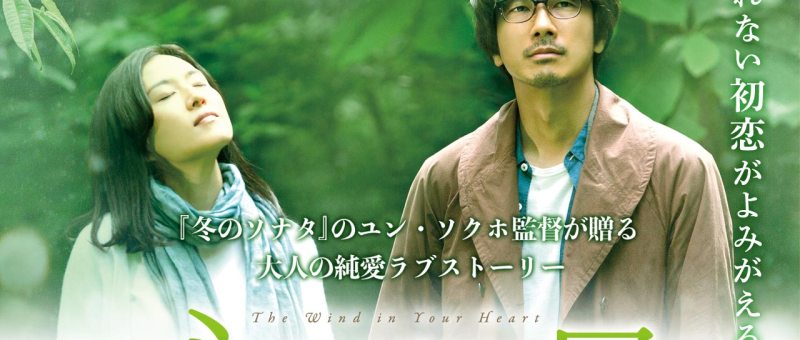
Narratge poster 1Isao Yukisada made his name with the jun-ai landmark Crying Out Love in the Centre of the World back in 2004. Adapted from a best selling novel (which had also been adapted as a TV drama around the same time), Crying Out Love was the epitome of a short lived genre in which melancholy, lovelorn and lonely middle-aged heroes looked back on the lost love of their youths. Jun-ai has never really gone away though it might not be so popular as it once was, but the focus has perhaps shifted and in an unexpected direction. Narratage (ナラタージュ), once again adapted from a best selling novel though this time one by an author still in her early 20s when the book was written (incidentally smack in the middle of the jun-ai boom), is another sad story of frustrated love though in contrast to the jun-ai norm, its tragedies revolve around loves which were tested and subsequently failed, leaving the broken hearted romantics trapped within their own tiny bubbles of nostalgia.

The heroine, Izumi (Kasumi Arimura), narrates her tale from three distinct periods of her young life speaking from the perspective of her still young self now living as a lonely office worker. A lonely high school misfit, she found herself drawn to a sensitive teacher, Hayama (Jun Matsumoto), who rescued her from despair through an invitation to join the drama club. Relying on him ever more, she began regularly visiting his office for guidance and the pair bonded over their shared love of cinema. On graduation Izumi decided to declare her love, but earned a sad story in return and resolved to move on with her life. Then in the second year of university, she gets an unexpected phone call, calling her back to help out with a play at the school’s culture festival.

Yukisada begins with a rather unsubtle metaphor in which the older Izumi lovingly fondles an antique pocket watch which has long since stopped ticking. 20-something Izumi apparently has very little in her life, a pang of melancholy envy passing her face as she talks to a friend on the phone at home with a new baby while she prepares for another lonely night of (unnecessary) overtime. Where the heroes of jun-ai obsess over true love lost, Izumi struggles to face the fact that the man she loved did not, could not, love her in the way that she wanted him to. There is, of course, something deeply inappropriate in the awkward relationship between Izumi and Hayama who are a teenage student and her teacher respectively – connect as they might, there are moments when a line is crossed even while Izumi is still a schoolgirl which is in no way justified by the presentation of their (non)romance as a natural consequence of their mutual suffering.

Hayama and Izumi are presented as equals but they aren’t and never could be. As if to continue the chain, university era Izumi gets a love confession of her own from old classmate Ono (Kentaro Sakaguchi) who has apparently been carrying a torch for her all this time. Ono’s love, like Izumi’s, is originally generous and altruistic – he understands her unrequited affection for Hayama and perhaps even sympathises, but once Izumi decides to try and make things work with someone who loves her it all starts to go wrong. Ono is jealous, possessive, desperate. He demands to inspect her phone, insists she erase Hayama from her mind and devote herself only to him. Izumi, sadly, goes along with all of this, even when her attempts to turn to Ono for protection when afraid and alone are petulantly refused. When the inevitable happens and she decides to try and sort things out with Hayama, Ono tries to exert an authority he doesn’t really have, ordering her to bow to him (literally), and harping on about all the hard work he personally has put into their relationship which, he feels, she doesn’t really appreciate while berating her for not really loving him enough. As it turns out, neither of Izumi’s romantic options is particularly healthy or indeed viable.

At one particularly unsubtle moment, Izumi (alone) attends a screening of Naruse’s Floating Clouds – another film about a couple who fail to move on from a failed love affair though their struggle is ultimately more about the vagaries of the post-war world than it is about impossible love. Meanwhile the school play is to be A Midsummer Night’s Dream which is also about misplaced and unrequited loves which spontaneously sort themselves out thanks to some fairy magic and a night in a confusing forest. No magic powers are going to sort out Izumi’s broken heart for her. Like the pocket watch, her heart has stopped ticking and her romantic outlook appears to be arrested at the schoolgirl level. She and Hayama maybe equally damaged people who save and damn each other in equal measure, but the central messages seem to be that difficult, complicated, and unresolved loves and the obsessive sadness they entail produce nothing more than inescapable chains of loneliness. Simplistic as it may be, Izumi at least is beginning to find the strength to set time moving once again prompted perhaps by another incoming bout of possibly requitable love lingering on the horizon.


International trailer (English subtitles)
A Fishwife’s Tale (魚河岸の女石松, Eiichi Kudo, 1961)

A Fishwife's Tale VHS coverWho better to take on post-war corruption and personal injustice than Hibari Misora? In another of her typically feisty roles, Hibari stands up for her friends, her community, and her family when they are threatened by the exploitative forces of the tabloid press, rubbish boyfriends, and evil corporations all while accidentally falling in love with Ken Takakura in an early role as cynical reporter with a heart of gold. Eiichi Kudo may be best remembered for a string of samurai movies in the ‘60s including 13 Assassins and The Great Killing, but like many of his generation he made a fair few programme pictures including several starring Hibari Misora of which A Fishwife’s Tale (魚河岸の女石松, Kashi no Onna Ishimatsu) is one.

Kudo opens with stock footage of a small fishing harbour which is all aflutter with the arrival of some unusual outsiders. A photographer from a “magazine” has arrived claiming that he wants to document the lives of ordinary working class people from the fishing industry. While some of the young women doll themselves up and plead with the photographer, “Lady Ishimatsu”, Keiko Kano (Hibari Misora), steals all the attention by defiantly rolling through in her truck ready for a day’s work. As predicted Keiko doesn’t want anything to do with this photography nonsense, and as it turns out she was right not to. The guys aren’t from the Sundays or National Geographic, they’re a scandal rag and they’ve bulked out their story with a lot of made up rubbish about the “sexy lives of fishwives” which paints them all as predatory nymphomaniacs. Matters come to a head when Keiko’s friend Yoko (Yukiko Nikaido) tries to kill herself in shame because of the paper’s implication that she’s a loose woman which causes her wealthy boyfriend to dump her (luckily, she’d mixed up tummy tablets with sleeping pills so thankfully survived even if feeling a little sick and silly).

The newspaper business has a second unforeseen consequence. When Keiko stands up to the achingly cool reporter, he realises she’s connected to another case he’s working on. Across town, a canned food magnate is facing ruin thanks to a standards scandal and is also earnestly searching for his long lost daughter, born to a geisha 20 years earlier and then adopted by another family. Dogged reporter Kitagawa (Ken Takakura), recognising the necklace around Keiko’s neck, wonders if she might be the girl Tachibana’s looking for. When it turns out that he’s right, Keiko’s world turns upside-down. Tachibana (Eijiro Yanagi), overjoyed to have found his daughter, goes about everything the wrong way and tries to take her back from her loving home with the promise of wealth and comfort, but Keiko loves her parents even if they aren’t hers by blood and resents the attempt to drag her away. 

Nevertheless, when the two cases turn out to be even more connected thanks to Yoko’s terrible boyfriend being the no good son of one of the conspirators, and Mr. Tachibana falling ill though the stress of his situation, the entire family reconsiders if they haven’t perhaps been selfish in resolutely rejecting a lonely old man trying to make up for a past mistake. Keiko becomes committed to standing up to the bullies. “We’re still young, as long we’re alive we’ll resist you” she tells her biological father’s arch enemy in what might as well be a rallying cry for post-war youth fed up with the corrupted older generation.

Then again perhaps things don’t change all that much. Rather than a salt scam or rice profiteering, this time it’s fiddling with the labels on tin cans but ordinary people are still having their food supply tampered with by those with enough money not to need to worry so much about food security – the amoral petty samurai of the Edo era have merely become amoral businessmen in the dog eat dog post-war world.

Comparatively light on song and dance – Hibari sings the title track as she drives in on her truck, hums a few tunes, and gets one dramatic musical number when she goes undercover as a nightclub singer to spy on the bad guys, Kudo ups the action quotient as Hibari makes herself the chief of the fishwives and takes on the photographers, sneaks around investigating, and then starts a full on brawl with goons in the final showdown. This time around the romance between frequent co-stars Hibari Misora and Ken Takakura is spiky and sparky, fuelled by Keiko’s strange positioning as a “tomboyish” bossy boots more at home in her truck and wellies than prancing around for the camera like the other girls. Oddly warm and filled with rebellious energy, A Fishwife’s Tale is, in its own quiet way, perhaps subversive in allowing a little political spirit of the age to creep in around the edges as Keiko steps forward to stay true to her roots, opposing injustice wherever she sees it and always acting on her own initiative.


Selection of scenes from the movie including Hibari’s big club number (no subtitles)

Maintitles song – Hibari no Dodonpa

It’s Only Talk (やわらかい生活, Ryuichi Hiroki, 2005)

It's Only Talk poster“I’m scared of wanting to die” the heroine of Ryuichi Hiroki’s It’s Only Talk (やわらかい生活, Yawarakai Seikatsu) confesses during an awkward car ride with a childhood friend, perhaps one of the only absolute truths she offers in her infinite quest to escape existential loneliness through the false connection of mass tragedy. Yuko (Shinobu Terajima) tells people that her parents died in the Kobe Earthquake, but they actually died in a house fire a few years later. She tells people that her best friend died in 9/11 (she died in New York in the early 2000s but in a car accident), and that her former lover died during the sarin gas attacks on the Tokyo Subway (this one might even be true, but who really can say). She lies, not about facts only details, in the belief that her private pain is somehow not relatable enough and if she ties herself into a wider sense of national or global tragedies then others can share in her grief and she won’t be so alone in her sadness.

Following the deaths of her parents when she was 29, Yuko was diagnosed with bipolar and has been in and out of hospitals for the past six years. Now 35, single, and unemployed, Yuko has found herself cast out from mainstream society and fulfils her (minimal) needs for human connection through meeting “perverts” on specialist message-boards. Through one of these illicit connections she meets K. (Tomorowo Taguchi) – a 50-year-old husband and father who drives her all the way out to provincial suburb Kamata to ensure the liaison (which extends only to watching a porn film together in a public cinema and a cup of tea afterwards) remains secret. Taken with the suburb’s retro charm and unassuming air of faded grandeur, she decides to move and starts life over again in the somewhat nostalgic past which brings her into contact with two men from her youth and another still battling his own.

A portrait of inescapable loneliness, Yuko’s life is both as frozen as the photographs she takes of local landmarks to post on her fledgling blog and permanently in flux as she tries to navigate the constantly shifting tides of her condition. After moving to Kamata she unexpectedly reencounters an old university friend who recalls their spirited discussions of world politics from the fall of the Berlin Wall to Tiananmen Square when they were both bright and engaged students. Like Yuko, Honma (Shunsuke Matsuoka) has wound up in Kamata as a kind of retreat from the harshness of life in Tokyo. Unwilling to embrace life in the public eye, he’s decided to concentrate on a career in local politics instead hoping to work his way into the ministry of education as a civil servant. He is also unmarried – partly as a result of debts accrued during unsuccessful electoral campaigns, and, as we later find out, erectile dysfunction. Honma reintroduces Yuko to another old friend, “Bach” (Nao Omori) who has gone the opposite way and become a venture capitalist but apparently still holds a torch for the young Yuko all these years later. Meanwhile, she’s been meeting up with a lonely yakuza, Noboru (Satoshi Tsumabuki), who also has bipolar and longs for the world of childhood safety and innocence he associates with the strange Godzilla tyre park Yuko photographed and put on her blog.

The most significant relationship in her short-lived period of connection is in fact with her childhood friend and cousin, Shoichi (Etsushi Toyokawa), who abruptly turns up at her flat unannounced. Shoichi, also depressed but perhaps in a less extreme way and hiding it much better, left his marriage because he felt pushed out when the baby was born and then ran after a younger woman who went to Tokyo but ultimately did not want him. The two share a strange sort of intimacy born of their long history which is almost fraternal but laced with minor awkwardness and ancient resentments. Though his wife berated him for his refusal to help out at home, Shoichi tenderly cares for Yuko just as she is at her most vulnerable having entered an extreme depressive episode – washing her hair, doing her laundry, and picking up her medication while trying to remain patient even when Yuko rejects his gestures of help. The giving and receiving of care provides each with a new sense of purpose and connection but their paths are perhaps set on different courses in the immediacy of the need to deal with the unresolved past.

Waking up from her depression, Yuko discovers life has delivered her yet another cruel blow, witnessing others moving on in one way or another and leaving her once again all alone marooned on the sidelines. Yet she lives on, “scared of wanting to die” but daring to remove the towel which hides an ugly scar from a previous suicide attempt to revisit a public bath which holds a memory perhaps both happy and sad. Melancholy in the extreme, It’s Only Talk is not a tragedy but an aching portrait of spiritual loneliness in a society only too happy to exclude.


Original trailer (no subtitles)

The Devil’s Island (獄門島, Kon Ichikawa, 1977)

Devil's Island posterKon Ichikawa revisits the world of Kosuke Kindaichi for the third time in Devil’s Island (獄門島, Gokumon-to). Confusingly enough, Devil’s Island is adapted from the second novel in the Kidaichi series and set a few years before Ichikawa’s previous adaptation The Devil’s Ballad (the twin devils are just a coincidence). As with his other Kindaichi adaptations, Ichikawa retains the immediate post-war setting of the novel though this time the war is both fore and background as our tale is set on profane soil, a pirate island once home to Japan’s most heinous exiled criminals, which is to say it is the literal fount of every social failing which has informed the last 20 years of turbulent militarist history.

In 1946, Kindaichi (Koji Ishizaka) travels to Kasaoka to catch the ferry to the island. On the way he runs into a demobbed soldier hobbling along on crutches only to catch sight of the man quickly picking his up crutches and running across the railway tracks when he thought no one was looking. Kindaichi is in luck – before he even reaches the boat he runs into the very man he’s come to see, Reverend Ryonen (Shin Saburi), for whom he has a message. Posing as a fellow soldier, Kindaichi reveals he has a “last letter” from a man named Chimata who sadly passed away right after the cessation of hostilities having contracted malaria. Chimata, as we later find out, was the legitimate heir of the island’s most prominent family. Kindaichi chooses not to reveal his true purpose, but the truth is that Chimata suspected his death would put his three younger sisters in danger from various unscrupulous family members attempting to subvert the succession.

Your average Japanese mystery is not, as it turns out, so far from Agatha Christie as one might assume and this is very much a tale of petty class concerns, island mores, and changing social conventions. The extremely confusing island hierarchy starts with the head of household who doubles as the head of the local fishing union and then shuffles out to the branch line and brassy sister-in-law Tomoe (Kiwako Taichi) who is keen claim all the authority she is entitled to. The old patriarch, Yosamatsu (Taketoshi Naito), went quite mad at the beginning of the war and is kept in a bamboo cage in the family compound where he screams and rails, only calmed by the gentle voice of Sanae (Reiko Ohara), a poor relation raised in the main house alongside her brother Hitoshi who hasn’t yet returned from the war. Aside from Yosamatsu, the absence of the two young men means the main house is now entirely inhabited by women, looked after by veteran maid Katsuno (Yoko Tsukasa).

Then again, Japanese mysteries hinge on riddles more than they depend on motives and there are certainly plenty of those on this weird little island where they don’t like “outsiders”. Ichikawa hints at the central conceit by flashing up haiku directly on the screen along with a few original chapter headings for Kindaichi whose eccentricities might seem less noticeable in such an obviously crazy place but strangely seem all the more overt, his trademark dandruff falling like rain from his tousled hair. It has to be said that Kindaichi fails in his otherwise pure hearted aims – he doesn’t make a great deal of effort to “save” the sisters and only attempts to solve the crimes as they occur, each one informing the next. This time around he gets trouble from both irritatingly bumbling detective Todoroki (Takeshi Kato) and his assistant Bando (Kazunaga Tsuji) , and the local bobby who immediately locks Kindaichi up and declares the crimes solved on the grounds that they only started happening after Kindaichi arrived.

Meanwhile, there are rumours of an escaped “pirate” running loose, demobbed soldiers, and a host of dark local customs contrasting strongly with the idyllic scenery and the strange “pureness” of this remote island otherwise untouched by the war’s folly save for the immediate events entirely precipitated by the absence of two young men taken away to die on foreign shores. Though the various motives for the crimes are older – shame, greed, classism, a bizarre dispute between Buddhists and Shamans, none of this would have been happening if the war hadn’t stuck its nose into island business and unbalanced the complex local hierarchy. Tragically, the crimes themselves all come to nought as a late arriving piece of news renders them null and void. Just when you think you’ve won, the rug is pulled from under you and the war wins again. Ichikawa opts for a for a defiantly straightforward style but adopts a few interesting editing techniques including fast cutting to insert tiny flashbacks as our various suspects suddenly remember a few “relevant” details. This strange island, imbued with ancient evils carried from the mainland, finds itself not quite as immune from national struggles as it once thought though perhaps manages to right itself through finally admitting the truth and acknowledging the sheer lunacy that led to the sorry events in which it has recently become embroiled.


Original trailer (no subtitles)

The Devil’s Ballad (悪魔の手毬唄, Kon Ichikawa, 1977)

Devil's Ballad posterA year after his box office smash The Inugami Family, Kon Ichikawa returns to the world of eccentric detective Kosuke Kindaichi with The Devil’s Ballad (悪魔の手毬唄, Akuma no Temari Uta). Like many a Kindaichi mystery, Devil’s Ballad finds him called upon to delve back into the past to satisfy an ageing detective’s anxiety about an old case, only to be faced with a series of new ones as a consequence. This time, however, the mystery leans less on buried secrets than deeply held grudges, betrayals, and lingering feudal feuds as the post-war society tries and fails to free itself from ancient oppressions.

The film opens with a tryst between two adolescent lovers in the ominously named “Devil’s Skull Village” in 1950. Yasu (Yoko Takahashi), the girl, is at pains to let her boyfriend, Kanao (Koji Kita), know that she is keen to take the relationship to the next level but he is old fashioned and wants to wait until their union is formalised. The pair are interrupted by some of their friends who are in the middle of planning a celebration for a visit from a girl who moved to the city, Chie (Akiko Nishina). Meanwhile, Kindaichi (Koji Ishizaka) has arrived at the inn owned by Kanao’s mother Rika (Keiko Kishi) on invitation from a retired policeman, Isokawa (Tomisaburo Wakayama), who wants Kindaichi to look into the murder of Rika’s husband twenty years ago. Isokawa, then a young rookie, is convinced that Rika’s husband was not the victim but the murderer and the corpse actually belonged to another man entirely – Onda, a drifter who defrauded half the village with a wreath making scam.

Rika and her children – 20-year-old Kanao and his younger sister Satoko (Eiko Nagashima) who has prominent facial birthmarks and rarely leaves the house, came to the village with her husband and are therefore slightly divorced from the longstanding social rivalries. The village has two noble families – the Yuras and the Nires. Feeling the need to modernise, the Nires bet everything on vineyards and it paid off. The Yuras, by contrast, were defrauded by Onda’s wreath scam and lost their fortune and social standing. Yasu, Kanao’s girlfriend, is a daughter of the Yuras, but the Nire’s have been petitioning Rika for quite some time to have her son marry their daughter, Fumiko (Yukiko Nagano), who also has a crush on him (though this is largely irrelevant to her father’s dynastic ambitions). When the younger generation start getting bumped off in ways eerily similar to a local folk song, Kindaichi and Isokawa are on the case, wondering if these new murders have anything to do with their old one.

Despite its 1950 setting, Devil’s Ballad is unusual in resolutely making an irrelevance of the war which only receives a brief mention as an explanation for why some of the case files have been destroyed and for why marriage is such a hot button issue given the lack of men and abundance of women. Nevertheless, the crimes span a turbulent 20 years of Japanese history with the original murder taking place in the early ‘30s during a period of economic instability following the Manchurian Incident. In the socially conservative pre-war era, it seems Onda also got around and may have fathered several illegitimate children with women in the village, some of them noble, some not. These buried secrets seem primed to bubble to the surface now that the children are coming of age and marriage again becomes an issue as worried parents try to think of acceptable ways to block potentially “inappropriate” matches without sending their children off into ruinous elopements or tipping off the wrong people that their kids may not be their kids.

The crimes themselves, old fashioned as they are, are partly reactions to a changing society. We discover that the reason Rika and her husband were forced to come back to the village was that their showbiz careers were stalling – she was a vaudeville performer specialising in shamisen, and he a “benshi” (narrator of silent films) who became convinced his job was obsolete after witnessing a subtitled print of Morocco. Likewise, the two rival families cannot let go of their petty provincial privileges, and as Kanao angrily snaps back at his mother, Japan is now a democratic country and he is free to choose his own wife at a time of his own choosing with or without parental blessing. This remote village is perhaps isolated from the privations of the post-war world but it’s also stuck in the past, hung up on past transgressions and unable to move forward into the new era. However, the primary motivations for murder are as old as time – guilt, humiliation, and self preservation.

Ichikawa keeps things simple but splices in a few strange, avant-garde sequences of kokeshi dolls menacingly bouncing balls coupled with shifts to black and white, fast-paced reaction shots, and stuttering still frame sequences all while Kindaichi showers innocent passersby with his famous dandruff, the idiot police officer continues to offer ridiculous theories while his sergeant dutifully follows him around, and the local bobby perfects a line in hilarious pratfalls. Overlong at two and a half hours and falling prey to the curse of the prestige crime drama in spoiling its mystery through casting, the Devil’s Ballad may not be the best of the Kindaichi mysteries but offers enough of a satisfying twist to prove worthy of the Kindaichi name.


Original trailer (no subtitles)

Shoplifters (万引き家族, Hirokazu Koreeda, 2018)

Shoplifters poster 2Tolstoy once said that all happy families are alike, but each unhappy family is unhappy in its own way. The family drama is the mainstay of Japanese cinema, though to be fair it rarely features families which are noticeably “unhappy” so much as struggling under the weight of social expectations. Nevertheless, since consumerism arrived in force, the concept of “the family” has come in for regular interrogation. That at the centre of Shoplifters (万引き家族, Manbiki Kazoku), Hirokazu Koreeda’s return to the genre with which he is most closely associated, are on one level among the happiest of families ever captured on film, but then again they are not quite like all the others.

The Shibatas live in a small Japanese-style house owned by “grandma” Hatsue (Kirin Kiki) whose pension (or, to be more precise, that of her late husband) makes up a significant portion of the family income. Patriarch Osamu (Lily Franky) has a casual job as a day labourer while his wife, Nobuyo (Sakura Ando), works in a laundry. Her “sister” Aki (Mayu Matsuoka) tells people she works as a kind of hostess but actually dresses up as a schoolgirl and performs sex services behind a two-way mirror in a sleazy club. Meanwhile, Osamu and Nobuyo’s “son”, Shota (Jyo Kairi), alternates his time between homeschooling himself and helping out with the family’s only other source of income – thievery. It’s after one partially successful foray to the local supermarket that Osamu and Shota come across a little girl, Yuri (Miyu Sasaki), stuck out on a balcony alone in the freezing cold and decide to take her home for something warm to eat.

Of course, this family itself is the very definition of makeshift. Osamu and Nobuyo may be a “real” couple, but no one else is actually related. The Family Game may have attempted to take the family apart and expose it as an artificial mechanism devoid of real feeling in which each is simply playing the role expected of them, but Shoplifters asks the opposite – if a found family can actually be more “real” that the real thing because it has been chosen, is wanted, and continues to function because of an organic bond between individuals which exists in the absence of blood.

In a sense, the family itself has been “shoplifted”. Later, under questioning, Nobuyo is accused of “throwing away” Hatsue but she corrects them – she didn’t and she wouldn’t. Someone else “threw away” Hatsue and she found her. Hatsue was abandoned by her husband who fathered a family with another woman, but seemingly not with her. Alone she longed for a family of her own and most of all to avoid the looming threat of a “lonely death”. Whatever else they might have gained from the “arrangement”, Osamu and Nobuyo are at least able to offer her the thing that would make her life complete as she prepares to meet its end. By the logic of the family drama, one family must be broken in order to forge another and it’s true enough to say that each member of the Shibata clan has been pilfered from somewhere else but in the end perhaps it’s better this way, free of the cold obligation of a blood or legal tie.

Then again, there are cracks in the foundation. Little Shota, growing fast into a young man, is increasingly conflicted about the way the family makes ends meet. Trapped in low paid, casual employment, Osamu and Nobuyo are working but poor, unable to support their family on their wages alone. Injured at work, Osamu is left without compensation because he’s only a day labourer and therefore not entitled to workplace protections while Nobuyo is eventually forced into a “workshare” arrangement and then to resign when her boss cruelly tells her and a friend that they can decide between themselves which of them gets to keep their job. They steal because they’re hungry, but also perhaps because they enjoy this small way of rebelling against the system. Osamu tells Shota that stealing from stores is OK because no one really “owns” anything while it’s still on the shelf, but Shota begins to doubt his logic. It’s not just “taking”, it’s taking “from” and Shota is increasingly worried about who it is their way of life may be harming. He worries that in taking in Yuri the family is corrupting her, indoctrinating her into their morally dubious universe.

Morally dubious it may be, but life with the Shibatas is warm and safe which is a lot more than can be said for Yuri’s life with her birth parents who don’t even bother to report her missing – social services eventually figure out she isn’t around two months later and come to the conclusion that the parents may have got rid of her in some unspecified way. Which sort of “corruption” is worse – an upbringing filled with abuse and neglect, or one filled with love and habitual criminality? Yet it’s an act of love that finally breaks the family apart and leaves them at the mercy of cold and official forces too obsessed with their own sense of narrative to bother listening to the “truth”. Shoplifters wants to ask if the “natural” laws of society still serve us when little girls fall through the cracks and our definition of “family” is so narrow and rigid that it denies us a way of saving them. Sometimes the found family is stronger than the inherited one, but society is primed to crush it all the same in its relentless and indifferent quest to preserve the social order.


Shoplifters opens in UK cinemas on 23rd November courtesy of Thunderbird Releasing.

International trailer (English subtitles)
Dangan Runner (弾丸ランナー, SABU, 1996)

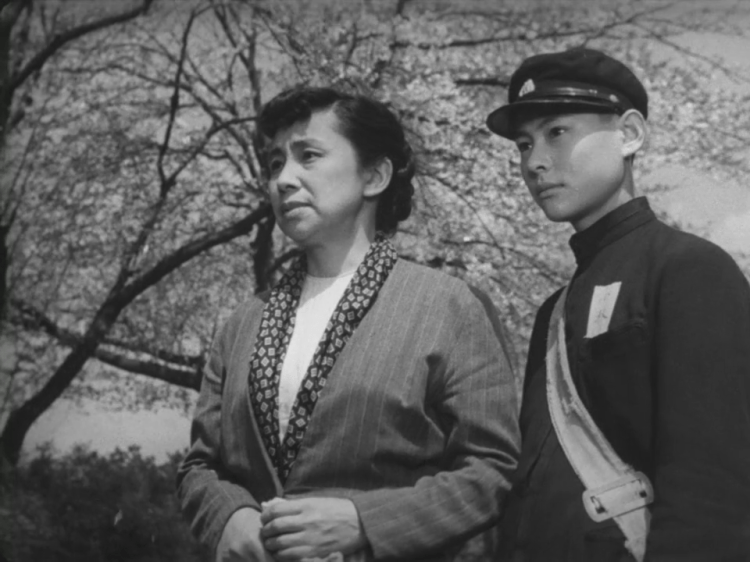
Dangan Runner posterIt’s not difficult to see what might send three young men running like stray bullets from a random gun in the Japan of the mid-90s, but each of the various protagonists of SABU’s debut feature Dangan Runner (弾丸ランナー, AKA Non-Stop) is reaching for a different target. Like much of the director’s later work, Dangan Runner pivots on random circumstance which somehow conspires to bring our three runners together as if bound by cosmic thread while they too are chased by an oncoming storm in the form of vengeful yakuza and the bumbling cops hot on their trail.

Kickstarting the whole affair, lowly restaurant worker Yasuda (Tomorowo Taguchi), fed up with the petty humiliations of his life, decides to rob a bank. He has everything planned, even rehearsed and choreographed down to the second, but when the time comes he makes a mistake. Having left his mask at home, he decides to buy one from a local combini but panics and accidentally shoplifts instead, attracting the attentions of bullet two – Aizawa (Diamond Yukai), who is wounded in the arm by Yasuda’s nervous shot when his gun accidentally goes off. A drug addict and former rockstar, Aizawa, intent on revenge for the disrespect he’s just been paid, retrieves the gun dropped by Yasuda and chases him through the streets of Tokyo. Aizawa in turn continues the chain reaction when he bumps into a yakuza, Takeda (Shinichi Tsutsumi), who is “triggered” by a deep seated trauma into chasing off after Aizawa, knife in hand. Meanwhile, a rival yakuza clan is also after Takeda because of gangland politics while they too are being monitored by the police who have gotten wind of a gang war in the offing.

Though SABU’s film is not in the least political, it is like much of his work a mild satire even if its sympathy lies firmly with its three central heroes each desperately trying and failing to outrun themselves. Yasuda, a small man with a slight frame, is the lowest of the low. He has a terrible job as a kitchen assistant in a small restaurant where he is constantly bullied by the head chef and belittled by the other kitchen staff who are all much taller and stronger than he is. It’s not difficult to see why he might bristle so much when one calls him “good for nothing”, yet he’s not the type to offer more than an angry stare in return. To make matters worse, he runs into an old girlfriend who appears to have moved on and up. Walking arm in arm with a wealthy salaryman, she has apparently jettisoned the “common” name of “Midori” for the relatively more sophisticated one of “Yasuko”, presumably hoping to hook someone who is indeed the polar opposite of a “loser” like Yasuda.

Aizawa also has his share of woman troubles though his are of an opposing dimension. A failed musician with a drug problem, Aizawa alienated his loving girlfriend while hoping his addiction would save him from his unattainable dreams. Of course, it’s an entirely different “shot in the arm” that starts him running, but like Yasuda in the end all he can think of is the girl and how he did everything wrong. Takeda, by contrast, is a yakuza through and through. His regrets are bound up with homosocial bonding and male loyalty, mourning the death of the trusted superior he failed to save in dodging the blows of a random assassin. Yet as his superior tells him, all living beings run towards the same thing. A yakuza cannot control his death but he can control his life and the effect he has on others. He urges Takeda to run and find life in the process, but perhaps Takeda’s destination is the run itself rather than where it will eventually take him.

Indeed, Yasuda, accidentally landing up in the middle of the yakuza gang war, affirms that he never felt so alive as when he was running for his life. All three men, running fast from failure, finally achieve the freedom they’d dreamed of through the intense exertion of their flight which later literally becomes orgasmic as all three fantasise about a pretty woman seen on the side of the road. Like bullets fired from a gun powered by social impossibility, each is destined to explode on reaching its chosen target. Like many of SABU’s later protagonists, these are men brought low by life and circumstance, driven slowly mad by a conspiracy of cosmic coincidence, mere playthings of fate without power or agency. Angry young men are a powder keg waiting to ignite, but in SABU’s whimsically surreal universe they usually sort things out amongst themselves. For the Dangan Runners, they only need to look in the mirror to figure out where it is they need to go.


Dangan Runner is available on dual format DVD & blu-ray from Third Window Films. On disc extras include a video essay on the history of V Cinema from film scholar Tom Mes, and an expansive audio commentary by Jasper Sharp providing detailed background on SABU’s career and the Japanese cinema landscape of the mid-90s.

Original trailer (English subtitles)

Ten Years Japan (十年 Ten Years Japan, Chie Hayakawa, Yusuke Kinoshita, Megumi Tsuno, Akiyo Fujimura, Kei Ishikawa, 2018)

Ten Years Japan posterBack in 2015, five aspiring Hong Kong filmmakers came together to present a collection of shorts speculating on the fate of their nation in 10 years’ time. Coinciding with if not directly inspired by the Umbrella Movement, Ten Years was a deliberately political project which tapped into the nation’s unique preoccupations almost 20 years on from the end of British rule and a little more than 30 before One Country, Two Systems expires. The film proved an unexpected box office hit and has gone on to become an unconventional franchise with a host of other Asian nations creating their own omnibus movies musing on what may or may not have occurred in a decade’s time.

Unlike the original Hong Kong edition, Japan’s vision (十年 Ten Years Japan) is decidedly less political, perhaps reflecting a greater level of stability. Nevertheless, taken as a whole there are a number of recurrent themes running through each of the segments from the ageing population to the increasing power of the state and the dark possibilities of technology.

In Chie Hayakawa’s Plan 75, the first and darkest of the shorts, a conflicted salaryman (Satoru Kawaguchi) makes his living selling the titular “retirement” plans to those who have reached the age of 75 and decided enough is enough. Japan’s population is ageing faster than any other and caring for the elderly has placed a significant strain on the young. The old and infirm are therefore encouraged to think of themselves as burdensome, that they should do the decent thing and relieve the pressure on their loved ones by going gracefully at the right time. So far so Ballad of Narayama, but age isn’t quite the issue – the rich are excluded because they’re still spending their money and therefore economically useful. The government would rather roll out the invitations to the “unproductive”.

Ironically enough, a little girl who wants to be a vet in Yusuke Kinoshita’s Mischievous Alliance is advised to become a doctor instead and specialise in elder care which is in fact a growth industry. Unlike the elderly in Plan 75, the kids of Mischievous Alliance are not quite so willing to sit back and conform despite being fitted with invasive headsets connected to a monitoring program which “corrects” their bad behaviour whenever they try to break the rules. The hero rejects his oppressive schooling by self identifying with a stabled horse previously used for medical experimentation, longing to run free if only for a few moments.

If the “promise” system at the centre of Mischievous Alliance presented a vision of a future in which privacy and individual agency have all but disappeared, Data asks us if we have the right to reconstruct someone’s identity after they’ve gone by examining their digital footprint. A high school girl (Hana Sugisaki) tries to adjust to the idea of her widowed father’s (Tetsushi Tanaka) new girlfriend by opening up her mother’s “digital inheritance” but learns more than her mother might have wanted her to know. High school videos and pictures of old boyfriends jostle with beautiful flowers and private anxieties, but when it comes right down to it the organic memories are the only ones that count and the only things to make sense of the cluttered imagery in an uncurated personal museum of random digital moments.

Youth’s desire for knowledge and freedom is also at the heart of Akiyo Fujimura’s The Air We Can’t See which is the only one of the shorts to address nuclear anxiety in the post-Fukushima world. After some kind of event has made the surface uninhabitable, humanity has survived underground. A curious little girl, however, is fascinated by the idea of the outside. Longing to hear the birds and feel the rain, she imagines herself an exterior world but also comes to wonder if her home is a kind of prison born of fear and maybe it’s all alright up top if only you have the courage to look.

Meanwhile the apocalypse is still a little way off in Kei Ishikawa’s For Our Beautiful Country which hints obliquely at the growing threat of North Korea as missiles fly overhead with increasing frequency. The references, however, are older. A cynical ad man (Taiga) oversees a campaign promoting Japan’s remilitarisation but is later charged with letting the elderly, eccentric graphic designer (Hana Kino) know her poster is being “substituted” with something more “powerful”. After spending the day with her and coming to understand the subtle act of rebellion which has made her poster unusable for its propaganda purposes, the ad man gets a new a mission. It’s all up to the young now who have both an opportunity and a duty to ensure their country does not fall into the same kind of ugliness that sent young men off to die in the name of beauty.

Bookending the piece, Hayakawa and Ishikawa present the bleakest visions in which the descent into cruel authoritarianism may have already passed the point of no return. The children, however, seem to disagree and universally turn away from oppressive social codes, preferring to find their own truths and committed to exploring their own freedoms. Ten Years Japan may shed the overtly political overtones of its Hong Kong inspiration but finds brief rays of hope in the midst of despair in a child’s ability to break the programming and strive for a better, fairer world free of adult duplicity.


Screened as part of the 2018 London East Asia Film Festival.

Original trailer (no subtitles)

Ghost in the Well (怪談番町皿屋敷, Toshikazu Kono, 1957)

Ghost in the Well poster 2Love across the class divide threatens to overthrow the social order. Inspired by the classic folktale Bancho Sarayashiki, Ghost in the Well (怪談番町皿屋敷, Kaidan Bancho Sarayashiki) is indeed the story of a haunting though perhaps not altogether of the kind you might be expecting. This is a tale of romance, but also one of impossible love in which the only possible union is in death. The pure love of a servant girl is deemed incompatible with the oppressive world of samurai honour, and so she must die, but her lord cannot survive it. He cannot reconcile himself to having chosen to preserve his honour, his status, his lineage at the cost of her life and his love.

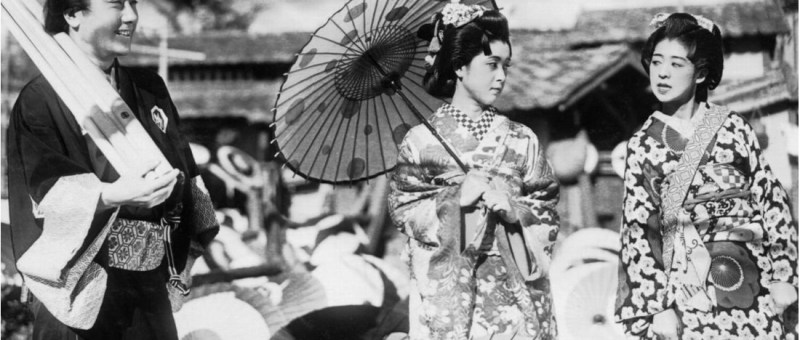
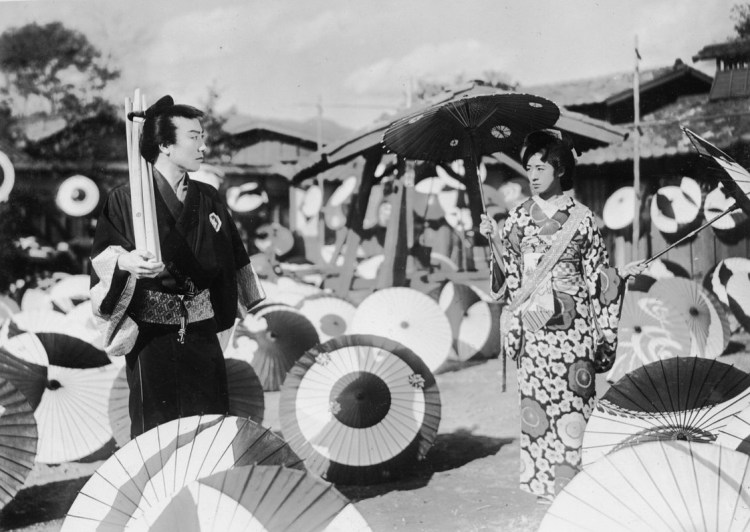
Rowdy samurai Harima (Chiyonosuke Azuma) loves making trouble in the streets. As the lord’s bannerman he knows he has a degree of status and likes to throw his weight around in the yoshiwara, much to the lord’s consternation. Harima has also taken a fancy to one of his maids, Okiku (Hibari Misora), who continues to reject his advances despite returning his affections because she knows the class difference makes a legitimate relationship between them impossible and a dalliance with her lord means losing the opportunity to marry anyone else. Harima tells her that there’s no such thing as status when it comes to love and that he doesn’t think of her as a passing infatuation. Eventually Okiku gives in and a kind of promise is made between them.

Nevertheless, it’s a promise which can’t be kept. The Aoyama family is in trouble and the obvious answer is to make a good match for Harima that will restore both status and wealth. When one of Harima’s friends is ordered to commit seppuku for the exact same petty punk antics Harima gets up to all the time matters come to a crunch. To keep him safe, Harima’s uncle arranges a marriage with an influential family. Harima tries to refuse but he too is more or less powerless even if he weren’t torn between the obligation to his samurai code and his illicit love for servant girl whom he would never be permitted to make his wife. To cement the match, Harima’s uncle has prepared 10 precious plates as a dowry, but Okiku, catching sight of Harima’s bride-to-be, drops one and breaks it in two. Her fate is sealed. Harima draws his sword on her and she backs away, eventually falling into the well and dying there.

The broken plate is, of course, a symbol of their broken covenant but also of Okiku’s shattered dreams as she watches a beautiful but haughty woman steal away her last hope of happiness solely through the accident of noble birth. As her friend tells her, a commoner cannot become the wife of a samurai and all Okiku can do is resign herself to her unhappy fate. Having broken the plate, however, all is lost. The men of the household admit their responsibility for entrusting the entirety of their future to a mere slip of a girl in the middle of intense heartbreak, but Okiku cannot go unpunished and Harima must claim his new life by destroying his past love.

Harima does what he’s supposed to do, if in passion and half by accident. Yet the marriage remains broken, the family in jeopardy, and Harima without hope of future. The ghost of Okiku, real or imagined, haunts him while he remains guilt ridden and filled with regrets. Despite his rowdiness and manly pride, he chose his samurai honour and condemned his one true love to a lonely death. Her love has, however, survived and resurrected her not as a demon of vengeance come to lead him to his doom but as a lovelorn woman keen to remind him of the promise he made and broke but which might be mended.

Harima pays for his transgressions, though more as a mischievous samurai who allowed his over inflated ego to convince him he had the right to oppress his fellow retainers than as a man who caused the death of an innocent woman, first by corrupting her and then by the same rigidity which has led to his present predicament. There can be no “love” in a such a society, let alone the love of a bannerman and a servant girl. Theirs is a blood wedding, uniting them in death, consumed by the impossibilities of the samurai era. At only 45 minutes, Ghost in the Well is perhaps a slight retelling of the tale and somewhat in imbalanced in its presentation of the fates of the two lovers but is nevertheless a refreshingly romantic take on an often dark story in which a scorned woman’s vengeance is reframed as a powerful condemnation of an oppressive society.