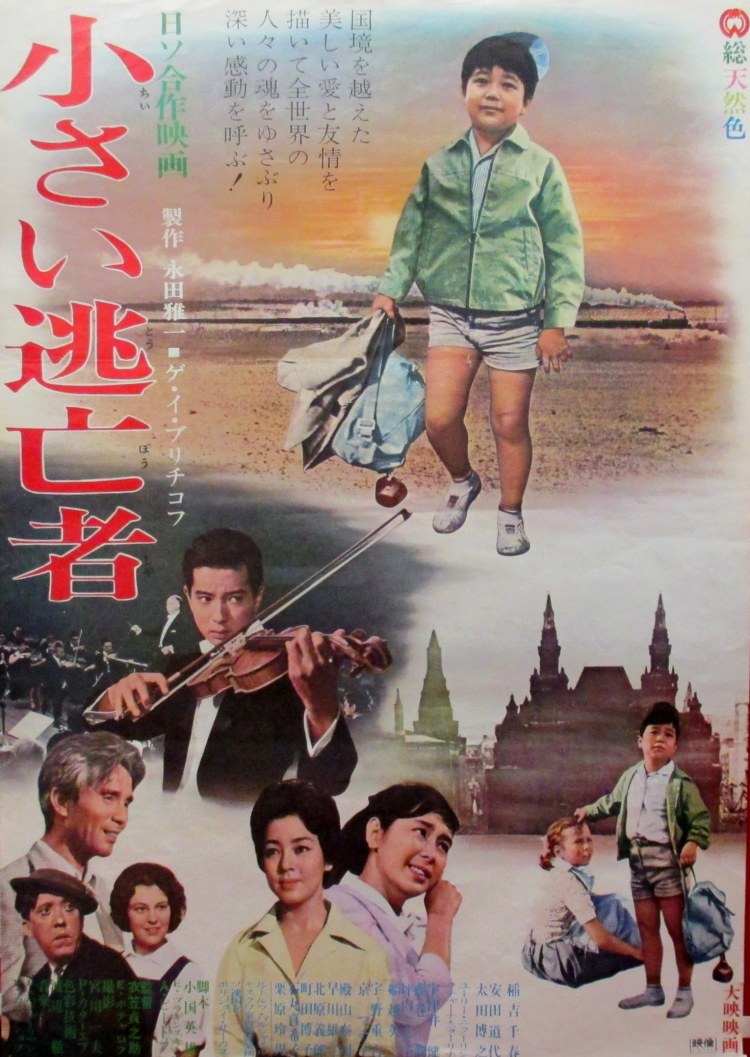
 Teinosuke Kinugasa maybe best known for his avant-garde masterpiece The page of Madness even if his subsequent work leant towards a more commercial direction. His final film is just as unusual, though perhaps for different reason. In 1966, Kinugasa co-directed The Little Runaway (小さい逃亡者, Chiisai Tobosha) with Russian director Eduard Bocharov in the first of such collaborations ever created. Truth be told, aside from the geographical proximity, the Japan of 1966 could not be more different from its Soviet counterpart as the Eastern block remained mired in the “cold war” while Japan raced ahead towards its very own, capitalist, economic miracle. Perhaps looking at both sides with kind eyes, The Little Runaway has its heart in the right place with its messages of the universality of human goodness and endurance but broadly makes a success of them if failing to disguise the obvious propaganda gloss.
Little Ken (Chiharu Inayoshi) is ten years old and lives with his violinist uncle, Nobuyuki (Jukichi Uno). Ken has obvious talent at the violin and, like most kids in this rundown area, his drunken uncle has roped him into helping out for a few extra pennies. One fateful night, Nobuyuki has tied one on and lets slip that Ken’s dad might not be dead, but stuck in a hospital in Moscow. Soon enough a Russian circus comes to town and Ken strikes up a strange friendship with the kindly clown, eventually stowing away to the Soviet Union to look for his long lost father.
From one point of view, The Little Runaway conforms to a certain type of family drama which centres on the disconnect between a father and a son. Ken feels abandoned (no reference is ever made to his mother), though he loves and respects the uncle who takes care of him even if recognising his standard of care often leaves a lot to be desired. His desire to find his father is not so much motivated by unhappiness (his life is difficult but it’s the only one he’s ever known), but by the desire for answers as regards his own ancestry and the emotional need to reconnect with the biological father he no longer remembers clearly.
From another point of view, The Little Runaway conforms to the genre of children’s cinema in its close following of Ken’s quest. With no word of warning, Ken takes off for Russia as if he were simply going to check out a neighbouring town. Unaware of the political context and hoping to use his friendship with the circus troupe to his advantage Ken stows away on a boat headed for the USSR, but his clowning friends aren’t on it and he doesn’t speak any Russian.
The central tenet of the story is that there are kind people everywhere willing to help a determined little boy with melancholy eyes. Ken manages to get to Russia but then escapes his “escort”, hoping to travel to the capital faster. Wandering through the empty landscape, he chances into a house and makes friends with a peasant boy who introduces him to his wider family and a man with many daughters who could use a son just like Ken. Ken also tries to support himself by taking casual work as a labourer, having learnt the Russian word for such a job and repeatedly emphasising it, trying to assure them that he’s stronger than his appearance suggests.
Despite not speaking the language Ken manages to make himself understood through sand paintings, though the Russians he meets are all eager to share their food and shelter with him without much by way of explanation. As might be expected, the Russia depicted may not be particularly realistic, the officials are kind and jovial, the streets are clean, the people healthy and happy, and you can even buy Moscow cigarettes from woman running a stand in the square. The Japan Ken knows, by contrast, is one down at heels in which children are being pressed into shady forms of employment from Ken’s violin playing to little girls selling flowers on the street.
Depicting events from an innocent, child’s eye view, The Little Runaway finds only goodness rather than political anxiety but it is quick to emphasis the importance of helping those in need as the clown later avows. More or less straightforward in shooting style, Little Runaway is more intent on seeing the virtues of the cooperation between the Soviet block and the burgeoning Japanese economy than resolving its central mystery but nevertheless provides another welcome addition to the plucky child adventure genre while urging a kind of universal kindness probably not much in evidence in the real life Tokyo or Moscow of 1966.
Original Japanese trailer (no subtitles)
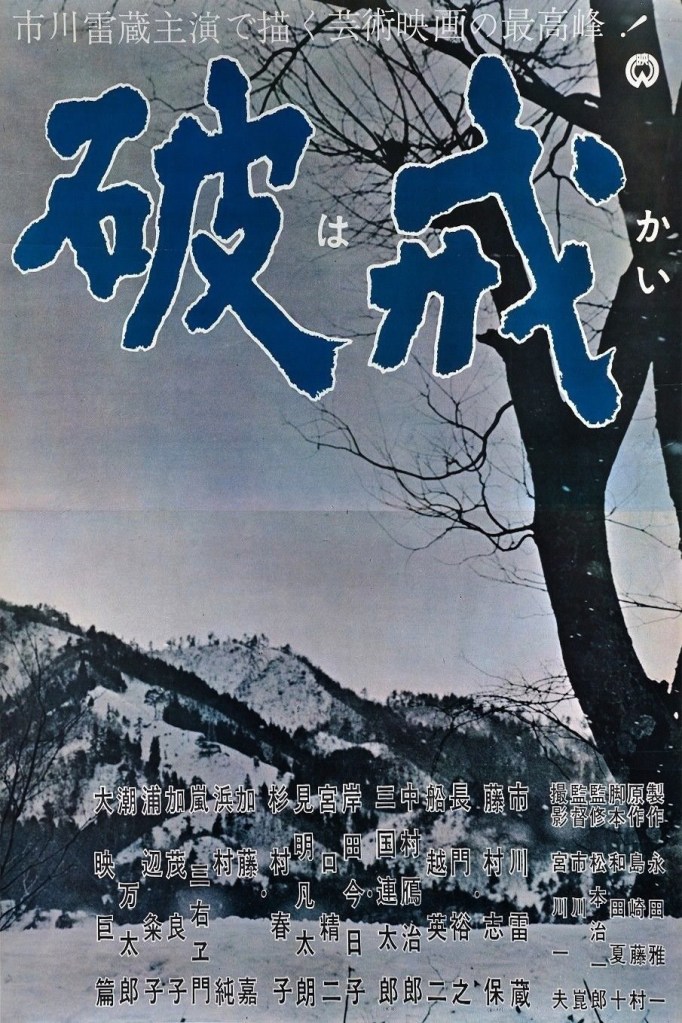 Kon Ichikawa’s approach to critiquing his society was often laced with a delicious slice of biting irony but he puts sarcasm to one side for this all too rare attempt to address the uncomfortable subject of Japan’s hidden underclass – the burakumin. The term itself simply means “people who live in hamlets” but from feudal times onwards it came to denote the kinds of people with whom others did not want to associate – notably those whose occupations dealt in some way with death from executioners and undertakers, to butchers and leatherworkers. Though outright discrimination against such people was outlawed during the Meiji restoration, social stigma and informal harassment remained common with some lingering tendency remaining even today.
 Junichiro Tanizaki is widely regarded as one of the major Japanese literary figures of the twentieth century with his work frequently adapted for the cinema screen. Those most familiar with Kon Ichikawa’s art house leaning pictures such as war films The Burmese Harp or Fires on the Plain might find it quite an odd proposition but in many ways, there could be no finer match for Tanizaki’s subversive, darkly comic critiques of the baser elements of human nature than the otherwise wry director. Odd Obsession (鍵, Kagi) may be a strange title for this adaptation of Tanizaki’s well known later work The Key, but then again “odd obsessions” is good way of describing the majority of Tanizaki’s career. A tale of destructive sexuality, the odd obsession here is not so much pleasure or even dominance but a misplaced hope of sexuality as salvation, that the sheer force of stimulation arising from desire can in some way be harnessed to stave off the inevitable even if it entails a kind of personal abstinence.
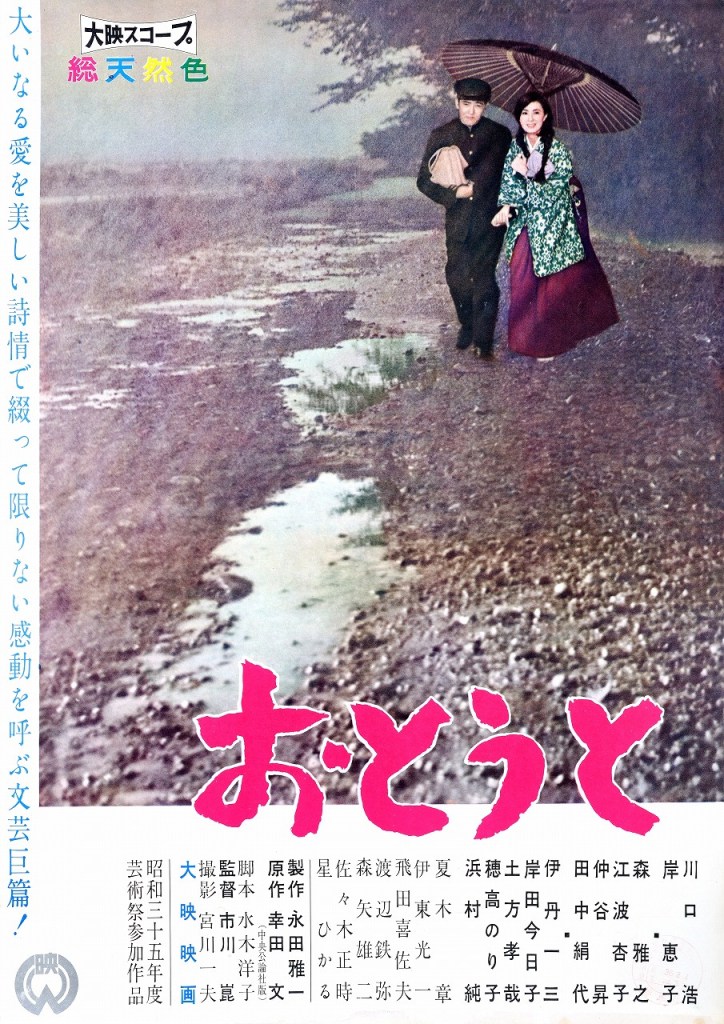 Perhaps oddly for a director of his generation, Kon Ichikawa is not particularly known for family drama yet his 1960 effort, Her Brother (おとうと, Ototo), draws strongly on this genre albeit with Ichikawa’s trademark irony. A Taisho era tale based on an autobiographically inspired novel by Aya Koda, Her Brother is the story of a sister’s unconditional love but also of a woman who is, in some ways, forced to sacrifice herself for her family precisely because of their ongoing emotional neglect.
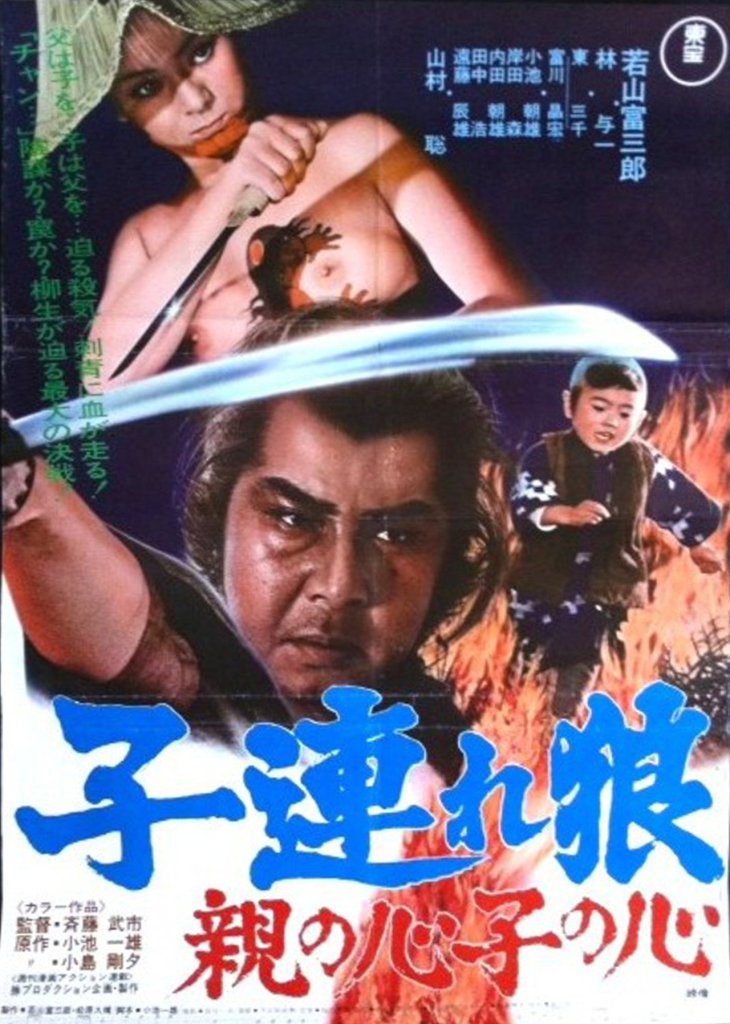 Now four instalments into the Lone Wolf and Cub series, Ogami (Tomisaburo Wakayama) and Daigoro (Akihiro Tomikawa) have been on the road for quite some time, seeking vengeance against the Yagyu clan who framed Ogami for treason, murdered his wife, and stole his prized position as the official Shogun executioner. Lone Wolf and Cub: Baby Cart in Peril (子連れ狼 親の心子の心, Kozure Okami: Oya no Kokoro Ko no Kokoro) is the first in the series not to be directed by Kenji Misumi (though he would return for the following chapter) and the change in approach is very much in evidence as veteran Nikkatsu director Buichi Saito picks up the reins and takes things in a much more active, full on ‘70s exploitation direction. Where
 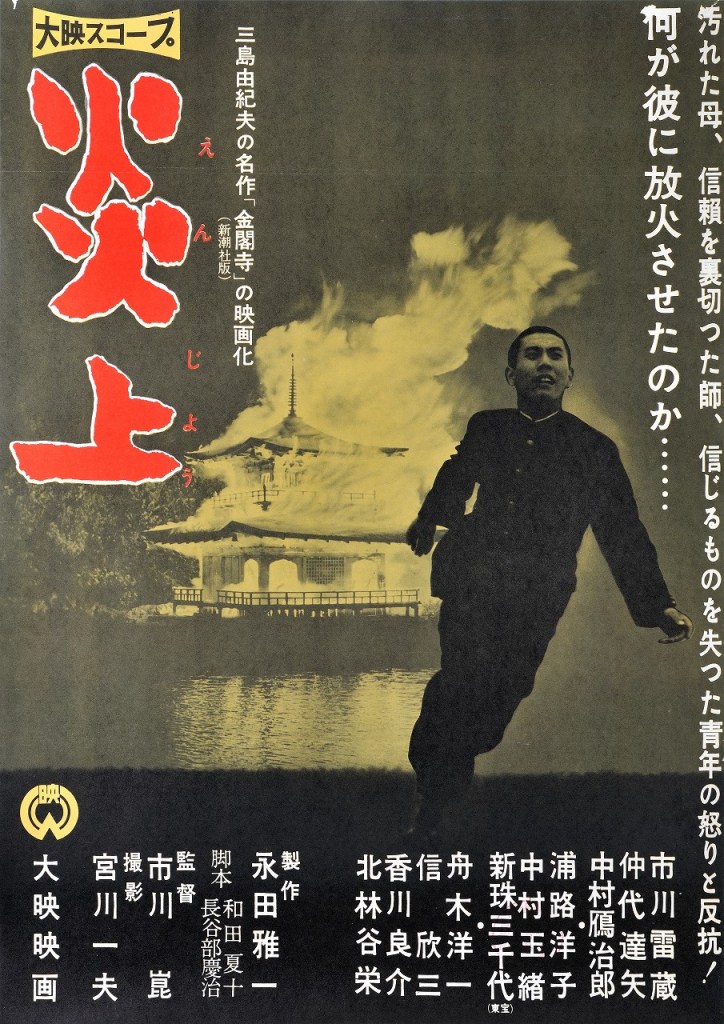 Kon Ichikawa turns his unflinching eyes to the hypocrisy of the post-war world and its tormented youth in adapting one of Yukio Mishima’s most acclaimed works, The Temple of the Golden Pavilion. Inspired by the real life burning of the Kinkaku-ji temple in 1950 by a “disturbed” monk, Enjo (炎上, AKA Conflagration / Flame of Torment) examines the spiritual and moral disintegration of a young man obsessed with beauty but shunned by society because of a disability.
 Bunraku playwright Chikamatsu Monzaemon had a bit of a thing about double suicides which feature in a number of his plays. Though these legends of lovers driven into the arms of death by a cruel and unforgiving society are common across the world, they seem to have taken a particularly romantic route in Japanese drama. Brought to the screen by the great (if sometimes conflicted) champion of women’s cinema Kenji Mizoguchi, The Crucified Lovers (近松物語, Chikamatsu Monogatari) takes its queue from one such bunraku play and tells the sorry tale of Osan and Mohei who find themselves thrown together by a set of huge misunderstandings and subsequently falling headlong into a forbidden romance.
 Windows on Worlds