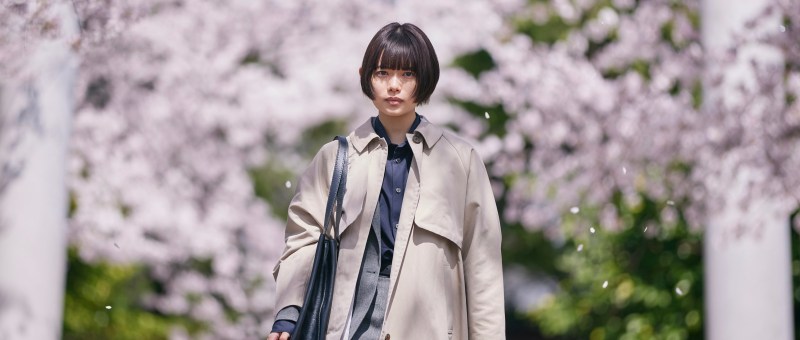
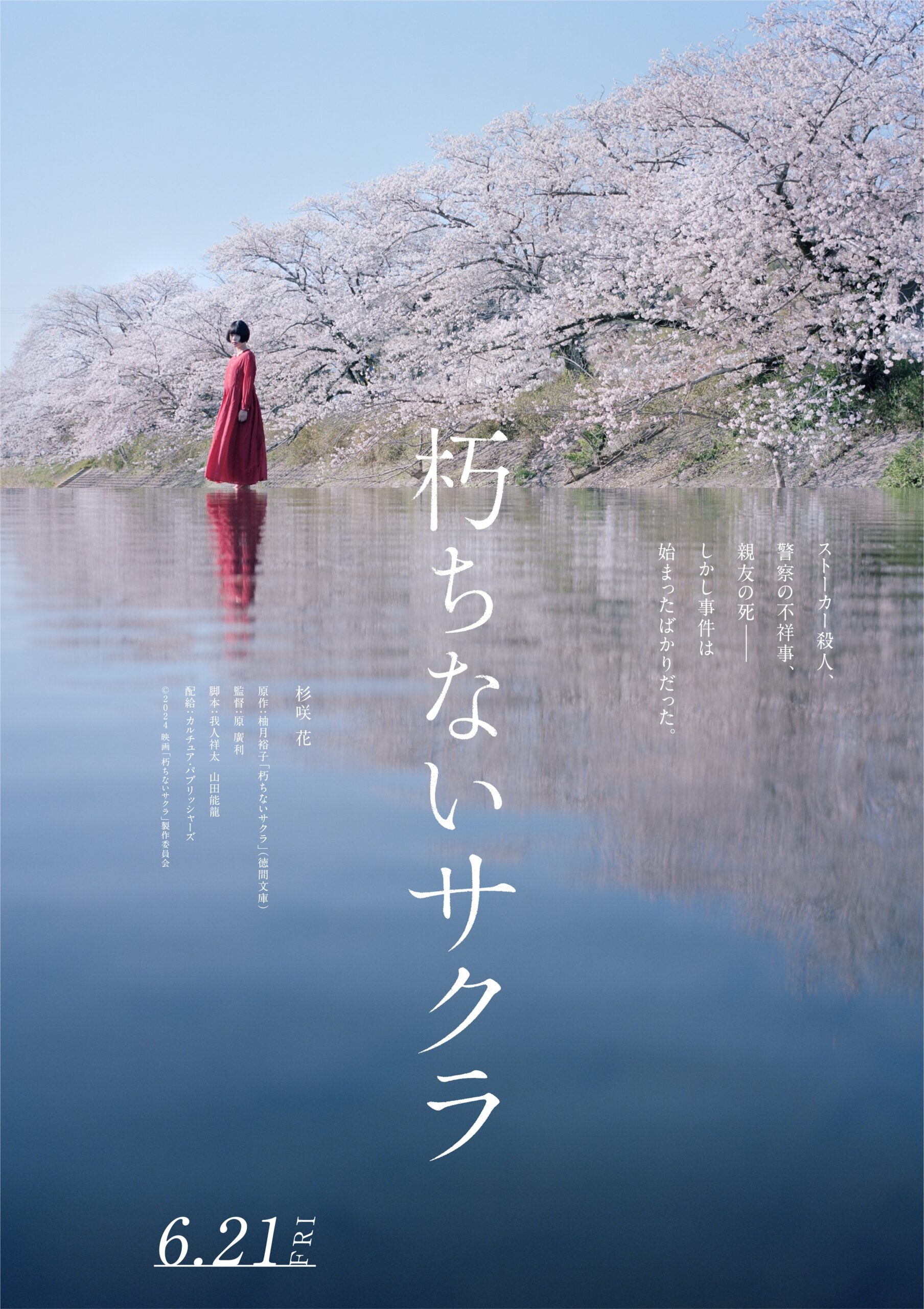
SAKURA (朽ちないサクラ, Hiroto Hara, 2024)

Sakura, or cherry blossoms, are often seen as emblematic of “Japan”. A potent poetic symbol, they blossom only for a short time and then slowly fade away. In the case of Hiroto Hara’s conspiracy drama SAKURA (朽ちないサクラ, Kuchinai Sakura), however, the title refers to a nickname for the security services. In fact, the title could be read either as the “sakura never decays,” or perhaps “will never be tarnished”, “will never die,” echoing the frequent messages that you can never really escape your past for like sakura it will always blossom again while the security services themselves will never fall.

In this case, the event that reverberates is a nerve gas attack on a station that is clearly an allegory for that conducted by Aum Shinrikyo in 1995. Like Aum which is now known as Aleph, the cult in the movie simply changed its name and carried on. Now the head of the police PR department for which the heroine works, former security agent Togashi (Ken Yasuda), is haunted by a mistake he made as a rookie cop and blames himself for not being able to stop the disaster. As fate would have it, the case they’re currently investigating ties back to the cult suggesting a much wider conspiracy in play than the simple intention to cover up a murder.

But there are also two killings here that are likely connected, the first being that of a woman whose allegation of stalking was ignored by the police who, rather than investigate, went off to enjoy themselves on some kind of outing The press is having a field day with the implication the police are both lacking in compassion and negligent in their work. Predictably, the PR division’s main intention is to uncover the source of the leak with Togashi seemingly already suspecting a woman in his department, Izumi (Hana Sugisaki), whose boyfriend, Isokawa (Riku Hagiwara), was himself on that outing. Izumi had accidentally let slip about the police’s activities to her best friend Chika (Kokoro Morita), a reporter who works at the local paper that broke the story. Chika insisted it wasn’t her who wrote the article, but Izumi didn’t believe her. Chika is then found dead after vowing to investigate more fully and prove Izumi wrong with an original hypothesis that she took her own life in guilt over betraying her friend.

Obviously, there’s more to it than that and it soon becomes clear she was murdered probably because she got too close to the truth. Izumi isn’t a detective, but finds herself trying to investigate out of a sense that she contributed to Chika’s death by not believing her when she said she never broke the promise she made not to tell anyone else about the police outing. One might legitimately ask why she is allowed to do this, and the lead detective is not originally happy about it, but as they’re grateful for the leads she turns up, Izumi effectively gets a sort of promotion to investigator. Later events might lead us to wonder if she isn’t being manipulated as part of a wider conspiracy, but then the central intention remains unclear as does the reason the shady forces in play would allow her to investigate Chika’s death knowing the possibility that she may stumble on the “real” truth in the process.

It could be that they simply don’t need to stop her because they know there’s nothing she can do. She has no evidence for her final conclusions and no one would believe her if she spoke out, but it seems odd that conspiracists who’ve already bumped off several other people would allow her to simply walk away knowing what she knows if there were not some grander plan in motion. The question is, is it justified to cause the deaths of a small number of people in order to save the lives of hundreds more who might otherwise die if the cult carries out another terrorist attack before they can be stopped? Sakura apparently have spies and informants everywhere and will do everything they can to protect them in order to facilitate their goal of protecting the nation. Thus the famed cherry blossoms now become another symbol of constant threat and oppression in the spectre of the security services who watch and oversee everything but remain in the shadows themselves. Hara homes in on this sense of paranoia and injustice but in the end cannot resist indulging Izumi’s plucky rookie investigator spirit. Her final decision may not make an awful lot of sense while essentially pitting one authority figure against another. Nevertheless, the tension remains high as Izumi presses forward towards the truth no matter what the danger while like her policeman boyfriend determined to pursue justice wherever it may lie.


SAKURA screens as part of this year’s Japan Foundation Touring Film Programme.

Trailer (English subtitles)

Images: ©2024 SAKURA Film Partners
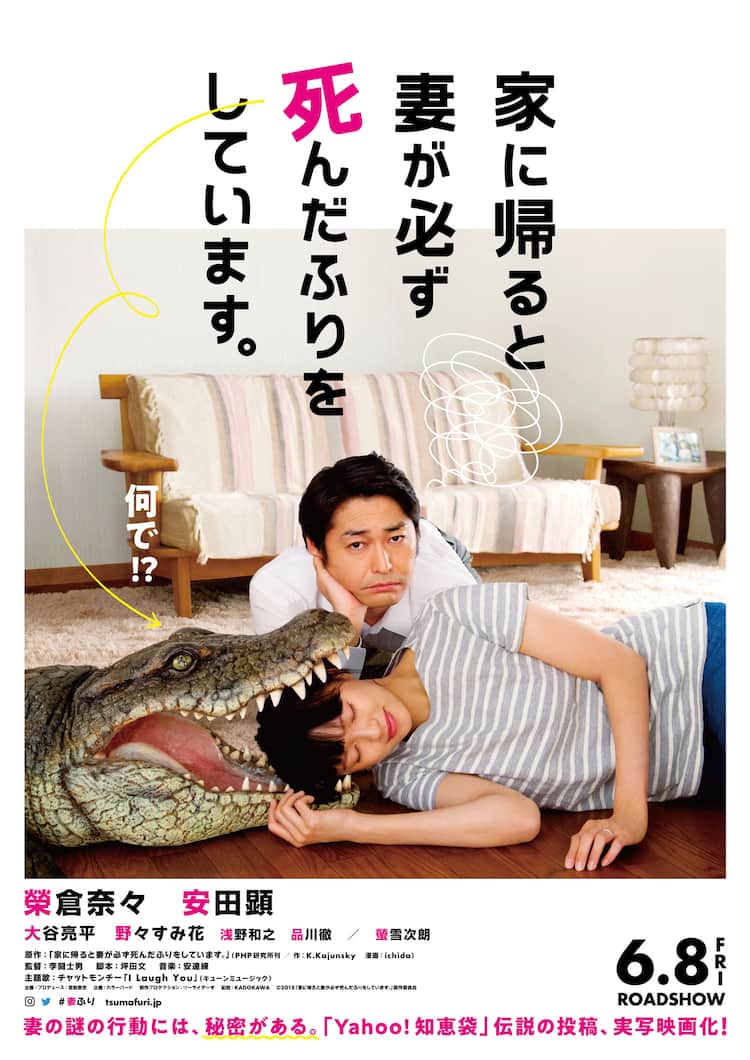
When I Get Home, My Wife Always Pretends to be Dead (家に帰ると妻が必ず死んだふりをしています。, Toshio Lee, 2018)

“If you give it some time it becomes just right,” according to the eccentric wife in Toshio Lee’s quirky contemplation of the modern marriage, When I Get Home, My Wife Always Pretends to be Dead (家に帰ると妻が必ず死んだふりをしています。Ie ni kaeru to tsuma ga kanarazu shinda furi wo shite imasu.). A more cheerful take on Harold and Maude, Lee’s not quite newlywed couple are heading out of their honeymoon phase and perhaps harbouring twin anxieties as they face the three year itch and start to wonder what marriage is all about and if they have what it takes to go the distance. 

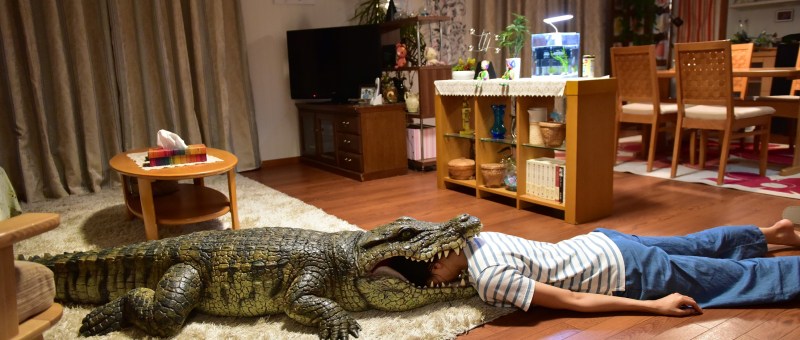
Regular salaryman Jun (Ken Yasuda) is particularly preoccupied with the “three year wall” because he was married once before and the relationship failed at the three year level which is, coincidentally, when many small businesses and restaurants fail. Perhaps unusually he has a friend at work, Sano (Ryohei Ohtani), with whom he discusses his marriage who ironically points out that Jun is essentially thinking of his marital status in the same way as a “contract renewal” as if worried he’s about to be let go. Around this time, however, he gets a nasty shock on returning home discovering his wife Chie (Nana Eikura) lying on the living room floor covered in blood. Distraught, he struggles to remember the number to call an ambulance only for Chie to suddenly burst out laughing. The same thing begins happening to him every time he goes home with the scenarios becoming increasingly elaborate such as being eaten by an alligator, for example, or being abducted by aliens. All things considered, Jun is quite a dull man, too embarrassed even to let his wife kiss him goodbye on the doorstep lest it scandalise the neighbours, so all of this fantasy is doing his head in but his rather blunt hinting that he’d prefer it Chie stop with the playing dead stuff only seems to hurt her feelings while she shows no signs of abandoning her strange hobby. 

Part of the problem is that Jun is also intensely self-involved and perhaps the product of a conformist, patriarchal society. He never reveals the reasons why his first marriage failed, only that his wife abruptly left him without much of an explanation. It never seems to occur to him that Chie may be fixating on death because she lost her mother young, possibly around the same age she is now, and is in a sense role playing demise to ease her anxiety probably grateful each time he returns home and “saves” her. For his part he insists he doesn’t “need excitement” and wants “a normal wife”, desperate to appear conventional and paranoid that Chie is going out of her mind. Rather than fully see her he keeps trying to “fix” the problem by encouraging her to take a part-time job and make new friends, worried she’s bored at home and lonely after moving away from her family home in Shizuoka.  

His friend Sano, seemingly happily married for five years, has a much more relaxed attitude to the mysteries of marriage but as the two wives begin to bond the cracks in their respective relationships are gradually revealed. Like Jun, Sano is also a conventional salaryman with traditional ideas about marriage which he somewhat rudely exposes in thinking he’s doing Jun a favour by “explaining” to Chie that her hobby is offensive to Jun because men work hard all day and want to sit down quietly without any bother when they come home. His quiet word provokes an outburst in his own wife Yumiko (Sumika Nono) who can no longer bear the irony, asking him why it is that she’s supposed to tiptoe around because he’s “tired” as if she does nothing at all day just waiting for him to come home. It’s as if they think their wives go back in the box until they ring the doorbell in the evening and wake them up again, as if the only value in their existence lies in supporting their husbands. Sano is mildly shocked on witnessing Yumiko suddenly brighten and embark on a mini lecture of crocodile facts after catching sight of Chie’s prop (bought on sale, making the most of her thrifty housewife skills), totally unaware she was into reptiles and equally stunned to learn she’s also a karate master. Five years, and it’s like they’re strangers. 

“Thinking won’t give you answers, when you don’t know, ask,” advises Jun’s boss, constantly carping about his ungrateful wife but later revealing that his deep love for her is what’s kept him going all these years. Miscommunication lies at the root of all their problems, Jun even failing to identify the most common if poetic of cliched idioms in his wife’s tendency to remark on the beauty of the moon seemingly at random. Clued in a little by Chie’s patient father, Jun begins to wake up himself, finally seeing his wife and understanding that she’s been trying to tell him something all this time only he was too self-involved to notice. “You can always find me if you look,” Chie was fond of saying, indirectly hinting that marital bliss is a matter of mutual recognition aided by empathy and a willingness to be foolish in the pursuit of happiness. 


When I Get Home, My Wife Always Pretends to be Dead is available to stream in the UK via Terracotta

Original trailer (English subtitles)

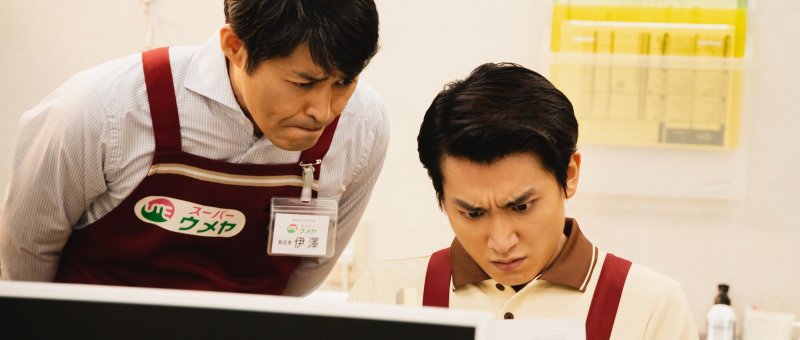
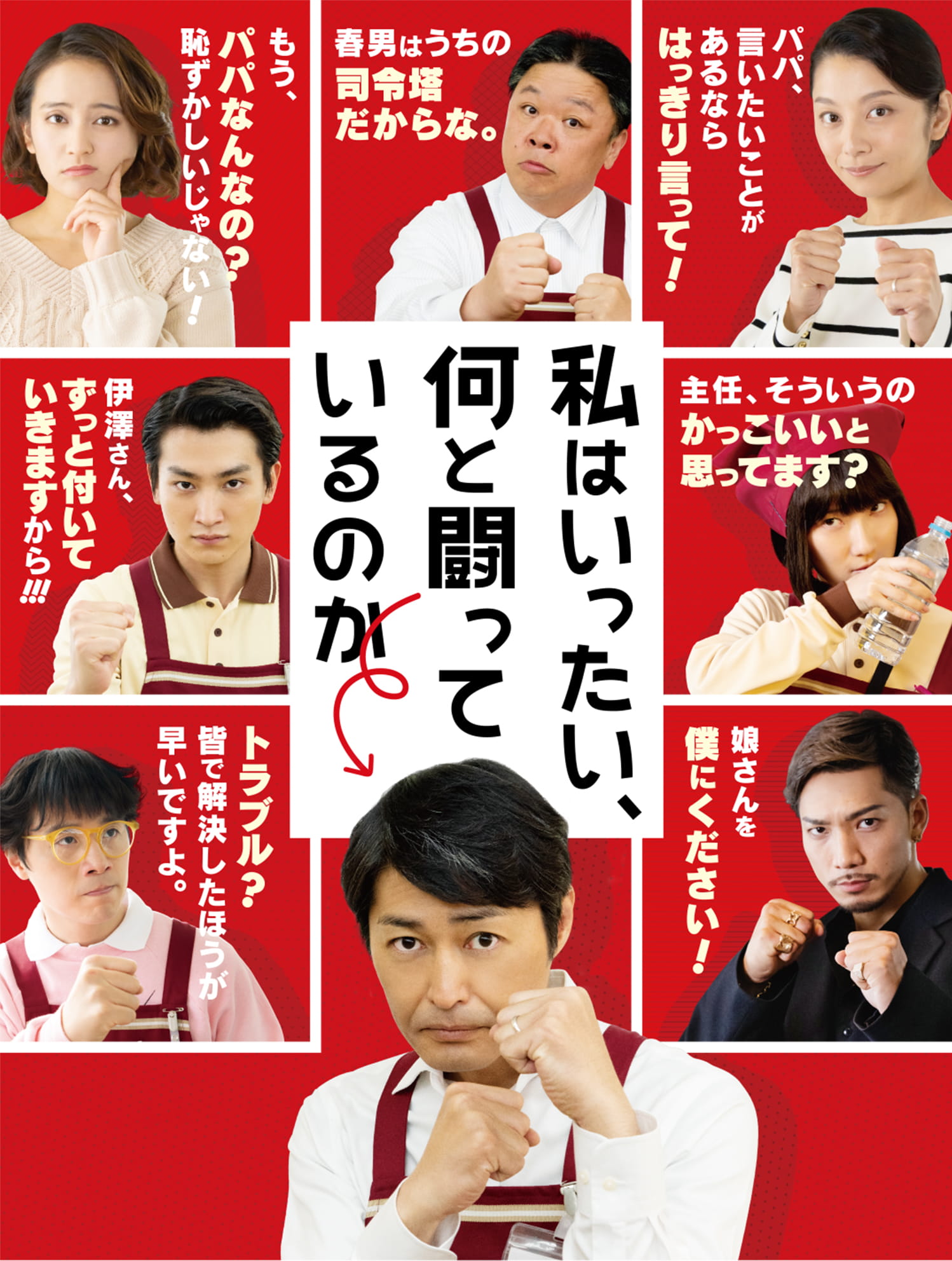
Struggling Man (私はいったい、何と闘っているのか, Toshio Lee, 2021)

Life is a lonely battlefield for the middle-aged hero of Toshio Lee’s Struggling Man (私はいったい、何と闘っているのか, Watashi wa Ittai Nani to Tatakatteiru no ka). The film’s English-language title and supermarket setting may recall Juzo Itami’s Supermarket Woman, but Lee’s lighthearted dramedy soon takes an unexpected left turn as the hero battles a kind of mid-life crisis of fracturing masculinity as his professional and family lives come under simultaneous threat firstly by his failure to land a long overdue promotion and secondly by his eldest daughter’s impending marriage. 

After 25 years working at the same small-town supermarket, Haruo Izawa (Ken Yasuda) is well respected by his colleagues and often depended on by his boss Mr. Ueda (Hikaru Ijuin) yet harbours an internalised inferiority complex that he has not yet made manager. When Mr. Ueda passes away suddenly, everyone, including Haruo himself, just assumes he’ll finally be getting promoted but head office soon parachute in an extremely strange man from accounts, Nishiguchi (Kentaro Tamura), who knows nothing at all about how to run a supermarket. Haruo ends up with an awkward horizontal promotion to deputy manager while Nishiguchi basically leaves everything up to him. 

Haruo is always being told that he’s too nice but as he later tells another employee, he too is really just thinking of himself as revealed by his ever running interior monologue in which he often imagines himself in situations which will show him in a good light only for things not to pan out as he’d hoped. It’s clear that what he’s experiencing is partly a middle-aged man’s masculinity crisis often comparing himself to others and embarrassed on a personal level in not having achieved his career goals while directly threatened by the presence of his daughter’s new boyfriend fearing that he will lose his patriarchal authority within his own household in which he is already somewhat mocked by an otherwise genuinely loving and supportive family. His anxiety is compounded by the fact that he is a stepfather to the two daughters while he and his perspicacious wife Ritsuko (Eiko Koike) have a son together. The discovery of plane tickets sent by the girls’ estranged birth father in Okinawa with the hope that they will visit unbalances him in his increasing fear of displacement.  

As in the Japanese title of the film, Haruo is always asking himself what it is he seems to be fighting with the obvious answers being an internalised inferiority complex and toxic masculinity while constantly told that he doesn’t help himself with his Mr. Nice Guy approach to life. When he discovers an employee may be defrauding the business, he stops his assistant from reporting it and after discovering the truth decides to help cover it up so they won’t lose their job but later loses out himself when his simple act of kindness and compassion is viewed in bad faith by a potential employer. He tries to make things work with Nishiguchi, but Nishiguchi is a defiantly strange person and so all of Haruo’s attempts to help him integrate into supermarket life backfire. As it turns out, he’s in a constant battle with himself against his better nature but always resolving to be kind and put others first while privately annoyed that the universe often seems to be unkind to him. 

Then again as an old lady running a curry house puts it, happiness is having a full belly and so long as Haruo has a healthy appetite things can’t really be that bad. His life is quite nice, which is something he comes to appreciate more fully while reclaiming his image of himself as a father and along with it a sense of security brokered by a truly selfless act of kindness informed by paternal empathy. Professional validation may be a little harder to win, but lies more in the gentle camaraderie with fellow employees than in ruthless workplace politics or rabid ambition. Life need not be a lonely battle as Haruo begins to learn setting aside his manly stoicism and trusting in his ace detective wife who has been engaging in a similar and apparently victorious battle herself reaffirming her love for the kind of sweets so unexciting no one remembers they’re there which may seem a little plain on the outside but have their own kind of wholesome sweetness. 


Struggling Man streams in the US Sept. 17 – 23 as part of the 15th season of Asian Pop-Up Cinema.

International trailer (English subtitles)

Ring Wandering (リング・ワンダリング, Masakazu Kaneko, 2021)

“Don’t forget me” pleads a mysterious young woman guiding the hero of Masakazu Kaneko’s Ring Wandering (リング・ワンダリング) towards the buried legacy he is unwittingly seeking. In this metaphorical drama, the aspiring manga artist hero is on a quest to discover the true appearance of the long extinct Japanese wolf, but is confronted by a more immediate source of unresolved history while working on a construction site for the upcoming Tokyo Olympic Games. 

The manga Sosuke (Show Kasamatsu) is working on is about a wolf and a hunter, Ginzo (Hatsunori Hasegawa), whose daughter Kozue was killed by one of his own traps. Though praising the general concept, his workplace friend points out that his manga lacks human feeling but Sosuke claims it’s unnecessary in a story that’s about a duel to the death between man and nature while matter of factly admitting that Kozue is merely a plot device designed to demonstrate Ginzo’s manly solitude. Yet Soskue complains that he can’t make progress because the Japanese wolf is extinct and he can’t figure out how to draw it. 

His quest is in one sense for the soul of Japan taking the wolf as a symbol of a prehistoric age of innocence though as it turns out he knows precious little about more recent history. The workers at the construction site have heard rumours about a stoppage at another build and joke amongst themselves that if they should find any kind of cultural artefact they’ll just ignore it rather than risk the project being shut down or any one losing their job. The site itself symbolises a tendency to simply build over the buried past erasing traces of anything unpleasant or inconvenient. When Sosuke comes across an animal’s skull buried in a pit he has recently dug, he is convinced it’s that of a Japanese wolf only later realising it is more likely to be that of a dog killed in the fire bombing of Tokyo during the war along with thousands of others on whose bodies the modern city is said to lie. 

Then again, impassive in expression Sosuke is particularly clueless when it comes to recent history. While searching for more wolf cues he comes across a young woman (Junko Abe) looking for her missing dog but completely fails to spot her unusual dress aside from assuming the old-fashioned sandals she is wearing are for the fireworks show set to take place that day incongruously in the winter. Similarly in accompanying her to her home he is confused by all her references to things like the metal contribution and her brother having been sent to the country. He wonders if she might be a ghost, and she wonders the same of him, but still doesn’t seem to grasp that he’s slipped into another era fraught with danger and anxiety only realising the truth on exiting the dream and doing some present day research. 

The fallacy of violence works its way into his manga in the fact that Ginzo’s traps eventually lead to the death of his daughter while he becomes on fixated on besting the wild wolf as a point of male pride though others in the village are mindful to let it live. A pedlar meanwhile explains that the wolf has been forced down towards the village because of the declining economic situation as more people hunt in the mountains for food and fur depriving him of his dinner. He tells Ginzo that the country has been “brainwashed in militarism” and the gunpowder that killed Kozue and will one day be repurposed to create joy and awe is now his most wanted commodity. In the end Ginzo too is saved by a kind of visitation, a ghost from the past offering a hand of both salvation and forgiveness along with an admonishment forcing him to take responsibility for his role in his daughter’s death.

In forging a familial relationship with a lost generation Sosuke comes to a new understanding of more recent history and in a sense discovers the connection he was seeking with his culture, weaving the anxieties of 1940s into an otherwise pre-modern fable about the battle between man and nature in which wolf becomes not aggressor but casualty in a great national folly. Like Kaneko’s previous film Albino’s Trees deeply spiritual in its forest imagery and oneiric atmosphere, Ring Wandering finds its hero transported into the past while unwittingly discovering what it is he’s looking for without ever realising that it has always been right beneath his feet. 


Ring Wandering streamed as part of this year’s Nippon Connection.

Original trailer (English subtitles)

Images: ©RWProductionCommittee

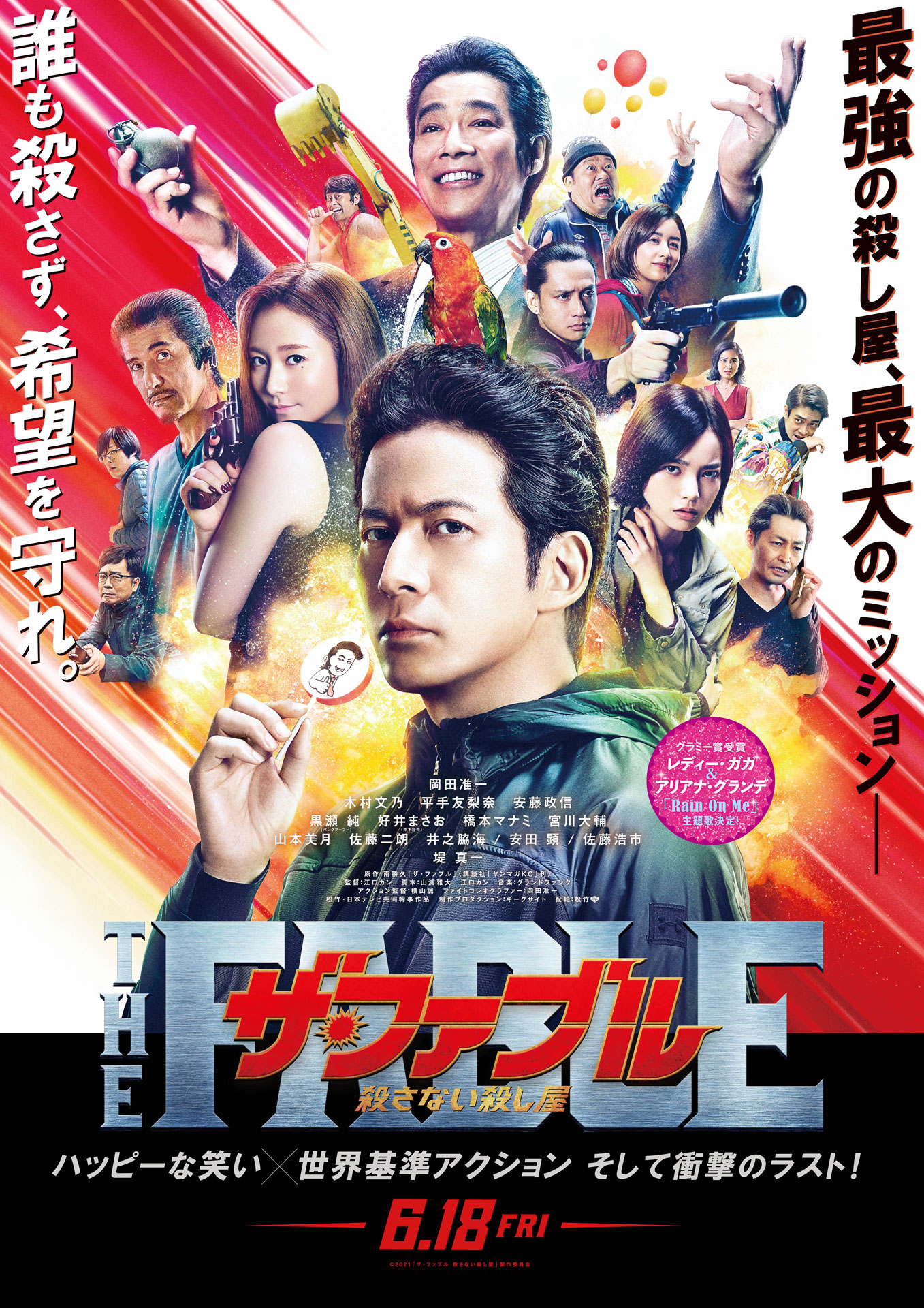
The Fable: A Contract Killer Who Doesn’t Kill (ザ・ファブル 殺さない殺し屋, Kan Eguchi, 2021)

Appearances can be deceptive. A case could be made that everyone is in a sense living undercover, pretending to be something they’re not in order to survive in a conformist society and most do indeed have their secrets even if they’re relatively benign. Others, meanwhile, are on a kind of sabbatical from a life of meticulous violence such as the hero of Kan Eguchi’s sequel to smash hit action comedy The Fable, The Fable: A Contract Killer Who Doesn’t Kill (ザ・ファブル 殺さない殺し屋, The Fable: Korosanai Koroshiya) or like his antagonist living a double life with his apparently genuine concern for the lives of disabled and disadvantaged children balanced by his business of targeting wayward youngsters for the purposes of extortion. 

Some months on from the previous action, “Sato” (Junichi Okada), formerly a top Tokyo assassin known as The Fable, is successfully maintaining his cover hiding out in Osaka as an “ordinary” person with a part-time job in a print and design shop. His cover is almost blown, however, when his colleague Etsuji (Masao Yoshii) is targeted by Utsubo (Shinichi Tsutsumi), ostensibly the leader of a local organisation advocating for the rights of children but also a shady gangster who finances his “philanthropy” by extorting the parents of young people who’ve in someway gone off the rails. Etsuji’s crime is, as was exposed in the previous film, his spy cam habit and in particular his planting of hidden cameras in the home of colleague Misaki (Mizuki Yamamoto) with whom he has an unhealthy obsession stemming from her time as an aspiring idol star. Blaming Misaki for his misfortune, Etsuji turns to violence but is shut down by Sato who risks blowing his cover in order to protect her. Realising he has a previous connection with Utsubo, Sato makes the gang an offer they can’t refuse in order to get Etsuji back but quickly finds himself drawn into another deadly battle with bad guys endangering his still in progress no kill mission. 

Focussed this time much more on action than the fish out of water comedy of Sato’s attempts learn the rules of polite society having been raised in the mountains as a super efficient killing machine, The Fable 2 nevertheless wastes no time in exposing the murkiness of the “normal” world Sato is intended to inhabit. Utsubo is a hit with the local mothers, taken with his smart suit and professionalism as he gives “inspirational” speeches about park safety while making time to converse in sign language with a deaf little girl explaining to another mother that it’s important to “listen to every voice”. As part of his patter he implies his assistant, Hinako (Yurina Hirate), who uses a wheelchair, was injured in a freak park-related accident as a child when in reality she sustained the injury while trapped in the back of a car which veered off a roof after The Fable took out its driver. Vaguely recognising her in the local park, Sato takes an interest out of guilt as the young woman attempts to rebuild her strength in the hope of walking again though that might in itself be contrary to Utsubo’s desires. 

As in the first film, Sato may be a ruthlessly efficient killing machine but at heart he’s still childishly innocent, hoping to help the young woman he unwittingly hurt but also keen not interfere with her ability to help herself. Misunderstanding the situation, Hinako asks Utsubo to lay off Sato, explaining that he gives her confidence as she begins to realise that she can stand alone, as the sometimes uncomfortably ablest metaphor would have it, and no longer needs to be complicit in Utsubo’s nefarious schemes nor need she continue to punish herself in guilt over her traumatic past. While Sato and his handler Yoko (Fumino Kimura) pose as a pair of siblings watched over by their benevolent if absent boss (Koichi Sato), Hinako and underling Suzuki (Masanobu Ando) similarly pose as brother and sister only with the comparatively dubious guidance of Utsubo who affects kindness and generosity while burying problematic youngsters alive in the forest in order to extort money from their “protective” parents. “It’s always the villain who tells the truth” Utsubo explains, insisting that it’s shame and humiliation which build self-esteem in direct contrast to the gently invisible support which seems to have re-activated Hinako’s desire for life.

Sato has at least discovered the benefits of a well functioning and supportive “family” network thanks to the, as we discover, equally handy Yoko, and his still largely oblivious workplace friends. Amping up the action value, Eguchi careers from set piece to set piece culminating in a high octane chase through an apartment block and its eventually unstable scaffolding while making space for slapstick comedy such as two guys trying to move a piano at a very inconvenient moment. A gently wholesome tale of a pure-hearted hitman kicking back against societal hypocrisy while figuring out how to be “normal” in a confusing society, The Fable 2 more than builds on the promise of its predecessor while allowing its hero the space to grow as he begins to adjust to his new and very “ordinary” life.


The Fable: A Contract Killer Who Doesn’t Kill screens on July 7 as part of this year’s Neuchâtel International Fantastic Film Festival (NIFFF)

Original trailer (English subtitles)

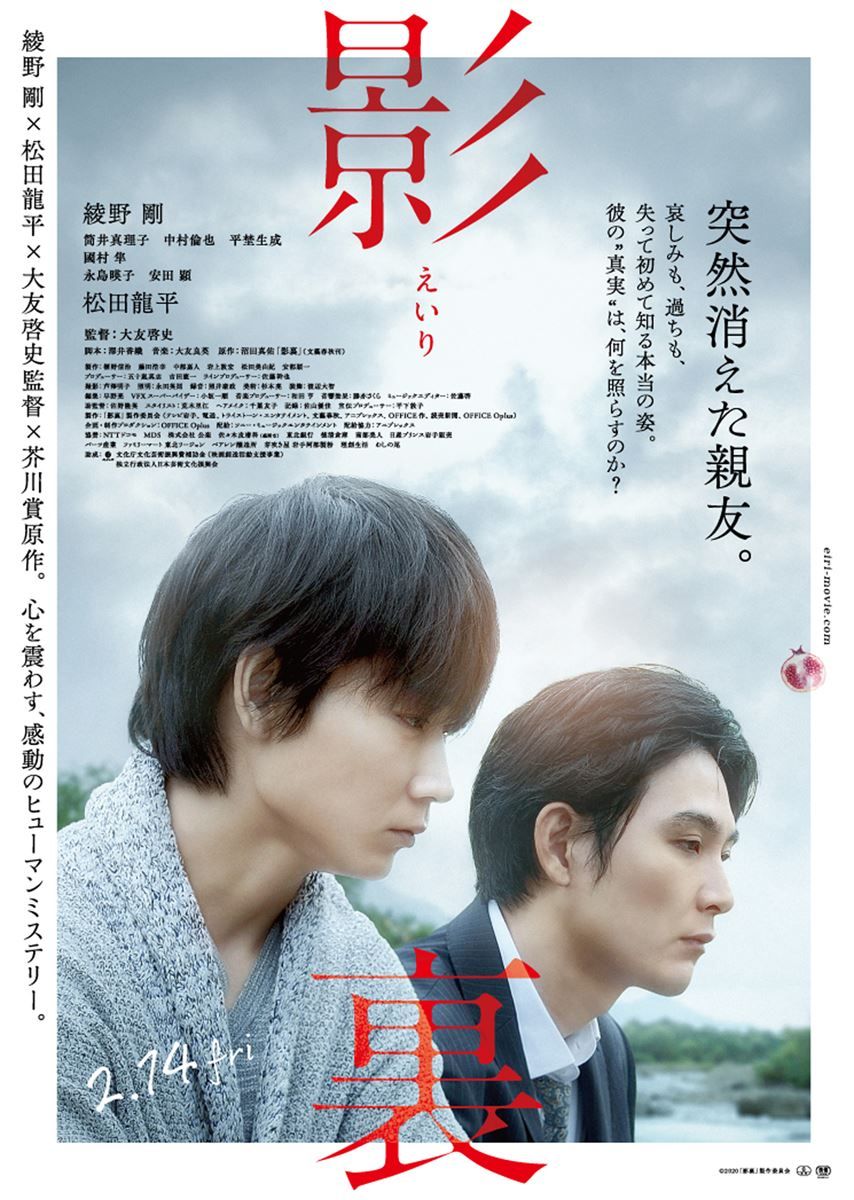
Beneath the Shadow (影裏, Keishi Ohtomo, 2020)

“There’s nothing wrong with leaving it a mystery” the enigmatic presence at the centre of Keishi Ohtomo’s Beneath the Shadow (影裏, Eiri) advises the hero as he vows to look into the unexpected appearance of a fish found swimming in the wrong river. Best known for mainstream blockbusters such as the Rurouni Kenshin series, March Comes in Like a Lion, and Museum, Ohtomo shits towards an arthouse register in adapting the Akutagawa Prize-winning novella by Shinsuke Numata which is in a sense obsessed with the unseen, the hidden details of life and secret sides we all have that are perhaps intended to protect but also leave us vulnerable. 

Konno (Go Ayano), an introverted man in his 30s, has just been transferred to rural Morioka by the pharmaceuticals company at which he works. He keeps himself to himself and largely spends his time caring for a Jasmine plant which appears to have some especial yet unexplained significance. It’s at work that he first encounters the enigmatic Hiasa (Ryuhei Matsuda), reminding him that theirs is a non-smoking building only to discover that Hiasa isn’t the sort to care very much about rules. For some reason or other, Hiasa takes a liking to Konno, turning up at his house with sake, teaching him how to fish, and going on what to anyone else look like dates. Yet when winter comes Hiasa abruptly quits his job and disappears without a word, resurfacing a few months later with a better haircut and a sharp suit explaining that he’s now a top salesman for a suspicious insurance company designed to help pay for expensive ceremonies such as weddings or more commonly funerals. The two men resume their friendship, but soon enough Hiasa again disappears. Only when he’s contacted by a co-worker (Mariko Tsutsui) after the earthquake hoping to find him because it turns out he owes her a large some of money does Konno begin to reflect on how little he might really have known this man he thought a friend. 

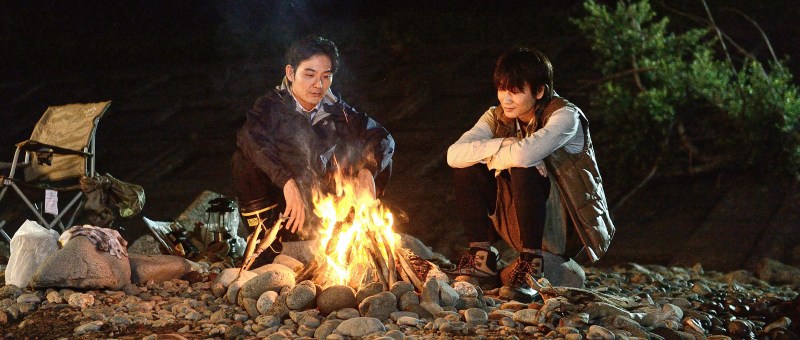
“Right from the start you have to groom it so it’s tantalised” Hiasa later explains, operating on several metaphorical levels but talking quite literally about lighting a fire. Konno has to wonder if that’s all it really was, if Hiasa is just a manipulative sociopath playing a long game, getting him on side in case he’d be useful later. When he resurfaces after his first absence, Hiasa eventually asks Konno to sign for one of his policies claiming that he’s one away from his quota and will be getting the can if he can’t fill it despite having talked a big game in proudly showing off a commendation he’d won as a top salesman when he turned up on Konno’s doorstep. “What you see is where the light hit for an instant, no more than that. When you look at someone you should look at the other side, the part where the shadow is deepest”, Hiasa had pointedly told him during a heated fireside conflagration, seemingly hurt as if in the moment he had wanted to be seen and is disappointed to be met with Konno’s irritated rejection, fed up with his mixed signals and distance both emotional and physical. 

Yet Konno is also himself living half in shadow as a closeted man choosing not to disclose his sexuality to those around him. A meeting with an old friend who has since transitioned presumably having embraced her own essential self raises further questions about the reasons he accepted the transfer to Morioka as if he too, like Hiasa, wanted to disappear from his old life and reinvent himself somewhere new, he’s just done it in a more conventional way. Even in contemporary Japan which is in some ways very old fashioned when it comes to the technology of everyday life and with a strong belief in personal privacy it’s surprisingly easy to just vanish at the best of times, but even his family members who are in no hurry to find him wonder if Hiasa may simply have used the cover of disaster to disappear for good. His conflicted brother (Ken Yasuda) affirms he thinks he’s probably alive because he’s “someone who can survive anywhere” which in the way he’s putting it is not much of a character reference. 

The conclusion Konno seems to come to, in a happier epilogue some years later, is that Hiasa himself was perhaps a fish swimming in the wrong waters, unable to adapt to the world around him. Perhaps it’s alright for him to remain a mystery because a mystery was what he was. Konno, by contrast, sets himself free apparently less gloomy, no longer living half in shadow, even if still hung up on the one that got away. A slow burn affair, Beneath the Shadow eventually refuses conflagration in favour of something cooler in accepting that you never really know anyone, perhaps not even yourself, even when you peer into the darkest part of the shadow. In the end you just have to let it go, “the cycle keeps repeating”. 


Beneath the Shadow streams in the US via the Smart Cinema app until Sept. 12 as part of this year’s New York Asian Film festival.

Original trailer (no subtitles)

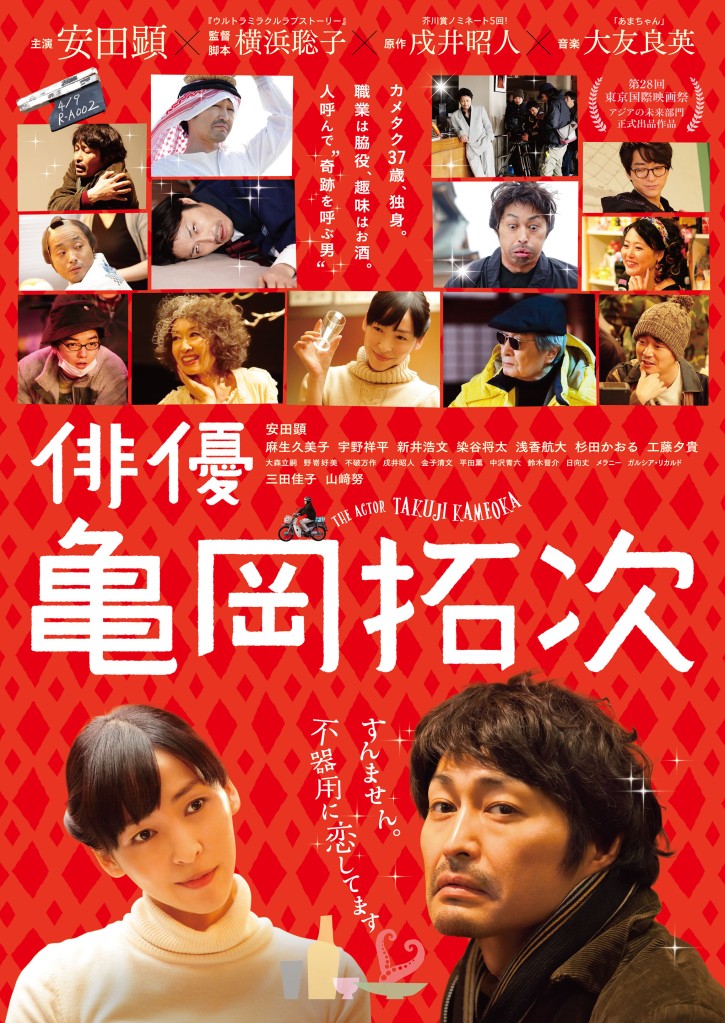
The Actor (俳優  亀岡拓次, Satoko Yokohama, 2016)

“There are no small parts, only small actors” according to the mantra of the bit part player, but perhaps deep down everyone wants to play the lead. Most jobbing actors will tell you that they’re happy to be working and if you work as much the dejected hero of Satoko Yokohama’s The Actor (俳優  亀岡拓次, Haiyu Kameoka Takuji), you can make a pretty decent living with a little more job security than a big name star whose career will inevitably hit the odd dry spell. Yet, who doesn’t want to at least feel that they’re the lead in their own life story? Spending all your time being other people can make you lose sight of who you really are and live your life with a sense of cinematic romanticism forever at odds with accepted reality. 

Takuji Kameoka (Ken Yasuda) is a classic background actor, turning up in small roles in TV dramas, often playing the villain of the week or appearing as a prominent extra. Meanwhile, his offscreen life seems to be lived in a booze-soaked haze, hanging out in his favourite bar surrounded by similarly dejected middle-aged men or occasionally meeting up with colleagues. Even his agent expects him to be sozzled when she rings to confirm new jobs though to be fair she doesn’t seem too bothered about it. 

Kameoka has perhaps made his peace with the kind of actor he is, but there’s also an inbuilt anxiety in waiting for people to ask what it is he does, knowing that it sounds glamorous and exciting when, to him at least, it’s anything but. Chatting with a pretty young woman, Azumi (Kumiko Aso), working behind a bar in a small town where he’s filming, Kameoka spins her a yarn about being a bowling ball salesman rather than be forced into a conversation about the life of a jobbing actor which might perhaps depress him more. Alone in the bar, the pair of them strike up a rapport over shared sake, but Kameoka forgets that in essence she’s just the same as him – acting, performing her role as the cheerful hostess, keeping him happy to sell more drinks. Later, she tells him that she’s switching roles, “recasting” herself as a good wife and mother, pointing again towards the unavoidable performative quality of conforming to socially defined labels such as “wife”, “mother”, “landlady”, “actor” or “man”. 

Everyone is, to some degree, acting, forced to perform a role in which they may privately feel miscast but are unable to reject. Kameoka is losing sight of who he is and so his life begins to feel increasingly like a movie, obeying narrative logic rather than that of “reality” while he often drifts off into flights of fancy in which he gets to play not the lead but a slightly bigger supporting part, recasts himself as the star of a favourite film, or finds himself momentarily in a film noir. Real or imagined, his directors have nothing but praise for him to the degree that it somehow feels ironic. He’s brought in to show the rookie leads how it’s done, an accidental master at dropping dead on camera, but as the landlady at his local says of another actor on TV, he just doesn’t have that leading man sparkle. Of course, not having that kind of presence is perfect for being a background player but a great shame when he has the talent to succeed, just without the burden of “star quality”. 

Then again, his talent is uncertain. Despite telling his agent that he doesn’t do stage, he agrees to work with a famous actress/director on an avant-garde theatre piece. Though she’s much harder on the young female star, Matsumura (Yoshiko Mita) rarely compliments his acting and eventually advises him that he’s unsuited to stage work because he has “film timing”. Privately, he might agree, but a job’s a job. Ironically enough, the performance that Matsumura failed to bring out in him is vividly brought to life during a very weird audition for a Spanish director who happens to be one of Kameoka’s favourites. He inhabits the role so strongly as to completely become it to the extent that its world rises all around him, but all too soon the audition is over with a simple “that’s great, thank you – we’ll be in touch”. Kameoka even suffers the indignity of crawling under the frozen shutters to exit the building while the next hopeful, a top TV actor he worked with on a previous job, makes his way inside. 

The woman in Kameoka’s audition fantasy is clearly Azumi, something that becomes clearer to him still during another flight of fancy that recasts him as a romantic hero making the grand gesture of a rain soaked dash, motorcycle filmed against rear projection, as he prepares for the inevitable “happy ending”. Reality, however, triumphs once again. Lovelorn, Kameoka declares himself lonely and indeed is always alone, not one of the “main cast” just a “bit player” hanging round until his scene and then moving on to the next project. He waves at women who weren’t waving at him, sympathises with a failed singer turned bar hostess, and celebrates the unexpected marriage of a friend but in a strange sense perhaps misses “himself”, gradually eclipsed by all the roles he plays onscreen and off. “Who are you?”, the Spanish director’s interpreter asks. “Takuji Kameoka, Japanese Actor”, is as good an answer as any. 


Screened as part of the Japan Foundation Touring Film Programme 2020.

Original trailer (English subtitles)

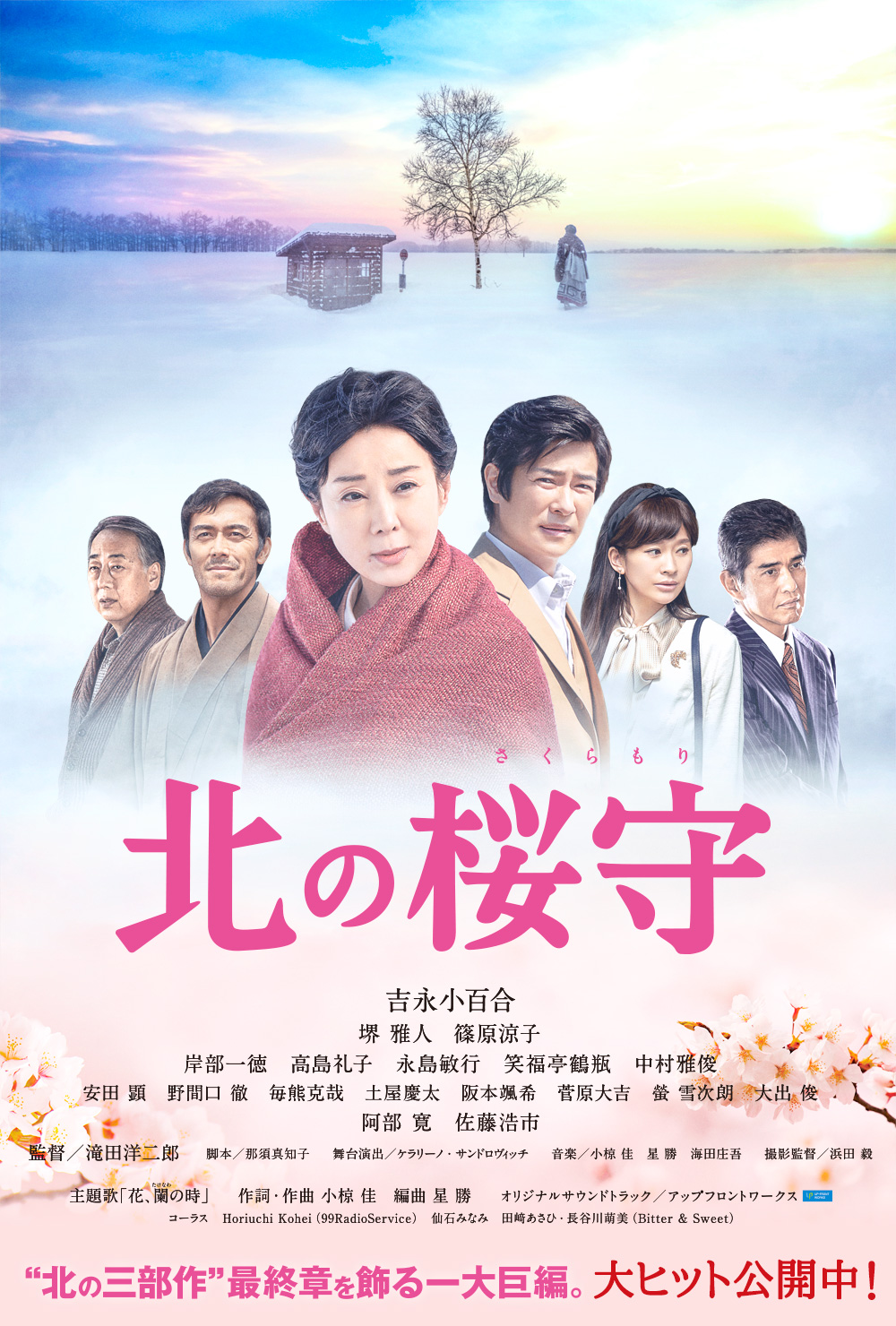
Sakura Guardian in the North (北の桜守, Yojiro Takita, 2018)

Sakura Guardian in the North posterStill a major marquee star and one of the few golden age actresses regularly playing leading roles in box office hits, Sayuri Yoshinaga has for one reason or another become somewhat synonymous with a brand of quietly patriotic tales of wartime endurance and maternal suffering. Sakura Guardian in the North (北の桜守, Kita no Sakuramori), apparently the conclusion of a loose trilogy of “Northern” films which began with Year One in the North in 2005 and led on to Junji Sakamoto’s A Chorus of Angels in 2012, sees her once again engage with post-war trauma as a mother eventually driven out of her mind by the inability to come to terms with the weight of tragedy.

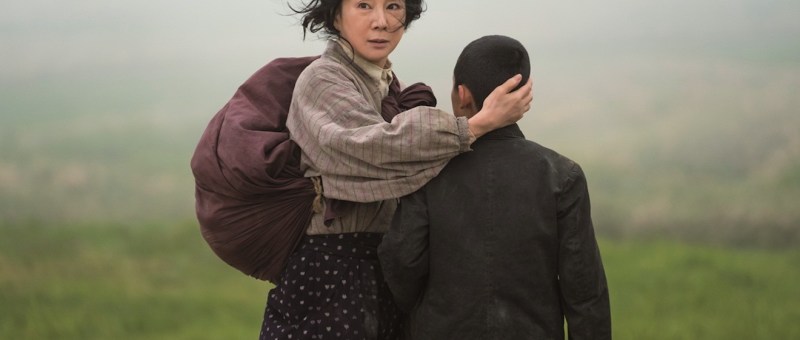
The tale begins on Sakhalin in spring 1945. Despite the intense cold of the frozen North, Tetsu (Sayuri Yoshinaga) – mother to two young sons, Seitaro and Shujiro, has carefully nurtured cherry trees grown from seeds brought from the mainland ensuring that they blossom even here. The family’s happiness will however be short lived. Dad Tokujiro (Hiroshi Abe) is sent off to the war while Tetsu and the children are eventually forced to evacuate to escape the Russian invasion, planning to wait for Tokujiro in Abashiri on the north coast of Hokkaido.

Flashing forward to 1971, we find ourselves in Tokyo with Shujiro (Masato Sakai), now a grown man married to the Japanese-American daughter of an LA hot dog entrepreneur, Mari (Ryoko Shinohara). Having made something of himself in the New World, Shujiro has returned to Japan to open the first branch of his father-in-law’s convenience stores. His plans are disrupted when he gets an unexpected call from Abashiri about his mother, whom he hasn’t seen since she told him to leave her behind and seek his fortune 15 years previously. The public housing shanty town where Tetsu ran her restaurant is being torn down but she’s showing no signs of leaving, and not only that, she’s begun to act strangely.

This Shujiro finds out for himself by visiting her and witnessing Tetsu talk to her own reflection as if it were a long lost friend. His sudden decision to bring his mother back with him to Tokyo without talking to his wife, who has never even met her mother-in-law, places a strain on his marriage on top of the already heavy burden of the store but Shujiro is determined to make it work. Tetsu, however, finds its hard to adjust. Used to living in small country towns where everyone knows everyone, she doesn’t realise you can’t just walk off from stores shouting “put it on my tab”, and annoys the neighbours by starting a smoky fire outside trying to cook rice the old fashioned way. With Shujiro busy with work, the burden falls disproportionately on the patient but exasperated Mari who is forced to apologise when Tetsu walks off in someone else’s shoes after trying on city-style outfits at a department store, and looks on in horror as her new mother-in-law starts an intense conversation with a cherry blossom tree.

Tetsu’s down home charm does, however, begin to give Shujiro some business inspiration as he ponders why his top American hotdogs aren’t selling now the novelty’s worn off. As his staff tell him, maybe they need to think a little more “Japanese” – more fresh veggies and innovative toppings, less ketchup and mustard. Shujiro has another idea – the original Japanese “convenience” food, onigiri, made with rice cooked in a pot and roughly shaped by a loving mother’s hands.

Rice, however, despite its ubiquity in the comparatively comfortable world of 1971 brings with it traumatic memories. Starving after the war, white rice was something Shujiro and Tetsu could only dream of, getting their first taste of it in many moons only when cooked to place on a funeral altar. Meanwhile, rice was also the only reason they survived after running into a slightly dodgy young man who gave them “jobs” helping him to smuggle it for sale on the black market. Shinji (Koichi Sato) helped them in other ways too, eventually putting up the money for Tetsu’s homely eatery, and would have married her if she were not on the one hand loyal to the memory of her absent husband, and so troubled by survivor’s guilt as to believe that she is “a person who does not deserve happiness”.

To punish herself for perceived failures, Tetsu has lived a life of austerity – working hard in the restaurant, dressing in simple ragged clothes, and eating only enough not to starve. She forced Shujiro away to make something of himself, but never spent any of the money he sent home to her nor answered any of his letters. Shujiro, by contrast, has swung the opposite way – determined to live a life of luxury and becoming unforgiving with it. Mari sees an ugly side to him when he’s visited by one of the boys who used to bully him (Ken Yasuda) for being a refugee and a black-marketeer back in Abashiri now fallen on hard times. Superficially polite, Shujiro humiliates him with undignified zeal while wilfully planning to exploit his workforce, quickly silencing an employee who tries to point out violations to the labour code.

Yet like Tetsu, who is somewhat unstuck in time, he begins to find a softer side of himself as the pair of them journey back into the past and revisit the sites of their shared traumas. Yojiro Takita stages Tetsu’s internal confusion somewhat incongruously as an avant-garde stage play offering occasional background info on the exodus from Sakhalin, an experience Shujiro is seemingly shut out from as he tries to reconnect with his mother only to lose her again but rediscovering a better version of himself before he was hardened by the burden of his memories and the hardships of the post-war era. Tetsu keeps the cherry blossoms in bloom in the North, cultivating beauty as a means to connect with her loss, and eventually finding a kind of resolution in the returned ghosts of her past given life once again by the strength of her devotion.


Singapore trailer (English / Simplified Chinese subtitles)

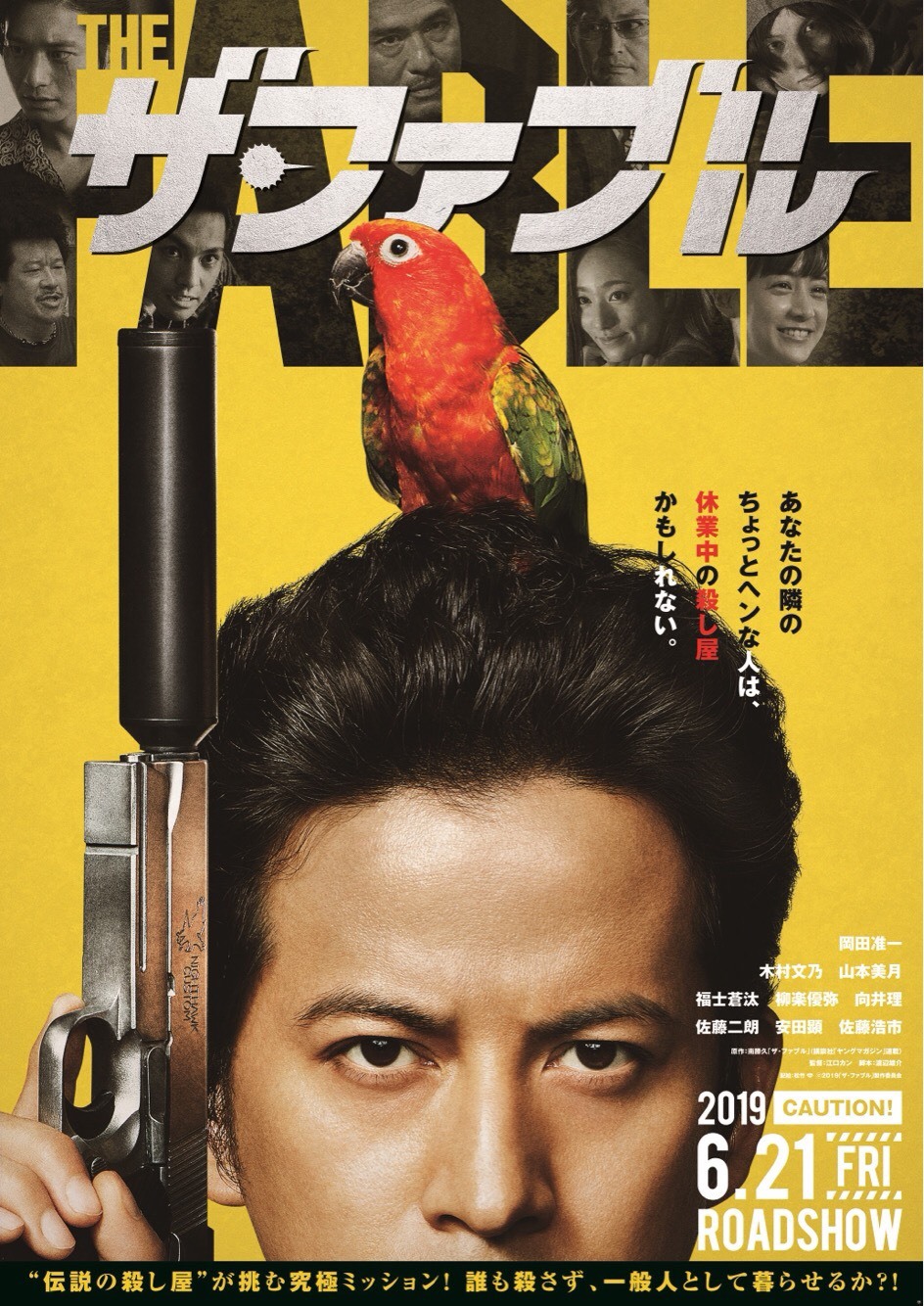
The Fable (ザ・ファブル, Kan Eguchi, 2019)

The Fable poster 2It’s easy to become a victim of your own success when you’re a top assassin. Being the best only makes you target, and over exposure can prove fatal. If you’ve lived by taking the lives of others, can you ever really go back to being just like everyone else? The hero of Kan Eguchi’s The Fable (ザ・ファブル) tries to do just that, but then “back” might not quite be the best way to think about it in his case. Silly slapstick humour meets fast and furious gun fu but always with a soulful heart as our heroes try to figure out how to live “normally” while inhabiting a very abnormal world.

“The Fable” (Junichi Okada) is Tokyo’s top assassin, as he proves effortlessly taking out a room full of yakuza at a wedding reception. He is not, however, heartless, letting the gangster’s pregnant wife alone unlike the next bunch of goons to turn up. In any case, Fable has been far too successful, which is why his handler (Koichi Sato) hands him an unusual new mission – to live as a “normal” person in Osaka for a whole year without killing anyone at all. Along with his assistant posing as his sister under the cover ID “Yuko” (Fumino Kimura), and a pet parrot, Fable becomes “Akira Sato” and begins his new life as a “normal” man nominally under the aegis of the local mob.

The problem is “Sato” never had much of a “normal” life. As a child, he was abandoned in the mountains with only a pocket knife to toughen him up for a life of killing. He didn’t go to school, has never had a job, and struggles with social situations. He is however extremely dedicated and committed to fulfilling his mission which means he is very keen to figure out what “normal” people do so he can do that too, quickly noting that “normal” people don’t usually eat the skin on edamame beans or the rind on watermelon so doing either of those things in public will instantly arouse suspicion. Meanwhile, he takes a minimum wage job at small printshop working alongside the lovely Misaki (Mizuki Yamamoto) who was nice enough to offer him some tissues when he let himself get beaten up by thugs to prove how “professional” he could be in maintaining his cover.

That’s something that might be easier said than done given the rapidly unfolding yakuza drama all around him. Recently released thug Kojima (Yuya Yagira) is stirring up trouble everywhere he goes, exacerbating a growing division between the big boss (Ken Mitsuishi) and ambitious underling Sunagawa (Osamu Mukai) who is already fed up with Kojima’s antics while two crazed admirers are also hot on Sato’s trail hoping to knock him off the top spot.

Meticulous and efficient, Sato is still in many ways a child trying to learn to live in the “normal” world. Somewhat arrested in having missed out on a normal childhood, his “childish” drawings of zoo animals become an unexpected hit with the print shop crew, while his justice loving heart also has him subtly undermining the office pervert who has a habit of installing illicit spy cams targeting female employees. Despite his icy profession, Sato is a goodnatured guy and deep down just wants to help and protect people. Thus he is very invested in his mission and actively tries to become “normal” while bonding with Misaki and taking care of his pet parrot (a Le Samouraï reference and ironic mentor in mimicry) as he navigates the difficult waters of interpersonal interaction.

Frustrated male relationships are indeed key from Sato’s with his boss who orders him not to die but then says he’ll kill him if he fails his mission, to the homoerotic tension between Sato’s contact Ebihara (Ken Yasuda) and the relentlessly psychotic Kojima. Sato’s boss and Ebihara acknowledge they will have to accept responsibility for their respective charges and if necessary take preventative measures in order to ensure they don’t cause trouble, but they do so with heavy hearts in service of their codes. Silly slapstick humour quickly gives way to slick action set pieces as Sato steps back into his element, ably assisted by his sake-loving “sister” who has committed to her cover ID almost as deeply as Sato. Sweet and affecting, Kan Eguchi’s adaptation of the much loved manga is a charmingly surreal one in which his fish out of water hero figures out how to live in a new pond thanks to unexpected kindnesses and honourable yakuza ethics.


The Fable screens on 2nd July as part of the 2019 New York Asian Film Festival.

Original trailer (no subtitles)

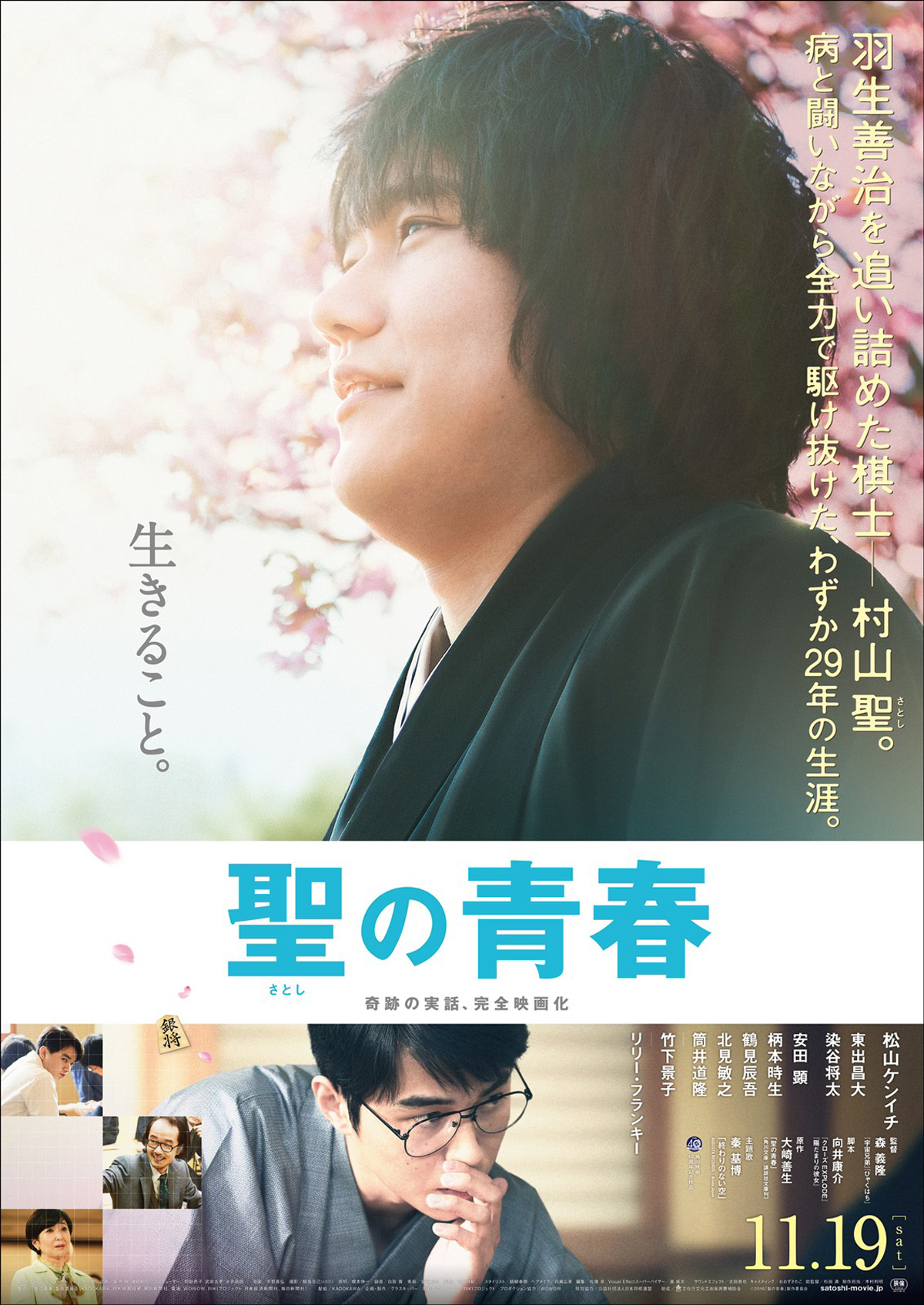
Satoshi: A Move for Tomorrow (聖の青春, Yoshitaka Mori, 2016)

satoshiThere’s a slight irony in the English title of Yoshitaka Mori’s tragic shogi star biopic, Satoshi: A Move For Tomorrow (聖の青春, Satoshi no Seishun). The Japanese title does something similar with the simple “Satoshi’s Youth” but both undercut the fact that Satoshi (Kenichi Matsuyama) was a man who only ever had his youth and knew there was no future for him to consider. The fact that he devoted his short life to a game that’s all about thinking ahead is another wry irony but one it seems the man himself may have enjoyed. Satoshi Murayama, a household name in Japan, died at only 29 years old after denying chemotherapy treatment for bladder cancer in fear that it would interfere with his thought process and set him back on his quest to conquer the world of shogi. Less a story of triumph over adversity than of noble perseverance, Satoshi lacks the classic underdog beats the odds narrative so central to the sports drama but never quite manages to replace it with something deeper.

Diagnosed with nephrotic syndrome as a child, the young Satoshi spent a lot of time alone in hospitals. To ease his boredom his father gave him a shogi set and the boy was hooked. Immersing himself in the world of the game, Satoshi read everything he could about tactics, practiced till his fingers bled and came up with his own unorthodox technique for playing that would eventually take him from his Osaka home to the bright lights of Tokyo. Determined to become the “Meijin”, beat top shogi player Habu (Masahiro Higashide), and get into the coveted 9th Dan ranking Satoshi cares for nothing other than the game, his only other hobbies being drink, junk food, and shojo manga.

Undoubtedly brilliant yet difficult, Satoshi is not an easy man to get along with. Years of medical treatment for nephrosis have left him pudgy and bloated, and an aversion to cutting his hair and nails (poignantly insisting that they have a right to live and grow) already makes him an unusual presence at the edge of a shogi board. He’s not exactly charming either with his overwhelming intensity, aloofness, and fits of angry frustration. Yet the shogi world fell in love with him for his encyclopaedic yet totally original approach to the game. His friends, of which there many, were willing to overlook his eccentricities because of his immense skill and because they knew that his anger and impatience came from forever knowing that his time was limited and much of life was already denied to him.

This insistent devotion to the game and desire to scale its heights before it’s too late is what gives Satoshi its essential drive even if the road does not take us along the usual route. Reckless with his health despite, or perhaps because of, his knowledge of his weakness, Satoshi operates on a self destructive level of excessive drink and poor diet though when he starts experiencing more serious problems which require urgent medical intervention, it’s easy to see why he would be reluctant to get involved with even more doctors. Eventually diagnosed with bladder cancer, Satoshi at first refuses and then delays treatment in fear that it will muddy his mind but the doctors tell him something worse – he should stay away from shogi and the inevitable stress and strain it places both on body and mind. For Satoshi, life without shogi is not so different from death.

Satoshi has his sights set on taking down popular rival Habu whose fame has catapulted him into the Japanese celebrity pantheon, even marrying a one of the most beloved idols of the day. Habu is the exact opposite of Satoshi – well groomed, nervous, and introverted but the two eventually develop a touching friendship based on mutual admiration and love of the game. On realising he may be about to beat Satoshi and crush his lifelong dreams, Habu is visibly pained but it would be a disservice both to the game and to Satoshi not to follow through. Outside of shogi the pair have nothing in common as an attempt to bond over dinner makes clear but Habu becomes the one person Satoshi can really talk to about his sadness in the knowledge that he’ll never marry or have children. As different as they are, Satoshi and Habu are two men who see the world in a similar way and each have an instinctual recognition of the other which gives their rivalry a poignant, affectionate quality.

Despite the game’s stateliness, Mori manages to keep the tension high as elegantly dressed men face each other across tiny tables slapping down little pieces of wood featuring unfamiliar symbols. Japanese viewers will of course be familiar with the game though overseas audiences may struggle with some its nuances even if not strictly necessary to enjoy the ongoing action. Matsuyama gives a standout performance as the tortured, tragic lead even gaining a huge amount of weight to reflect Satoshi’s famously pudgy appearance. Rather than the story of a man beating the odds, Satoshi’s is one of a man who fought a hard battle with improbable chances of success but never gave up, sacrificing all of himself in service of his goal. Genuinely affecting yet perhaps gently melancholy, Satoshi: A Move for Tomorrow is a tribute to those who are prepared to give all of themselves yet also a reminder that there is always a price for such reckless disregard of self.


Satoshi: A Move for Tomorrow was screened as part of the Udine Far East Film Festival 2017.

Original trailer (English subtitles)

https://www.youtube.com/watch?v=dNN7OrXsrvI