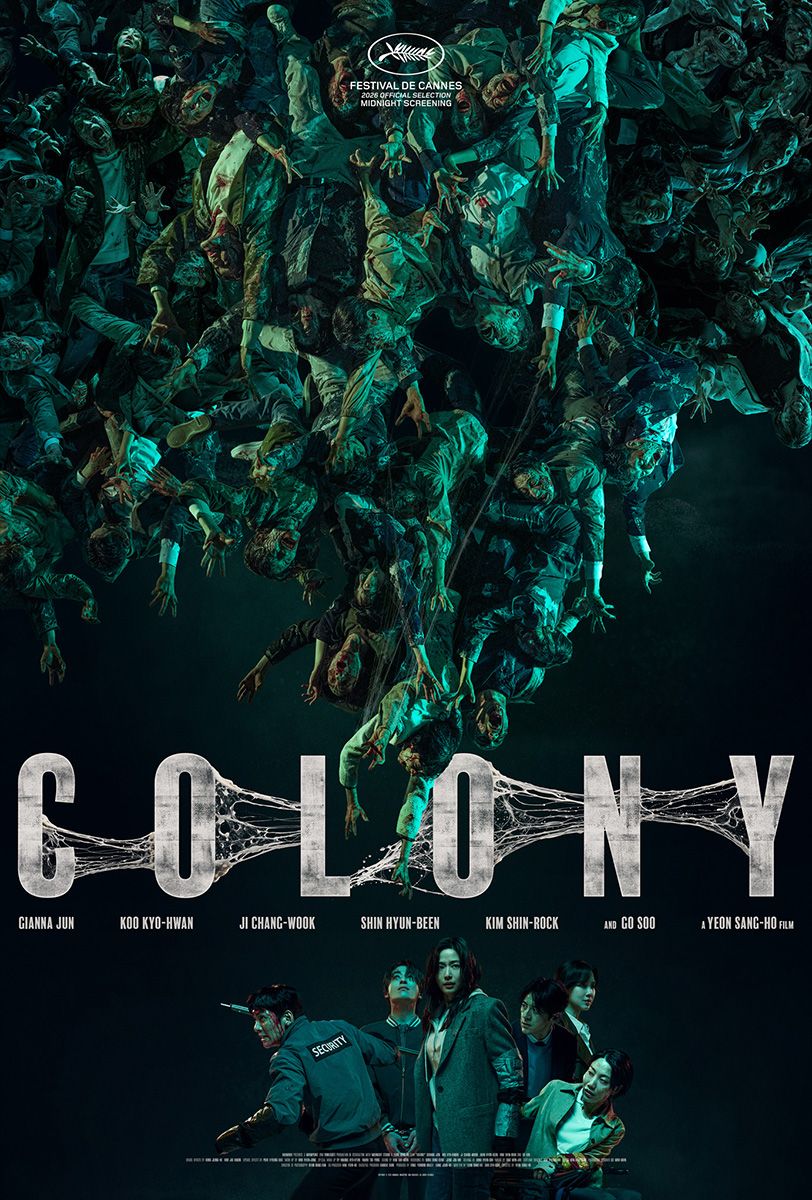
“Can you handle the freedom to be an outcast?” asks the villain of Yeon Sang-ho’s zombie-esque drama Colony (군체, Gunche) who believes that tragedies are caused by “imperfect communication.” He may not be entirely wrong, but his instinct to destroy all traces of individuality and replace them with a hive mind might not necessarily solve the problem in the way he implies it will, especially as it transpires that everyone will effectively be pulled into his own consciousness.
To that extent, the “zombies” in this film are representatives of social conformity, but perhaps they could also be read as an AI army with “psycho” scientist Suh (Koo Kyo-hwan) as the prompter. His big idea is bringing about a second cognitive revolution that emerges from a desire to repair the body so that those who have developed a disability would be healed. This is also, it turns out, a byproduct of being inducted into Suh’s hive where humanity must start from scratch evolving all over again. But at the same time, it seems like members of the hive still need to actively share information rather than simply having access to it. Suh gives them commands by shaking his head, while the zombies often stop dead and stare at the ceiling with their mouths open as if they were uploading something to the cloud. At one point, they’re seen accessing a computer to get the location of a room where one of their targets is hiding which demonstrates how far they’ve evolved in their ability to use tools, but at the same time they already have members of the security team in their hive. One would assume that they would already be familiar with the building’s layout and so the closest zombies could just start making their way there. This communication is still “imperfect” and Suh may choose not to share what he knows with the others anyway.
Professor Se-Jeong (Jun Ji-hyun), however, has never been one to go along with the group. Her exasperated ex-husband (Go Soo) complains that she’s always doing things that make people hate her, but still cared enough for Se-jeong to try to set her up with another steady job before he moves to America with his current wife and child. Which is all to say, she is very much prepared to be an outcast in a society in which challenging the system or disrupting group harmony are often taboos. She’s disadvantaged in her career because she turned another professor in for exploiting his research staff and misappropriating funds, meaning that others don’t necessarily want to work with her. She will, however, stand up for what’s right even when others won’t.
The government, meanwhile, is portrayed as another kind of group think if one paralysed by indecision because, unlike Se-jeong, they aren’t prepared to be hated by the public for making a call they disagree with even if it’s the right thing to do. With the building sealed off, orders have been given not to harm any of the infected in case they can be saved when they retrieve the vaccine from Suh, but it quickly becomes clear that the victims are most likely braindead and cannot be healed. Nevertheless, the policeman who takes Suh into custody eventually begins shooting his own team members, sacrificing them to protect Suh, while rescue teams deliberately leave other survivors behind. “It’s a shame,” one of the officers in control laments after seeing Se-jeong dart into a storage cupboard when the rescuers retreat with Suh, making it clear they have no intention of going back for her even though she’s been helping them retrieve the vaccine.
Her best ally turns out to be another female scientist, her ex’s wife Gong (Shin Hyun-been). Though you might expect the two women to loathe each other, they in fact get along quite well and have some affection for each other that makes Gong increasingly unwilling to toe the government line and leave Se-jeong to be devoured by the zombies. They are at least willing to stand up for the scientific argument and do what’s right, even if it’s not going to be popular and will make them outcasts for the rest of their lives. Someone has to be willing to make these difficult decisions from a position of rationality, the film seems to say. Nevertheless, it also argues for a slightly less prejudicial, more equal world in championing other kinds of outsiders such as a woman who uses a wheelchair and finds an ideal fit for her skillset in the zombie apocalypse and an old man who proves to be far more physically adept than an ageist society gave him credit for. “I guess we have a lot of work ahead of us,” Se-jeong admits acknowledging that it will not end just with the quelling of this particular zombie horde.
Trailer (English subtitles)