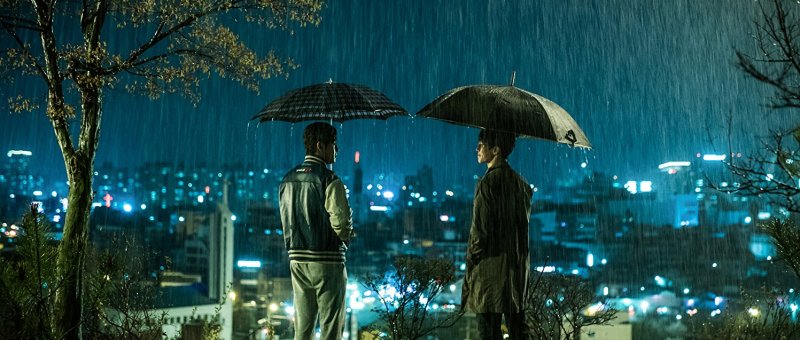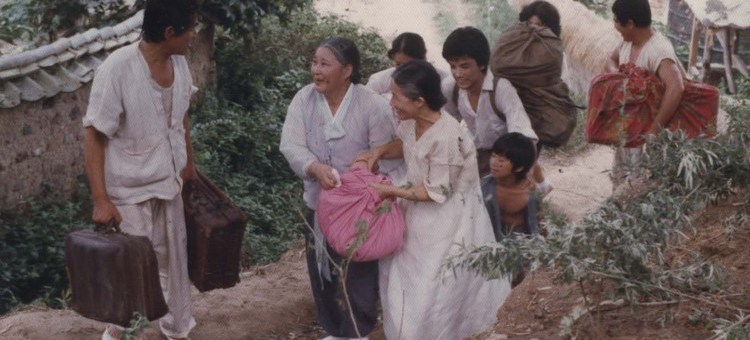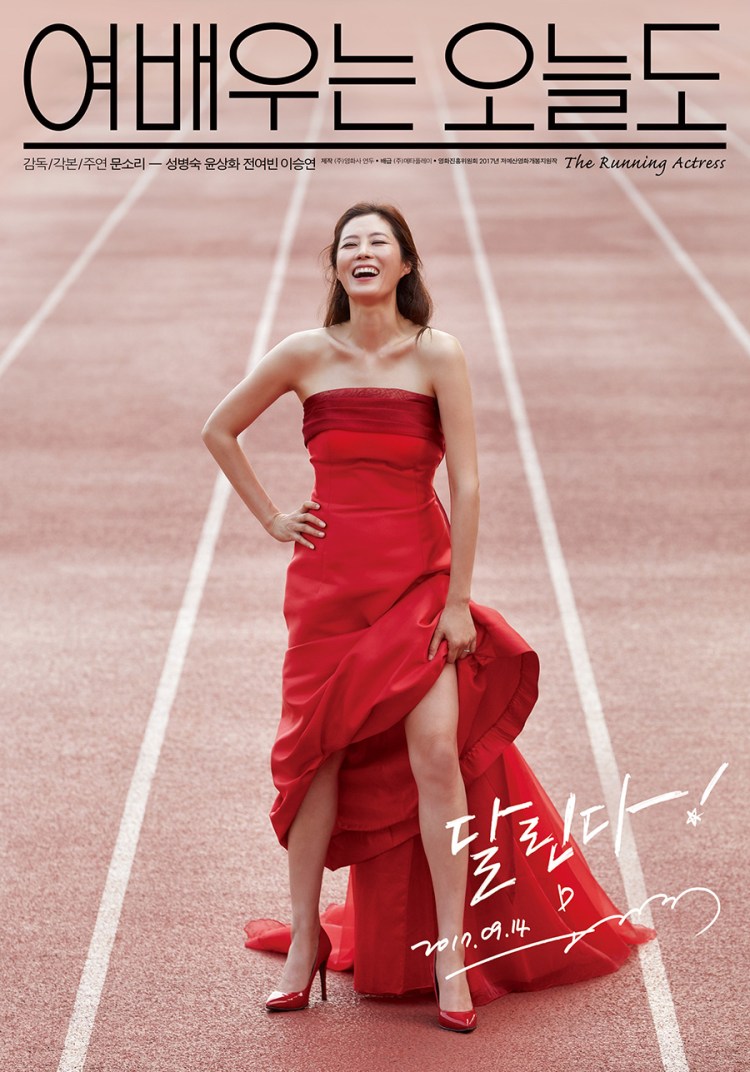
The Running Actress (여배우는 오늘도, Moon So-ri, 2017)

running actress posterIn international eyes at least, Moon So-ri is one of Korea’s most prominent actresses. She has worked with such highly esteemed directors as Lee Chang-dong, Hong Sang-soo, and Park Chan-wook, yet she continues to face the same kinds of issues as many women in the film industry despite her immense critical success and popularity at the box office. The Running Actress (여배우는 오늘도, Yeobaewooneun Oneuldo) is her first feature as a director and brings together three of her short films which neatly form a tryptic depicting the trials and tribulations of the contemporary actress.

Moon also stars in the films, playing a character called Moon So-ri, apparently inspired by her “real” life. Kicking off with the first segment titled The Actress, Moon introduces the fears and anxieties which recur throughout most notably in her preoccupation with gaining good roles and worrying that she is losing out on them though not being “pretty” enough. Her friends, attempting to be supportive, only add to her discomfort by assuring her that she is pretty “in her own way” and reminding her that in any case she is a wonderful actress. Confidence at rock bottom, Moon laments that her industry prefers airheaded beauty to technical skill and is unwilling to accept that women continue to exist past the age of 25 without suddenly morphing into spiky aunties and salty grandmas. Unexpectedly running into a producer whilst hiking, she gets a temporary boost when it seems he has her in mind for a dream project with a director she’s long wanted to work with but is dismayed when she realises the character has a college age child meaning she’ll be making a possibly irreversible step into playing suffering mothers rather than interesting women with nuanced character arcs.

Meanwhile, she runs into the producer and his friends at an inn on the way down and is forced to endure a drinking session with two starstruck fans whose increasingly drunken conversation turns to the rude and loutish in which they too begin picking apart Moon’s looks while mocking her acting skills, one of them even offering a slightly offensive caricature of her award winning performance as a disabled woman in Lee Chang-dong’s Oasis (the title of which he seems to have forgotten).

Moon’s fears and insecurities follow her into her family life in the second chapter, The Running Actress, which finds her attempting to juggle the demands of being a wife and mother with her acting career. In a running joke, everyone seems to assume that mega famous actress Moon So-ri must be filthy rich but like everyone else she has trouble making ends meet, especially as she is constantly worrying over where the next job is coming from. As if that wasn’t enough she also has to put up with her mother continuing to treat her like a petulant teenager (which to be fair her behaviour sometimes mimics) and trading photo opportunities for free dental work, while her adorable little daughter is sharp as a tack. 

The social and the professional come together in the final segment which sees Moon attend the funeral for a director she once worked with years ago and to tell the truth did not particularly like. Planning to show her face but not stay very long, Moon is dismayed to realise she is one of an extremely small number of mourners which include a drunken actor she doesn’t really get on with either, and an aspiring young actress who may have been involved in an improper relationship with the late director in the hope of furthering her career. In a lovely human touch, Moon breaks away from the rapidly declining situation at the wake to spend some time with the director’s young son who has been left all alone watching a few home videos his father shot by means of a handheld projector.

The film takes its title from a humorous moment in the second chapter in which Moon suddenly orders her driver to stop the car and jumps out to run away screaming, making a bid for frustrated freedom from her often exasperating life and career. Moon is obviously not afraid to poke fun at herself or her industry, taking her (presumably very real) fears and insecurities and exposing them for all to see. Taking a cue from Hong Sang-soo, Moon’s deadpan style only adds to the comic effect of her razor sharp dialogue which is filled with small moments of everyday humour somehow assuming wider dimensions thanks to the well crafted nature of the script. Addressing real problems faced by women today in all walks of life, The Running Actress is a warm and funny effort from the veteran performer turned first time director and will hopefully pave the way for an interesting second career.


Screened at the 20th Udine Far East Film Festival.

Original trailer (Korean subtitles only)

Last Child (살아남은 아이, Shin Dong-seok, 2017)

Last Child posterPeople grieve in different ways. Some stop altogether, lost in a fog of confusion and regret, while others try to keep themselves busy or at least feel as if they are doing “something” to try and find whatever positivity they can in the midst of such terrible tragedy. The parents at the centre of Shin Dong-seok’s extraordinarily accomplished debut feature Last Child (살아남은 아이, Salanameun Ayi) find themselves on opposite sides of a grief divide after their son is killed trying to save another boy from drowning. While the mother is angry and resentful, the father finds strength in pride for his son’s act of heroism, nominating him for a local heroes award and donating the compensation money they have been awarded to their son’s school to fund a new scholarship place in his name.

Eunchan, the teenage son of Misook (Kim Yeo-jin) and Sungcheol (Choi Moo-seong), passed away some months ago leaving his parents numb and grief stricken. As far as they’re aware, Eunchan lost his life while valiantly trying to save that of another boy – Kihyun (Seong Yu-bin). Asking after the boy whom his son sacrificed his life to save, Sungcheol is dismayed to learn that he’s dropped out of school, possibly as a consequence of bullying and social stigma because of the well publicised incident he has been involved in.

Spotting Kihyun around town riding his delivery scooter, Sungcheol later decides to intervene when he catches sight of some other boys harassing him. Sungcheol buys the boy dinner and tells him to call if he ever needs anything. Kihyun, despite his obvious discomfort calls when the manager of the fast food restaurant he had been delivering for accuses him of lying about his bike being stolen. As Kihyun is a minor, he needs a responsible adult to talk to the police but his mother abandoned him years ago and though his father used to send money for his upkeep, he has now remarried and severed all connection with his son. Feeling sorry for the boy and not wanting Eunchan’s sacrifice to go to “waste”, Sungcheol offers Kihyun a job in his interior construction company as a trainee apprentice.

Though originally shy and afraid, Kihyun begins to blossom under the gentle, positive parental input of Sungcheol as he picks up the paternal reins, not only teaching him a trade but investing in him the confidence to succeed. Misook, horrified at first by her husband’s decision, begins to come around to this wounded young man who perhaps reminds her a little of her own son. Despite his lingering feelings of shame and guilt in accepting such kindness from the people he feels may continue to suffer solely because of his continued existence, Kihyun slowly starts to look on Misook and Sungcheol  as surrogate parents as they provide the love and care he has never really known from Sungcheol’s down to earth fatherly pep talks to Misook’s home cooked dinners.

Kihyun does, however, have a secret he has been withholding from Misook and Sungcheol which becomes increasingly difficult for him to keep the nicer they are to him and the more he comes to respect them. Though he might have been able to push it to the back of his mind, an unexpected meeting with another friend of Eunchan’s who was also there that fateful day convinces him he has to speak the truth no matter how much more pain it may to cause to all concerned (including himself).

Sungcheol had invested heavily in the heroic nature of his son’s death and finding out it might not have been quite so straightforwardly noble as originally described is a crushing blow for him. The reopening of a wound which had begun to scar pushes Misook and Sungcheol back into their respective corners as they each attempt to process the situation in their own particular way, beginning to mildly resent each other in the process. Meanwhile, having considered the matter closed, there is little appetite to reopen the investigation into Eunchan’s death. The other parents club together to keep their kids out of it while the school sends a polite message asking Misook and Sungcheol to leave it alone to avoid damaging the school’s reputation. Sungcheol, filled with a righteous anger and a need to find out what really happened to his son, is advised to drop the matter, that it’s better to be remembered as a “hero” rather than a “victim”, implying that Sungcheol ’s quest for “truth” is in someway sullying his son’s memory.

Kihyun, meanwhile, is a mess of conflicted emotions. Grieving himself for the family he’d begun to form with Misook and Sungcheol , he tries to move on with his life whilst hoping to somehow repair what has been broken. Kihyun is not a bad kid at heart, whether changed by his experiences or simply freed from a destructive environment, but he has done bad things which fill him with guilt and remorse compounded by the faith and kindness Misook and Sungcheol have tried to show him.

Yet good as they are, the intensity of their rage and pain threatens to consume the bereaved parents who begin to turn their thoughts towards poetic justice and exacting their own revenge even if they also know it will only bring them more suffering. Isolated by their grief, ostracised for the need for truth, and torn apart by their ambivalent emotions towards each other, the trio walk headlong into a spiralling abyss of nihilistic violence and despair, rejecting the idea of a future in which the concept of family continues to exist. Shin’s drama is bleak in the extreme but strangely hopeful in its clear hearted determination to believe in human goodness which just might be the only way back from the brink.


Screened at the 20th Udine Far East Film Festival.

Original trailer (English subtitles)

Interview with director Shin Dong-seok from the 2017 Busan International Film Festival. (scenes from the film not subtitled, interview subtitled in English)

Be with You (지금 만나러 갑니다, Lee Jang-hoon, 2018)

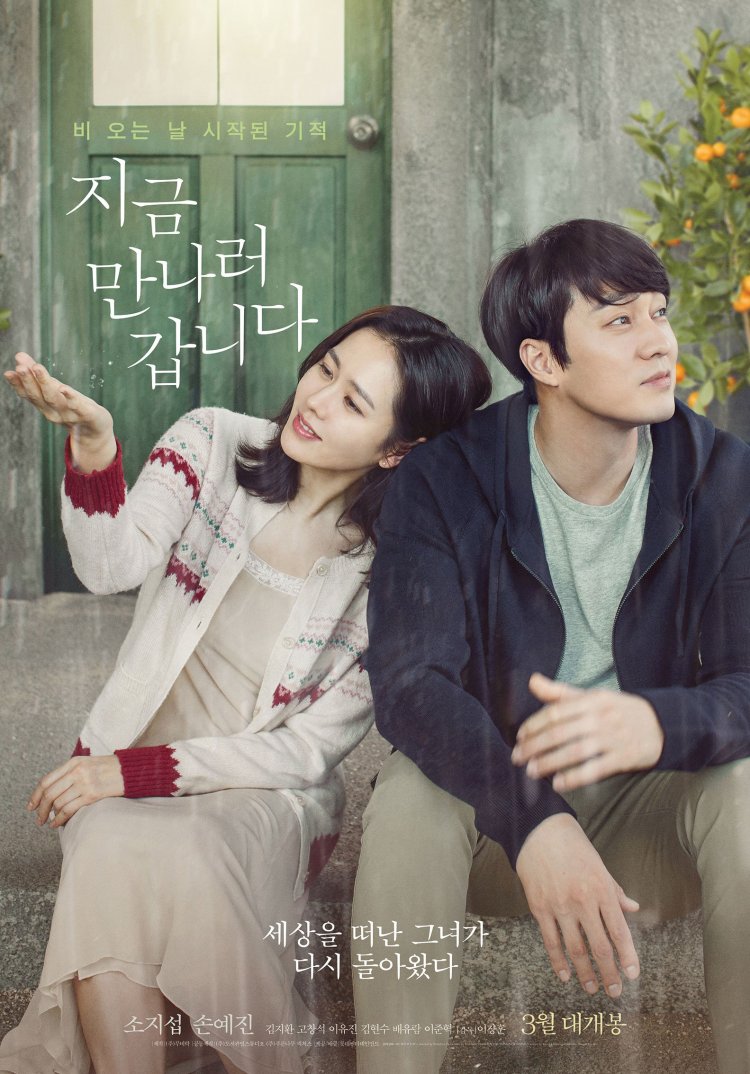
be with you Korean posterWhen Nobuhiro Doi’s Be With You was released in 2004, it followed the even more popular Crying Out Love in the Centre of the World as the second in a wave of “jun-ai” or “pure love” romantic dramas in which the heroes and heroines struggle to move past romantic tragedy. Where Be With You differed from the genre norm was on its focus on a love that was already successful – the couple were older, had married, and even had a son before their happiness was taken from them by a cruel illness. Lee Jang-hoon, adapting the source novel by Takuji Ichikawa, shifts the setting to Korea but more or less follows Doi’s blueprint with a number of notable exceptions.

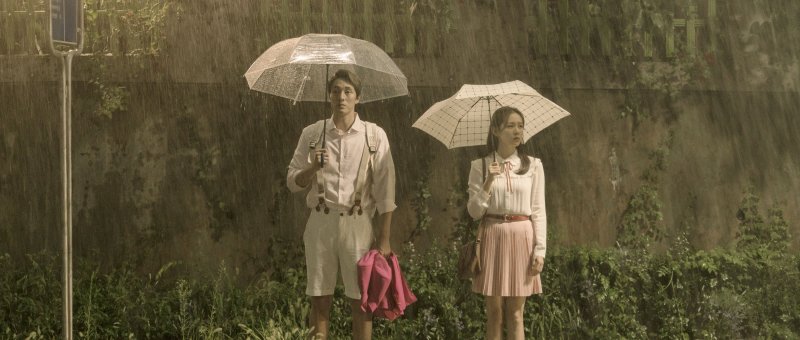
Rather than the framing sequence which kicks off the original, Lee opens with the beautifully illustrated picture book Soo-a (Son Ye-jin) made for her son shortly before she passed away. In the book a cute mummy penguin lives up above in Cloudland watching her baby through a crack in the clouds. When the rainy season arrives, the mummy penguin will be able to catch the Raindrop Train to come back to Earth, but before the summer ends she’ll have to return else she’ll lose her place among the clouds and won’t be able to watch over her son even from afar.

Little Ji-ho (Kim Ji-hwan) has taken the book to heart and really believes his mother will come back when the first rains fall. His father, Woo-jin (So Ji-sub), knows better but hasn’t the heart to tell his son that the book is just a story and that he will never see his mother again. Against the odds, Ji-ho and Woo-jin do indeed find a woman who looks exactly like Soo-a collapsed in an abandoned railway tunnel in the forest but she has no memory of her life as a wife and mother or of the family who’ve been patiently waiting for her return.

In contrast to her counterpart in Doi’s original, Son Ye-jin’s Soo-a is a much less passive presence, less inclined to simply go along with her new circumstances and keen to remind us that the decision to “work or lurk” is entirely her own. Likewise, Lee scales back on Woo-jin’s disability, rendering it far less visible than it had been in Doi’s adaptation. Bar some barbed comments from insensitive relatives at Soo-a’s funeral who question Woo-jin’s ability to raise his son alone, Woo-jin suffers little by the way of stigma regarding his medical condition though he does worry he might have embarrassed his son by pushing himself too hard at a school sports day and making himself ill in the process. Rather than the typical “jun-ai” selfish selflessness which caused the hero to breakup with his one true love out of a noble desire not to be a burden, Woo-jin’s decision is perhaps more out of pride and insecurity than it is out of misplaced consideration.

Nevertheless the timeless innocence of the couple’s early courtship (such as it was) retains its essential sweetness. As Soo-a can’t remember her romantic past, Woo-jin recounts his recollection of it to her in all its painful honesty, and in return later gets to hear her side of events thanks to the diary she left behind for him to read. Having met in high school, the pair entertained crushes on each other they assumed were unrequited, never quite working up the courage to declare themselves and squandering opportunities through nerves and awkwardness. Reliving their original romance the couple fall in love all over again only to be parted by a season’s end.

Yet it is familial love rather than the romantic which eventually takes centre stage as the love of Soo-a and Woo-jin envelops their son in something deeper and richer than your average tragic love story and becomes all the more poignant for it. Realising her time is short, Soo-a sets about teaching her husband and son how to live without her – showing Ji-ho how cook eggs, how to do the washing, how to keep the place tidy etc while giving them a few more happy memories to see them through and reminding them to take care of each other in her absence. Dreamlike and ethereal as Lee effortlessly blends one time period into another in a vast web of memory, Be With You is a heartbreaking drama in which a family must attempt to come to terms with irreparable loss through learning to treasure past happiness and living on in its memory.


Screened at the 20th Udine Far East Film Festival.

Also screened as the first in a series of teaser screenings for the upcoming London Korean Film Festival. The next screening in the series will be Memoir of a Murderer on 21st May, Regent Street Cinema.

International trailer (English subtitles)

1987: When the Day Comes (1987, Jang Joon-hwan, 2017)

fullsizephoto931939The political history of Korea is long and complex and oftentimes sad. The events depicted in 1987: When the Day Comes (1987), pivotal as they were, occurred just 30 years ago. Yet the recent past has also been one marked by protest, public anger, and political scandal though this time around with far less fear or danger. The protests of 1987 were a different story. The rule of Chun Doo-hwan, a military dictator who had seized power following the assassination of the previous dictator, Park Chung-hee, was one of extreme oppression which had already seen a widespread massacre of peaceful protestors by the state in Gwangju in 1980. Chun’s term, under the constitution, was set at seven years after which many hoped for a path to modern democracy but those hopes were dashed when he announced an intention to appoint his successor rather than call a free and fair election.

In depicting the climactic events of that summer, Jang Joon-hwan begins with chaos as a doctor is summoned to a mysterious room where a young man lies unconscious in a pool of water. The police have gone too far, and boy has died during interrogation. Aware of the potential danger of the public finding out that the state has in effect murdered a suspect in an act of torture, the head of the ACIB, Park (Kim Yun-seok), orders the body to be quickly cremated. This, however, needs a certificate signed by a prosecutor and Prosecutor Choi (Ha Jung-woo) is fed up with the ACIB and unwilling to cooperate especially as he smells a rat with the cause of death for a healthy 22-year-old listed as a “heart attack”. Not wanting to be on the wrong side of it if it does get out, Choi refuses the cremation and orders an autopsy which in itself triggers a series of other events eventually bringing the government to its knees.

The state remains cruel and duplicitous. The death of Park Jong-chul (Yeo Jin-goo) would become a catalyst and a rallying call, not just for the injustice of it but for the injustice of covering it up. Park’s family are denied their basic rights, his mother and sister literally dragged away from the morgue screaming while his traumatised father looks on in silent agony. They say that Park was a communist, that he died of fear because he weak while claiming all along to have done no wrong. Only when the “truth” begins to emerge does the ACIB decide to hang a few of its guys out to dry, urging them to “patriotically” take one for the team and head to prison for a while with a hefty compensation package to help sweeten the deal.

The death in custody becomes just one event in a situation spiralling out of control. Paranoid in the extreme, the Chun regime is also working on bringing down a “North Korean Spy Network” controlled by a democracy activist on the run who, unbeknownst to them, is also working with the Catholic Church who will eventually prove pivotal in delivering the truth to the people. Meanwhile, the press has also decided to jump ship, ignoring the government’s carefully crafted guidelines in favour of running actual news. Chun’s iron grip is slipping.

Jang’s biggest takeaway is that corrupt regimes crumble when enough people find the strength to go on saying no. It begins with Choi refusing to stamp a certificate then travels to the reporter who won’t back down, passes on to the secret revolutionaries bravely carrying messages at great personal costs, the not so secret clergy who perhaps have more protection to speak their minds (up to a point) than most, and of course the students in the streets who risked their lives to build a better future. One of the few completely fictional characters, the niece (Kim Tae-ri) of a prison guard (Yu Hae-jin) charged with conveying messages to an activist in hiding, proves the most illuminating in her inward struggle towards the democratisation movement. Afraid of the consequences and preferring to remain politically apathetic, she is eventually radicalised through witnessing the brutality of the regime first hand and suffering personal loss because of it.

Playing out as a taut thriller, 1987: When the Day Comes has a lived in authenticity from the motif of being constantly deprived of one shoe by a cruel and absurd regime to the deadly serious ridiculousness of men like Park who hate “the enemy” enough to destroy the thing they claim to love in pursuit of it. Timely and filled with melancholy nostalgia, Jang’s depiction of the pivotal events of 30 years ago is also a rallying cry in itself and an important reminder that the fight for justice is never truly won.


Screened at the 20th Udine Far East Film Festival.

International trailer (English subtitles)

Steel Rain (강철비, Yang Woo-suk, 2017)

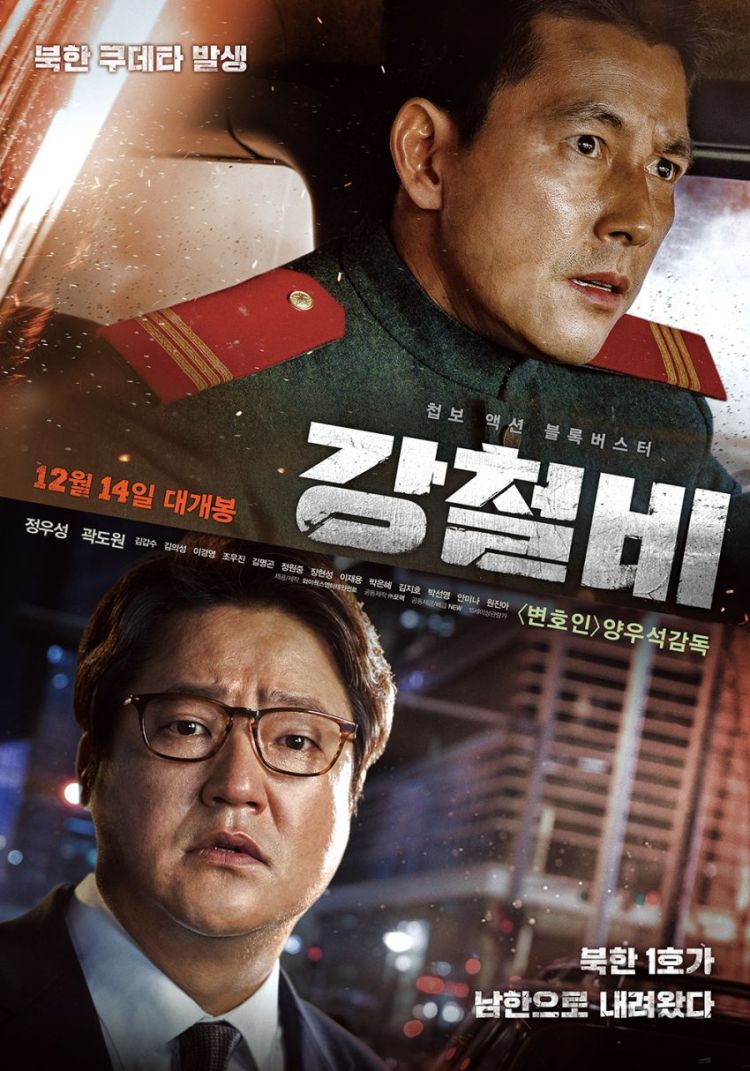
Steel Rain posterA little way in to Steel Rain (강철비, Gangchulbi), one of its heroes – a Blue House official, gives a pointed lecture on Korea’s past to some students of Geopolitical History. Fiercely critical of Korea’s previous subjugation by Japan, he laments that his nation was not able to free itself from the Japanese yoke and was awarded its freedom with the end of a wider political conflict which saw the Japanese “empire” collapse. According to Kwak Cheol-u, Korea has never quite lost its cultural admiration for its former colonisers which is why its most prominent corporations – Samsung, Haeundae etc, are all direct competitors with similar Japanese firms (and are only now pushing past them in terms of global market penetration and technological innovation).

Switching tack, he wonders why it is that Japan lost a war and Korea got cut in two by two new “colonising” forces. In his oft observed mantra, Kwak (Kwak Do-won) insists that the citizens of a divided nation suffer more from those who seek to manipulate the division for their own ends than they do from the division itself, which is where we find ourselves in the contemporary era of my button’s bigger than his button in which “capitalist pig dogs” face off against “dirty commies”. Adapting his own webcomic, Yang’s action thriller is among the most recent in a long line of North/South buddy movies and even if its cold-war paranoia feels distinctly old hat, it just goes to prove that everything old is new again.

Eom Cheol-u (Jung Woo-sung), a former North Korean special forces agent, is called back into the fold by his old commander for a very special mission. Tensions are about to boil over in the perpetually precarious state and the Dear Leader’s life is under threat from a suspected coup. Eom is to silence one of the conspirators in return for which he will be given elite status and his family will be well looked after. Unfortunately, the mission does not go to plan and Eom ends up witnessing a missile strike on a welcome meeting at a Chinese managed factory in which the (mostly young and female) employees are murdered in cold blood. Managing to escape with the Dear Leader himself who is seriously wounded, Eom travels over the border along with two young girls. From this point on he’s in conspiracy thriller territory trying to work out just what’s going on and who he can really trust.

The symbolism is rammed home by the fact that our two heroes, Kwak and Eom, have the same first name – Cheol-u, only one uses the characters for “strong friendship” and the other “bright world”. Taken together they paint a pretty picture, brothers in arms despite the political difficulties which place them on differing sides of an arbitrary line drawn up by a foreign power without much consideration for those divided by it. As in many North/South buddy movies of recent times, the North Korean agent displays the best qualities of his nation in his essential “goodness” – a caring husband and father, he executes his mission with maximum efficiency but bears no ill will towards those outside of it and is keen to protect the people of North Korea from almost certain doom should a nuclear war break out between the two peoples. Kwak, by contrast, is more of a schemer whose moral universe is much less black and white. A fluent Mandarin speaker he’s in tight with a North Korean official who keeps trying to talk him into taking a research post at a Chinese university while his family life is somewhat complicated thanks to a divorce from his plastic surgeon wife.

Meanwhile, the film is at pains to point out that Korea became the focus point of the first East/West proxy war and, in Kwak’s view at least, remains insufficiently important in the eyes of its “allies” to merit much direct consideration. Thus our boardroom squabbles are often reduced to the looming face of the American President “advising” the Korean officials on the best course of action while others worry about what Japan is going to think and wonder if the US secretly values the opinion of the Japanese more than the Koreans on the ground. The situation is further complicated by the fact that the government is in a transitionary phase in which a new president has been elected but not sworn in. The crisis may well play out entirely within the old president’s final hours which means that diplomatically he has little to lose and as he is a conservative, might as well milk the situation for all it’s worth. In short, he’s as keen to ruffle diplomatic feathers and bring the situation to a head as everyone else is and war looks more likely than not. The central message is that, as Kwak is fond of implying, governments care little for their people or that millions may die when idea of division is so easily manipulated, especially if it’s not “their” people who will be doing the dying.

Not for nothing is the new president seen reading copy of Willy Brandt’s book on successful reunification, even if he begs his outgoing predecessor to consider the economic impact of any possible change in relations with a Northern neighbour. The North Korean official also warns that China is not keen on the idea of a war seeing as that will necessarily mean an influx of North Korean refugees no one wants to take responsibility for. The cold war may be about to turn hot, but the heroics that cool it down turn out to be of a much less gung-ho nature than might be expected, relying on personal sacrifice and a perhaps outdated code of honour. Nevertheless, the crisis is averted not through macho posturing but through “diplomatic channels” and a careful balancing of powers. Perhaps not so farfetched after all.


Streaming worldwide via Netflix.

Steel Rain will also receive its international festival premiere as the opening night gala of the Udine Far East Film Festival on 20th April.

Far East Film Festival trailer (no subtitles)

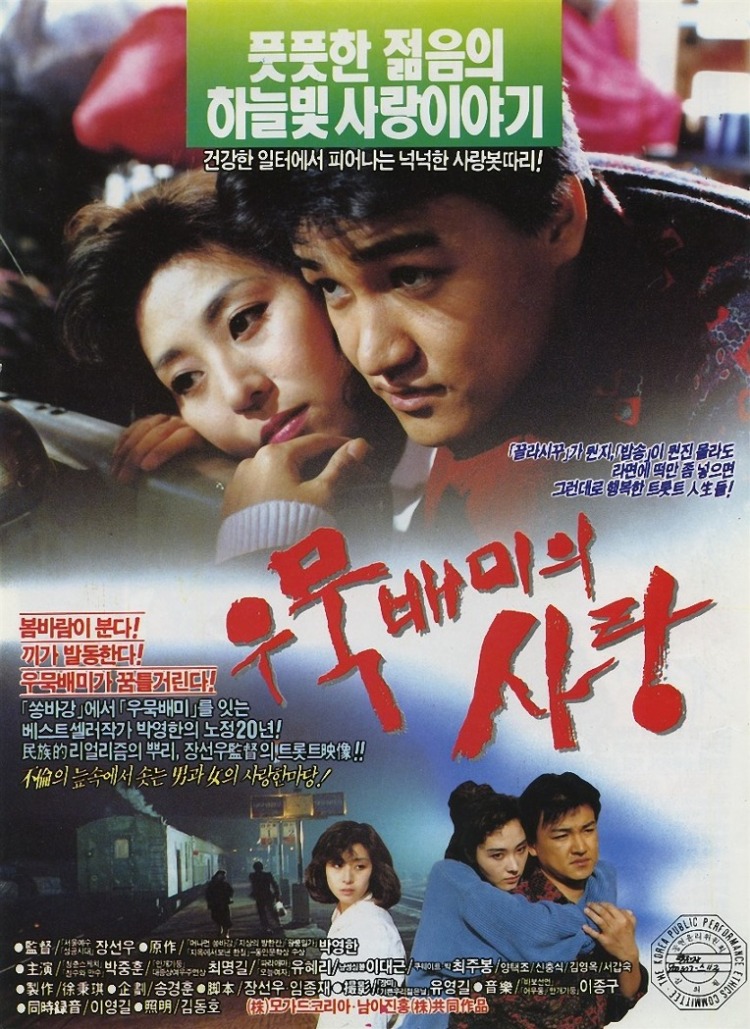
Lovers of Woomuk-Baemi (우묵배미의 사랑, Jang Sun-woo, 1990)

The Lovers of Woomook-baemi posterJang Sun-woo, a former political activist and underground filmmaker, is best remembered for formal experimentation and pointed social commentary, but his third feature The Lovers of Woomook-Baemi (우묵배미의 사랑, Umukbaemi Eui Sarang), stands out in his filmography in its fiercely naturalistic portrayal of working class life on the margins of a society in flux. Based on a novel by Park Yeong-han, The Lovers of Woomook-baemi, is a classic melodrama with infidelity at its core but it’s also a story of futility, the destructive effects of patriarchal social codes and toxic masculinity, and the frustrated promises of a new era for those excluded from its various benefits.

Jang begins his tale in the middle as Bae Il-do (Park Joong-hoon), a frustrated husband, returns home late to a troubled “wife” (Yoo Hye-ri) who promptly kicks him out again. Complaining furiously, Il-do dreams of another woman, Gong-ryae (Choi Myung-gil), with whom he had a brief affair, idly thinking that he might have been happy if he hadn’t got his current partner pregnant and got himself stuck with her for life even if they aren’t technically “married” in the legal sense.

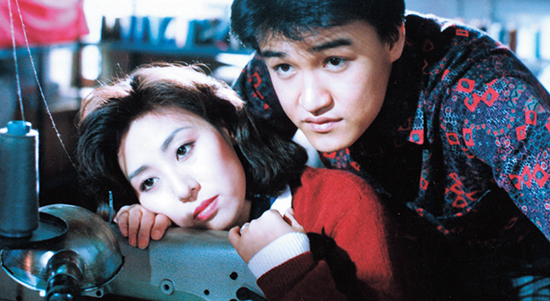
Moving backwards, we see Il-do, having failed in Seoul, returning to his home village with his common-law wife Sae-daek and infant child after an offer of work in a small seamstressing firm. The only man among a room full of mostly elderly women, Il-do is something of a novelty but is also taken by the woman on the machine next to him, Gong-ryae, who he later learns is also unhappily married and intensely lonely in her small-town existence. After some initial indecision, the pair embark on an affair, (still illegal at the time of the film’s release) but their prospects for future happiness seem slim given the restrictive quality of their lives.

The world that Jang depicts, for all its naturalistic flair, is intensely misogynistic. Il-do’s early recollections of Gong-ryae revolve around her bad marriage to an impotent man (Lee Dae-Geun) who mercilessly beats her. Indeed, we later see Gong-ryae turning up for work after suspicion has arisen about her relationship with Il-do with a black eye and bruises on her face while the other women giggle over the obviously awkward gossip. Domestic violence is, however, just a part of life in the village and the older women in particular view it as a sign of a healthy marriage. One woman even exclaims that she wishes she had a man to beat her, but thinks she’s unlikely to find anyone given her age and the fact that she already has numerous children.

Il-do, by contrast, proves somewhat popular among the ladies at the shop because of his relative lack of machismo. Like Gong-ryae, Il-do is also a victim of domestic violence. His wife beats, slaps, and attacks him verbally, later even dragging him home by the testicles along a very public walk of shame. He is not above violence or aggression, but as in much of Jang’s work, male violence is a sign of weakness rather than strength and each of Il-do’s violent episodes is more to do with defeat and repressed emotion than it is about strength or conquest. This also seems to be true for Gong-ryae’s husband whose violence and jealously is perhaps a reaction to his impotence, but when we later meet him we find a man much like Il-do. Chastened, Gong-ryae’s husband politely asks the man who bedded his wife if he knows where she is and if he sees her to please tell Gong-ryae that he’s sorry and wants her to come home.

As he does with Gong-ryae’s husband, Jang plays with our sympathies and allegiances, switching perspective to reveal to us that villains and victims are often one and the same. Sae-daek originally seems like our villain, a shrewish, henpecking “wife” who won’t let our hero go despite the evident toxicity of the pair’s non-marriage, but seen from her point of view we understand her plight. After running away from a violent home environment she winds up a bar hostess in the city where she builds up a spiky relationship with Il-do which goes south when he gets her pregnant. Despite this being the age of illegal adultery, it’s not so much a marriage certificate that binds a man and a woman together for good or ill but a child. As a neighbour puts it, a woman might leave her husband, but what sort of woman leaves a child? Sae-deok cannot care for her child alone and she cannot abandon it with Il-do and so she must keep him no matter how much personal suffering she must endure as the common law wife of a no good philandering ne’er do well.

Il-do likes to drift off into philosophical reveries in which he idly remarks on the futility of his existence, but in a very real sense he’s not wrong. He tried life in the city but it didn’t want him and he came home. Sae-deok, oddly enough, likes it in the village with its sense of community especially among the other put upon and oppressed women who attempt to support each other (whilst accidentally supporting the mechanisms which continue to oppress them), but there’s no pretending there’s anything more to life in Woomuk-Baemi than work and drink. Il-do knows this, as does Gong-ryae, and it’s their mutual sense of existential ennui which finally forces them together in an impossible attempt to rebel against the futility of their existence through transgressive sex and an attempt at emotional connection.

In the end, Il-do is dragged (by the short and curlies) back into the past, literally, as Sae-deok takes him back to his mother’s house to complain about the terrible way she’s been treated. Creating a scene outside, Sae-deok eventually manages to get through to her mother-in-law who had previously rejected her because of her lowly peasant background and history of sex work, enabling the two women to bond in their shared disappointment with Il-do who has now failed as a “man” on every possible level. Briefly reuniting with Gong-ryae in the greenhouse in which they used to meet, now reduced to ruins, Il-do declares that his love is like a mummy, wrapped so well it will endure for thousands of years without decay, but it’s already too late. Choices have been made, implicitly, which cannot be reversed. Jang leaves his protagonist where he started, frustrated and inert, suffering without hope in an oppressive environment which he knows, in his heart, he does not possess the courage to resist.


Available on region free blu-ray courtesy of the Korean Film Archive which also includes an audio commentary in English from film scholars Darcy Paquet and Marc Raymond, and Tony Rayns’ documentary The Jang Sun-woo Variations, as well as a 36 page bilingual booklet featuring essays by Rayns and film critic Lee Yeon-ho. Also available to stream via the Korean Film Archive’s YouTube Channel.

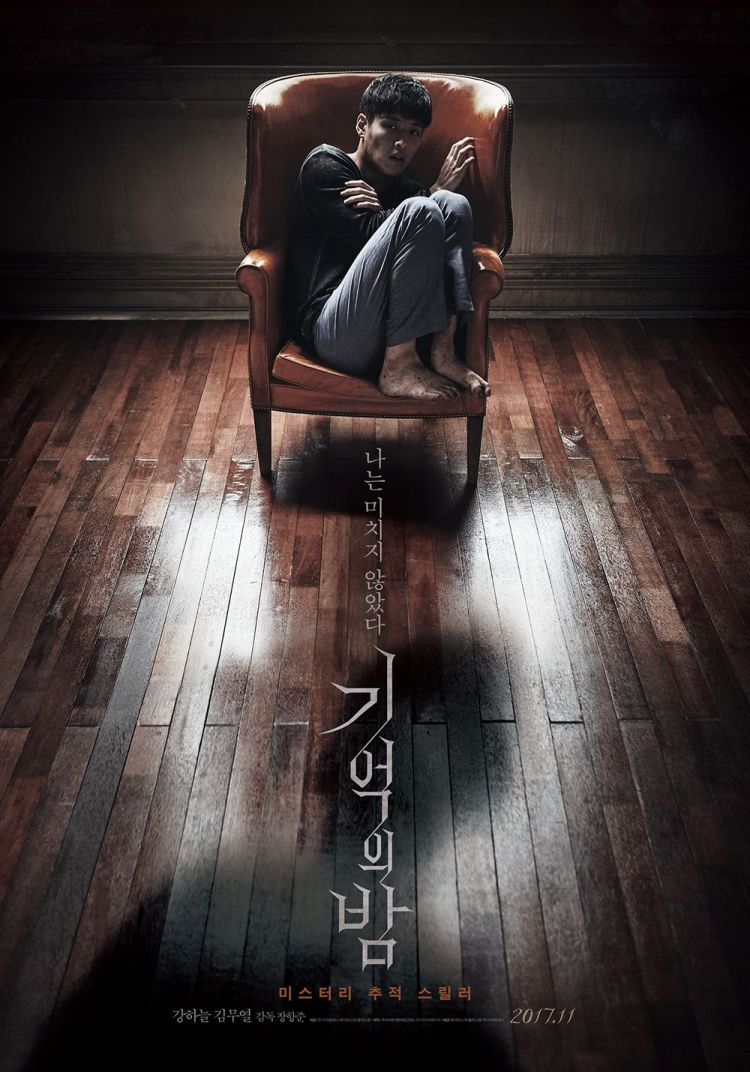
Forgotten (기억의 밤, Jang Hang-jun, 2017)

forgotten posterEver wondered if you’re living in a simulacrum? Strangely, the thought isn’t one which occurs to the hero of Jang Hang-jun’s Forgotten (기억의 밤, Gieokui Bam) despite his sense of déjà vu and the uncanny eeriness of his world. Then again, perhaps that’s because he is wilfully complicit in his own life lie, afraid to open the door and confront the ghosts trapped inside his psyche seemingly desperate get out. A tense psychological thriller, Forgotten is also a symbolist drama in which Jin-seok, a man literally trapped in the past, is forced to free himself from a locked room mystery only to discover his own dark truths.

Following some distressed sounds from someone who claims not to be able to remember whatever it is they’re being interrogated about, we find a young man, Jin-seok (Kang Ha-neul), peacefully asleep on his mother’s shoulder as his family drive to their new home. Jin-seok is an anxious young man under a lot of stress studying to retake university exams while his brother, Yoo-seok (Kim Mu-yeol), is the archetypal good Korean son. He is handsome (if a little geeky looking), clever, good at sports, patient and kind. In short Yoo-seok is everyone’s hero, not least his little brother’s, while Jin-seok is a nervous wreck who rarely leaves the house and makes sure to have his discman with him when he does to block out the noise and fury of city life. According to the prominently displayed calendar, it is May 1997.

Things start to go awry when Jin-seok finds out that the house’s previous owner has left some property in the upstairs room which he will collect at a later date. The family aren’t supposed to go in there ’til he does and so the brothers will be sharing a room. Jin-seok is however fascinated by the locked door and the strange noises he thinks he can hear coming from upstairs. Things go from bad to worse when Jin-seok witnesses Yoo-seok being kidnapped in the street only to return 19 days later with no memory of where he’s been. Little by little, Jin-seok comes to doubt that the man who has returned is really his brother, but if he isn’t, then who is he and why is any of this happening?

Like all good gothic mysteries, the first problem is Jin-seok’s supposedly fragile mental state. His family repeatedly check he’s taking his medication and take care to ensure his life is as stress free as possible, apparently afraid that he will relapse into some kind of breakdown the cause of which may be partly the reason that the family has moved to a quieter area. Thus neither he nor we can be sure if everything he experiences is real, a product of his strained mind, or a problem with his medication.

Wedded to this story is the coded past of Korea in 1997 struck by the Asian economic crisis which, the film seems to say, provoked a kind of paranoid madness generalised across society. In this difficult climate in which jobs were scarce and even those in professional occupations faced a significant drop in living standards, extreme solutions began to seem attractive. A young woman and her daughter are murdered and the killer never caught, a little boy orphaned and abandoned by his relatives who keep his family’s money for themselves, a young man resolves to commit a terrible transgression in the hope of saving a loved one, and all because of a tragic accident and some random numbers on a screen. 

Jang Hang-jun turns the relatively low budget to his advantage in creating a world of intense uncanniness, somehow realer than real but never quite right. Gradually peeling back the layers of Jin-seok’s existence to expose the wires below, Jang’s artistry becomes apparent as the world comes into focus albeit presenting a different kind of mystery. Anchored by the impressive performance of a deglammed Kang Ha-neul, Forgotten is as bleak a tragedy as they come. The truth may set one free, but not quite in the way the saying implies and there are some things with which is it impossible to live. The unseen legacy of a traumatic era sends its invisible shockwaves through the present and out into the future, and perhaps the only way to survive them is to avoid opening the door.


Streaming worldwide via Netflix.

Original trailer (no subtitles)

Rainy Days (장마, Yu Hyun-mok, 1979)

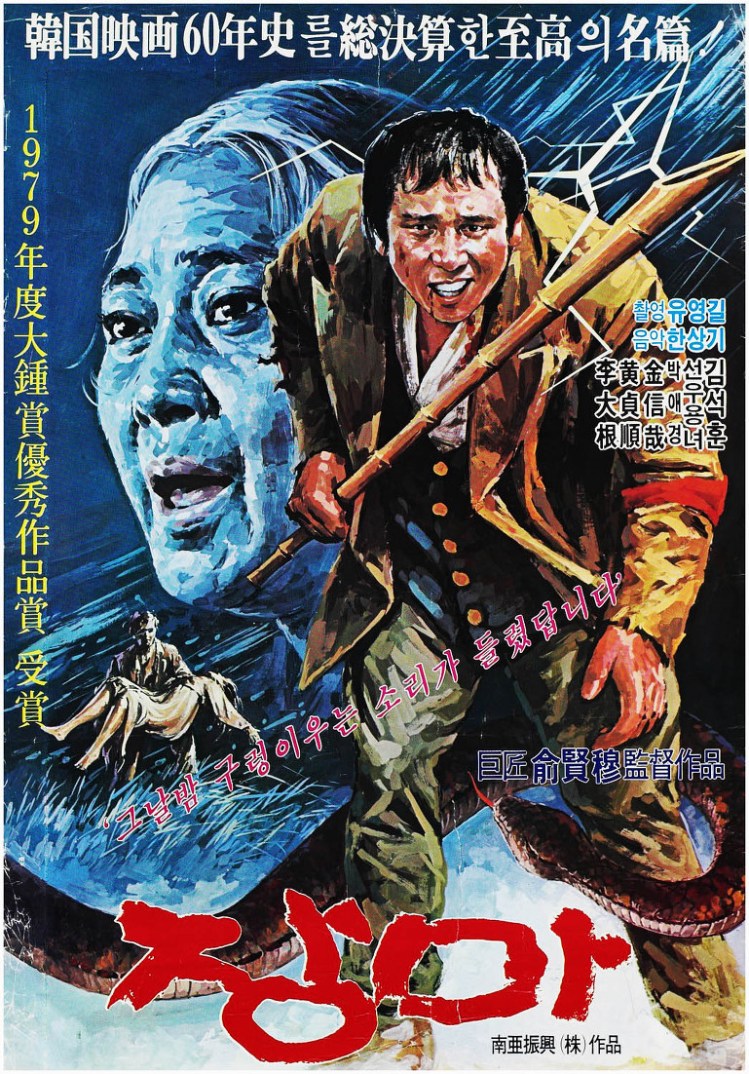
Rainy Season posterOften regarded as an “intellectual” filmmaker, Aimless Bullet’s Yu Hyun-mok returns to one of his central preoccupations in 1979’s Rainy Days (장마, Jangma). Released close to what would be an abrupt end to the oppressive and authoritarian rule of Park Chung-hee (which would be followed by another repressive military regime), Yu’s literary film falls into the anti-communist subgenre though Yu is careful to reframe his tale not as one of left versus right but of right versus wrong and of the dangerous gulf in-between. As it would in 1979, the political wind shifts without warning and then reverses itself leaving few untouched by the chaos and confusion of a government in flux. Rainy Days is a season of silence and tension, waiting for the sun but weathering a storm which may never end.

In the early 1950s, a family moves from Seoul to stay with relatives including Dongman (Choi Yong-weon) – the grandson of the older woman who is coming to live with her daughter’s family along with her university educated son Giljun (Kang Seuk-woo) and student daughter Gilja (Ju Hae-kyeong). Towards the end of the war, Maternal Grandmother (Hwang Jung-seun) has a prophetic and traumatic dream of trying to pull her own tooth which she interprets as a warning that Giljun, a serving soldier fighting for the South, has been killed in action. Sure enough, the next day a telegram arrives carrying the dreadful news back to the family. Maternal Grandmother tries to comfort herself as best she can, pretending to have grown used to the news thanks to her dream but in reality heartbroken and distraught by the loss of her only son.

Meanwhile, Dongman’s other uncle, the son of Paternal Grandmother (Kim Shin-jae), is off fighting for the North as a communist partisan hiding in the mountains. Suncheol (Lee Dae-geun) was once so kind hearted that as a boy he released the fish he caught in the local river, but when the communists took his village he was quickly seduced by their recently acquired power. While Giljun was forced to hide in a makeshift hollow covered by leaves in the woods, Suncheol was busy getting in with communists and though he claims to want to protect his family eventually informs on his brother-in-law only to find it blowing back on him when they doubt his commitment to the cause in not having turned the “Southern Sympathiser” in sooner. A simple man, Suncheol joins the communists and turns on Giljun as a reaction against his feelings of inferiority in the face of urban sophistication. Suncheol is cheerful and goodhearted, broadly liked by those around him, but he is also like a child who acts on impulse and takes things too far without considering the consequences of his actions just as he does when instigating a little “mob justice” against a villager who had tried to crack down on the trafficking of illegal moonshine much to the consternation of his neighbours.

The central conflict is dramatised by the sparky relationship between the two grandmas who have each passed into the age in which it becomes appropriate to voice one’s concerns openly without particularly caring how those views will be received. Paternal Grandmother, having opened her house to Maternal Grandmother and her children, feels herself to be in a position of superiority and is often wilfully unkind to her guests, offering a series of truly unforgivable words to the bereaved Maternal Grandmother who has, quite reasonably, cursed all the communists who are responsible for the death of her son. Seeing as Paternal Grandmother’s son Suncheol is a communist partisan she takes exception to this which provokes a fierce, accidentally political family row which may be eternally irreparable.

The North is, however, beaten back and the village retaken by the South. Suncheol is now a fugitive hiding in the mountains who has killed many men and fears he will not be forgiven even if he gives himself up to the authorities in the hope of rejoining his family. Proud Paternal Grandmother remains proud of her brave son, refusing to believe what they say about the partisans and secretly hoping for a resurgence of the North though like Maternal Grandmother before her she cannot say these words plainly for fear of getting into trouble with the authorities. When Suncheol makes a brief visit back to the family home, broken and desperate, to float the idea of turning himself in, it has grave consequences for little Dongman who is tricked into to informing on his uncle and earns the wrath of Paternal Grandmother in the process. Maternal Grandmother, however, has had more time to come to terms with her grief and is sympathetic to her grandson’s plight, knowing that he is just a child and did not understand the consequences of his actions.

Played by the wonderful Hwang Jung-seun, Maternal Grandmother becomes the heart of the drama. Having lost everything – her only son, her life in Seoul, her hopes for the future, she remains stoic, repeating the mantra that everything is fine because she knew all along how it would be. Following her painful outpouring of grief and war of words with Paternal Grandmother she comes to terms with her situation and tries to carry on as best she can with warmth in her heart. She even tries to forgive Paternal Grandmother and expresses sympathy for her as another mother losing a son in a stupid and senseless war. Paternal Grandmother cruelly pointed out that Maternal Grandmother would have no son to perform her funeral rites, but it is Maternal Grandmother who eventually performs the shamanistic ritual at the film’s conclusion in place of Paternal Grandmother, provoking a reconciliation of the two women and a banishment of the rancour which had existed between them.

Focussing tightly on the realistic emotions of the contemporary villagers who hold no particular political views but are caught in the middle of a war and simply trying to survive, Yu dramatises the tragedy of division not in a question of “good” Southerners, and bad “Communists”, but of bereaved grandmothers and broken families, ruined futures and fractured pasts. Yet once again he departs from the tragic ending of the novel for one which allows hope for the future. Little Dongman, put on house arrest by his irritated father, is finally allowed to go out to play with the other village children, rejoicing in the sunny skies and beautiful forrest scenery, returning to a childhood idyll now free of wartime confusion.


Available on DVD as part of the Korean Film Archive’s Yu Hyun-mok boxset. Also available to stream via the Korean Film Archive’s official YouTube Channel.

The Daughters of Kim’s Pharmacy (김약국의 딸들 / 金薬局의딸들, Yu Hyun-mok, 1963)

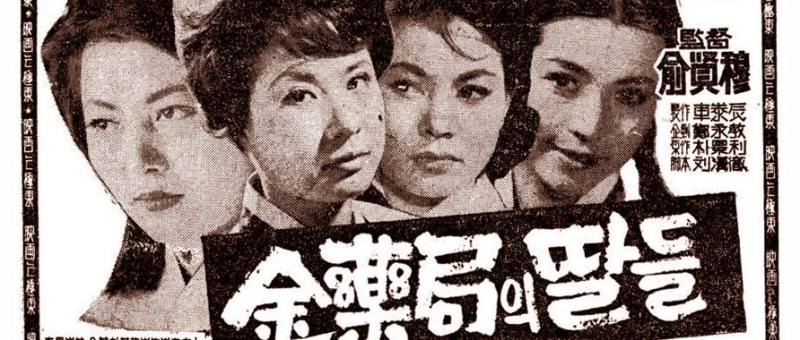
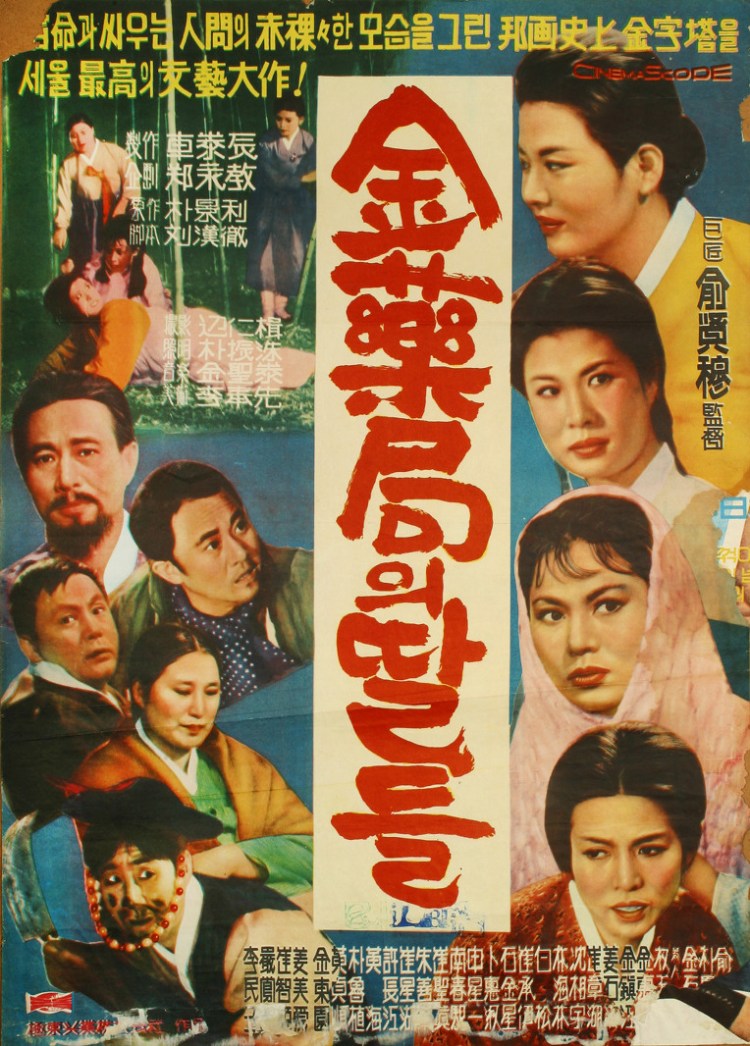
Daughters of Kim's Pharmacy poster“Literary Film” had become a kind of genre of its own in Korean cinema, both embracing and rejecting the nation’s taste for melodrama with differing degrees of artiness. Director Yu Hyun-mok, however, was not generally associated with the kind of affectation coupled intense sentimentality that sometimes marked the worst examples of the genre but with a unique brand of cinematic realism which attempted to address the social issues of the day whilst still getting past the censors who were hot on politics but increasingly lax on sex and violence. Nevertheless, The Daughters of Kim’s Pharmacy (김약국의 딸들, Kim yakgukjib daldeul) is a “literary film” adapted from a novel by Park Gyoung-li and set firmly in the recent past. Yu eventually gives in to the inherent melodrama of a small family battling a legacy of pain and destruction, but tellingly subverts it by discarding the tragic ending of the original novel for something that offers a degree of hope albeit in an all but hopeless world.

The film begins at the close of the Joseon Dynasty as a young man runs into another man’s house and desperately reaffirms his love for a woman who is now married to someone else while he is also married to woman from his village. The woman refuses to see him while he pleads with her, sobbing, but when her husband returns home unexpectedly he doubts his wife’s virtue. Threatening her and then chasing off the lover, the husband kills him by accident and is forced to flee while the woman takes poison and kills herself in her misery leaving her son, who will later become Kim the pharmacist, orphaned and alone, and the family forever “cursed” by her unquiet spirit.

18 years later Kim himself is forced into an arranged marriage which he wanders away from on the wedding day, leaving his aunts to wonder if he hasn’t been “possessed” by the vengeful spirit of his late mother. Despite the “curse” the marriage is successful in that it is not particularly unhappy and produces four daughters who are each of age when the story begins thirty years after Kim’s wedding.

The central heroine, Yong-bin (Um Aing-ran), is a “modern woman” of the colonial era, taking advantage of a shift forward into a progressive new world by leaving her tiny home village for university in Seoul. Though she longs to be free of the primitivism of her origins with its shamanistic rituals and patriarchal traditions, she is also of an elegant, conservative disposition and loves her parents deeply – something that provokes conflict in her desire for the comforts of home and the promise of away.

Of the other three daughters, each represents a particular kind of trap of the age. The oldest, Yong-sook (Lee Min-ja), has given birth to a child out of wedlock and lives alone independently raising her son in penury. Meanwhile third sister Yong-ran (Choi Ji-hee) is no longer a child but continues to loll around the house showing off her legs and posing provocatively. Her father is thinking of marrying her off to a local fisherman who has taken a liking to her, but the plan is scuppered when it is revealed that Yong-ran has been taking frequent nighttime excursions to the graveyard in the forest for secret trysts with one of the servants. When they are discovered, Kim chases the man away leaving Yong-ran publicly shamed and heartbroken. Eventually she is married off to someone befitting her social class only to discover that her new husband is impotent thanks to an opium addiction. She is routinely beaten and abused but can do nothing to escape her life of violence and terror. Yong-oak (Kang Mi-ae), the youngest sister, will eventually suffer a similar fate if one more usual, when she marries Yong-ran’s fisherman suitor only to find him rough and resentful as the fishing industry continues to fluctuate.

When Yong-bin’s mother (Hwang Jung-seun) meets her at the harbour on her return from Seoul she mentions the family curse by way of bemoaning their increasing ill fortunes. Yong-bin dismisses her mother’s concerns, preferring to think that its one’s own deeds that determine one’s future, but her mother sadly shakes her head and repeats that it’s all fated. Yong-bin’s modern way of thinking will increasingly come into conflict with her superstitious upbringing, but there’s no denying her family has had a run of bad luck – one which is only set to intensify as time moves on.

This is the central tragedy – the Kim family, trapped in the past, is unable to move beyond its “curse” and whether fated or not is set to destroy itself through outdated thinking. Though it is undoubtedly not the message the film is intended to convey, it’s impossible to ignore the degree of unhappiness which has been caused by the system of arranged marriages and the convention that true feelings must be suppressed in order to maintain ancient social codes. The Kims’ “curse” comes from the death of a woman scorned in love and betrayed by a prideful husband. If only she had been allowed to marry the man she chose, there would be no curse, no violence, no fear. As long as personal happiness is undervalued, there will be only suffering and misery for all but most particularly for the young women of Korea.

Yong-bin, an urban sophisticate, knows this more than most. Her father thinks he ought to marry her off first so he can marry off Yong-ran whose precociousness is beginning to alarm him. Yong-bin, however, wants to finish her education before submitting herself to a lifetime of servitude as someone’s wife and later mother. Her father has his eye on a match – the son of a usurious loanshark who is also a Japanese collaborator. Luckily, Yong-bin likes the man her father has chosen and sees only a romantic fantasy in marrying a childhood friend despite a warning from another mutual acquaintance that Hong-sub is a timid yet ambitious man – a dangerous combination which is unlikely to yield much happiness. She is going to get her heartbroken in more ways than one, her illusions of innocent romantic destiny shattered and her heart wounded by a spiritual as well as physical betrayal by the feckless Hong-sub who turns out to be not the man she thought he was but the one she was warned about.

Yet there is something in Yong-bin’s modernism that cannot be denied. This being the colonial era, the influence of the Japanese is felt even in this tiny village. Kim has sold the family pharmacy because of the influx of Western medicine coming in through Japan. He invested heavily in fishing, but the Japanese are ruining that too through invading local waters and overfishing them. Yet Kim still thinks of himself as a feudal lord with a real duty towards the people of his village. When his boat is ruined in a shipwreck and many sailors killed, he feels he must compensate the victims’ families who are now without the means to support themselves. This leaves him open to exploitation by Hong-sub’s usurious father who is in big with the Japanese who are, to an extent, the route cause of all these problems. Hong-sub’s father laughs when Kim declares his need of extra cash to support those who’ve suffered because of his failed fishing venture, thinking his sense of duty merely stupid but also seeing that it’s another hook for him to exploit that brings him closer to his goal of harnessing Kim’s ancestral estate with its large amount of farmland and property.

The Japanese play into a small sub-plot in which Yong-bin’s cousin (Shin Seong-il) is engaged in the resistance movement and eventually leaves for a covert mission in Japan. Before he leaves he introduces Yong-bin to a friend, Kang-geuk, who has been arrested and is being carted off to Japan for trial but has apparently fallen in love with her based only on his friend’s stories and a photograph. She’s back to a romantic fantasy once again and gravitating towards the spectre of arranged marriage which the film has already done such a great job of discrediting. It is, however, the perfect symbiosis of the film’s themes allowing Yong-bin to embrace both sides of herself. Meeting again after the liberation and a succession of terrible tragedies for the Kim family, Kang-geuk responds to Yong-bin’s intention to leave her hometown forever by asking her to name a place which is not tinged by loss and tragedy, and of course she can’t. Suddenly, her village doesn’t seem so bad anymore.

The “curse” is broken in being acknowledged and Yong-bin exercises her freedom to choose, consenting to a marriage, and making a decision to stay rather than being forced to leave. Yu’s comparatively hopeful ending in which Yong-bin nevertheless places herself back within a patriarchal value system stands in sharp contrast to that of the novel in which the Kim family’s failure to reconcile themselves to modernity provokes their downfall, but there is only so much hope in this hopeless world and Yong-bin, like her surviving sisters, will continue to suffer in an existence which offers little else to Korea’s oppressed women, remaining complicit in her own misery.   


Available on DVD as part of the Korean Film Archive’s Yu Hyun-mok boxset. Also available to stream via the Korean Film Archive’s official YouTube Channel.

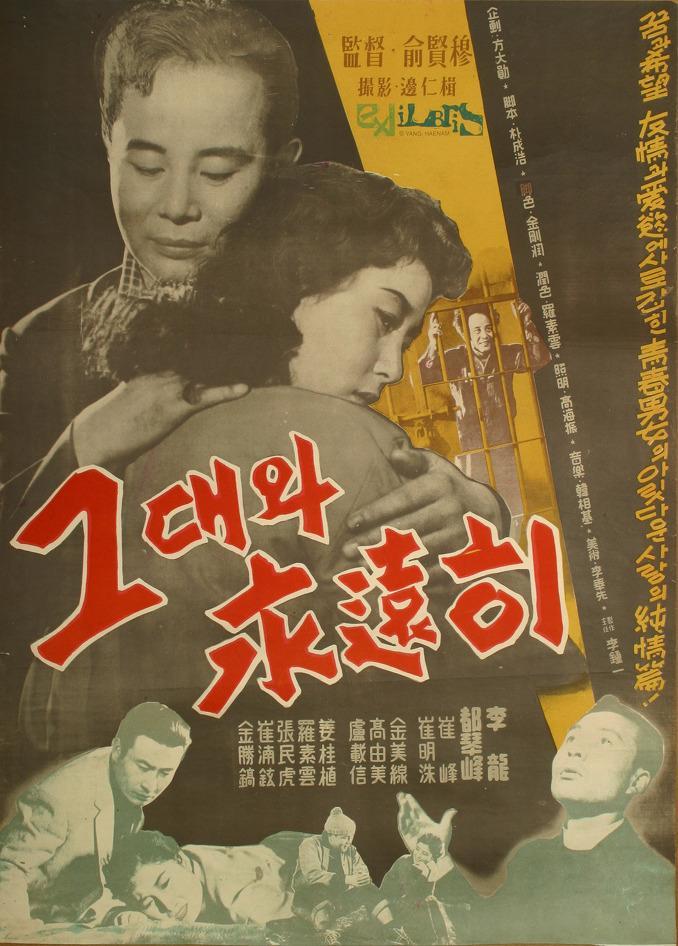
Forever With You (그대와 영원히 / 그대와永遠히, Yu Hyun-mok,1958)

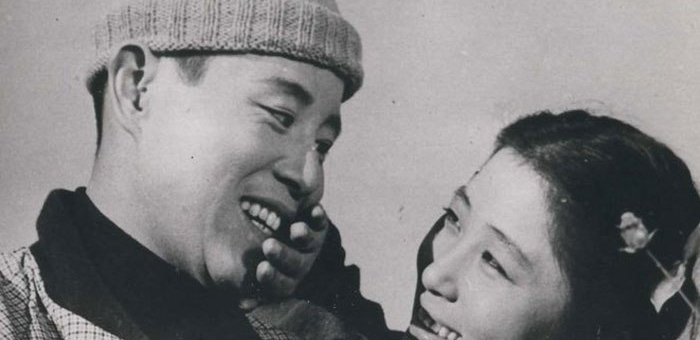
Forever with you posterBest remembered for his 1961 feat of neorealist social drama Aimless Bullet, Yu Hyun-mok was one of the early masters of Korea’s golden age who sought to bring a degree of intellectual rigour and formal experimentation to a medium which often favoured the populist or propagandist. He did, however, have to start somewhere and the earliest surviving film in Yu’s filmography is indeed a melodrama though one perhaps a little to the side of the norm and with an axe to grind as regarding economic equalities and the demands of spiritual morality, even if he is forced to retreat to entrenched social codes in the closing moments.

The camera pans over a city filled with rooftops and eventually lingers on a group of children playing quietly by a wall. Panning over the wall which is exceedingly high, Yu reveals the children to have been playing on the other side of a prison where Gwang-pil (Lee Ryong), an inmate, is about to be released after 10 years inside. All things considered, Gwang-pil does not seem to be a hardened criminal and is optimistic for the future, intending to go straight and hoping to reconnect with the childhood sweetheart he believes is still waiting for him in the outside world though they have not seen each other since Gwang-pil made an ill-advised escape attempt and got his sentence increased a number of years. He recounts all of this to another inmate who is happy for him, broadly, but not quite convinced Gwang-pil is going to make it in the regular world.

Switching to a lengthily flashback, Yu allows Gwang-pil to recount the circumstances which landed him in jail, which also gives the director a chance to engage with his socio-political concerns. 10 years previously, Gwang-pil was a happy young man from an exceptionally poor village who was best friends with Ae-ran (Do Kum-bong). Ae-ran works in a bakery to help support her family, and often walks home with Gwang-pil which is one of the few times they have to be together. A happy day at the beach sees them building sandcastles and dreaming of the life they will one day live with a house and children of their own, only to see all their dreams washed away by a sudden outbreak of rain. In desperate need of money both to support himself and his bedridden mother and to impress Ae-ran, Gwang-pil starts hanging round with delinquents and picking pockets. Though Gwang-pil wants to give back some of the money they stole fearing the woman they took it from is also poor and cannot spare it, he goes along with the delinquents’ plan to rob a nearby US army depot. The others get away but Gwang-pil is arrested and sent to prison.

The first and foremost motivator for Gwang-pil’s descent into criminality is poverty and familial breakdown. His father was a gambler who left his mother flat, while she has become bedridden and is dependent on her teenage son for financial support. With no real jobs available in the town and no prospect of a way out through education, Gwang-pil is seduced by crime despite having no real aptitude for it. The other motivator, if indirectly is Ae-ran or, more specifically, jealous insecurity related to the harmonica playing delinquent Dal-soo (Choi Nam-hyun). Too poor to afford a harmonica of his own, Gwang-pil fears losing Ae-ran to a flashier guy and so he picks pockets to buy her fancy treats little realising all she wants is his time – something he will rob her of by getting himself sent to prison.

The war between Gwang-pil and Dal-soo over possession of Ae-ran will occupy the rest of the film though Ae-ran, like many women in the golden age of Korean cinema, is left with little choice of her own other than to continue suffering. When Gwang-pil gets out of jail it’s one of the other delinquents who meets him – Sang-moon (Choi Myung-soo) has become a priest, in part out of remorse for what happened to Gwang-pil and regret over his criminal past. Sang-moon is determined to help Gwang-pil repair his life but knows finding out what happened to Ae-ran is going to break his heart and send him spiralling into a nihilistic whirlpool of despair. Ae-ran has married Dal-soo who chose the path of crime and still operates a dodgy hostess bar as a front for his gangster activities.

Gwang-pil is just as upset and angry as Sang-moon feared. So much so that he completely misses how miserable Ae-ran is in her marriage and that her daughter, Eun-joo, is nine years old meaning she was conceived before he went to prison. Obsessed with his own pain, anger, and self loathing he fails to see anything other than his ruined hopes and commits himself only to further ruination through drink and the attentions of the manager at Dal-soo’s bar which are not altogether as one might assume them to be.  Only too late does he begin to grasp the real situation but is still too wounded to process it fully. Dal-soo, knowing Ae-ran has never loved him and wondering if her decision to become his wife has been a long form act of revenge, sets a plan in motion to remove his rival from the scene while Gwang-pil also longs for revenge against the man who has stolen everything from him.

Dal-soo and Gwang-pil square off, leaving Ae-ran whose health is so poor and nerves so fragile that she has virtually lived in hospital for the last few years, to suffer alone with only the austere comfort of Sang-moon’s priestly ministrations. Wanting to be “a good wife” she stands by Dal-soo but fears for Gwang-pil, not only for his life but also for his soul lest he fall back into criminality in the shock and hopelessness of her betrayal. Her situation is impossible and the strain of it difficult to bear. She hates her husband and blames herself for the fate of her one true love but has no recourse other than to continue suffering or die. In keeping with the story’s melodrama origins, Ae-ran pays a heavy price for her “weakness”, as does Dal-soo, leaving only the priest and the wronged man behind, strengthened by the need to care for the daughter he never knew he had.

Far from the rigour and furious intent of Aimless Bullet, Forever with You (그대와 영원히 / 그대와永遠히, Geudaewa yeongwonhi) is a much more modest effort even among studio pictures from 1950s. Largely filmed on set with low production values, Forever With You does allow Yu a degree of formal experimentation as he makes frequent use of pans and zooms more commonly seen in the films of 20 years later and occasionally gives in to ostentation as in his expressionist spinning shot of Gwang-pil and a bar girl dancing as he attempts to lose himself in abandon, or an overhead view of a gangster meeting. In the end Gwang-pil comes to himself too late, only realising his foolishness just as he loses everything that mattered to him but Yu changes track, gives him hope again in the prospect of a new beginning, learning to live for others in purehearted sincerity whilst walking away proudly into the harshness of the post-war world.


Available on DVD as part of the Korean Film Archive’s Yu Hyun-mok boxset. Also available to stream via the Korean Film Archive’s official YouTube Channel.