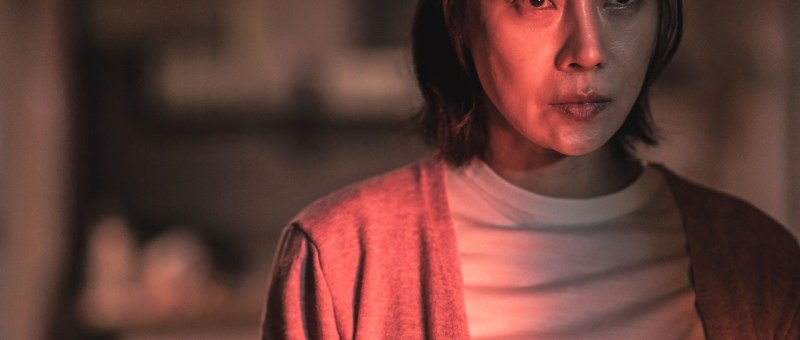
Is it the “black mould” that’s driving new homeowner Eun-jin (Yoo Seon) out of her mind, or the combination of unresolved trauma and the financial pressures of trying to secure a safe and comfortable living environment for your family in contemporary Seoul where out of control property prices have made ownership an unattainable dream for many? Echoing a motif that’s become increasingly familiar in recent Korean films, Eun-jin buys an apartment which looks out onto a complex of other, much nicer, luxury apartment blocks that are well out of her reach. Yet she’s convinced herself that the building she’s moved in to will soon be redeveloped and she could make a life-changing amount of money by flipping it once the renovations are completed.
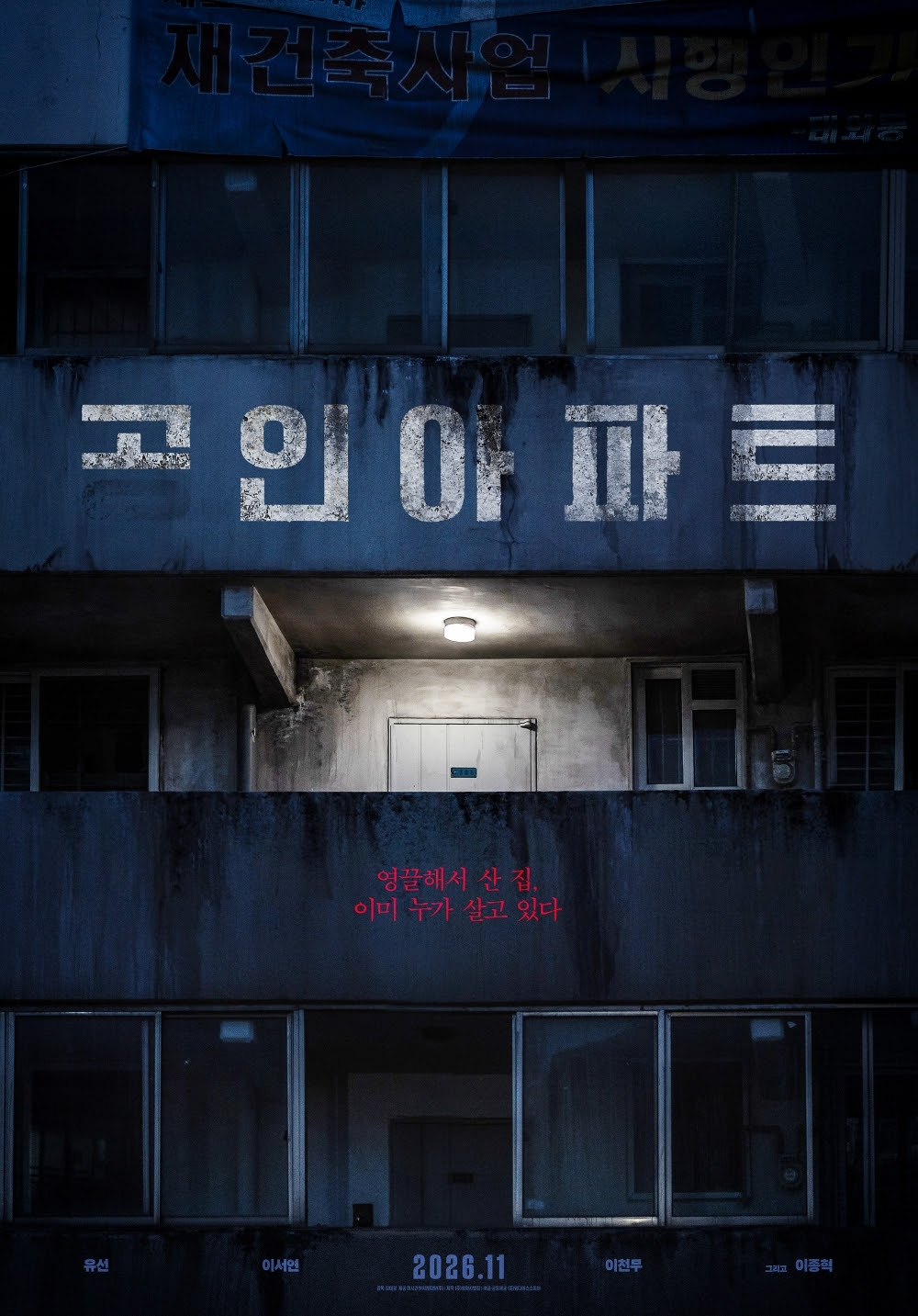
The only snag would seem to be that the block is plastered in signs that say things like “redevelopment equals death”. In fact, Gong-in Apartments is well known locally as “Go-in Apartments” which sounds like “apartments of the departed”, making this place seem “haunted” in a less literal sense as something that exists out of time with the world around it. The local residents seem to regard the blocks as old-fashioned and an eyesore. They are slightly embarrassed by them, and prefer to avoid the people that live there. The block is then “haunted” in another sense in that most of the “inhabitants” are “ghost owners” who bought the apartments as an investment but do not live there, nor do they rent the apartments out due to the rundown nature of the building. Despite having pushed her to invest by implying that the city had virtually already agreed to go ahead with the redevelopment, Eun-jin’s estate agent is surprised that she actually intends to live there given the building’s reputation, yet later revelations suggest she may have sold this unit before. She has definitely sold others in the building to people who were financially ruined by their decision to buy and in some cases took their own lives.
Yet Eun-jin is proud of her new status as a homeowner, as if reaching a new level as a fully-fledged member of society. She cleans and redecorates it herself, peeling off the layers of lining on the ceiling and clearing away the mould assuming it’s only caused by the fact the apartment had been empty. Yet as a doctor later explains, you can’t get rid of that kind of mould by papering over it, just as Eun-jin cannot get over the familial trauma from her childhood by creating a superficially happy home of her own. In some ways, the film ultimately takes a turn for the conservative in its messaging as most of the problems are attributed to paternal absence, even if that absence was also caused by the economic conditions of the society which forced Ji-chul (Lee Jong-hyu) to live separately from his family in order to provide for them while Eun-jin works in a local factory to make ends meet.
In the opening stretches of the film, one almost wonders if Ji-chul is a ghost himself as Eun-jin only talks to him on the phone through which he offers words of kind support that might as well be Eun-jin talking to herself, while he is able to offer little in the way of practical help. Though his absence obviously increases the strain on Eun-jin as she has to care for the family alone while also working, the doctor frames it in more patriarchal tones as if things like this happen when women live without men. On one level he is blaming Ji-chul for failing as a man by leaving his family undefended, but also suggesting that women are incapable of protecting themselves. Eun-jin repeatedly states that she will “protect” her family, but ends up endangering them as her reality becomes ever more fragmented and confused. In the end only Ji-chul’s return can save the children from her mania, though he cannot cure her of her delusions alone.
It soon becomes apparent that Eun-jin has been experiencing reality differently to those around her, frequently seeing centipedes in the house while others seemingly don’t react to potentially life-threatening situations. At one point, she arrives at work wearing a very old-fashioned, purple wraparound dress and with a makeup and hair style that seems reminiscent of an earlier era, suggesting that she may have been possessed by something more than just fear and fury that her investment is not actually going to pay off and she won’t even be able to afford to continue living in this moribund building where the lifts don’t work and no one has noticed the little boy from upstairs has been living alone so long he’s turned feral. Homeownership seems to have turned Eun-jin into a selfish and suspicious person, instinctively fearing the homeless as if now afraid either to become one or that they will somehow steal her space. She stops her son playing with the other boy, complaining that people like that will become stuck to you if you let them get too close while making no attempt to help him. Perhaps this is also a reflection of her own childhood trauma as are the visions she begins to see of a malevolent presence out to destroy her family. “I just wanted to do better,” she says, but it seems this society doesn’t really want to let her even as it dangles a vision of future happiness that is destined to remain far out of reach.
Home A Loan screened as part of this year’s London Korean Film Festival.
Trailer (English subtitles)

