
River’s Edge (リバーズ・エッジ, Isao Yukisada, 2018)

River's Edge poster 2The ‘90s were a strange time to be a teenager, but then what age isn’t? Isao Yukisada, surprisingly making his first manga adaptation, brings Kyoko Okazaki’s cult hit River’s Edge (リバーズ・エッジ) to the big screen, recreating those days of nihilistic despair in which ordinary teens spiralled out of control in the wake the bubble bursting, watching all their possibilities disappear in a cloud of smoke. Set in 1994, River’s Edge is a post-bubble story but it also takes place in the period immediately before everything started to go wrong. In 1995 there was a devastating earthquake followed by terror in Tokyo and somehow it all seemed so dark – something the kids at the centre of River’s Edge already seem to see as they watch time flow, knowing all that awaits them is yet more emptiness.

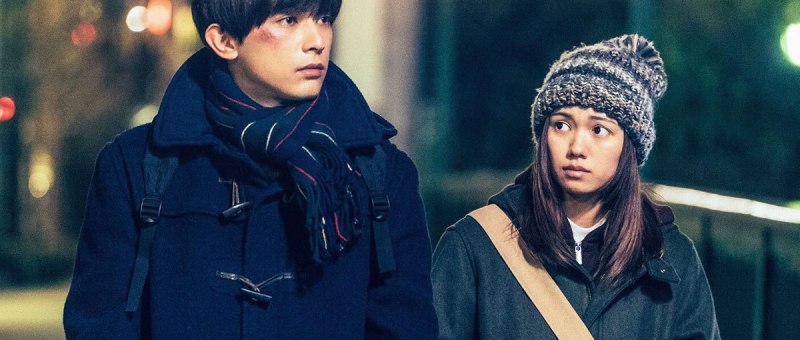
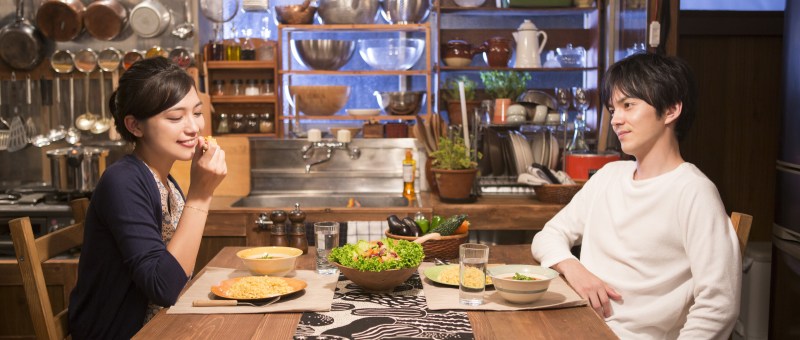
Haruna (Fumi Nikaido), a spirited tomboy and latchkey kid living with her busy single-mother, is in a lazy relationship with violent popular boy Kannonzaki (Shuhei Uesugi) though in truth she doesn’t seem to like him very much. One of her major problems with Kannonzaki is that he keeps picking on one particular guy, Yamada (Ryo Yoshizawa), who is rumoured to be gay. Warned by one of Kannonzaki’s minions, Haruna races off to an abandoned storeroom where she finds Yamada trussed up and naked hidden inside a locker. The pair become friends and he offers to show her his “special treasure” which turns out to be a dead body hidden among the reeds near the edge of the river. Yamada, with another friend, Kozue (Sumire) – a model with an eating disorder, likes to come to the river to gaze at the body in an effort to feel alive.

The ‘90s were full of tales of cruel, emotionless youth torturing itself without mercy and there is something of the era’s insensitivity in the detachment of the central trio. Unable to feel alive, the teens of River’s Edge chase sensation and oblivion through indiscriminate sex, drugs, violence, and self harm but rarely find the kind of fulfilment they so desperately crave. Kannonzaki, the rowdy delinquent, blames his broken home for his lack of connection, making a fierce resentment of a perceived rejection his excuse for his dangerously violent proclivities which run not only to venting his rage on the figure of the gay outsider Yamada but also to drug fuelled rough sex with one of Haruna’s classmates, Rumi (Shiori Doi), who is also chasing agency through sexuality but eventually finds herself cornered in the most terrible of ways.

Yamada is indeed gay, but can hardly say so in the environment in which he lives and so has turned in on himself with a near sociopathic detachment. Having given up on the idea of romantic fulfilment he has resigned himself to loving the object of his affection from afar, happy enough that he exists in the world even if he can never declare himself let alone dare to hope his feelings may be returned. Yamada works as a rent boy in the evenings, going to hotels with middle-aged men for money, but has a fake girlfriend at school, Kanna (Aoi Morikawa), whom he uses as a beard. Kanna, seemingly sweet and oblivious, soon becomes jealous of her boyfriend’s friendship with Haruna and is driven into her own kind of despair by Yamada’s continued coldness.

There’s an especial irony in Yamada’s use of Kanna which is almost certainly not lost on him. These kids, like many before them, abhor the fakery of the adult world but are also unable to embrace their own painful truths. Yamada covers up his sexuality through misleading Kanna, while Kannonzaki is resentful towards his parents who put on a front of marital harmony even after his father ran off with his mistress only to come back a week later with his tail between his legs, and Kozue laments the superficiality of her industry in which everyone falls over themselves to declare something ugly beautiful in order to make themselves feel better. There are no responsible adults here, having ruined the future for their kids they no longer have any kind of moral authority that can offer guidance or support to a jaded generation.

Shooting in the classic 4:3 of a ‘90s TV, Yukisada recreates the narrowness of an era in which the kids struggle to see past themselves, blinkered by their own solipsistic perspective and trapped by the shallowness of their perceptions. Permanently dark, gloomy, and lonely their world is one nihilistic despair in which they feel themselves already dead, living in the half-dug grave of a moribund city giving off its last few puffs of toxic industrial smoke before the whole thing collapses in on itself. In one sense nothing changes, there are no answers or cures for adolescent malaise, but something does eventually seem to shift in the genuine connection formed between two detached outsiders standing on the brink, watching the decay of their era flow past them with melancholy resignation.


Screened at Nippon Connection 2018.

Original trailer (no subtitles)

The Scythian Lamb (羊の木, Daihachi Yoshida, 2017)

Scythian Lamb posterSometimes life hands you two parallel crises and allows one to become the solution to the other. So it is for the bureaucrats at the centre of Daihachi Yoshida’s The Scythian Lamb (羊の木, Hitsuji no Ki). The prisons are overcrowded while rural Japan faces extinction thanks to depopulation. Ergo, why not parole some of those “low risk” prisoners whose problems have perhaps been caused by urban living and lack of community support on the condition that they move to the country for a period of at least ten years and contribute to a traditional way of life. The prisoners get a fresh start where no one knows them or what they might have done in the past, and the town gets an influx of new, dynamic energy eager to make a real go of things. Of course, there might be some resistance if people knew their town was effectively importing criminality, but that’s a prejudice everyone has an interest in resisting so the project will operate in total secrecy.

Not even civil servant Tsukisue (Ryo Nishikido), who has been tasked with rounding up the new recruits, was aware of their previous place of residence until he started to wonder why they were all so unusual and evasive. Tsukisue likes to think of himself as an open-minded, kind and supportive person, and so is disappointed in himself to feel some resistance to the idea of suddenly welcoming six convicts into his quiet little town, especially on learning that despite being rated “low risk” they are each convicted murderers. Thus when a “murder” suddenly happens in the middle of town, Tsukisue can’t help drawing the “obvious” conclusion even if he hates himself for it afterwards when it is revealed the murder wasn’t a murder at all but a stupid drunken accident.

The ex-cons themselves are an eccentric collection of wounded people, changed both by their crimes and their experiences inside. Many inmates released from prison find it difficult to reintegrate into society, especially as most firms will not hire people with criminal records which is one of the many reasons no one is to know where the new residents came from. Yet, there are kind and understanding people who are willing to look past the unfortunate circumstances that led to someone finding themselves convicted of a crime such as the barber (Yuji Nakamura) who reveals his own difficult past and happiness in being able to help someone else, or the woman from the dry cleaners (Tamae Ando) who is upset by other people’s reaction to her new recruit who, it has to be said, looks like something out of Battles without Honour. Tsukisue doesn’t know anything about these people save for the fact they’ve killed and has, unavoidably, made a judgement based on that fact without the full details, little knowing that one, for example, killed her abusive boyfriend after years of torture or that another’s crime was more accident than design.

Tsukisue later becomes friends with one of the convicts, Miyakoshi (Ryuhei Matsuda), whose distant yet penetrating stare makes him a rather strange presence. Miyakoshi is the happiest to find himself living in the small coastal town, enjoying the lack of stimulation rather than resenting the boredom as some of the other new residents do. Despite his obvious inability to “read the air”, Miyakoshi is quite touched by Tsukisue’s kindness and by the way he treated him as a “normal” person despite his violent criminal past, excited to have made a real “friend” at last. Trouble begins to brew when Miyakoshi joins Tsukisue’s garage band and takes a liking to another of its members – Aya (Fumino Kimura), another returnee from Tokyo with a mysterious past though this time without a prison background. Tsukisue has had a long standing crush on Aya since high school but has always been too shy to say anything. He thought now was his chance and is stunned and irritated to realise Miyakoshi might have beaten him to it and, even worse, given him another opportunity to disappoint himself though doing something unforgivable in a moment of pique.

The bureaucrat in charge of the scheme wanted it kept secret in part because he was afraid the criminals might find each other and start some sort of secret murderer’s club (betraying another kind of prejudice) which actually turns out not to be so far fetched, though the main moral of the story is that kindness, understanding, and emotional support go a long way towards keeping the peace. Meanwhile, another of the convicts has taken to “planting” dead animals inspired by a plate she finds on a refuse site featuring a decoration of a “Scythian Lamb” – a plant that grows sheep which die when severed from their roots, and the evil fish god Nororo sits atop the cliffs in reminder of the perils of the sea. The Scythian Lamb is a poignant exploration of the right to start again no matter what might have gone before or how old you are. It might not always be possible to escape the past, and for some it may be more difficult than others, but the plant withers off the vine and there’s nothing like good roots for ensuring its survival.


Screened at the 20th Udine Far East Film Festival.

Original trailer (English subtitles)

Inuyashiki (いぬやしき, Shinsuke Sato, 2018)

inuyashiki_poster_B1_0206D_fin_ol_3Japanese cinema has long been preoccupied by the conflict between age and youth though it usually comes down on the side of the youngsters, even when rebuking them for their selfish immorality. Inuyashiki (いぬやしき), adapted from the manga by Hiroya Oku, is similarly understanding but makes a hero of its sad dad protagonist whose adult life has been a socially acceptable disaster, while finding sympathy for his villainous teenage counterpart who resents his lack of possibilities in an already unfair world.

Unsuccessful salaryman Inuyashiki (Noritake Kinashi) has just moved into a new house of which he is very proud but his wife (Mari Hamada) and children find small and old fashioned. He’s bought sushi to celebrate the occasion, but the other family members ignore him and head out for dinner on their own. Held in contempt at home, Inuyashiki’s working life is also something of a disaster in which he is publicly berated by his boss who threatens to fire him, leaving Inuyashiki kneeling in supplication just to be allowed to work until retirement so he can keep up the mortgage payments on that new house (which he bought for his family who all hate him).

To make matters worse, Inuyashiki has also just received the news that he is suffering from terminal cancer and has only a few months to live. His only ray of sunshine appears when he finds an abandoned dog, Hanako, and decides to adopt her but his wife orders him to throw the dog out in case it messes up the house (that she already hates). Sadly walking Hanako to the park with the intention of sending her on her way, Inuyashiki is struck by a mysterious blast and later wakes up to discover he has become an all powerful cyborg with booster rockets on his back and guns in his arms.

Inuyashiki’s first instinct is that he can use his new found powers to save people. Contemplating his mortality, Inuyashiki was made to feel that his life had been a failure; he’d never done anything of consequence and had never been able to protect anyone. Reviving a wounded bird in the street, he realises he has the power to heal along with super sensitive hearing which allows him to hear the cries of those in peril.

Meanwhile, the teenager caught in the same blast, Shishigami (Takeru Satoh), is heading in the opposite direction. Shishigami is also filled with resentment though mostly as regards his poverty and comparative lack of possibilities. He hates that his single-mother (Yuki Saito) has to work herself to the bone because his father (Kiyohiko Shibukawa) left the family for another woman with whom he has built another home and become extremely wealthy. He hates that his video game otaku friend (Kanata Hongo) is mercilessly bullied and has stopped coming to school altogether rather than fight back. Filled with a young man’s rage and a mild kind of psychopathy, Shishigami doesn’t see why it’s wrong to become a bully rather than fighting them. Frustrated beyond reason he declares war on an uncaring society and sentences everyone in Japan to death for their indifference to their fellow citizens.

The conflict between the angel and the devil concludes in predictably bombastic fashion as our two cyborgs go head to head in a climactic battle for the soul of Japan. Strangely enough both men are motivated by love even if one’s actions are darker than the other’s. Inuyashiki wants to protect, to be someone his family can respect and depend on – he flees the scenes of his miracles because he isn’t interested in being a “hero”, just in being of use. Shishigami, by contrast, is motivated by love for his mother whose continuing suffering proves too much for him to bear though his attempts to take revenge only end in more tragedy. Mustering all the technology of the age from smartphones to live broadcasts, Shishigami makes himself a familiar face on TV sets and LCD screens across the country to preach his message of hate as a declaration of war.

Shishigami proclaims that Inuyashiki’s sense of justice is no match for his hate, but there is a definite irony in the squaring off of two men from different generations trying to figure out their differences by pounding the living hell out of each other and destroying half of Tokyo in the process. Still, that is in many ways the point as these two “gods” actively choose the sides of light and darkness, vying for the right to rule the future as forces of destruction or salvation.


Screened at the 20th Udine Far East Film Festival.

Original trailer (English subtitles)

Little Forest (リトル・フォレスト 夏・秋 / 冬・春, Junichi Mori, 2014/15)

Divided into four hour-long segments, Little Forest (リトル・フォレスト) opens with a voice over from Ichiko (Ai Hashimoto) introducing us to Komori, her home village. High in the mountains, Komori is a community of farmers without a single store though there is a farmer’s co-op if you make the half-hour bike ride to the high street. It’s downhill so not so far on a bike on your way, but a good 90 minute walk in the winter snow. Most people do their shopping at the supermarket a few towns over but if Ichiko wants to go there it takes her the best part of a day. Ichiko, however, has a taste for doing things herself and so she grows most of her own food or barters for that which she doesn’t have with some of the other sharecroppers. Always with one eye on the future and particularly for the winter to come, Ichiko preserves her produce and makes the most of all she has.

Despite her feelings of inadequacy and incompleteness, Ichiko throws herself into the business of farming, weeding her rice field and preparing for the harvest all alone. She doesn’t seem to mind the solitude or the monotony, rejoicing in cooking the food she has grown and savouring each of its flavours. A gifted cook, Ichiko also likes to experiment, finding new ways to use each of the vegetables in her garden and trying them out on her two old school friends Yuta (Takahiro Miura) and Kikko (Mayu Matsuoka).

Yuta, like Ichiko, tried life in the city but ultimately decided to come home to the country. Despite wanting nothing but escape, Yuta found that he couldn’t adapt to the city’s insincerity. He missed real conversation and the ability to talk seriously about serious things whilst learning from others – something he so admired in the village. Ichiko, rather than empathising with him, is a little jealous. Yuta came home to face himself and discovered who he really was whereas she suspects she came back to escape doing exactly that. In short, she ran away and is living in hiding.

Yuta, adopting the gentle tones he was so in praise of, almost points this out to Ichiko albeit in a subtle way by telling her that he admires the way she does everything for herself but that he’s worried she may have missed the point. Ichiko’s need for independence is perhaps a reaction to abandonment by her mother which apparently happened quite abruptly in her teenage years. Her mother’s letters are vague and don’t include a return address or any details regarding where, how, or with whom she is currently living. Her last letter, however, seems to contain some relevant advice in the form of various excuses. Ichiko’s mother tells her that she was worried she’d just been wandering round in circles but finally realised that the arc of her life has been more like a spiral. Never taking the same path twice, she learned as she went and so finding yourself back at the start is not the same as never having set off.

Rather than actively making the choice, Ichiko merely commits to making it. Realising that it’s time to come out of hibernation and figure out where it is she wants to be rather than simply allowing Komori to become her default setting, the decision is made quickly and keenly. Yet it takes time, effort, and experience to bring something to fruition and, skilled as she is, Ichiko still has a few things to learn. Filled with wonderful food and idyllic scenery, Little Forest is perhaps an idealised view of country life – the kind of life lived by those who know how to live happily even when life is hard, but there is truth in its age old wisdom as long as you know how to harvest it.


Released as two two-part movies: Summer/Autumn (2014) & Winter/Spring (2015)

Summer/Autumn trailer (no subtitles)

Winter/Spring trailer (no subtitles)

https://www.youtube.com/watch?v=Agqqgb0TbOQ

Bittersweet (にがくてあまい, Shogo Kusano, 2016)

bittersweet poster“Vegetarian Men” became an unlikely buzzword in Japanese pop culture a few years ago. Coined by a confused older generation to describe a perceived decrease in “manliness” among young, urban males who had apparently lost interest in women and gained an interest in personal appearance as an indicator of social status, the term feeds into a series of social preoccupations from the declining birthrate and changing demographics to familial breakdown and economic stagnation. In an odd way, Bittersweet (にがくてあまい, Nigakute Amai) backs into this particular alley by adding an extra dimension in the story of a somewhat “manly” career woman and her non-romance with a gay vegetarian she meets by chance who eventually helps her to escape her arrested adolescence and progress towards a more conventional adulthood.

Maki (Haruna Kawaguchi), an advertising agency employee and workaholic career woman in her late ‘20s, has a philosophical objection to the existence of vegetables. Unable to cook and generally disinterested in food (or house work, clothes, makeup etc), Maki sucks on jelly packs at her desk so she can keep on typing, sometimes treating herself to a store bought bento. She’s told her “friends” at work that she’ll shortly be moving in with a boyfriend, but in reality she’s recently broken up with someone and is being evicted from her flat. Things are looking up when she’s put in charge of a commercial but the commercial turns out to be for goya bitter melon which is both a vegetable and not exactly an easy sell.

Fast forward to a bar where Maki is a regular. After getting blind drunk and going off on an anti-vegetable rant, Maki wakes up at home with Nagisa (Kento Hayashi) – a guy she quite liked the look of the previous night but went off when she noticed he was carrying a giant box of veggies, making her a nutritious breakfast which she then refuses to eat. Paranoid that Nagisa took advantage of her in the night, Maki goes through his bag and discovers that he’s a high school art teacher. Challenging him about what exactly happened, he is forced to tell her that she’s not his type. Nagisa is gay and brought the blackout drunk Maki back to her flat on the instructions of his friend, the gay bartender at Maki’s local. Maki, classy as ever, threatens to blackmail Nagisa by outing him at school unless he agrees to move in with her.

Thankfully, Bittersweet drops the romance angle relatively quickly as Maki begins to grow up and accepts that there’s no point chasing a man who will never be interested in her. Nagisa, originally adopting an almost maternal attitude towards the sullen Maki, later becomes something like a big brother figure, gently coaxing his friend towards self realisation through a series of well cooked meals and hard won life advice. Though there is a degree of stereotyping in his refined, elegant personality, cleanliness, and cooking ability, Nagisa’s sexuality is never much of an issue outside of the obvious fact that he is not “out” at work and that it may be impossible for him to be so. Despite Maki’s original consternation she gets over the shock of Nagisa’s confession fairly quickly and when he eventually meets her parents, they too react with relative positivity (Maki’s mum even slips a copy of a BL manga into her next care package).

Somewhat bizarrely the central drama revolves around Maki’s hatred of vegetables which stems back to a stubborn resentment of her parents’ unconventionality. In combatting her parents’ decision to abandon the world of corporate consumerism, Maki has become a “career woman”, eschewing the feminine arts in favour of the male drive. Where Bittersweet was perhaps progressive in its acceptance of Nagisa’s sexuality, it is less so with Maki’s seeming “maleness” – her drinking, meat eating, and workaholic ambition all painted as aspects of her life which are in need of correction. Though some of her habits are undoubtedly unhealthy – she could definitely benefit from better nutrition and scaling back on the binge drinking, Bittersweet is intent on “restoring” Maki to the cuteness befitting the heroine of a shojo manga rather than allowing her to become a confident modern woman who can have both a career and a love interest with little conflict between the two.

Through meeting Nagisa Maki is able to get over her vegetable hate and repair her strained relationship with her comparatively more down to earth parents while also realising she doesn’t necessarily want the life of empty consumerism symbolised by her relationship with her status obsessed former boyfriend. Meanwhile Nagisa has his own problems in dealing with a past trauma which his new found, quasi-familial relationship with Maki is the key to addressing. A pleasant surprise, Bittersweet is not the awkward romance the synopsis hints at, but a warm and gentle coming of age story in which vegetarian cookery, mutual respect, and a lot of patience, allow two youngsters to become unstuck and find in each other the strength they needed to finally move forward into a more promising future.


Original trailer (English subtitles)

Fullmetal Alchemist (鋼の錬金術師, Fumihiko Sori, 2017)

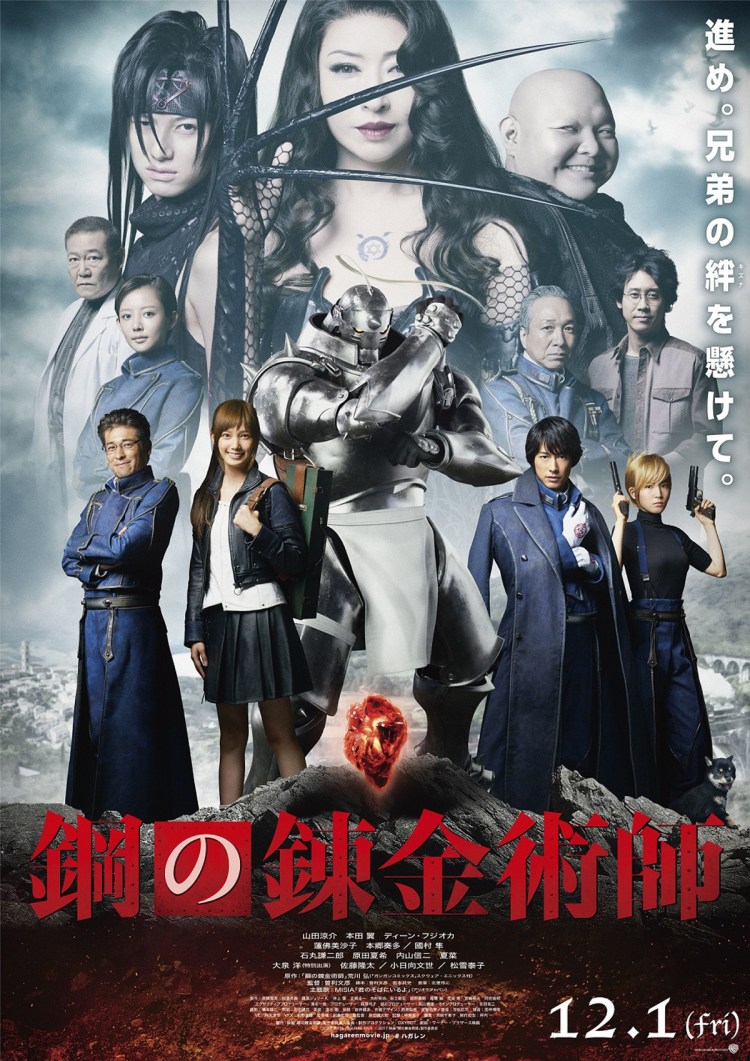
Fullmetal Alchemist posterEvery so often a film comes along which makes you question everything you thought you knew. Fullmetal Alchemist (鋼の錬金術師, Hagane no Renkinjutsushi) is just such as film but less for the philosophical questions fans of the source manga may have been expecting, than for the frankly incomprehensible fact that it exists at all. Produced not by a major studio but by Square Enix – best known as a video game studio but also the publisher of manga magazine Monthly Shonen Gangan in which the series was originally serialised, and effects studio Oxybot Inc., Fullmetal Alchemist is not the big budget extravaganza a franchise of this size might be expected to generate but a cut price blockbuster attempting to pack a much loved, long running saga into just over two hours.

For the uninitiated, the movie begins with the little Elric Brothers – Ed and Al, who live in the countryside with their doting mother while their father is away. When their mother is struck down by a sudden illness and dies, the boys raid their dad’s Alchemy library for clues as to how to bring her back. There is, however, a taboo surrounding human transmutation and when the brothers cast their spell they pay a heavy price – Al loses his entire body though Ed manages to save his soul and bind it to a suit of armour by sacrificing his own right arm.

Many years later, Ed (Ryosuke Yamada) and Al (Atomu Mizuishi) are still looking for the mythical “Philosopher’s Stone” which they believe will allow them to cast another spell and get their fleshy bodies fully restored. This takes them to a small town where they encounter a dodgy priest and their old commander, Captain Roy Mustang (Dean Fujioka), who wants to bring them back into the State Alchemist fold. The priest’s stone turns out to be a fake though his connections to the film’s shady antagonists are all too real, and the brothers are soon faced with another dilemma in their quest to restore all they’ve lost.

Sori shifts away from the frozen Northern European atmosphere of the manga for something sunnier and less austere, shooting in Italy’s Volterra with its narrow medieval streets and iconic Tuscan red roofs. He is, however, working on a budget and it shows as his cast are costumed at cosplay level with awkward blond wigs attempting to recreate the manga’s European aesthetics. Al, rendered entirely (and expensively) in CGI, is deliberately kept off screen while the quality of the effects often leaves much to be desired.

Al’s frequent absence is a major problem seeing as the series’ major theme is brotherhood and Ed’s tremendous sense of guilt over his brother’s condition coupled with his recklessness in his need to put things right is only explained in a piece of bald exposition following a fight between the pair after Al’s mind has been corrupted by a mad scientist who implied that he may not really be “real” after all. While Al’s false memory paranoia may be among the more interesting issues the film attempts to raise, it’s quickly pushed into the background, eclipsed by the ongoing conspiracy narrative which places the Elric Brothers in a difficult position regarding their need to get their body parts back. 

A symptom of the attempt to condense such a much loved and well known manga into a two hour movie, there is rather a lot of plot going on and numerous side characters on hand to enact it. Though fans of the original manga may be pleased to see their favourite characters have made it into the movie, they maybe less pleased about how one note they often are or the various ways their personalities have needed to shift in order to fit into the new narrative arcs the film employs. Aside from the young and pretty cast, Fullmetal Alchemist also finds room for a host of veteran talent from the ubiquitous Jun Kunimura in a small role to Yo Oizumi turning villainous and Fumiyo Kohinata at his most Machiavellian.

Extremely silly, poorly put together and burdened with some very unfortunate wigs, the Fullmetal Alchemist live action adaptation is as much of a misfire as it’s possible to be but viewers hoping for a continuation to the tale would do well to stay tuned for a post-credits sting strongly hinting at a part two.


Streaming worldwide on Netflix.

Original trailer (English subtitles)

Tokyo Ghoul (東京喰種, Kentaro Hagiwara, 2017)

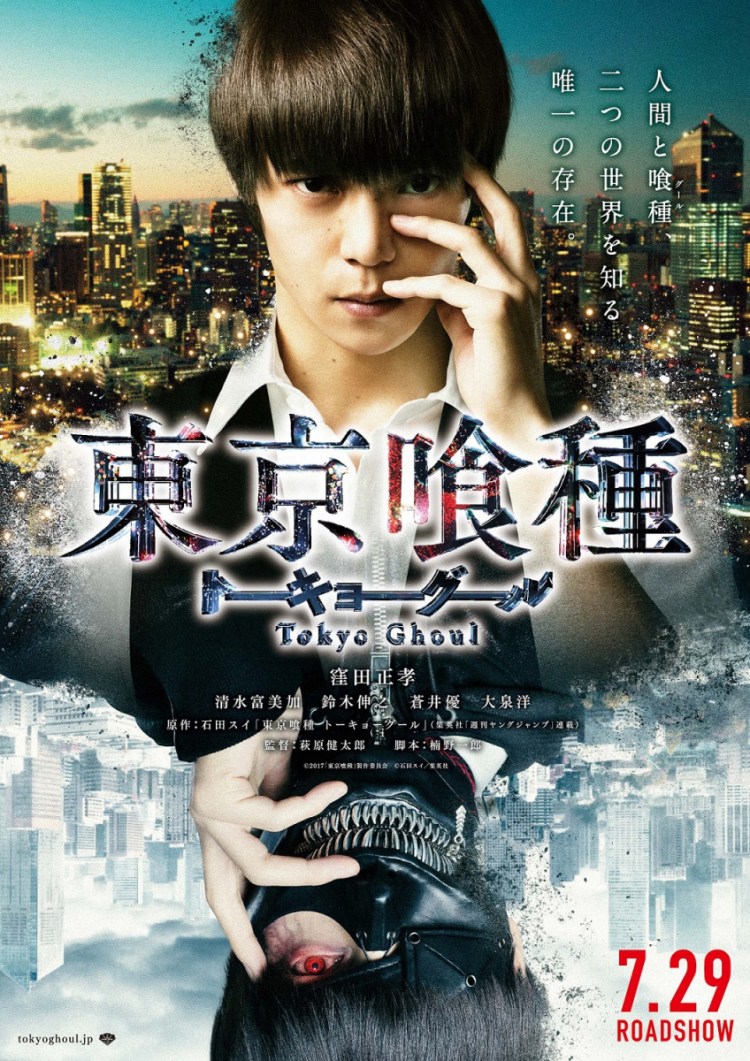
Tokyo Ghoul posterThough the idea has never been far away, Japanese cinema has largely steered clear of the enemy within. Recently however the “they walk among us” phenomenon seems to have gained traction from the horror-leaning Parasyte to the contemplative Before We Vanish. Parasyte would seem to be an appropriate point of departure for Kentaro Hagiwara’s debut feature, an adaptation of Sui Ishida’s hugely popular manga Tokyo Ghoul (東京喰種). Like Hitoshi Iwaaki’s ‘80s take on Invasion of the Body Snatchers, Tokyo Ghoul creates for itself a subsection of “humanity” which is not quite human yet apparently lives alongside “us” keeping its true nature and identity a secret in order to avoid detection. Unlike Parasyte, however, the intentions of the Ghouls are not so much destruction or colonisation as simple survival.

Ken Kaneki (Masataka Kubota), a shy bookworm with only one real friend, is trying to pluck up the courage to talk to another shy bookworm he often notices reading the kind of books he likes in a cafe they both seem to enjoy going to. It would seem that they have quite a lot in common already, but when Ken ends up on a successful date with Rize (Yu Aoi) he gets a little more than he bargained for. Far from the shy and mousy creature of his dreams, Rize is a raging Ghoul hungry for flesh rather than love. Luckily, Rize is killed in a freak accident just as she’s about devour poor Ken. Ken, however, survives but only thanks to a transplant of Rize’s organs meaning he is now part-Ghoul and can only live on human meat.

Neither one thing nor another, Ken struggles to accept his new nature as he craves flesh and has strange visions in which he imagines himself as Rize the crazed and ravenous Ghoul. Starving and alone he finally finds his way to the Anteiku cafe where he first met Rize and now finds a support network led by ethical Ghouls who sustain themselves on ethically sourced meat and high end coffee. These Ghouls do not want to kill, they simply want to survive which also means keeping one step ahead of the CCG which exists specifically in order to hunt down Ghouls with extreme prejudice.

In many a sci-fi tome, the CCG would be the good guys – protecting regular humans from a monstrous threat lurking in the shadows. After all, who would defend a substratum of cannibal serial killers who think nothing of devouring human flesh in front of its horrified offspring, but the CCG have perhaps begun to take too much pleasure in their work. Cold and calculating detective Amon (Nobuyuki Suzuki) has an idea that the world is “wrong” and it’s his job to put it right by exterminating the Ghouls, whereas creepy silver-haired detective Mado (Yo Oizumi) enjoys toying with his prey as much as Rize did and has even begun to harvest the various “Kagune” protuberances with which the Ghouls are endowed to use in his quest to defeat them.

The CCG may be justified in their fear in but in their methods they are little different than their quarry. The Ghouls too have a right to survive and are, after all, only being what they are. CCG might be better off working with Anteiku to minimise the Ghoul threat rather than engaging in a pointless and internecine war that guarantees only a continuation of violence and fear on both sides.

Having posited such interesting ideas it’s a shame that Tokyo Ghoul reverts to the classic super hero formula of resolving everything through a climactic battle in which Ken is forced to confront himself whilst battling CCG. Neither Ghoul nor human, Ken sees faults on both sides but perhaps learns to come into himself, no longer a diffident young man but one committed to protecting his friends even if it’s themselves they need protecting from.

Hagiwara opts for an artier approach than might expected though his noble intentions are often undercut by poor quality CGI and the inescapably outrageous quality of the source material. Nevertheless he gets impressive performances from his young cast even if some fan favourite characters are relegated to little more than background decoration and others scarcely written at all. Perhaps biting off more than it can chew, Tokyo Ghoul is an uneven experience but one that does its best to find heroism in villainy and villainy in heroism, negating the good/evil dichotomy of superhero morality for something altogether more complex.


Tokyo Ghoul was screened for one night only across the UK and will be released by Anime Limited later in the year.

UK release trailer (English subtitles)

Chin-yu-ki: The Journey to the West with Farts (珍遊記, Yudai Yamaguchi, 2016)

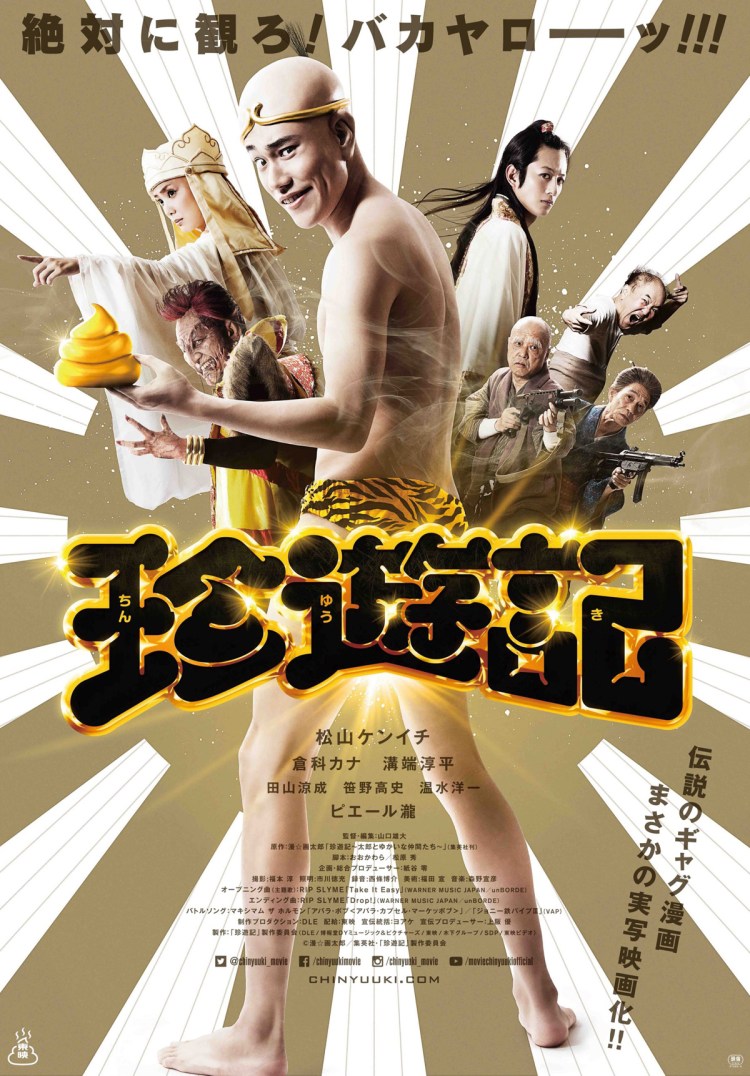
Chin-yu-ki posterWhen a film tells you what it is, you should believe it the first time. Many fine films are undone by unwise titles, but if you were expecting anything more than what is promised by the title of Chin-yu-ki: Journey to the West with Farts (珍遊記), you have only yourself to blame. Director Yudai Yamaguchi is known for his distinctly lowbrow, zany humour and it seems he’s met his match in adapting the much loved Journey to the West parody manga, Chin-yu-ki – Taro to Yukaina Nakamatachi. Set in Japan in an indistinct period possibly somewhere around the Meiji restoration, Chin-yu-ki is a bawdy story of penis power, fantastic farts, romantic disappointments, and the ongoing path to enlightenment of its slightly more than cheeky hero.

Beginning as it means to go on, the film opens with a Buddhist nun, Genzo (Kana Kurashina – renamed “Shenzang” in the subtitles on this HK blu-ray to match the original Journey to the West), talking to an older couple referred to as “Old Fart” (Ryosei Tayama) and “Old Bag” (Takashi Sasano). The couple were never blessed with children of their own and so when they notice a great flash and something falling to Earth, they are delighted to find a lovely baby boy lying in the crater. Unfortunately, Taro Yamada (Kenichi Matsuyama), as the baby is called, is a wrong ‘un. Now 16 years old, Taro is a fiery demon who has robbed the entire area to build himself a giant mansion where he lives on his own and has provided his adoptive parents with a small hovel on the outskirts of town. Old Fart and Old Bag try to warn Genzo that Taro is not your average sinner – he controls people with his giant penis and stinky farts.

Genzo is undeterred and demonstrates her various skills which, strangely, centre around the ability to unping a bra at 20 paces (yes, apparently in this version of the Meiji era, people wear bras). Her other trick is magically hurling buns into people’s mouths which does at least shut them up for a bit. Against the odds she manages to tame Taro, reducing him to his basic, naked state in which she manages to shove a magic crown on his head which allows her to control him and stop him doing naughty things. Genzo determines to take Taro to Tianzhu to purify his soul and so the pair walk off together towards their joint destiny.

The road trip format provides plenty of scope for set piece gags as Genzo and Taro encounter various strange characters along the way who often make surprising returns. This is no character drama, but Taro does indeed learn a few things even as he remains as wilfully naughty as in his unreformed state. As it turns out, the major narrative event revolves around a grudge held by a man who previously encountered Taro at his most cruel. Ryusho (Junpei Mizobata), now a famous pretty boy actor, is still nursing a broken heart after Taro ruined his true love dream which had proved so difficult for him to win as a shy young schoolboy. Now backed by a series of strange companions including a dominatrix-type assistant who dresses in shiny leather and carries a whip, a woman in Cheongsam, and a man in anachronistic Chinese PLA uniform, Ryusho is still a hopeless romantic and develops an unlikely crush on Genzo, which she returns but is unable to act on because of her vows and her mission to reform Taro.

Misunderstandings abound and it has to be said, the crosstalk between Ryusho who has been abandoned by his buddies and has hired a series of Vietnam-era American mercenaries, Genzo, and Taro as they argue about an unclear subject is genuinely quite funny as is the reaction when Taro unmasks himself in a local bar full of bounty hunters who don’t believe he is who he says he is because he’s wearing a shirt with the name of a guy he just robbed on it. The rest of the humour is, however, of a lower order even if the penis and fart jokes fade out in the middle section of the film which does have a few amusing jokes of its own. Matsuyama delivers a surprisingly energetic performance which is in strong contrast with the distant, inscrutable characters he often plays but as cheerful as his Monkey King stand in is, he can’t compensate for the film’s otherwise disposable quality which seems primed to appeal to those seeking zany, lowbrow humour but offers very little else.


Original trailer (no subtitles)

https://www.youtube.com/watch?v=Mwpro6w8z3o

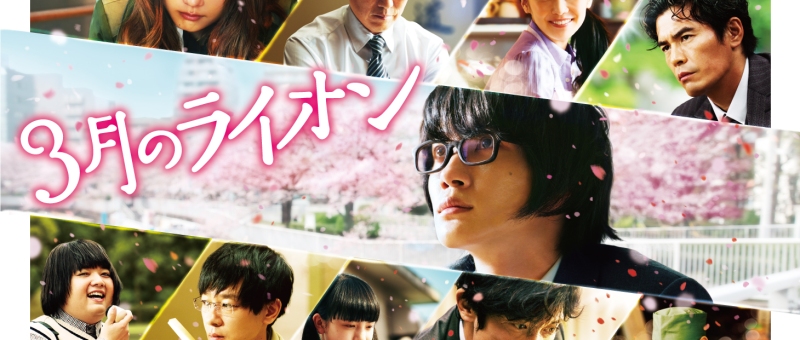
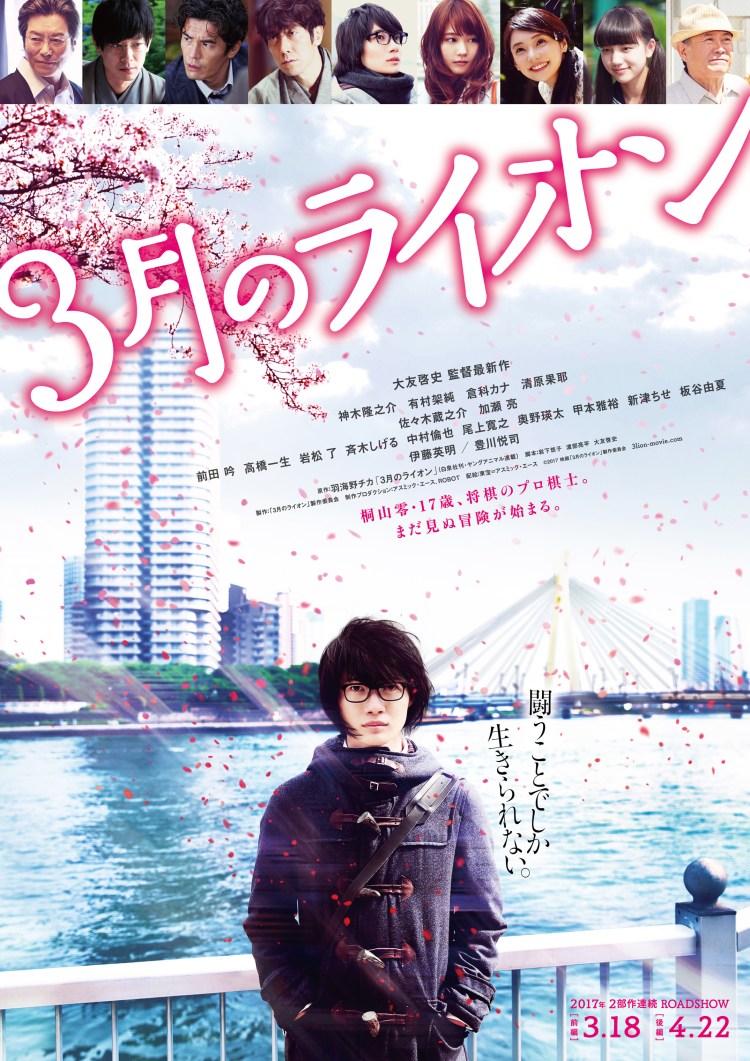
March Comes in Like a Lion (3月のライオン, Keishi Ohtomo, 2017)

march comes in like a lion posterShogi seems to have entered the spotlight of late. Not only is there a new teenage challenger hitting the headlines in Japan, but 2017 has even seen two tentpole Japanese pictures dedicated to the cerebral sport. Following the real life biopic Satoshi: A Move for Tomorrow, March Comes in Like a Lion (3月のライオン, Sangatsu no Lion) adapts the popular manga by Chica Umino in which an orphaned boy attempts to block out his emotional pain through the taxing strategising becoming a top player entails. Shogi, however, turns out to be a dangerous addiction, ruining lives and hearts left, right and centre but, then again, it’s not so much “shogi” which causes problems but the emotional volatility its intense rigidity is often masking.

Rei Kiriyama (Ryunosuke Kamiki) lost his family at a young age when both parents and his little sister were tragically killed in a car accident. Taken in by a family friend, Rei takes up shogi (a game also apparently beloved by his late father) in the hope of being accepted in his new home. A few year’s later, Rei’s plan has worked too well. Better than either of his foster-siblings, Kyoko (Kasumi Arimura) and Ayumu, Rei has become his foster-father’s favourite child causing resentment and disconnection in the family home. Believing himself to be a disruptive influence among those he loves (even if he suspects they still do not love him), Rei removes himself by deciding to live independently, shunning all personal relationships and dedicating his life to the art of shogi.

Everything changes when Rei is taken for a night out by some senior colleagues and is encouraged to drink alcohol for the first time despite being underage. A kindly young woman who lives nearby finds Rei collapsed in the street and takes him home to sleep things off. The oldest of three sisters, Akari (Kana Kurashina) has a habit of picking up strays and determines to welcome the lonely high schooler into her happy home. Suddenly experiencing a positive familial environment, Rei’s views on interpersonal connection begin to shift but people are not like shogi and you can’t you can’t expect them to just fall into place like a well played tile. 

Like Satoshi, the real life subject of which is also echoed in March through the performance of an unrecognisable Shota Sometani who piles on the pounds to play the sickly yet intense shogi enthusiast and Rei supporter Harunobu Nikaido, March dares to suggest that shogi is not an altogether healthy obsession. Koda (Etsushi Toyokawa), Rei’s foster-father, is a shogi master who trained both his children to follow in his footsteps only to pull the rug from under them by ordering the pair to give up the game because they’ll never be as good as Rei. Thinking only of shogi, he thinks nothing of the effect this complete rejection will have on his family, seeming surprised when neither of his children want much more to do with him and have been unable to move forward with their own lives because of the crushing blow to their self confidence and emotional well being that he has dealt them.

Kyoko, Rei’s big sister figure, remains resentful and hurt, embarking on an unwise affair with a married shogi master (Hideaki Ito) who is also emotionally closed off to her because he too is using shogi as a kind of drug to numb the pain of having a wife in a longterm coma. Believing himself to be a disruptive influence who brings ruin to everything he touches, Rei has decided that shogi is his safe place in which he can do no harm to others whilst protecting himself through intense forethought. He is, however, very affected by the results of his victories and failures, feeling guilty about the negative effects of defeat on losing challengers whilst knowing that loss is a part of the game.

Drawing closer to the three Kawamoto sisters, Rei rediscovers the joy of connection but he’s slow to follow that thread to its natural conclusion. His shogi game struggles to progress precisely because of his rigid tunnel vision. Time and again he either fails to see or misreads his opponents, only belatedly coming to realise that strategy and psychology are inextricably linked. Yet in his quest to become more open, he eventually overplays his hand in failing to realise that his viewpoint is essentially self-centred – he learned shogi to fit in with the Kodas, now he’s learning warmth to be a Kawamoto but applying the rules of shogi to interpersonal relationships provokes only more hurt and shame sending Rei right back into the self imposed black hole he’d created for himself immersed in the superficial safety of the shogi world.

As Koda explains to Kyoko (somewhat insensitively) it’s not shogi which ruins lives, but the lack of confidence in oneself that it often exposes. Rei’s problem is less one of intellectual self belief than a continuing refusal to deal with the emotional trauma of losing his birth family followed by the lingering suspicion that he is a toxic presence to everyone he loves. Only in his final battle does the realisation that his relationships with his new found friends are a strength and not a weakness finally allow him to move forward, both personally and in terms of his game. Rei may have come in like a lion, all superficial roar and bluster, but he’s going out like a lamb – softer and happier but also stronger and more secure. Only now is he ready to face his greatest rival, with his various families waiting in his corner silently cheering him on as finally learns to accept that even in shogi one is never truly alone.


Released in two parts – 3月のライオン 前編 (Sangatsu no Lion Zenpen, March Comes in Like a Lion) / 3月のライオン 後編 (Sangatsu no Lion Kouhen, March Goes Out Like a Lamb).

Original trailer (no subtitles)
https://www.youtube.com/watch?v=jjZB0T8PHXE

Gantz:O (ガンツ:オー, Yasushi Kawamura, 2016)

Gantz-oHiroya Oku’s long running manga series Gantz has already been adapted as a TV anime as well as two very successful live action films from Shinsuke Sato. Gantz:O (ガンツ:オー) is the first feature length animated treatment of the series and makes use of 3D CGI and motion capture for a hyperrealistic approach to alien killing action. “O” for Osaka rather than “0” for zero, the movie is inspired by the spin-off Osaka arc of the manga shifting the action south from the regular setting of central Tokyo.

Kicking off in Shibuya, the first scene features the demise of the franchise’s protagonist, Kei Kurono (Yuki Kaji), as he defeats one of the giant monsters terrorising the city and saves his friends but fails to save himself. A quick geographical cut takes us Osaka where there are reports of another disturbance, but the major threat turns out to be a depressingly commonplace one as a lone madman goes on a stabbing spree at a Tokyo train station.

17 year old high school student Masaru Kato (Daisuke Ono) gets himself mixed up in the incident when he ignores the crowds of people running in the opposite direction and comes to the aid of an injured old man. Sadly, Kato is repeatedly stabbed by the attacker and “dies” at the scene only to be resurrected in front of Gantz. Introduced to fellow players Suzuki (Shuuichi Ikeda) – an old man who “died” of a stroke, Reika (Saori Hayami) – an idol who was “killed” in a car crash, and the sardonic teenager Nishi (Tomohiro Kaku), Kato learns that he’s been given a second chance at life as a warrior in Gantz’s survival game in which he must fight off huge monsters within the time limit or die for real.

The entirety of Gantz:O revolves around this one climactic battle in the Osaka streets as Kato, Suzuki, Reika, and Nishi come into contact with the much more successful (but definitely less “nice”) Osaka detachment as backup in the fight against these fearsome monsters. As such, the main draw is furious action filled with bizarre scenes of carnage as the gang take down a collection of strange creatures often inspired by traditional folklore such as the huge winged tengu or shapeshifting priest-like boss. The visuals are extremely impressive displaying extreme fluidity of motion almost akin to live action photography.

Aesthetics are the key as the movie’s other elements are more or less inconsequential. As a bonus episode in the Gantz world, this is only to be expected and O makes no real attempt to do anything other than focus on the monster killing action. Thus character development is often shallow or non-existent, falling into genre clichés of cool heroes and depressed, brokenhearted women.

The question of self preservation vs altruism is central to the Gantz universe which begins from a position of nihilism and narcissistic self determination but gradually opens up to the importance of protecting one’s comrades, friends, family, and fellow human beings. Kato is the selfless hero the gang have been awaiting – his “death” results directly from his reckless attempt to help an injured person and his instinct is always to help those in need no matter the personal cost. His determination to save the lives of strangers is directly contrasted with his responsibility to the younger brother who is entirely dependent on him and would be lost should Kato lose his life. The film is ambivalent towards this dilemma as it constantly harks back to the people waiting for these secret warriors to come home, at once critical of them for risking their lives and acknowledging the fact that someone has to fight these monsters or everyone will die.

Despite the exposition heavy opening, Gantz:O does little to explain its world to the uninitiated and provides no logical explanations for its machinations leaving newcomers to the franchise with a host of unanswered questions but then all Gantz really wants to do is sell the message of altruism whilst destroying odd looking monsters in various bloody ways. Depressingly sexist, if edging away from the franchise’s nihilistic baseline, Gantz:O is an impressive visual spectacle but remains an essentially hollow, inconsequential addition to the Gantz canon.


Original trailer (no subtitles)