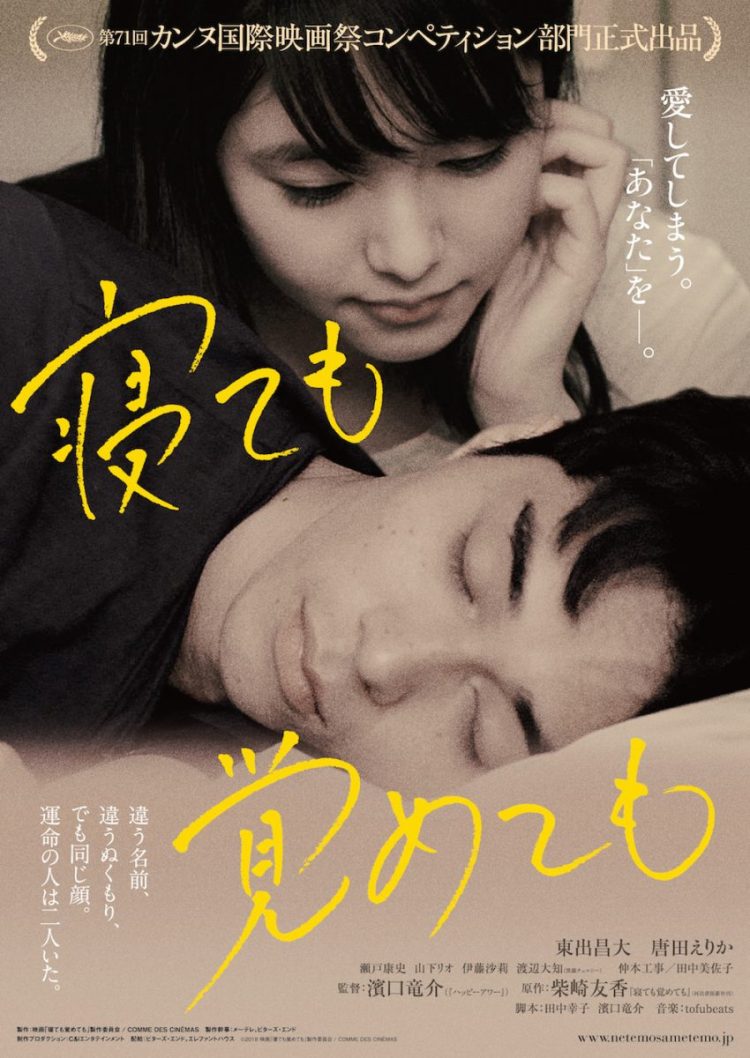
Asako I & II (寝ても覚めても, Ryusuke Hamaguchi, 2018)

asako I & 2 posterDualities define the perpetually submerged worlds of Ryusuke Hamaguchi’s Happy Hour followup Asako I & II (寝ても覚めても, Netemo Sametemo). Waking and sleeping, fantasy and reality, past and present, presence and absence, love and sadness. Asako (Erika Karata), an ordinary young woman of the contemporary era, finds herself in a similar position to many of the heroines of contemporary Japanese literature in that she has no idea what she really wants out of life and is essentially torn between a series of idealised lives snatched from movies and magazines. Yet she is also haunted by a broken heart, arrested in a state of perpetual adolescence thanks to an early disappointment in love in which remains horribly unresolved.

As a university student in Osaka, Asako attends a photo exhibition dedicated to one of the few books put out by legendary Japanese photographer Shigeo Gocho titled “Self and Others”. Fascinated by an eerie picture of two little girls dressed identically, one slightly taller than the other, Asako’s attention is eventually caught by a striking young man. She leaves the exhibition and follows him until he eventually turns and faces her. Firecrackers some teenagers had been struggling to light suddenly explode around his feet. He strides over to her, asks for her name, and then leans in for a kiss – at least, that’s the way he later tells it to a disbelieving friend who points out that “no one meets like that”. An arty type in dungarees and shaggy hair, the young man’s name is “Baku” (Masahiro Higashide) – he uses the character for wheat (his dad was big into grains) but it’s also a homonym for explosion which a is key indication of the unpredictable excitement he comes to represent for Asako as her uni best friend Haruyo (Sairi Ito) attempts to warn her by insisting that Baku is the heartbreaking type and whatever she has with him is destined to end in tears.

Haruyo’s prediction comes to pass when Baku steps out one day to buy some shoes and never returns. A brokenhearted Asako makes her way to Tokyo and begins working a cafe but two and a bit years later, she is stunned to find “Baku” wearing a suit and working in an office. He doesn’t remember her and says his name’s Ryohei, but Asako can’t shake the association which is both attractive and repellent in equal measure. Ryohei is smitten, he felt the connection too, but Asako doesn’t quite know what to do with this unfortunate coincidence.

Events repeat themselves with only mild distortions – Asako and Ryohei attend another Gocho photo exhibition though this time with Asako’s Tokyo best friend, Maya (Rio Yamashita). Rather than a motorcycle accident, Ryohei and Asako find and comfort each other after the 2011 earthquake and eventually become a couple, move in together, and even get a cat. Asako begins to fall for Ryohei, but can’t be sure her love for him isn’t really love for Baku refracted through a different lens. Baku, a man with a wandering heart, once told her he would always return no matter how long it might take. There’s a part of Asako that’s always waiting, held back, afraid to move and unwilling to acknowledge the death of her younger self as immortalised in the image of herself with Baku.

When Haruyo runs into Asako and Ryohei unexpectedly in Tokyo, she gives us our first indication that Ryohei really does look like Baku and the association isn’t just a projection of Asako’s romantic anxieties. Haruyo’s first words to Asako are that she hasn’t changed – they’re intended as a compliment, but Asako bristles. She feels as if she’s moved forward, matured, is preparing to enter a comfortable middle age with Ryohei at her side but deep down she knows she hasn’t. She’s still the naive student pining for a lost love that never cared enough about her to resolve itself. She worries she’s been playacting and that her relationship with Ryohei isn’t “real” even if she cares about him enough to have her feeling guilty for this mild form of betrayal.

Later, offered another possibility, Asako feels as if her life with Ryohei has been like a dream, or perhaps the only waking moment of her life. When Ryohei introduces a work friend to Maya as an excuse to get close to Asako, they watch a video of her performing a scene from Chekhov’s Three Sisters – a play famously about self delusion in which the fierce belief in an impossible future becomes the only thing which makes life possible. The climactic earthquake hits just as Ryohei is preparing to watch Maya perform in Ibsen’s The Wild Duck – the play which lays bare the playwright’s key tenet, that if you take away a man’s life lie you take away his happiness. Ryohei’s friend Kushihashi (Koji Seto) might rip into Maya’s “narcissistic” acting, denigrating her for attention seeking rather than baring her soul on stage, but Asako admires her determination and absolute certainty in her chosen goal, things she herself lacks.

Talked down by the soothing tones of practiced de-escalator Ryohei, Kushihashi is prompted to confess that his outburst was mostly out of jealously, that having given up his dreams of the stage for a conventional salaryman life he resented seeing someone else embrace theirs. Asako can’t decide which “dream” she wants – a life of fireworks and unpredictability with Baku for all the heartbreak it might bring, or one of gentle happiness with the good and kind Ryohei. A series of crises prompt her into making a clear choice – seemingly her first, though it may be too late. Real love is messy, painful, and ugly, but it’s beautiful too once you learn to see through the miasma of self delusion and romantic fantasy.


Screened as part of the 2018 BFI London Film Festival.

Original trailer (no subtitles)
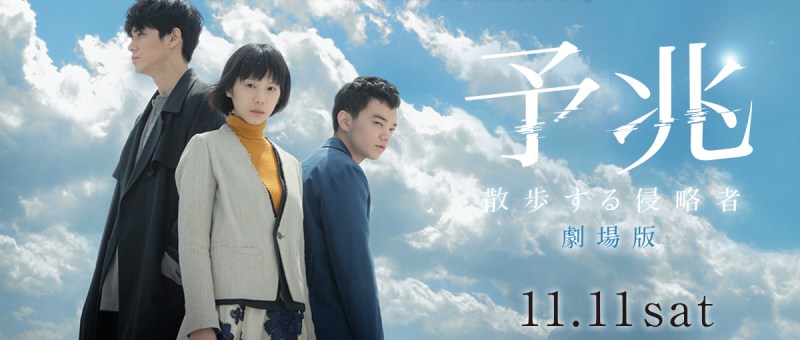
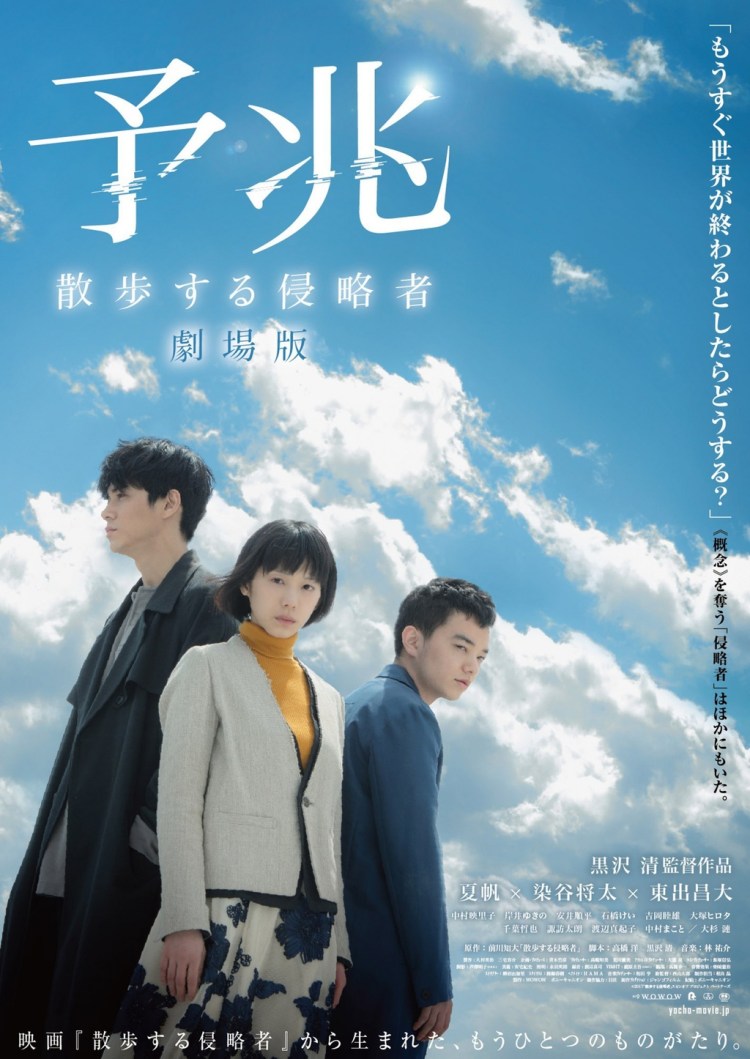
Yocho (Foreboding) (予兆 散歩する侵略者, Kiyoshi Kurosawa, 2017)

Yocho posterBefore We Vanish, Kiyoshi Kurosawa’s take on the alien invasion drama, was an oddly romantic affair which made a case for the ineffability of love as the only possible form of human salvation. Meanwhile, cheating on cinema with television, Kurosawa tells us a different story. Yocho (Foreboding) (予兆 散歩する侵略者, Yocho: Sanpo Suru Shinryakusha) was first conceived as a TV drama running as a companion piece to the big screen experience but its canvas is noticeably darker. At heart, we have the same story with a slight variation as a bold wife attempts to save her weak willed husband from alien manipulation, risking all to keep him safe him while the world burns around her. What we see this time is less the enduring power of love as a force for good, than yet another form of human weakness which encourages selfishness and creates a space into which nefarious forces may move.

In contrast to Masami Nagasawa’s conflicted, wounded wife of Before we Vanish, Etsuko (Kaho) is happily married to Tatsuo (Shota Sometani) who works at the local hospital. As she loves her husband so much, Etsuko is quick to realise there’s something not quite right in the way he’s been silently gazing off into space and walking around like a man possessed. Meanwhile, she’s accosted by a friend at work who asks to stay over because she’s too afraid to go home on account of “the ghost”. Eventually Etsuko goes investigating and discovers “the ghost” is really just her friend’s dad only her friend seems to have forgotten all about him and doesn’t quite understand what a “father” is anymore. Fearing the worst, Etsuko arranges to take her to the hospital, which is where she comes into contact with the strange and intimidating Dr. Makabe (Masahiro Higashide).

Dr. Makabe is one of the alien invaders seen in Before We Vanish who have come to Earth on a scouting mission ahead of its destruction. His mission is to steal “concepts” from people’s heads so the aliens can catalogue soon to be extinct humanity. Makabe has recruited Tatsuo to be his guide but this is a very different arrangement to that Shinji makes with his “wife” Narumi. Tatsuo is not so much an interpreter as an informant. His “job” is to select Makabe’s “victims” in return for preferential treatment when the apocalypse arrives. Increasingly conflicted in betraying his own species, Tatsuo is going slowly off the rails while the world disintegrates all around around him.

Etsuko, meanwhile, has a kind of superpower of her own in that she is apparently “immune” to alien interference. They can’t take concepts from her, they can’t manipulate her will, and they can’t break her bond with her beloved (if slightly useless) husband. The power of love still reigns supreme but this time it’s not entirely a good thing as Etsuko, who has the means to resist the evil invaders, focusses on rescuing her one true love rather than defending humanity. Love is her weakness, whereas Tatsuo’s seems to be a low lying resentment of his lack of authority. A showdown with Makabe sees him offer a grim prognosis, as long as humans lust for power there will be no escape.

Makabe, meanwhile, has experienced the opposite revelation to his Before we Vanish counterpart in learning about death and human fear of mortality. Suddenly knowing what it means to die, he understands something of human existence, realising that death is forever beside you. Love maybe be the cure for “eternal loneliness”, but Makabe’s enlightenment is born of fear and darkness rather than human warmth.

Yocho, in a sense, mirrors Before We Vanish but in a darker hue. Etsuko and Tatsuo maybe a “happier” couple than Shinji and Narumi, but Tatsuo has already crossed to the dark side, abandoning his humanity and committing heinous and unthinkable acts on behalf of his alien master out of fear and desire. Makabe, taking Tatsuo to task, points out his weakness in his need for painkilling drugs to overcome the punishment Makabe has handed down for his betrayal. Humans, he says, always choose the comforting lie over the painful truth, swallowing pain killers rather than killing the pain by dealing with its root cause. This is in a way what Etsuko has chosen to do in her quest to save Tatsuo rather than using her skills to resist the alien invasion, though Makabe remains oddly fascinated by her various unusual qualities. Foreboding fills the frame as Etsuko meditates on the various oddities of her world while the skies thunder behind her, sending curtains billowing ominously in the absence of wind. A wounded Makabe ironically remarks that he has “underestimated the power of love”, reminding us that the greatest of human strengths is also its weakness, promising destruction as much as salvation.


Screened at the 20th Udine Far East Film Festival.

Original trailer (English subtitles)

https://www.youtube.com/watch?v=9_vEqvtUdxM

Sekigahara (関ヶ原, Masato Harada, 2017)

Sekigahara posterWhen considering a before and an after, you’d be hard pressed to find a moment as perfectly situated as the Battle of Sekigahara (関ヶ原). Taking place on 21st October 1600 (by the Western calendar), Sekigahara came at the end of a long and drawn out process of consolidation and finally ended the Sengoku (or “warring states”) era, paving the way for the modern concept of “Japan” as a distinct and unified nation. In actuality there were three unifiers of Japan – the first being Oda Nobunaga who brought much of Japan under his control before being betrayed by one of his own retainers. The second, Toyotomi Hideyoshi, continued Oda’s work and died a peaceful death leaving a son too young behind him which created a power vacuum and paved the way for our third and final creator of the modern Japanese state – Tokugawa Ieyasu whose dynasty would last 260 years encompassing the lengthy period of isolation that was finally ended by the tall black ships and some gunboat diplomacy.

Loosely, we begin our tale towards the end of the rule of Toyotomi Hideyoshi (Kenichi Takito) though, in a nod to the novel, director Masato Harada includes a temporal framing sequence in which our author depicts himself as a boy during another war sitting in these same halls and hearing stories of heroes past. As well he might given where he was sitting, the narrator reframes his tale – our hero is not the eventual victor, Tokugawa Ieyasu, but a noble hearted retainer of the Toyotomi, Mitsunari (Junichi Okada).

Riding into battle, Mitsunari reminds his men that this is a war of “justice and injustice” – they cannot lose. Yet lose they do. The narrator recounts Mitsunari’s improbable rise as an orphan taken in by Hideyoshi on a whim who nevertheless became one of the most powerful men in late 16th century Japan. Despite his loyalty to his master, Mitsunari cannot abide the cruelty of the samurai world or its various modes of oppression both in terms of social class and even in terms of gender. He resents the subversion of samurai ethics to facilitate “politics” and longs to restore honour, justice, and fairness to a world ruled by chaos. Rather than the bloody uncertainty and self-centred politicking that define his era, Mitsunari hopes to enshrine these values as the guiding principles of his nation.

On the other hand, his opponent, Tokugawa Ieyasu (Koji Yakusho) is famed for his intelligence and particularly for his political skill. Hoping to swoop into the spot vacated by Hideyoshi which his young son Hideyori is too weak to occupy, Ieyasu has been playing a long game of winning alliances and disrupting those other candidates had assumed they had secured. Unlike Mitsunari, Ieyasu is ruthless and prepared to sacrifice all to win his hand, caring little for honour or justice or true human feeling.

The framing sequence now seems a little more pointed. Sekigahara becomes a turning point not just of political but ideological consolidation in which Mitsunari’s ideas of just rule and compassionate fair mindedness creating order from chaos are relegated to the romantic past while self interest triumphs in the rule of soulless politickers which, it seems, travels on through the ages to find its zenith in the age of militarism. Mitsunari is the last good man, prepared to die for his ideals but equally prepared to live for them. His tragedy is romantic in the grander sense but also in the more obvious one in that his innate honour code will not let him act on the love he feels for a poor girl displaced from Iga whose ninja service becomes invaluable to his plan. With a wife and children to consider, he would not commit the “injustice” of creating a concubine but dreams of one day, after all this is over, resigning his name and position and travelling to foreign lands with the woman he loves at his side.

Working on a scale unseen since the age of Kurosawa, Harada patiently lays the groundwork before condensing the six hours of battle to forty minutes of fury. The contrast between the purity of the past and the muddied future is once again thrown into stark relief in the vastly different strategies of Ieyasu and Mitsunari with Ieyasu’s troops armed to the teeth with modernity – they fire muskets and shout cannon commands in Portuguese while Mitsunari’s veteran warriors attempt to face them with only their pikes and wooden shields. Unable to adapt to “modern” warfare and trusting too deeply in the loyalty of his comrades, Mitsunari’s final blow comes not by will but by chance as a young and inexperienced vassal vacillates until his men make his decision for him, betraying an alliance he may have wished (in his heart) to maintain. Goodness dies a bloody death, but there is peace at last even if it comes at a price. That price, for some at least, may have been too great.


Original trailer (no subtitles)
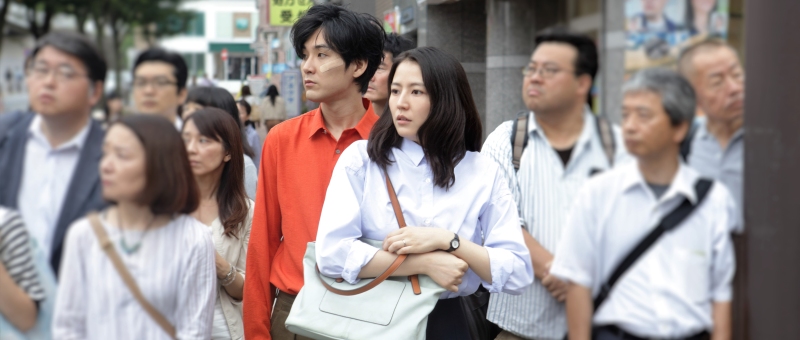
It All Began When I Met You (すべては君に逢えたから, Katsuhide Motoki, 2013)

It All Began When I Met You posterChristmas, in Japan, is an occasion for romance. Strangely, the Christmas date movie has never quite taken off though there are a fair few examples of this oft maligned genre even if they don’t generally help to ameliorate the contempt in which it is held. Truth be told, It All Began When I Met You (すべては君に逢えたから, Subete wa Kimi ni Aeta kara) won’t help to do that either but then it isn’t really intended to so much as provide a little warmth combat the to Christmas cold whilst celebrating the centenary of Tokyo Station (a destination surely as romantic as meeting under the clock at Waterloo).

Spinning out from Tokyo Station, the film splits into six interconnected stories of love ranging from dealing with long distance romance to an orphaned little girl who has projected her need to believe in the existence of her parents onto a faith in Santa Claus. Counting down to Christmas Day, the protagonists each progress towards some kind of crisis point which will allow them to deal with their various problems whilst getting into the holiday spirit.

Couple one are a pair of youngsters, one a fashion designer, Setsuna (Fumino Kimura), and the other an engineer, Takumi (Masahiro Higashide), who are separated because of differing work commitments. She’s in Tokyo, he’s up North, but they chat on the phone all the time and seem close despite the distance between them. The truth is revealed when Takumi comes to Tokyo and is supposed to meet up with Setsuna but stays out all night drinking with a (female) colleague instead.

Meanwhile, a college student (Tsubasa Honda) is invited to a karaoke party but isn’t sure whether to go because her crush is going and she can’t pluck up the courage to confess to him. Her boss at the pastry shop (Chieko Baisho) where she works tells her to go get him rather than allow her true love to slip away as, we later find out, happened to her when her boyfriend failed to appear at Tokyo Station 49 years earlier when they had arranged to elope. One of their regular customers, a Shinkansen driver (Saburo Tokito), has just retired early and, it turns out, may not have long to live but wants to make the most of his last Christmas with his son (Ryutaro Yamasaki) who is preoccupied about a “half-coming of age” ceremony they’re having at school.

Across down, the train driver’s brother-in-law, an arrogant CEO (Hiroshi Tamaki), runs into an aspiring actress (Rin Takanashi) who is currently in rehearsals for a play she puts on every year at a local orphanage. This year might be her last, however, because she’s begun to accept that her acting career will never take off and it’s time to go home. One of the little girls at the orphanage, Akane (Emiri Kai), is particularly looking forward to the festivities because she’s invested in the unseen figure of Santa as a substitute for believing in the unseen figures of the parents she never knew.

Each of the stories is intended to capture something of the complicated business of modern city living – a long distance relationship is, perhaps, something that many will be familiar with, relating to the pain and confusion of being not quite sure where each party currently is in terms of commitment. The pace of contemporary life frustrates romance, but the station is there to connect people and bring them back together. The conclusion is perhaps a little optimistic in its sudden cementing of a romantic bond but broadly in keeping with the Christmas theme.

The CEO and the actress, by contrast, are a much more conventional rom-com couple. Serendipitously meeting each other at various upscale joints, the CEO immediately tags the actress as a gold digger after she (accidentally) catches him flashing his premium credit card. Offended she spins him a yarn about a dead boyfriend as payback but finds it backfiring when he is unexpectedly moved and tries to make it up to her. Warmer in tone, this strand sets the station up as a symbol of the interconnectedness of city life where such mini miracles are indeed possible even if the perfectly rational reason for all the coincidental meetings is later explained to us.

However, where there’s joy there’s also heartbreak. The train driver’s tale seems out of place here, but plays into other themes of coming to terms with reality and committing to enjoying the now rather than worrying about the past or future. Similarly, the little girl begins to work out her faith in Santa maybe misplaced because the letter he’s written her is in Japanese, which is weird because isn’t Santa Swedish? Learning to accept that not having parents is not due to a lack of faith and that she has good people looking after her helps Akane move past her loneliness while the baker gets a surprise visitor who helps fill in a few details about her failed romance which in turn helps her offer advice to her young assistant faced with her own typically adolescent love worries.

Miracles really do take place at Tokyo Station, which, it has to be said, is quite picturesque. Saccharin and superficial, It All Began When I Met You is nevertheless a heartwarming tribute to the strange serendipity of city life, throwing in a good amount of Christmas cheer with hope for the future and presumably a happy new year.


Original trailer (no subtitles)

Before We Vanish (散歩する侵略者, Kiyoshi Kurosawa, 2017)

©2017 BEFORE WE VANISH FILM PARTNERS

before we vanish posterKiyoshi Kurosawa is getting sentimental in his old age. In Journey to the Shore and Real, brokenhearted, left behind spouses went on long and difficult journeys of grief and salvation. In Before We Vanish (散歩する侵略者, Sanpo Suru Shinryakusha) we receive a visitation that presages our doom but wishes to know us before we go. An alien invasion movie which takes its cues from Invasion of the Body Snatchers and They Live, Kurosawa’s quirky drama is less about the enemy within than the hidden existential threat of a failure to understand oneself. As the Japanese title suggests, these invaders are merely out for a stroll, making time to smell the flowers before the big lawnmower arrives to cut them all down.

Strange events are afoot in Tokyo. A high school girl wanders home with a pair of goldfish in a plastic bag before brutally murdering her entire family, gazing at the scene of carnage with a beatific smile. Meanwhile, the estranged wife of Shinji Kase (Ryuhei Matsuda), Narumi (Masami Nagasawa), has been sent for to claim her presumably amnesiac husband from a medical facility. Shinji was brought in after wandering the streets cluelessly and seems to have lost certain sections of his memory. The doctor’s diagnosis is uncertain but leans towards some kind of temporary psychotic break or early onset Alzheimer’s. In any case, he is now Narumi’s responsibility, much to her consternation. Across town a down on his luck journalist (Hiroki Hasegawa) covering the brutal family murder finds himself the designated “guide” to another strange young man, Amano (Mahiro Takasugi), who seems to have done something very untoward to his parents.

These three “strangers” are really invaders from outer space – something which they freely confess to anyone who will listen, only everyone assumes they are joking. Exactly why they want to destroy the Earth is never revealed, nor is the the reason for the strange mission undertaken by the three researchers acting as the vanguard for the upcoming invasion. These three have been tasked with a thorough investigation of “humanity” in which they must learn and acquire certain “concepts”. They do this by requiring the subject to visualise their thinking behind a word or phrase and then tapping the head to pinch it causing that concept to be removed from the person’s interior cosmology.

The aliens learn as much from the effect of removing the concept as they do from its explanation. This being Japan, it’s not surprising that the first concept Shinji removes is that of “family” which he takes from Narumi’s younger sister, Asumi (Atsuko Maeda). Asumi had decamped to Narumi’s after an argument with her parents over their railroading her into a mainstream life she doesn’t really want. The removal of the concept of family means Asumi no longer needs to be bound by hollow obligation but her sudden coldness towards her sister immediately invites a series of other questions as to the true nature of their relationship. Similarly, Shinji removes a concept of “possession” from a young man. The young man does not immediately lose understanding of the word, but the concept ceases to be important to him. He is, in a sense, freed from the burden of materialism. Paying an unexpected visit to Narumi’s workplace and meeting her boss who, it seems, has just belittled her work on an important project after she rebuffed his attempt at sexual harassment, Shinji removes his concept of “work” leading him to play aeroplanes all around the office like an overexcited child.

There are positive effects of losing some of these centrally held ideas even if their loss seems tragic or painful on the surface. They are, however, what make us human whether that be attachment to family or an irrational desire to devote all to work and ceaseless acquisition. The final, most elusive concept is that of love – something alien and fascinating to the visitors which they find impossible to harvest due its essentially nebulous nature. Despite being part of a uniform hive mind, the invaders have each developed unique personality traits as a consequence of their “human” lives – the schoolgirl craves violence and destruction, Amano fatherly friendship, and Shinji something close to love with his own “guide” in the form of Narumi whose love for her husband apparently endured despite his betrayal.

Far from the gloomy nihilism of Pulse in which death is eternal loneliness, Before We Vanish suggests that what will survive of us is love. Salvation does, however, require a sacrifice which provokes the film’s romantic conclusion in which the absence of love becomes the “eternal loneliness” promised by Pulse but is tempered by patience and devotion. A gleefully absurdist exploration of the human soul, Before We Vanish finds Kurosawa at his most optimistic affirming the power of the human spirit at its most indestructible.


Screened at the London East Asia Film Festival 2017.

International trailer (English subtitles)

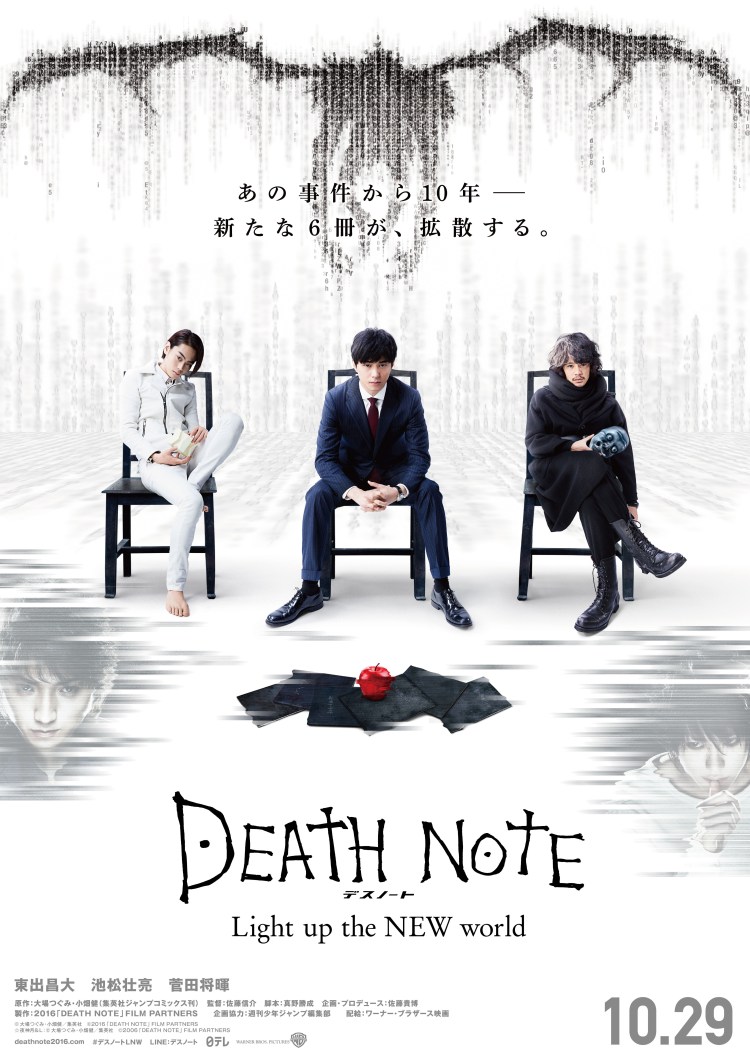
Death Note: Light Up The NEW World (デスノート Light up the NEW World, Shinsuke Sato, 2016)

Death Note- Light up the NEW WorldTsugumi Ohba and Takashi Obata’s Death Note manga has already spawned three live action films, an acclaimed TV anime, live action TV drama, musical, and various other forms of media becoming a worldwide phenomenon in the process. A return to cinema screens was therefore inevitable – Death Note: Light up the NEW World (デスノート Light up the NEW World) positions itself as the first in a possible new strand of the ongoing franchise, casting its net wider to embrace a new, global world. Directed by Shinsuke Sato – one of the foremost blockbuster directors in Japan responsible for Gantz, Library Wars, and the zombie comedy I am a Hero, Light up the NEW World is a new kind of Death Note movie which moves away from the adversarial nature of the series for a more traditional kind of existential procedural which takes its cues from noir rather the eccentric detectives the franchise is known for.

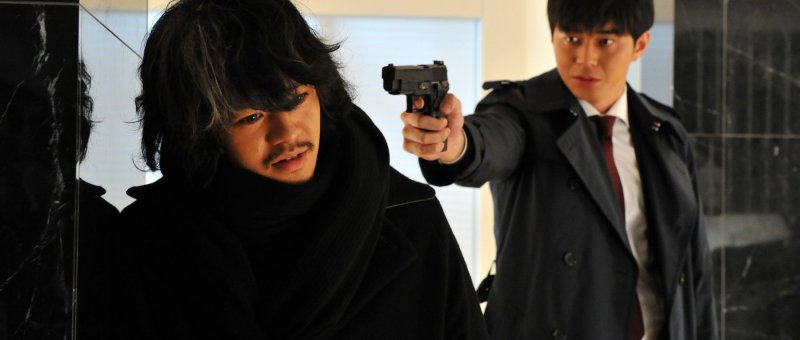
Ten years after Kira, the Shinigami are bored out of their minds and hoping to find themselves a new puppet to play with and so they drop six notebooks at different places across the world and wait to see who picks them up. The first is a Russian doctor who uses it out of curiosity and compassion when faced with the desperate pleas of a suffering, terminally ill man. Others are not so altruistic, as a young girl with reaper eyes goes on a mass random killing spree in the busy Shibuya streets while the police attempt to cover their faces so they can’t fall victim to her relentless writing. Mishima (Masahiro Higashide) of the special Death Note task force hesitates, uncertain whether he should disobey orders and shoot the girl to end her killing spree, but his dilemma is solved when a strangely dressed masked man appears and shoots her for him. He is special detective Ryuzaki (Sosuke Ikematsu) – L’s successor, and a crucial ally in discovering the Shinigami’s intentions as well as the counter plan to obtain the six books and lock them away to permanently disable the Death Note threat.

As in the original series, Kira has his devotees including the cybercriminal Shien (Masaki Suda) who is intent on frustrating the police’s plan by getting his hands on the books and using them to complete Kira’s grand design. This time around, there’s less questioning of the nature of justice or of the police but at least that means there’s little respect given to Kira’s cryptofascist ideas about crime and punishment. At one point a very wealthy woman begins to voice her support of Kira because something needs to be done about “the poor” and all their “crimes” but she is quickly cut down herself as her well dressed friends attempt to rally around her.

The focus is the police, or more specifically their internal political disputes and divisions. Mishima, described as a Kira geek, heads a special squad dedicated to Death Note related crimes, where he is asssited by the flamboyant private detective Ryuzaki who is apparently the last remaining inheritor of L’s DNA. Mishima remains distrustful of his colleague but the bond between the rest of the team is a tight one. In order to frustrate possible Death Note users, none of the squad is using their real names which places a barrier between comrades in arms when it comes to building trust and solidarity in addition to leaving a backdoor open for unexpected secrets.

Sato’s focus, as it has been in the majority of his career, is genre rather than character or exploring the wider themes of the Death Note franchise from the corrupting influence of absolute power to vigilante justice and the failings of the judicial system. The new Death Note world is a more conventional one loyal to the police procedural in which dogged detectives chase mad killers through whatever means necessary whether on foot or online.

The action, however, is generally exciting as the police engage in a cat and mouse game with Shien even if not as complex as that between Kira and L. The Death Notes are an unstoppable force, corrupting otherwise fair-minded people and turning them into vengeful killing machines acting like gods in deciding who should live and who die. Moving away from the series trademark, Light up the NEW World is, essentially, the generic thriller spin-off to the main franchise but is no less fun for it even if it necessarily loses a little of itself in the process.


Death Note: Light up the NEW World was screened at the 17th Nippon Connection Japanese Film Festival.

Original trailer (English subtitles)

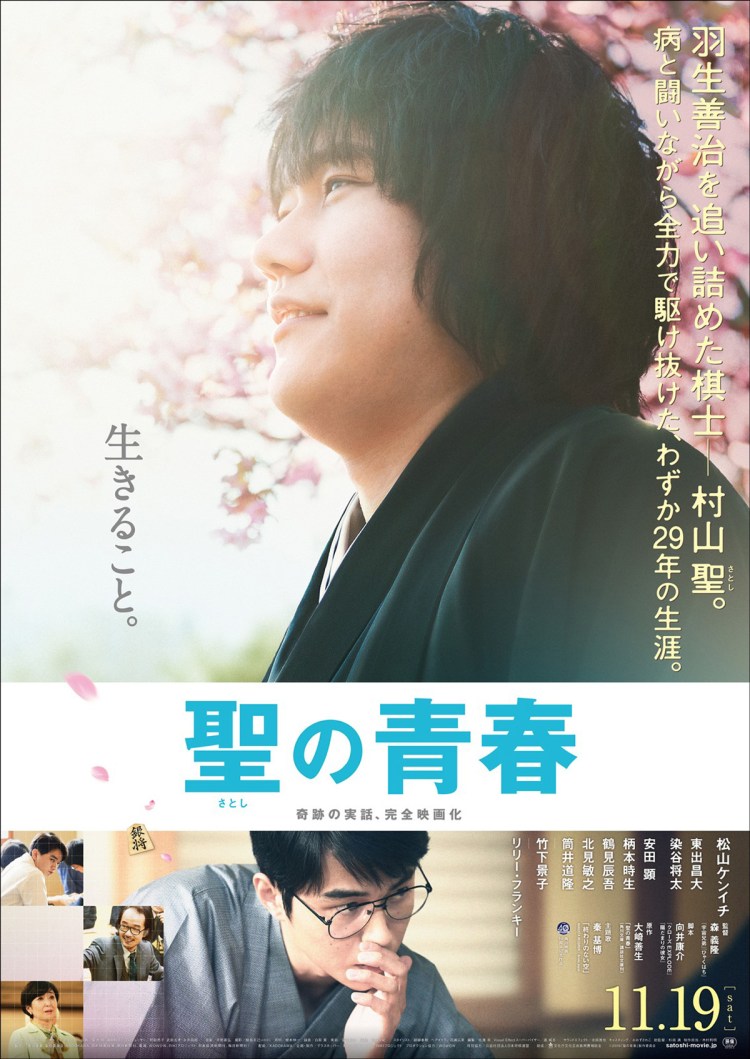
Satoshi: A Move for Tomorrow (聖の青春, Yoshitaka Mori, 2016)

satoshiThere’s a slight irony in the English title of Yoshitaka Mori’s tragic shogi star biopic, Satoshi: A Move For Tomorrow (聖の青春, Satoshi no Seishun). The Japanese title does something similar with the simple “Satoshi’s Youth” but both undercut the fact that Satoshi (Kenichi Matsuyama) was a man who only ever had his youth and knew there was no future for him to consider. The fact that he devoted his short life to a game that’s all about thinking ahead is another wry irony but one it seems the man himself may have enjoyed. Satoshi Murayama, a household name in Japan, died at only 29 years old after denying chemotherapy treatment for bladder cancer in fear that it would interfere with his thought process and set him back on his quest to conquer the world of shogi. Less a story of triumph over adversity than of noble perseverance, Satoshi lacks the classic underdog beats the odds narrative so central to the sports drama but never quite manages to replace it with something deeper.
Diagnosed with nephrotic syndrome as a child, the young Satoshi spent a lot of time alone in hospitals. To ease his boredom his father gave him a shogi set and the boy was hooked. Immersing himself in the world of the game, Satoshi read everything he could about tactics, practiced till his fingers bled and came up with his own unorthodox technique for playing that would eventually take him from his Osaka home to the bright lights of Tokyo. Determined to become the “Meijin”, beat top shogi player Habu (Masahiro Higashide), and get into the coveted 9th Dan ranking Satoshi cares for nothing other than the game, his only other hobbies being drink, junk food, and shojo manga.

Undoubtedly brilliant yet difficult, Satoshi is not an easy man to get along with. Years of medical treatment for nephrosis have left him pudgy and bloated, and an aversion to cutting his hair and nails (poignantly insisting that they have a right to live and grow) already makes him an unusual presence at the edge of a shogi board. He’s not exactly charming either with his overwhelming intensity, aloofness, and fits of angry frustration. Yet the shogi world fell in love with him for his encyclopaedic yet totally original approach to the game. His friends, of which there many, were willing to overlook his eccentricities because of his immense skill and because they knew that his anger and impatience came from forever knowing that his time was limited and much of life was already denied to him.

This insistent devotion to the game and desire to scale its heights before it’s too late is what gives Satoshi its essential drive even if the road does not take us along the usual route. Reckless with his health despite, or perhaps because of, his knowledge of his weakness, Satoshi operates on a self destructive level of excessive drink and poor diet though when he starts experiencing more serious problems which require urgent medical intervention, it’s easy to see why he would be reluctant to get involved with even more doctors. Eventually diagnosed with bladder cancer, Satoshi at first refuses and then delays treatment in fear that it will muddy his mind but the doctors tell him something worse – he should stay away from shogi and the inevitable stress and strain it places both on body and mind. For Satoshi, life without shogi is not so different from death.

Satoshi has his sights set on taking down popular rival Habu whose fame has catapulted him into the Japanese celebrity pantheon, even marrying a one of the most beloved idols of the day. Habu is the exact opposite of Satoshi – well groomed, nervous, and introverted but the two eventually develop a touching friendship based on mutual admiration and love of the game. On realising he may be about to beat Satoshi and crush his lifelong dreams, Habu is visibly pained but it would be a disservice both to the game and to Satoshi not to follow through. Outside of shogi the pair have nothing in common as an attempt to bond over dinner makes clear but Habu becomes the one person Satoshi can really talk to about his sadness in the knowledge that he’ll never marry or have children. As different as they are, Satoshi and Habu are two men who see the world in a similar way and each have an instinctual recognition of the other which gives their rivalry a poignant, affectionate quality.

Despite the game’s stateliness, Mori manages to keep the tension high as elegantly dressed men face each other across tiny tables slapping down little pieces of wood featuring unfamiliar symbols. Japanese viewers will of course be familiar with the game though overseas audiences may struggle with some its nuances even if not strictly necessary to enjoy the ongoing action. Matsuyama gives a standout performance as the tortured, tragic lead even gaining a huge amount of weight to reflect Satoshi’s famously pudgy appearance. Rather than the story of a man beating the odds, Satoshi’s is one of a man who fought a hard battle with improbable chances of success but never gave up, sacrificing all of himself in service of his goal. Genuinely affecting yet perhaps gently melancholy, Satoshi: A Move for Tomorrow is a tribute to those who are prepared to give all of themselves yet also a reminder that there is always a price for such reckless disregard of self.


Satoshi: A Move for Tomorrow was screened as part of the Udine Far East Film Festival 2017.

Original trailer (English subtitles)

https://www.youtube.com/watch?v=dNN7OrXsrvI

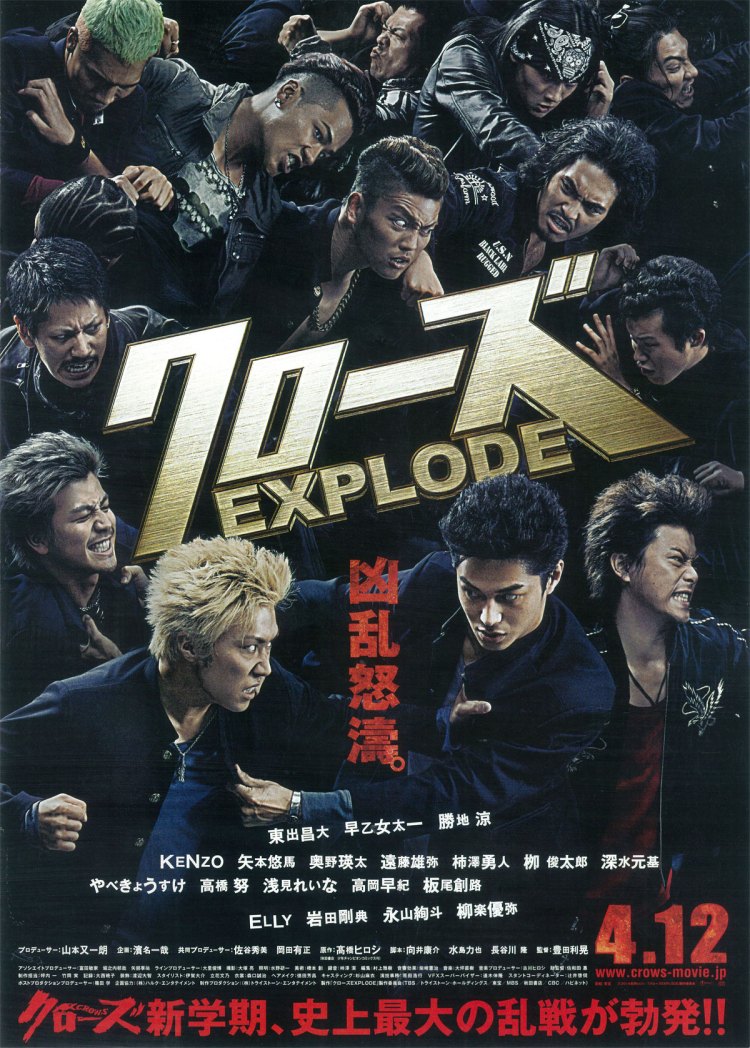
Crows Explode (クローズ EXPLODE, Toshiaki Toyoda, 2014)

crows explodeToshiaki Toyoda made an auteurst name for himself at the tail end of the ‘90s with a series of artfully composed youth dramas centring on male alienation and cultural displacement. Attempting to move beyond the world of adolescent rage by embracing Japan’s most representative genre, the family drama, in the literary adaptation Hanging Garden, Toyoda’s career hit a snag. Despite the film’s favourable reception with critics, a public drugs scandal cost Toyoda his career in Japan’s extremely strict entertainment industry. Since his return to filmmaking in 2009 Toyoda has continued to branch out but 2014’s Crows Explode (クローズ EXPLODE) throws him back into that early world of repressed male energy as internalised rage and frustration produce externalised violence. Picking up the Crows franchise where Takashi Miike left off, Toyoda brings his unique visual sensiblilty to the material, swapping Miike’s irony for something with more grit but losing the deadpan depth of its adolescent posturing in the process.

The old gods have fallen and new ones must rise. Tough guys graduate, but the battlefields of Suzuran High endure eternally. Suzuran is the ultimate in delinquent schools. None of the boys here are under any misapprehension that the adult world holds any promise for them. Many will drop out without completing high school, condemning themselves to a precarious life of continually uncertain, low paid employment, but even those who do manage to leave with a certificate will be heading into another competition to find a steady job in economically straightened times.

That is, those of them who don’t end up in a gang. The thing at Suzuran is that your fate is determined by your fists. Boys roam the halls looking for a fight, each vowing to become the top dog and de facto leader by proving themselves the best and the strongest of the strapping young men all vying for the title. A new challenger arrives in the form of transfer student, Kaburagi (Masahiro Higashide), whose intense energy upsets the dynamic between presumed number one Goura (Yuya Yagira) and his challenger Takagi (Kenzo) but Kagami (Taichi Saotome), the loner son of a fallen yakuza, seems further set to pose a threat in this knife edge environment.

Toyoda has some interesting points to make about the legacy of violence and the importance of father son relationships as each of these young men is reacting in some sense against a father or just his father’s world. Kaburagi, the film’s protagonist, is nursing a deep wound of double abandonment after witnessing his father’s death and then being deposited in a foster home by his sorrowful mother who promises to return for him soon but makes do with occasional visits and monetary gifts. Kaburagi is an angry young man and like many angry young men, he is eager not to become his father – a situation complicated by the fact that his father was a prize fighter who died in the ring.

His “mirror” Kagami, has a similar problem only his father died in a yakuza turf war. A surrogate presents himself in the form of former Suzuran scrapper “Jarhead Ken” (Kyosuke Yabe), now an ex-yakuza helping out at a friend’s second hand car dealership but unable to escape gangland troubles when it emerges Kagami’s clan are intent on acquiring it in order to turn the place into some kind of “entertainment complex”. Ken, a tough guy but soft hearted, has a talent for paternalism which he turns on the fatherless little boy of the car dealership’s owner to whom he teaches the importance of a hefty punch but also of friendship and loyalty.

Miike’s world was a surreal one, inflected with a wry middle aged eye which sees all of this teenage rambunctiousness for the ridiculous posturing it really is. Toyoda’s attempts to be more in the moment, experiencing the adolescent angst with all of its immediate force but unlike his early protagonists the boys of Suzuran are forced to “explode” rendering that central tenet of repressed anger redundant. Externalising the internal war somehow makes it much less interesting as boys trade blows, mindlessly trying to work out a mental struggle which their ill drawn backgrounds will not support.

The environment which the boys inhabit is a grey and hopeless one. Toyoda paints it with his characteristic visual flair, returning to his trademark sequences of slow motion coupled with indie music, but his energy is very different from Miike’s and its more contemplative rhythm never quite gels with the pugilistic fury of the source material even as it gives way to his more expressionistic imagery. The franchise is feeling a little punch drunk by this point, and Toyoda finds it in a particular puddle of teenage malaise. Still, the fists fly and the boys of Suzuran rise and fall as always providing enough self consciously cool action to sustain interest despite the otherwise insubstantial quality.


International trailer (English subtitles)

Creepy (クリーピー 偽りの隣人, Kiyoshi Kurosawa, 2016)

creepyHow well do you know your neighbours? Perhaps you have one that seems a little bit strange to you, “creepy”, even. Then again, everyone has their quirks, so you leave things at nodding at your “probably harmless” fellow suburbanites and walking away as quickly as possible. The central couple at the centre of Kiyoshi Kurosawa’s return to genre filmmaking Creepy (クリーピー 偽りの隣人, Creepy Itsuwari no Rinjin), based on the novel by Yutaka Maekawa, may have wished they’d better heeded their initial instincts when it comes to dealing with their decidedly odd new neighbours considering the extremely dark territory they’re about to move in to…

The Takakuras, Koichi (Hidetoshi Nishijima) and Yasuko (Yuko Takeuchi), have just relocated to the suburbs where Koichi will be taking a position at a local university teaching criminal psychology. A year previously, Koichi had been a member of the police force working on serial murder cases but after a serious miscalculation on his part during a negotiation with an escaped prisoner leaves an innocent woman dead and himself in the hospital, Koichi comes to the conclusion that he’s not quite cut out for the force after all.

Having just moved into the neighbourhood, Koichi and Yasuko attempt to make the expected visit to announce their presence to their neighbours only to find that the locals aren’t exactly friendly. After one neighbour slams the door in her face, Yasuko pays a visit to the other one, Nishino (Teruyuki Kagawa), but the way in which be begins talking to her is very strange indeed. Though unsettled, Yasuko just can’t let the idea drop and becomes intent on building up a more conventional relationship with her hard to read neighbour, ignoring all of her better instincts in the process.

Meanwhile, Koichi has become intrigued by a six year old cold case in which three members of a family abruptly disappeared leaving their young daughter, Saki (Haruna Kawaguchi), behind. Working with a former colleague, Nogami (Masahiro Higashide), Koichi tracks down the abandoned little girl (now a teenager) and attempts to get to the bottom of the mystery.

Japanese films are full of the parasitic interloper who wheedles his way into a family only to usurp control for himself and eventually colonise it. Generally, such families go back to normal once the interloper has had his fun but for the families of Creepy that would be quite difficult. In the modern world when the family unit has become so fractured and insecure that it renders once permanent communities only temporary, a chasm has been opened in human interactions which makes it easier for extreme horror to locate itself right next door to you. Nobody knows what goes on behind closed doors, and in a sense no one wants to know. Koichi attempts to use his scientific knowledge to reassure Yasuko that, as psychopaths are usually very good neighbours, Nishino must be fine, but this only goes to show superficial the couple’s interest in their environment really is.

Koichi has a mild obsession with serial killers. His desire to spend more time with a real life psycho contributed to this fall from grace at the beginning, but his investigative abilities leave a lot to be desired. Yasuko may have suggested that Nishino is the kind of person who “has no social skills” but Koichi is the archetypal interrogator – only interested in the facts and blind to the emotional subtext. After Koichi puts too much pressure on the traumatised Saki, she accuses him of tearing into people’s emotions as if dissecting a rat, and later asks him if he has any kind of heart or real human empathy at all. For all his highly prized science, most of Koichi’s clues are based on his intuition – he just “feels” the house seems like a crime scene, that Nishino is a bad guy, and that something strange is going on.

This almost supernatural “feeling” becomes the central spine of the film as creepiness travels through the air in invisible waves. Kurosawa adopts a swirling, floating approach to camera movement in the early part of the film which gives it a drunken, ethereal atmosphere, preventing any concrete attempt to grasp the reality. Playing with lighting levels Kurosawa emphasises and isolates the characters but also adds a note of uncertainty that hints at the darkness lingering at the edges of the frame. This sense of the ever present evil that exists within otherwise pleasant environments contributes to the Lynchian sense of the absurd which is also echoed by the anxiety inducing lingering camera shots of banal objects such as room thermostat or closed gates.

Despite the eeriness of the general tone, Kurosawa encourages a strain of black humour which helps to cover some of the more outlandish plot elements. The final conclusion perhaps strains credulity and is never fully explained but then the lack of concrete details adds to the already overwhelming creepiness of the events in play. Wonderfully atmospheric, beautifully photographed, and filled with a spirit of absurdism, Creepy is a very modern horror story though one not unafraid to step into the realms of the senses.


Reviewed at 2016 BFI London Film Festival

Original trailer (English subtitles)

Parasyte The Movie Part 2 (寄生獣 完結編, Takashi Yamazaki, 2015)

parasyte part 2Review the concluding chapter of Takashi Yamazaki’s Parasyte live action movie (寄生獣 完結編, Kiseiju Kanketsu Hen) first published by UK Anime Network.


So, at the end of Part 1, Shinichi and Migi had successfully dispatched their creepy fellow student enemy in the midst of high school carnage but if they thought it was over their troubles were only just beginning. While Shinichi and Migi struggle to define what it is that they are, Ryoko Tamiya’s network is also showing cracks as her increasing levels of humanity contrast with her fellow Parasytes’ ambivalent attitudes to their host species. Ryoko may regard humans as the best hope for the survival of her kind, but you can’t argue with the fact that humanity is often the biggest threat to its own survival. The Parasytes may have a point when they describe us as a pestilence, blighting the planet with our lack of interest in our own living environment. Parasytes, dispassionate as they are, are better equipped to take the long view and ensure the survival of the Earth if only so that they may live in it.

Diverging slightly from the sci-fi movie norm, the police have cottoned on to the Parasyte threat and even uncovered the city hall based conspiracy though they haven’t quite got it all figured out yet. They are also completely unprepared to deal with the big bad that is Goto – a super Parasyte introduced in a Hannibal Lecter inspired cameo at the end of the previous film. Goto also has a minion, Miki, intent on making trouble whereas Ryoko still has various “experiments” on the go including her recently born son and a blackmail scam involving a low rent photojournalist. Add to the mix a dangerous serial killer who can ID Parasytes and the end of mankind seems like a very real possibility.

By this point, Shinichi and Migi have developed a symbiotic relationship which includes endearing little episodes like cooking dinner together with Migi using his unique capabilities to chop veg and make the ultimate miso soup. Ryoko has now given birth to her son and finds herself unexpectedly attached to her experimental offspring. After playing peekaboo with him one evening, she mimics the baby boy by laughing out loud and observing her reflection. Her human disguise has begun to feel good – what she wants now is less colonisation than peaceful co-existence. If Parasytes and humans could truly become one, embracing both the dispassionate Parasyte capacity to plan for their survival and the human capacity for compassion, perhaps both could achieve mutual salvation.

However, Ryoko’s comparatively hippy trippy viewpoint won’t play city hall and the new mayoral stooge is not as well disposed to humanity as his co-conspirator. In attempting to remove Ryoko’s various irons from the fire, the local government gang do nothing so much as invite their own destruction both at the hands of Ryoko herself and at those of the police. However, the police have not banked on Goto who has already become more powerful than they could possibly imagine. The series’ big bad, Goto isn’t given much of an opportunity play the mastermind card but is allowed to expound on his philosophy during the final fight. He says he hears a voice which instructs him to devour the whole of humanity but, after thinking about who this voice might belong to, he concluded that it belongs to humanity itself, begging to be released from its cycle of self destruction.

Less than subtle philosophising aside, Yamazaki maintains the approach and aesthetic from the first film though Part 2 is a little more serious in tone and more given over to meaningful speechifying than its gore filled predecessor. The body horror shenanigans are much less prevalent until the quite gruesome practical effects based final fight, though we’ve already seen enough Parasyte carnage by this point to know the score. That said, the Terminator 2 inspired car sequence and Goto’s unexpected superhero metamorphosis more than satisfy the craving for explosive action.

Parasyte plays with dualities to the max as Ryoko and Shinichi travel the same path from opposite directions ending by meeting somewhere in the middle and parting on a note of understanding rather than one of conflict. In the end, the film’s major message seems to be a plea for harmony in all things. One of Ryoko’s final thoughts casts grief as another kind of parasite – invading the soul, corrupting it and transforming a once rational person into a creature of fear and rage. She eventually finds an answer to all of her questions in the most human of things, emotional connection becomes her salvation and her final hope was that this union of pragmatism and passion could serve as a plan for the salvation of both species.

Even if Parasyte is a little blunt in delivering its well worn messages about the mankind’s negative effect on the planet, the essential baseness of the human spirit, and that desire for survival in one form or another is the driving force of all life, it does so in an interesting fashion and generally avoids falling into the cod philosophy trap of more seriously minded science fiction adventure. Once again Yamazaki marshals all his powers to create a well produced genre-hybrid of a blockbuster movie which takes its cues from 80s genre classics and is well anchored by a series of committed, nuanced performances from its admittedly starry cast.


Parasyte The Movie: Part 2 is available on DVD and blu-ray in the UK from Animatsu Entertainment.

English subtitled trailer: