The Woman in the Rumour (噂の女, Kenji Mizoguchi, 1954)

A mother and daughter find themselves deceived by the same man, each hemmed in by realities which cannot be altered but eventually coming to a place of mutual understanding that allows them to restore their relationship not only as parent and child but as women in Kenji Mizoguchi’s 1954 melodrama, The Woman in the Rumour (噂の女, Uwasa no Onna). The first question we might ask ourselves is to which of the women the title refers, or indeed to which rumour, though in a sense rumours matter little for either of them when the problem is the constraints which each of them feel as women in the contemporary society. 

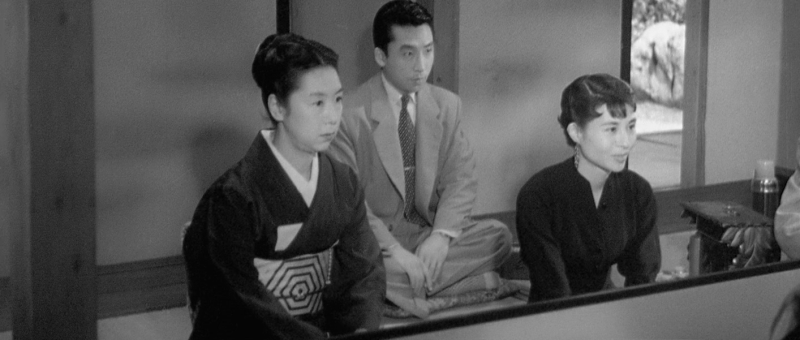
Even so, the sense of shame is evident when Yukiko (Yoshiko Kuga) is brought back to the geisha house run by her mother Hatsuko (Kinuyo Tanaka) after having attempted to take her own life in Tokyo. As we learn, the reason for her despair is in part heartbreak. She had been engaged but her fiancé’s family convinced him to end their relationship when they discovered that her mother ran a geisha house. Thus the suicide attempt is also a reflection of her sense of futility. She will always be the daughter of a woman who earned her living in the sex trade. This is a fact that cannot be changed and may lead her to think that her situation is hopeless because the same thing is likely to happen again leaving her unable to marry in a society in which there are few options for a single woman to make a life for herself not to mention the loneliness of living without romantic love. 

Hatsuko, meanwhile, is uncertain how seriously she should take the situation in part believing that it’s a product of youthful naivety in her daughter’s first romantic heartbreak. When a young doctor with whom she is close, Matoba (Tomoemon Otani), explains to her that Yukiko is depressed because she feels deep shame, self-loathing, and hopelessness due to her mother’s occupation, Hatsuko struggles to understand it and does not fully believe him. Nevertheless, she took care to bring her daughter up largely outside of the geisha world, sending Yukiko to Tokyo to study music implying that she herself to some degree sees her work as improper. The other girls view Yukiko with a degree of disdain, realising that her refinement was bought with their exploitation and noticing her animosity towards them. 

Hatsuko is mother both to Yukiko and the young women under her care who are always quick to point out that this is one of the better geisha houses because they are well looked after. When one of the women, Usugumo (Kimiko Tachibana), is taken ill, Hatusko calls in the doctor and allows her time off to rest which likely would not be granted at another house. She is reluctant to send her to hospital, but would if the situation called for it. In a sense it’s this solicitation that eventually allows Yukiko to find accommodation with her mother’s profession as she grows closer to the other women while nursing Usugumo herself and comes to understand their particular circumstances that have left them no choice but to live as geisha. Usugumo is reluctant to go to hospital because she is worried about the money she’d usually send to her sister Chiyoko (Sachiko Mine) who works the family farm and cares for their sickly father, but when she dies Chiyoko herself is left with little option other than to petition the geisha house to take her sister’s place. 

On seeing Chiyoko sitting on the step and pleading to be taken on, another of the women laments as she’s leaving that she wonders when there will be no more need for women like them. The geisha world is perhaps an unchangeable reality, just like Yukiko’s birth and her mother’s age. The rumours that surround Hatsuko are to do with her closeness with Matoba with whom she has clearly been in an intimate relationship, dreaming of becoming his wife and even considering selling the geisha house to buy a large property where they could live together as a couple while he runs a private clinic. Matoba predictably decides he prefers the younger Yukiko, Hatsuko increasingly desperate after overhearing their conversation about leaving her behind to move to Tokyo together where Matoba ponders finishing his education. The play they’ve gone to see almost feels like a personal attack as an actor intones that feelings of love at 20 are fine but at 60 it’s merely shameful. “Even carp know better than to fall in love at this age”, he adds, the old woman a figure of ridicule in her romantic delusion leaving Hatsuko feeling both humiliated and resentful.

When Hatsuko finally confronts Matoba, she does it as a scorned woman rather than as a mother, while Yukiko in turn first turns on her rather than Matoba even as she begins to realise the reality of the situation that the man who seduced her had been using her mother for his own gain in total disregard of her feelings. In short, even if Hatsuko were not her mother which certainly makes this a very complicated situation, he is not the sort of man she’d want to make a life with. Acutely aware of her own experiences of heartbreak, she fears for her mother’s wellbeing and comes to an understanding of her as a woman while accepting that “men are all alike” and in that at least perhaps her mother’s profession is the most honest of all. Mutually betrayed, mother and daughter are able to repair their familial bonds while Yukiko finds herself taking refuge in the geisha house as a space of female solidarity and bulwark against a cruel and patriarchal society. 


Sword of Destiny (孤剣は折れず 月影一刀流, Yasushi Sasaki, 1960)

A wandering swordsman winds up in intrigue on returning to his fencing school to find his old master murdered in Yasushi Sasaki’s Sword of Destiny (孤剣は折れず 月影一刀流, Koken wa Arezu: Tsukage Ittoryu). A classic jidaigeki adventure, it nevertheless has to be said that this one is a little more sexist than most in actively pushing its series of female warriors into the background as the hero by turns sends them all back to typically feminine roles while declaring that he will be the one to claim vengeance and clear up corruption in the court itself caused by a woman’s apparent forgetting of her place. 

At least, this is what Mikogami Genshiro (Koji Tsuruta) is told by an old friend, Izu, after an altercation with the fiery princess Kazu (Hibari Misora). The Shogun’s nurse, Lady Kasuga, has apparently taken an interest in politics and has most of the inner palace in her grasp enriching herself in the process. Izu believes that she may also be behind the assassination of Geshiro’s former mentor Ono while working in league with the Yagyu who coveted the position of fencing master to the Shogun. He asks Genshiro to kill her which he’s only too happy to do while seeking vengeance for Ono, but later gains a second reason after meeting the two orphaned daughters of a former retainer forced to take his own life thanks to Lady Kasuga’s machinations. 

Itoya (Yoshiko Fujita) wanders round with a gun and disrupts Genshiro’s first assassination attempt. He later tells her to leave the killing business to him and live “the life of a woman” insisting that one girl has no power to kill Lady Kasuga anyway. Meanwhile, he also makes an enemy of the Shogun’s sister Princess Kazu after challenging her in the street on seeing her callous disregard for a peasant her horse had run over. Princess Kazu falls in love with him after he defeats her in a duel, temporarily rebelling in insisting she will resist a dynastic marriage and take no other husband though he eventually rejects her partly on the grounds of their class difference and partly because he is a wandering sword who lives in the moment and may know no tomorrow. 

Nevertheless, she is later seen capitulating to her proper role as a princess who exists largely to continue the family line, marrying a man chosen by the Shogun and his advisors with no real power to chose anything other than her obedience. In much the same way he does with Itoya, Genshiro pushes her back towards the typically feminine while falling for Itoya’s meek, sickly sister Mine (Hiroko Sakuramachi) who is otherwise an idealised image of femininity in her softness and naivety while like every other woman in the picture falling for Genshiro because of his robust manliness and ability to protect her by gaining the sisters’ vengeance on their behalf. 

Meanwhile, Genshiro also facing off against the rival Yagyu school whom he suspects of having killed Ono to usurp his place as the shogunate fencing master with the assistance of underling Takagaki who has now taken over leading to a mass exit of students fed up with his authoritarian teaching methods. Interestingly enough, Genshiro is temporarily imprisoned by the Yagyu alongside a dissident Christian whose death they’d faked while keeping him alive in order to torture the names of other Christians out of him. On fulfilling his request to take his cross to his daughter who has become a sex worker, Genshiro succeeds only in endangering her while she also falls in love with him. 

All in all, he’s not much of a responsible hero also reckless with the life of his former burglar sidekick Kurobei (Shin Tokudaiji) who uses his ninja tricks to get him out of prison. As expected, it all ends with in a battle against a treacherous swordsman and the spineless Takagaki with the final revelation that Lady Kasuga (who just dies of old age) had not much to do with anything anyway despite having been a “meddling” old woman who forgot her proper place. Even Mine is forced to admit that she can’t come between Genshiro and his sword so she plans to become a nun while Kazu sends him an elaborate katana to remember her by certain that he will not accept a place in the Shogun’s household but will return to the road to continuing his training. In any case, a kind of justice is done and order restored even if that order is in itself fairly unideal. 


Chikamatsu’s Love in Osaka (浪花の恋の物語, Tomu Uchida, 1959)

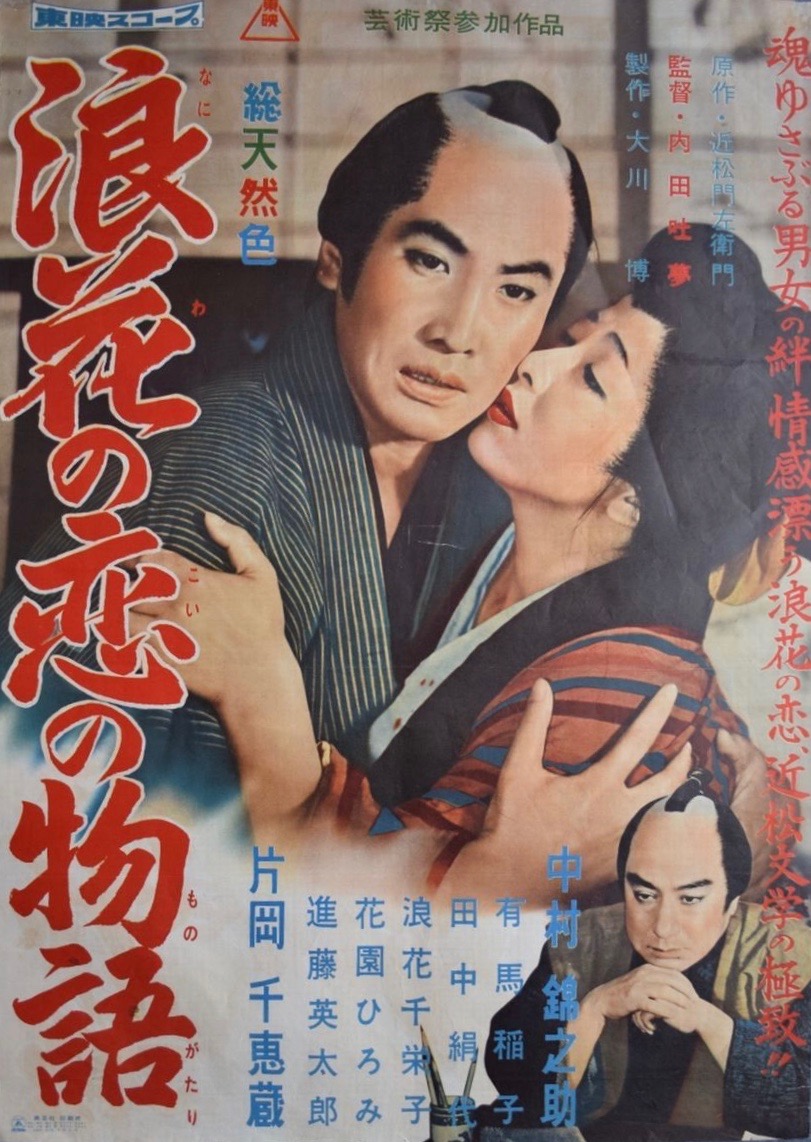
Chikamatsu's love in Osaka poster“Money is the enemy” a dejected geisha declares in an attempt to explain her desperate circumstances to a naive young man part way  through Tomu Uchida’s Chikamatsu’s Love in Osaka (浪花の恋の物語, Naniwa no Koi no Monogatari). Before a wartime flirtation with the militarist far right, Uchida had been closely involved with the leftwing “tendency film” movement and his post-war work perhaps displays much the same spirit only with a world weary resignation to the inherent unfairness of human society. Chikamatsu, as cited in the slightly awkward English language title, was a Japanese playwright of the 17th/18th century who also specialised in tales of social oppression, most notably in frustrated romance and eventual double suicides.

Uchida’s masterstroke is that he retells Chikamatsu’s well known bunraku play The Courier for Hell and its kabuki counterpart Couriers of Love Fleeing to Yamato from the inside out. Among Chikamatsu’s most famous works the play was in fact inspired by a real life event which took place in Osaka (then known as “Naniwa”) in 1710. Uchida places the grumpy, worldweary figure of the playwright directly into the action as a powerless observer, trapped on the wrong side of the stage able only to observe and comment but, crucially, with the ability to remake reality in altering his tale in the telling.

The tale is familiar enough and possibly a little too close to that of Chikamatsu’s previous hits including Love Suicides at Sonezaki which is given a grim namecheck as events begin to mirror one of his plays. Our hero, Chubei (Kinnosuke Nakamura), is an earnest young man who has been adopted into the Kameya family with the intention that he will marry its only daughter and take over the courier business now being run by stern widow Myokan (Kinuyo Tanaka). Early foreshadowing reminds us that immense responsibility is regularly placed in Chubei’s hands and he must remain above suspicion. Embezzlement is a capital offence in the increasingly austere 18th century society.

Chubei is an honest man, but meek. Unable to risk offending a bawdy client, he allows himself to be bamboozled into the red light district where Hachiemon (Minoru Chiaki) buys him the prettiest courtesan in the place, Umegawa (Ineko Arima). Chubei tries to leave as soon as Hachiemon disappears but is convinced to stay by Umegawa’s entreaties that his sudden exit will reflect badly on her and possibly result in censure or punishment. Struck by her predicament, Chubei falls in love. He makes repeated returns, dips into his savings, and finally makes the fateful decision to spend money not his own when he discovers that a lascivious magnate has made an offer to buy out Umegawa’s contract.

Meanwhile, Chikamatsu hovers on the edges conducting “research” for a new play to save his failing theatre company which itself is suffering due to lack of monetary receipts seeing as audience members obviously prefer the heartrending melodrama of Sonezaki to the more artistic fare he’s currently running. Though he is obviously a frequenter of the red light district and its surrounding drinking establishments, Chikamatsu has a noticeably ambivalent stance towards its existence. His sympathy is instantly caught by the melancholy Umegawa when he notices her tenderly bandage the hand of a little girl who serves in the brothel, only to have her beautiful gesture of human kindness immediately mocked by the lascivious magnate who witnesses the same thing but chooses to ask her to repeat the act on him.

Chikamatsu was supposed to come to the teahouse in order to schmooze the magnate so that he will invest in the theatre company which perhaps generates an odd commonality between the playwright and courtesan both at the mercy of wealthy patrons who, one might say, are all money and no class. Umegawa, however, as Chikamatsu is painfully aware is in no way free and entirely dependent on pleasing men like the magnate whether she likes them or not. As she tells Chubei, Umegawa didn’t choose this line of work but people judge her for it anyway. She has no bodily autonomy and is bought and sold daily with no right to refuse. She is “merchandise” that “talks, laughs, cries, and gets angry” and the sole concern in all of her life is money which she now regards as “the enemy” for the subjugated position in which the need for it has placed her.

Of course, the playwright (our stand-in) has been listening all along. He too would like to free Umegawa from her torment, but he is powerless and can only blame the world that created the circumstances that trap her. Chubei is no hero either, he is weak and feckless even if his eventual willingness to damn himself by embezzling other people’s money (and ruining his adopted family in the process) proves the depth both of his love and of his rage at the social injustice which prevents him from pursuing his romantic desires. Chikamatsu can’t save his fatalistic heroes, but he can create a more fitting vision of their love imbued with all world nearly grandeur of tragic romance that returns our eyes to the cruelty of the world that wouldn’t let them be. A stunning final shot pulls us from Chikamatsu once again in the background as he watches his own play onto the other side of the stage and then back again as the playwright’s eyes burn with silent rage and impotence as he offers the only kind of resistance he can in the face of a cruel and indifferent society.


Love Under the Crucifix (お吟さま, Kinuyo Tanaka, 1962)

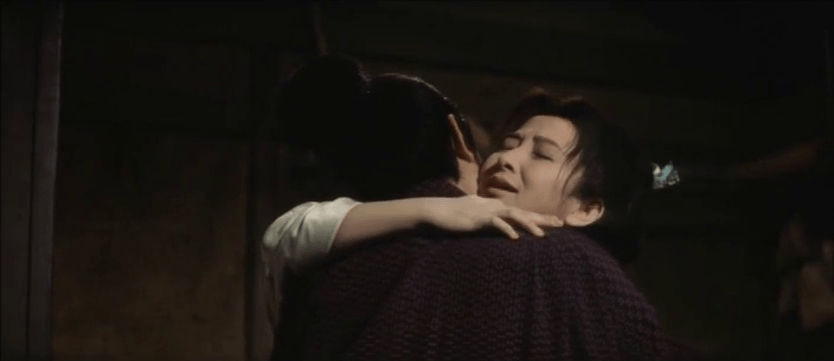
Love Under the Crucifix cap 1A legendary screen actress, Kinuyo Tanaka completed only six films in her career as a director. The last film that she would ever make, Love Under the Crucifix (お吟さま, Ogin-sama), is the only one to be set in the historical past taking place against the backdrop of turbulent late 16th century politics just forty years or so before the nation would embark on 200 years of self imposed isolation undertaken in the name of preserving the national character while solidifying a political regime. As in her other films, however, Tanaka employs a standard melodrama narrative in order to subvert it. Her heroine defies all “for love”, but not so much in itself as for the right to it and to the legitimisation of her feelings as a human woman with all the rights and freedoms that ought to entail.

The film begins in the 15th year of Tensho (or 1587). Toyotomi Hideyoshi (Osamu Takizawa) is attempting to solidify his command over a Japan which is in a state of constant warfare. Meanwhile, foreign trade and influences, including Christianity, are flooding into the nation. There is growing suspicion among Hideyoshi’s advisors that Christian converts are nothing more than foreign spies working to undermine the social order and cannot be trusted. Therefore, Christianity is a spanner thrown in the works of Hideyoshi’s plans for peace and unification, only no one is quite sure as yet what to do about it except disapprove.

Meanwhile, our heroine, Ogin (Ineko Arima), is the step-daughter of prominent tea master Rikyu (Ganjiro Nakamura). She has long been in love with Ukon (Tatsuya Nakadai) – a young lord who has converted to Christianity and is in fact already married. Despite the impossibility of her love, Ogin holds fast to its purity and has refused all entreaties to marry. However, she is placed in a difficult position when it is made clear that a prominent suitor affiliated with the local lord desires her. Rikyu affirms that he will follow Ogin’s will, but Mozuya (Hisaya Ito) is too important a man to be refused out of hand and the consequences of turning him down may be severe. Ogin searches for a sign from Ukon, but he coldly tells her to marry, refusing any confirmation of the feelings which she believes to exist between them.

The film’s English title, Love Under the Crucifix, reminds us that this is not so much a story of religious freedom as social oppression. Divorced form its Christianising context, the crucifix was in this era the primary punishment for sexual transgression, most often for both men and women committing adultery or daring to love in places where society would not approve. Thus Ogin lives her life under it in being reminded of the potential costs of her inappropriate emotions. Even so, observing a young woman tied to the cross (Keiko Kishi) and apparently electing to go to her death rather than become the concubine of the local lord against her will, Ogin sees in it not censure but defiance and path towards personal empowerment if only in ultimate negation.

The literal crucifix becomes a noose around Ogin’s neck in the form of the necklace given to her by Ukon. Ogin remains unconvinced by Ukon’s religiosity even if she respects it but later resents the austerity it provokes in him while wondering if his friendship with her was only ever a pathway to conversion. Ukon’s troubles are multiple, not only is he oppressed by the social strictures of his time but also by an additional burden of Christianising morality which instructs him that his feelings are sinful and must be rejected.

Later, Ogin berates Ukon insisting that all of this suffering and the predicament they now find themselves in might have been avoided if only he had not kept his feelings hidden. Ukon’s religiosity obliges him to behave in ways which are cruel and selfish, and which ultimately bring him little other than additional suffering and unhappiness. This emotional tension has also played into the hands of the ruling regime who are content to use their feelings, and the prevailing tendency towards properness, against them as a plot against Rikyu and to prevent Ukon’s return as a military rival.

Despite Rikyu’s best efforts, Ogin has indeed become a pawn in the hands of men. Rikyu, as we’re reminded at the film’s conclusion, fell from favour and committed ritual suicide at the age of 70. Like Ogin, he remained true to himself even when politically unwise, advancing his philosophies of simplicity and respect for the natural world in the face of what he saw as Hideyoshi’s increasingly gaudy superficiality. Thus he councils Ogin that there is nothing wrong in her feelings and her only duty to him or to anyone else is to try to live happily even if that means she must live in hiding with the less courageous Ukon who refuses to abandon his faith but struggles to find the courage to fight for love, or more specifically for the right to love, as Ogin has done all her life.

Ogin is, in a sense, already on the cross as she continues to suffer not for faith but for faith in love and in her own right to her individual feelings and agency. Faced with being forced to surrender her body to a man she does not love because of a cruel game played by men for men, Ogin prefers death and finds in it the ultimate expression of her personal freedom and emotional authenticity.