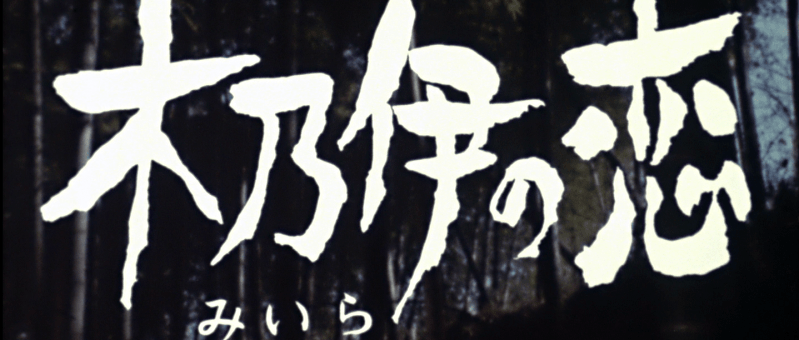
A Mummy’s Love (木乃伊の恋, Seijun Suzuki, 1973)

vlcsnap-2018-05-28-23h20m55s542After getting fired from Nikkatsu for making films which made no sense and no money, Seijun Suzuki cemented his place as a thorn in the side of the establishment by suing them for breach of contract. The “dispute” dragged on, eventually seeing him blacklisted by the other major studios and unable to make a feature film for ten years. This did not mean however that Suzuki was entirely idle between the releases of Branded to Kill and his 1977 “comeback” movie A Tale of Sorrow and Sadness. Like many other directors who found themselves adrift in the changing film industry, Suzuki busied himself with short projects for television, both commercials and stand alone episodes of anthology series including one for Eiji Tsuburaya’s Twilight Zone-esque Horror Theater Unbalance.

Horror Theater Unbalance, produced by Tsuburaya Pro, was in keeping with the studio’s other similarly themed horror and science fiction SFX series but took the form of 13 one off one hour dramas. Although production began in earnest in 1969, filming didn’t finish until 1972 and the series eventually aired in 1973. Many of the episodes were inspired by well known mystery stories and each also featured a framing sequence in which author/actor/TV personality (and later politician) Yukio Aoshima introduced and then wrapped up the tale à la Alfred Hitchcock, Rod Serling, or perhaps Cookie Monster whilst sitting in a creepy mansion filled with weird skeletal objet d’art. Tsuburaya Pro was able to mop up some prime Nikkatsu talent which was gradually seeping out of the studio as it crept towards its eventual rebirth as the producer of Nikkatsu Roman Porno. This included not only Suzuki but also Yasuharu Hasebe and Toshiya Fujita among others, as well as outlying figures from the independent world such as Kazuo Kuroki.

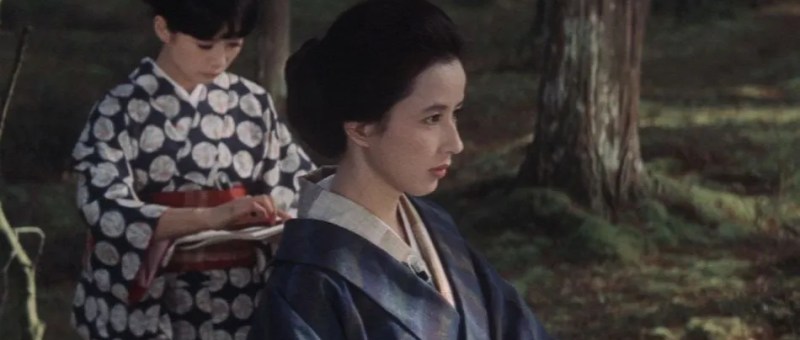
The first to be broadcast, Suzuki’s episode was adapted from a short story by Fumiko Enchi whose recurrent themes share much with those of the director in her frequent use of fantasy and eroticism. A Mummy’s Love (木乃伊の恋, Miira no Koi) is technically a triple tale as it contains an internal framing sequence in addition to the broader one common to the series. The lead is actually Shoko (Misako Watanabe) – a widowed middle-aged editor working with her now elderly professor on a new version of a classic tale from Japanese literature. Her memory is sparked when she catches sight of an oddly vacant-looking monk in the back of a car – eerily like the one in the story which revolves around the discovery of a monk who was buried alive as way of achieving enlightenment but has recently (or perhaps not) begun ringing his bell to alert those above to his conscious presence.

One of the villagers, Shoji, becomes fascinated with the idea of the unsleeping monk. When they dig up the corpse it’s a stiff, strangely robust skeleton which some of the villagers end up using for a game of punt the monk, but little by little his flesh returns. He is not, however, as enlightened as one might hope. To begin with he’s a gibbering wreck, and then finally something more like a crazed sex pest whose pent up amorous energy eventually wears out his new “wife” in a matter of days when she suddenly gives “birth” to a small army of mini dust buddhas. Shoji is sick of the monk and wants to get rid of him, but when he takes his own wife sometime later all he can hear is the sound of a little tinkling bell and suddenly he can’t bear to touch her.

The theme seems to be that unquenched desire will drive you insane with the ambiguous addition that desire itself is best overcome rather than satisfied. Having recounted to us the story of the monk, Shoko finds his tale echoing in her own life. A war widow she lost her husband young and has experienced near constant sexual harassment from her former professor, now bedridden and defeated. Unbeknownst to her, the professor has been keeping her engagement photo in his study for the last decade. He claims that it’s not impossible for an ordinary many to resurrect himself solely through the power of enduring sexual desire, rightly (but somewhat inappropriately) implying that Shoko too harbours lingering desires which have gone unsatisfied since her husband’s passing.

The story culminates with Shoko’s pleading hope for a resurrection as she unwittingly arrives at the place of her husband’s death where she encounters a strange man who might or might not be her late spouse. Making either real or hallucinatory love atop a grave with either a resurrected corpse, a ghost, a phantom of memory, out of body spirit, or just a random rough man talking shelter from the rain, Shoko is a prisoner of her desires but the source of her visitation remains difficult to discern.

Working within a TV budget, Suzuki reins himself in but lends his idiosyncratic sense of ironic fun to an otherwise gloomy, dread-laden tale as the villagers gleefully kick around the dried corpse of the old monk as if he were a long buried football and then seem to meet an unquiet knowingness in his ever hungry eyes. Peppered with surrealist touches, Suzuki’s contribution to Horror Theater Unbalance is a heady affair but one imbued with his characteristic twinned sense of irony and wistful melancholy in a tale of those undone by unresolved longing.


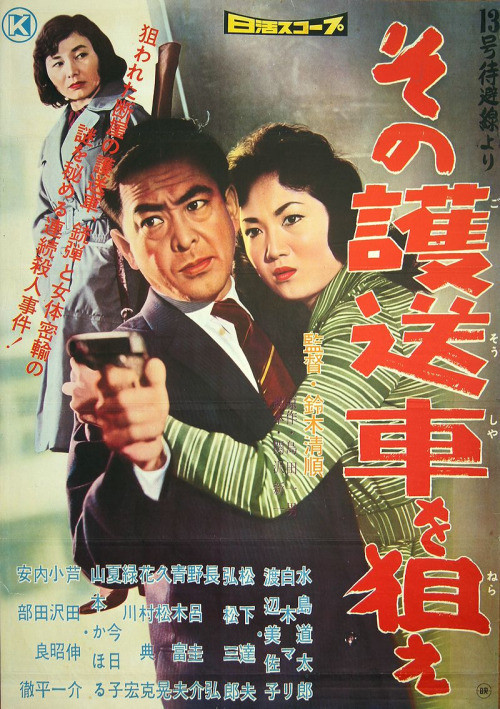
Take Aim at the Police Van (13号待避線より その護送車を狙え, Seijun Suzuki, 1960)

o0500070913581105946Nikkatsu’s main stock in trade during its 50s/60s heyday was the youth movie – films which captured the frustrations of being young (and usually male) in the scrappy post-war years. It’s a surprise then that the hero of Seijun Suzuki’s “action” movie Take Aim at the Police Van (13号待避線より その護送車を狙え, Jusango Taihisen Yori: Sono Gososha wo Nerae) is a genial middle-aged man who’s more Cary Grant in North by Northwest than Japanese James Dean. A programme picture, there’s nothing particularly interesting about the movie on paper but it’s among the first in which Suzuki indulges his talent for the surreal including a number of fantastically choreographed action sequences.

The film opens with a warning as a sniper trains his sights on a set of road signs which state that many accidents have occurred in this area. The one which is about to befall unlucky prison warden Tamon (Michitaro Mizushima) is however entirely man made. Momentarily confused by the figure of a woman watching the bus from the roadside, Tamon is blindsided when the sniper opens fire and kills several of the passengers while another, Goro (Shoichi Ozawa), cowers in the back. Tamon is suspended for six months but isn’t particularly upset about it. He’s not a detective and he knows he should leave it to the professionals, but he’s desperate to know why someone would bother attack such a lowly crew of petty criminals. Wondering who the woman was and how she fits into the case, who the snipers were aiming for and if they got them, and perhaps wanting to assuage his own feelings of powerlessness during the attack Tamon gets on the case.

Tamon is not your typical Nikkatsu action hero. He’s a little on the old side for starters – hardly the marquee face the studio was beginning to favour with its collection of “Diamond Guys”. He’s also not a policeman or a detective, he has no idea what he’s doing or what he’s getting himself into. What Tamon is is a righteous man. Almost immediately he’s sucked into the seedy underbelly of late ‘50s Tokyo with its strip clubs, trafficked women, and petty gangsters. This world is alien to him and he’s disgusted by it. Meeting the female manager of the “talent agency” which supplies in-room strippers to sleazy hotels where businessmen go when they’ve told their wives they’re at a conference, Tamon is horrified to hear her admit she thinks of the girls as “merchandise”. He pauses to explain to her that he always thought of the felons he looked after as “humans” rather than “criminals”, no matter what it was they’d done. Such naive humanitarianism is too much for Yuko (Misako Watanabe) – she’s instantly smitten, which is a problem because it means she needs to play both sides of her own game.

The pair end up in an uneasy alliance as Tamon’s goodness begins to work its magic. An unlikely white knight, Tamon finds himself wanting to save all the ladies threatened by “Akiba’s” dastardly plan from the icy charms of Yuko to Goro’s cabaret girl Tsunako (Mari Shiraki), and another young one, Shoko (Kyoko Natsu), about to get sucked into the Akiba web. What he discovers is a nasty trail of exploitation running from the bars and clubs of the city centre to the genial holiday spa towns where the moderately wealthy travel to pursue their discrete pleasures.

Tamon may be a little older than your average Nikkatsu action star, but he’s also a perfect fit for a film noir hero in wrong man mould. Tamon is not on the run, but he is out of place in this world, perhaps harking back to a presumably more innocent age where honesty and compassion still counted for something. He views his job as a prison warden as a public service, believing that there is goodness in everyone and it’s the job of people like him to find it and bring it to the surface. This he does at least seem to accomplish with Yuko who (despite her role in events so far) seems to have “reformed” and intends to follow Tamon’s lead in taking her “talent agency” in a more legitimate direction. 

Suzuki often claimed that Youth of the Beast was the first of his films where he was able to fully embrace his madcap desires, but Take Aim at the Police Van contains a fair few Suzuki touches of its own from the bold opening sequence shot through the sights of a sniper rifle, to the show girl killed by an arrow to her bare breast, bizarre murder by petrol tanker set piece, and exciting train station finale. Keeping the camera fluid, Suzuki captures a world in motion, seemingly running away from our noble hero until justice, in the form of an unstoppable steam train, finally arrives.


Attack on the police van clip (English subtitles)

https://www.youtube.com/watch?v=D2FcJY003HA

Youth of the Beast (野獣の青春, Seijun Suzuki, 1963)

youth of the beast posterSeijun Suzuki had been directing for seven years and had made almost 20 films by the time he got to 1963’s Youth of the Beast (野獣の青春, Yaju no Seishun). Despite his fairly well established career as a director, Youth of the Beast is often though to be Suzuki’s breakthrough – the first of many films displaying a recognisable style that would continue at least until the end of his days at Nikkatsu when that same style got him fired. Building on the frenetic, cartoonish noir of Detective Bureau 2-3: Go to Hell Bastards!, Suzuki once again casts Jo Shishido in the the lead only this time as an even more ambiguous figure playing double agent to engineer a gang war between two rival hoodlums.

Suzuki opens in black and white as the bodies of a man and a woman are discovered by a small team of policemen. Finding a note from the deceased female which states that she settled on taking her own life because she loved her man and thought death was the only way to keep him, the police assume it’s an ordinary double suicide or perhaps murder/suicide but either way not worthy of much more attention, though discovering a policeman’s warrant card on the nightstand does give them pause for thought.

Meanwhile, across town, cool as ice petty thug Jo Mizuno (Jo Shishido) is making trouble at a hostess bar but when he’s taken to see the boss, it transpires he was really just making an audition. The Nomoto gang take him in, but Mizuno uses his new found gang member status to make another deal with a rival organisation, the Sanko gang, to inform on all the goings on at Nomoto. So, what is Mizuno really up to?

As might be expected, that all goes back to the first scene of crime and some suicides that weren’t really suicides. Mizuno had a connection with the deceased cop, Takeshita (Ichiro Kijima), and feels he owes him something. For that reason he’s poking around in the local gang scene which is, ordinarily, not the sort of world straight laced policeman Takeshita operated in which makes his death next to a supposed office worker also thought to be a high class call girl all the stranger.

Like Detective Bureau 2-3: Go to Hell Bastards!, Youth of the Beast takes place in a thoroughly noirish world as Mizuno sinks ever deeper into the underbelly trying to find out what exactly happened to Takeshita. Also like Detective Bureau 2-3: Go to Hell Bastards!, Youth of the Beast is based on a novel by Haruhiko Oyabu – a pioneer of Japanese hardboiled whose work provided fertile ground for many ‘70s action classics such as The Beast Must Die and Resurrection of the Golden Wolf, but Suzuki’s ideas of noir owe a considerable debt to the gangster movies of the ‘30s rather than the moody crime dramas of twenty years later.

Jo Shishido’s Mizuno is a fairly typical ‘40s conflicted investigator, well aware of his own flaws and those of the world he lives in but determined to find the truth and set things right. The bad guys are a collection of eccentrics who have more in common with tommy gun toting prohibition defiers than real life yakuza and behave like cartoon villains, throwing sticks of dynamite into moving cars and driving off in hilarious laughter. Top guy Nomoto (Akiji Kobayashi) wears nerdy horn-rimmed glasses that make him look like an irritated accountant and carries round a fluffy cat he likes to wipe his knives on while his brother Hideo (Tamio Kawaji), the fixer, is a gay guy with a razor fetish who likes to carve up anyone who says mean stuff about his mum. The Sanko gang, by contrast, operate out of a Nikkatsu cinema with a series of Japanese and American films playing on the large screen behind their office.

The narrative in play may be generic (at least in retrospect) but Suzuki does his best to disrupt it as Mizuno plays the two sides against each other and is often left hiding in corners to see which side he’s going to have to pretend to be on get out of this one alive. Experimenting with colour as well as with form, Suzuki progresses from the madcap world of Detective Bureau 2-3: Go to Hell Bastards! to something weightier but maintains his essentially ironic world view for an absurd journey into the mild gloom of the nicer end of the Tokyo gangland scene.


Original trailer (no subtitles)

https://www.youtube.com/watch?v=RoruaIPA41U

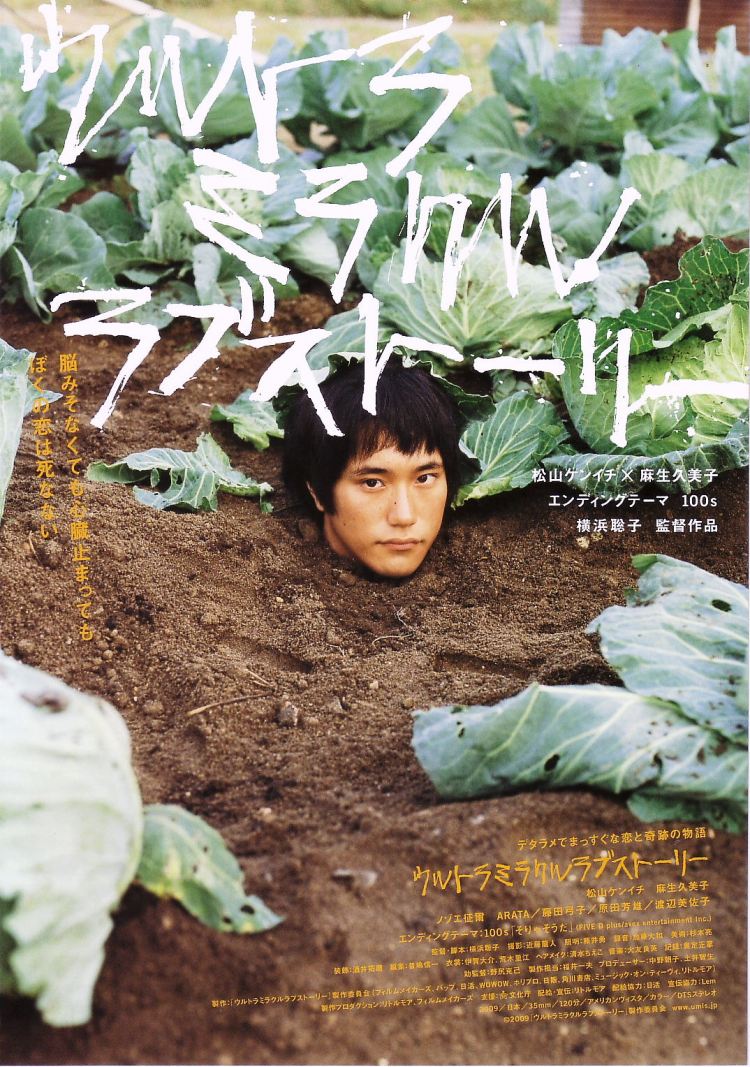
Bare Essence of Life (ウルトラミラクルラブストーリー , Satoko Yokohama, 2009)

©Little More Co.

bare essence of life posterThere might be a pun involved in the title of Bare Essence of Life – another example of a Japanese film with a katakana English title, Ultra Miracle Love Story (ウルトラミラクルラブストーリー), given a completely different English language title for overseas distribution, but that would be telling. Following her feature debut German + Rain, Satoko Yokohama once again tells a tale of small town misfits only this time of an Aomori farm boy whose brain is wired a little differently to everyone else’s – “not broken, just different”. Though everyone in the village knows Yojin (Kenichi Matsuyama) and is familiar with his sometimes unusual behaviour, a young visitor taking a temporary job in a quaint rural backwater may need a little more time to acclimatise.

Yojin is, as he says, a little different from the others. Neatly signalling a problem with executive functioning, he lives his life to the tune of several different alarm clocks with deliberately different sound cues to help him remember what he’s supposed to be doing. Grandma also helps with that too through use of a giant whiteboard which has Yojin’s daily itinerary on it so he can keep track of where he is and record his thoughts about the day. Yojin’s grandfather has passed away but has left him some valuable horticulture tips on a cassette tape which Yojin listens to diligently every day whilst tending to his cabbages, trying to work out a good way of keeping them safe from creepy crawlies seeing as grandma doesn’t really trust him with insecticide (later events will prove this to be wise).

Everything changes when brokenhearted school teacher Machiko (Kumiko Aso) arrives all the way from Tokyo as temporary cover for maternity leave at the local nursery. Oddly, seeing as there are so few young people around, the school seems pretty busy with youngsters but then again perhaps they’ve come from neighbouring villages which would explain why the parents are sometimes so late coming to pick their kids up. In any case, Machiko instantly captures Yojin’s heart and he becomes fixated on the idea of making her his one and only. Machiko, however, is battling her own romantic woes and is originally quite taken aback by Yojin’s odd combination of directness and innocence.

Yojin is, undoubtedly, a lot to take in, but the villagers are all very used to his ways and mostly just shrug his various antics off even when they entail inconveniences like office paperwork suddenly scattered to the wind, or getting pelted with vegetables after taking issue with Yojin’s sales patter. Grandma bears the brunt of his rudeness not to mention self-centred attitude and otherwise difficult behaviour but she also worries how he’s going to look after himself when she’s gone. Hence the vegetable patch – a literal testing ground. Machiko makes Yojin wish he were different, and a half-baked experiment in which he buries himself up to the neck in his cabbage patch (perhaps to better understand cabbages so that he can figure out how to grow them) and a neighbourhood boy sprinkles him with pesticide shows him a way he can make it happen.

So begins Yojin’s long, strange path towards “evolution” as he discovers that exposure to various chemicals helps him slow everything down so he can be a little more like everyone else. Moving into the centre ground makes his presence more palatable to Machiko, giving them time to bond during nighttime walks as Machiko outlines her curious theories on the forward motion of the human race. Machiko wonders if humanity’s need to control the unpredictable, smooth out rough edges and tame nature is limiting its ability to change and grow, yet even as she says so Yojin is attempting to temper his own wildness expressly for Machiko. Nevertheless, getting to know him Machiko comes to the conclusion that maybe what Yojin needs is to become more Yojin, rather than dousing himself in dangerous chemicals which seem to have provoked some kind of strange metamorphosis as yet unknown to medical science.

Chemicals aside, Yojin’s world takes a turn a definite turn for the surreal as he chats with headless ghosts and then temporarily joins the ranks of the undead himself. Yokohama has a point or two to make about the use of pesticides – a neighbourhood woman warns Machiko to head indoors when she first arrives because it’s crop spraying day, but then refuses to buy Yojin’s “organic” vegetables because she’s not convinced anything grown without chemical assistance could really be “safe” or “clean” enough for consumption. This need to control nature may eventually ruin it, and us too – much as Machiko’s hypothesis posited. Maybe Yojin is the most evolved us all, defiantly in touch with his essential nature and, perhaps, finally allowing his soul to find its true home if in the strangest of ways.


Screened as part of Archipelago: Exploring the Landscape of Contemporary Japanese Women Filmmakers.

Original trailer (English subtitles)

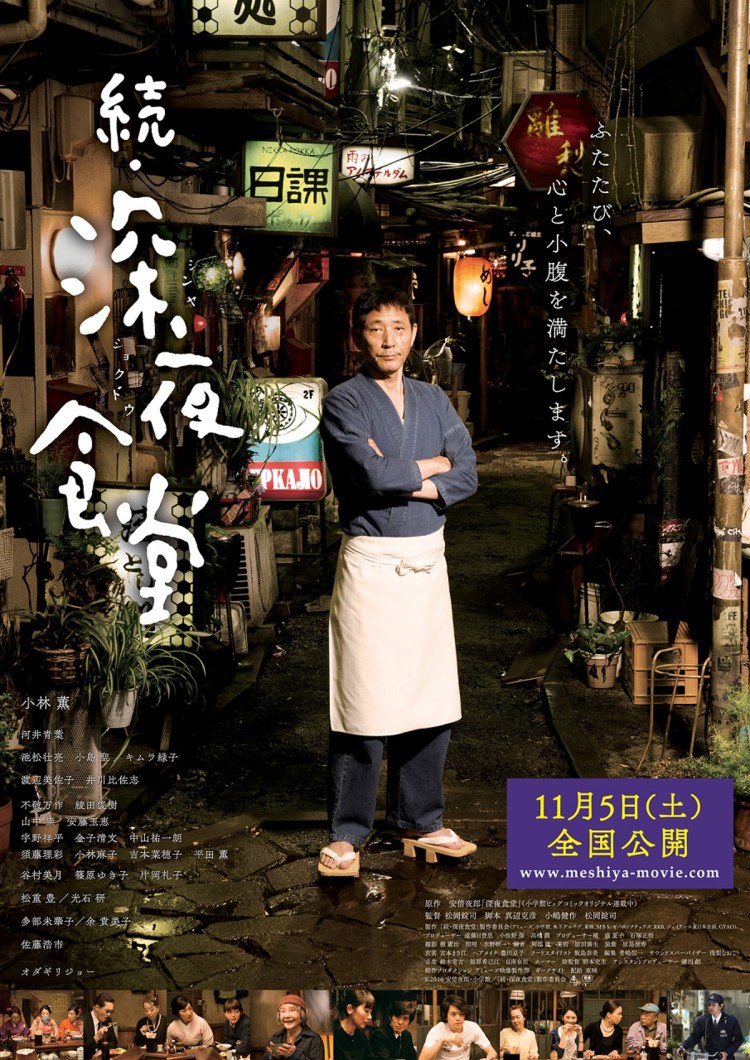
Midnight Diner 2 (続・深夜食堂, Joji Matsuoka, 2016)

midnight diner 2 posterThe Midnight Diner is open for business once again. Yaro Abe’s eponymous manga was first adapted as a TV drama in 2009 which then ran for three seasons before heading to the big screen and then again to the smaller one with the Netflix original Midnight Diner: Tokyo Stories becoming the de facto season four. Midnight Diner 2 (続・深夜食堂, Zoku Shinya Shokudo) returns with more of the same as Master puts out his sign and opens the shop, welcoming the denizens of Tokyo after dark in search of a little place to call home amid all the chaos and alienation.

To re-cap, the Midnight Diner is a casual eating establishment run by Master which opens only between the hours of midnight and 7am. The restaurant has only a small formal menu but Master’s selling point is that he is prepared to make whatever the customer so desires (assuming the ingredients are available). Regulars and newcomers alike are given a warm welcome and a place to feel at home, free of whatever it was that was bothering them in the outside world.

Like the first film, Midnight Diner 2 is really three TV episodes stitched together. The first begins on an ominous note as each of the regulars arrives in mourning clothes only to be struck by the coincidence that they’ve each been to a different person’s funeral. A woman arrives dressed in black but reveals she hasn’t been bereaved, she simply enjoys dressing like this to destress from the difficult atmosphere at her publishing job. Noriko (Aoba Kawai) is a top editor but often finds herself sidelined – this time by a young author whose book she made a success but has now dumped her owing to all her notes on his second effort. Saddled with an elderly client who doesn’t like taking advice from a woman, Noriko’s fortunes fall still further when she finds him dead. A visit to a real funeral threatens to change her life completely.

Strand two follows the son of a nearby soba shop, Seita (Sosuke Ikematsu), who has fallen in love with a much older woman and wants to marry despite his mother’s reservations. The third segment continues along the familial theme with an old woman travelling all the way from Kyushu to Tokyo after falling victim to an “Ore Ore” scam.

Scams and parental bonds become the central themes tying the episodes together as each of the lovelorn protagonists finds themselves taking advantage of Master’s sturdy shoulders. Noriko and Mrs. Ogawa (Misako Watanabe) fall victim to an obvious conman but do so almost willingly out of their desperate loneliness. Noriko, dissatisfied with her working environment, takes to the streets dressed in black but becomes the target of “funeral fetishists” who are only interested in her “bereaved” state. A chance encounter at a real funeral makes her believe her life can change but she is deceived again when a man she came to care for is unmasked as a serial trickster. Mrs. Ogawa faces a similar problem when she races all the way to Tokyo to pay off a “colleague” of her son’s, so desperate to help that she never suspects that she’s fallen victim to a scam.

Mrs. Ogawa’s deep love for the son she has become estranged from is contrasted with that of the soba noodle seller for the son she can’t let go. Seita cares for nothing other than ping pong, much to his mother’s consternation and has little interest in taking over the family business. A young man, he’s tired of the constraints his lonely widowed mother continues to place on him though his determination to marry an older woman at such a young age bears out his relative maturity.

As usual Master has good advice and a kind word for everyone that helps them get where they need to go, softly nudging them in the right direction through the power of comfort food. By now the cast of familiars is well and truly entrenched but there will always be space at Master’s counter for those in need who will be greeted warmly by those already aware of its charms. True enough, Midnight Diner 2 offers little in the way of innovation (though we do get a little more information about the mysterious Master) but no one comes the Midnight Diner looking to try something new. In here, nostalgia rules and we wouldn’t have it any other way.


Original trailer (no subtitles)

With Beauty and Sorrow (美しさと哀しみと, Masahiro Shinoda, 1965)

with beauty and sorrwMasahiro Shinoda, a consumate stylist, allies himself to Japan’s premier literary impressionist Yasunari Kawabata in an adaptation that the author felt among the best of his works. With Beauty and Sorrow (美しさと哀しみと, Utsukushisa to Kanashimi to), as its title perhaps implies, examines painful stories of love as they become ever more complicated and intertwined throughout the course of a life. The sins of the father are eventually visited on his son, but the interest here is less the fatalism of retribution as the author protagonist might frame it than the power of jealousy and its fiery determination to destroy all in a quest for self possession.

Middle-aged author Oki (So Yamamura) is making a trip to Kyoto in order to hear the New Year bells but whilst there he wants to reconnect with someone very dear to him whom he has not seen for a long time. 15 years previously, Oki, already around 40 and married with a young son, had an ill advised affair with 16 year old Otoko (Kaoru Yachigusa). Oki’s indiscretion was discovered after Otoko fell pregnant and gave birth to an infant who sadly died after just a few months provoking Otoko’s own suicide attempt. Oki turned the traumatic events into a best selling novel which made his name and has not seen Otoko during the intervening years. Now a successful painter, Otoko has remained unmarried, still traumatised by her youthful experiences, and is currently in a relationship with a female student, Keiko (Mariko Kaga).

Keiko, a beautiful though strange young woman, will be the cause of much of the sorrow resulting from Oki’s decision to visit Otoko after all these years. Angry on her lover’s behalf, Keiko takes it upon herself to exact revenge for the wrong which was done to Otoko at such a young age, ignoring her lover’s pleas to leave the situation well alone.

Perhaps surprisingly, Shinoda avoids the temptation to retain Oki’s central viewpoint by attempting to survey the various threads which bind and contain each of the protagonists, locked into a complex system of love, jealously, pain and obsession. Oki sows the seeds of his own downfall in his improper relationship with a teenager over twenty years younger than himself whom he has no intention of marrying seeing as he is already married and even has a child. Little is said about the original affair save for the effect it had both on Otoko and on Oki’s marriage which endures to the present time even though it appears Oki continues to pursue other women outside of the home. Not only does Oki turn his scandalous love life into a best selling novel, but he makes his wife, Fumiko (Misako Watanabe), type it up for him, forcing her to read each and every painful detail of his relations with another woman.

During the writing of the novel, Fumiko begins to become ill, depressed and listless, but not out of suffering or disgust – what she feels is jealousy but of a literary kind. Fumiko laments that Oki has written an entire book about Otoko, but never thought to write one for her. Even if depicted as some kind of harridan or vengeful, shrewish woman, Fumiko wanted to be Oki’s muse and was denied. Otoko, by contrast never wanted anything of the sort and has lived quietly and independently ever since her traumatic teenage love affair with a married, older, artist. Her feelings, complicated as they may be, are the motivation for the actions of her obsessive lover, Keiko, determined on taking “revenge” for pain Otoko is not entirely certain she feels. Keiko’s jealously has been roused by Oki’s return and the possibility that it may reawaken Otoko’s youthful romantic yearnings. Unwilling to surrender her beloved to another, she sets about destroying that which may come between them, perfectly willing to destroy both herself and the woman she claims to love in the process.

Oki is, after all, a novelist and therefore apt to ascribe a kind of narrative to his life which may ignore its more ordinary baseness. His equally sensitive son, Taichiro (Kei Yamamoto), brings up the subject of Princess Kazu and the glass panel and lock of hair which were discovered with her body and muses on whether these belonged to her husband, as is said, or her “true love” as seems to be suggested by the evidence at hand. Loves true and false are played off against each other but the forces at play are less grand romances than petty lusts and obsessions. Keiko wants to own her lover absolutely but her games of revenge cause Otoko only more pain and take her further away from that which she most loves towards the film’s dark and ambiguous conclusion in which the innocent are made to suffer for other people’s transgressions.

Otoko’s suffering is largely ignored by all concerned though it’s clear that the loss of her child is a deep wellspring of pain which has become the dominant force in her life. Misused and abandoned, Otoko has sought only quietness and solitude living independently and without the need for male contact. Keiko, whilst crying out that she hates men and is going to destroy the family of the man who has destroyed her lover, acts only out of selfishness, refusing to see how far her actions are wounding the woman she loves even as she sets out to make a weapon of her beauty and turn it on the male sex.

Shinoda films with his characteristic aesthetics adopting a position of slight distance as his protagonists gaze at reflections of themselves and talk through mirrors yet refuse the kind of introspection which a novelist like Oki would be expected to project. A final moment of high drama is offered in a series of freeze frames, as if the emotions are too big and complex to be understood as a whole but can only be grasped in painful fragments snatched from among the resultant chaos. With Beauty and Sorrow conjures the idea of nobility in romance, enhanced by the inevitability of its failure, but for all of its aesthetic pleasures and enduring sadness this is not the elegant coolness of romantic tragedy but the painful heat of love scorned as it festers and corrupts, spreading nothing other than pollution and decay.


Original trailer (no subtitles, NSFW)

Samurai Spy (異聞猿飛佐助, Masahiro Shinoda, 1965)

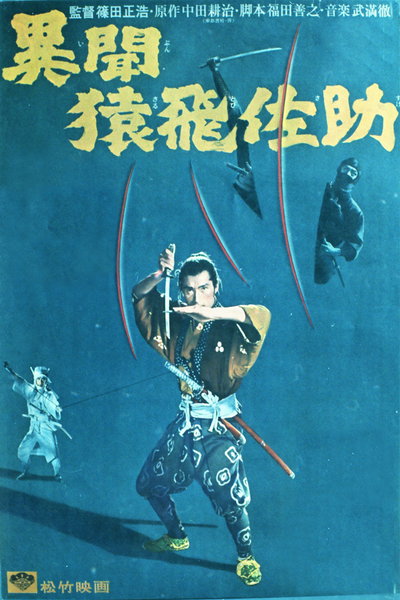
samurai-spyNothing is certain these days, so say the protagonists at the centre of Masahiro Shinoda’s whirlwind of intrigue, Samurai Spy (異聞猿飛佐助, Ibun Sarutobi Sasuke). Set 14 years after the battle of Sekigahara which ushered in a long period of peace under the banner of the Tokugawa Shogunate, Samurai Spy effectively imports its contemporary cold war atmosphere to feudal Japan in which warring states continue to vie for power through the use of covert spy networks run from Edo and Osaka respectively. Sides are switched, friends are betrayed, innocents are murdered. The peace is fragile, but is it worth preserving even at such mounting cost?
Our “hero” Sasuke (Koji Takahashi) is a wandering spy for the Sanada clan, nominally part of the Tokugawa though with no strong allegiance to either side. Everywhere he goes he feels hunted, watched by shadowy forces and unseen motivators. After bumping into Mitsuaki (Mutsuhiro Toura), an old comrade who fought alongside him at the Battle of Sekigahara, Sasuke is pulled into the ongoing intrigue as his friend is murdered and he assumed to be the culprit. Things are further complicated when a mysterious woman to whom he had become attached, Okiwa (Misako Watanabe),  is killed in a similar fashion. A political shift is taking place as a high ranking Tokugawa official, Tatewaki (Eiji Okada), is in the process of defecting to the Toyotomi with white cloaked ninja master Takatani (Tetsuro Tanba) (presumably) working against him. Sasuke is charged with trying to sort all of this out but constantly finds himself on shaky ground as everything around him is constantly changing and the air is filled with conspiracy.

Shinoda aims to disorientate. After beginning with a brief historical narration to set the scene including a bloody excerpt from the horrific Battle of Sekigahara (the historical context presumably much more apparent to a Japanese viewer than an overseas one), he jumps forward 14 years and proceeds to give a rundown of the current situation. Quick fire naming and a lack of external context intentionally make it difficult to pin down who is who and which side is which. The opening sequence takes place in darkness with only moonlight and lanterns to light the way, so our players are always cast in shadows, only half visible and unidentifiable. Nothing is as it seems, the world is murky and the people in shadier still.

Sasuke fought at Sekigahara when he was just 15. His true coming of age has been in an era of peace and he is committed to sustaining that peace at all costs rather than return to the bloody, internecine warfare of the past. This stands in contrast to his double dealing friend, Mitsuaki, whose own coming of age was forged by war and so now finds himself at a loose end as warriors are obsolete in an age without war. Nevertheless, Sasuke feels the peace is threatened – all conversations are eventually about conflict, no one thinks about the meaning of death or what it is to be alive. Men like Mitsuaki have decided to live purely for pleasure, wanting nothing more than women and sake, thinking of nothing beyond satisfying their needs, and rarely consider the moral or political dimension of their actions. Mitsuaki’s unexpected degree of self interest accidentally threatens to completely destabilise the status quo, setting off a series of betrayals and counter betrayals in its wake, but all Mitsuaki was thinking about was a how to get paid twice for doing one job.

Navigating this complex network of allegiances and betrayals, Sasuke comes to discover what it is he really wants out of life and what he needs to do to get it. No longer a neutral observer, he has to pick a side and the one he picks that of the wronged. Coming to the aid of the threatened and oppressed, Sasuke adds himself to the list of enemies of the state yet he sees it as his duty to fight against the forces of darkness for a better, fairer world. Of course, he has his personal reasons for revenge but even these are partly born out of a sense of outrage for the injustice done to people who mattered to him.

Yet for all of the real world intrigue and political allegory Samurai Spy is also imbued with an unsettling sense of the absurd. Sasuke is plagued, yet at times assisted, by the almost supernatural Takatani who, incongruously, dresses in a bright white outfit with the fabric of his hood tied up into horns on the front. Appearing as needed along with his more conventionally dressed ninja minions, Takatani seems to float through the air performing strange acts of ninjadom and acting with no firm course of action. Shinoda shoots the battle scenes from odd angles using slow motion to give them a strange kind of power, even in one instance allowing a severed limb to float to the ground. In a nod to the circularity of violence, he even allows the climactic fight to be interrupted and witnessed by a small boy, shocked by what he has seen. The fact that the situation is laid to rest by a forgotten deus ex machina is yet more evidence for the world’s essential leaning towards constructed narrative.

Filled with the fog of war (literally so in places), Samurai Spy dramatises the uncertainties of its environment through the extreme lack of visual clarity. The audience is as disorientated as Sasuke, continually wrong footed and left at a loss as to the true motivations of each of the major players. The atmosphere is palpably intense, as if sitting on a powder keg ready to explode at any spark of conflict. From this viewpoint, it’s impossible to see who is in the right and who the wrong or even if those two ideas are even appropriate ways of thinking about things. Peace stands on a knife edge and, ironically, only survives if robustly defended. Violence is shown up for all of its essential cruelty and senselessness yet it is the only thing which is certain. Sasuke, at least, seems to have made his own peace in one way or another but the world he leaves behind him is far from ready to do the same.


Kwaidan (怪談, Masaki Kobayashi, 1964)

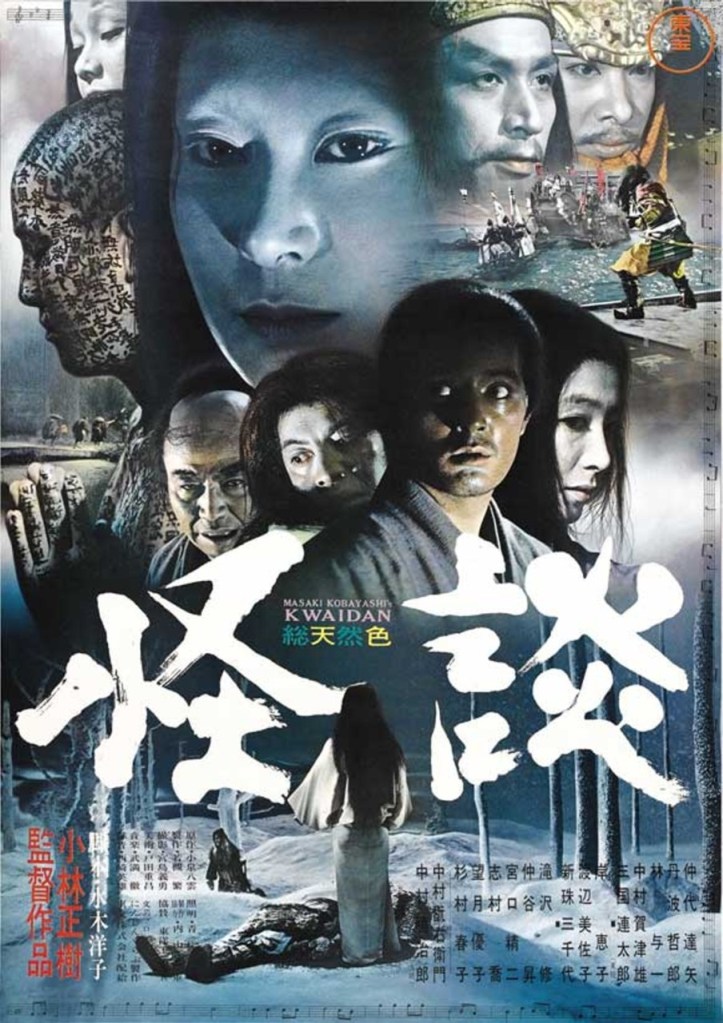
tumblr_ly5zbgdNH61rn3yrmo1_1280Kwaidan (怪談) is something of an anomaly in the career of the humanist director Masaki Kobayashi, best known for his wartime trilogy The Human Condition. Moving away from the naturalistic concerns that had formed the basis of his earlier career, Kwaidan takes a series of ghost stories collected by the foreigner Lafcadio Hearn and gives them a surreal, painterly approach that’s somewhere between theatre and folktale.
The first tale, Black Hair, is the story of an ambitious young samurai (Rentaro Mikuni) who abandons his one true love to marry a wealthy woman and advance his career. However, his second marriage is far from happy and he begins to appreciate just what it is he’s cast aside. Eventually returning home he meets his former wife again and harbours the desire to start afresh. However, when the sun comes up all is not as it seems.

Tale two, The Woman of the Snow, begins when two woodsmen are caught in a blizzard and a mysterious woman appears to suck one of them dry of blood. She spares the other, Minokichi (Tatsuya Nakadai), because she’s moved by his youth but she instructs him never to reveal the events of that evening or she will return to finish what she started. Minokichi returns home and meets another mysterious woman who later becomes his wife and bears him three children but will he remember to keep his secret even from the love of his life?

The third tale is perhaps the most famous, Hoichi the Earless, and features the sad tale of a blind biwa player (Katsuo Nakamura) whose storytelling ability is so great that the dead themselves petition him nightly to recount their story. Eventually the head monk finds out and disapproves of Hoichi’s dealings with the supernatural so the monks paint sutras all over his body to protect him from the malevolent spirits. However, like achilles and his vulnerable heel, they forget to paint Hoichi’s ears…

The fourth tale, A Cup of Tea, is a little more whimsical and opens with a framing sequence lamenting the fact that some ancient tales were never finished for one reason or another. The tale within the tale features a samurai who keeps seeing a face appear in his tea. Obviously this is quite disturbing, but eventually he just decides to drink it anyway only for the owner of the face to suddenly appear and complain about soul having been stolen.

Like all good fables the stories each have a moral to offer but also, crucially, paint the protagonists as victims of circumstance more than rash or unwise people. The samurai feared poverty so he abandoned his love in search of riches only to discover he’d been chasing the wrong kind of dreams. Minokichi momentarily forgot himself, perhaps entrapped by the Snow Woman’s final trick, Hoichi just wanted to play his biwa but his desires were frustrated by the powers at be who further mess things up for him by botching the sutra application. The protagonist of A Cup of Tea does choose to drink the tea himself but the resultant madness is not something that could ever have been reasonably expected. These are worlds of spirits where the doorway to the supernatural is always ajar, waiting for some ordinary person to tumble through accidentally.

Though employing slightly different styles for each of the four segments, Kobayashi sets his stage with a deliberately theatrical, almost hyperreal set design. Obviously shot on a soundstage, the tales take on the feeling of stories which have been told and retold, replayed countless times across the great theatre of life. Black Hair steers closest to a traditional kabuki play, an effect aided by Toru Takemitsu’s more traditional score but The Woman of the Snow gives way to intense color play full of cold blue ice vistas mixed with impressionistic, passionate red skies. Hoichi’s tale begins with an overlay of a scroll painting recounting the famous The of the Heike of which Hoichi sings his song. Full of epic battle scenes, ghostly apparitions and a whole load of biwa music, this segment is the lengthiest but also the meatiest when it comes to subtext. The final tale by contrast is much more straightforward and brings a little chanbara exuberance to the otherwise heavy atmosphere though it does leave us with one of the most haunting images in the entire film.

Kwaidan may look like an exercise in style for Kobayashi – it was also his first colour picture and he makes full use of that aspect of the film. However, that isn’t to say he’s abandoned his recurrent concerns. The people in the stories are all ordinary, they’re flawed but they aren’t evil. The samurai comes closest to bringing his fate on himself when he makes the selfish decision to abandon his loving wife for money and status though he pays a heavy price when he finally realises his foolishness. Minokichi’s crime is a loss of faith of perhaps of having doubted the truth of his tale in itself. In the end, he simply forgot his promise rather than making a conscious decision break it like the samurai. Hoichi is something of a passive player here as his blindness renders him unable to understand his plight – he is unable to keep his promise to the fallen samurai firstly because of the physical toll it’s taking on him and secondly as he’s prevented by his superiors. The protagonist of the final tale simply gives in to temptation and then to madness perfectly symbolising human weakness. Kobayashi maybe more artful here than acerbic but his bleak view of human nature still wins out. However, what Kobayashi crafted in Kwaidan is a beautiful, dreamlike canvas of supernatural visions which continue to dazzle in their artistry long after the screen has gone dark.


Kwaidan is available on blu-ray in the US from Citerion and on DVD in the UK from Eureka Masters of Cinema.


The Inheritance (からみ合い, Masaki Kobayashi, 1962)

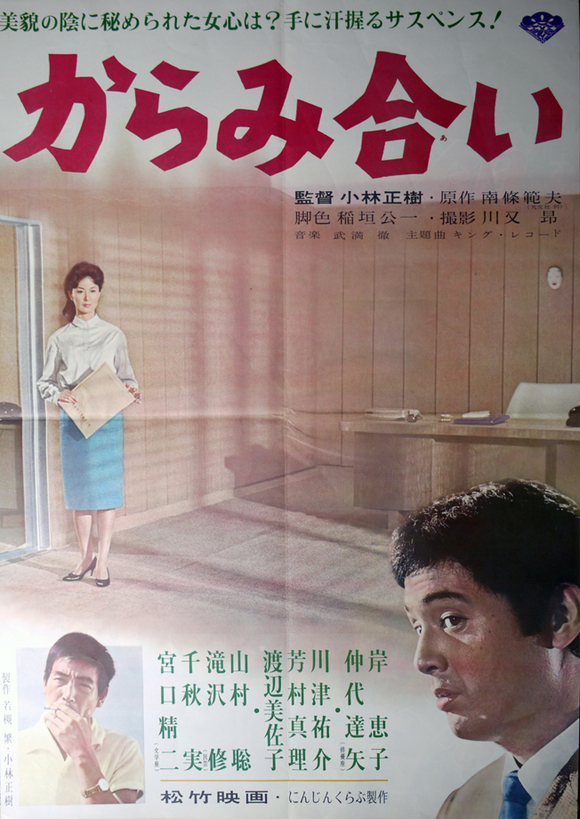
the inheritance Japanese posterKobayashi’s first film after completing his magnum opus, The Human Condition trilogy, The Inheritance (からみ合い, Karami-ai) returns him to contemporary Japan where, once again, he finds only greed and betrayal. With all the trappings of a noir thriller mixed with a middle class melodrama of unhappy marriages and wasted lives, The Inheritance is yet another exposé of the futility of lusting after material wealth.

The film begins in a framing sequence in which Yasuko, an elegant woman dressed in a fashionable outfit, sunglasses and large black hat, is aimlessly window shopping when she encounters a familiar face she’d no desire to see ever again. The pair head for coffee with Yasuko lamenting that her pleasant afternoon has been ruined by the necessity of spending time with this “unpleasant” man. We then flashback to some time previously when Yasuko was just a poor secretary working for a top executive and lamenting over her sad life in her “concrete coffin” of a tiny apartment. When her boss discovers he has a terminal illness he makes a surprising declaration – he isn’t going to leave all of his money to his wife. The law says she has to get a third so she will, but the couple had no legitimate children and Kawara wants an heir. Apparently, he has three illegitimate children with whom he did not keep in contact so he intends to find these young people of differing ages and divide the money between them. As you can imagine, this news pleases no one and it’s not long before everyone is scheming how they can manipulate the situation to grab some of the money for themselves.

Shot this time in 2.40:1, The Inheritance has a slightly more whimsical air than some of Kobayashi’s other efforts. Aided by Toru Takemitsu’s jazz infused score, there’s a feeling of a chaotic, black farce lurking below the surface as the complicated schemes and counter schemes play off against each other all while an old man lies dying and largely, it seems, alone. In fact, the dying man himself is relegated to little more than a plot element, a physical countdown to the zero hour of his death and the release of his funds. Though charged with the task of tracking down these, until now forgotten, offspring, Kawara’s underlings immediately start thinking about the best way to spin their assignments. Maybe it’s better if they just can’t find the kids, or maybe if they find them and manipulate them into a more beneficial course of events. The only thing that matters is sticking to the course of action which is most likely to bring them into contact with the money.

The children themselves? Well, they’ve not turned out quite the way Kawara might have hoped. He stated that they’d only get the money if he finds out that they’re honest, decent, right living people. However, the oldest, a son, is a delinquent college student who likely wouldn’t be able to cope with receiving a sudden large lump sum of money so he’s out. The middle daughter is a nude model living a lifestyle Kawara would most likely regard as “immoral” so she will require some “fixing” if her side is to prevail. The youngest child, a seven year old daughter, has sadly passed away after being adopted in another town. However, the enterprising wife and her paramour have an ace up their sleeve in the form of another child they can substitute in her place. This child is quiet, well behaved and in all an ideal candidate for Kawara’s money (if only she actually were his daughter).

Our story is being recounted by Yasuko, so how does she fit into all of this? Commentator, heroine, perpetrator? We can guess a little of what must have happened from her appearance in the later framing sequence with which the film began. Though apparently wealthy, this Yasuko doesn’t seem particularly happy (even bar her unwanted reunion with Kawara’s lawyer). After being entrusted with the task of tracking down the oldest son who then develops a crush on her, Yasuko finds herself ensconced in Kawara’s household and eventually becoming his mistress. The affair begins with a quasi-rape after which Yasuko receives a large amount of money in a white envelope – an offering which repeats itself after each encounter with Kawara. At first she tries to pretend there was something more to it but eventually admits she got used to taking the money. Though she later tries to refuse Kawara’s offering, the corruption has already set in.

Recounted in a world weary tone by Yasuko, The Inheritance is another, though less abrasive, look at greed and lack of moral authority. Kawara is dying and perhaps regrets his devotion to his career rather than something with a greater legacy. However, he evidently showed no interest in his children before and has no real desire to meet and have a relationship with them before it’s too late – he simply wants an heir. His marriage turns out to be mostly physical convenience and even his wife is not so broken up about his illness so much as irritated to have sacrificed the last seven years and only receive a third of what she assumed would all be hers. The underlings scheme amongst themselves and unwittingly open a door for a challenger nobody expected. In some ways, from our point of view, the “right” person won but this was a game that had no right to be played. A sordid farce of squabbling over a dying man’s estate and for what, in the end? A fancy hat? Kobayashi doesn’t push as hard here as he has before, this time he casts veniality as black comedy rather than a social evil but still the lesson is clear, in most cases avarice will get you nowhere and even if you play the slow game and win you may not like where it takes you.


The Inheritance is the fourth and final of the early films from Masaki Kobayashi available in Criterion’s Eclipse Series 38: Masaki Kobayashi Against the System DVD boxset.