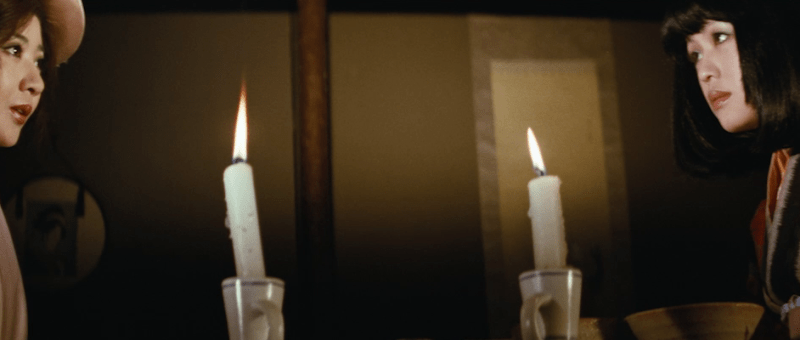
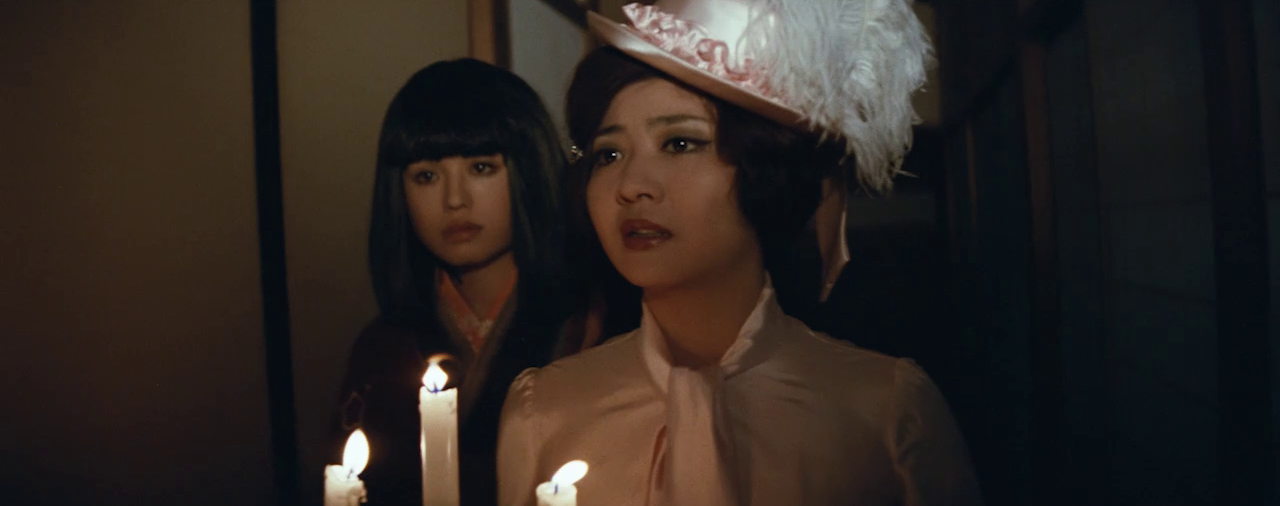
Woods Are Wet (女地獄 森は濡れた, Tatsumi Kumashiro, 1973)

As long as people live honest lives, eventually good things will happen to them, according to the sinister mistress at the centre of Takumi Kumashiro’s Roman Porno Woods Are Wet (女地獄 森は濡れた, Onna Jigoku: Mori wa Nureta). Perversely, she may actually believe this to be true but only in the most ironic of senses as she and her “cruel” husband enjoy incredibly happy lives together having decided to “honestly” embrace their true desires, which include things like rape, murder, and eating grapes off the corpses of their victims.

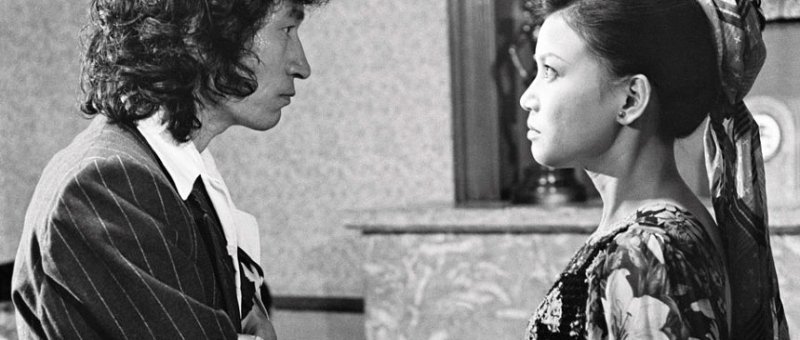
Inspired by the Marquis de Sade’s Justine and set in the Taisho era, the film begins in true gothic style as Sachiko (Hiroko Isayama), a runaway maid in flight from an accusation of having murdered her mistress, encounters Yoko (Rie Nakagawa), an upper-class lady who unexpectedly comes to her rescue in a small town. Yoko takes her back to the Western-style mansion she shares with her husband Ryunosuke (Hatsuo Yamaya) whom she describes as being incredibly cruel. Explaining that she’s been desperately lonely since her marriage at 19, Yoko begs Sachiko to stay but as her companion rather than a servant, which is another act of class transgression for which there will presumably be a price. 

In any case, the atmosphere changes when Ryunosuke arrives and reveals he knows all about Sachiko’s predicament and blackmails her into helping with his schemes to rape and murder guests at the hotel he runs. He explains that he’s very wealthy and does this for kicks not out of financial necessity but nevertheless uses her to spice up his game by directly telling her to warn the guests that their lives are in danger. If she manages to get them to escape, he’ll let her go too, but of course it’s not as easy as she’d assumed it would be, especially as the first two guests she’s sent to brutally rape her. Even so, she vows to escape with them, only they are not quite clever enough to beat Ryunosuke’s game.

Out in the middle of nowhere, the mansion is a true gothic fantasy lit by candle light due to an absence of electricity because of the Depression. Ryunosuke has adapted it so that it contains a series of prison-like doors with iron bars and locks that allow him to trap Sachiko and others exactly where he wants them. He is vile and depraved, as is Yoko, though they later brand themselves as simply liberated and living “honestly” having embraced their true desires. Ryunosuke paints himself as a quiet revolutionary, asking why he should conform with rules and laws dictated by a distant authority to which he himself does not subscribe. He describes commonly held visions of morality as nothing more than a tool of social coercion designed to control the common man (which he is not), in which he may have a valid point despite the depravity of his apparently honest nature. 

This aspect of Ryunosuke as an anti-social force was apparently something very much intended by Kumashiro, who was himself rebelling against a moral panic which had seen Nikkatsu’s Roman Porno line condemned under public obscenity laws. To make a point, he inserts large black blocks and lines throughout the film to mimic those sometimes demanded by the censors, though enlarged to an absurd degree and often not actually covering what they would presumably be intended to or actually drawing attention to it. In any case, what the censors objected to in this case was not apparently the sex itself but the violence which accompanies it, notably in the scenes in which blood-soaked sex continues after Yoko has shot one of the male victims she effectively raped at gunpoint. 

The central part of the film is a lengthy orgy scene in which Ryunosuke has his maids whip the victims while he anally rapes them while they are forced to have sex with Yoko and Sachiko on the pretext of saving their lives. It only gets grimmer from there, though there’s a censoriousness about Sachiko’s insistence that happiness should come from correctness to counter the “happiness” that Yoko and Ryunosuke exude in their embrace of their baser desires that undercuts her role as the innocent heroine standing up to their depraved inhumanity amid the absurd interruption of a radio taiso broadcast signalling the arrival of the next unhappy guests to rock up for a less than pleasant stay at this decidedly unluxurious hotel.
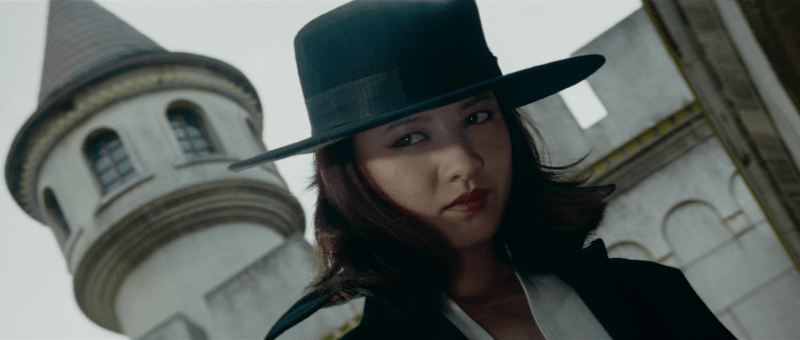
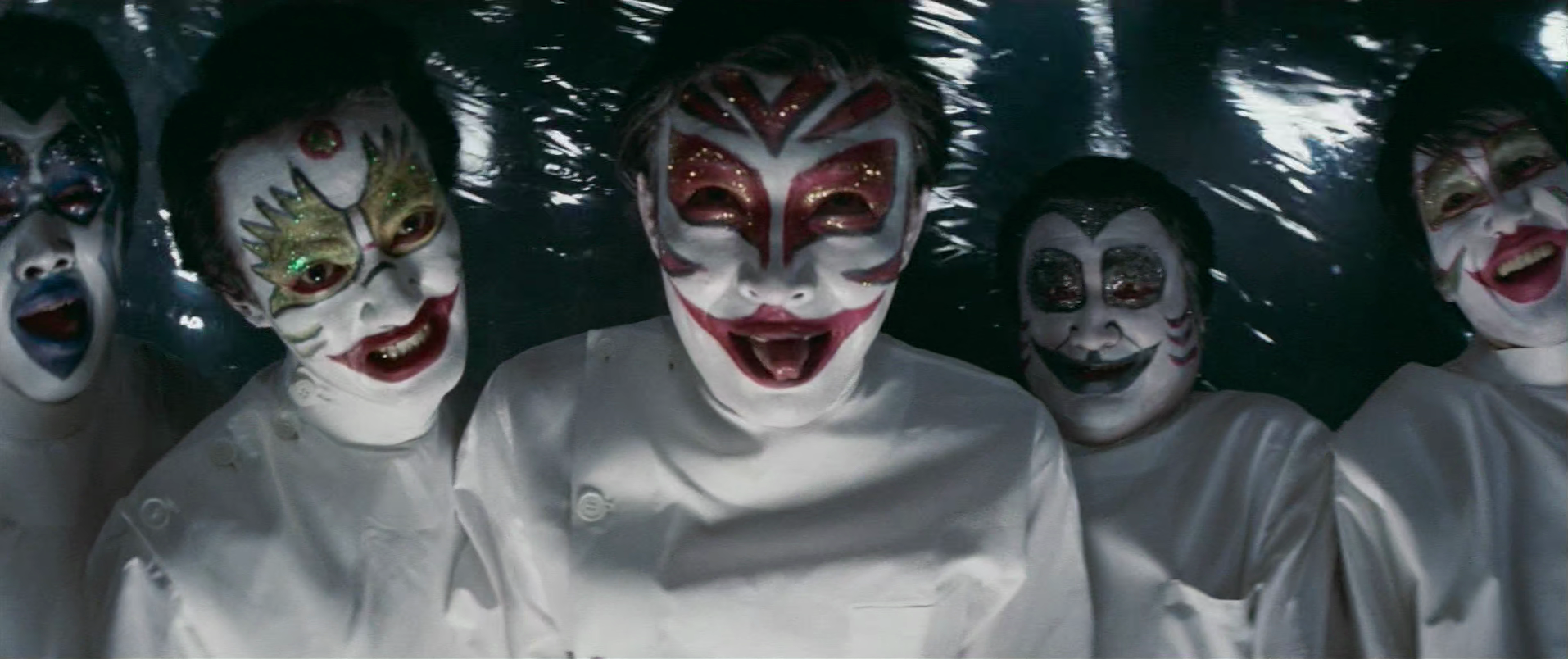
New Female Prisoner Scorpion: Special Cellblock X (新・女囚さそり 特殊房X, Yutaka Kohira, 1977)

After Meiko Kaji declined to appear in further Female Prisoner Scorpion movies, Toei attempted to reboot the franchise under the “New Female Prisoner Scorpion” banner much as they did with some of their other franchises such as New Battles without Honour and Humanity. This second, and in fact final, instalment Special Cellblock X (新・女囚さそり 特殊房X, Shin Joshu Sasori: Tokushu-bo X) is not a sequel to New Female Prisoner Scorpion but itself another reboot that like its predecessor takes place amid a backdrop of paranoia and political corruption. 

Arriving back at the prison after a failed escape attempt, this Nami (Yoko Natsuki) has an all new backstory as an idealistic nurse whose doctor boyfriend was given shock therapy that destroyed his mind and left him in a vegetative state after threatening to blow the whistle on his hospital’s decision to let the man at the centre of a growing political scandal quietly pass away. These facts are first communicated to us through a surreal fever dream Nami has presumably caused by an infected wound on her leg. She first dreams herself frolicking cheerfully with the doctor before frightening figures of darkness pull him back into an abyss while terrifying clowns leer over and then rape her. She’s only saved from her life-threatening medical condition by the intervention of Kiyomi (Kaori Ono), a fellow prisoner who feels indebted to her because of a blood transfusion she received three years earlier before everything in Nami’s life went wrong. 

But otherwise Nami enjoys little respite in the prison as the other inmates take out their frustrations on her in regards to the reprisals enacted on them following her escape attempt. Like most other prisons in the franchise, this one employs a tactic of divide and rule encouraging the prisons to turn on Nami rather than the guards for their treatment of them. But things are changing in the prison. Chief guard Kajiki (Takeo Chii) had ruled supreme, but the warden has different ideas and objects to Kajiki’s tactic of appeasement by allowing things like cigarettes and chocolate to circulate in the prison to keep the inmates happy. He brings in a super tough security enforcer from the face male Abashiri prison which means Kajiki’s career is definitely on the decline and leaving him increasingly siding with the prisoners over the cruel treatment they’re exposed to by the warden who is too busy courting the justice minister in the hope of a government position to consider things like prison regulations or the welfare of the prisoners. 

Of course, it’s also the justice minister against whom Nami wants revenge. This Sasori is even more silent than most, glaring angrily at those around her but saying little other than stopping to advise Kiyomi not to get involved with her because it won’t end well in a prediction that turns to be accurate. When she eventually assumes her Sasori persona, it’s a little different from that of her predecessors as she dresses all in white (perhaps apt for a former nurse) with a long black over coat. Her black hat has a wide, stiff brim and a feather tucked in the side. She kills with a scalpel, as if she were literally excising the corruption in society and is prepared to play a little bit dirty. The justice minister had asked the warden to kill her and pass it off as an illness. She threatens to blackmail him though it’s obvious she’s not after money and executes the warden when he delivers the pay off on a cheerful fairground ride. 

Though it may lack the striking cinematography found in Ito’s trilogy, the film nevertheless skews surreal with its strange fever dream that turns out not to be so far from the reality as you’d assume along with weird gags like Nami and Kojiki stealing the clothes of a young couple after escaping together who happened to be dressed in identical outfits. Nami teaming up with a former guard is also something of a surprise and though she fights with him and rejects his romantic advances, she seems to have genuine pity when he gives up his life to save her. In any case, they each have something in common as those who now resist the system as Kajiki became a victim of a more authoritarian regime that doesn’t like his lax approach to rule keeping and Nami pursues her desire for justice in an unjust society at all costs. Dropping a bloody scalpel behind her, she disappears into the night, justice done, but presumably onto some other kind of vengeance against a corrupt authority that equally will stop at nothing to hang on to its power.


All Under the Moon (月はどっちに出ている, Yoichi Sai, 1993)

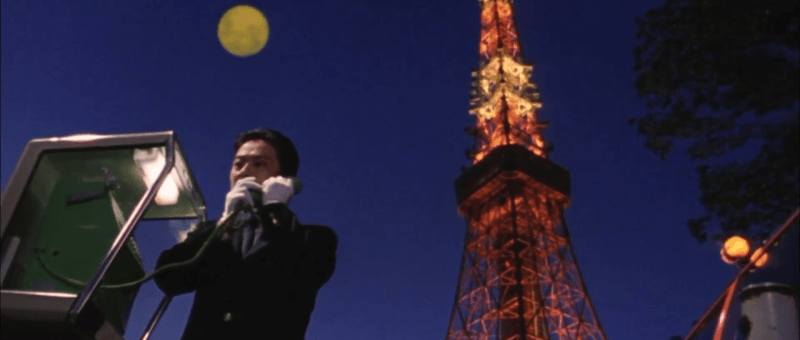
Throughout Yoichi Sai’s All Under the Moon (月はどっちに出ている, Tsuki wa Dotchi ni Dete iru), an earnest taxi driver, Anbo (Akio Kaneda), repeatedly calls in to despatch to inform them that he’s become lost and has no idea where he is despite rocking up next to such prominent landmarks as Tokyo Tower and Mount Fuji. His confusion reflects that of the changing post-Bubble society in which those like him struggle to reorient themselves and find new direction just as the nation appears slow to recognise itself and adjust to a new reality. 

It does seem that many of the drivers at Kaneda Taxi have themselves lost direction in their lives and are living very much on their margins while their rather deluded boss Sell is behaving like it’s still the Bubble dreaming of building a golf course and then a hotel to accommodate 2000 people. The Korean loan shark working with him alternately tells fellow Zainichi taxi driver Chun (Goro Kishitani) that he’s acquiring wealth to use for the reunification of Korea, and Sell that they are all children of capitalism, “Damn Reunification!”. At the wedding Chun attends, the guests take phone calls to deal with business and each remark on the precarious economic situation while one suggests that the North Korean association he represents is probably on the brink of failure joking that he fears they may sell their school and pocket the money. 

Yet despite the economic turbulence, the country has been slow to accept the presence of workers from outside Japan and many, including those at the taxi firm, still face discrimination as does Chun himself by virtue of his Korean heritage. One Japanese employee also seems to face a good deal of stigmatisation simply because he has a speech impediment, while an older mechanic with a limp insists on calling an Iranian colleague by a similar sounding Japanese name while baselessly accusing him of theft. Hoso (Yoshiki Arizono), a man with mental health issues provoked by his previous career as a professional boxer in which he accidentally killed an opponent during a bout, is fond of saying “I hate Koreans, but I like you” while otherwise fixating on Chun as a dependable big brother figure and resentful enough when he starts dating a Filipina hostess, Connie (Ruby Moreno), who works at his mother’s bar to pound down the door of her flat and demand to be let in. 

Chun himself is at least problematic and especially by the standards of today as he tries a series of crass pickup lines on Korean women at the wedding and then eventually forces a kiss on Connie not to mention physically striking her during a heated argument. He also insensitively tells her about his family’s tragic history in the war emphasising that citizens of Korea were abused for slave labour while seemingly unaware of the history of the Japanese occupation of the Philippines. Meanwhile, he also lies that his father was killed by the Japanese and that all his brothers died of malnutrition whereas they are (presumably) alive if possibly not so well in North Korea. His hard as nails mother (Moeko Ezawa) points out that she came to Japan at 10, while Connie counters that she came at 15, though their experiences have perhaps been very different leaving them somewhat at odds rather than sharing a kind of solidarity as otherwise echoed in the marginal status of each of the migrants who are similarly othered as merely not Japanese yet largely left to fend for themselves while facing possible exploitation and deportation. 

Divisions exist even within the Korean population with guests at the wedding complaining that there have been too many long and boring speeches along with North Korean propaganda songs, claiming that it is discriminatory against South Koreans and finally being allowed to sing a South Korean folksong instead which is at least a good deal more lively. The gangsters leverage the idea of reuinifaction to carry out their scams while later claiming that they have been scammed by their Japanese backer who turned out to be more racist than they had first assumed. Yet as Chun says during one of his cheesy pickup attempts, what really has reunification got to do with them, the younger post-war generation who know no other homeland than Japan? He too flounders, caught between a series of names from “Tadao Kanda” to “Chun”, to the name which appears on his taxi license “Kang” the Korean pronunciation of character read “ga” Japanese which is only otherwise used in the word for ginger as pointed out by a slightly racist fare who goes on to remark that he doesn’t see the point of the “comfort women issue”. Chun has to grin and bear it while technically powerless despite being in the driver’s seat. Predictably, the prejudiced passenger also attempted to make a run for it rather than actually pay Chun his money. “I was born after the war too” Chun reminds him, “but we say after the liberation.”

Sai introduces us to the world of Kanda Taxis through a roving long shot around the carpark travelling from one employee to another before drifting up to management on the second floor. He returns to a similar scene near the film’s conclusion as the remaining workers playfully hose each other with water while literally watching their world burn. Yet for some at least it may be liberating experience, Chun finally gaining the courage to choose his own destination and go after something that he wants, even if it he does it in a characteristically problematic way, seemingly no longer worrying about where it might be taking him but content to simply drive in the direction of the moon. 


Original trailer (no subtitles)

Supermarket Woman (スーパーの女, Juzo Itami, 1996)

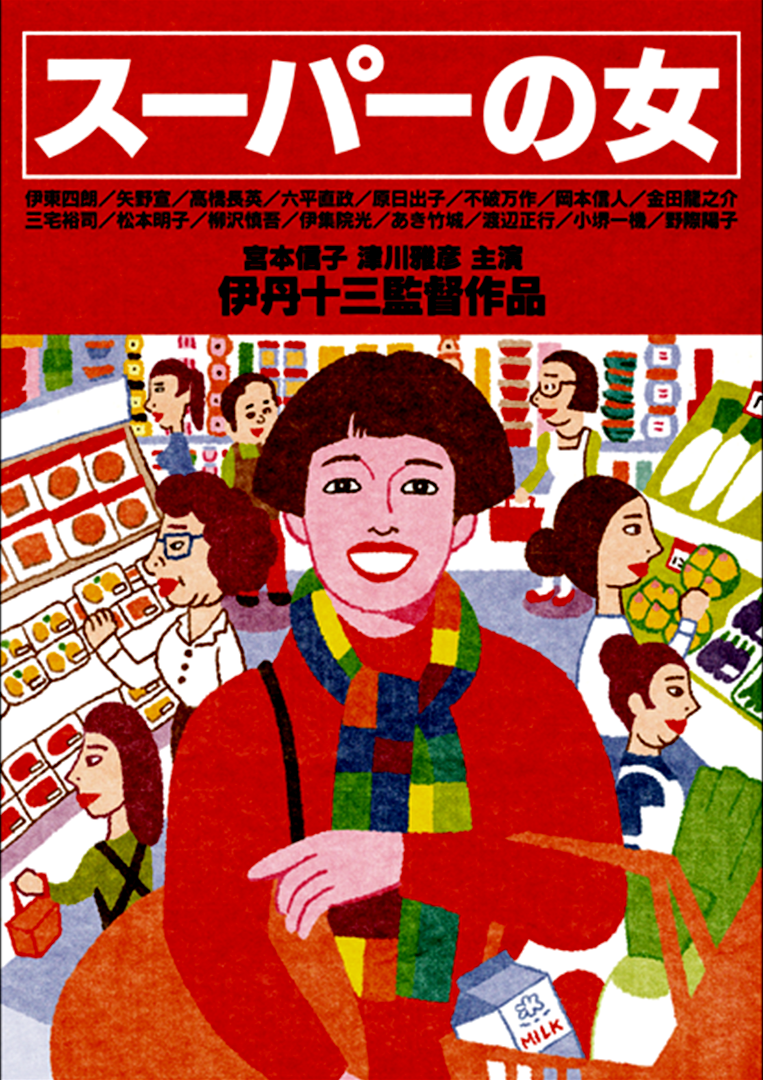
By 1996 Japan had entered an extended period of economic stagnation which signalled the end of post-war aspiration but for many at least the false promises of the Bubble era proved hard to dispel. In what would be his penultimate film, Supermarket Woman (スーパーの女, Supa no Onna), Juzo Itami turns his attentions to the insular world of the nation’s family-held, independent supermarkets to ask a few questions about integrity in business which cut straight to the heart of what kind of society post-Bubble Japan intended to be given yet another opportunity to make itself anew. 

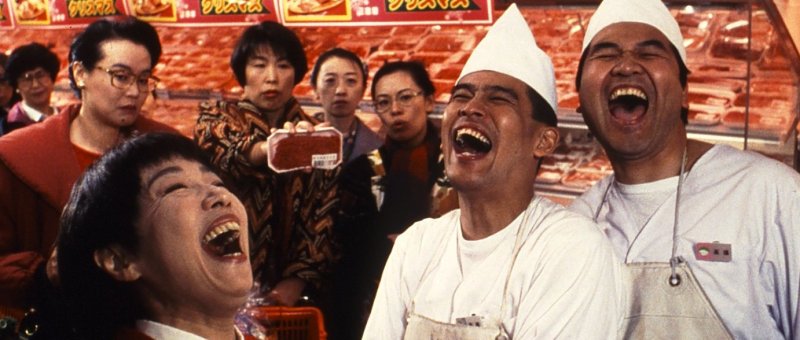
As the opening text crawl explains, this is a story not about giant supermarket chains but your friendly indie local. “Honest Mart” is a family-owned, mid-range supermarket in a declining industrial area nominally run by absentee CEO Goro (Masahiko Tsugawa) who was bequeathed the place by his father but is a melancholy drunkard delegating responsibility to his manager. The store has a huge problem in that a rival has recently re-opened under the new name “Discount Demon” and seems primed to steal all their business. On a stakeout of the new place, Goro runs into a childhood friend, Hanako (Nobuko Miyamoto), who is now a widow returning to the area. With her lifelong experience as a veteran housewife, Hanako knows a few things about supermarkets and she’s not very impressed with Discount Demon, doing a few quick calculations to realise the supposed discounts aren’t as enticing as they seem while common gimmicks like the all pervasive red glow that makes their meat look fresher than it really is only irritate her. Goro asks her for a “professional” opinion on Honest Mart without telling her who he is, only to discover she’s even less impressed with them, certain that his place is on the way out thanks to its dated decor, uninviting atmosphere, and low quality produce. 

The irony is Honest Mart is not much better than Discount Demon, both stores are subject to the same industry standards in which a certain degree of obfuscation is permissible. “In business honesty doesn’t pay” Hanako is told by the onsite butcher after she questions his tendency to mix meats to pass them off as more expensive cuts, while she later discovers that the store engages in the practice of repackaging unsold meat and fish with new expiration dates and is not very particular about its suppliers when it comes to buying in ready-made products. Brought on board to save the store, Hanako breezes in with a new mission to win the hearts and minds of her customers, and she can’t do that if she can’t have confidence in her stock. In any case, her the customer is always right policy quickly brings her into conflict with the store manager, an older more conservative man who actively resists innovation and resents having his authority undercut by an interloping woman. 

Meanwhile, we can also see that customer attitudes have changed. There’s a problem with availability of trolleys because, perhaps unusually for Japan, customers are just abandoning them willy-nilly in the carpark instead of retuning them to the trolley point like responsible shoppers. One man is even for some reason intent on stealing a large number of shopping baskets, caught by Hanako loading them into his car. Everybody wants cheap, which is understandable especially given the economic situation, and they might even be a little underhanded when it comes to getting it, but they also expect a reasonable level of quality and to be able to trust that the food they’re buying is safe to feed their families. Hanako is most alarmed that the ladies who work in the kitchen area, who are obviously wives and mothers themselves, do not shop at Honest Mart because they know what goes on at the store and they don’t trust it. 

“A housewife knows” Hanako is fond is saying. Her revolution is in essence a vindication of “the housewife”, perhaps the most maligned and dismissed figure of the mid-90s society, putting to good use all of her veteran experience both of running a home and of working a series of part-time jobs including those in supermarkets which she claims to love. Approaching the problem from the point of view of a consumer, she attempts to help Goro achieve his dream of making Honest Mart number one in Japan not through making it the most financially successful but the most loved by listening to women like her in the form of a focus group of local aunties some of whom had previously been serial complainers. 

Then again, some of her decisions are in a sense contradictory as she attempts to streamline the business along classically capitalistic lines in suggesting that the store doesn’t really need its overqualified butcher and fishmonger because the part-timers could be trained to do a “good enough” job. “Good enough” is in a sense her business philosophy, only not in the sense that somewhere like Discount Demon which falsely advertises regular steak as discount Wagyu means it, rather that her customers are after an everyday level of produce and so it’s not surprising that premium meats don’t sell. She wants to get rid of the butcher, who turns out to be on the fiddle, and the melancholy fishmonger disappointed no one wants his top quality seafood, because their “artistic temperament” is disruptive to the flow of the store and their presence is perhaps emblematic of the bloated, pretentious management style which is holding it back. 

Positioning the “housewife’s choice” as the ultimate seal of approval, Supermarket Woman advocates for a return to wholesome, small-town values, prioritising a sense of integrity as Honest Mart projects itself as a corporate force their customers can trust, perhaps anticipating a trend in dedicating itself to providing good quality fresh produce at fair prices in direct opposition to Discount Demon and its underhanded trickery. “Honest Mart keeps its word” Goro assures, pledging to honour a mistaken ad which promised eggs at prices so good it caused minor riot. In the end, it’s all about trust and integrity. If you don’t have that, you don’t have anything and the housewives of post-Bubble Japan will it seems vote with their feet. 


Currently available to stream in the US via Criterion Channel.

Original trailer (no subtitles)

Case of the Disjointed Murder (不連続殺人事件, Chusei Sone, 1977)

Case of the disjointed murders posterJapanese cinema of the 1970s fell hard for the prestige murder mystery. Following the success of The Inugami Family, an early and unexpected hit thanks to Kadokawa’s “innovative” marketing strategy, multi-cast detective dramas dominated the box office for the rest of the decade. Meanwhile, ATG had been known for serious and high-minded avant-garde cinema throughout the 1960s but its brand of left-leaning, politically conscious, arthouse-fare was tantamount to box office poison in the increasingly consumerist post-Asama-Sanso world. ATG’s Kindaichi-centric Death at an Old Mansion, updated to the present day, pre-dated Ichikawa’s series for Toho by a whole year and perhaps signalled their resignation to shifting into the mainstream. By 1977, that transition was perhaps complete with former Nikkatsu Roman Porno director Chusei Sone’s adaptation of a classic serial penned by Ango Sakaguchi, an author of the “Buraiha“ school well known for chronicling post-war aimlessness.

Set in the summer of 1947, Case of the Disjointed Murder (不連続殺人事件, Furenzoku Satsujin Jiken, AKA Unrelated Murder Cases) is a classic country house mystery in which a series of high profile writers are invited to a mansion owned by a wealthy family, the Utagawas. Only, as it turns out, many of the letters of invitation are forgeries or have been doctored so that several unexpected guests have arrived including dissolute artist Doi (Yuya Uchida) whose presence is particularly awkward because he is the former husband of the host Kazuma’s (Tetsuro Sagawa) new wife Ayaka (Junko Natsu). Soon enough, one of the guests is murdered, and then another, and still more, seemingly for no real reason. Amateur detective Kose (Kazuya Kosaka), one of the “unexpected” guests, tries to piece the crime together to prevent its expansion but finds himself outflanked by a lack of material evidence.

Sakaguchi’s original tale ran as a newspaper serial which promised a cash prize for anyone clever enough to identify the murderer(s) before the truth was revealed as it eventually is in true country house mystery fashion with the detective explaining everything in a lengthy monologue while all the interested parties sit around a dinner table. The gamified nature of the serial is perhaps the reason for the large cast of characters comprising of Utagawa family members, the literary house guests, and staff all of whom become mixed up in the ongoing crime drama which Kose comes increasingly to believe is engineered rather than random as it might originally seem.

The “supposed” random chaos of the the “unconnected” murders is a key part of Sakaguchi’s interrogation of post-war anxiety. For a time it seems as if these mostly quite unpleasant people have taken the opportunity of being trapped within a claustrophobic environment to air out their own grievances with each other in an atmosphere already tainted with violence and resentment. Meanwhile, the moral corruption of the Utagawa household continues to come back to haunt them in the sexual transgressions of the late grandfather who apparently fathered several illegitimate children in addition to those from multiple marriages. The half-siblings bring additional strife into the Utagawa home in Kazuma’s incestuous desire for his half-sister Kayoko (Hitomi Fukuhara) who returns his affections and even hopes to marry her brother, while he has also transgressed by “buying” Ayaka from her venal first husband Doi.

As in most Japanese mysteries, however, the motives for murder turn out to be banal – simply monetary greed and seemingly nothing more even if backed up by a peculiar kind of romanticism. Such unbound desire for riches is perhaps another symptom of the precariousness of the post-war world in which individual survival is all in a chaotic environment where financial security is more or less impossible for those not already born into wealth. Kose begins to solve the crimes through the “psychological traces” the killer(s) leave behind, the various ways in which “scenes” are calculated and contrived but fail to entirely mask the truth which lies behind them.

Which is to say that the mechanics behind the killings ultimately become secondary to their psychological import in which Kose analyses superficial relationships to uncover the depths which underpin them and their implications for a conspiracy of crime. This persistent amorality in which human relationships and connections are subverted for personal gain is yet another example of post-war inhumanity in which the corruption of the war has destroyed the “innocence” of pre-modern Japan and provoked nothing more than a moral decline born of a confused anxiety and a generation struggling to adjust itself to a new reality.

Death at an Old Mansion aside, the ‘70s mystery boom had a peculiar obsession with post-war crime in the comparative comfort of the economic miracle. 30 years on, society was perhaps ready to ask more questions about an intensely traumatic moment in time but equally keen to ask what they might say about another anxious moment of social change only opposite in nature. No longer quite so burdened by post-war regret or confusion, some began to wonder if consumerism was as dangerous as poverty for the health of the national soul, but nevertheless seem content to bask in the essential cosiness of a country house mystery in which the detective will always return at the end to offer a full and frank explanation to a roomful of compromised suspects. If only real life were so easy to explain.


Original trailer (no subtitles)

Puppets Under Starry Skies (星空のマリオネット, Hojin Hashiura, 1978)

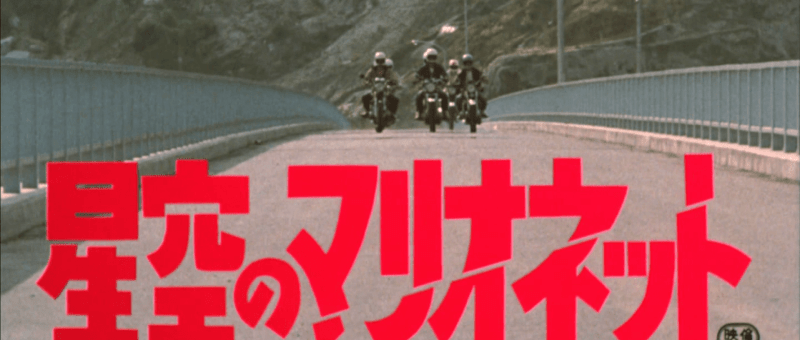
Puppets under starry skies posterThe youth movie had been the populist rebellion against the stately Japanese cinema of the golden age, but many of its representative directors had quickly tired of the restrictive studio system. Some had decamped into the “independent” arena which offered relative artistic freedom if without the resources and financial rewards of the commercial sector. The Art Theatre Guild had provided a valuable outlet for experimental film since it began to shift from distribution of foreign films into production of Japanese language art movies, but paradoxically the early 1970s saw it shift again as the studio’s “arthouse” aims fell by the wayside and more conventional youth films made a gradual return. Puppets Under Starry Skies (星空のマリオネット, Hoshizora no Marionette), the first of three films directed by Hojin Hashiura for ATG (aside from an earlier 16mm independent effort, the only films Hashiura would ever make), is very much a youth movie in the new ATG mould which is to say its tone is one of sadness rather than anger as its protagonists find themselves adrift in the changing 1970s society, unable to find their place in the world their parents have been building for them.

Hideo (Yoichi Miura), leader of small biker gang, is best friends with Hiroshi (Kazuhito Takei) – an effeminate young man from a wealthy family who likes to wear makeup and dress in (slightly) flamboyant outfits. The trouble starts when Hideo picks a fight with a rival gang boss and then charges in for a rematch to avenge his honour only to be set on by thugs, stabbed, and beaten so badly he winds up in hospital for over a week. Humiliated, Hideo loses all his gang member friends with only Hiroshi sticking by him. Later he takes up with a local bar girl, Akemi (Ako), who has a promiscuous past and is already pregnant with another man’s child. Together the three attempt to find a way forward into a more conventional adulthood but struggle to find a place for themselves within a rigidly conformist society which has already rejected them.

Parental disconnection seems to be a recurrent theme in the lives of each of the troubled youngsters. Hideo lost his mother young, not long after they’d moved into the town from the mountains. Never having been able to come to terms with his mother’s death he has a difficult relationship with his father and takes out his frustrations through meaningless violence and male posturing. Akemi too has a difficult family background but this time with a single mother who is a former sex worker turned publican. Working in a local bar (not her mother’s) Akemi is harassed by the customers but is well known for being open to casual sex, suffering a degree of social stigma both because of her liberated attitude and because of her mother’s former profession.

Hiroshi’s problems are perhaps of a different order. From an “elite” family, he feels himself entirely disconnected from normal family life and has been raised in an atmosphere of cold austerity rather than parental love. Hiroshi believes this is partly because he has “bad blood” and is cursed beyond redemption. He is not his father’s biological son but the child of a sperm donor enlisted to ensure an heir for his father’s bloodline. Hiroshi, however, is gay and will not be able fulfil the purpose he was born for, at least not in the way that was expected of him. He is also effeminate, something of which his family do not approve, and feels himself excluded from mainstream society because of his sexual orientation. To combat his feelings of intense alienation, Hiroshi has become a drug user, sniffing glue in order to send himself on psychedelic trips to outer space in which he merges with the deep blue vacuum free of all worldly concerns.

Hideo too gets in on the glue sniffing act but feels himself becoming one with the river of life and death, feeling it flow through him as he flows with it. The river itself, and the idea of passive resignation that comes of simply allowing oneself to float, becomes a grim symbol of the futility that faces Hideo as he struggles to reassemble an identity in a world which consistently denies him one. The future looks bleak for each of our protagonists, the only one with any sense of hope once again investing it in the system which has already betrayed her – the family. Youth looks for new models, new standards by which to live, but does not find them. Puppets of fate, the trio dance under starry skies until the sun comes up and they realise that the day holds nothing for them except the nihilistic desire for its end.


A Taxing Woman (マルサの女, Juzo Itami, 1987)

A Taxing Woman posterIn bubble era Japan where the champagne flows and the neon lights sparkle all night long, even the yakuza are incorporating. Having skewered complicated social mores in The Funeral and then poked fun at his nation’s obsession with food in Tampopo, Juzo Itami turns his attention to the twin concerns of money and collective responsibility in the taxation themed procedural A Taxing Woman (マルサの女, Marusa no Onna). Once again starring the director’s wife Nobuko Miyamoto, A Taxing Woman is an accidental chronicle of its age as Japanese society nears the end of a period of intense social change in which acquisition has divorced mergers, and individualism has replaced the post-war spirit of mutual cooperation.

Ryoko Itakura (Nobuko Miyamoto), a single mother and assistant in the tax office, has a keen eye for scammers. She demonstrates this on a stakeout with a younger female colleague in which she keeps a shrewd eye on the till at her local cafe and comes to the conclusion that they’ve been running a system where they don’t declare all of their cheques. Running her eyes over the accounts of a mom and pop grocery store, she notices some irregularities in the figures and figures out the elderly couple feed themselves from the supplies for the shop but don’t “pay” themselves for their own upkeep. That might seem “perfectly reasonable” to most people, but it’s technically a small form of “embezzlement” and Ryoko doesn’t like figures which don’t add up. Seeing as the couple probably didn’t realise what they were doing was “wrong” she lets them off, this time, as long as they go by the book in the future. A more complicated investigation of a pachinko parlour finds a more concrete form of misappropriation, but Ryoko is fooled by the owner’s sudden collapse into inconsolable grief after being caught out and leaves him in the capable hands of his confused accountant.

Nevertheless, Ryoko may have met her match in sleezy corporate yakuza Hideki Gondo (Tsutomu Yamazaki). Dressing in a series of sharp suits, Gondo walks with a pronounced limp that hints at a more violent past but as his rival from the Nakagawa gang points out, violence is a relic of a bygone era – these days gangsters go to jail for “tax evasion” as means of furthering their “business opportunities” and facilitating ongoing political corruption. Gondo’s business empire is wide ranging but mainly centres on hotels, which is how he arouses Ryoko’s interest. She looks at the numbers, does a few quick calculations, and realises either the business isn’t viable or the correct figures aren’t being reported. Ryoko doesn’t like it when the books don’t balance and so she sets her sights on the seedy Gondo, but quickly discovers she has quite a lot in common with her quarry.

Itami was apparently inspired to make A Taxing Woman after the success of Tampopo shoved him into a higher tax bracket. Given Japanese taxes (at the time) were extremely high, getting around them had become something of a national obsession even if, in contrast to the preceding 30 years or so, there was plenty of money around to begin with. More than the unexpected tendency towards civil disobedience the times seemed to cultivate, Itami homes in on the increasingly absurd desire for senseless acquisition the bubble era was engendering. Thus Gondo who owns a large family home well stocked with symbols of his rising social status, also occupies a bachelor pad where he keeps a mistress which reflects the gaudy excess of the age right down to its random stuffed hyena. Nevertheless when one of the tax clerks asks for some advice as to how to have it all, Gondo replies that that’s easy – to save money, you simply avoid spending it. Gondo lets his glass run over and delights in licking the edges. It’s all about delayed gratification, apparently, and having a secret room full of gold bars to gaze at in order to relieve some of that anxiety for the future.

Gondo, like many of his ilk, has “diversified” – yakuza are no longer thuggish gangsters but incorporated organisations operating “legitimate” businesses through “illegitimate” means. Thus we first find him using a nurse who allows herself to be molested by an elderly, terminally ill client whose identity they will steal to found a company they can quickly dissolve when he dies to shift their assets around and avoid the tax man. Later he pulls another real estate scam by pressing a desperate family but his real focus is the love hotels, whose slightly embarrassing existence ensures that not many come poking around. Ryoko, however, is unlikely to let such a large scam slide and delights as much in closing loopholes as Gondo does in finding them. Noticing a kindred spirit, Gondo quite openly asks his new tax inspector “friend” what she’d think if he married his mistress, gave her all his money, and divorced her – divorce proceeds are after all tax free. Sounds great, she tells him, as long as you trust your wife not to skip town with all the doe.

Ryoko, a modern woman of the bubble era, single and career driven, is a slightly odd figure with her officious approach to her job and unforgiving rigour. Unlike her colleague who dresses in the glamorous and gaudy fashions of the times, Ryoko wears dowdy suits and her mentor boss is always reminding her about her “bed hair”, meanwhile she stays late at the office and offers instructions to her five year old son over the phone as to how to microwave his dinner. Though there is another woman working with her at the tax office, when she’s finally promoted to full tax inspector status she finds herself in a room full of guys who apparently hardly ever go home. On her first job she’s only really brought along because she’s a woman and they want to threaten a mob boss’ mistress with a strip search to find a missing key for a safety deposit box. The mistress, however, tries to throw them off the sent by publicly stripping off and encouraging them to check her “cavity” if they’re so keen to find this key, only for Ryoko to find it under the sink while all the guys are busy being shocked. Ryoko’s methods are occasionally as underhanded as Gondo’s and, like his schemes, built on gaming the system but she’s certainly a force to be reckoned with for those considering defrauding the Japanese government.

Gondo’s schemes excel because they aren’t entirely illegal, only clever ways of manipulating the system, but they’re also a symptom of a large conspiracy which encompasses improprieties right up the chain as banks, corporations, and politicians are all part of the same dark economy managed by a corporatising yakuza. Gondo takes frequent calls from a local representative who often “helps him out”. Later the same representative tries to put pressure on the tax office to back off, but Ryoko’s boss points out that he doesn’t need to because the press are already on the story so he should probably get started on his damage control rather than bothering public servants. Gondo and Ryoko, perhaps as bad as each other, lock horns in a battle wills but discover a strange degree of respect arising between them in having discovered a worthy adversary. There’s something undeniably absurd in Ryoko’s firm determination to catch out struggling businesses and the confused elderly with the same tenacity as taking on a yakuza fronted conspiracy, and there’s something undeniably amusing in Gondo’s attempts to beat the man by playing him at his own game, but the overall winner is Itami who once again succeeds in skewering his nation’s often contradictory social codes with gentle humour and a dispassionate, forgiving eye.


Currently available to stream in the US/UK via FilmStruck.

Original trailer (no subtitles)

Wild Berries (蛇イチゴ, Miwa Nishikawa, 2003)

wild berries poster

The family drama was once the representative genre of Japanese cinema. In the turbulent post-war world, the one unchanging, unbreakable touchstone was the bonds between parents and their children even if it must also be realised that those bonds will necessarily change over time. Tiny cracks might have been visible even in Ozu’s Tokyo Story in the growing disconnection between the old folks in the country and their city kids, but it wasn’t until the ‘80s when Japan’s economic recovery had fully taken hold that the family itself began to come under fire. Yoshimitu Morita’s The Family Game kickstarted a trend of family implosion movies which implied that familial bonds were more social affectation than genuine connection, but post-bubble the tables turned again. These days, Hirokazu Koreeda has picked up the family drama mantle, depicting broadly positive pictures of normal family life. It is then all the stranger that his protege, Miwa Nishikawa, should be the one to ask again if family really is all it’s cracked up to be.

An ordinary breakfast in the Akechi household. Grandpa (Matsunosuke Shofukutei ) is dipping his toast in the coffee again while salaryman dad Yoshiro (Sei Hiraizumi) reads his paper. Schoolteacher Tomoko (Miho Tsumiki) barely has time to look at her breakfast before her mother, Akiko (Naoko Otani), reminds her that today is “Wednesday” – not only does she need her PE kit, but it’s also the day that her fiancé, Kamata (Toru Tezuka), is coming round to tea to meet the folks. The atmosphere is pleasant, genial, but why has Yoshiro had his mobile phone cut off and is the bald spot Akiko has just discovered on the top of her head really anything to worry about?

The Akechis are the archetype of a modern middle-class family, living a comfortable life in a nice home while dad goes out to work and mum does everything else. It is not, however, quite as it seems. Yoshiro’s phone has been cut off because he hasn’t paid the bill. He hasn’t paid the bill because he’s lost his job. He hasn’t told his wife he’s lost his job because he’s too ashamed, so he’s taken out vast loans from gangsters rather than trying to find a more honest solution. Mum Akiko plays the dutiful housewife, cooking, cleaning, putting up with Yoshiro’s imperious behaviour and looking after grandpa who has advanced dementia and thinks he’s still at war. In reality she’s bored and resentful, tired of the burden of looking after her husband’s ungrateful father and longing to have some time for herself. The only uncorrupted member of the family is schoolteacher Tomoko who finds herself giving a strange lesson on the evils of lying to her class of small children. Tomoko is perhaps too uncorrupted, prim as a schoolmarm but dull with it.

When grandpa meets an unfortunate end, the longstanding family secret is revealed – Tomoko is not an only child, she had an older brother, Shuji (Hiroyuki Miyasako), who had been expelled from the family for his immoral ways – i.e, lying, cheating, and stealing. In fact, Shuji’s return was an accident – his main job is stealing the condolence money from funerals and he just happened to be at the one next door. Shuji’s conman credentials might be just what the family needs, but could they and should they let him save them and is “saving” the family that rejected him really a part of Shuji’s grand plan?

Japan’s rapid economic recovery is usually blamed for the collapse of the family, sending sons away from the villages and prizing the commercial over the spiritual. Tomoko’s fiance, Kamata, has a slightly different take on the problem. After his first meal with the Akechis he’s touched by the warm and friendly family atmosphere, comparing them favourably with his own upperclass family which he feels to be cold and austere. The class difference and Kamata’s obvious discomfort surrounding it is one problem as is his problematic characterisation of Tomoko’s family as earnest and hardworking as, perhaps, he thinks people without inherited wealth ought to be is another, but the real irony is reserved for Kamata’s eventual reaction to discovering the truth. Yoshiro didn’t take to Kamata because he thought him “unconventional” with his unkempt hair and pretentious tastes, but Kamata proves himself the most conventional of all in his cruel rejection of his fiancée over what he sees as a betrayal by her family.

Wild berries, once they take root, quickly take over, leaving a trail of destruction in their wake. Secrets, and the need to keep them, have eaten away at the foundations of the Akechi family but which is the best way to repair them – starting all over again and working hard to put things right, as Tomoko would have it, or opting for Shuji’s dishonest quick fix? The youngsters battle it out amongst themselves for the soul of the family unit while mum and dad are just too world weary to even care anymore. Faith in the family may be running at an all time low, but Nishikawa at least manages to mine the situation for all of its bleak irony, laughing along knowingly with each dark revelation or small tragedy.


Screened as part of Archipelago: Exploring the Landscape of Contemporary Japanese Women Filmmakers.

Original trailer (no subtitles)

Getting Any? (みんな~やってるか!, Takeshi Kitano, 1995)

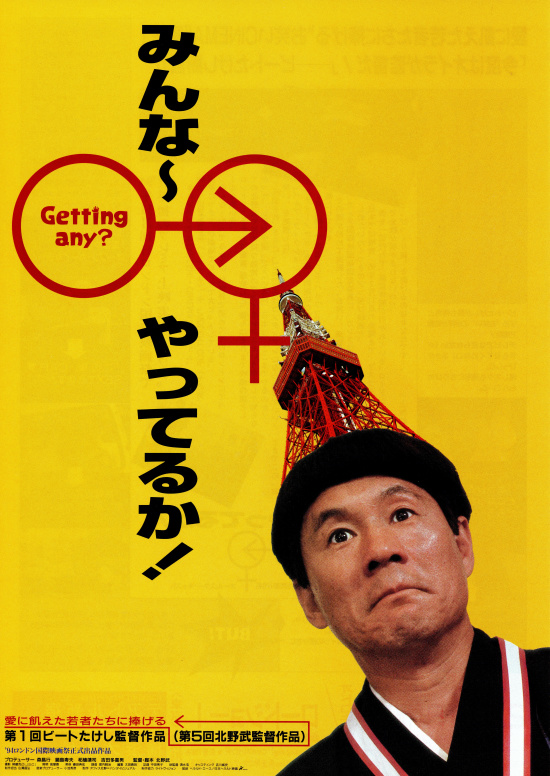
getting any? posterDespite his reputation for violent gangster dramas and melancholy arthouse pieces, Takeshi Kitano is one of Japan’s most successful comedians and began his career as half of an irreverent and anarchic “manzai” comedy double act. 1995’s Getting Any? (みんな~やってるか!Minna – yatteruka!) is his first big screen comedy and loosely takes the form of a series of variety-style skits in which a lonely, hapless middle-aged man tries on various different personas in the pursuit of his goal but remains an isolated bystander in the surreal events which eventually engulf him. Part bawdy, sleazy sex comedy and satire on the death of materialism in the post-bubble world, Getting Any? is a cineliterate journey through Showa era pop culture peppered with gratuitous nudity and absurd running jokes.

After watching a very 1980s “aspirational” movie in which a good looking, wealthy young salaryman type gives a young lady a lift in his flashy convertible in which they later end up having sex, Asao (Dankan), watching at home in his pants with his grandpa sitting behind him, decides the reason he hasn’t got any luck with women is that he doesn’t have a car. So, he goes and gets one from a very strange salesman but as he doesn’t have much money the car he gets is, well, it’s unlikely to get stolen, and he still isn’t getting anywhere. He tries a convertible too but that’s no good. Then he starts fantasising about air hostesses, decides to become an actor, gets mistaken for a top yakuza hitman, and comes into contact with a pair of mad scientists who want to turn him invisible.

Asao has only one goal – to have sex with a lady (preferably in a car), but he never stops to think of his potential partners as anything more than a receptacle for his desires. Consequently, he refuses to look at himself or consider the ways he might be getting in the way of his own needs, but constantly chases a quick fix thinking that the reason women don’t want him is because of something material that he lacks. He thinks the path to sexual success lies in cars, money, status, and finally technology, but none of these things really matter while Asao remains Asao.

As part of his journey, passive as it is, Asao does not always remain Asao, or at least the Asao he was for very long. Having failed to be the sort of man who can woo with car, he tries acting – literally playing a part, at which he seems quite good except for going “overboard”. An incident on an aeroplane sees him mistaken for a top yakuza which he is less good at but every mistake only ever works out in his favour. Thanks to his involvement with the mad scientists whom he allows to experiment on him so that he can go peeping in the women’s baths, Asao will finally become another kind of creature entirely, literally reduced to feeding off the excrement his nation has recently produced.

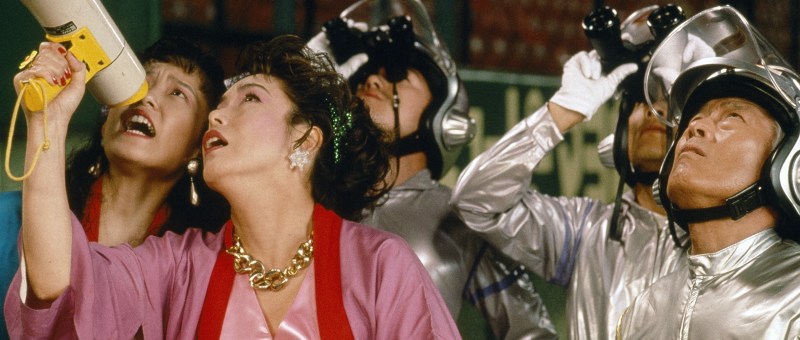
Kitano works in just about every element of almost “retro” pop-culture he can think of from the amusing soundtrack of Showa era hits and references to famous unsolved crimes to a hitman named “Joe Shishido” (star of Branded to Kill), the Zatoichi series, a Lone Wolf and Cub ventriloquist dummy duo, the Invisible Man, Ghostbusters, The Fly, and finally Toho’s tokusatsu classics culminating a lengthy skit inspired by Mothra including the iconic Mothra song given new lyrics and the same old dance performed by two full-sized ladies. Though most viewers will be able to spot the joke even without quite understanding it, some knowledge of Japanese pop-culture from the ‘70s and ‘80s will undoubtedly help.

The central joke revolves around Asao’s fecklessness as he repeatedly fails at each of his schemes, only occasionally succeeding and then by accident, and not for very long. A charmless literalist who lacks the imagination to achieve his goals in a more natural way, Asao fails to learn anything at all, engulfed by one surreal situation after another. It does however give Kitano the excuse to indulge Asao’s flights of fancy as his sexual frustration sends him off into a series of bizarre reveries involving topless women desperate to make love to the suave male stand-in Asao has imagined. Filled with silly slapstick humour and frequent nudity, Kitano’s subtle satire may get lost but even if the joke begins to wear thin just as “flyman” finally lands on his object of desire, there is plenty of amusement on offer for fans of lowbrow humour.


Getting Any? is released on blu-ray by Third Window Films on 16th October, 2017.

Original trailer (English subtitles)

The Killing Game (殺人遊戯, Toru Murakawa, 1978)

the killing gameFollowing the success of The Most Dangerous Game, the second in what was to become a trilogy arrived within the year and once again stars Matsuda as the ice cold hitman Narumi. Sunnier in outlook, The Killing Game (殺人遊戯, Satsujin Jiken) unfolds along the same pattern as the first instalment as Narumi is dragged out of the shadows to intercede in a gang war only to find himself surplus to requirements.

Narumi (Yusaku Matsuda) has been retired from the killing game for the last five years and now lives a life of poverty and dissipation. Gone are his swanky apartment and stylish suits, now he lives in a bare hovel which is covered in dust and cobwebs, and he dresses like a farm boy in a white vest and jeans with a straw hat hanging on his back. He’s trying to lie low, but gets pulled into the kind of hostess bar he can’t really afford where he meets the first of two familiar faces which threaten to send him back into the middle of chaos. Akiko (Kaori Takeda), now a hostess at Bar Tako, is the daughter of the chairman Narumi bumped off in his last job before retiring but far from bearing a grudge against him, Akiko is grateful to have been set free. The second familiar face belongs to the same chairman’s former secretary/mistress, Misako (Yutaka Nakajima), who is now a mama-san at a bar popular with the local goons. All those years ago Narumi let Misako go in a moment of weakness and now regrets it but attempting to “reconnect” is going to land him right back in the thick of things.

Murakawa begins with a prologue which takes place in the noirish urban darkness of The Most Dangerous Game, but shoots in dreamy soft focus to emphasise that this is all memory before jumping forward five years. Exactly why Narumi has decided to give up a career in assassination is not revealed, nor is what he’s been doing the last five years, but he has apparently got himself an annoying sidekick who, in contrast to Narumi’s intense reserve, does not shut up. The first half of the movie is Narumi and his buddy trying to get by as outlaws including one humorous skit where they get themselves a van with a nudie pinup on the front plus a loudspeaker to humiliate debtors into paying up.

Things take a darker turn when Narumi runs into Misako – a chance meeting that seems almost like fate. Gradually the old Narumi begins to reappear. Deciding to pay Misako a visit he runs into her new man, gang boss Katsuda (Kei Sato), who figures out who he is and wants him to bump off another old gang boss. Narumi needs to get back in shape which he does via the tried and tested method of a training montage, lifting weights and running through the town with his trademark perm returning to its stylish buoyancy. This time around Narumi has buddy to help out, even if he only ends up being a liability, but the same strange dichotomy occurs – he may be an ace hitman, but Narumi is a mess without a gun in his hand.

Perhaps weathered by his experiences, Narumi is also much less cocky and much more unwilling to take a chance on trust. Once again he is betrayed by clients who’d rather not pay up and forced to play a “dangerous game” to bring the whole saga to a close in such a way as to keep both his life and the money. Rather than the surprising and largely inexplicable devotion of Dangerous’ Kyoko, Narumi finds himself torn between two women – the youthful Akiko who is grateful to Narumi for releasing her from an overbearing father, and the jaded Misako whose feelings for Narumi are complex, mingling fear, gratitude, attraction, and resentment into an irresistible storm of ambivalence. Again Narumi’s cool, animalistic aggression seems to be the key to his mysterious sex appeal but this time around there are no flickers of response as there were for the devoted Kyoko, these “relationships” are opportunistic and transactional.

Ironically titled, The Killing Game makes plain that Narumi will never be able to escape his chosen profession even if he wanted to. Without a gun in his hand Narumi is a pathetic wastrel, playing around at tuppenny schemes with his rather dim but talkative friend, and trying to play the big shot by buying out a hostess bar he is entirely unable to afford despite his recent windfall. The setting may be brighter, but Narumi’s word is still a nihilistic one in which he’s conditioned to expect betrayal and the only remaining vestiges of his humanity are his strange friendship with his bumbling sidekick and his ongoing fecklessness at coping with everyday life. Matsuda is as cool as ever in his effortless ability to cope with any given situation and kill with ruthless efficiency, but as Narumi edges ever closer to machine it is clear there is only one way to beat The Killing Game.


Original trailer (no subtitles)

https://www.youtube.com/watch?v=-fjYrwzafxw