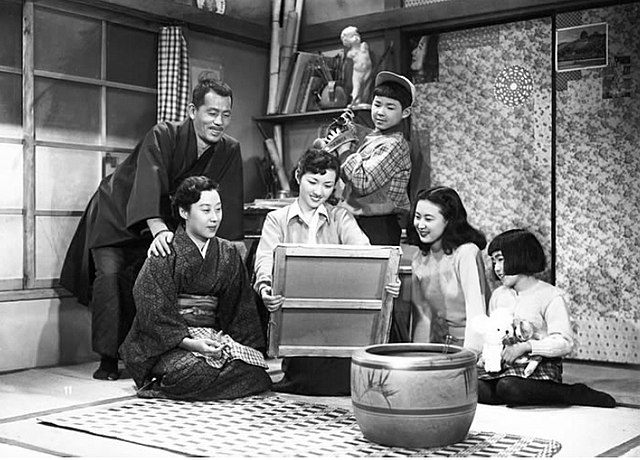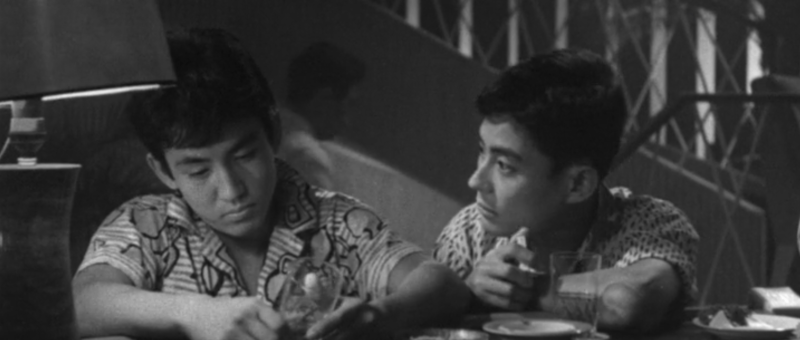
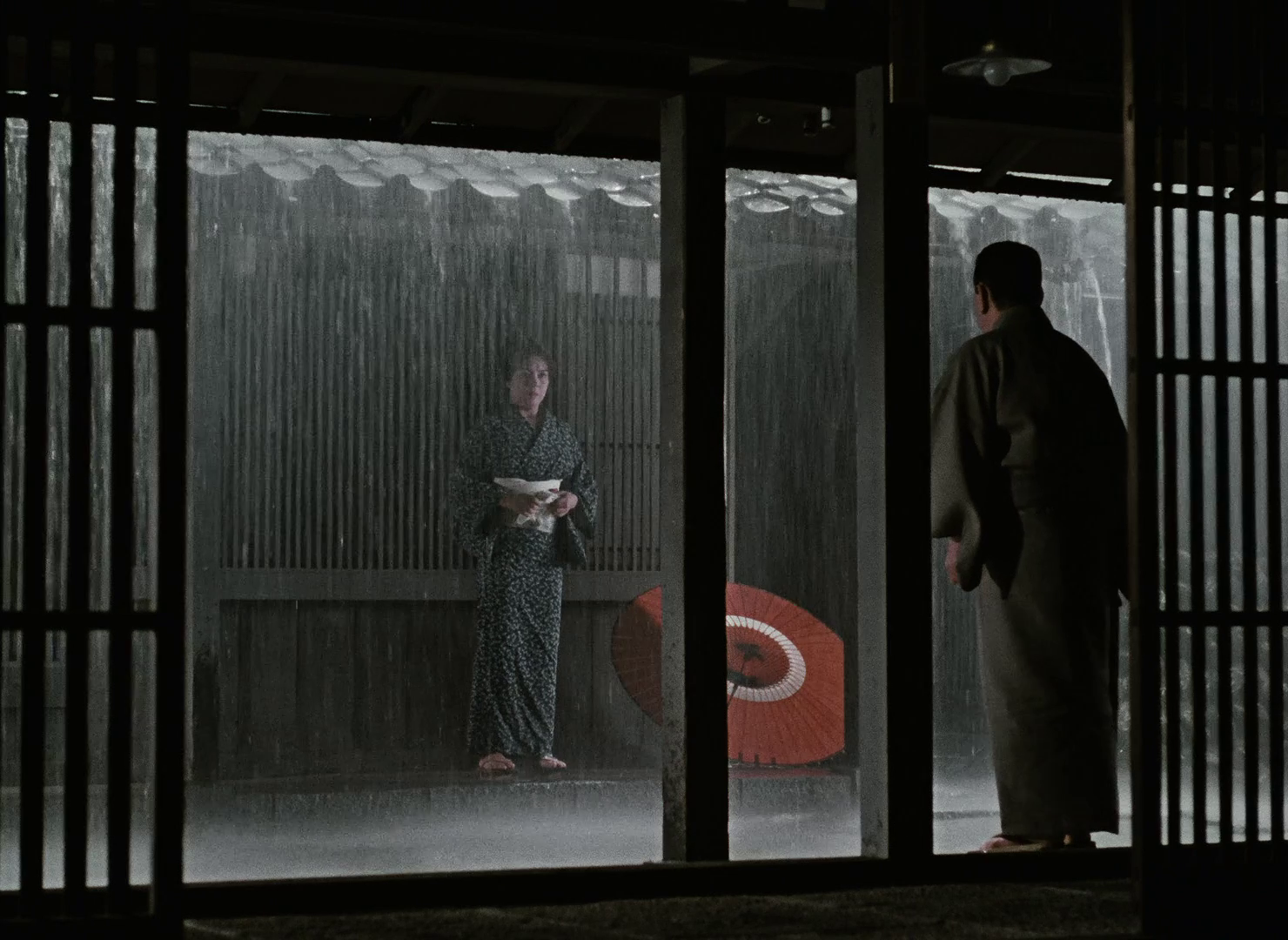
Floating Weeds (浮草, Yasujiro Ozu, 1959)

An oft-repeated criticism of the work of Yasujiro Ozu is that it is all the same. The similarity of the English-language titles with their ubiquitous seasonality doesn’t help, but you have to admit there is some truth in it. On closer inspection, however, it becomes clear that Ozu was not so interested in uniformity or repetition as he was in dialogue with himself. Thus Late Spring becomes Late Autumn and the abandoned father a conflicted mother, the two boys of I Was Born But… who rejected their father’s descent into corporate lackydom become arch consumerists seceding from society until their parents give them a TV set in Good Morning. Ozu refrained from remarking on the repurposing of old plots for new dramas, but did expressly regard his 1959 Floating Weeds as a “remake” of the 1934 A Story of Floating Weeds updated to the present day and filmed in the, by then, classic Ozu style. 

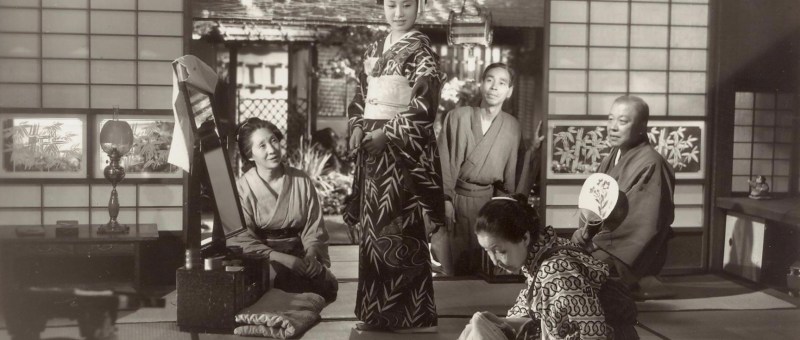
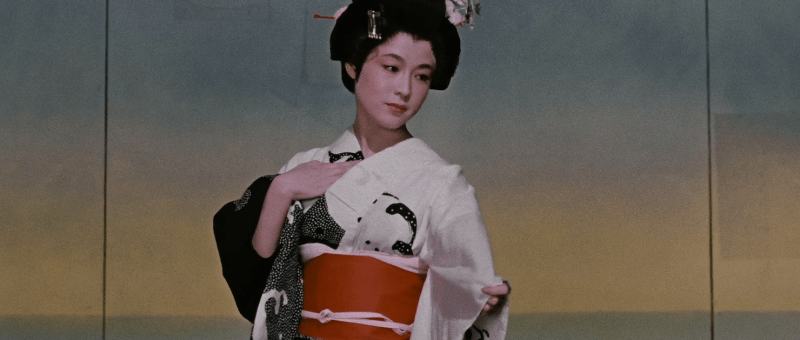
As in the 1934 version, the action centres on the arrival of a theatrical troupe to a small town which they have not visited in some years, in this case 12. This time around, the troupe is a little more exulted, performing kabuki-style narrative theatre rather than rustic entertainment, but is subject to many of the same problems. Kihachi is now Komajuro (Ganjiro Nakamura), a much older man though cheerful and energetic. He has chosen this town because it is home to an old flame, Oyoshi (Haruko Sugimura), who is the mother of his adolescent son, Kiyoshi (Hiroshi Kawaguchi). Kiyoshi thinks that Komajuro is his mother’s brother and that his father is long dead. He recognises Komajuro right away and is pleased to see him, though they evidently have not met in many years. 

The 1934 version had revolved around Kihachi’s corrupted paternity in his shame regarding the stigma of being a travelling player. By 1959 that is simply no longer so much of an issue, but whereas the financial difficulties Kihachi’s troupe faced were partly a symptom of the depression and partly of their misfortunes, those of Komajuro take on a more melancholy quality because it is obvious that this is a way of life which is coming to an end. When Kihachi says he’s going to start over, it seems futile but he is still young enough to have a credible chance. Komajuro is already “old” and it’s clear that he will struggle to support himself as a travelling actor simply because it is no longer a viable occupation. 

Thus Komajuro’s story is less one of frustrated fatherhood than of melancholy resignation to the vagaries of a lifetime. “Life is an unknown course”, he tells Oyoshi, “the only constant is change”. Like Kihachi he doesn’t want his son to see the show, though perhaps more out of embarrassment. Kiyoshi complains that the character in his play is “unrealistic” because he doesn’t relate to the modern world. Komajuro objects but explains that he is “a character from another era”, making it plain that he is talking as much about himself. Komajuro is a man left behind by time and incapable of understanding the world in which he now lives which may be one reason he seems to hang on to an intense desire to save Kiyoshi from being affected by the stigma of being the son of a travelling actor even though that is no longer something he would need saving from. 

This slight disconnect, along with Gajiro Nakamura’s cheekily comical performance, adds to the genial comedy which characterised the majority of Ozu’s colour films though this one is admittedly slightly less colourful owing to being produced by Daiei as one of a handful of films made outside Ozu’s home studio of Shochiku. Komajuro becomes a tragicomic rather than purely tragic figure, a man suddenly realising he has become old and facing the decline of his patriarchal authority. Like Kihachi he turns violence on both his mistress, Sumiko (Machiko Kyo), and the young actress Kayo (Ayako Wakao) who has fallen for his son, but it’s futile and born of desperation. A more sympathetic figure than 1934’s Otaka, Sumiko seems to genuinely like Komajuro and is hurt as well as jealous and threatened by the existence of his “secret” family. Her petty revenge is taken in response to Komajuro’s bitter claim that his son “belongs to a higher race” moments after bringing up her past as a sex worker. Rather than a simple desire for chaos and upset, she intends to pull Kiyoshi down to her level through getting him to sleep with Kayo, but Kayo falls for him for real only to worry she is perhaps ruining his bright future. 

“One can’t suddenly show up out of nowhere and assert one’s parental authority,” Komajuro eventually realises. His hopes are dashed by Kiyoshi’s relationship with Kayo not because of her proximity to the world of the travelling actor, but because he fears it means that Kiyoshi is just like him, an irresponsible womaniser. He wanted to save Kiyoshi as a means of saving himself, pushing his son into a more respectable world he had been unable to enter. Kiyoshi, however, rejects his sacrifice, describing his parents as “selfish” for keeping the secret all this time only to drop a bombshell now. He complains he’s been fine these 20 years and does not want or need a father beyond the one he already thought to be dead. Rather than the nobility Komajuro’s of paternal sacrifice, the focus is pulled back towards the son and his filial responsibility to live up to it by becoming a fine and upstanding young man while Komajuro is once again exiled back to the moribund world of the travelling actor. 

Of course, the world of 1959 was very different to that of 1934. The economy was at last improving and consumerist pleasures were very much on the horizon, meaning that for many life was comfortable at last. Japan was at peace if not completely free of political strife which removes the constant anxiety felt by those trying to survive the mid-1930s. But Ozu himself was also 25 years older and had perhaps reached that sense of resignation with the world that allowed him to sigh and laugh where before he may have trembled with fear or rage. Komajuro is as he always was, a floating weed, a man without a home, but now perhaps one of many rootless wanderers off the post-war landscape.
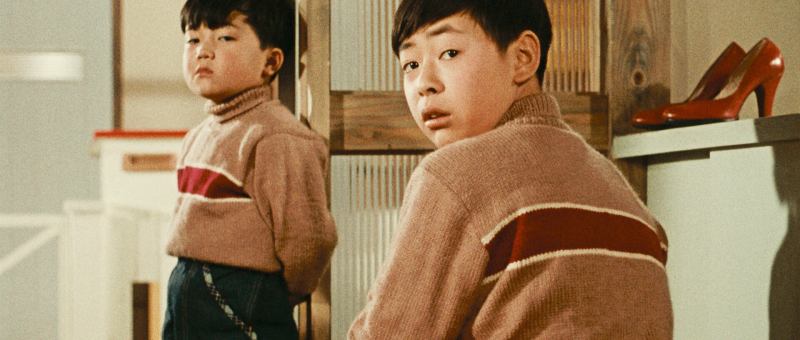
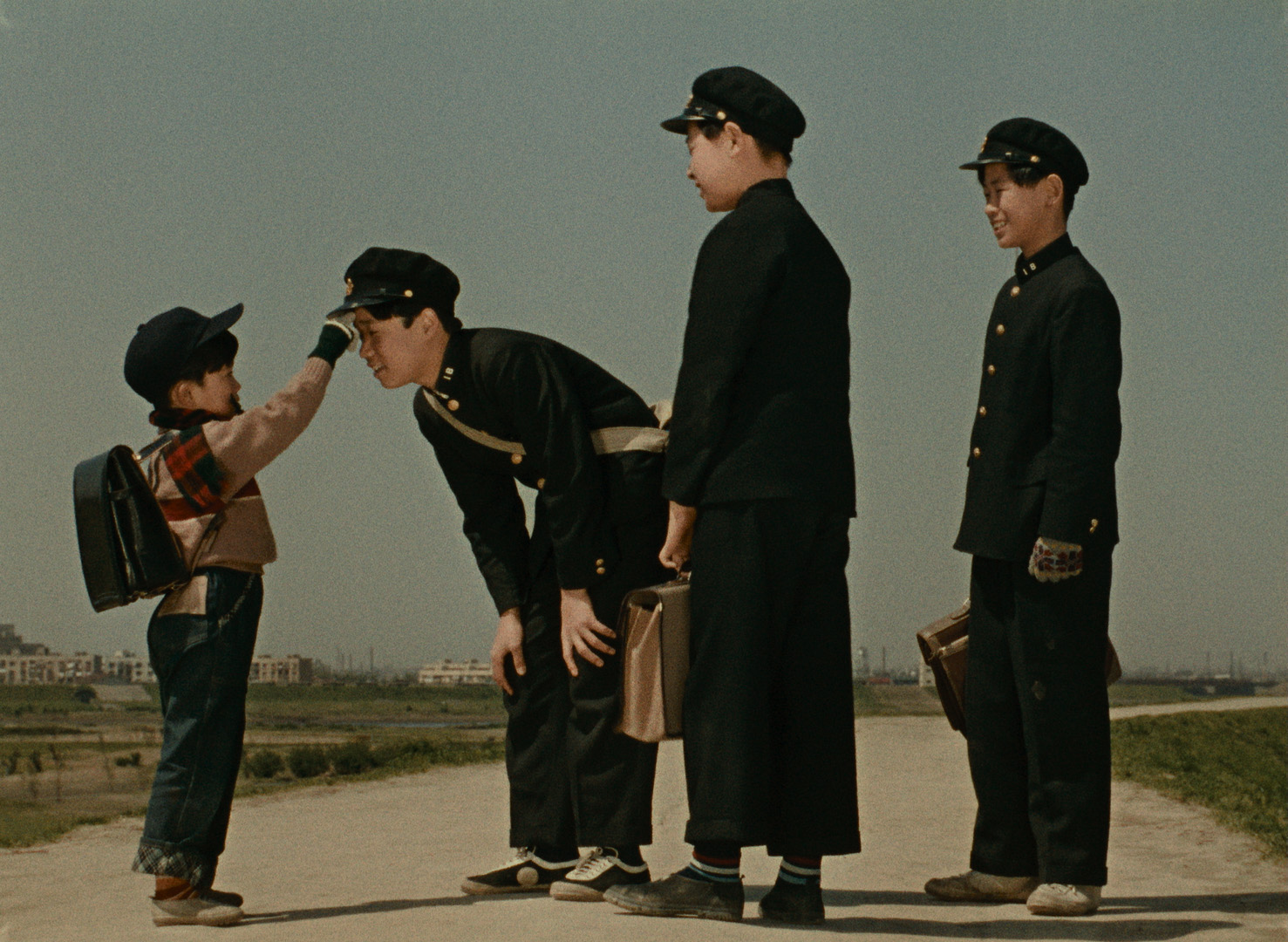
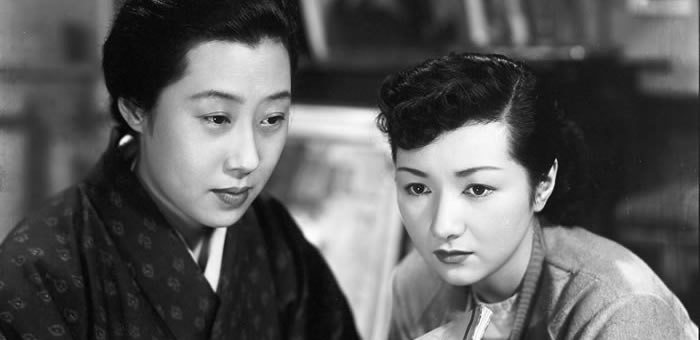
Good Morning (お早よう, Yasujiro Ozu, 1959)

Even the most casual viewer of Japanese cinema will be aware that something as simple as “lovely weather today” can mean quite a lot more than it at first seems. Small talk isn’t really so small after all and without it, as one quite perceptive yet perennially tongue-tied translator points out midway through Yasujiro Ozu’s charming late career comedy Good Morning (お早よう, Ohayo), our lives would be quite boring. Boring it is not, however, when two young boys decide to rebel against the pointless politeness of the adult world by taking a vow of silence after being told off for going on in their constant tantrums over the unfairness of being denied a TV set. 

As he often did, Ozu repurposes the plot of an earlier film, in this case I Was Born But… and subverts it. The two boys at the centre of the 1932 silent film ended up going on a hunger strike out of humiliation and despair on realising that their dad, who they’d idolised, was also a soulless corporate lackey forced to debase himself in deference to his boss. The father is ashamed, he doesn’t want his boys to end up living a meaningless worker drone existence, but the boys’ decision not to eat also carries much more weight considering they are in living in a time of economic depression during which many do not have the luxury of choice. 

The Hayashi boys, Minoru (Koji Shitara) and Isamu (Masahiko Shimazu), by contrast are also rebelling against the meaningless adult world but for the opposite reasons. They don’t seem to have a lot of respect for their father and probably don’t really care if he humiliates himself on a daily basis so long as they can watch sumo on TV without needing to go next door. These are consumerist kids, they want what they want and they want it now. Minoru is really too old for screaming tantrums, but still rolls around on the floor kicking his legs in frustration because it’s all just so unfair that mum and dad won’t get him a TV even though it’s not a matter of money. The parents, for their part, are trying their best to resist the onset of consumerism. Mr Hayashi (Chishu Ryu) is against the TV because he fears the boys will stop studying and hours of vacant staring will ruin their young minds. He might have a point, but you can’t hold back the tides forever. 

It’s his scolding of the boys which eventually leads to all the subsequent problems as his insistence that they are being far too noisy and talk much more than children have a right to leads them to declare an ironic vow of silence in protest against the “meaningless” chatter of adults filled with random pleasantries such as “good morning”, “where are you off to today?”, “what lovely weather we’re having!”, etc. Their decision, however, comes at a bad moment. There has recently been some unpleasantness over misplaced money for a local community group and gossip about Mrs Haraguchi’s (Haruko Sugimura) new washing machine. The other housewives on the block also seem to be resistant to consumerist desires and do not approve of the purchase, channeling their resentment into assuming that Mrs Haraguchi may have embezzled the money. Grown up chatter isn’t always meaningless and the frivolous local gossip has a profound bearing on the social politics of the block. So when the boys don’t reply to Mrs Haraguchi’s good morning, she assumes they are deliberately snubbing her on their mother’s instruction because of a petty grudge over harsh words exchanged on account of the misunderstanding surrounding the missing club dues.

Meanwhile, we can see the shadows of a lingering economic instability. These are all modest homes where families make an effort to appear frugal, hence the outrage over the washing machine, but the family friend who teaches the boys English and has a crush on their aunt, Heiichiro (Keiji Sada), has been laid off after his company went bust. He’s supported by his older sister who remains unmarried and works at a car dealership (more consumerism) while doing translation on the side for extra money. The neighbour across the way is technically “retired” but looking for work partly because his pension’s not enough to live on and partly because what’s a man supposed to do all day in a society which expects everyone to be productive? The new neighbours next-door to the Hayashis who’ve caused all this trouble because of their TV set are viewed as scandalous because they live in their pyjamas and she used to be a cabaret bar girl. The middle-aged gossips don’t think they’re respectable while she eventually decides to move because the neighbours are too “annoying”. 

Ironically enough, it’s sumo the boys most want to watch, about as traditionally Japanese a pastime as is possible even as they yearn for colourful consumerist modernity. They communicate by refusing to communicate. As Heiichiro points out, small talk is a social lubricant but meaningless things are easy to say while important things are not. Which is not to say you can’t communicate something important by saying something seemingly as meaningless as “that cloud has an interesting shape”, but that you won’t get anywhere unless you listen to what people are actually saying even when they’re saying nothing at all. They boys can’t win against the inherent meaninglessness of adult life with its superficial conformities, petty resentments, and wilful misunderstandings but perhaps we can all learn something from their straightforward earnestness in their refusal to submit themselves to empty pleasantries. 


Home Sweet Home (我が家は樂し, Noboru Nakamura, 1951)

There must have been a lot of families like the Uemuras in the Japan of 1951. As film’s title implies, their home is a happy one and though they may not have much they make the most what they have and are cheerful and loving towards each other. Still, the world stores up trouble for them perhaps because they are so very defiant of their circumstances. In many ways a classic shomingeki, Home Sweet Home (我が家は樂し, Waga Ya wa Tanoshi) was the film that put Noboru Nakamura on the map and finds Japan at a kind of crossroads edging past post-war privation towards a broadly consumerist society.

We can get a sense of that in the constant needs of four children in the Uemura family, patriarch Kosaku (Chishu Ryu) picking up his young son Kazuo (Katsumasa Okamoto) after baseball on his way home and noticing that his mitt is almost worn through only to get there and spot his daughter’s boots are getting pretty thin too. It’s clear they struggle for money despite Kosaku’s steady job for which he is about to receive a 25-year good service commendation as wife Namiko (Isuzu Yamada) supplements the family income by taking in sewing at home while we later find out that she’s already sold most of her kimono to help make ends meet and is considering selling her wedding ring to pay for middle daughter Nobuko’s (Keiko Kishi) school trip to Kyoto.

But her hard-nosed sister Kayo (Mutsuko Sakura) tells her that secondhand kimono have lost their value with so many new ones now available. In the immediate post-war era, rice and kimono were the only things that had held their value and so selling one could bring in a lot of money quickly. Conversely, after receiving a sizeable bonus along with his commendation, Kosaku and Namiko visit a department store which has a large range of affordable clothing for sale though the kimono fabric Kosaku picks out for Namiko is still fairly expensive so she instinctively puts it back insisting that they buy the presents they promised the children first. 

That was probably a good move, seeing as the rest of the money is stolen from them on their way home to a congratulations party the children are busy setting up. Kosaku asks why someone would rob people like them, honest, hardworking types who don’t have much to begin with but as Namiko sensibly points out pickpockets don’t really think like that and how would they know anyway. The subtext is that times are still hard for a lot of people even if there are now more exciting, definitely non-essential things appearing on shelves for people with disposable income to buy and a new kimono, though out of fashion, is no longer so out of reach for the ordinary housewife. 

The loss of the money might seem as if it should place a wedge between husband and wife, but bar a moment of disappointment cured by the realisation that oldest daughter Tomoko (Hideko Takamine) has been considerate enough to place hot water bottles in their futons, they resolve to muddle through together and in any case they’re no worse off than they were before. Tomoko herself is conflicted, feeling as if as a young woman in her early 20s she should give up her dreams of becoming a painter and get a job to support the family but Namiko always tells her not to. She encourages each of her children to follow their dreams, perhaps a sign of a new post-war liberation, telling her sister that she’d happily sell all her kimono so that Tomoko could go on painting. Later we discover that she also dreamed of becoming an artist and that though Kosaku had encouraged her to keep it up, a housewife’s day is never done and there was simply no time left for herself. Painting is just another thing she sacrificed for her family and Namiko seems to be determined that Tomoko won’t have to do the same not that she particularly regrets her decision.

Tomoko only really comes to understand her mother’s sacrifices on noticing that the cupboards really are bare, she’s sold everything that could be sold and pawned her ring though the colleague that owned the house they were renting has encountered some financial difficulties of his own and going to to sell to the grumpy old man who bought the house across the way. The Uemuras are such obviously good people that it feels so unfair that so much bad luck has come their way all at once though it is their goodness that eventually saves them when the old man is touched by seeing youngest daughter Mitsuko (Kazuko Fukui) playing with his dog. He later comes to admire Tomoko’s painting of his garden though he’d put a fence up to stop her peering in. The scars of the post-war era are visible in the damage to Uemura’s front wall which would have blocked the way but now perhaps enables them to become good neighbours after all. Though the film may lack some of the visual flair present in Nakamura’s later work, it more than makes up for it with genuine sentiment and the implication that in the end the world is basically good and rewards those who are the same even if it sometimes tests their resilience.


The Rose on His Arm (太陽とバラ, Keisuke Kinoshita, 1956)

In the mid-1950s, a minor moral panic took hold over the so-called “Sun Tribe” movies which, inspired by the novels of Shintaro Ishihara, depicted a world of crazed abandon in which a collection of bored rich kids lost themselves in the hedonistic pursuits of sex and drugs rejecting the stability the wartime generation had striven so hard to create for their children. Shochiku, at that time the home of polite melodrama, nevertheless attempted to get in on the youth movie boom mostly through commissioning a series of young directors such as Kiju Yoshida and Nagisa Oshima in the hope that they could speak directly to their generation. Meanwhile, the by that point well-established Keisuke Kinoshita also made his own, perhaps surprising, take on the genre with The Rose on His Arm (太陽とバラ, Taiyo to Bara), a youth movie melodrama which nevertheless anticipated the questions others were beginning to ask about the Sun Tribe movies in their very particular view of contemporary class dynamics. 

Our hero, Kiyoshi (Katsuo Nakamura), is like the (anti-)heroes of the post-Sun Tribe youth movies, a poor boy turned delinquent out of a sense of frustrated hopelessness. Quitting one job after another solely because the work is boring, he spends most of his days hanging out at the beach with other no good kids robbing unsuspecting bathers. Kiyoshi’s sense of inferiority is compounded by the fact that his mother (Sadako Sawamura) works as a maid for a wealthy family while making ends meet by crafting paper flowers by night. The young master of the house where his mother works, Masahiro (Akira Ishihama), never misses a chance to lord his wealth over him but later co-opts Kiyoshi into his group of wealthy friends as a source of entertainment (and because his delinquent friend, Yamanaka (Tamotsu Tamura), begins supplying them with drugs).

“I screwed up my life because I was poor, what’s your excuse?” Kiyoshi eventually asks an indifferent Masahiro after beginning to see him for what he is. Like the hero of Punishment Room, Kiyoshi’s internalised resentment is partly down to a paternal failure in that he is deeply ashamed of his late father who died, his mother claimed, saving him but also in the course of his activities as a black marketeer in which he’d forced his son to be complicit. The family had apparently tried to make a life for themselves in the new colonies, in this case Palau, but of course had to return to Japan and were then penniless. People did what they had to do, but no one trusts a black marketeer and it seems to be a stain Kiyoshi (whose name means “pure”) cannot wash off. As a poor boy with no education or prospects, he knows all that awaits him is drudgery, so why not make a fast buck stealing purses at the beach rather than slave away at the factory for a week making less than Masahiro gets in pocket money from his factory owner father? 

Convincing himself he’s no good, Kiyoshi consistently sabotages opportunities but resents himself for doing so. He begins to buckle down at the factory but quickly becomes “bored” and starts taking advantage of his supportive floor manager while sucked into Masahiro’s hedonistic lifestyle even after it becomes obvious that he’s keeping him around to be some kind of hired goon, good for punching other pasty rich boys and hooking him up with underworld thrills. Masahiro is a delinquent because his life is too easy, he has no economic imperative to be responsible and will most likely go to college and then either take over the factory or walk into a lucrative salaryman job. Kiyoshi is a delinquent because he’s desperate and has no other means of living. 

Meanwhile he resents his mother’s love, shamed, in more than one sense, by her continuing industry. She often tells him the story of how he fell ill on Palau only to make a miraculous recovery after which she collapsed into a rose a garden. To spite her, Kiyoshi gets the titular rose tattooed on his arm, something which forever marks him out as a ne’er do well in conservative Japanese society, all but guaranteeing he’ll never get an honest job (he even has to cover the tattoo with bandages in public places to avoid causing offence). Eventually he takes drastic action to end his sense of hopelessness, pursuing what is strangely a darker yet more romantic destiny than that of his post-Sun Tribe compatriots in taking a poetic stand, paper rose in hand, defying his despair only through embracing it. 


The Rose on His Arm is currently available to stream in the US via Criterion Channel.

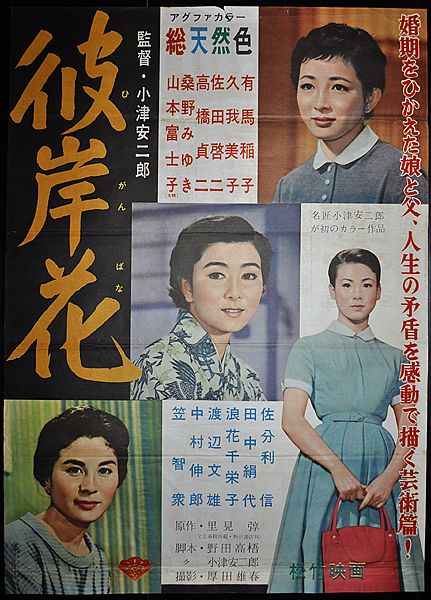
Equinox Flower (彼岸花, Yasujiro Ozu, 1958)

Japanese golden age cinema is famed for its centring of female stories, but while it’s true that many of Yasujiro Ozu’s family dramas revolve around a young woman’s feelings towards marriage, the perspective is often surprisingly male. Equinox Flower (彼岸花, Higanbana), his first film in colour, marks something of a change in direction in its spirited defence of the young, but at heart is still a story as much about impending old age, the responsibilities of fatherhood, and changing times as it is about contemporary family dynamics or female agency. 

The father in question, Hirayama (Shin Saburi), is a high ranking executive with two daughters. The older, Setsuko (Ineko Arima), is working at another company, and the younger, Hisako (Miyuki Kuwano), is still in school. Marriage is on his mind because he’s just attended the wedding of an old school friend’s daughter at which he gave a speech, with his wife Kiyoko (Kinuyo Tanaka) sitting awkwardly next to him, describing the arranged marriage he had with her as “pragmatic, routine” while he envies the young couple’s “fortunate opportunity” to indulge in romance. He and Kiyoko idly discuss the idea of Setsuko’s marriage, it seems as if there is a promising match on the horizon, with Hirayama conflicted while Kiyoko is very much in favour of doing things the traditional way. She’s already mentioned it to her daughter, but all she does is smile demurely which seems to provoke different interpretations from each of the parents. 

While thinking about all of that, Hirayama receives a visit from an old friend who was a notable absence at the wedding asking him to check up on his daughter Fumiko (Yoshiko Kuga) who ran away from home two months ago to live with a musician after he tried to veto her intention to marry without consulting him. Hirayama is sympathetic, perhaps thinking his friend has acted foolishly and pushed his daughter away. After visiting the bar where she works, he comes to the conclusion that as long as she’s happy with her choice then everyone else should be too. That all goes out the window, however, when a young man, Taniguchi (Keiji Sada), visits him unexpectedly at work and asks for permission to marry Setsuko. Hirayama quite rudely asks him to leave and then irritatedly talks the matter over with Setsuko before petulantly refusing his consent, not because he objects to Taniguchi, but because he is hurt on emotional level that she hadn’t talked to him about this first (not least so that they stop worrying about arranging a marriage) while resentful that she’s gone behind his back and undercut his patriarchal authority. 

In addition to the changing nature of family dynamics, Hirayama is perhaps conscious of his advancing age, feeling himself increasingly obsolescent and therefore additionally wounded by this assault on his authority as a father. The generation gap, however, is all too present. Both Setsuko and Fumiko feel as if they simply cannot talk to their parents because they wouldn’t listen and will never understand. Yukiko (Fujiko Yamamoto), the daughter of another friend, feels something similar in her exasperation with her well-meaning single mother who keeps hatching plans to set her up with various men she isn’t interested in. Intellectually, Hirayama sides with the young, envying them their freedoms and advising Yukiko firstly not to marry at all, and then encouraging her desire to resist arranged marriages despite trying to foist them on his own daughters. 

Even Kiyoko eventually describes her husband’s continuing petulance as “inconsistent”. It seems obvious that Kiyoko is siding with her daughter, immediately taking a liking to Taniguchi who politely brought her home after she stormed out following an argument with her father, but she continues to behave as a “good wife” should, politely minding her husband while gently hoping that he will eventually come round. Only once pushed does she try to explain to him, again politely, that he’s being selfish and unreasonable, but he continues on in resentment while causing his daughter emotional pain simply for trying to find her own happiness rather letting him decide for her. Kiyoko is afraid that if it carries on like this, then Setsuko will, like Fumiko, eventually leave and they’ll lose her completely, something which Hirayama either hasn’t fully considered or is actively encouraging through his petulance. 

In the end the conclusion he comes to is that the parents will eventually have to give way or risk losing their children entirely. He tells both Fumiko and Yukiko that all parents want is for their children to be happy and so nothing else matters, but struggles to put his advice into practice when it comes to his own daughter. Like pretty much everyone in an Ozu film, Hirayama is a good, kind person, even if one struggling against himself as he contemplates a loss of authority, a change in standing, and the difficulty of dealing with complex emotions as a man in a patriarchal society. Predictably, it’s women who essentially bully him into making better decisions, Yukiko “interfering” in the nicest of ways, while his wife makes it clear that though she thinks he’s wrong she will continue to stand by him if only in the hope he will eventually see the light. “Life is absurd, we’re not all perfect” he admits, only later realising how his stubborn foolishness may have caused unnecessary suffering to those he loves the most.


Currently streaming in the UK via BFI Player as part of Japan 2020. Also available to stream in the US via Criterion Channel.

Original trailer (no subtitles)

Tokyo Twilight (東京暮色, Yasujiro Ozu, 1957)

Closely associated with the family drama, Yasujiro Ozu is perhaps the most socially conservative of golden age directors. Unlike Naruse or Mizoguchi, he cheerfully reinforces patriarchal social norms and foregrounds the paternal experience while upholding the primacy of the traditional family in a rapidly modernising society. In his later career he’d come to sympathise more strongly with the young, but 1957’s Tokyo Twilight (東京暮色, Tokyo Boshoku), perhaps his bleakest take on familial failure, is essentially a treatise on the legacy of corrupted motherhood and rebuke to growing post-war freedom in which a young woman is made to feel that her future is impossible because of maternal betrayal while her sister is forced back into an unhappy marriage to an abusive husband in order to avoid the same fate befalling her own daughter. 

Unlike most Ozu families, the Sugiyamas do not seem to be particularly happy in each other’s company, living in superficial politeness rather than true intimacy. This may partly be because the sisters had a brother who passed away young in a mountain climbing accident, but it also seems that Mr. Sugiyama (Chishu Ryu), though kind and polite, is a typically authoritarian, distant father. Oldest daughter Takako (Setsuko Hara) has returned home declaring herself unable to go on living with her professor husband Numata (Kinzo Shin) who, she says, has become increasingly erratic, taking out his petty professional disappointment on their small daughter Michiko whom he seems to resent. Younger sister Akiko (Ineko Arima) meanwhile is sullen and introverted. Unmarried, she lives at home and is studying to become a stenographer. 

As we later discover, the girls’ mother Kikuko (Isuzu Yamada) left the family during the war after falling in love with the junior officer Mr. Sugiyama enlisted to look in on the family while he was away in Seoul. Akiko was only three when their mother left and barely remembers her. Takako attributes her wayward behaviour to “loneliness”, that she has been forever corrupted through never knowing a mother’s love. Mr. Sugiyama admits he tried his best, but both agree that children need two parents and no matter how much he wants to a father cannot make up a mother’s share. 

This atmosphere of alienation is perhaps why Akiko feels as if she has no one to turn to in her own moment of maternal crisis. She has become pregnant by her college student boyfriend who has been avoiding her and even has the audacity to ask if the baby’s his when Akiko finally manages to pin him down. Trying to borrow money for an abortion, Akiko visits her aunt who declines to give it to her without knowing why, eventually turning to a family friend who apparently provides no questions asked. The woman at the clinic assumes she is a bar girl, as does a policeman who eventually “arrests” her for loitering in a sleazy cafe where her boyfriend has obviously stood her up which is quite openly being used as a place for men to pick up call girls. All of this contributes to Akiko’s increasing sense of shame and worthlessness. She sees herself as a fallen woman, convinced that she is all her mother’s child contaminated by her “bad blood” which makes a conventionally successful life as an ordinary wife and mother an impossibility. 

Akiko’s aunt wants to set her up with arranged marriage matches, but Akiko declares she has no intention of marrying or having children. Without knowing anything of Akiko’s circumstances, Takako assumes this is because of her obviously unhappy marriage, trying to convince her sister that there are plenty of happy couples she is merely unlucky. Mr. Sugiyama attempts to talk to his son-in-law but finds him strange and indifferent, offering treatises on familial love while implying that he has little of it. He regrets pressuring Takako to marry him when he knew that she preferred someone else while Takako is once again haunted by the spectre of corrupted maternity in her mother’s decision to leave the family for emotional fulfilment and is fearful of making the same mistake creating another troubled daughter just like Akiko in denying her a father’s love (which seems a moot point given that Numata does not care for the child). 

Neither woman is able to escape paying for their mother’s transgression. Akiko is punished firstly for embracing her sexuality and secondly for the rejection of motherhood in choosing to have an abortion. Alone and humiliated by her unreliable boyfriend, she is denied the opportunity to start over, while Takako meditates on female failure and believes that her only option is to live in misery with a cruel and narcissistic husband because that is the “proper” thing to do and the only way to bring her daughter up “right”. The absent mother, meanwhile, is denied reconciliation and left only with the painful separation from her daughter who finally rejects her in order to reclaim the image of the good wife and mother by returning to her unhappy home. Bleak as it is, all of this is presented as a kind of happy ending in that it restores the idea of the traditional family, increasingly threatened by post-war modernity, to its original primacy. We leave with Mr. Sugiyama rehiring his maid and heading cheerfully back to the male world of work, making the fresh start that his daughters have been so cruelly denied.  


Currently streaming in the UK via BFI Player as part of Japan 2020. Also available to stream in the US via Criterion Channel.

Late Autumn (秋日和, Yasujiro Ozu, 1960)

“It’s people who complicate life. Life itself is surprisingly simple” according to a puffed up old man having just hugely overcomplicated an admittedly delicate situation in Yasujiro Ozu’s Late Autumn (秋日和, Akibiyori). A reinterpretation of his classic Late Spring, Late Autumn once again stars Setsuko Hara but this time as a widowed mother far more enthusiastic about marrying off her only daughter while enduring the sometimes unwelcome assistance of a group of middle-aged men stepping into the decidedly female realm of matchmaking and of course concluding that they are doing a fantastic job. 

The action opens at the seventh memorial service for Akiko’s (Setsuko Hara) late husband, Miwa, attended by his three old high school friends, Taguchi (Nobuo Nakamura), Hirayama (Ryuji Kita), and Mamiya (Shin Saburi) who’s turned up fashionably late in the hope of skipping most of the sutras. At the refreshments afterwards, talk turns to the marriage of Miwa’s daughter Ayako (Yoko Tsukasa) who is now 24 which is actually edging towards the late side by the standards of the time. The three old men offer to help find prospective matches with Taguchi instantly proposing an acquaintance to which Ayako smiles demurely but is later relieved to discover is already taken. Mamiya too has a lead, a nice young man from his office, Goto (Keiji Sada) who graduated from a good university and is not bad looking either. Though Akiko is excited, she’s surprised to discover that her daughter wants to shut the offer down immediately before even exchanging photos. She feels she’s not ready for marriage and is happy the way things are. Of course, if she fell in love it might be a different matter, but to her mind there’s no rush to get married just for the sake of it. 

Generally speaking, it’s other women who mostly enforce these restrictive patriarchal social norms, after all a daughter’s marriage is ironically the one area of a woman’s life over which she usually has total control. In this case, however, Ayako’s marriage becomes a kind of hobby for three eccentric old men who each have problems of their own they don’t seem to be in a big hurry to deal with. They each have a latent crush on Akiko from their youth though it was obviously Miwa who later married her. Hirayama is widowed with a teenage son, but Mamiya and Taguchi have wives and daughters of their own, Taguchi’s already married but apparently experiencing frequent bouts of “frustration” with her husband, and Mamiya’s still in school, while their wives are fully aware of their lingering affections for Akiko but mostly content to laugh at their ridiculousness. They are all certain that Ayako “needs” to get married as soon as possible and that they are “helping” her towards “happiness” though what they’re mostly doing is a father knows best routine in which they resolutely ignore her repeated desire for things to go on as they are until she decides that they shouldn’t. 

Ayako isn’t interested in arranged marriage, but does become interested in Goto after accidentally meeting him at Mamiya’s company and then discovering they have a mutual friend, all of which makes their relationship both “arranged” and “not”, giving Mamiya cause to think he’s responsible when he’s really just incidental. Thinking things aren’t moving fast enough, the guys decide the problem is Akiko and if they can persuade her to remarry then Ayako will be less reluctant to leave home. Their behaviour is in fact quite manipulative, something they are later called out on by Ayako’s feisty friend Yuriko (Mariko Okada) who is also trying to help but determined to do it in a less problematic way. The gang’s suggestion to Ayako that her mother is considering remarriage when in fact she had no such intentions at all places a rift between the two women with Ayako left feeling hurt and betrayed, as if her mother has offended her father’s memory and done something improper behind her back. 

Ayako is not alone in her lingering prejudice against second marriage even if Yuriko tries to explain to her that she’s being unreasonable. Hirayama too originally objects to the gang’s plan to get him to marry Akiko on the grounds that it would be “immoral” to marry his old friend’s wife, but is brought round when he puts the idea to his son and finds him wildly enthusiastic if only in part because he’s already thought ahead to his own marriage and is worried his dad will want to live with them and that would inconvenient for everyone. When it comes to Akiko’s marriage, there seems to be more wiggle room. Everyone wants her to be “happy” and so there’s a greater freedom to explore various options while completely ignoring her preference to remain a widow. As we see from Akiko’s life, she is already financially independent and really has no “need” to remarry unless she happened to fall in love though she remains attached to her husband’s memory. As she later confesses to Ayako, she has no desire to “climb that mountain” again, and in fact will be happier living in freedom as an independent woman. 

As so often, however, while remarriage is optional marriage is not. Ayako has to marry, she never really has the option to remain single even that was what she wanted. She falls in love with Goto and indeed wants to marry him if perhaps worried about leaving her mother behind, making the three old men partially correct in their conviction that her reluctance was more anxiety than it was opposition. Unfortunately, their “success” emboldens them towards the next match and possibly more unhelpful meddling, complicating what should be simple with their increasingly outdated ideas fuelled by a desire to rebel against their sense of impending obsolescence. “In marriage you just give up” an exasperated wife admits, but wouldn’t it be something if you didn’t have to?


Late Autumn is currently streaming on BFI Player as part of the BFI’s Japan season.

Original trailer (no subtitles)

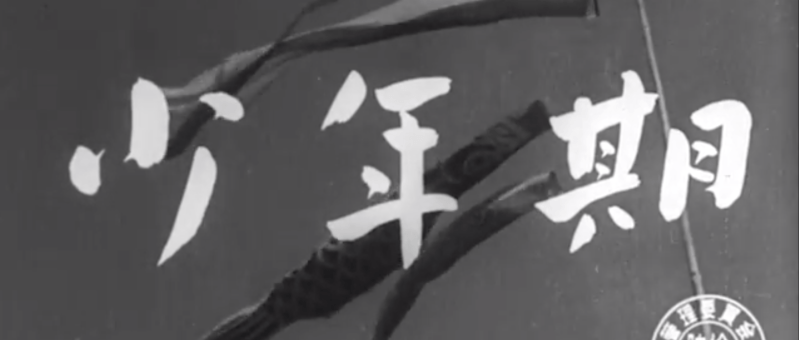
Boyhood (少年期, Keisuke Kinoshita, 1951)

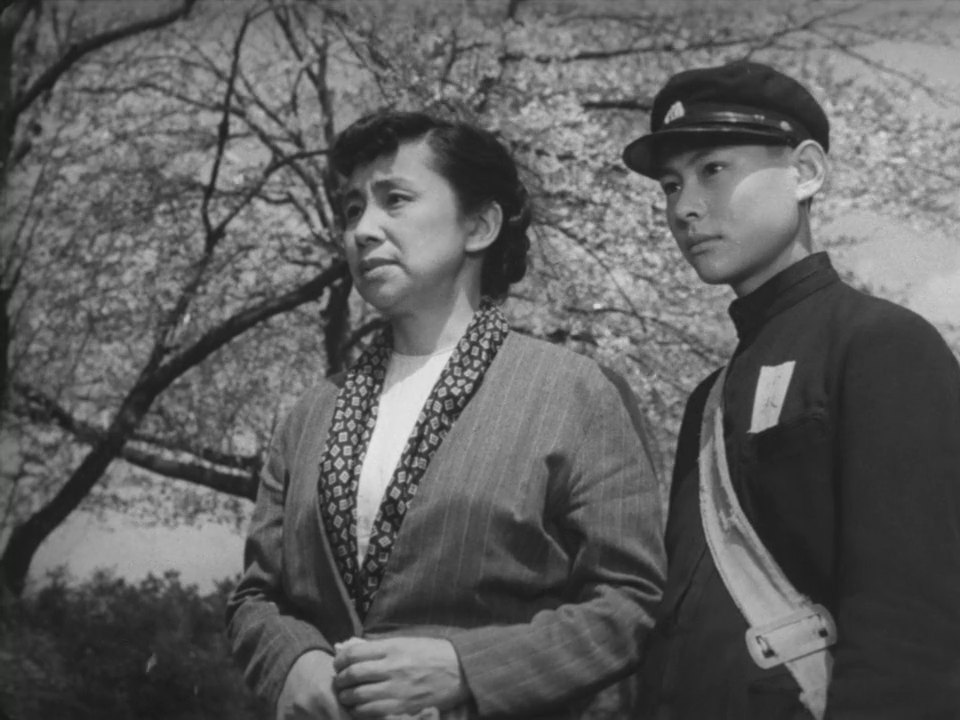
Boyhood (Kinoshita) screencapIt’s easy to look back in judgement with the benefit of hindsight, but much less so to see clearly in the moment. Keisuke Kinoshita’s Boyhood (少年期, Shonenki), arriving just six years after the events that it depicts, is a painful if sympathetic look at the conflicts of the age seen through the eyes of a conflicted adolescent as he struggles to understand his place in a world which is becoming ever colder.

In the spring of 1944, 16-year-old Ichiro (Akira Ishihama) and his mother (Akiko Tamura) investigate the possibilities of retreat, back to the country and away from the increasingly fraught and dangerous city. Their first prospect which offered the comfort of family nevertheless proves too inconvenient and so Ichiro’s mother decides perhaps Suwa, a rural area not quite so out of the way, might be better even if it would mean starting all over again with no friends or family to offer support. Ichiro, however, doesn’t want to leave at all. He is afraid of being thought a coward and doesn’t see why he should have to leave his school and classmates behind just because there’s a war on. If he had his druthers, he’d be a pilot dropping bombs, not a resentful schoolboy torn between his feelings for his family and the increasingly austere demands of militarism.

Ichiro may be 16, and if it were not for his poor health perhaps he might already have been drafted, but he seems younger and is trapped in the difficult gulf between boy and man which makes him petulant and occasionally unreasonable. His father (Chishu Ryu), a professor of English literature, is a well known social liberal which is a problem that eventually makes it impossible for the family to stay on in the city. They decide to sell the house and move to Suwa, allowing Ichiro to stay behind alone as a lodger for the family of greengrocers who are the new occupants, but despite his insistence on his independence Ichiro is not yet ready for self sufficiency and misses his family, especially his mother, dearly, while he also experiences harsh treatment from the military instructors at school thanks to his general lack of soldiering aptitude.

Like his nation, Ichiro is lost in a fog of confusion – torn between the prevailing ideology of the age and that of his gentle hearted father. His problem is that as he is still “a child” and the conditions in which they find themselves make openness difficult, nobody is willing to talk to him seriously about the issues at hand – his father perhaps less out of fear or reticence than because he is acutely aware that his son must come to his own conclusions even if those conclusions prove contrary to his own. Thus, much to Ichiro’s consternation, he refuses to allow him to enrol at a military academy but does not explicitly state why, leaving him with only the vague idea that his father is “anti-war” and therefore a social pariah in a nation where everyone is expected to do their duty.

Ichiro begins to resent his father for the family’s plight, certain that he is the reason they were forced out of their home and also the ongoing cause of his mother’s suffering as she finds herself becoming the family breadwinner as an unlikely milk lady – a job she was only able to get thanks to the friendship of a gregarious neighbour, herself a fellow evacuee in a similar position. Far from the community spirit such situations are said to engender, Ichiro and his family find themselves perpetually excluded, viewed with suspicion as “outsiders” and at the bottom of the pile when it comes to the distribution of resources. “Extra” people get only the extra after the real villagers have had their fill. Meanwhile, Ichiro is bullied by the full on fascists at school, one of whom is the son of a local military commander and has fallen completely under the militarist spell.

Everyone is always telling Ichiro that he will come to understand when he is older. Being young, he resents this intensely but eventually comes to see that they were right, some things can only be understood with the weight of experience. With the war’s end and the eventual defeat of militarism, the fog begins to lift, allowing him to see that the prevailing ideology is not always the correct one and that there’s something to be said for quiet resistance and sticking steadfastly to one’s principles even if it would be much easier to go along with the majority. His father, however, reminds him that those who chose to do just that can hardly be blamed and will likely suffer in whatever is to come. They will need the all love and compassion in the world in order to find a new, less destructive path than the one they had been obliged to walk through a time of fear and madness. Using imperialistic song and propaganda to ironic, somewhat chilling effect Kinoshita presents a characteristically empathetic portrait of a “difficult age” in the life of a young man and his country who each find themselves emerging from chaos and confusion into something completely unknown and perhaps frightening but open and filled with possibility.


Title sequence and opening (no subtitles)

Growing Up (たけくらべ, Heinosuke Gosho, 1955)

Gosho Growing UpCaught in a moment of transition, it’s no great mystery that post-war Japanese cinema began to look back at the Meiji past. Progress had indeed been rapid but ended in national tragedy and collective madness. The post-war humanists were eager for a different outcome, to avoid the mistakes of the last fifty years and build a society that was kinder and freer than that which had come before. Though on the surface it might seem as if much had changed since the dawn of a new century, the problems were still the same and a failure to address them only likely to add new tragedies in place of the better future many hoped for. Among the foremost proponents of post-war humanism, Heinosuke Gosho made a rare trip back into the Meiji past in 1955’s Growing Up (たけくらべ, Takekurabe), an adaptation of the well known short story by Ichiyo Higuchi, finding that nothing much had really changed when it came to the fates of women and the poor in an often wilfully indifferent society.

The action opens on the outskirts of the Yoshiwara in 1894. Our heroes are a collection of children who find themselves dealing with typically adolescent problems but also, by modern standards, expected to grow up all too fast. Chief among them is 13-year-old Midori (Hibari Misora) whose sister, Omaki (Keiko Kishi), is the most famous courtesan of the red light district. Although she knows on some level that her parents have already sold her to the brothel owner in whose house they live as servants, Midori has not yet quite processed the full implications of her destiny or that her world of childhood innocence is rapidly drawing to a close. She is in love with a local boy, Shinnyo (Takashi Kitahara), who seems to return her feelings but is as awkward and confused by them as any teenage boy and treats her by turns with coldness and contempt mixed with grudging affection.

Shinnyo, meanwhile, is the son of a greedy and heartless monk (Takamaru Sasaki) who has decided to sell his older sister as a concubine to a wealthy man who already has a wife. As he loves his sister dearly and has a naive, childish sense of absolute morality, this is a sin Shinnyo cannot forgive. He argues with his father but has no real power to change the situation and then decides on rebelling against his father’s wishes that he not become a monk by leaving for the main temple in Kyoto to take holy orders. Of course, this also means he must sacrifice any youthful idea he might have had of pursuing his love for Midori.

The title, in a sense, could refer not only to the increasingly melancholy youngsters coming of age in an oppressive society, but also to Japan itself as it emerged into modernity in an effort to prove itself the equal of any other major power in the late 19th century. It is, however, an ironic a title as any could be. To “grow up” here is to abandon one’s humanity and conform to the kind of “real world” thinking that codifies cruelty and makes a virtue of heartlessness. Still an innocent child, Midori bounces her ball and basks in her somewhat elevated position as a wealthy young girl and sister of a “notorious” woman without fully understanding all that entails. When her sister tells her about a dream she had of climbing trees and picking persimmons, she is incapable of understanding her warning about the loss of innocence she’s about to experience, but her world is brought crashing down when a gang of rival boys rudely attack her and point out that all her finery was bought through “whoring” and that she is nothing more than a “whore” in waiting.

Another of the boys, Sangoro (Masanori Nakamura), whose family is poor, says he can’t wait to be “grown up”, reacting with less than sensitivity to Midori’s pained pleas that she wishes everything could stay as it was and they could be children forever. Sangoro sees adulthood as freedom. He’ll be free to earn his own living and maybe he won’t have to be like his father, too afraid to stand up to people with money because when you don’t have any you’re always reliant on their kindness. Sangoro may be poor, but he’s a man (or will be) and can’t process the total lack of agency that comes with being an adult female whose future is decided entirely by her closest male relative. Midori, like Shinnyo’s sister, has been sold by her father and there’s nothing she or anyone else can do about it now.

Nevertheless, confronted by her fate, Midori decides to own it. She encourages her parents to think of her as dead, cooly hitting back at their callousness but acknowledging an obligation as she goes. The final scenes preceding her passage across the small bridge which will forever sever her from her childhood are filled with dread and anger as if crying out for someone to stop the inevitable from happening, but of course, no one can. An old woman and former courtesan, Okichi (Isuzu Yamada), who owns a shop where Midori used to spend time and is indirectly responsible for Midori’s acceptance of her fate in some cruel, drunken words she threw at her, puts it best when she briefly feels as if she could have done something in affirming that it isn’t her fault, and it isn’t Midori’s, it’s simply “the world”.

Midori meets her fate not with resignation but rage and defiance. Shinnyo, who runs away from his inability to help his sister by becoming a monk, is forever incapable of declaring his real feelings in words but leaves a flower in front of her window in echo of another he gave her long ago. At first Midori picks it up and cherishes it for the innocent symbol of love that it is, but by the time she has travelled half way along the bridge which will take her to the Yoshiwara, she has realised this kind of innocence does not belong inside. She throws the flower to the mud and leaves her youthful dreams of love and happiness behind as she prepares to step through the doorway into a future which is not of her making and over which she has no say. To “grow up”, in this world, is a kind of spiritual death in which there exists nothing other than emptiness and indifference.


Thus Another Day (今日もまたかくてありなん, Keisuke Kinoshita, 1959)

Thus Another Day vertical bannerThe cinema of the immediate post-war era, contrary to expectation, is generally hopeful and filled with the spirit of industry. Keisuke Kinoshita might be thought of as the primary proponent of post-war humanism in his fierce defence of the power of human goodness, but looking below the surface he’s also among the most critical of what the modern Japan was becoming, worried about a gradual loss of values in an increasingly consumerist society which refuses to deal with its wartime trauma in favour of burying itself in intense forward motion.

The housewife at the centre of Thus Another Day (今日もまたかくてありなん, Kyo mo mata Kakute ari nan), Yasuko (Yoshiko Kuga), is a perfect example of this internal conflict. She and her husband Shoichi (Teiji Takahashi) have built a modest house way out of the city in the still underdeveloped suburbs for which they are still burdened by an oppressive mortgage. Shoichi has a regular job as an entry level salaryman but his pay is extremely low and Yasuko is forced to scrimp and save just to get by. The central conflict occurs one summer when Shoichi’s boss declares he’s looking to rent a summer house in the quiet area where the family live. Shoichi thinks it would be a great idea to rent out their house to his boss earning both money and favour. Yasuko can go stay with her family who live in a pleasant resort town while he will stay with a friend in a city apartment. Yasuko does not really like the idea, but ends up going along with it.

Shoichi is trying to live the salaryman dream, but it isn’t really going anywhere. Yasuko is home alone all day with the couple’s small son, Kazuo, who is too young to understand why the family lives the way it does and continuously asks probing questions which upset and embarrass his mother. Watching her painstakingly washing clothes by hand, Kazuo wants to know why they don’t have an electric washing machine like some of his friends’ mothers do. Yasuko tells him they’re saving money to get one, at which point he pipes up that he personally would rather have a TV set. Like his father, he is rather self-centred but being only four can perhaps be forgiven. Nevertheless, Yasuko is constantly embarrassed by the family’s relative poverty. When another neighbour spots her out shopping and decides to accompany her, she is visibly distressed that the stall she takes her to is a little more expensive than the one she had in mind. Wanting to save face, she buys expensive fish but is mindful of there being less money for the rest of the week.

Meanwhile, Shoichi is obsessed with “getting ahead” by ingratiating himself with his bosses – hence why he decided to let out his own house over the summer. The house is, after all, Yasuko’s domain and she perhaps feels family atmosphere isn’t something you should be selling. She resents that the family will be split up over the summer even if it gives her an opportunity to visit her mother and sister out in the country. Even when Shochi arrives to visit, he makes them trot out to a neighbouring town to visit his boss’ wife also on holiday in the area, and stays there all day playing mahjong while Yasuko and Kazuo are bored out of their minds sitting idly by. The second time he doesn’t even bother to invite them.

The small resort town itself is something of a haven from the demands of the city but there is trouble and strife even here. Shortly after her arrival Yasuko meets a strange, rather sad middle-aged man who is a stay at home dad to his beloved little girl, Yoko. Takemura (Nakamura Kanzaburo XVIII) came of age in the militarist era, attending a military university to become one of the elite. The world changed on him and he remains unable to reconcile himself to the demands of the post-war society. Experiencing extreme survivor’s guilt, Takemura is filled with regret and resentment towards the ruined dreams of his misguided youth in which he abandoned a woman he loved to marry a wealthy man’s daughter who he has also let down by refusing his military pension, forcing her into the world of work and eventually onto the fringes of the sex trade as a hard drinking bar girl.

As if to underscore the looming danger, a thuggish gang of yakuza have also decided to spend the summer in the resort, holing up at the inn where Takemura’s wife is working. The young guys terrorise the youngsters of the town, disrupting the well established social hierarchy with acts of violence and intimidation. The punks cause particular consternation to Takemura who remembers all the men their age who went to war and never came back only for the successive generation to live like this. Having lost everything which made his life worth living, Takemura decides to take a stand against modern disorder, hoping to die in battle the way he feels he ought to have done all those years ago.

Thus Another Day is among the darkest of Kinoshita’s post-war dramas, suggesting that there really is no hope and that past innocence really has been lost for good. The values of Takemura’s youth, however, would not perhaps line up particularly well with those most often advanced in Kinoshita’s cinema, as kind and melancholy as he seems to be. Yasuko goes back to her crushing world of unfulfillable aspirations with her obsequious husband and demanding son with only gentle wind chimes to remind her of happier days while she tries to reaccommodate herself to the soullessness of post-war consumerism .


Original trailer (no subtitles)