

In authoritarian regimes, dissidence is merely reframed as “mental illness”. Those who speak out are simply dismissed as “mad”, to be pitied for their inability to feel the love the state has for them or to understand that their policies are good, and right, and just. They must be healed, made to see the truth. When Cho Nam-joo’s Kim Ji-young, Born 1982 (82년생 김지영, 82 Nyeonsaeng Kim Ji-young) was published in South Korea it created a cultural schism in a still fiercely patriarchal society, provoking a sustained backlash from conservative commentators while resonating strongly with female readers. The film adaptation directed by Kim Do-young necessarily diverges from the structure of the novel, but once again sees its heroine driven quietly out of her mind by an oppressive society while encouraged to doubt herself for her desire to seek personal fulfilment, as if those who believe in sexual equality are somehow “mad”, treacherous, and ultimately dangerous to the social order.
When we first meet everywoman Kim Ji-Young (Jung Yu-mi) she’s in her mid-30s, a housewife with a young daughter. She seems harried, a little frantic and tired but perhaps that’s only to be expected caring for a small child. Her husband, Dae-hyeon (Gong Yoo), however is beginning to worry there’s something seriously wrong. Ji-young has been having dissociative episodes in which she speaks about herself in the third person as if possessed by someone else. Matters come to a head when the condition manifests itself at the home of Dae-hyeon’s parents during the New Year celebrations where Ji-young talks back to her mother-in-law, upset that she’s treated like a servant as soon as Dae-hyeon’s sister and her family arrive, snapping that she both is and has a daughter too and that her mother-in-law should have let her leave before her own daughter turned up so she could visit her mother. Dae-hyeon makes his excuses, later calling to apologise and explain that Ji-young is “ill” and so it would be better if they could give her some space, and drives to Ji-young’s parents where she falls deeply asleep and is thereafter unable to remember what happened at her in-laws’ or understand why Dae-hyeon’s mother didn’t pack them off with a boot full of food as she usually would.
Dae-hyeon’s mother Mrs. Jeong is an embodiment of the various ways women oppress other women in that she is extremely conservative and overbearing, giving Ji-young an unironic floral apron (free from a bank) as a New Year present, and continually resenting her for being her precious son’s wife. When Dae-hyeon tries to help out with the washing up, Mrs. Jeong is scandalised and Ji-young tries to swat him away out of embarrassment while her mother-in-law mutters about modern men, subtly suggesting that Ji-young must be a bad wife if her husband has to pitch in with housework. She does something similar later when she finds out that Dae-hyeon has offered to take paternity leave so that Ji-young can go back to work in the hope that it will help alleviate some of her malaise, destructively yelling at Ji-young over the phone that she’s ruining her son’s precious career, that what she’s doing is selfish and “mad” in rejecting her proper roles as wife and mother. Chastened, even Ji-young then finds herself telling others that Mrs. Jeong has a point, there’s nothing wrong with her housewife life and she wouldn’t earn as much as Dae-hyeon so perhaps it’s not practical for her to go back to work, but also admitting that she sometimes feels trapped.
Her own mother, Mi-sook (Kim Mi-kyung), points out that Ji-young studied hard too and had a good job before she gave it up to become a mother so it’s not unreasonable to suggest that they look for some kind of balance in the relationship, but is left feeling responsible in that she unwittingly brought her daughter up with the cognitive dissonance of living in a patriarchal society. Mi-sook wanted to be a teacher, but had to give up her education to pay her brothers’ school fees. Ji-young’s sister Eun-young (Gong Min-jung) had to give up her dreams too becoming a teacher for the steady paycheque, while their affable brother Ji-seok (Kim Sung-cheol) was indulged to infinity and allowed to do whatever he pleased. Only Eun-young has been able to some extent to escape the pattern by remaining unmarried, otherwise we can see a long line of thwarted female ambition, women like Mi-sook forced to sacrifice their hopes and dreams but hoping that their daughters wouldn’t have to.
Meanwhile, Ji-young can’t win. She takes her daughter to the park and is gossiped about by sleazy businessmen who think women like her have it too easy, living off their husband’s salaries failing to appreciate that work done at home is still work. Dae-hyeon does indeed seem to be a “modern” man, good and kind and genuinely concerned for his wife while also guilty that he has contributed to her “madness” through their married life, but he’s also a product of a patriarchal society and largely unaware of his privilege or its effects no matter how much he struggles against his programming. At work, he’s surrounded by sleazy guys who crack sexist jokes and bitch about their wives while attending sexual harassment workshops which are almost offensive in their superficiality.
Chief Kim (Park Sung-yeon), Ji-young’s boss and mentor, finds herself in a similar position, derided as a coldhearted ballbuster by the male members of staff who criticise her for allowing someone else to raise her child while she works, while her boss openly insults her during a meeting and is pissed off when she tricks him into admitting he’s been inappropriate. She however laments that she’s trapped in the middle, feeling that she’s “failing” at being a mother while knowing that she’s approaching the glass ceiling, and Ji-young’s colleague complains that it’s taken her much longer to get a promotion than the men who joined alongside her. If all that weren’t enough, they also have to contend with the knowledge that the male office workers have been swapping footage from illegal spy cams placed in the ladies’ loos by a rogue security guard.
Ji-young flashes back to the various instances of sexism and harassment she’s experienced in her life from being saved as a schoolgirl from an attacker on a bus by an older woman (Yeom Hye-ran) coming to her rescue when all her dad could do was blame her, insisting that it’s her responsibility to keep herself safe not men’s responsibility to behave appropriately, to being questioned why her wrist hurt when women have rice cookers now by a male doctor, and her grandmother telling her girls must be quiet and calm. She internalises a sense of misogyny that forces her to question herself, that perhaps she is at fault in feeling trapped because others found an exit she fears she lacked the ability to find. After a lifetime of patriarchal gaslighting, Ji-young is being driven quietly out of her mind by the cognitive dissonance of feeling so unhappy in having achieved so much “success”. Kim Do-young engineers for her a more positive future than Cho Nam-joo had done in her novel, but makes it all too plain that in escaping the madness of the modern patriarchy you might just have to go “crazy”.
Kim Ji-young, Born 1982 streams in the US via the Smart Cinema app until Sept. 12 as part of this year’s New York Asian Film Festival. It will also be screened in London on 10th September at Genesis Cinema as a teaser for the upcoming London Korean Film Festival.
International trailer (English subtitles)


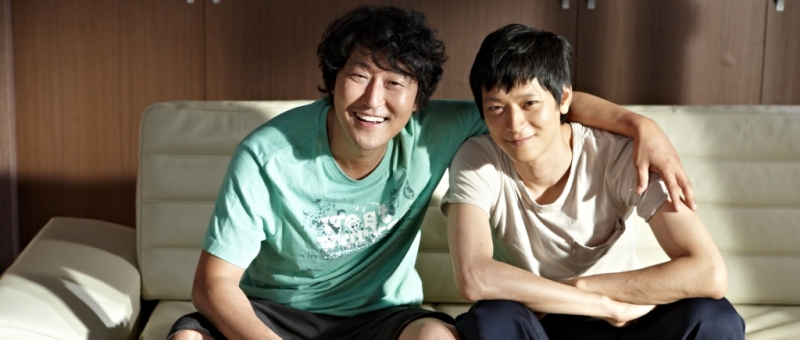

 Up until very recently, many of us lucky enough to live in nations with entrenched labour laws have had the luxury of taking them for granted. Mandated breaks, holidays, sick pay, strictly regulated working hours and overtime directives – we know our rights, and when we feel they’re being infringed we can go to our union representatives or a government ombudsman to get our grievances heard. If they won’t listen, we have the right to strike. Anyone who’s been paying attention to recent Korean cinema will know that this is not the case everywhere and even trying to join a union can not only lead to charges of communism and loss of employment but effective blacklisting too. Cart (카트), inspired by real events, is the story of one group of women’s attempt to fight back against an absurdly arbitrary and cruel system which forces them to accept constant mistreatment only to treat their contractual agreements with cavalier contempt.
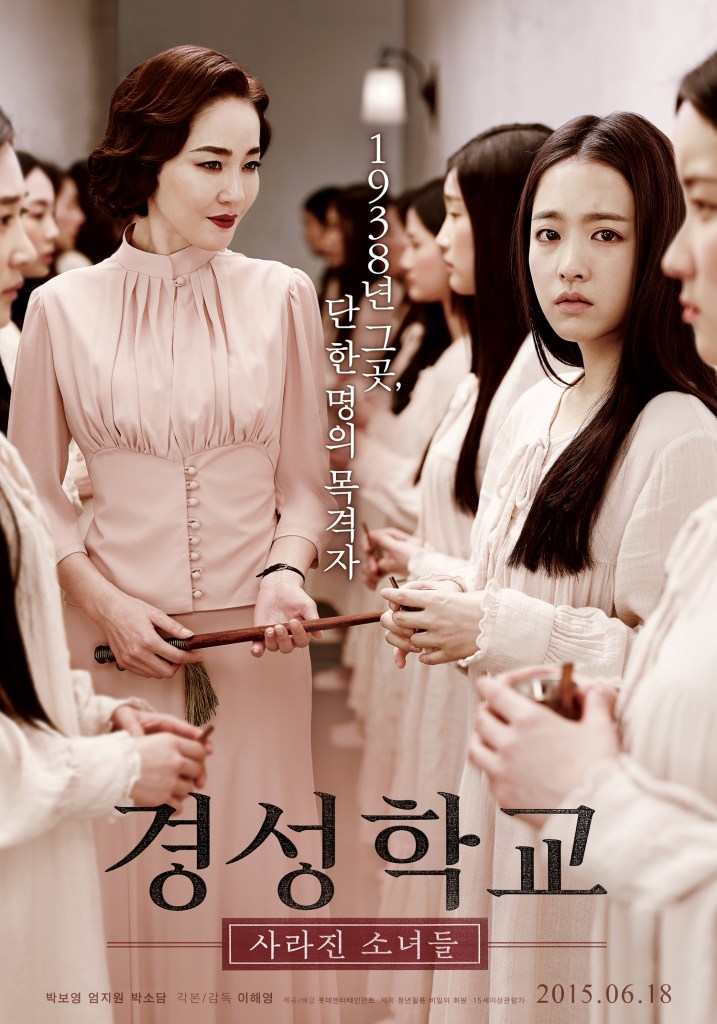 The Silenced (경성학교: 사라진 소녀들, Gyeongseonghakyoo: Sarajin Sonyeodeul) has all the classic genre aspects of the boarding school horror story familiar to fans of gothic literature everywhere, but this is no Victorian tale of repressed sexuality and hallucinatory psychosis. What The Silence does is take all of these essential elements and remix them as a metaphor for the horror of colonialism. Surrounded by quislings and forced into submission in order to survive, how does the essential soul of an oppressed people survive? The Silence would seem to argue that perhaps it can’t, but can evolve and learn to resist its colonisers even if it has to bend to do so.
 For the world’s more full of weeping than you can understand – the residents of Goksung, the setting for Na Hong-jin’s nihilistic horror movie The Wailing (곡성, Goksung), might be inclined to agree with Yeats if only because the name of their town is also a homonym for the “sound of weeping”. There is plenty to weep over, and in places Na’s film begins to feel like one long plaintive cry reaching far back to the dawn of time but the main wounds are comparatively more recent – colonisation, not only of a landscape but of a soul. When it comes to gods, should you trust one over another simply because of its country of origin or is your faith to be bestowed in something with more universal application?
 Windows on Worlds