Wild Ducks and Green Onions (カモとねぎ, Senkichi Taniguchi, 1968)

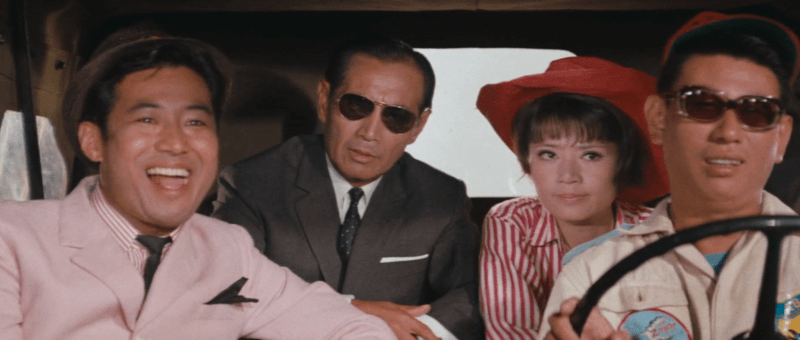
Outside of Japan, Senkichi Taniguchi is most likely best known as the director of Toshiro Mifune’s debut film Snow Trail, or else as the screenwriter of one of Akira Kurosawa’s lesser known works The Silent Duel. Yet throughout the 1960s, he also made a series of silly comedies including Wild Ducks and Green Onions (カモとねぎ, Kamo to Negi), an absurd crime caper revolving around a gentleman thief’s attempts to plot the perfect crime while assisted by two bumbling henchmen and a young woman with a hidden agenda.

The film’s Japanese title is likely inspired by a proverb, “a duck comes carrying an onion” which means something close to “there’s a sucker born every minute” though it might be up for debate who exactly is the sucker here. In any case, dapper mastermind Nobukichi (Masayuki Mori) has plotted the perfect heist which involves rigging a speedboat race by nobbling the propellers on two of the four boats and then betting accordingly. So far so good, but the enigmatic Mami (Mako Midori) has been watching their every move and is able to swipe the bag containing the money before henchmen Yosuke (Hideo Sunazuka) and Kyuhei (Tadao Takashima) can return it to their boss who for once has agreed to an equal split. The guys eventually track her down, but she tells them she spent the money on bail for her husband but it turns out he left the police station with two other women and hasn’t been seen since. The gang then determine to track him down to get the money back, but become involved in several other scams along the way. 

Despite having been able to rob them blind, all the men seem to be under the impression that Mami is a brainless airhead though she later reveals herself to speak fluent English and in fact comes up with a few scams of her own that are better than Nobukichi’s whom the guys refer to as “Cap’n”. Nevertheless, the guys only tolerate her because they need to find her husband though all’s not quite as it seems. Kyuhei in particular seems to have a rather misogynistic streak and is somewhat jealous that Nobukichi gets to have Mami to himself though he remains a perfect gentleman, sleeping on the sofa and giving her the bed. But it’s Kyuhei’s lascivious nature that eventually gets them into trouble when he tries to drag a reluctant Yosuke into a cinema screening pink films only to be pulled aside by some kind of anti-delinquency brigade who read off some unconvincing statistics stating that 80% of young male sex offenders are fans of pink films. 

This annoys them so much they decide to scam the organiser, Tomiko (Hisano Yamaoka), by appealing to her vanity and tricking her association, which is dedicated to conservative family values, into watching (and apparently enjoying) a porn film on school premises believing it to be an “educational movie”. Tomiko in some senses represents the forces of order against which the gang are rebelling, though she’ll get her revenge in time. In any case, they find a more worthy target after travelling to a seaside town and encountering the daughter of a man who has been poisoned by industrial pollution while the local factory insists everything is within “safe limits” and they aren’t the cause of the sickness spreading across the area. 

Conducting another expert heist to steal the secret documents to prove otherwise, Nobukichi could make a lot of money blackmailing the factory owner but instead gives the report to the man’s daughter so she can pursue justice and compensation for her father much to the chagrin of Mami and proving that it isn’t all about the money after all. Then again, he has another document that, once translated by Mami, reveals the factory has actually been producing Napalm for the Americans which is a bit of a grey area as far as the constitution is concerned. This time, they play a nasty trick on the heartless factory owner (Eijiro Tono) though he is hardly remorseful and in fact was too greedy to pay their blackmail money despite the vast sums it would cost him if the news ever got out. 

Despite its silliness and absurdity, the film takes an ironic swipe at serious issues of the day such as scandals like the Minamata disease and Mary Whitehouse-esque social campaigners ranting about a decline in morals while simultaneously enjoying the platform that protesting them grants them. In some ways, the gang themselves exist as a kind of rebellion against the salaryman society with their various scams presented as silly games targeting faceless or ridiculous figures who can either afford to lose the money or were ripe for a comeuppance though in the end, crime doesn’t really pay either and the gang find themselves hoist by their own petards, robbed of enjoying their ill-gotten gains by unexpected twists of fate. Very much of its time the film has a kind of charm in its whimsical score and pastel colours but has lingering darkness in its threats of unexploded bombs and hidden Okinawan torture facilities in a society increasingly ruled by amoral capitalists.

The Inferno (地獄, Tatsumi Kumashiro, 1979)

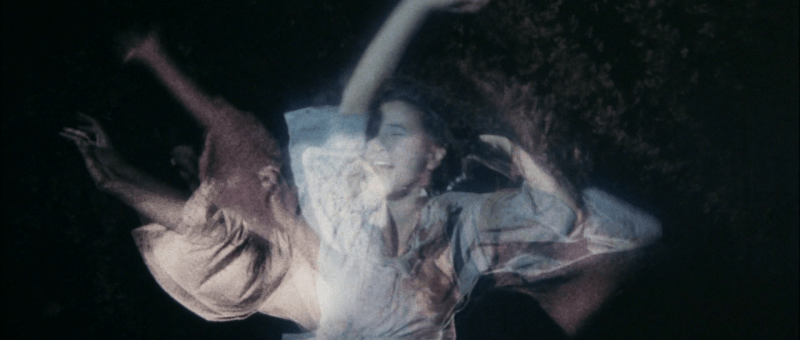
No one can escape from their sins according to the ominous voiceover that opens Tatsumi Kumashiro’s loose reimagining of Nobuo Nakagawa’s Jigoku, The Inferno (地獄, Jigoku). Then again, some of these “sins” seem worse than others, so why is it that a woman must bear a heavy burden for adulterous transgression while the man who killed her seemingly suffers far less? Perhaps hell, in this case, is born of conservative social attitudes more than anything else besides the darker elements of the human heart such as jealousy and romantic humiliation. 

Those negative emotions are however as old as time as reflected in the folk song which opens the film about a young couple, though not the young couple currently onscreen, who are eloping because their incestuous desire is not accepted by the world around them. The connection between the couple onscreen might also be deemed semi-incestuous for Ryuzo (Ken Nishida) has run off with the wife of his brother, Miho (Mieko Harada), who is carrying (what she claims to be) Ryuzo’s child. Unpei (Kunie Tanaka), the brother, finally catches up with them and shoots Ryuzo with a shot gun. Miho tries to escape, but her foot is caught in a bear trap and Unpei decides to leave here there to die, while Ryuzo’s jealous wife Shima (Kyoko Kishida) later does the same. The body is found by local hunters, and in a strange miracle the baby is born from Miho’s dead body while Miho is dragged to hell for her “sins” where she learns that her baby has been born in hell but remains above. Not knowing what to do, the locals give the baby, Aki, to Shima but she obviously doesn’t want it and so swaps it with a foundling thanks to a weird old man, Yamachi, coming to love this other child, Kumi, as a daughter. 

This is quite literally a tale of the sins of the parents being visited on the child, the 20-year old Aki (Mieko Harada) later lamenting that she has no identity of her own and is solely a vehicle for her mother’s revenge. Though she apparently ends up in the same rural town “by chance” knowing nothing of her past, she resembles her mother physically and discovers she has some of her talents such as an innate ability to play the shamisen. What she also has is a trance-like lust that bewitches the men around her, though this is in a sense complicated by the fact it does not seem to be of her own volition so much so as a manifestation of her mother’s curse. Thus she ends up sleeping with the vulgar younger brother of the man she actually likes, Suchio, who in truly ironic fashion is actually her half-brother. She describes herself as having her mother’s “tainted blood”, while Shima later adds in a degree of class and social snobbery revealing that Miho had been a geisha Unpei unwisely fell for and was unworthy even of being a maid in their upper-middle class household let alone the wife of the second son. 

For all of her resentment, Shima is otherwise a loving mother to her sons and even to Kumi whom she is able to accept as a daughter in a way she would never have accepted Aki who was after all an embodiment of her husband’s betrayal. Colder and more austere than Aki or Miho would seem to be, she clings to the mummified body of her husband kept in a secret vault as a secret triumph over her humiliation laughingly remarking that now he’s hers forever and will never cheat on her again. Even if she left Miho to die, Shima does not particularly resist her fate well aware that her son has fallen for his half-sister (which probably wouldn’t have happened if she hadn’t swapped babies) and merely hoping Aki can be convinced to leave town alone rather than plotting any more drastic action. 

But the inferno of hell envelopes them all, crying out for retribution as the cycles of repressed or inappropriate attractions repeat themselves. Kumi realises that her love for her brother, Suchio, is actually not inappropriate because they are not related after all but is then consumed by her own hell in realising that he does in fact love his biological half-sister but is uncertain if he accept damnation in order to pursue it. What she, Miho, and Aki are punished for is female sexual desire aside the arguably taboo qualities of its direction though in hell it seems men are punished for this too, or more accurately for giving in to it, in a way they often aren’t in the mortal realm. “They cut their own flesh and blood for the vision of a woman in the future,” the guide explains as the brothers and Unpei literally climb over each other reaching for an illusionary representation of Aki/Miho at the top of the tree. In the mortal world they do something similar, grappling with each other, mired in competitions of masculinity as mediated through sexual dominance, conquest, or humiliation. 

Yet Aki’s path to hell is also a confrontation with her femininity and her search for an identity as a woman by reuniting with the birth mother who died before she was born. Kumashiro’s visions of hell are terrifying and outlandish, a giant land in which the dead are thrown into a huge meat grinder they then have to push themselves. For the sin of eating meat, others are condemned to spend eternity eating human flesh. Miho has lost all sense of reason and is incapable of recognising her daughter seeing her only as another source of food but there is a kind of rebirth that takes place even if it’s only once again to be born in the underworld. Surreal and harrowing, Kumashiro’s eerie land of giant demons and shuffling corpses does indeed suggest that as the opening titles put it we all live our lives alongside hell.


Original trailer (no subtitles)

The Possessed (妖婆, Tadashi Imai, 1976)

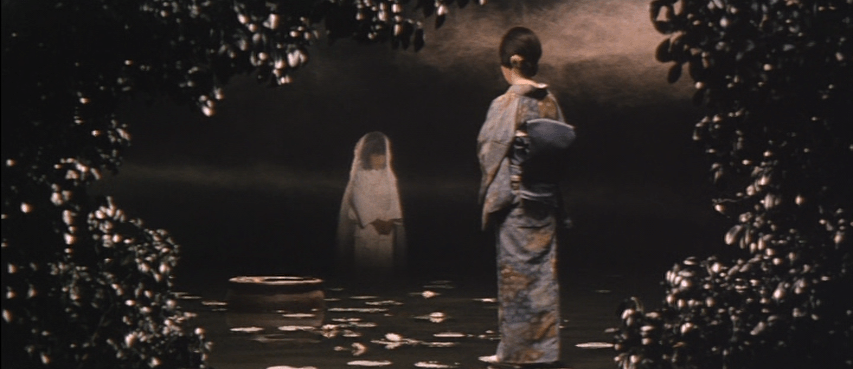
Shinto priests, black magic, and demonic possession. As the opening voiceover of Tadashi Imai’s The Possessed (妖婆, Yoba) remarks, you can hardly believe that such things could happen in the modern world alongside cars, trains, and telephones yet the tale we’re about to be told begins in 1919. Based on a story by Akutagawa, the film is however less a contemplation of ancient superstition amid rising modernity than the destructive patterns of class and patriarchy which conspire against the lives of two women who had once been good friends. 

In 1919, Shima (Machiko Kyo) marries Shinzo (Shinjiro Ehara) who has taken her name and become the presumptive heir of her family. Everyone at the wedding remarks on what a good catch he is, adding almost as an after thought that Shima seems happy about it too. The problem is that Shinzo is repeatedly unable to consummate the marriage. Part of this seems to be down to his wounded masculinity in having married into the family. He resents being under the thumb of his father-in-law along with the rumours that he only married Shima for her money even though this appears to be exactly what he has done. Perhaps further humiliated by his inability to perform, Shinzo tells Shima that it’s her fault because there is something wrong with her body that prevents him from becoming sufficiently aroused. Being a sheltered woman of the Taisho era, Shima wonders if her husband has a point and visits a doctor to find out but as expected he tells her there’s nothing at all wrong with her and it’s most likely Shinzo’s performance anxiety that is to blame. 

However, when her cousin Sawa’s (Kazuko Ineno) comb is found inside Shinzo’s kimono sleeve, the family begin to realise that the problem is he prefers her. He later admits as much and reveals that he’s planning to move closer to the family’s goldmine in Hokkaido and install Sawa in a house there as his common law wife with Shima left behind as a spouse of symbolic value. Shima has already felt herself haunted, but it’s at this point that the family brings in a Shinto priest who explains that Shinzo is possessed by an evil spirit though also giving the more rational advice that she should probably divorce him. Shima is forced to endure a strange ritual including purification by waterfall, but is also sexually assaulted by the randy priest though it it’s not completely clear that she fully realises what has happened to her. 

The implication is that the family treated Sawa as a kind of poor relation they trotted out to keep Shima company because she was an only child. Having grown resentful of Shima’s class privilege, Sawa’s jealousy manifested as covetousness that made her intent on taking whatever Shima had. She too later resorts to shamanistic black magic, fearful that Shima bears her a grudge for ruining her life and hoping to neuter any dark energy that she might be emanating in order to protect her teenage daughter Toshi (Miki Jinbo) who, ironically, has been betrothed to the son of a kimono shop named Shinzo (Taro Shigaki). 

Sawa never married and bore her child out of wedlock. She implies that she depended on men for financial support but never elaborates further. Shima, meanwhile, has been able to build an independent life for herself as a well-respected tailor. “It’s not normal for someone to suffer this much” a shamanically-inclined midwife later tells her when she too becomes pregnant out of wedlock but loses both the child and the man. The boot is perhaps on the other foot, Shima envies the life Sawa has with the one thing that will always be denied her, a child of her own. The midwife had once again told her that she was possessed, this time by the vengeful spirit of her lover’s daughter with his legal wife she fears may have been drowned deliberately by her mother out of jealousy. 

Shima is given a talisman of beads from the goddess of mercy, Kanon, and told that she can have what she wants if she prays hard enough, but Sawa is told the same thing and ends up going too far with the help of a shamaness praying to Basara Okami who later affirms that Sawa’s request comes with a price for the god wants Shima as a human sacrifice which is not really what Sawa had in mind. There is perhaps something symbolic in Shima’s gradual wasting away, becoming old before her time in her loneliness and sorrow (she is only supposed to be 33 at the film’s conclusion, actress Machiko Kyo was 52 at the time) even if she were not having the life force sucked out of her by a supernatural entity, though both women eventually pay a heavy price for their jealousy set against each other by a fiercely patriarchal and classist society which forces them to compete for husbands and standing. 

Imai’s photography is noticeably eerie if occasionally surreal as in the frequent and increasing sight of frogs, usually sign of good fortune or fertility but here ominous harbingers of supernatural dread in league with dark shamanistic forces. As the voiceover admits, it’s difficult to believe that these primitive ideas can exist side by side with the motor car but then again jealousy is as old as time itself and unlikely to disappear from the human psyche anytime soon even if in this case it could have been avoided if only the world were a little more equal. The film’s conclusion suggests it may now be, in a way, with a love match in the younger generation bringing the cycle of envy and resentment to a close even if the vengeful ghost of Shima may still be lurking somewhere in the shadows. 


Horror of the Wolf (狼の紋章, Masashi Matsumoto, 1973)

“All I wanted was to live a quiet life alone” a teenage werewolf laments unfairly forced into a human world which has no real place for him while he can find no accommodation with its innate cruelty. Adapted from the manga by Kazumasa Hirai & Hisashi Sakaguchi, Horror of the Wolf (狼の紋章, Okami no Monsho) is part high school delinquent movie and part psychedelic werewolf exploitation film in which the hero finds himself drawn into a weird supernatural battle with a crazed nationalist while falling for his beautiful high school teacher who perhaps uncomfortably reminds him of his late mother. 

Akira Inugami (Taro Shigaki) spent the early years of his life in Alaska playing with the local wolves until his anthropologist parents were murdered “due to suspicions of spy activity”. After spending some time raised by the wolves, Akira was then taken in by his fantastically wealthy aunt, the CEO of the top chain of Japanese restaurants in the US where he was schooled until returning to Japan. As the film opens, he’s attacked by a gang of thugs, refusing to fight back and later stabbed but cooly removing the knife from his stomach as if it were only an inconvenience to him. Witnessing this strange event, school teacher Miss Aoshika (Yoko Ichiji) promptly faints, only to receive a shock the next day when the man she thought she saw murdered the night before shows up as a mysterious transfer student at her elite academy. 

Hinting at an underlying theme of class conflict and institutional corruption, the school doesn’t really want to take Akira because he’s a troublemaker who’s always getting into fights, though this claim seems to conflict with his ongoing refusal to engage with physical violence, but is reluctant to dismiss him because his aunt is so very wealthy. The same goes for his rival, Haguro (Yusaku Matsuda), whose father is a yakuza boss. Haguro is the leader of the school’s delinquent thugs, a distinctly cool presence who wanders around brandishing a katana which he is frequently seen unsheathing with the Japanese flag in the background while his family crest appears to feature an eagle reminiscent of those seen in Nazi Germany.

Nationalism aside, the film has an ongoing preoccupation with animal imagery not only with Akira’s wolfishness but Aoshika whose name literally means “blue deer” often appearing in front of a wooden deer ornament while Akira’s apartment seems to be kitted out with AstroTurf or at least a vibrant green carpet with the appearance of grass as well as occasionally shifting into an idyllic dreamscape where he can frolic cheerfully in the wild. When Aoshika comes looking for him, he tells her that he’s simply wearing a wolf mask and refuses to take it off, urging her to leave him in peace because “women are so lacking in delicacy and so overbearing it drives me nuts”. 

Akira is not alone in his apparent misogyny, Aoshika is violently raped on three separate occasions the first being by her own students which the headmaster brushes off as a rather frequent occurrence giving rise to the question of why she continues to work at the school, where she is apparently the only female member of staff, if she continually faces such traumatic violence. Her final assault meanwhile comes at the hands of Haguro who seems to be performing some kind of bizarre ritual while preparing to face off against Akira who saved her from a previous attack by street punks while in his werewolf guise.  

Aside from his brooding intensity, there are few clues to Akira’s true identity other than his ability to heal in rapid time following injury and skilful athleticism in dodging attacks. Repeatedly referred to as a “lone wolf”, partly an insult based on his name (which literally means “dog god” and is used to describe those possessed by the spirit of a dog), Akira adopts a pacifist stance towards his aggressors refusing to fight back later telling Haguro that they’re simply not worth the bother yet his refusal to fight is mistaken for a philosophical position that eventually makes him a figurehead for a gang of leftist teens trying to halt the culture of violence in the school in what seems to be an ironic swipe at the student protests even if also setting up a challenge to Haguro’s crypto-fascist authoritarian thuggery. 

A curiously avant-garde affair, Masashi Matsumoto’s teen wolf drama features striking composition with frequent use of solarisation and an almost mythical opening sequence detailing the hero’s origin story amid the snows of Alaska, along with incongruous practical effects such as the furry wolf mask Akira often wears in his apartment in his half-transformed state. It is also somewhat lurid, unnecessarily revelling in the sexualised violence directed at the heroine with three lengthy rape scenes of varying intensity. Even so in its undeniable strangeness and eventual pathos for those who cannot survive in “a cruel world made by humans” Horror of the Wolf reserves its sympathy for the outsiders unwilling to submit to a world of human cruelty.


Sun Above, Death Below (狙撃, Hiromichi Horikawa, 1968)

“Fighting is the only way I have to live my life” according to a hitman battling existential ennui in Hiromichi Horikawa’s Toho action B-movie, Sun Above, Death Below (狙撃, Sogeki). A starrier affair than the studio’s other forays into moody crime, Horikawa’s psychedelic exploration of a killer drawn to death nevertheless situates itself very much in the world of 1968 in which the hero’s attempt to escape his sense of emptiness through killing is directly linked to an increasing economic prosperity and its concurrent costs in the nation’s current geopolitical positioning. 

As if to signal this sense of societal anxiety, the first target Matsushita (Yuzo Kayama) knocks off is sitting in the back row of the last carriage on the Shinkansen out of Tokyo. His next job, however, will apparently be more complicated. A criminal gang want him to take out “five or six” targets at a specific location in order to intercept a fortune in gold smuggled by, as later becomes clear, an international Chinese gangster, though the men at the waterside greet each other in Arabic. The hit does not go entirely to plan but Matsushita is later able to bring the situation under control allowing the gang to get their hands on the gold. The smugglers, meanwhile, are obviously unhappy with this turn of events and send in their best hitman (Masayuki Mori), who permanently travels with a blonde companion, to take back what’s theirs. 

Matsushita is a killer for hire so he doesn’t really care very much about the gold and is even annoyed when the gang try to pay him with it, correctly surmising they didn’t really expect him to succeed so haven’t bothered bringing any cash. As he explains to love interest Shoko (Ruriko Asaoka), he doesn’t really care about anything. He simply shoots at the best target, man, with his favourite gun. He kills to feel alive, explaining that the intense concentration in which he becomes one with the gun as if it were an extension of his own body allows him to overcome his sense of existential dread which is why he’s so ice cool all the time. 

A fashion model obsessed with rare butterflies and the paradise to be found New Guinea Shoko dreams of a time in which they can become one under the sun, envisioning a future in which Matsushita has become friends with all the creatures of the forest. Yet as Matsushita tells an old friend, Fukazawa (Shin Kishida), running a secondhand gun shop near a US army base as a front for his revolutionary activities, he has no dream or ideal and knows nothing other than killing. Whereas as his friend is apparently working for some kind of never quite explained but seemingly left-wing/anarchist cause, Matsushita simply lives out his days of emptiness on some level knowing he’ll probably never make it to Shoko’s New Guinean utopia. 

Fukazawa nevertheless hints at the political instability all around them, firstly agreeing to pawn a gun for a pair of Americans after beer money, and then by handing Matsushita an AK47 apparently smuggled back from Vietnam via the American base. Matsushita’s sense of ennui is born of this growing unease with empty capitalistic consumerism and a concurrent sense of powerless in Japan’s ongoing complicity with American foreign policy in Asia. Displaying a sense of Sinophobia familiar from many similar films of this era, the big boss turns out to be Chinese while many that surround him are also from outside of Japan even if Matsushita’s rival is just a slightly older, crueller version of himself. 

One of Toho’s more serious crime dramas, Horikawa often veers into experimental territory with his psychedelic butterfly imagery Matsushita apparently having some kind of vision while experiencing carnal ecstasy that equates climax with literal gunshot, while his usage of stock footage featuring the New Guinean indigenous community along with an out of place blackface tribal dance performed in a hotel room clearly display some outdated attitudes otherwise unacceptable and potentially offensive in the present day. Nevertheless, Sun Above, Death Below largely lives up to its hardboiled title, the Japanese “Sniping” perhaps also hinting at the various ways Matsushita eventually strays into the crosshairs of his own inevitable destiny. 


Original trailer (no subtitles)

A Wife Confesses (妻は告白する, Yasuzo Masumura, 1961)

Mountains are dangerous places in Japanese cinema. Yasuzo Masumura’s tense, claustrophobic courtroom noir A Wife Confesses (妻は告白する, Tsuma wa Kokuhaku Suru) was released in the same year as Toshio Sugie’s Death on the Mountain, adapted from a popular story by legendary mystery writer Seicho Matsumoto in which a veteran climber is ushered towards his death through a series of machinations by his friend which might or might not be regarded as “murderous” depending on your point of view. Masumura wants to ask us a similar question but from another angle as he puts a woman on trial not quite for the “murder” of her husband but the fact of her survival.

Opening outside the courthouse with a gum-chewing paparazzo, Masumura unwittingly makes us part of the baying mob watching intently as a young woman hides her face with her handbag while the press more than live up to their name, pinning her with questions about the salacious case at hand. Inside, however, he shifts the focus. We are now in the dock with Ayako (Ayako Wakao), looking up at the three men who will judge her for her “crime” from a literal moral high ground. A youngish widow, Ayako is charged with the murder of her husband who died during a freak mountain climbing accident. Caught between a handsome young man, Koda (Hiroshi Kawaguchi), and her abusive husband, Takigawa (Eitaro Ozawa), with no way up or down Ayako chose to cut the rope and let her husband fall. If she had not done so, both she and Koda would also be dead. Ayako is on trial because she refused to sacrifice herself for a wifely ideal. The question is, in many ways, if a woman’s or more to the point a wife’s life has worth, not just worth equal to that of her husband’s but any kind of worth at all. 

The first charge against Ayako is a lack of womanliness. A man at the scene testifies that they don’t usually allow wives or mothers to view bodies and Takigawa’s was in a particularly bad way but Ayako insisted on seeing it only to react with a calm he found suspicious. A policeman then echoes his sentiment, admitting that he arrested Ayako for her unwifeliness. “A wife should stick with her husband ’til the end no matter how tough it is” he says, adding that his own wife agrees with him. As her lawyer points out, had Ayako been a man, or the person below her on the rope a stranger, the policeman would not have arrested her but her refusal to die with her husband, which would have resulted in the “murder” of another man, is an arrestable offence. You can argue about the moralities of choosing to end someone else’s life to save your own, a kind of self defence permitted under Japanese law through the “necessity” legislation, but Ayako’s transgression is in believing that her life and her husband’s weigh the same and that she had a right to save herself. Many feel she should perhaps have cut the rope above her own head, saving Koda only in a lovers’ suicide with Takigawa. 

The policeman offers more grounds for suspicion having discovered that Ayako had taken out an insurance policy on her husband and hoped to profit from his “accidental” death, though as an act of premeditated murder this would certainly be quite an elaborate plot. Furthermore, the prosecution posit that she and Koda were having an affair but, for reasons which are not clear, Koda is not under suspicion or cited as a co-conspirator and is in fact testifying in her defence. He is also engaged to someone else, Rie (Haruko Mabuchi), though the marriage was arranged by his boss for strategic reasons because she is the daughter of a major client at their insurance firm and yes Koda drafted the policy which is currently being used as evidence against Ayako. All very Double Indemnity, but Ayako is certainly no cold and scheming Phyllis whether or not she made a conscious decision to free herself from a man who made her life a misery by literally cutting him loose. 

Yet Ayako’s victimisation is also used against her as further evidence of her unwomanly coldness. She testifies that she married Takigawa after he attempted to rape her and then proposed, confessing that she did so in order to escape a life of poverty that had already driven her into suicidal despair (she still has a vial of potassium cyanide she had taken from his office with just this in mind). She did not love him, but did her best to become a “good wife”, even beginning to wear kimono because he preferred it. Her predicament is no different than that of many other women who agreed to an arranged marriage and found themselves shackled to an unpleasant man with whom they could not get along but the marriage’s failure is laid squarely at Ayako’s feet for not trying hard enough and having insufficient love for the husband who treats her like a glorified maid, is cruel and emotionally abusive, and finally forces her to have an abortion against her will because he doesn’t want to spend money on a child. She asks for a divorce but he points out that as things stand a woman cannot escape a bad marriage without a husband’s consent and he has done nothing to break their marital contract and so to that extent he owns her. 

But for all she’s a cold woman who resented her husband and longed to be free of him, Ayako is also condemned for illicit passion in her secret love for Koda. Indeed we can see she is clearly fond of him, and in flashback we realise much of this is simply because he was kind to her though the extent of his kindness was only to the level of general civility. At heart, they are both “decent” people and so there is nothing more between them than unexpressed longing but still the kernel of their attraction remains and the prosecution has indeed found a grain of truth on which to found a motive for murder.

For his part, in another kind of film Koda would be the hero but here his “goodness” is intensely problematic in that he falls for Ayako precisely because of her suffering. His problem is that he later doubts her, swayed by arguments that paint her as a plotting femme fatale. Though amused by the whole affair, Koda’s boss warns him that women like Ayako are “trouble” and that he’s only been taken in because he is young and naive. Rie, meanwhile, is resentful and wounded, contemplating her own revenge but ultimately testifying in Ayako’s favour, she claims more for herself than for Koda or “justice” too embarrassed to take the stand and offer her own feminine “inferiority” as evidence against her romantic rival. Yet she later comes to admire her, seeing her as one who was bold enough to chase love at the expense of all else no longer caring what anyone might say or think. Ayako is the most liberated woman alive, and she would die for love but did not love her husband and so would not die for him. 

Koda is punished because he fell in love with an image of suffering womanhood but is afraid of Ayako’s transgressive femininity. He is conflicted in the knowledge that if she killed her husband her love for him may have been the reason, and is disturbed by her venality in that she would have taken the insurance money and lived well without finding it distasteful while he would have preferred to reject the settlement entirely lest it besmirch the innocence of their love. In real terms it doesn’t really matter why she did it, Ayako cut the rope and whether she did so out of an instinct for self preservation, in hate, or in love, the result is all the same. What she’s on trial for is defiance, that she acted, seized her own agency and made a choice to value her life over her husband’s which is still, as it turns out, a moral crime in the supposedly modern and democratic society of 1961. Masumura’s accusatory camera finds her pinned, confined, trapped at the edges of frames hiding her face with her single permitted feminine accessory while the subject of our judgemental gaze until the curtain finally closes leaving her in shadow but perhaps finally free of her cruel and oppressive society. 


Original trailer (no subtitles)

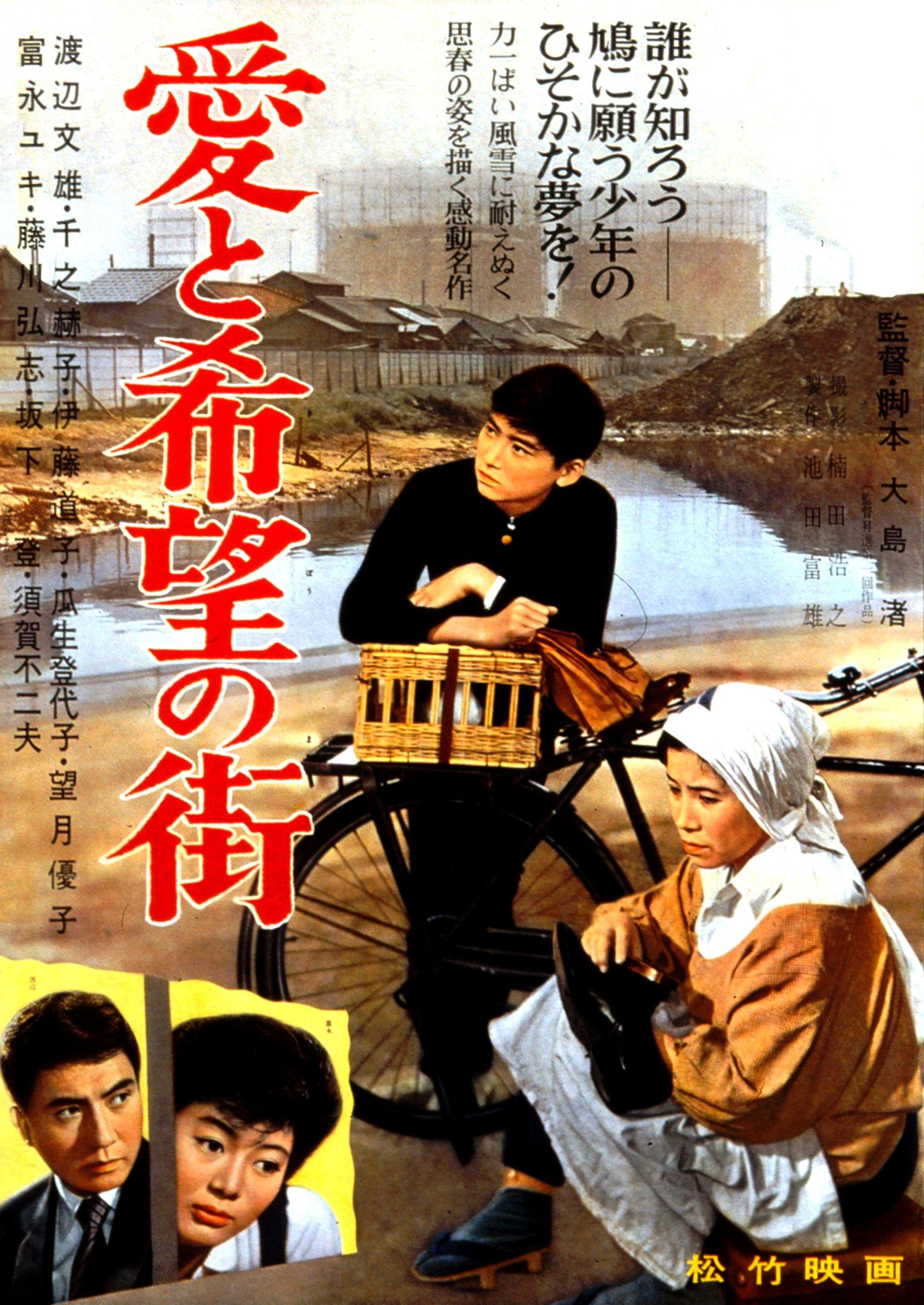
Street of Love and Hope (愛と希望の街, Nagisa Oshima, 1959)

“You must sell your pigeons or you can’t survive in this world” a less progressive figure than he first seemed eventually admits in Nagisa Oshima’s ironically titled debut feature Street of Love and Hope (愛と希望の街, Ai to Kibo no Machi). As might be expected given the director’s later trajectory, there is precious little love or hope on offer and it seems his particular brand of grumpy pessimism ruffled studio feathers from the very beginning earning him a sixth month directing ban with a top executive complaining “this film is saying the rich and poor can never join hands”. The executive may have had a point in the increasing inequalities of the post-war society in which humanist hypocrisy offers only entrenched division and inevitable class conflict. 

As the film opens, the hero, Masao (Hiroshi Fujikawa), is selling his sister’s beloved pet pigeons because, as his social worker later explains, welfare payments are not enough to live on and his mother Kuniko (Yuko Mochizuki), who usually shines shoes for a living, has TB which leaves her unable to work. Kuniko is keen for Masao to stay in education and attend high school, but he acutely feels the burden on his mother and intends to work while attending evening classes. The trouble begins when Masao sells his pigeons to a wealthy young lady, Kyoko (Yuki Tominaga), who is the teenage daughter of an electronics factory boss. 

Well-meaning as she is, Kyoko tries to give Masao the change from her purchase after he explains he’s selling the birds because he needs money. Ironically she gives one of them to her sickly younger brother, but the problem is that Masao is effectively running a scam. The birds are homing pigeons. Assuming the new owners don’t cage them in properly, the birds will fly right back home and he can sell them again. He’s already done this a couple of times and is at least conflicted about it, especially as it upsets his sister Yasue (Michio Ito) so much, though what else really is he supposed to do?

This central question is the one that eventually comes between Masao’s progressive schoolteacher Miss Akiyama (Kakuko Chino) and Kyoko’s sympathetic older brother Yuji (Fumio Watanabe) who works in HR at his father’s factory. Another of Oshima’s mismatched, ideologically opposed frustrated couples, Miss Akiyama and Yuji find themselves on either side of a divide. It seems that the factory does not ordinarily employ city boys, preferring to recruit from the countryside and house employees in dorms because the boss is convinced rural youth is less corrupted by amoral urbanity. Hoping to help Masao, Kyoko and Miss Akiyama team up to convince him to change his mind and give Masao a chance, but they eventually fail him during the exam because it accidentally uncovers his pigeon scam and therefore proves the boss’ point. 

That isn’t all it exposes, however, as even the seemingly progressive Yuji expresses some extremely outdated, quite offensive prejudices even as he insists they didn’t fail Masao because he comes from a single-parent family. According to the boss, children of “broken families” become “twisted human beings” which is unfortunate because “corporations value stability”. Even while not disagreeing with his father’s logic, Yuji explains that he can’t employ Masao not because of his fatherless status but because he’s fundamentally dishonest as proved by his pigeon scam. Miss Akiyama who’d previously described him as the kind of boy who never lies, is shocked but later reflects on his circumstances and her own. In its own ways, her life is also hard and she can see how it might happen that she too may have to “sell her pigeons” (a handy piece of wordplay hingeing on the fact the Japanese for pigeon, “hato”, sounds similar to the English word “heart”) in order to survive. She can forgive Masao for doing the same in the knowledge he had no other choice, but believes Yuji wouldn’t nor would he forgive her if he discovered that she too had sold herself. She cannot be in a relationship with a man who is so “heartless” and unforgiving and it is this which creates the unbreachable gulf between them itself informed by their differing socioeconomic circumstances. 

These differences in standing are also brought out in the youthful idealism of Kyoko who wholeheartedly believes she can help Masao by giving him money and then trying to improve his circumstances by getting him a job in her father’s factory. Both her father and her brother dismiss her altruistic desire to help as childish, Yuji pointing out that there are millions of poor people not just one and you can’t help them all, while their cynicism is eventually validated in the exposure of Masao’s “fraud” which accidentally brands those living in difficult economic circumstances as duplicitous criminals even as it directly implies that it is an unfair society which turns honest boys like Masao who never lie and just want to take care of their mothers into “heartless” bird traffickers. You can see why Shochiku didn’t like it, the hope of the post-war era shot down by the gun of a conflicted industrialist. 


Cruel Story of Youth (青春残酷物語, Nagisa Oshima, 1960)

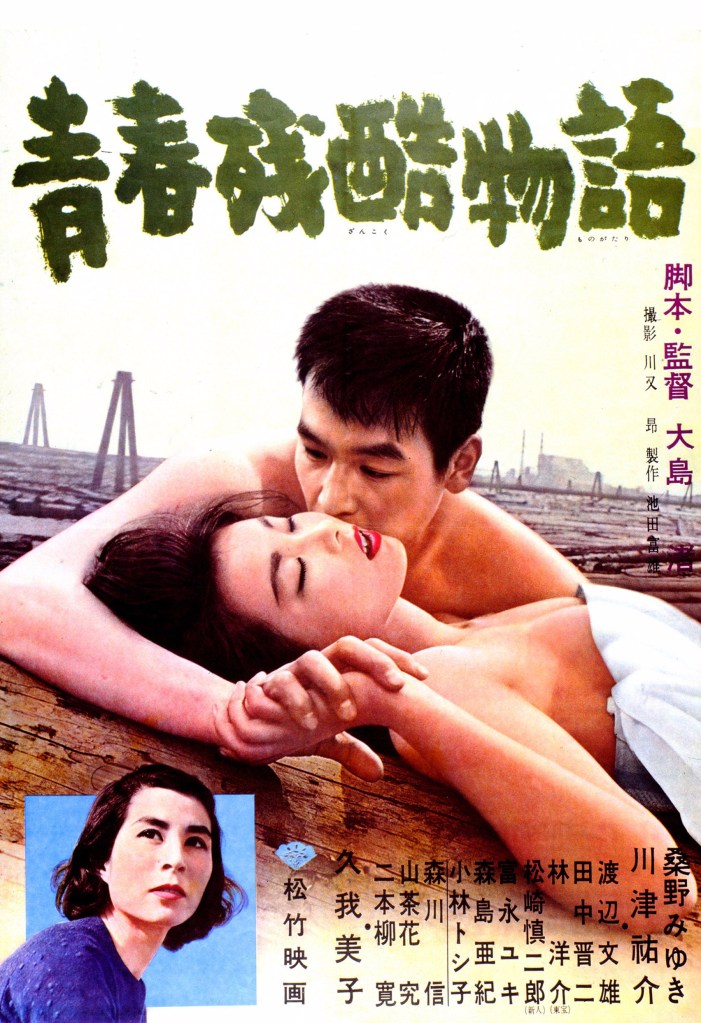
More interested in politics than cinema and never quite at home in the studio system, Nagisa Oshima began his career at Shochiku as one of a small group of directors promoted as part of the studio’s effort to reach a youth audience they feared their particular brand of inoffensive melodrama was failing to capture. Like The Sun’s Burial, Cruel Story of Youth (青春残酷物語, Seishun Zankoku Monogatari) is a nihilistic tale of a fracturing society, but it also looks forward to Night and Fog in Japan in its insistence that youth itself is a failed revolution and this generation is no more likely to escape existential disappointment than the last. 

The film opens with teenager Makoto (Miyuki Kuwano) and her friend Yoko (Aki Morishima) trying to get free rides from skeevy middle-aged men rather than having to pay for a cab. As you might expect, that’s a fairly dangerous game and while it might be alright while there’s two of you, as soon as Yoko has been dropped off, the driver changes course and suggests going for dinner only to park in front of a love hotel and try to drag Makoto inside. Luckily, or perhaps not as we will see, she is “rescued” by young tough Kiyoshi (Yusuke Kawazu), a student and angry if politically apathetic young man. Struck by his manly white knight act, Makoto takes a liking to Kiyoshi but he too later rapes her under the guise of satisfying her curiosity about sex to which he attributes her ride hailing activities. After this violent genesis, they fall in “love” but continue to struggle against an oppressive society.

We assume that the “cruel story of youth”, and it is indeed cruel, that we are witnessing is that of Makoto and Kiyoshi, but it’s also that of her slightly older sister Yuki (Yoshiko Kuga) and her former lover Akimoto (Fumio Watanabe) who has become a conflicted doctor to the poor betraying himself by financing the clinic through charging for backstreet abortions. Yuki complains to her apathetic father that they were strict with her in her youth, that she’d get a hiding just for coming home after dark, whereas Makoto can stay out all night and not get much more than a stern look. Her father explains that times were different then, “We thought we had new horizons. We started again as a democratic nation, and it was a responsibility that went hand in hand with freedom. What can I say to this girl today?” admitting both the failures of the past and the mistaken future of a society that actively resists change. 

Yuki and Akimoto were part of the post-war resistance, left-wing students like the older generation of Night and Fog in Japan, who’d actively fought for real social change but had seen that change elude them. Yuki, we hear, left Akimoto for an older man but perhaps now regrets it along with her half-finished revolution. She may not approve of her sister’s choices, but she also on some level admires her for them or at least for the strength of her rebellion even if it will ultimately be as fruitless as her own. “This is a cruel world and it destroyed our love” Akimoto laments, mildly censuring the youngsters in suggesting that his love was pure and chaste because they vented their youthful frustrations through political action whereas this generation is already lost to the mindless hedonism of unbridled sexuality. 

He forgives them, because he feels that their plight is a direct result of his failure to bring about the better world, but there is also a suggestion that it is a lack of political awareness which is somehow trapping the young. Oshima cuts from footage of the April Revolution in Korea which is described as a “student riot” in the news to a protest against the Anpo treaty at which Kiyoshi and Makoto look on passively from the sidelines. “I think taking part in the demonstrations is stupid”, Makoto’s friend Yoko tells a prospective boyfriend, “why don’t we think about getting married instead?”, drawing a direct line between social conservatism and political inaction. 

Makoto and Kiyoshi rebel by using, or to a point not using, their bodies as a direct attack on the society. Following their rather odd and troubling meeting, the pair earn their keep through repeating the experience. Makoto picks up men who will inevitably have an ulterior motive, and Kiyoshi rescues her, extorting money from their targets. Yet it is Kiyoshi who is forced to prostitute himself, gaining financial support as a gigalo kept by a wealthy middle-aged housewife who is just as sad and defeated as Yuki and Akimoto, dissatisfied with the path her life has taken and in her case attempting to escape it through passion and control exerted over the body of a young man. Though the consequences of a becoming a kept man may be different than those Makoto would face should the less “nice” delinquents get their hands on her, they do perhaps fuel his sense of violent emasculation which he channels into a pointless act of revenge against the society in the form of its most powerful, wealthy middle-aged men whose misogyny he claims to abhor while simultaneously mirroring and directly exploiting.

“Someone needs to be responsible” a strangely sympathetic policeman insists, chiding Kiyoshi that at heart he’s just a petty criminal who liked having money no matter how he might have tried to dress it up. “You’re just like them, you’re a victim of money too”, he adds correctly diagnosing the flaws of an increasingly consumerist society. Only, no one takes responsibility. Kiyoshi’s lady friend pulls stings. It turns out her husband does business with Horio, one of Makoto’s pick ups who despite being nice and kind still had his way with her and then reported Kiyoshi for extortion. Akimoto explained that their failures would drive them apart, but Kiyoshi swore they’d always be together only to wonder if in his love for her the only thing to do is save Makoto from his corrupting influence though she does not want to leave him. We won’t be like you, Kiyoshi countered, because we have no dreams with which to become disillusioned. But youth itself is a failed revolution, and the force which destroys them is perhaps love as they meet their shared destinies at the hands of an increasingly cruel society.


Cruel Story of Youth is currently streaming on BFI Player as part of the BFI’s Japan season.

Original trailer (no subtitles)

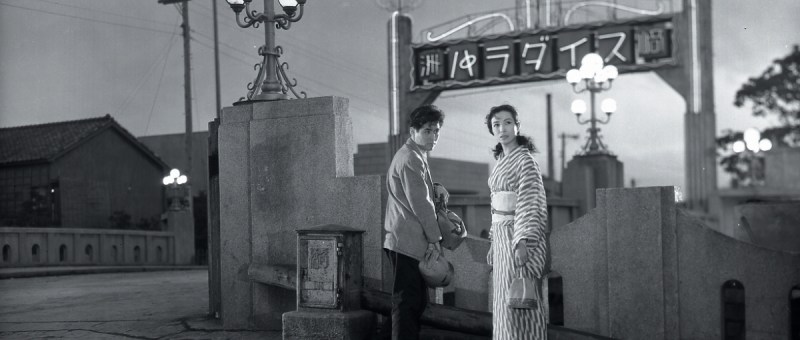
Suzaki Paradise: Red Light (洲崎パラダイス 赤信号, Yuzo Kawashima, 1956)

Suzaki paradise posterBy 1956, things were beginning to look up. Post-war privation was receding into the distance with the consumerist future already on the horizon, but as much as there were possibilities for some others found themselves floundering, unable to find direction in a world of constant change. Yuzo Kawashima’s Suzaki Paradise: Red Light (洲崎パラダイス 赤信号, Susaki Paradise: Akashingo)* was released in the same year that the anti-prostitution law came into force forever changing the face of the red light district and like its heroes finds itself hovering on a precipice caught between an old world the new.

Lovers Tsutae (Michiyo Aratama) and Yoshiji (Tatsuya Mihashi) have found themselves at a crossroads, or more accurately on a bridge, unsure whether to go forward, or back, or some other place entirely. Tsutae is disappointed in Yoshiji, expecting him as the man to have some kind of plan, while he is a little resentful of her fortitude and tendency to take the lead. Yoshiji grows maudlin and moody, berating himself for his failure of manhood, a failing for which Tsutae has little sympathy. Fed up with him, she runs off and catches a bus. He chases her, and they both get off at Susaki, home to a famous red light district. Yoshiji isn’t happy with this development, worried that Tsutae will cross the bridge and fall back into her “old self”, perhaps hinting at the kind of life she lived before. Luckily for them, Tsutae spots a help wanted sign at a tiny bar firmly on this side of the river. The landlady, Otoku (Yukiko Todoroki), is a kind woman raising her two sons alone, but is wary of handing the job to a woman the like of Tsutae. As she tells her, no one stays here long, most just see it as a stepping stone, a place where they can acclimatise themselves to the idea of crossing the bridge into the ironically named “Susaki Paradise”.   

Once you cross the bridge, most seem to say, you never really cross back. Later we learn that Tsutae is from the other side of the water and seemingly forever trying to escape her past though mostly through trying to attach herself to a man she thinks can carry her out it. Yoshiji seems to be aware that Tsutae is a former sex worker and is desperate to prevent her returning to her previous occupation, worried that he’ll lose her if she does or perhaps just unfairly judgemental. Likewise, we learn that he lost his job through some kind of impropriety, perhaps committed trying to keep Tsutae with him. Each of them is in one way or another trapped by patriarchal social codes, Tsutae believing that the only way she can save herself is by finding the right man to save her, and Yoshiji increasingly resentful for not living up to the male ideal. He can’t keep his woman, can’t provide for or protect her, most pressingly he cannot find a job but is also proud, shamed by the idea of accepting low paid manual work. He feels belittled and humiliated and is embittered by it.

Tsutae meanwhile takes to Otoku’s bar like a duck to water, quickly bringing in a host of male custom while bonding with the cheerful owner of a radio shop in nearby electronics centre Kanda, Ochiai (Seizaburo Kawazu). Otoku manages to find a job for Yoshiji delivering soba noodles in a local restaurant which he decides to take despite his intense resentment and wounded male pride. Ironically enough, the name of the soba restaurant is “Damasare-ya” which sounds like “tricked”, explaining why he might be reluctant to take the job, but the biggest problem is that he can’t trust Tsutae and is always paranoid about her meeting men in the bar or deciding to cross the bridge in his absence. Eventually, Ochiai offers to make Tsutae his mistress and provide a flat for her in Kanda, leaving her with a choice – “love”, if that’s what it is, with the feckless and jealous Yoshiji, or perfectly pleasant yet transactional comfort with Ochiai. Yoshiji, meanwhile, attracts the attentions of an earnest waitress in the soba noodle restaurant (Izumi Ashikawa) who seems to support his attachment to Tsutae but is also rooting for him to get over himself and live an honest life of hard work by knuckling down at his new job.

Yet that post-war restlessness won’t seem to let either of them go. Once you fall, you fall and it may not be possible to climb back up, or at least not without the right person to help keep you from slipping back down. Otoku has managed to keep a steady hand on the tiller, apparently waiting, we’re told, for the return of her husband who ran off with a woman from the red light district four years previously. The red light district, like toxic masculinity, cuts both ways and you’ll pay a heavy price for crossing the bridge. “People had better live honestly” a middle-aged man avows after having apparently seen the error of his ways, but it’s easier said than done.

When their worlds come crashing down, Tsutae and Yoshiji find themselves right back where they started, hovering on the bridge. “We have to live until we die” Tsutae once said, dismissing any fears we might have had that the pair might jump, but their course is both set and not. Now chastened, Tsutae’s decision to take a step back is both a reflection on the failure of her Susaki experiment, and also perhaps a mild concession to patriarchal social norms as she actively assumes the submissive role, affirming that she will follow Yoshiji’s lead while he reassumes his masculinity by finally taking charge. No longer quite so liminal they move on, another pair of floating clouds, perhaps more at home with who they are and can never be, but with no clear destination in sight.


*The reading of this place name is “Susaki” but the film has become more commonly known under the title “Suzaki Paradise”

Currently streaming on Mubi as part of an ongoing Yuzo Kawashima retrospective.

Title sequence (no subtitles)

The Catch (飼育, Nagisa Oshima, 1961)

The Catch poster1960 was a turbulent year for many, not least among them Nagisa Oshima who dramatically broke his contract with Shochiku after the studio withdrew Night and Fog in Japan on grounds of sensitivity after the leader of Japan’s Socialist Party was murdered by a right-wing assassin live on TV. 1961’s The Catch (飼育, Shiiku), an adaptation of a novel by Kenzaburo Oe, was Oshima’s first post-studio picture and as uncompromising as anything else he’d worked on up to that point. Unlike many other filmmakers of the post-war generation who had been keen to use the corruption of the war as an excuse for a failure of humanity they now thought could be repaired, Oshima suggests that the rot was there long before and all the war did was give it justification.

In the summer of 1945, a small village captures a black American airman (Hugh Hurd) shot down over a nearby forest. They are originally quite jubilant about their act of heroism, believing that they will eventually be rewarded by the authorities, but are then irritated by their new responsibility. They are already low on food, and now they’ll have to feed this full grown man or risk being branded as amoral war criminals. Predictably, nobody wants to be saddled with looking after him until the authorities arrive with further instructions or knows what to do now, so in time-honoured fashion they tie him up in a shed and hope for the best. Only latterly when one of the children points it out do they realise that they should probably remove the bear trap attached to the airman’s foot which may already be infected seeing as he seems to be in a considerable amount of pain and is running a high fever.

It goes without saying that villagers are extremely racist, using quite pointed racial slurs and dehumanising language to describe their captive, even when others stop to remind them that he is after all human too even if he’s an enemy. Just as their sons and husbands are overseas fighting, and dying, bravely for the emperor so was this man valiantly risking his life for his country. Shouldn’t he be accorded some respect just for that? Wouldn’t they want that for their sons too?

Sadly thoughts are thin on the ground, as is food. Jiro (Toshiro Ishido), a young man shortly to enlist, wants a bag of rice off his dad to take into town to buy a woman, but his dad doesn’t have any because he’s already in debt to the immensely corrupt village chief (Rentaro Mikuni). Jiro eventually satisfies himself with a sexually liberated high school girl evacuated from the city and thereafter disappears – the first of many negative events to be randomly blamed on the captive airman. Meanwhile the village chief is responsible for a series of problems because of his out of control need for sexual dominance which sees him apparently abusing his daughter-in-law (Masako Nakamura) and attempting to assault a young widow (Akiko Koyama) with two children evacuated from the city and otherwise undefended in the village.

The rot here is feudalism, the idea that gives free rein to the village chief to misuse his position for his own satisfaction – extracting sexual favours from the women and controlling the men economically. Because he’s the village chief no one really questions his authority or his orders, so when he says all the problems are new and caused by the “black monster” they’ve brought into the village then everyone believes it to be true. The airman, who cannot be responsible for any of these crimes because he is still recovering and locked up in the shed, becomes a scapegoat for every bad thing that has ever happened in the village. More than an embodiment of the war, he is a symbol of all the external pressures that the village would like to pretend are the reasons it has turned in on itself.

Yet the airman is only one kind, the deepest kind, of other. The village hasn’t quite even integrated its evacuees who also constitute a secondary community. The young woman’s two starving children are repeatedly caught with their fingers in other people’s rice jars and receive little sympathy from the villagers, but their crimes only expose the fact that the man who has sheltered them, and also owns the shed where the airman is kept, has been keeping quiet about people thieving his potatoes. He knows it’s not the widow because there are simply too many taken to feed a small family of three, which means that there are probably several “thieves” among the villagers, content to betray their neighbours in thinking that the wealthy farmer won’t miss a measly few root vegetables.

Predictably, rather than deal with the problem, everyone obsesses over the idea that the corruption is born only of the airman and if they could just eliminate him everything would go back to “normal” – i.e. the feudal past in which everyone does what the village chief says and lives in superficial harmony without complaining about their reduced status as lowly peasants forced to live in penury by an unfair and essentially corrupt system. To cure the discord between them, they decide that the airman must be killed, no longer caring about the censure they may face from the authorities. Only two young boys stick up for him, remaining sane amid the madness all around them in insisting that the airman is a person too, is unrelated to the village drama, and deserves his dignity and respect. Sadly, however, the madness has already taken hold.

On learning that the war is over, the villagers refuse to reflect on their behaviour and seek only to bury the past, superficially smoothing over their barbarity with convenient justification. They receive the news that the American authorities do not trust the Japanese with surprise and hurt, despite the fact they are living proof of the reasons why they would be foolish to do so. We gave him white rice while we ate potatoes, he had goats milk, they say, what more could he have wanted? The answer is self evident, but it’s already been forgotten. The villagers start blaming each other, and eventually settle on another scapegoat – a deserter, as if another death could tie all of this into a neat bundle to be burned away on a funeral pyre as if it never existed at all. The evacuees are invited to leave, and the villagers start thinking about the harvest festival, as if the evil has been excised and everything is returning to the way it’s supposed to be, but this “peace” is brokered on the back of secrecy and an abnegation of responsibility. A grim exposé of man’s essential cruelty and selfishness, The Catch rejects the tenets of post-war humanism to suggest that the corruption of feudalism has not and may never be eliminated at least as long as a nation remains content to bury its past along with its shame.


Short clip (English subtitles)