Husband and Wife (夫婦, Mikio Naruse, 1953)

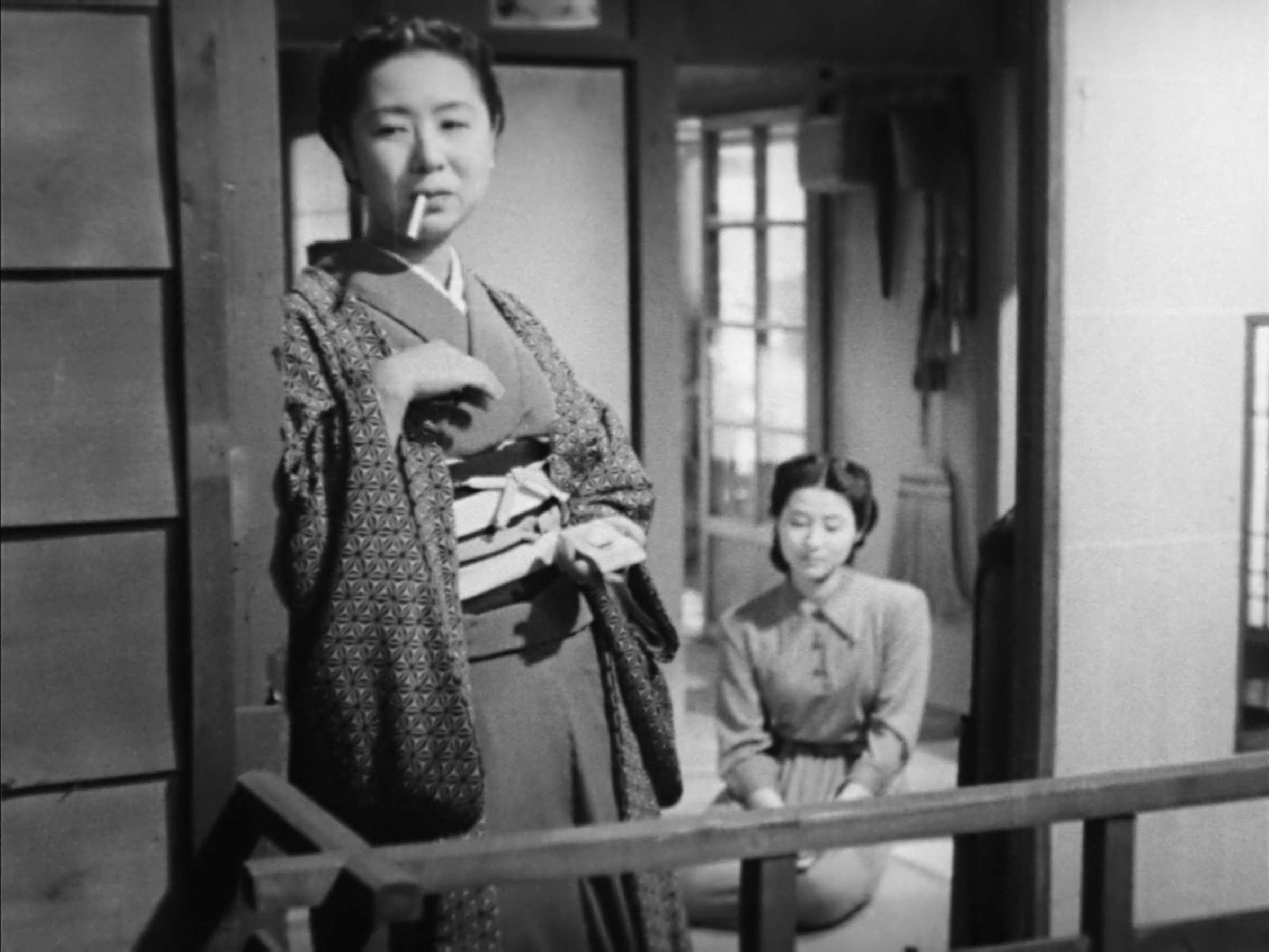
Kikuko (Yoko Sugi) climbs the stairs to the roof of a department store and pauses at the top looking down on her friends below, but they appear to be looking down on her. They’re disappointed. She looks so “provincial”, even though she has no children and therefore more time to spend on herself. They’re envious of her “freedom” to return home late while they have to get back to their husbands or in-laws, but Kikuno isn’t really free at all while trapped in a stifling marriage to the incredibly dull and petulant Isaku (Ken Uehara). 

One of a series of films about marriage and originally envisaged as a sequel to Repast until Setsuko Hara fell ill, Husband and Wife (夫婦, Fufu) paints a rather bleak picture of married life even by Naruse’s standards. The couple are quite literally but also spiritually “homeless” in that they cannot find a home to share, while the absence of a domestic space to call their own prevents them from solidifying their marriage. They’re pushed out of Kikuko’s parents’ home because her brother’s getting married and they need the space, but Isaku drags his feet over finding somewhere else and leaves much of the legwork to Kikuko alone. The main problem seems to be that Isaku can’t afford anything decent, which places a strain on his male pride, but in a repeated motif, rather than confront the situation, he ignores it completely and then crassly presses his recently widowed colleague to let them rent a room in his now much emptier house. 

It’s a mystery why Isaku has so many financial problems when he and Takemura (Rentaro Mikuni) work for the same company, save that Isaku had evidently spent some time working in the provinces, and his colleague had already bought a home with no apparent money worries, but it further sets the two men apart and fuels Isaku’s sense of inadequacy. Having returned from a leave of absence following his wife’s death, Takemura is grief-stricken and apparently uxorious. He complains that he’ll never find another woman like his late wife, all while Isaku won’t shut up about the house and others relentlessly encourage him to remarry. Nevertheless, after the couple move in with him, a natural connection arises between Kikuko and Takemura who is Isaku’s total opposite, both in his treatment of Kikuko and general personality. Where Isaku is sullen and resentful, Takemura is cheerful despite his grief and generous of spirit. Kikuko effectively becomes a wife to both men, taking care of each of them by cooking and cleaning, but while Takemura goes out of his way to thank her, all Isaku does is run her down and humiliate her in front of company.

Then again, having fallen in love with Kikuko precisely because she is a “proper wife,” Takemura then runs his own late wife down by complaining that she wasn’t very pretty and couldn’t cook. The only thing she had going for her was her health, and then she died. He says got a bum deal, and that Kikuko has shown him a different side of womanhood. When two colleagues come to the house and compliment Kikuko’s cooking but are surprised when she eats nothing herself (because they have no money), Isaku responds to their assertion that it’s difficult to be a housewife by replying that men work hard all day while women “only” have to look after the house. For her part, Kikuko says that she was happier when she was working. Men can fall in love several times, but once a woman’s married her romantic life is over. As her friend tells her, men soon get bored of their wives and hers has already taken a mistress at work. 

At several points and with the women in earshot, the men warn each other about the pitfalls of marriage. Irritated that Kikuko has returned to their home on New Year’s Eve after becoming fed up with Isaku, her father advises her brother that women show their true faces after six or seven years and it’s going to horrify him. Isaku tells him not to be too nice or obedient during the early days because his wife will get used to it, while Kikuko counters that men are overgrown children and as long as you make sure to cradle them like babies everything will be fine. Neither of them seem to have a very positive idea of what marriage should be and frame it almost in terms of a war in which they are continually at odds with each other. Isaku describes a husband and wife as a pair of scissors, intending it as a positive metaphor about how one half can’t cut alone, before reframing it as two knives coming together. He becomes unpleasant and chauvinistic, blaming Kikuko for everything by complaining that it’s her fault that he wears a torn up old coat that causes him some embarrassment in front of his boss and a tactless geisha, while criticising her for not having the bath ready when he comes home tired from working all day. Kikuko points out that men seem to assume they’re the only ones who get tired while her loved up brother swears he’ll be different and even if they’re in the honeymoon phase, they do seem much happier and more suited than the already resentful Kikuko and Isaku.

It’s the sister-in-law who throws them a lifeline by introducing them to a relative looking to rent a vacant room, allowing them a means to save their marriage by leaving Takemura’s house. Increasingly resentful of the growing attachment between Kikuko and Takemura, Isaku starts avoiding coming home and hanging out with a young woman at the office with, at least, the danger of a burgeoning affair for which he’s taken to task by Takemura. As Takemura says, it’s not much of a marriage if Isaku can’t trust his wife while Kikuko is eventually so sick of the cold shoulder and constant denigration that she considers leaving him. The new apartment finally gives them a domestic space they can call their own, but it comes with the caveat. The landlady doesn’t allow children because the tenant next door is an ikebana teacher who demands peace and quiet, but Kikuko is in fact already pregnant which might present another means of saving their marriage by becoming a family but Isaku immediately rejects it. He complains he doesn’t have any more money to move again and tells Kikuko to get an abortion, strong-arming her when she refuses. Kikuko can’t go through with it and the nicest thing Isaku says to her in the entire picture is that they can go home, he’s giving in and will raise the child even if it’s difficult. But even this bittersweet moment seems more like condemning them to marriage rather than repairing their relationship with Isaku only grudgingly accepting, most likely because he realises that his marriage is dead anyway if he forces Kikuko to give up their child against her wishes. Despite the changing season, the air between them remains frosty, and marriage is exposed for the prison that it is trapping each of them in loneliness and resentment rather than bringing them together in joy as they prepare to become a family rather than just husband and wife.


Husband and Wife  screened at Japan Society New York as part of Mikio Naruse: The World Betrays Us – Part I.
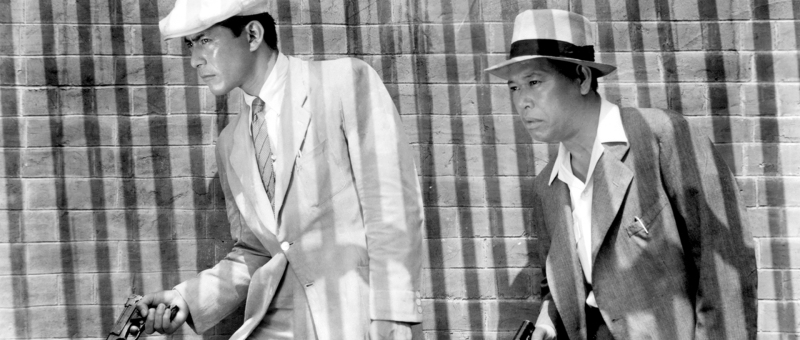
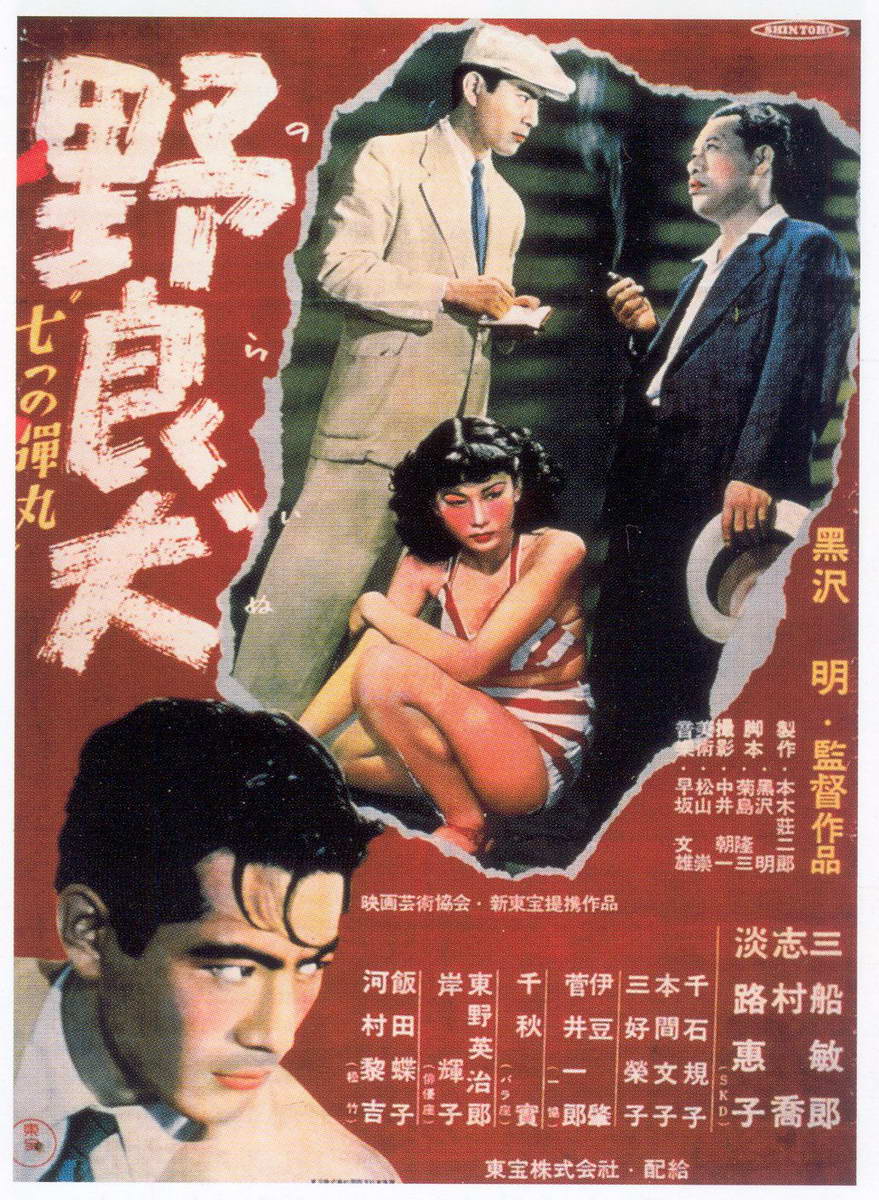
Stray Dog (野良犬, Akira Kurosawa, 1949)

“And, yes, I think the world’s not right. But it’s worse to take it out on the world” the conflicted policeman at the centre of Akira Kurosawa’s Stray Dog (野良犬, Nora Inu) explains as he struggles to reacquire his sense of authority while weighing up its limits and his own right to pass judgement on what is right or wrong or merely illegal. He must ask himself how he can enforce the law while faced with the reality that the man he chases is an echo of himself, the him that took another path amid the chaos, confusion, and despair that followed in the wake of defeat and occupation even as his well-meaning mentor insists that some people are good and others bad and he won’t be able to do his job if he gives it much more thought than that.

The policeman, Murakami (Toshiro Mifune), is perhaps the stray dog of the title who can only follow the straight path towards his missing gun taken from him on a sweltering bus in the middle of summer while he was distracted not only by the heat but by exhaustion having been up all night on a stakeout. As we later discover, Murakami is a rookie cop and recently demobbed soldier trying to make a life for himself in the post-war society. In this he is quite lucky. Many men returned home and struggled to find employment leaving them unable to marry or support families, a whole pack of stray dogs lost in an ever changing landscape. This must have weighed quite heavily on his mind as he made the decision to resign from the police force to take responsibility for the laxity that led to the gun possibly ending up in the wrong hands only to discover his superiors don’t regard it as seriously as he does. His boss tears up the letter and tells him to turn his defeat into something more positive by trying to do something about it, which might in its own way be a metaphor for the new post-war society. 

So closely does Murakami identify himself with his gun that on hearing it has been used in a violent robbery it’s almost as if he has committed the crime and is responsible for anything it might do. There is an essential irony in the fact that this weapon that was supposed to prevent crime is being subverted and used in its service as if mirroring the paths of the two men who both returned to a changed Japan and had their knapsacks stolen on their way back home. Murakami has chosen the law, while the thief Yusa (Isao Kimura) is thrown into nihilistic despair unable to make a life for himself. Murakami’s sense of guilt is further compounded on realising that he may have frustrated Yusa’s attempt to turn back, returning the gun to the underground pistol brokers who make their living through selling illegal weapons stolen from police or bought from occupation forces.

As he admits, Murakami could have ended up committing a robbery but realised he was at a dangerous crossroads and made a deliberate choice to join the police instead. He literally finds himself walking the other man’s path when he’s told by a pickpocket, Ogin (Noriko Sengoku), that the underworld pistol dealers will find him if he walks around downtown looking like he’s at the end of his rope. Ogin, the woman reeking of cheap perfume who stood next to him on the bus, was once known for her fancy kimonos but is now in western dress, signalling perhaps a further decline. In this age of privation, only kimonos and rice have held their value and it’s not unreasonable to assume that she’s sold all of hers and joined the modern generation. Ogin doesn’t have anything to do with the theft, but seems to take pity on Murakami seeing him as naive and essentially unable to understand the way things work on the ground. His mentor, Sato (Takashi Shimura), seems to understand too well, on one level looking down on those like Ogin as simply bad but otherwise happy in her company knowing exactly how to get what he wants through their oddly flirtatious conversation as they suck ice lollies and smoke illicit cigarettes in the interview room. 

Dressed in a ragged military uniform, Murakami wanders around the backstreets of contemporary Tokyo past street kids and sex workers and groups of men just hanging around. Kurosawa employs montage and superimposition to reflect the endless drudgery and maddening circularity his of passage under the stifling heat of summer in the city that allows him a better understanding of what it is to live in this world. Even so, the boy who eventually makes contact seems to see through him pointing out that he looks too physically robust to pass for a desperate drifter. Yusa meanwhile is wiry and hollow, a frightened man who uses Murakami’s gun to affect an authority he does not own which might explain why both of his victims are women. Sato emphasises the worthiness of their victimhood, explaining that the first was robbed of the money she’d saved over three years for her wedding meaning she might have to wait even longer at which point there would be no point getting married at all, while the second woman was killed at home alone and defenceless. We’re also told that her body was nude when discovered which raises the question of whether she might have been assaulted before she died which would cast quite a different light on Yusa’s crimes no longer an accidental killer but a crazed rapist well beyond salvation. 

Yet the accidental nature of Yusa’s fall does seem to be key. The trigger seems to have been a childhood friend he’d fallen in love with gazing at a dress he could never afford to buy for her, pushed into a corner by his wounded masculinity and taking drastic action to reclaim it in much the same way Murakami later does in searching for his missing gun. In their final confrontation they grapple violently in existential struggle in a small grove behind some posh houses where a woman plays a charming parlour tune on the piano pausing only for a few moments to peer out of the window on hearing gunshots. Murakami retrieves his gun and the pair fall to the ground side by side to be met by the sound of children singing, provoking a wail of absolute despair from a defeated Yusa suddenly hit by the full weight of his transgressions. He too was a stray dog heading straight in one direction driven out of mainstream society by the unfairness of the post-war world. Sato tells Murakami that he’ll eventually forget all about Yusa, that he’ll become “less sentimental” and accept the world is full of bad guys and those who fall victim to them, but Murakami doesn’t seem too convinced, for the moment at least unable to forget that Yusa was man much like himself only less lucky or perhaps simply less naive.


Stray Dog screens at the BFI Southbank, London on 1st & 13th February 2023 as part of the Kurosawa season.

Fallen Blossoms (花ちりぬ, Tamizo Ishida, 1938)

By the late 1930s, film censorship had tightened and it was perhaps all but impossible to rebuke the militarist regime through the silver screen. Nevertheless, as always setting your film in the past can make the impossible possible through thinly veiled allegory. This may not have been its primary intention, but it’s impossible to ignore the subtext of Tamizo Ishida’s Fallen Blossoms (花ちりぬ, Hana Chirinu) which sets itself entirely within the confines of a geisha house on the night of the Kinmon incident or Hamaguri Gate Rebellion in 1864 during which anti-Shogunate forces from Choshu marched on Kyoto with the intention of kidnapping the emperor in order to restore imperial rule. The incident ended in devastating defeat for Choshu with rebel forces setting fire to the city as they bid their retreat. 

There is therefore an uncomfortable anxiety in the context of the Japan of 1938 as the women trapped inside the teahouse remark on the chaos outside with unfamiliar soldiers on the streets and townspeople deciding to remain at home which is of course very bad for their business. Aside from the sense of danger, the major problems inside the house are economic with constant talk of declining revenues and the recent closure of similar establishments while even the guests that have come have done so to drown their sorrows as their own business is also going badly because of the rumours of imminent unrest. The situation is all the more acute for Akira (Ranko Hanai), daughter of the house’s madam, because she’s secretly fallen in love with a young man of Choshu she fears may be marching on the city which is one reason she deflects her mother’s attempts to encourage her to accept an offer of marriage from a wealthy associate. 

As Akira later puts it, her mother was born in the teahouse, became a geisha and then its madam. She sees herself sharing the same fate but wants to experience a different kind of life, curious about what lies outside the pleasure district. Maid Miyako (Kimiko Hayashi) was sold to the geisha house as a child because her family was poor, she doesn’t think the life outside is anything worth seeing. Yet she too wonders what her fate might be, believing herself to be too plain to make it as a geisha and particularly to attract the kind of wealthy patron who could provide an escape route. Matsuba (Ayako Ichinose), a former geisha, did just that but now she’s come back apparently regretting her decision because she’s neither wife not maid in her new home but also occupies a liminal status in the teahouse, her actions deliberate or otherwise reinforcing the idea that she is no longer a geisha in her inability to tie Akira’s obi and claims to have forgotten the words when asked to rehearse a piece of music with another of the women. “Surely it’s OK for a girl to dream, even in the Kuruwa” Akira fires back but perhaps on some level knowing that her mother has a point when she says that samurai don’t marry young women of the pleasure district. 


Even so Akira’s romantic fantasy takes on even greater import when a man begins loudly banging on their door and demanding to be let in, presumably in fear for his life. Akira rushes forward to open it, but is held back by her mother and the other women. After a while the sound of fighting stops and it’s assumed the man has been killed. Akira doesn’t know if the man was her lover or not, but it makes no difference. Someone called for her help and she refused it. Guilt and shame overwhelm her. Her mother’s decision may prove to be a prudent one, though she is in any case later arrested by the pro-shogunate Shinsengumi police presumably suspicious the geisha house may have harboured rebel soldiers. Akira’s double sense of guilt that what’s happened to her mother is partly her own fault prevents her from leaving with the others when it becomes certain that their only choice is to evacuate the city. Her only point of refuge is on the watchtower, apparently unique to her geisha house and said to be haunted by someone murdered by the Shinsengumi, where she sees the smoke of fires glowing on the horizon. Her lover’s poem falls from her hand as if in admission that her dream is ended and there will be no escape for her from the environs of the Kuruwa.

The moment is therefore one of eclipse and endings, a city a falling but not as the invaders are beaten back and defeated. Prophetic and chilling in its import as bells strike ominously in the background while the city burns, the film paints a bleak prognosis for a Japan of mounting imperialist ambitions. Drunken geisha Tanehachi (Reiko Minakami), herself trapped in the Kuruwa apparently because of a bad man she cannot escape, reveals that her father was beheaded in the street for disrespecting a samurai and if this is the beginning of their end then so be it, but even so “Kyoto is finished. No matter who loses it will make no difference.” Adapted from a stage play by Kaoru Morimoto, Ishida’s increasingly anxious drama never leaves the geisha house or repeats a shot and situates itself entirely within a world of women where men are heard but never seen, but finally leaves its heroine all alone watching helplessly as the fires creep closer. 


Ginza Cosmetics (銀座化粧, Mikio Naruse, 1951)

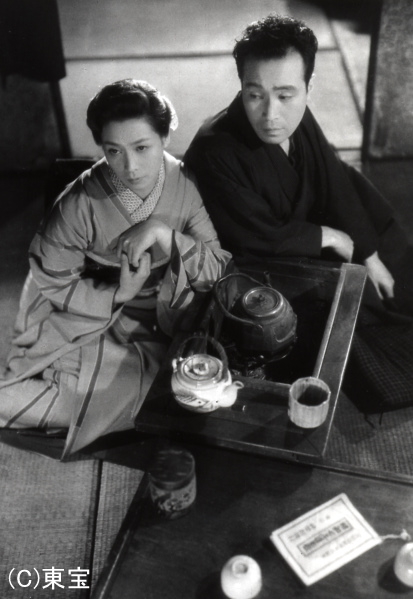
1951’s Ginza Cosmetics (銀座化粧, Ginza Kesho) is often said to mark a kind of rebirth in the career of director Mikio Naruse whose output in the 1940s was perhaps unfairly denigrated not least by Naruse himself. As in much of his golden age work and in anticipation of When a Woman Ascends the Stairs, Ginza’s heroine is a resilient bar hostess whose brief hopes of escape through romance are doomed to failure, but it’s also, like the slightly later Tokyo Profile (Hiroshi Shimizu, 1953) and Tales of Ginza (Yuzo Kawashima, 1955) an ode to the upscale district and all the defeated hopes of its illusionary glitz and glamour. 

Yukiko (Kinuyo Tanaka), the heroine, is a single-mother approaching middle age and working as a hostess in a Ginza bar. Her landlady who runs a nagauta school on the ground floor and constantly complains about her feckless though goodnatured unemployed husband seems to think she could do better, pointing out that she is an educated woman who seems slightly out of place in the rundown backstreets of this otherwise aspirational area. Even for educated women, however, there may not be many other opportunities in the straitened and socially conservative post-war economy especially for those without connections, and Yukiko also needs to provide for her young son Haruo (Yoshihiro Nishikubo), born out of wedlock after an affair with a customer with whom she had fallen in love but abandoned her when she became pregnant. 

As a slightly older woman who has been working at the Bel Ami bar for many years, seemingly from war to occupation, Yukiko is both looked up to by the younger women and resented as a stern older sister who does not approve of the way some of them ply their trade. She’s taken one, Kyoko (Kyoko Kagawa), who often babysits for her, under her wing, cautioning her against making the same mistakes that she once made in taking the kinds of men that come into the bar at their word. “Men are all animals” she warns her, supporting her desire not to give in to her parents’ attempts to arrange for her not a marriage but a “position” as a mistress. Unlike Yukiko, Kyoko still has hope of leaving the Ginza bar world behind to become a respectable wife even if those hopes are fading with the relative unlikelihood of finding a “good” man with a salary good enough to support a wife who is not already married and can be understanding of her bar girl past. 

The bar world may be on the fringes of the sex trade, but the bar girls are not necessarily sex workers even if some of the younger women are clearly engaging in the kinds of casual sex work of which Yukiko clearly disapproves even while not against consensual romantic liaisons. For her own part, she finds herself in the awkward situation of a continuing non-relationship with a failed businessman, Fujimura (Masao Mishima), who was fairly wealthy during the war but apparently no longer. Yukiko attributes this to him being in someway too good to prosper, though having money in the war which disappeared afterwards perhaps implies the opposite. She does not love him and seems to find his presence a little irritating, but feels indebted because he stood by her when she was pregnant and alone. In any case, he has a wife (whom he apparently resents) and children (whom he claims to adore) and so she feels at best conflicted, especially as the tables have turned and it’s him now constantly asking her for money. Money is not something Yukiko has a lot of, but she isn’t mean and often consents to losing it with a resigned shrug as she does by taking on Kyoko’s bar debt after a customer runs out on the bill and then tricks Yukiko into buying more drinks while waiting for a “friend” to arrive. 

Men, it seems, will always be predatory and unreliable. On hearing from her boss and longtime friend that the bar is in trouble and may have to close, Yukiko ends up acting on an introduction from an acquaintance, Shizue (Ranko Hanai), to meet a “stingy” industrialist who had expressed an interest in her. Shizue has escaped the bar world by becoming a wealthy man’s mistress and with it has claimed a kind of independence. He splits his time between Tokyo and Osaka, leaving her free to do whatever she likes (including meeting other men) for most of her time with none of the strings that go with being a wife. Yukiko is perhaps too “pure” for that kind of arrangement, hinting at the Ginza paradox that only those who learn to accept a certain level of complicity can ever truly be happy there. She agrees to meet Kanno (Eijiro Tono), the businessman, in order to ask him to “invest” in the bar, suggesting they talk things over in a coffeeshop while he tries to pull her into various shady establishments before pushing her into a warehouse and attempting to rape her to get his money’s worth. Yukiko escapes and resolves not to see him again. After all, the point of getting the money to keep the bar open was precisely to avoid having to make arrangements with men like Kanno. 

It’s Shizue, however, who later gives her a last shot at escape when she introduces her to her “true love”, Ishikawa (Yuji Hori), making a brief trip into the city. Shizue can’t entertain him herself because her patron is in town and so entrusts him to Yukiko with the strict instruction not to try it on. Despite herself, however, Yukiko becomes fond of him, reassuming something of a past persona in engaging in intellectual conversation, once again an educated, middle-class woman rather than a bar hostess used to telling men what they want to hear. She has been warned, however, that Ishikawa hates anything “low culture” which is why Shizue has told him they are both war widows and discovers that he has a strong dislike for Ginza which sees him longing for the wholesome charms of home. 

The crisis occurs when Yukiko has to break a promise to Haruo to take him to the zoo in order to look after Ishikawa, causing him to go temporarily missing when he wanders off on his own roaming all over the endless construction site of the contemporary city standing in for the makeshift, in-progress reconstruction of the post-war society. She perhaps feels she’s being punished for choosing to disappoint her son in order to pursue a dream of romantic escape she might also feel is somehow undeserved, but pays in quite a different way after accidentally setting Ishikawa up with Kyoko whom she introduced as her “sister”. Originally angry and resentful, proclaiming herself disappointed with Kyoko in assuming she is the same as the other young women at the bar, Yukiko’s good nature eventually wins out as she realises that Kyoko and Ishikawa seem to have fallen in love in a single night. She has told him everything, and he apparently wants to marry her anyway. Kyoko, at least, is getting out, and Yukiko can be happy about that while privately internalising defeat. Acknowledging that Haruo is the only one on whom she can depend, she resolves to live on as a mother only, trapped in the deceptive diminishing returns of a Ginza bar life even while knowing it has increasingly little place for her.  


Marital Relations (夫婦善哉, AKA Meoto Zenzai, Shiro Toyoda, 1955)

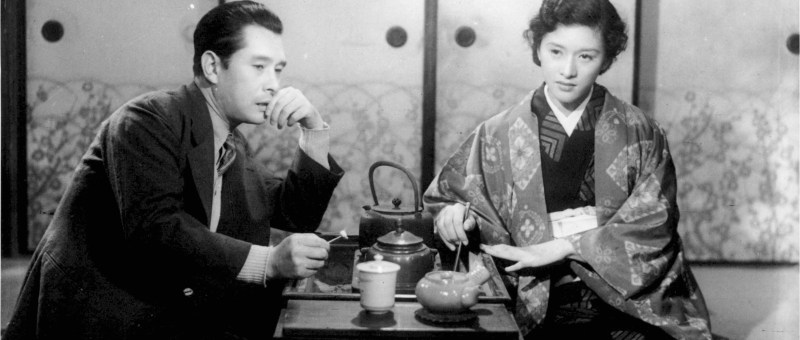
Marriage is not always simple, but when you aren’t actually married (and one of you is technically still married to someone else) the difficulties can be all the more pronounced. Often neglected in comparison with some of his contemporaries, Shiro Toyoda is best remembered for his often humorous literary adaptations. Marital Relations (夫婦善哉 Meoto Zenzai), based on a 1940 novel by Sakunosuke Oda and runner up to Naruse’s Floating Clouds in Kinema Junpo’s top ten for 1955, is a prime example of his style as it examines the unconventional relationship between a spoilt younger son of a wealthy family and a feisty geisha who nevertheless remains devoted to him despite his often insensitive treatment.

In the early 1930s, the oldest son of a wealthy family has scandalised his conservative father by continuing to consort with a local geisha. Irritated, Ryukichi (Hisaya Morishige) elopes with Choko (Chikage Awashima) assuming that he will eventually get his own way only to find his father is just as stubborn as he is. Ryukichi is already married though living apart from his wife who has a serious illness and has returned to her family with their only child, Mitsuko. Nevertheless, Choko and Ryukichi manage to live together as man and wife even without the official paperwork, installing themselves at her parents’ tempura shop. Though the couple are happy enough, Ryukichi is unused to living without his family money and Choko soon has to go back to work.

Even in early Showa things were changing. Ryukichi, spoilt and made useless by access to his family fortune and previously secure path to succession, pouts and whines about his arranged marriage and the wife he’s abandoned, emphatically demanding a free choice of mate even if she happens to have been a geisha. Choko, a working class daughter of shopkeepers, seems to have been sold to the geisha house to fund her parents’ store – in fact, Choko’s abrupt decision to leave the geisha house will also have financial consequences which Ryukichi claims he will take up with his father. Even if Choko were not a geisha, she would likely not have been accepted by the traditional upper middle class family and her constant battle is always for recognition as Ryukichi’s significant other (or perhaps primary carer). Geisha she was though, and will be again thanks to Ryukichi’s recklessness and mistaken assumption that he will regain his former status simply by being his father’s son.

Not having had the luxury of a wealthy upbringing, Choko is (financially, at least) a realist and prepared to work hard for what she wants. Heading back into the geisha world as a hostess and entertainer, Choko is the sole breadwinner of their technically illegitimate union though Ryukichi cannot entirely break with his former habits, casually burning Choko’s carefully balanced housekeeping accounts book, and eventually spending all her savings on a night of debauchery. Nevertheless, it’s Choko who eventually takes the initiative and goes into business with a friend opening a successful night spot which cleverly caters to her internationalist clientele with a “traditionally Japanese” theme. Like many of Toyoda’s women, Choko is a hardworking, practical lady determined to make a success of everything she does even if she’s had the misfortune to find herself shackled to the inconvenient man child that is Ryukichi.

Eventually it all gets too much and Choko takes a drastic decision after receiving a cruel and thoughtless slight from Ryukichi’s brother-in-law who has been adopted as the heir to the family. This shocking incident aside, the tone is largely one of comic knowingness as Ryukichi continues with his various schemes to wheedle his way back into his elite social circle while Choko spends her time working hard to create something new. Ryukichi is the worst of the old world – lazy, entitled, often selfish and thoughtless (if well meaning and resolutely devoted to Choko), whereas Choko is the best of the new – resilient, hardworking, honest and kind. Towards the end, having settled some of their differences, Choko and Ryukichi appear to have cemented their coupledom for good but are suddenly confronted with another ugly aspect of class legacy when a former servant (and sort of friend) of Ryukichi’s passes them in the street now obviously raised in status, and blanks them even as they call out to him.

Ryukichi’s sister comments at one point that her brother’s personality has been warped by his strict upbringing and the pressure to conform to social conventions has meant that he doesn’t quite know himself, though at heart he is good and kind. She may indeed have a point, honest in his love, at least, both for his daughter and for Choko, Ryukichi finds he lacks the moral compass which comes with needing to live in an interconnected society rather than the deference associated with being “the young master”. Subtle political commentary aside, Marital Relations is a wry, humorous look at an unconventional family life as its put upon heroine does her best to rescue her consistently disappointing (if often amusing) unofficial spouse.