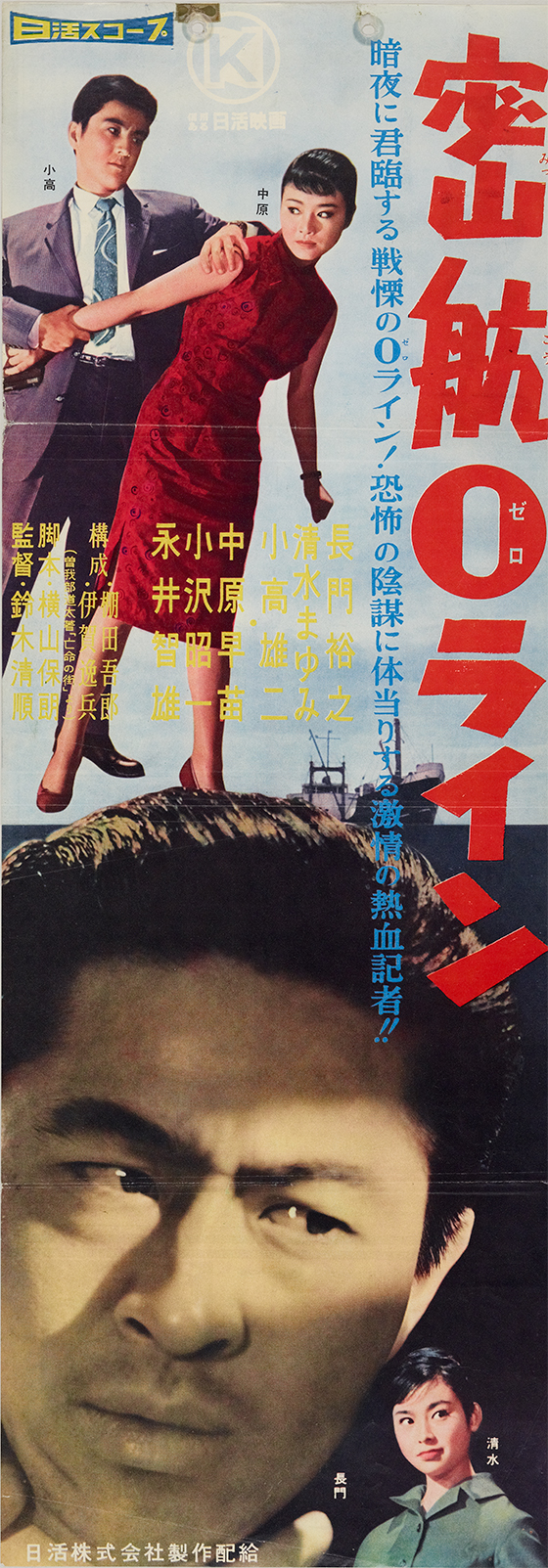
Smashing the 0-Line (密航0ライン, Seijun Suzuki, 1960)

(C) Nikkatsu 1960

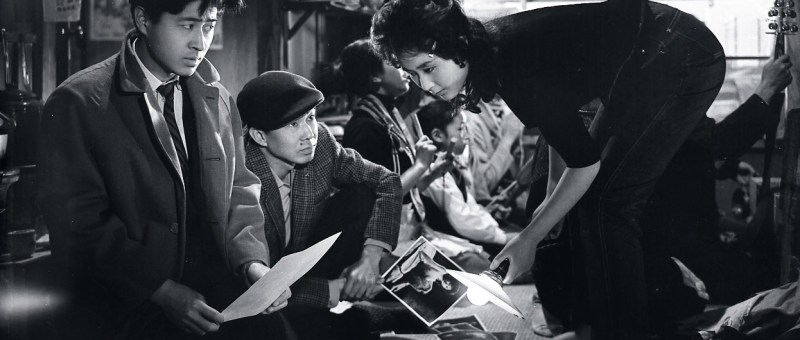
(C) Nikkatsu 1960Looking from the outside in, the Tokyo of 1960 seems to have been one of rising economic prosperity in which post-war anxiety was beginning to transition into a relentless surge towards modernity, but there also seems to have been a mild preoccupation with the various dangers that same modernity might present. Like The Sleeping Beast Within released just two months previously, Smashing the 0-Line (密航0ライン, Mikko Zero Line) centres on a mystery which leads straight back to Hong Kong and a dangerous, international smuggling ring – this time involving both drugs and people. Our heroes are both reporters, but at odds with each other despite being old friends in having diametrically opposed notions of professional ethics.

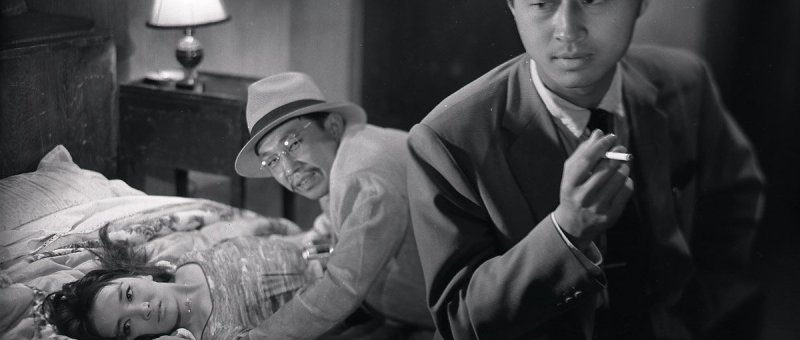
Katori (Hiroyuki Nagato), our anti-hero, is a man so desperate to get a scoop that he thinks little of engineering one. Thus we witness him making passionate love to a woman one minute before turning her into the police the next. The woman, Reiko (Sanae Nakahara), is also the little sister of one of his oldest friends, Saiko (Ryohei Uchida), whom he also decides to turn into the police in service of his story. Another old friend, Nishina (Yuji Kodaka), has also become a reporter but for a more respectable paper and is dating Katori’s little sister, Sumiko (Mayumi Shimizu), who is now the announcer at the local baseball stadium. Katori’s decision to turn on Reiko will have profoundly negative consequences for her former lover who is prepared to sacrifice all in pursuit of his goal.

Three men, once college friends, have chosen three radically different paths in the post-war world. Saiko has become a gangster while Katori has become an unscrupulous yet apparently publicly minded newshound and Nishina a pure hearted journalist who insists on doing everything by the book and abiding by conventional journalistic ethics. Yet despite himself, or possibly because of his love for Sumiko, Nishina tries to help Katori see the dangers of his extremely dangerous pattern of behaviour in which he has been content to use people like things to get what he wants.

Katori claims to be on the same side as Nishina – he thinks something is going sour in the city and that only he can stop it by exposing the various conspiracies in play. Katori’s chief fear is that Tokyo will become “another Hong Kong” – a crime ridden state of drug addled lawlessness (an extremely biased and seemingly inaccurate view of ‘60s Hong Kong but one that speaks of a certain fear of Japan’s new spot on the global scene). This particular conspiracy does indeed ping back to Hong Kong and the illegal traffic of drugs but also people heading in both directions. In the Japan of 1960, it was near impossible to get a passport and so smuggling yourself out might be the only way if you really need to get to Hong Kong which means you’ll need to pay a people trafficker to do it.

Katori, broadly, seems to think people trafficking is a bad thing he doesn’t want in Japan but is entirely blind to the same ways he himself uses people in pursuit of his goals. Not only does he bed Reiko (his friend’s little sister) only to make a speedy exit minutes before the police arrive, but he also palms off another mark on his informant only to turn them both in in hope of greater gain. He even manages to find time to seduce a doctor at the centre of the scandal who tries to pull a gun on him but later surrenders completely, only to fall victim to some proactive tidying up from the bad guys. Not content with sacrificing former lovers, Katori will not give in even for his sister, refusing to give up on his lead even when Sumiko is threatened with gang rape. When Nishina turns up and saves the day, Katori doesn’t even stop to ask how Sumiko is but walks off in the direction of the story with nary a second glance to his unconscious sister.

Yet Katori’s particular brand of nihilistic heroism consistently fails. His scoops are uninteresting and he only gets them by inserting himself into the story. Nishina, steadfast and honest – he even goes to the trouble of getting a proper passport to hide on his person in case he’s caught pretending to be a stowaway, is the one who gets there in the end, breaking the smuggling ring, rescuing Katori after he gets himself in trouble, and generally always being around to save the day. Mildly ironic themes of xenophobia aside, Smashing the 0-Line is a typically frenetic piece from Suzuki which offers only a few instances of unusual experimentation in his use of freeze frames and onscreen text but packs in plenty of punch in its amoral anti-hero and the dogged investigative reporter trailing along behind.


Available as part of Arrow’s Seijun Suzuki: The Early Years Vol. 2 Border Crossings box set (also features incisive audio commentary from Jasper Sharp providing a wealth of background information not just about Suzuki’s career but the state of the Japanese film industry at the time)

The Sleeping Beast Within (けものの眠り, Seijun Suzuki, 1960)

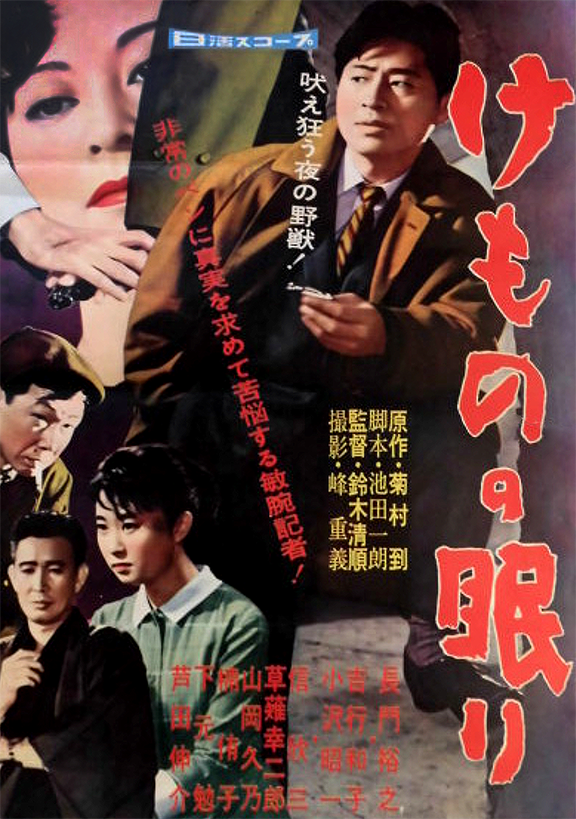
Sleeping Beast Within posterTo those of a “traditional” mindset, a woman’s career is her home and she never gets to retire. Men, by this same logic, are killed off at 60 and reborn into a second childhood where they get to indulge their love of fly fishing or suddenly discover an untapped talent for haiku. Seeing as a man often lives at the office, being excommunicated from his corporate family can seem like a heavy penalty for those who’ve devoted their entire existence to the salaryman ideal. So it is for the old timer at the centre of Seijun Suzuki’s 1960 mystery thriller, The Sleeping Beast Within (けものの眠り, Kemono no Nemuri) in which the sudden disappearance of a model employee sparks his daughter and her dogged reporter boyfriend to investigate, unwittingly discovering a vast drug smuggling conspiracy headed by a dodgy cult leader.

Veteran salaryman Junpei Ueki (Shinsuke Ashida) has been working in Hong Kong for two years and is finally coming home, to retire. His family have come to meet him but, as his daughter’s reporter boyfriend Kasai (Hiroyuki Nagato) points out, no one much else has turned up – so it is for those who don’t play office politics, claims one of the few colleagues who has arrived to greet the recently returned businessman. Ueki isn’t very happy about his retirement and believes he’ll be getting a part-time job at the same company only to be informed position has been “withdrawn”. When he doesn’t come home after his retirement party, something surely out of character for such a straight shooting family man, his wife and daughter become worried. Keiko (Kazuko Yoshiyuki) enlists Kasai to help figure out what’s happened to her dad only for him to suddenly turn up with a bad excuse and an almost total personality transplant. Kasai keeps digging, and the reporter in him loves what he finds even if the nice boyfriend wishes he didn’t.

Suzuki sets up what a good guy Ueki is when he brings back a modest ring for Keiko only for her to mockingly ask if her dad couldn’t have brought something a bit flashier. Ueki points out that the customs people might not have liked that so she jokes that he should have just smuggled it in like everyone else. Kasai reminds her that her dad’s not that kind of man, but two years in Hong Kong have apparently changed him. Having spent two years away from his family and 30 years slaving away at a boring desk job, Ueki feels he’s owed something more than an unceremonious kiss off and a little more time for gardening. The reason he ended up entering the world of crime wasn’t the money, or that he was blackmailed – it started because of his sense of integrity. He felt he owed someone and he did them a favour. It went wrong and he ended up here. His decision to join the gang came after he tried to “pay back” the money for some missing drugs only to realise that his entire retirement plan was worth only a tiny fraction of his new debt. Ueki felt small and stupid, like a man who’d wasted his life playing the mugs game. He wanted some payback, but his life as criminal mastermind turned out not to be much of a success either.

Trying to explain her father’s actions to the wounded Keiko, Kasai explains that everyone has a sleeping beast in their heart which is capable doing terrible things when it awakens. Ueki’s sleeping beast was woken by his resentment and sense of betrayal in being so cruelly cast aside by the system to which he’d devoted his life while the guys who broke all the rules – drug dealers, gangsters, and corrupt businessmen, lived the high life. One could almost argue that a sleeping beast is stirring in Kasai’s heart as he pushes his investigation to the limit, occasionally forgetting about the harm it will do to Keiko even whilst acknowledging the greater good of breaking the smuggling ring once and for all. Keiko too finds herself torn, confused and heartbroken by the change in her father’s personality though her mother feels quite differently.  Claiming that “a woman has no say in her husband’s work”, Keiko’s mum tells her daughter that a wife’s duty is to do as her husband says and avoid asking questions. Keiko has asked a lot of questions already and shows no signs of stopping now, even once she realises she won’t like the answers.

Despite the grimness of the underlying tenet that it doesn’t take much for honest men to abandon their sense of morality, Suzuki maintains his trademark wryness as Kasai and Keiko go about their investigation like a pair of pesky kids chasing a cartoon villain. Though the tale is straightforward enough, he does throw in a decent amount of experimentation with two innovative flashback sequences in which the flashback itself is presented as a superimposition with the person narrating it hovering at edges as if referring to a slide. The beast is quelled with a shot to the heart, but not before it wreaks havoc on the lives of ordinary people – not least Ueki himself who is forced to confront what it is he’s become and who he was prepared to sacrifice to feed the hungry demon inside him.


Available as part of Arrow’s Seijun Suzuki: The Early Years Vol. 2 Border Crossings box set.

Eight Hours of Terror (8時間の恐怖, Seijun Suzuki, 1957)

(C) Nikkatsu 1957

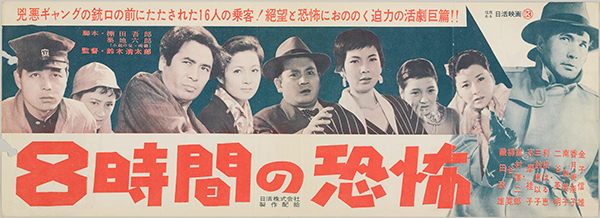
Eight Hours of Terror poster 2Mr. Thank You meets The Lady Vanishes? Seijun Suzuki’s early slice of claustrophobic social drama Eight Hours of Terror (8時間の恐怖, Hachijikan no Kyofu) is another worthy example Japanese cinema’s strange obsession with buses, transposing John Ford’s Stagecoach to the Japanese mountains as a disparate collection of travellers is forced onto a perilous overnight journey in the hope of making their city-bound connection. Shooting in academy ratio and with a mix of studio shot interior action and on location footage, Suzuki keeps the tension high but maintains his detached sense of humour, finding the comedy in the petty prejudices and selfish preoccupations which take hold when civilisation is abandoned and bandits run free.

When a typhoon causes a landslide and halts the trains, the anxious travellers in a small mountain town are left with the choice of waiting until the tracks are clear or piling into a rundown rail replacement service and driving through the mountains overnight to meet their Tokyo-bound connection set to leave at midday. They are warned that there has recently been a bank robbery and the police have issued a general alert for loose bandits. Those whose journey is not “urgent” might do better to wait, but the bus is the only solution for anyone wanting to get back to the city in good time.

Tense as Hitchcock’s Lifeboat, the bus journey throws together a group of people who would never normally keep company with each other and largely have no interest in bonding in their shared hardship. Businessmen moan endlessly about potentially missed meetings while student radicals ironically mirror them, giving mini lectures on leftwing politics to a disinterested audience and trying to raise rousing choruses of Russian folk songs to lift the spirits of the masses. Meanwhile, a suicidal mother with a young baby sadly bides her time, a pan pan makes the best of a bad situation, an elderly couple frets anxiously about making it back to the city to see their seriously ill daughter, and a policeman escorts a man arrested for the murder of his former wife and her new husband.

The spectre of the war haunts them all – almost like a fare-dodging stowaway concealed somewhere on the back of the bus. The driver lost his son and grandchildren in Manchuria, the nervous lingerie salesman claims to have led a motorised brigade but is constantly terrified by every little set back, and the convict turns out to be a former army doctor battling some kind of post-traumatic stress disorder coupled with intense rage and regret for his post-war fate. The student radicals regard the presence of the bandits as a symptom of social breakdown (a narrative they can get behind in the general failures of capitalism) while the fat cat CEO and his ridiculously bejewelled wife angrily bark at the young men who can’t find work in the struggling post-war economy, attributing their economic difficulties to pure laziness and failure to slot into to the demands of a conformist society.

The twin dramas revolve around the intertwined fates of the young woman and her baby, and the bank robbers who eventually turn up and hijack the bus. Despite a need to pull together in the face of adversity, many of the passengers are content to ignore the pain and suffering of those around them in order to achieve their own selfish goals. The lingerie salesman, panicked by the delay, attempts to drive the bus over a rickety bridge the driver is currently checking for safety at the risk of everyone’s lives. Meanwhile the woman and her baby are missing. Later found seriously ill, the woman recovers but the baby struggles. The pan pan, who becomes the de facto leader of group, suggests getting the convict, a former doctor, to treat the baby but not everyone is happy about uncuffing a potential killer even if it means life and death for an innocent child. Similarly, after the pan pan helps to despatch one of the hijackers, many of the passengers want to drive off and leave her behind with only the convict eventually coming to her rescue. Despite all she’d done for them, the passengers reject her once again when directly confronted by the taboo nature of her work as a prostitute at the American bases after someone steals her purse and finds a picture of a black GI inside the fold.

The world outside the bus is changing. The pan pan fears for her future now the occupation is coming to an end, as do some of the young men who’d relied on the presence of the American troops for their employment. The CEOs and lingerie salesmen of the world are content to remain within their own bubbles, ignoring everyone else they protect their elitist status while the idealistic student activists are perhaps no better – they too want to take the hijackers’ ill gotten gains and repurpose them for social good by getting more leftists elected to parliament. The convict and the pan pan are the kindest and the most human, finding an unexpected bond in their shared humanism while the aspiring actress finds joy in treating everything like a fantastic adventure only to give up on her dreams of stardom after realising she’d be forced to kiss a bunch of guys she didn’t like in order to achieve them.

Mixing studio shot rear projection and location shooting of the bus making its precarious journey along winding mountain roads, Suzuki keeps the tension high as the passengers bicker and bond, eventually banding together despite themselves in order to despatch the final bandit who finally takes care of himself. Things do, however, end by going back to normal. Crisis averted, the same old prejudices return as soon as “civilisation” reappears on the horizon. 


Available as part of Arrow’s Seijun Suzuki: The Early Years Vol. 2 Border Crossings box set.

A Mummy’s Love (木乃伊の恋, Seijun Suzuki, 1973)

vlcsnap-2018-05-28-23h20m55s542After getting fired from Nikkatsu for making films which made no sense and no money, Seijun Suzuki cemented his place as a thorn in the side of the establishment by suing them for breach of contract. The “dispute” dragged on, eventually seeing him blacklisted by the other major studios and unable to make a feature film for ten years. This did not mean however that Suzuki was entirely idle between the releases of Branded to Kill and his 1977 “comeback” movie A Tale of Sorrow and Sadness. Like many other directors who found themselves adrift in the changing film industry, Suzuki busied himself with short projects for television, both commercials and stand alone episodes of anthology series including one for Eiji Tsuburaya’s Twilight Zone-esque Horror Theater Unbalance.

Horror Theater Unbalance, produced by Tsuburaya Pro, was in keeping with the studio’s other similarly themed horror and science fiction SFX series but took the form of 13 one off one hour dramas. Although production began in earnest in 1969, filming didn’t finish until 1972 and the series eventually aired in 1973. Many of the episodes were inspired by well known mystery stories and each also featured a framing sequence in which author/actor/TV personality (and later politician) Yukio Aoshima introduced and then wrapped up the tale à la Alfred Hitchcock, Rod Serling, or perhaps Cookie Monster whilst sitting in a creepy mansion filled with weird skeletal objet d’art. Tsuburaya Pro was able to mop up some prime Nikkatsu talent which was gradually seeping out of the studio as it crept towards its eventual rebirth as the producer of Nikkatsu Roman Porno. This included not only Suzuki but also Yasuharu Hasebe and Toshiya Fujita among others, as well as outlying figures from the independent world such as Kazuo Kuroki.

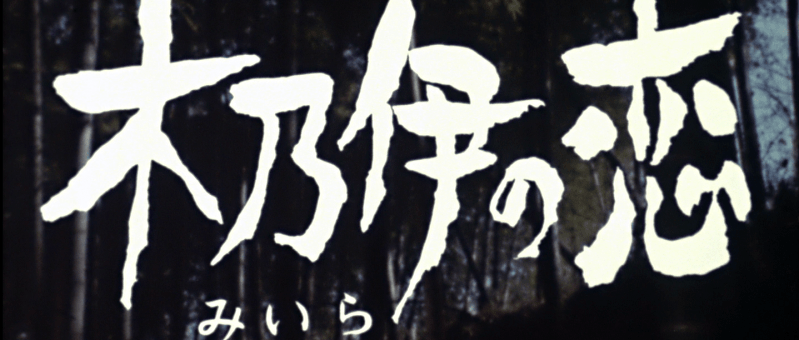
The first to be broadcast, Suzuki’s episode was adapted from a short story by Fumiko Enchi whose recurrent themes share much with those of the director in her frequent use of fantasy and eroticism. A Mummy’s Love (木乃伊の恋, Miira no Koi) is technically a triple tale as it contains an internal framing sequence in addition to the broader one common to the series. The lead is actually Shoko (Misako Watanabe) – a widowed middle-aged editor working with her now elderly professor on a new version of a classic tale from Japanese literature. Her memory is sparked when she catches sight of an oddly vacant-looking monk in the back of a car – eerily like the one in the story which revolves around the discovery of a monk who was buried alive as way of achieving enlightenment but has recently (or perhaps not) begun ringing his bell to alert those above to his conscious presence.

One of the villagers, Shoji, becomes fascinated with the idea of the unsleeping monk. When they dig up the corpse it’s a stiff, strangely robust skeleton which some of the villagers end up using for a game of punt the monk, but little by little his flesh returns. He is not, however, as enlightened as one might hope. To begin with he’s a gibbering wreck, and then finally something more like a crazed sex pest whose pent up amorous energy eventually wears out his new “wife” in a matter of days when she suddenly gives “birth” to a small army of mini dust buddhas. Shoji is sick of the monk and wants to get rid of him, but when he takes his own wife sometime later all he can hear is the sound of a little tinkling bell and suddenly he can’t bear to touch her.

The theme seems to be that unquenched desire will drive you insane with the ambiguous addition that desire itself is best overcome rather than satisfied. Having recounted to us the story of the monk, Shoko finds his tale echoing in her own life. A war widow she lost her husband young and has experienced near constant sexual harassment from her former professor, now bedridden and defeated. Unbeknownst to her, the professor has been keeping her engagement photo in his study for the last decade. He claims that it’s not impossible for an ordinary many to resurrect himself solely through the power of enduring sexual desire, rightly (but somewhat inappropriately) implying that Shoko too harbours lingering desires which have gone unsatisfied since her husband’s passing.

The story culminates with Shoko’s pleading hope for a resurrection as she unwittingly arrives at the place of her husband’s death where she encounters a strange man who might or might not be her late spouse. Making either real or hallucinatory love atop a grave with either a resurrected corpse, a ghost, a phantom of memory, out of body spirit, or just a random rough man talking shelter from the rain, Shoko is a prisoner of her desires but the source of her visitation remains difficult to discern.

Working within a TV budget, Suzuki reins himself in but lends his idiosyncratic sense of ironic fun to an otherwise gloomy, dread-laden tale as the villagers gleefully kick around the dried corpse of the old monk as if he were a long buried football and then seem to meet an unquiet knowingness in his ever hungry eyes. Peppered with surrealist touches, Suzuki’s contribution to Horror Theater Unbalance is a heady affair but one imbued with his characteristic twinned sense of irony and wistful melancholy in a tale of those undone by unresolved longing.


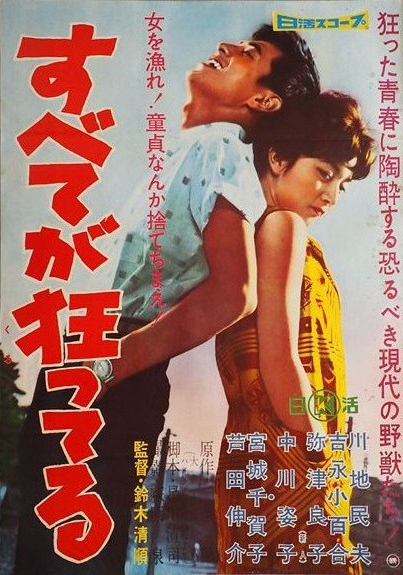
Everything Goes Wrong (すべてが狂ってる, Seijun Suzuki, 1960)

Everything goes wrong posterThe Tokyo of 1960 was one defined by unrest as the biggest protests in history filled the streets urging the government to rethink the renewal of the security treaty Japan had signed with America after the war in order to provide military support in the absence of a standing army. Yet the protests themselves are perhaps an indication of the extent to which the nation was already recovering. With the Olympics just four years away, post-war privation had been replaced by a rapidly expanding economy, dynamic global outlook, and increased possibilities for the young who enjoyed both greater personal freedom than their parents’ generation and a kind of optimism unthinkable merely ten years previously. Nevertheless, this sense of the new, of unchecked potential was itself disorientating and had, as some saw it, led to a moral decline in which youth aimlessly idled its time away on self indulgent pleasures – namely drink, drugs, promiscuous sex and American jazz.

This dark side of youth had become a talking point thanks to a series of notorious “Sun Tribe” movies produced by the youth-orientated Nikkatsu studios. The films were so controversial the studio was eventually forced to stop making them, but all they really did was tone down the shock factor to one of mild outrage. Seijun Suzuki, picking up the Sun Tribe mantle, goes further than most in Everything Goes Wrong (すべてが狂ってる, Subete ga Kurutteru), painting post-war malaise as a tragedy of generational disconnection as the chastened wartime generation, accepting their role in history, watch their children hurtle headlong down another alleyway of self destruction but are ultimately unable to save them.

Our “hero”, Jiro (Tamio Kawaji), is as someone later poignantly puts it, “a nice boy”. A student, he spends his spare time on the fringes of gang of petty delinquents who get their kicks freaking squares, engaging in acts of casual prostitution, and enacting non-violent muggings. Jiro’s main problem in life is his fierce attachment to his single-mother, Masayo (Tomoko Naraoka). After Jiro’s father was killed in the war (apparently run over by a Japanese tank), Masayo became involved with a married man who has been supporting herself and Jiro for the last ten years. Young enough to have an almost completely black and white approach to moral justice, Jiro cannot stomach this fact and accuses his mother of being a virtual prostitute, accepting money for sex without love.

Jiro repeatedly accuses the older generation of hypocrisy, that they lie about their true feelings and motivations whilst denying their responsibility for the war which took his father’s life. Yet, Nambara (Shinsuke Ashida), his mother’s lover, is a kind and honest man who answers every question put to him honestly and with fierce moral integrity. He admits his responsibility for the folly of war – something he feels keenly seeing as he is a weapons engineer by trade, but rejects Jiro’s characterisation of his relationship with Masayo as something essentially immoral. His justifications are perhaps, as Jiro puts it, “philanderer’s clichés”, but that doesn’t mean they aren’t true. Nambara, as a young man, entered into an arranged marriage with the daughter of a now deceased general. The marriage is loveless and emotionally dead, but Nambara is an earnest person and will honour the commitment he made to his first wife even if it brings him personal pain. Masayo has always known this and even if he cannot legally marry her, Nambara has given her his heart and will also honour that commitment in continuing to try and make her son see that he is not the enemy, just another man who loves his mother.

There is something quite ironic in Jiro’s strangely conservative moral universe which rejects the “impure” nature of his mother’s romance, while the older generation are better positioned to understand that things are never as simple as they seem. Jiro is rigid and unforgiving where his parents are flexible and empathetic. He rejects his mother for being a “whore” but throws money at a girl who is in love with him because he thinks that’s what women “want”. Unable to accept her emotional needs, he thinks of her as a prostitute and thereby abnegates his responsibility – the exact opposite of the “goodness” Nambara displays in offering financial support for a woman he loves which (in his eyes) has no particular strings and is given only with the intention of making her life easier.

Jiro, infected both by mother and madonna/whore complexes, is profoundly disturbed when another young woman tries to point out that aside from being his mother Masayo is also a woman with normal human needs both emotional and physical. Following his botched attempt to blacken Nambara in her eyes, he drags his mother to a breezy youth fuelled beach party where he throws her into a tent full of lithe young male bodies and tells her to have her fill. Nambara, still determined to talk Jiro around, laments to Masayo that they never had the opportunity to experience the kind of freedom that these youngsters feel themselves entitled to. If only they were not so trapped by the social codes of their era, they might have been happy. Yet these youngsters, with everything in front of them, are anything but – determined to destroy themselves in nihilistic confusion, caught in a moment of flux when nothing is certain and everything is possible.

At the film’s conclusion, a cynical journalist remarks to a sympathetic mama-san that “today, goodwill between people can’t exist anywhere, everything has gone wrong”. Jiro’s tragic fate is that he, like many “nice” kids like him, cannot reconcile himself to the moral greyness of the post-war world in which the “heroic sacrifice” of their parents’ is hypocritically held up as wholesome entertainment. Unable to accept the love and kindness of Nambara who only wants to act as a father to him and continues to believe that “one day he will understand” even after Jiro has hurt him deeply both emotionally and physically, Jiro has only one direction in which to turn.

Suzuki weaves Jiro’s tale around that of his friends – the unhappy delinquents and the struggling workers, women used by men who promise them love but reject their responsibilities, women who think they have to trade something to win love which ought to be freely given, and the older generation who can do nothing more than look on with sadness as youth destroys itself. Suzuki’s sympathies lie with everyone, but more than most with the Nambaras of the world who are desperately trying to fix what was broken but find that in a world that’s already gone crazy kindness is met with suspicion while money, corrupting true emotional connection, has become the only arbiter of bitter truths.


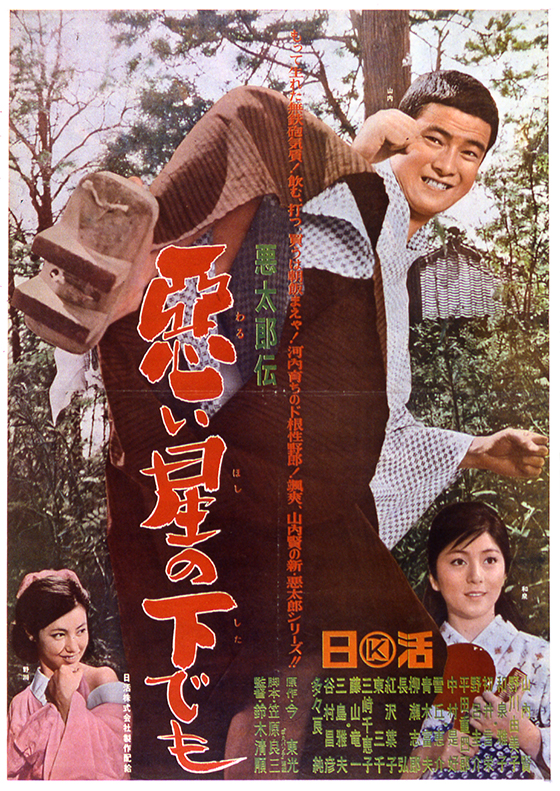
Born Under Crossed Stars (悪太郎伝 悪い星の下でも, Seijun Suzuki, 1965)

Born Under Crossed Stars posterFollowing his 1963 breakthrough, The Incorrigible, Seijun Suzuki returns to the work of Toko Kon for another tale of rural adolescent confusion in Born Under Crossed Stars (悪太郎伝 悪い星の下でも, Akutaro-den: Warui Hoshi no Shita demo). The Japanese title ties the film more closely to the earlier Kon adaptation by adding the preface “Stories of Bastards”, and once again stars Ken Yamauchi and Masako Izumi in leading roles though this time the setting is early Showa, swapping the promise and openness of Taisho for the rapidly closing doors of militarism. Much more obviously comedic than The Incorrigible, Born Under Crossed Stars is another anarchic coming of age tale in which an “incorrigible” youngster learns to find himself but is neatly undercut by the times in which he lives, his final triumph both a victory and a symbol of incoming tragedy.

Farmboy Jukichi (Ken Yamauchi) dreams of a way out of his lowly Osakan roots by getting into a prestigious local school, though his drunken father hardly sees the point of education and would prefer his son go out and earn some money. Jukichi is earning quite a bit working as a milkman for a local “cowboy” dairy farmer who’s recently returned from America but his sights are firmly set on university and a move into the city. Meanwhile, he experiences some personal turbulence thanks to his old friend, Yoshio (Jushiro Hirata). Yoshio gets himself into trouble with the Public Morals committee at school when he’s spotted out with a young lady – something which is against school regulations, but that’s not why he was stopped. Another boy, Oka (Keisuke Noro), wrote a letter to the girl Yoshio was with (who happens to be his cousin) but was rejected. Oka is abusing his position for personal point scoring. Jukichi can’t let it go and takes Oka to task, but his actions have serious repercussions when the humiliated Oka suddenly quits the school altogether.

Jukichi thinks Oka’s actions are very “manly”. Manliness is certainly something important to the boys at the school which has a noticeably militarist song along with various rituals involving fire and taiko drums, not to mention the shiny cap badges and weapons drills they seem to perform. As in Fighting Elegy released the following year, “manliness” precludes fraternising with women – sex has been placed off limits as the ultimate frivolity and a kind of theft of the zest of life which should be going towards more “productive” causes. Jukichi however, like The Incorrigible’s Konno has a taste for the ladies even if he reacts somewhat harshly to discovering Yoshio in flagrante with a girl in a park which turns out to be some kind of mass makeout spot behind a shrine. Uncovering the hypocrisy in his friend sets the two at odds and eventually turns them into enemies with disastrous consequences.     

Jukichi finds himself caught between two lovers – the elegant, shy sister of Yoshio, Suzuko (Masako Izumi), and the liberated, provocative Taneko (Yumiko Nogawa). Though resistant, Jukichi eventually succumbs to seduction and forever ruins his dreams in the process. Overcome with youthful frustrations, he channels his need for justice in a dangerous and destructive direction when he decides to start something with a bunch of local gangsters in a misguided attempt to avenge a wrong done to the father that has never supported him. Later seeing off an attack from the gangsters (tipped off by a remorseful Yoshio) Jukichi seals his fate, gives up on the “decent” life promised by a place at the prestigious middle school and commits himself to wandering, taking to the sea as one of many young men raised on nationalist myths finding their place in the military.

Another programme picture, Born Under Crossed Stars provides ample opportunity for Suzuki to embrace his taste for the strange – notably in his milk patter opening with its literal baby monkey, but also finding room for beetles on strings, “poisoned” manju buns, and illusionary visions. Sticking mainly to static camera, Suzuki nevertheless showcases his taste for unusual composition and editing, making use of rapid focus pulls, side wipes and dissolves to convey the passage of time. He closes with a voice over mimicking the one at the end of The Incorrigible only this time with a much more defiant (but in hindsight only tragic) declaration that Jukichi will continue living under his self made philosophy, vowing to do what ever it takes to survive and scale any wall which places itself in his path towards the achievement of his freedom.


Born Under Crossed Stars is the fifth of five films included in Arrow’s Seijun Suzuki: The Early Years. Vol. 1 Seijun Rising: The Youth Movies box set.

Original trailer (English Subtitles)

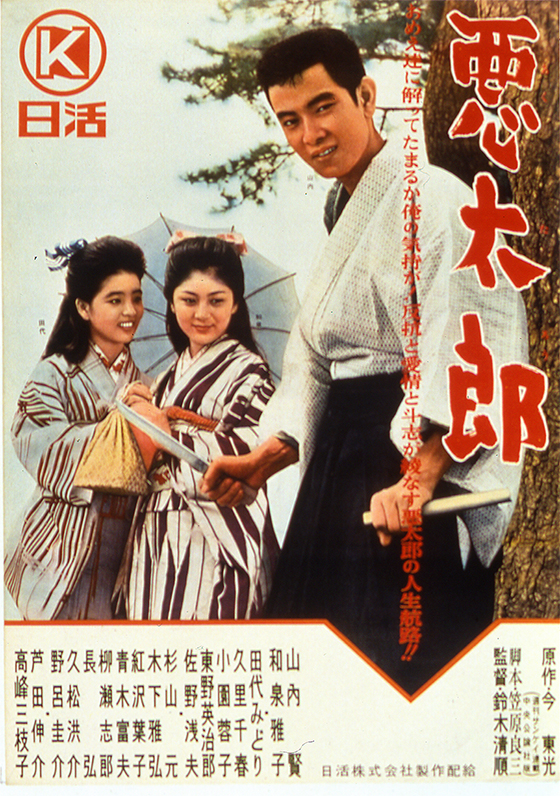
The Incorrigible (悪太郎, AKA The Bastard, Seijun Suzuki, 1963)

(C) Nikkatsu 1963

(C) Nikkatsu 1963

Seijun Suzuki often credits 1963’s Youth of the Beast as the real turning point in his directorial career, believing that it marked the first time he was ever really able to indulge his taste for the surreal to the extent that he truly wanted. The Incorrigible (悪太郎, Akutato, AKA Bastard), completed directly after Youth of the Beast, is another turning point of a kind in that it marks Suzuki’s first collaboration with set designer Takeo Kimura who would accompany him through his ‘60s masterpieces contributing to the uniquely theatrical aesthetic which came to be the director’s trademark.

Inspired by an autobiographical novel by Toko Kon, The Incorrigible of the title, Togo Konno (Ken Yamauchi), is a young man coming of age in the early Taisho era. He’s of noble birth and enjoys both wealth and privilege – something of which he is well aware, but is also of a rebellious, individualist character believing himself above the normal rules of civil society. Expelled from his posh Kyoto school after getting into a dalliance with a teacher’s daughter (she’s been sent off to a convent), Konno is then abruptly abandoned by his mother who has tricked him into travelling to a remote rural town where a friend of a family friend has promised to reform him at his military middle school. Konno thinks he’s too clever for this, he makes a point of deliberately failing his entrance exam in the mistaken belief that failing to get in would make him free to travel to Tokyo and start life on his own. He’s wrong, and failure to pass the exam would only entail being held back a year. Konno capitulates and agrees to start his new life as one among many in a backward little village in Southern Japan.

Though set in the Taisho era, Konno’s youth seems to suffer from the same problems that would plague the young men of 30 years later. His school is proto-militarist and hot on discipline. The boys are trained to be strong rather than smart and have inherited all the petty prejudices of their parents which they hone to the point of weaponry. The “Public Morals” department operates almost like a mini military police for students – making routine inspections of students’ home lives and keeping an eye out for “illicit” activities round and about town. Konno sees himself as grown man with a rebellious heart – he smokes openly, keeps a picture of the girl who got him into this mess in his room, and tells bawdy, probably made up stories about how he lost his virginity to a geisha (for free). He will not bow to the morality police, or any authority but his own.

Authority is something Konno seems to be good at. Picked on for his continuing preference for Japanese dress, Konno neatly deflects the attentions of the Public Morals division and comes out on top. When they raid his room and complain about his novel reading habit, he shouts them all down and gets them to sit on the floor while he “educates” them about foreign literature. Militarism has not yet arrived, but anti-intellectualism is already on the up and up. Konno’s love of literature is one of his many “deficient” qualities as teachers and students alike bemoan his “frivolous” hobbies, seeing his sensitivity and disregard for the commonly accepted ideals as signs of his unwelcome “unmanliness”.

Konno’s other big problem is, as might be expected, girls. Having been in town only moments Konno takes a fancy to doctor’s daughter Emiko (Masako Izumi) – his desire is only further inflamed after catching sight of her in the book shop and realising she too has bought a copy of Strindberg’s Red Room. She doesn’t care for Strindberg’s misanthropy, but a bond is quickly forged between the two sensitive souls trapped in this “traditional” small town where feelings are forbidden and youth constrained by social stricture.

It is, however, a love doomed to fail. The majority of Suzuki’s early work for Nikkatsu had been contemporary youth dramas, yet the artfully composed black and white photography of the Taisho setting is a melancholic affair which rejects both the rage of the modern action dramas and Suzuki’s trademark detached irony. Using frequent dissolves, The Incorrigible conjures a strong air of nostalgia and regret, a sad love story without end. Yet at its conclusion it makes sure to inject a note of uplifting inspiration as our hero wanders off into a fog of confusion, filled with a passion for pursuing truth and vowing to live without losing hope.


The Incorrigible is the fourth of five films included in Arrow’s Seijun Suzuki: The Early Years. Vol. 1 Seijun Rising: The Youth Movies box set.

Original trailer (English subtitles)
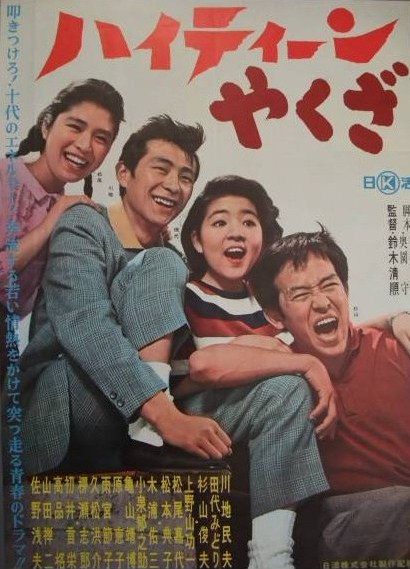
Teenage Yakuza (ハイティーンやくざ, Seijun Suzuki, 1962)

teen age yakuza poster jpgNikkatsu’s stock in youthful angst could have a nasty edge, even in their early days, but even so the Japanese teen movie is often a charming affair in which plucky youngsters defy the perils of their time from a position of relative safety. Rebellious punks die in Nikkatsu Action, but in the poppier coming of age world, innocence wins out as the angry young man finds a way to repurpose his rage for the good of society. Though Seijun Suzuki is generally associated with his “incomprehensible” work for the studio which eventually fired him in 1968, his trademark sense of absurd irony is a perfect fit for the essentially innocent world of the small town teen in ‘60s Japan.

High schooler Jiro (Tamio Kawaji) lives in a fatherless family with a grown-up older sister (Noriko Matsumoto) thinking about marriage and a mother (Kotoe Hatsui) about to open a trendy coffee shop/jazz parlour. He’s best friends with Yoshio (Hajime Sugiyama) – son of the carpenter working on the cafe, and is a typical scatterbrained teenage boy who enjoys fighting and has a “part-time job” taking illicit bets at the bicycle races. His problems start when he wins big on a bet but is hassled by a couple of punks dressed up like cowboys who deprive him of his winnings. Getting revenge, Jiro and Yoshio end up in a fight with the local gangsters in which Yoshio is stabbed in the leg and crippled for life and to make matters worse, his dad is killed in a traffic accident rushing to the scene of the crime. Filled with remorse, Yoshio turns to the dark side and falls out with Jiro while the petty punks start upping the ante and terrorising the town. The daughter of a local restaurant owner, Kazuko (Midori Tashiro), pulls Jiro in to frighten the punks off and convinces her dad to pay him for his time. Soon enough the other store owners are doing the same and Jiro is earning a pretty penny but what he thinks of as public service the store owners are beginning to think of as extortion – Jiro has become the yakuza he feared.

Like many a Nikkatsu hero, Jiro is a good kid misunderstood. He thought he was the lone voice standing up to the yakuza, the only sheriff in town and a shining beacon of justice. He didn’t see danger in taking the money because he genuinely thought it was a gift given freely out of gratitude, and perhaps to begin with it was. Danger rears its head when his sister’s fiancé suggests that Jiro’s illicit bodyguard business might cause problems for him at work and thereby endanger their marriage. When his mum talks sense into him, Jiro decides to try stopping the payments but it’s already too late. Thinking Jiro is after more money the store owners are scared, assuming Jiro will either remove his protection or turn on them as the yakuza they now believe him to be.

This sudden reversal of his self perception deeply wounds Jiro. He believed he was acting in the best interests of everyone and now has to accept he was corrupted by greed and status. He was acting like a yakuza, if accidentally, and has to accept his complicity in his present predicament. Rather than lashing out in rage and becoming the thing he’s been branded, Jiro (eventually) swings the opposite way, commits to ridding the town of yakuza but accepts that delinquency is not his best weapon.

Teenage Yakuza (ハイティーンやくざ, High Teen Yakuza) is no lone wolf story – lone wolves die at the end of Nikkatsu pictures, but Jiro and his ilk need to live to restore the peacefully innocent atmosphere that was broken by the random cowboys at the beginning. Jiro realises that saving the town is not his responsibility – at least not his alone, and he cannot do it all by himself. If the town is to be saved, it has to be because everyone chose to save it – Jiro’s job is not to fight the “yakuza”, but to make everyone else understand that the “yakuza”’s power is illusionary. Leading by example, he gradually wins them over (even the petty delinquents his original exploits helped to corrupt), ousting the growing influence of the shady gangsters through simple resistance.

A shorter, more disposable effort, Teenage Yakuza perhaps allows Suzuki wider scope for experimentation or at least allows him to express his trademark irony in a more direct way than your average programmer would. Filled with the youthful energy of the frequently echoed pop song, the twisters in the jazz bars, and the soba noodle delinquent with her cheerful ukulele, this is less youth on fire than youth breezing through. Teenage Yakuza neatly subverts the ideology of Nikkatsu’s action line, refusing the bad end for the angry lone wolf and gleefully restoring order with a hippyish plea for the solidarity of goodness. 


Teenage Yakuza is the third of five films included in Arrow’s Seijun Suzuki: The Early Years. Vol. 1 Seijun Rising: The Youth Movies box set.

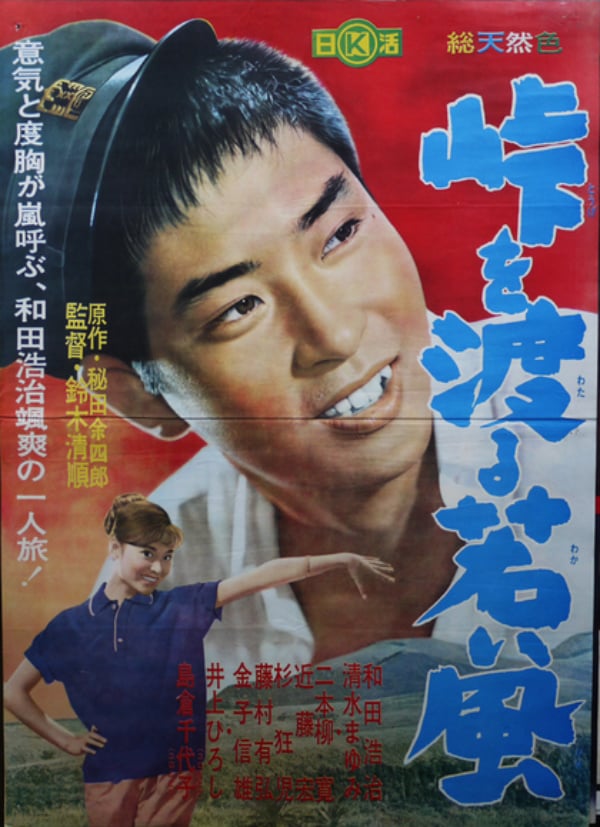
The Wind-of-Youth Group Crosses the Mountain Pass (峠を渡る若い風, Seijun Suzuki, 1961)

The Wind-of-Youth Group Crosses the Mountain Pass posterSeijun Suzuki made his first colour film in 1960 – Fighting Delinquents starred young matinee idol Koji Wada as a noble hearted construction worker with a temper who suddenly learns that he is the heir to an aristocratic fortune. Suzuki would make another two youth dramas starring Wada before getting to 1961’s The Wind-of-Youth Group Crosses the Mountain Pass (峠を渡る若い風, Toge wo Wataru Wakai Kaze, AKA Breeze on the Ridge) – this slice of colourful anarchy is a world away from Nikkatsu’s usual action fare though it does make space for the odd pop song or two.

Naive and cheerful university student Shintaro (Koji Wada) loves to travel and has taken off to wander around alone during the summer break. Getting thrown off a regular city bus for not having the cash for a ticket (his request to defer payment is not looked on kindly), Shintaro catches a lift with a group of travelling performers heading into the summer festival in the next town. Once there Shintaro showcases his lack of forethought once again when he happily sets down to start selling some of the “merchandise” he was given as a salary when the last place he worked at went bust. Not having realised that one generally needs a permit to sell goods in a market, Shintaro gets into an argument about the evils of monopolies and freedom verses regulation with the guy on the next stand all of which brings him to the attention of the yakuza. Luckily for Shintaro, he’s run into the nice kind of yakuza who just think he’s funny and invite him to travel on with them for a bit. Being so essentially good hearted and innocent, Shintaro agrees without thinking about all the reasons travelling around with a bunch of shady yakuza might not be a good idea.

Connecting with both the yakuza and the travelling players, Shintaro becomes involved in a number of interconnected crises – the biggest being the fate of the performers when a local gangster type swipes their headline act. The head of the troupe, Kinyo Imai (Shin Morikawa), is a traditional magician who performs in exaggerated Chinese dress complete with Fu Manchu moustache, but it doesn’t really matter how good he is, the rural audience is only here for the strip show. No stripper means no bookings which Kinyo knew already but it’s still a huge blow to his self esteem to realise that his magic doesn’t do the business anymore, especially as he’d always been conflicted about the strippers anyway.

Shintaro is one of Nikkatsu’s wandering heroes but unlike most he’s a cheerful soul who wanders out of a sense of curiosity and adventure rather than a need to escape something or someone at home. He likes meeting new people, even if the relationships are transitory and necessarily shallow, and treats everyone he meets with kindness and an open mind. In return he meets only kind and open people – even the yakuza are a generally decent sort who treat him like a new friend and can be relied upon to come to his aid if called. The only note of sourness arrives in the form of shady gangster Akita (Hiroshi Kondo) who pinches the troupe’s stripper, and their sometime patron who makes an indecent proposal to Kinyo as a kind of bet to decide whether he continues to fund their moribund performing career.

This being a regular program picture there’s not a lot of scope for experimentation but as it’s also a slightly odd entry to the Nikkatsu catalogue Suzuki does have the freedom to spice things up in his own particular way. Making the best use of colour film, Suzuki has a ball capturing Japan’s unique summer festival culture with its giant floats and cheerful market atmosphere. Wandering around the festival in a lengthy POV shot manages to exoticise something which would be quite ordinary to many viewers (at least those not born in large cities) but Suzuki’s other innovations are mostly relegated to one extremely interesting sequence in which Shintaro has a paint fight with yakuza he’s fallen out with (don’t worry, they both end up laughing like school boys). Every time Shintaro gets hit with paint, the entire screen tints to match neatly intensifying the effect and marking an early example of Suzuki’s love of colour play. Warm and goodnatured, The Wind-of-Youth Group Crosses the Mountain Pass is a gentle tale of youth finding its path but also one in which Suzuki takes advantage of the travelling motif to break from the regular programming and present an anarchic carnivale of music and song.


The Wind-of-Youth Group Crosses the Mountain Pass is the second of five films included in Arrow’s Seijun Suzuki: The Early Years. Vol. 1 Seijun Rising: The Youth Movies box set.

Original trailer (English subtitles)
The Boy Who Came Back (踏みはずした春, Seijun Suzuki, 1958)

the boy who came back posterSeijun Suzuki may have been fired for making films that made no sense and no money, but he had to start somewhere before getting the opportunity to push the boat out. Suzuki’s early career was much like that of any low ranking director at Nikkatsu in that he was handed a number of program pictures often intended to push a pop song or starring one of the up and coming stars in the studio’s expanding youth output. The Boy Who Came Back (踏みはずした春, Fumihazushita Haru, AKA The Spring that Never Came) is among these early efforts and marks an early leading role for later pinup star Akira Kobayashi paired with his soon to be frequent leading lady, Ruriko Asaoka. A reform school tale, the film is a restrained affair for Suzuki who keeps the rage quelled for the most part while his hero struggles ever onward in a world which just won’t let him be.

Keiko (Sachiko Hidari) is a conductress on a tour bus, but she has aspirations towards doing good in the world and is also a member of the volunteer organisation, Big Brothers and Sisters. While the other girls are busy gossiping about one of their number who has just got engaged (but doesn’t look too happy about it), Keiko gets a message to call in to “BBS” and is excited to learn she’s earned her first assignment. Keiko will be mentoring Nobuo (Akira Kobayashi) – a young man getting out of reform school after his second offence (assault & battery + trying to throttle his father with a necktie, time added for plotting a mass escape). Nobuo, however, is an angry young man who’s done all this before, he’s not much interested in being reformed and just wants to be left alone to get back to being the cool as ice lone wolf that he’s convinced himself he really is.

Made to appeal to young men, The Boy Who Came Back has a strong social justice theme with Keiko’s well meaning desire to help held up as a public service even if her friends and family worry for her safety and think she’s wasting her time on a load of ne’er do wells. Apparently an extra-governmental organisation, BBS has no religious agenda but is committed to working with troubled young people to help them overcome their problems and reintegrate into society.

Reintegration is Nobuo’s biggest problem. He’s committed to going straight but he’s proud and unwilling to accept the help of others. He turns down Keiko’s offer to help him find work because he assumes it will be easy enough to find a job, but there are no jobs to be had in the economically straightened world of 1958 – one of the reasons Keiko’s mother thinks the BBS is pointless is because no matter how many you save there will always be more tempted by crime because of the “difficult times”. When he calms down and comes back, agreeing to an interview for work at his mother’s factory Nobuo leaves in a rage after an employee gives him a funny look. There are few jobs for young men, but there are none for “punks” who’ve been in juvie. Every time things are looking up for Nobuo, his delinquent past comes back to haunt him.

This is more literally true when an old enemy re-enters Nobuo’s life with the express intention of derailing it. His punk buddies don’t like it that he’s gone straight, and his arch rival is still after Nobuo’s girl, Kazue (Ruriko Asaoka). If Nobuo is going to get “reformed” he’ll have to solve the problem with Kajita (Jo Shishido) and his guys, but if he does it in the usual way, he’ll land up right in the slammer. Keiko’s dilemma is one of getting too involved or not involved enough – she needs to teach Nobuo to fix his self image issues (which are largely social issues too seeing as they relate to familial dysfunction – a violent father and emotionally distant mother creating an angry, fragile young man who thinks he’s worthless and no one will ever really love him) for himself, rather than try to fix them for him.

A typical program picture of the time, The Boy Who Came Back does not provide much scope for Suzuki’s rampant imagination, but it does feature his gift for unusual framing and editing techniques as well as his comparatively more liberal use of song and dance sequences in the (not quite so sleazy) bars and cabarets that Nobuo and his ilk frequent. Unlike many a Nikkatsu youth movie, The Boy Who Came Back has a happy ending as everyone, including the earnest Keiko, learns to sort out their various difficulties and walks cheerfully out into the suddenly brighter future with a much more certain footing.


The Boy Who Came Back is the first of five films included in Arrow’s Seijun Suzuki: The Early Years. Vol. 1 Seijun Rising: The Youth Movies box set.

Original trailer (English subtitles)