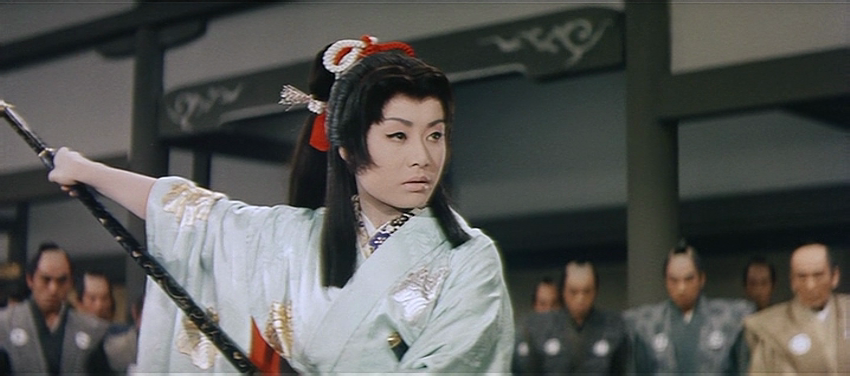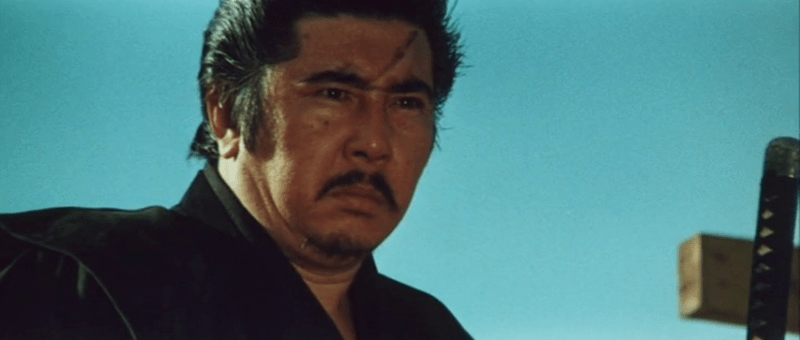
The Fort of Death (五人の賞金稼ぎ, Eiichi Kudo, 1969)

Shikoro Ichibei (Tomisaburo Wakayama) returns yet this time seemingly on the opposite side in the second in the Bounty Hunter series, The Fort of Death (五人の賞金稼ぎ, Gonin no Shokin Kasegi) this time directed by Eiichi Kudo. If the first film had been an Edo-era take on James Bond, the second is very much Spaghetti Western and feudal tragedy as Ichibei finds himself coming to, if not quite the rescue of the oppressed farmers, then at least moral support in taking stand against corrupt and self-interested lords.

This might be surprising in that in the first film Ichibei had been a shogunate spy and seemingly close friend of the man himself, yet this time around he’s working as a doctor while taking bounty hunter jobs to earn extra money to support the poor people who come to him for help. Like a true western hero, he has a small posse which includes the ninja lady, Kagero (Tomoko Mayama), from the first film only she’s being played by the actress who previously starred as his other love interest. In any case, he’s approached by a young man from a small village which is making a last-ditch appeal to the local lord to lower their tax burdens so they don’t all starve, though so far the lord’s response has been to add additional taxes and kill people for not paying them. 

On his arrival, Ichibei soon realises that the man who recommended him was actually the leader of the government forces during a previous peasant uprising at which Ichibei had also tried to help the farmers. In that case, Bessho (Shin Tokudaiji) had won, but it didn’t do him any good. His clan was dissolved and he became a wanderer, taken in by the village and now indebted to them, hoping Ichibei can help but fully aware of the brutality with which such challenges to the feudal order are put down. 

The lord later suggests it’s not really his fault. He has to curry favour with Edo to protect the domain, which is why he agreed to participate in a construction project that led him to confiscate all of his farmers’ rice and wheat. But then it’s also true that he is vain, and cruel. On realising the village has hired a man like Ichibei, some of the retainers suggest reopening negotiations but others complain that they must now crush the farmers or face ruin themselves while trying to ensure the strife in their domain does not come to the attention of the government in Edo. 

Part of their problem is that Ichibei simply has better technology in the form of gatling guns. Tying into the western themes, Ichibei is well versed in the use of firearms, while the samurai are mostly reliant on traditional weaponry such as arrows and swords. The lord later insists on using some canons, but is oblivious to the risk as the shogun has banned the use of gunpowder and using them may end up bringing him to his attention and thereby landing him in a lot of possible fatal trouble. 

In any case, it’s the villagers who suffer. Ichibei encounters a woman who has lost her mind, refusing to give up her baby who has died of malnutrition while her husband was executed for non payment of taxes. Meanwhile, some of the other ronin they hired attempt to rape a villager, and a young couple are prevented from marrying because the headman is worried that it would send the wrong message in a time so much strife. Then again, a woman basically attempts to rape Ichibei, descending on him while he’s still asleep which otherwise leads into a fairly comic sequence in which Ichibei must fight of a bunch of ninjas intent on stealing the gatling gun while dressed only his underwear.

Darkly comic it may be, but also surprisingly violent with a ninja at one point using a dead body as a Molotov cocktail not to mention the severed heads and limbs of the battle scenes. Ichibei is fully aware that the battle is a forlorn hope, but also that the villagers have no choice and perhaps this is better for them than simply accepting their fate and starving to death. Even so, he reserves his final words for the Edo inspector who arrives only when the battle is done to survey the scene, berating him that he ought to know what happened here from looking at the battlefield and deducing that this domain has not been run particularly well. It’s a tragedy of feudalism that provokes a tearful rage from the compassionate bounty hunter trying his best to heal the sickness in his society, though perhaps like the patient who visits him with a venereal complaint concluding the best solution is to cut it right off.

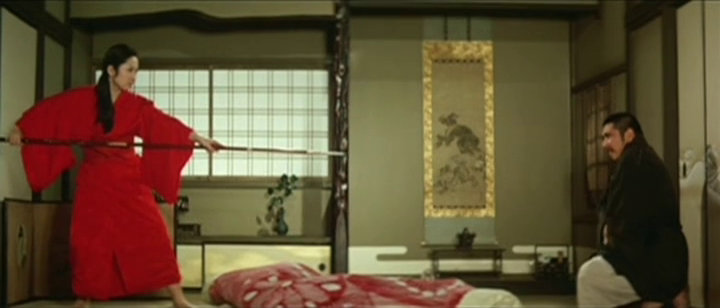
Wicked Priest 5: Breaking The Commandments (極悪坊主 飲む打つ買う, Buichi Saito, 1971)

The Wicked Priest returns for his final adventure and once again finds himself tackling the corruptions of the mid-Meiji society. Titled in English “Breaking the Commandments” (極悪坊主 飲む打つ買う, Gokuaku Bozu – Nomu Utsu Kau), the Japanese title refers to something Shinkai (Tomisaburo Wakayama) admits part way through, that his ironically non-buddhistic life revolves around drinking, gambling, and women all vices he seems unable to give up even as he continues to fight justice for the oppressed little guy amid the burgeoning capitalist society of the new Japan.

Indeed the film opens with him in a brothel where he’s exhausting one woman after another and demanding she be replaced with a fresh model while simultaneously covering for petty crook Hideji (Teruo Ishiyama) who is hiding his sex worker girlfriend in the cupboard to save her from a local gangster. In the first few instalment, Shinkai is a lecherous yet lovable rogue who in his own way respects women but in these last two instalments is certainly less kind, treating these sex workers more or less as disposable while later threatening to rape a lady gambler who tried to trick him. In any case, after realising that even Hideji who he went out of his way to help is trying to deceive him, Shinkai ends up getting involved with a local dispute over transportation licences and a nefarious land-sharking plan run by thuggish gangsters with the collusion of the police chief.

The land sharks want to take over the abandoned mansion where Hideji and his family of crooks are currently living in the company of a former samurai lord who seems to be suffering with some kind of delusion that it’s still the Sengoku era. The police chief isn’t up for the idea at first but the gangsters falsely imply that those living in this area of town are merely “jobless people and criminals” that they don’t need to worry about. But their plan depends on bringing on board Wajima who holds the license for running freight carts but Wajima is an honest man who isn’t interested in bribes and has no respect for those who exploit others. He refuses to participate in the project.

Shinkai too refuses to let the gangsters get away with mowing over Hideji and the others and is once again saved by Ryotatsu (Bunta Sugawara) who agrees to put off their final fight until Shinkai is finished cleaning up this dirty little town. He largely does this by donning an elaborate disguise and teaming up with lady gambler Gin to trick conspirator Kawashima into giving back Wajima’s (Takashi Shimura) license after setting him up so he’d lose it. Meanwhile he also tries to repair another broken father-son relationship between Wajima and his errant boy Ryutaro (Kyosuke Machida) whom he’d kicked out some years previously after he became a yakuza and got into trouble with the law. 

What seems clear is that the chaos of Meiji has allowed the greedy to profit over the changing orders of the hierarchical society, no longer bound by traditional notions of good conduct or basic humanity. The police chief first objects to the plan, stating that many people living in the area the gangsters have earmarked for their docks are honest and hardworking and shouldn’t be lumped in with “criminals”, but is soon won over by a bribe and is also supporting a mistress in a separate household. Yet even so, Shinkai turns this same weapon back on Kawashima (Fumio Watanabe) in pretending to be a general from Tokyo who will soon be his father-in-law, leveraging his social advancement to bring him back into line in appealing to his greed and ambition while hinting at a militarist future in reminding him that Wajima’s carts were essential during the Satsuma Rebellion and may be so again should the occasion call.

After seeing off a series of bounty hunters, one sent in via a honey trap that suggests the gangsters really know their enemy, Shinkai has no option but to clear out the corruption himself at the point of a sword culminating in another bloody showdown which is also in its own way a means of protecting Ryutaro from a pointless revenge. “If I die the devil in hell will be in for a big surprise!” Shinkai cooly remarks as he marches off to fight for justice, but then there’s another battle waiting for him in the postponed grudge match with Ryotatsu as the two men tussle atop a sand dune ironically trapped in a co-dependent cycle of vengeance and salvation while Shinkai’s wandering most likely will never end.


Vendetta of a Samurai (荒木又右衛門 決闘鍵屋の辻, Kazuo Mori, 1952)

During the American Occupation, period dramas were frowned upon, the occupation forces apparently fearing that they might encourage the latent feudalism in Japanese society. Released immediately before the Occupation’s end, Kazuo Mori’s Vendetta of a Samurai (荒木又右衛門 決闘鍵屋の辻, Araki Mataemon: Ketto Kagiya no Tsuji), not to be confused with the director’s similarly titled Samurai Vendetta from a few years later, is a suitably revisionist piece interrogating the legacy not only of the samurai but the samurai movie in demonstrating, quite poignantly for the contemporary audience, that the rigid and austere codes of a warrior class did nothing but create sadness which forced good men to sacrifice true friendship in service not even of an ideal but simply an agreement. 

To signal his intent, Mori opens with a bombastic sequence shot in the fashion of pre-war jidaigeki, all booming speeches and clashing swords before a voiceover cuts in to tell us everything we know of the events in play is wrong. The legends surrounding the battle at Kagiya Corner tell us that Jinza (Takashi Shimura) was a bad man, and that Mataemon (Toshiro Mifune) killed 36 that day, but in reality Jinza was kind and noble and in fact the two men were good friends while Mataemon in reality struck down only two enemies which is in any case much more plausible if perhaps less exciting. As the classic chanbara scene fades, we return to the modern city of Ueno in Iga which in some respects remains unchanged further emphasising the “reality” of the brief 17th century conflict. As we learn, a man called Matagoro (Minoru Chiaki) has poked a hole through the samurai order in killing the brother of a young man called Kazuma (Akihiko Katayama), and so a lot of people have to die to eradicate the corruption of his transgression.

Boasting a script by Akira Kurosawa, the action flips between Mataemon, brother-in-law of Kazuma, and his men waiting for the arrival of Jinza and Matagoro inside a small inn, and the circumstances which brought them to this point. Mataemon is duty bound to support Kazuma who is really just a boy forced to seek revenge because they are family though there does not seem to be much heat in his desire for justice against Matagoro. Jinza, by contrast, is positioned on the opposite side solely because he is affiliated with a high ranking Hatamoto who is protecting Matagoro. Yet the two men are good friends each resigned to their fates and in full knowledge of how the samurai world works. The have no quarrel with each other, but are forced into mortal combat because of a complex network of loyalties and obligations that can only be satisfied with blood. 

“What is the meaning of this violence?” an imperious official asks, receiving no answer only a mild plea for a little more time. “Being a samurai, what a funny thing,” Mataemon laments to himself reflecting on the fact he must now kill or be killed by his friend for no real reason but simply because things are the way they are. Jinza meanwhile agrees, “Being warriors, what a misfortune,” as the pair calmly discuss the inherent hypocrisies which define their lives wherein all that really matters is one’s proximity to the shogun. That’s one reason the nervous Mago (Daisuke Kato) has joined the mission for revenge, his loyalist father a former tutor to the lord and keen to show their fealty but also hoping to advance their fortunes through a successful vendetta. 

Mago isn’t the only one who’s scared. The inn keeper is visibly shaking. He didn’t really want to be ground zero for a samurai duel today and is presumably worried not just for his safety but for the repercussions of offending his guests and damage to his property. A crowd gathering around the fighting, which includes the wealthy merchant brother-in-law of Matagoro who declared himself unafraid of a few rural bumpkin samurai, remarks on the smell of blood in the air seemingly both horrified and excited by the spectacle though even that is thin on the ground. No grand duel, Mataemon merely strikes his friend down before the battle begins, thereafter coaching the young Kazuma to overcome his fear and claim his revenge despite the bloody ugliness of the task. Yet in the end all there is is fear and futility, along with still more duty and the promise of more blood to come.  


Sword of Destiny (孤剣は折れず 月影一刀流, Yasushi Sasaki, 1960)

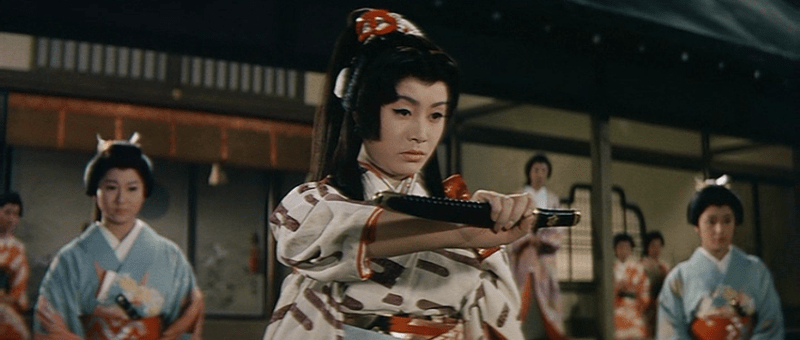
A wandering swordsman winds up in intrigue on returning to his fencing school to find his old master murdered in Yasushi Sasaki’s Sword of Destiny (孤剣は折れず 月影一刀流, Koken wa Arezu: Tsukage Ittoryu). A classic jidaigeki adventure, it nevertheless has to be said that this one is a little more sexist than most in actively pushing its series of female warriors into the background as the hero by turns sends them all back to typically feminine roles while declaring that he will be the one to claim vengeance and clear up corruption in the court itself caused by a woman’s apparent forgetting of her place. 

At least, this is what Mikogami Genshiro (Koji Tsuruta) is told by an old friend, Izu, after an altercation with the fiery princess Kazu (Hibari Misora). The Shogun’s nurse, Lady Kasuga, has apparently taken an interest in politics and has most of the inner palace in her grasp enriching herself in the process. Izu believes that she may also be behind the assassination of Geshiro’s former mentor Ono while working in league with the Yagyu who coveted the position of fencing master to the Shogun. He asks Genshiro to kill her which he’s only too happy to do while seeking vengeance for Ono, but later gains a second reason after meeting the two orphaned daughters of a former retainer forced to take his own life thanks to Lady Kasuga’s machinations. 

Itoya (Yoshiko Fujita) wanders round with a gun and disrupts Genshiro’s first assassination attempt. He later tells her to leave the killing business to him and live “the life of a woman” insisting that one girl has no power to kill Lady Kasuga anyway. Meanwhile, he also makes an enemy of the Shogun’s sister Princess Kazu after challenging her in the street on seeing her callous disregard for a peasant her horse had run over. Princess Kazu falls in love with him after he defeats her in a duel, temporarily rebelling in insisting she will resist a dynastic marriage and take no other husband though he eventually rejects her partly on the grounds of their class difference and partly because he is a wandering sword who lives in the moment and may know no tomorrow. 

Nevertheless, she is later seen capitulating to her proper role as a princess who exists largely to continue the family line, marrying a man chosen by the Shogun and his advisors with no real power to chose anything other than her obedience. In much the same way he does with Itoya, Genshiro pushes her back towards the typically feminine while falling for Itoya’s meek, sickly sister Mine (Hiroko Sakuramachi) who is otherwise an idealised image of femininity in her softness and naivety while like every other woman in the picture falling for Genshiro because of his robust manliness and ability to protect her by gaining the sisters’ vengeance on their behalf. 

Meanwhile, Genshiro also facing off against the rival Yagyu school whom he suspects of having killed Ono to usurp his place as the shogunate fencing master with the assistance of underling Takagaki who has now taken over leading to a mass exit of students fed up with his authoritarian teaching methods. Interestingly enough, Genshiro is temporarily imprisoned by the Yagyu alongside a dissident Christian whose death they’d faked while keeping him alive in order to torture the names of other Christians out of him. On fulfilling his request to take his cross to his daughter who has become a sex worker, Genshiro succeeds only in endangering her while she also falls in love with him. 

All in all, he’s not much of a responsible hero also reckless with the life of his former burglar sidekick Kurobei (Shin Tokudaiji) who uses his ninja tricks to get him out of prison. As expected, it all ends with in a battle against a treacherous swordsman and the spineless Takagaki with the final revelation that Lady Kasuga (who just dies of old age) had not much to do with anything anyway despite having been a “meddling” old woman who forgot her proper place. Even Mine is forced to admit that she can’t come between Genshiro and his sword so she plans to become a nun while Kazu sends him an elaborate katana to remember her by certain that he will not accept a place in the Shogun’s household but will return to the road to continuing his training. In any case, a kind of justice is done and order restored even if that order is in itself fairly unideal. 


Song of the Flower Basket (花籠の歌, Heinosuke Gosho, 1937)

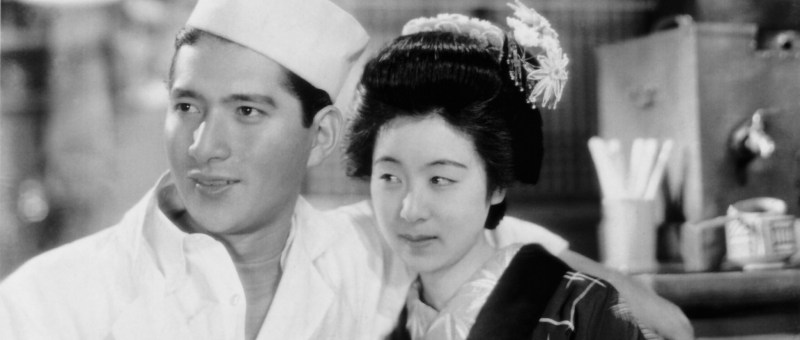
The daughter of a tonkatsu shop finds herself with an overabundance of suitors in Heinosuke Gosho’s generally cheerful yet occasionally dark melodrama Song of the Flower Basket (花籠の歌, Hanakago no Uta). Adapted from a novel by Fumitaka Iwasaki and scripted by Kogo Noda, the film finds its heroine caught at a moment of social change as she battles her snooty aunt for the right to decide her romantic future while her impoverished student boyfriend does something much the same in defying his family’s attempts to micromanage his life dreaming of the bright lights of Ginza. 

Yoko (Kinuyo Tanaka) is the “kanban musume” of her father Keizo’s (Reikichi Kawamura) pork cutlet restaurant, attracting customers with her charm and beauty while the Chinese chef her father brought back with him from Shanghai, Lee (Shin Tokudaiji), is the culinary star. Lee is secretly in love with Yoko whom he continues to refer to largely as “the young lady” and has long been writing an ode in her honour. Yoko meanwhile is in love with a penniless student, Ono (Shuji Sano), who at the beginning of the film has just returned home after visiting his family whom he has alienated by declaring that he doesn’t want to work in an office in the country while refusing an offer to marry into another family as an adopted son-in-law. The reason for this is less his pride than his desire to stay in Tokyo amid the bright lights of Ginza, sighing as he looks out into the neon-lit night gazing at adverts for Club Hamigaki toothpaste and Meiji Chocolate. The second reason may also be that he’s fallen for Yoko but given his precarious financial situation and lack of prospects does not quite dare to imagine a future with her. 

He must however be serious as we later learn he’s given up going to hostess bars with his friends, a bar girl greeting him in the restaurant evidently not having seen him in ages asking where he’s been much to Yoko’s embarrassment. The encounter places a seed of doubt in her mind in a minor role reversal as she begins to resent Ono’s past irrationally annoyed by the idea he has dated other women. Meanwhile, at the memorial event marking 11 years since her mother passed away while working as a steward on a boat in Singapore, Yoko’s snooty aunt tries to set her up with an arranged marriage to an Osakan doctor who may or may not marry depending on the “negotiations” but has also been promised his own clinic by his wealthy parents if the marriage is confirmed. Okamoto (Toshiaki Konoe) has visited the restaurant to get a better look at Yoko making him the third suitor to encircle her even though the chief concern of the family is that Yoko is almost 24 and therefore ageing out of top tier matches.  

To his credit, Yoko’s father is fully in her corner trying to stand up to the domineering aunt who is definitely overreaching in trying to micromanage the romantic lives of her nieces in the absence of her sister. He determines to find out if Yoko has her eye on someone already to get the aunt off their backs, but the situation develops in an unexpected direction when Lee mistakenly assumes that she likes him back. Too shy to say himself, he advises Keizo to ask frequent customer and best friend of Ono, Hotta (Chishu Ryu), who is on track to become a Buddhist priest and take over the family temple, only Hotta obviously tells him, correctly, that Yoko is in love with Ono having completely forgotten that Lee had once confessed his feelings to him. 

The film does its best to present a more positive vision an internationalist Japan even in 1937 despite the Aunt’s obvious disapproval of the family’s wandering past and is largely sympathetic of the lovelorn Lee yet implies that a romance between he and Yoko is so unthinkable that no one really considered the possibility that he may be in love with her himself even though it is incredibly obvious given his ongoing attempts to write a love song while he’s even torn out a picture of Yoko which appeared in a magazine and hung it on his wall. Yoko is oblivious to his feelings, believing that he is in love with their waitress, Oteru (Yaeko Izumo), who is indeed in love with him, and perhaps doesn’t appreciate the effect moving Ono in as a trainee chef will have on him both professionally and emotionally. The message that is emerges accidentally or otherwise is that Lee’s place at the cafe is insecure despite his skill being a large part of its success as he falls into a deep depression and eventually decides it’s too painful for him to stay. 

The revelations surrounding Lee further destabilise Yoko’s confidence in her choice of Ono whom she constantly doubts even suspecting he may have committed a violent crime when carted off by the police after newspaper reports stating the bar hostess he introduced her to earlier has been murdered in her apartment. Perhaps it’s normal enough to be uncertain if you’ve made the right choice in the early days of a marriage, but believing your spouse capable of murder is a significant stumbling block as is her final admission that she doesn’t really trust him and isn’t ready to accept his past with other women in a further reversal of their roles given he has now married into her family and taken her name. Nevertheless, the crisis seems to be repaired by her father’s simple act of ordering a round of beers making clear that he plans to celebrate and obviously still has confidence in Ono while preparing to adapt their restaurant to their new circumstances by branching out into sukiyaki. Expressing some of the anxieties of the 1930s from the precarious economy and uncertainty of the future to changing social mores as young people reject the traditional to craft their own romantic futures, Song of the Flower Basket nevertheless ends on a note of melancholy in the wandering Lee’s ode to loneliness and heartbreak under the neon lights of Ginza.


New Woman Question and Answer (新女性問答, Yasushi Sasaki, 1939)

Director Yasushi Sasaki is most likely best remembered for his post-war work at Toei where he specialised in jidaigeki and musicals, frequently working with tentpole star Hibari Misora on her period drama vehicles. He began his career, however, at Shochiku in 1929 as an assistant to Hiroshi Shimizu, later working with Yasujiro Ozu before being promoted as a director in his own right and gaining a reputation as a skilled producer of musical dramas with the release of Lovers’ Duet in 1939 which starred a young Mieko Takamine as an aspiring singer. 

Released in the same year, New Woman Question and Answer (新女性問答, Shin Josei Mondo) is by contrast a high-minded melodrama and rather surprising for the world of 1939, playing much more like the new constitution films appearing after the after such as Victory of Women which would unfortunately prove the last appearance from star Michiko Kuwano who sadly passed away on set during filming. At heart a female friendship drama, the film takes aim at the snobbery and lack of compassion among a group of upper-middleclass women while offering a slightly contradictory yet progressive view of the place of women in a changing society. 

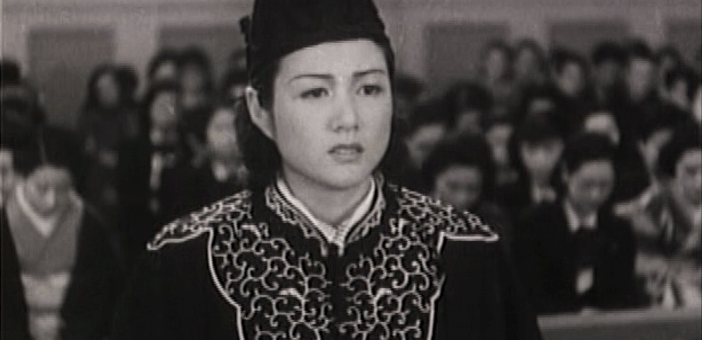
As the film opens, seven former high school friends are having a small party with one member, Michiko (Kuniko Miyake), set to resign from their club intending to give up her university studies in order care for her ailing father and prepare to get married. Michiko’s marriage scandalises her friends in part because it’s a love match, but Toki (Michiko Kuwano) is horrified to realise on seeing her fiancé’s photo that the man Michiko intends to marry is her sister’s boyfriend, Murakawa. Murakawa indeed breaks up with Oyo (Hiroko Kawasaki), a geisha, brushing off their relationship as casual and meaningless while insisting that he has to think of his future which is why he’s marrying the wealthy Michiko. Toki first talks to her sister who is stoical and self sacrificing before having it out with an unrepentant Murakawa and then directly with Michiko who refuses to break the engagement viewing it only as a trivial matter of his having broken up with another woman to be with her. 

What she says, however, is less forgivable bluntly stating that she doesn’t think a geisha’s life should be equal to her own. It apparently rings no alarm bells for her that Murakawa frequents the red light district, or that if he can treat another woman so callously he might not be good husband material, she simply sees a geisha as not worth worrying about. Michiko had kept her sister’s occupation a secret from her friends fearing just such judgement, telling them that Oyo works in a beauty parlour, and is therefore unable to explain why she and Michiko have fallen out or why she chooses not to attend the wedding. While they think Oyo is a working woman they universally admire her, yet on accidentally discovering the truth they soon change their tune, one young woman having an intense prejudice against geishas for having “deceived” her father for some reason never thinking perhaps that’s something she should have taken up with him. While some are only disappointed that Michiko kept the truth from them, the group eventually disowns her after making a series of offensively judgemental remarks only to be taken to task by Oyo’s less patient friend who returns that “no geisha could be so heartless” as to break a friendship over such trivial prudery. 

Even so the film sees the need to offer additional justifications for Oyo’s decision to become a geisha in order to put her sister through college, insisting that her goal of becoming a lawyer is also necessary in order to satisfy the dying wish of her father who died in prison after being deceived in business. Nevertheless the women are eventually forced to face their unfair prejudices, if only through the education they receive on entering the work force and finally understanding how the “real world” works, restoring their sense of female solidarity and extending it also to the ranks of geisha as they join in with the girls’ club song while celebrating Toki’s promotion to the bar. 

This does seem to be an age in which it becomes possible for a woman to become independent, earning a university degree and entering a profession which will allow her to support herself though this more progressive message is somewhat walked back during the closing moments in which Toki herself ponders getting married, her companions reminding her that “the duty of a housewife matters most of all” even while affirming that there is no problem with her continuing to work as a married woman. Meanwhile, as Michiko’s friendly neighbour later laments a woman is sunk with an unreliable husband as Murakawa turns out to be having married her for her money only to discover there was none and leave her only with note explaining he intends to go travelling for a couple of years. She first states that she intends to work and support herself waiting for her husband’s return only to discover she is pregnant and thereafter reliant on the goodwill of her former servants. She discovers that the only viable line of work open to her is as a bar hostess, ironically adjacent to the geisha whose lives she had previously believed to have been so unequal to her own. 

Nevertheless, the rather neat conclusion sees her reunited with Murakawa who had not only abandoned her but returned and asked for money, attempting to kidnap their baby when she objected to his attempt to install himself in her new life and thereafter landing her with a murder charge against which she is defended by the newly qualified Toki despite what appears to be a fairly massive conflict of interest. The triumph is both a victory of female friendship overcoming even the most unbridgeable of rifts and an awkward concession to the conservative status quo which demands a restoration of the traditional marriage insisting that Murakawa has now reformed in accepting his responsibilities while also reinforcing the class barriers against which the film had otherwise argued in the eventual union of the two servants one of whom had long been in love with Michiko. In any case despite its contradictions, New Woman Question and Answer provides a surprisingly progressive view of women’s rights and opportunities in the contemporary society affording them not only agency but the possibility at least of independence and personal romantic fulfilment of their own choosing. 


Road Warriors (あやめ笠 喧嘩街道, Tai Kato, 1960)

A penniless wanderer finds himself mixed up in chaos and conspiracy after deciding to help a lady travelling alone for the purposes of revenge in Tai Kato’s Toei chanbara, Road Warriors (あやめ笠 喧嘩街道, Ayame Kasa: Kenka Kaido). Truth be told, the hero isn’t much of a warrior at all and wisely prefers to avoid a fight if possible but is prepared to put his sword where his mouth is when the occasion calls. Still the conspiracy in this instance is small scale and incredibly petty as a trio of ambitious retainers attempt to frame their one time bodyguard for the murder of a lord.

Before all that, however, Gantaro (Ryuji Shinagawa) is as he’s fond of introducing himself a penniless traveller who makes his ends meet through gambling. In debt to local boss Hidegoro (Ushio Akashi) he agrees to act as an intermediary in a dispute with the greedy Onizo (Eijiro Yanagi) who has usurped some of their territory. Gantaro suggests they settle the matter through gambling but is then challenged to combat by the gang’s bodyguard, Akiyama (Shin Tokudaiji). The young man looks noticeably afraid, sweating at the temples and gripping his sword at an unusual angle, but holds his own in the fight until Onizo tries to cheat by sending in one of his minions to finish him off. Noticing what’s happening, Akiyama proves his nobility by ending the fight and accepting defeat. Onizo appears cheerful and even asks Gantaro to join his gang, but seconds after the young man leaves he sends his guys out after him and evidently has no intention of enforcing a truce with Hidegoro.

Meanwhile, Gantaro runs into a melancholy samurai woman, Miyuki (Kyoko Aoyama), chasing after a thief who has stolen something from her far more precious than money. Discovering the thief has robbed him too, Gantaro springs into action and soon discovers that Miyuki is on a quest for revenge against the man who killed her father but that she’s been betrayed by her three retainers and has managed to ditch them to proceed alone. Unsprisingly, the prime suspect appears to be Akiyama but as stabbing a man in the back and running away don’t seem to fit with the noble character he displayed in the fight, Gantaro has an idea that something’s not quite right. 

Of course, he also begins to fall for Miyuki despite the obvious affection held for him by Hidegoro’s daughter Omitsu (Hiromi Hanazono) which he otherwise seems keen to escape. It’s reasonable to assume that loveable rogue Gantaro is the love them and leave them type, though his love for a samurai’s daughter is always going to be an impossibility no matter how much she may come to admire him. Even so, the conspiracy angle along with Onizo’s smug and overbearing duplicity do begin to awaken his sense of justice especially while travelling with an incredibly cynical thief who will sell anything or anyone in search of a quick buck. Even he however eventually comes around to the idea of helping Miyuki get away from her retainers and enact her revenge especially after overhearing the truth while cowering behind some barrels. 

It may be an overly familiar chanbara tale if one enlivened by Gantaro’s wisecracking antics, but Kato brings to it his characteristic sense of uncertainty in the potent mists that seem to surround Gantaro and Miyuki as they travel the mountain paths in search their enemy. Then again, there are shades of unexpected darkness not least in the implication that Gantaro was about to rape Miyuki before she fainted and brought him back to his senses. Nevertheless, her retainers may tell her that she has “no choice” but to obey them, but Gantaro seems to feel differently if abruptly giving up his intention of protecting her on learning that she has someone else in her heart. This is indeed a harsh world for women samurai and otherwise, a mother and daughter are saved by Akiyama after being harassed by Onizo when he annexes the local market while both Miyuki and Omitsu are left to finish their father’s unfinished business in the wake of their untimely deaths. Notably, it is indeed they who finally strike the final blow to eliminate the corruption which surrounds them. Penniless wanderer Gantaro doesn’t have it that easy either, gambling his life away and ending up with debts both financial and moral that may have dangerous consequences while often beset by cynicism even if latterly deciding to help those in need for no reward. In any case, like any good wanderer all he can do is smile and wave as he departs for the next adventure on the violent streets of the Edo-era society.


In Search of Mother (瞼の母, Tai Kato, 1962)

The toxic hyper-masculinity of the yakuza world conspires against a sensitive young man who longs to reclaim his place in society through reuniting with the mother who was forced to abandon him at five years old in Tai Kato’s hugely moving jidaigeki, In Search of Mother (瞼の母, Mabuta no Haha). Adapted from a kabuki play by Shin Hasegawa, Kato’s wandering tale is perfectly tailored for post-war concerns situating itself in a world of mass displacement, economic inequality, and lonely regret in which the secrets of the immediate past have become a threat to the promise of the near future which may then in itself prove unrealisable. 

As the film opens, 25-year-old Chutaro (Kinnosuke Nakamura) is trying to stop his hot-headed friend Hanji (Hiroki Matsukata) from taking revenge on a rival gang on behalf of their boss who is to them something like a father figure. Chutaro reminds Hanji that he has other ties and should think about the mother and sister who wait for him in his hometown to whom he should return and attempt to live an honest life, the possibility of which Chutaro is deprived because he is an orphan with no home or family to turn to. His pleas fall on deaf ears, Hanji reminding him of the code by which they live. “What’s going to happen to my pride as a man?” he exclaims, later telling his mother “I’m not a man if I don’t accept their challenge”. “If that’s the case then don’t be a man” she counters, physically preventing him from leaving as if Hanji were a still a child but to him it seems life is not worth living if you are not accounted a proper “man” by the values of the society in which he lives. When Hanji’s sister Onui (Hitomi Nakahara) attempts to plead for him, the gangsters explain to her that they are trapped too, they cannot return without fulfilling this debt of honour. “That’s not how it works miss, if we let him go after he attacked our boss we won’t be able to survive in our world.” 

Just as Chutaro searches for his long lost mother in order to reclaim his place in mainstream society, he is pursued by the gangsters desperate to redeem themselves through revenge. Eventually arriving in Edo by winter, he adopts the rather unscientific tactic of stopping every middle-aged woman he comes across and asking her if she might once have had a son. The first of these is a blind shamisen player whom he witnesses being cheated by man who makes a point of dropping the coin he was to give her back in his own pouch to make it sound like he paid when he didn’t and then getting indignant when he she calls him on it. The woman gives her age as 50 though looks 20 years older and relates her own sad story of widowhood and a son she had to give up but is not Chutaro’s mother. In any case he gives her a large amount of money out of a kindness he might hope someone would show to his own mother were they in his position. 

He does something similar with the next woman, Otora (Sadako Sawamura), a sex worker, like him ostracised by the world around her, who had a son who died in infancy and is now rejected by a judgemental society for doing the only thing she can to survive. Kato films each of these poignant moments in long unbroken takes tinged with the desperation and loneliness of two people looking for something from the other which in the end they are not able to give each other only find relief in their shared sorrow. Nevertheless the encounters also expose the difficulties faced by women in this era in which they must be dependent on men, the shamisen player suffering in her widowhood and Otora left with no choice than to engage in sex work which then exiles her from society at large just as Chutaro is rendered an outcast because of his yakuza past yet as he later explains what else could a child without parents have done?

This is something which might press heavily on the minds of a post-war audience in which the plight of war orphans and otherwise displaced children was all too familiar. In terms of cinema, the yakuza is often presented as a surrogate family in which orphaned boys can replace unconditional love with the mutual solidarity of a brotherhood defined by highly codified existence. Yet Chutaro longs to repair his connection to mainstream society by finding his mother, carrying around money he has saved in order to help her should he discover that she, like Otora and the shamisen player, is living in poverty. What he did not consider, however, is that she may reject him. Acting from a tip off from Otora he pays a visit to a local store run by Ohama (Michiyo Kogure) who unlike the other women has been able to build an independent life for herself and is preparing to marry off her daughter Otose (Keiko Okawa) to a wealthy merchant’s son. When Chutaro first appears, she assumes he is a conman fed information by Otora, admitting that she once had a son by his name but was told he had died in an epidemic when he was nine. Just as we’d seen her reject Otora lest she expose her sex worker past, she rejects Chutaro in fear that his yakuza ties will ruin her reputation, wreck her daughter’s marriage, and disrupt the comfortable life which she worked so hard to create just at the moment of its fruition. 

“You are suspicious of people because you have wealth” Chutaro points out, making plain the various ways in which economic inequality continues to disrupt the bonds between people. As we discover, Ohama was forced to abandon him because his father was abusive. In that era it would not have been possible to take her son with her and so she made her peace with leaving him but despite herself is now conflicted on witnessing him crying in front of her like a child while afraid to acknowledge him lest it disadvantage her daughter. The problem here is not that her past is shameful or a secret, Otose knows she had an older brother, but the fact that Chutaro has become a yakuza with judgment unfairly placed upon him for simply doing what he could to survive without parents to care for or guide him. Too late, Ohama realises she has made a terrible mistake. She and Otose go out to look for Chutaro but either too hurt by the rejection or having come to believe that he cannot escape his yakuza past, he lets them pass him by resigning himself to the fate of a lonely wanderer. Shot entirely on stage sets more often from mid-height rather than his characteristically low perspective and with additional fluidity mimicing Chutaro’s restless sense of displacement, Kato’s take on this classic tale is a profoundly moving examination of the effects of oppressive social codes on even the most essential of connections. 


Lady Sen and Hideyori (千姫と秀頼, Masahiro Makino, 1962)

Son of cinema pioneer Shozo Makino, Masahiro Makino is most closely associated with the jidaigeki though he also had a reputation for highly entertaining, innovatively choreographed musicals some of which starred post-war marquee singing star Hibari Misora. The somewhat misleadingly titled Lady Sen and Hideyori (千姫と秀頼, Sen-hime to Hideyori), however, is pure historical melodrama playing fast and loose with the accepted narrative and acting as a star vehicle for Misora to showcase her acting talent in a rare dramatic role in which she neither sings nor engages in the feisty swordplay for which her otherwise generally lighthearted work at Toei was usually known. 

Lady Sen (Hibari Misora) is herself a well-known historical figure though Hideyori (Kinnosuke Nakamura) will not feature in the film beyond his presumed demise (his body was never found leading to various rumours that he had actually survived and gone into hiding) during the siege of Osaka in 1615. Born the granddaughter of Tokugawa Ieyasu (Eijiro Tono) who would later defeat the Toyotomi to bring Japan’s Warring States era to an end, Sen was sent to the Toyotomi as Hideyori’s future wife at seven years old (he was only four years older than she was and 21 at the presumed date of his death) and therefore perhaps far more Toyotomi that Tokugawa. In contrast to other portrayals of Sen’s life which centre on her understandable identity conflict and lack of agency in the fiercely patriarchal feudal society, Misora’s Lady Sen is clear in her loyalty to her husband whom she dearly loved and feels her father and grandfather who were directly responsible for his death are her natural enemies.  

Old Ieyasu and his son meanwhile do at least appear to care about Sen’s welfare, loudly crying out for a retainer to save her during their assault on the castle offering unrealistic rewards to any who manage a rescue. Unfortunately, however, having retrieved his granddaughter Ieyasu immediately marries her off to someone else demonstrating just how little control Sen has over her own destiny and how ridiculous it might be that she should have any loyalty to the family of her birth. His decision backfires on two levels, the first being that Dewa (Tetsunosuke Tsukigata), a lowly retainer responsible for Sen’s rescue from the falling castle, has taken a liking to her himself and fully expected to become her husband as a reward. While originally annoyed and hurt to think that perhaps she has rejected him because of the prominent facial scarring sustained while he was rescuing her, Dewa finally realises he just wants her to be happy only to be offended on realising that they’ve rerouted her bridal procession past his home which he takes as a personal slight. Nevertheless, in contrast with real life (Sen’s marriage to Honda Tadatoki was apparently amicable and produced two children though only one survived to adulthood) Sen’s relationship with her new husband is not a success, in part because she resents being used as a dynastic tool and in part because she remains loyal to Hideyori. In consequence, she makes full use of her only tool of resistance in refusing to consummate the marriage with the result that her new husband, Heihachi (Kantaro Suga), slowly drinks himself to death. 

Her other act of rebellion is however darker, striking down an old man who made the mistake of telling her with pride how he informed on retreating Toyotomi soldiers after the siege. Determining to become an “evil woman” she deliberately blackens the Tokugawa name by killing random commoners, chastened when confronted by a grieving widow but banking on the fact her relatives will not move against her and will therefore gradually lose public sympathy for failing to enforce the law against one of their own. The spell is only broken by the arrival of a former Toyotomi retainer (played by Misora’s frequent co-star in her contemporary films Ken Takakura) who reminds her of her loyalty to her husband’s legacy and prompts her retreat into religious life as a Buddhist nun mirroring the real Lady Sen who entered a convent after her second husband died of tuberculosis. Like most of Misora’s film’s Lady Sen ends with a softening, a rebuke to her transgressive femininity which in this case has admittedly turned worryingly dark her murder spree apparently a form of resistance to the entrenched patriarchy of the world around her and most particularly to her continued misuse at the hands of her father and grandfather. Despite the absence of large-scale musical numbers, Makino makes space for a fair few dance sequences along with festival parades and well-populated battle scenes but makes sure to place Misora centre stage as if countering the continual marginalisation of Lady Sen and all the women of feudal Japan. 


Clip (English subtitles)

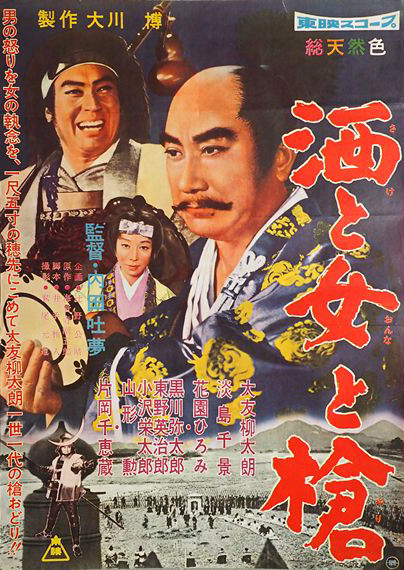
The Master Spearman (酒と女と槍, Tomu Uchida, 1960)

After the war during the American occupation, the samurai film encountered a de facto ban with the authorities worried that historical epics may encourage outdated fuedal and fascistic ideology. The period films of the post-war era, however, are often fiercely critical of the samurai order even as it stands in for the hypocrisies of the contemporary society. Two years before Masaki Kobayashi launched a similar assault on the notion of samurai honour in Harakiri, Tomu Uchida’s The Master Spearman (酒と女と槍, Sake to Onna to Yari) finds a loyal retainer similarly troubled when he is ordered to die only to be ordered not to and then finally told that yes he must commit suicide to serve a kind of honour in which he no longer believes. 

Takasada (Ryutaro Otomo) is a battlefield veteran with the Tomita clan much revered for his skill with the spear. As a retainer to the current regent, Hidetsugu (Yataro Kurokawa), he finds himself in trouble when the ageing Hideyoshi (Eijiro Tono) stages a coup to solidify his power, accusing his nephew of treason on abruptly “discovering” a stash of illegally obtained rifles. Takasada is outraged not to have been ordered to die with his master, but later resents being “strongly encouraged” to do so by his brother, the head of their clan. Storming out, he temporarily retreats into a drunken haze during which he convinces his favourite actress, Umeme (Hiromi Hanazono), to stay with him (just serving drinks, no funny business), before committing himself to public seppuku on a date of his own choosing. When the day arrives, Takasada is greeted by parades of “well wishers” keen to congratulate him for being such a fine samurai. Encouraging those in line to step out of it and stand horizontally without account of rank or status, he agrees to drink with them all, with the consequence that he becomes extremely drunk and passes out. 

Just as he’s about to cut his belly, a messenger arrives from Hideyoshi himself ruling Takasada’s suicide illegal. He if goes ahead and does it anyway, his clan will be disgraced. Takasada’s brother changes his tune and begs him not to proceed for the sake of the Tomita honour. Thoroughly fed up, Takasada has a sudden epiphany about the hypocrisies of the samurai code and decides to renounce his status, dropping out of court life to live simply in the country where he is eventually joined by Umeme who has fallen in love with him. 

Meanwhile, court intrigue intensifies. These are the quiet years leading up to the decisive battle of Sekigahara which in itself decided the course of Japanese history. While the elderly Hideyoshi attempts to hold on to power by ruling as a regent on behalf of his sickly son Hideyori, Tokugawa Ieyasu (Eitaro Ozawa) plots on the sidelines. Hideyoshi is advised by his steward Mitsunari (Isao Yamagata) to take a hard line with treachery, executing all 36 “spies” planted in his household by Ieyasu, including a number of women and children. Mitsunari is himself working with the other side, and the executions are nothing short of a PR disaster for Hideyoshi, provoking fear and resentment in the general populace who can’t accept the inherent cruelty of putting women and children to the sword. Sakon (Chikage Awashima), a kabuki actress and fiercely protective friend of Umeme, comes to a similar conclusion to Takasada, hating the samurai order for its merciless savagery. 

That’s perhaps why she’s originally wary of Takasada’s interest in Umeme, uncertain he will keep his promise to keep his hands off her and so staying over one night herself to make sure Umeme is safe. Umeme, meanwhile, may not have wanted him to be quite so honourable, leaving in the morning visibly irritated and exclaiming that Takasada is drunk on himself and understands nothing of women. That may be quite true, but it’s his sense of honour which eventually tells him that he must reject the samurai ideal. First they tell him honour dictates he must die, then that he must not, then when Hideyoshi dies and the prohibition is lifted, that he must die after all because his entire clan is embarrassed by his continuing existence. By this point, Takasada has decided to accept his “cowardice”. Sickened by the spectacle of his ritual suicide and the humiliation of its cancelation, he came to the conclusion that “loyalty and honour for world fame, glorious exploits etc” is all a big joke. He loves food, and wine, and his wife, and if that means others call him coward so be it because he’s finally happy and perhaps free. 

His spear, however still hangs over his hearth. He hasn’t truly let go of it or of the code with which he was raised. Sakon, perhaps on one level jealous and guarding her own feelings as she accepts that Umeme has chosen to leave the stage to retreat into an individual world with Takasada, warns her that her happiness will end if Takasada is convinced to accept a commission from the Tokugawa. He surprises her by once again renouncing his status as a samurai, choosing to stay a “coward” living a simple life of love and happiness. But as soon as he puts his hand on the spear intending to break it for good something in him is reawakened. He can’t do it. He finds himself at Sekigahara, confronted not only by samurai hypocrisy but by his own as Sakon does what he could not do to show him what he has betrayed. His rage explodes and he raises his spear once again but not for the Tokugawa, against the samurai order itself piercing the very banners which define it in an ironic assault on an empty ideology.